
×

Tanzania🇹🇿 | festivalsSauti za BusaraOld Fort stage, pan-African lineup, taarab, Stone Town parade | things to do and best time to go

Explore Nane Nane Agricultural ShowExplore Serengeti Music Festival

Backpacking in Sauti za Busara
🏆 Top pickfestival ranked #1
By Johan Kruseman 🇳🇱 | Updated October 22, 2026

Sauti za Busara takes place in Stone Town, on Zanzibar, not on the island's beach strips, and it is a pan-African music festival rather than a Swahili-only taarab showcase. Zanzibar is part of Tanzania, and the main stage sits inside the Old Fort (Ngome Kongwe) on the Stone Town waterfront, a short walk from most guesthouses. The festival runs for several days in February, with acts from Tanzania, Kenya, Mali, South Africa, Madagascar and beyond. Expect taarab, Bongo Flava, Afrobeat, Congolese rumba, hip-hop and traditional ngoma drumming, plus daytime film screenings and workshops. The crowd is a real mix: Zanzibari families, East African students, expat residents and backpackers who arrive without a plan and leave with ten new friends. The mood is relaxed, loud and sweaty, with dancing starting early. Walk the lanes, grab street food, then follow the bass to the fort. Late at night, the stone walls throw the sound back across the courtyard.

Discover everything you want to know in the 📖 Tanzania Travel Guide.


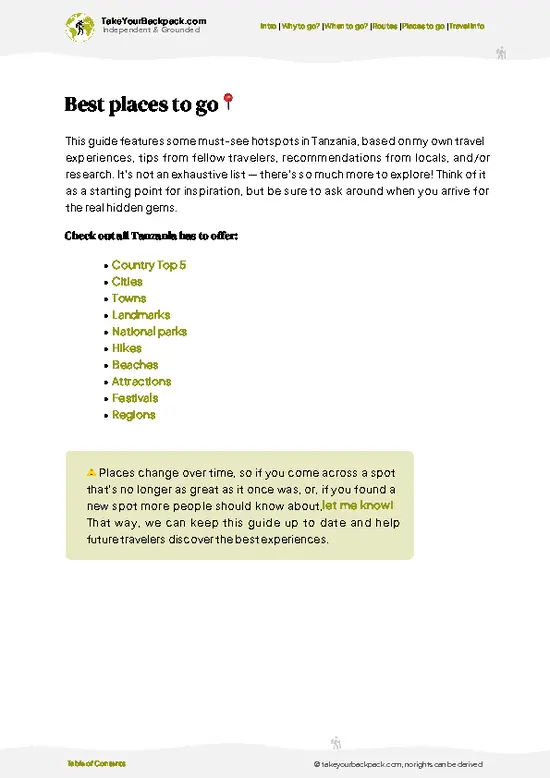
example page 0 from our offline Travel Guide for Tanzania
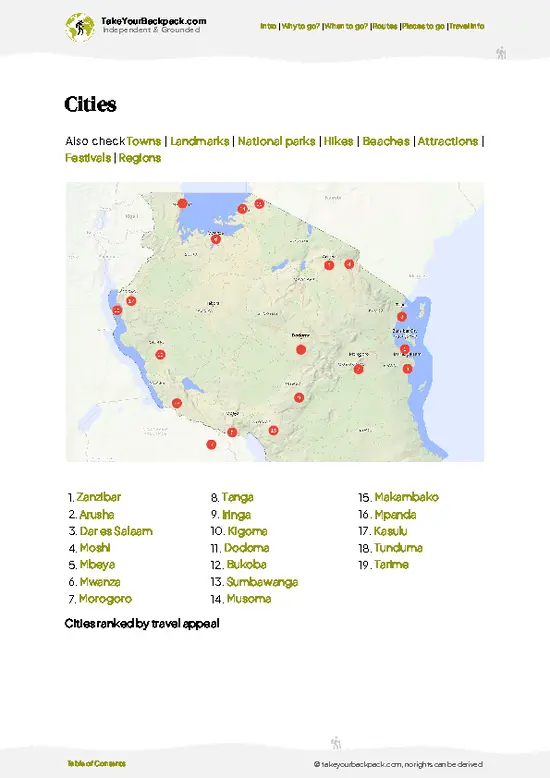
example page 1 from our offline Travel Guide for Tanzania
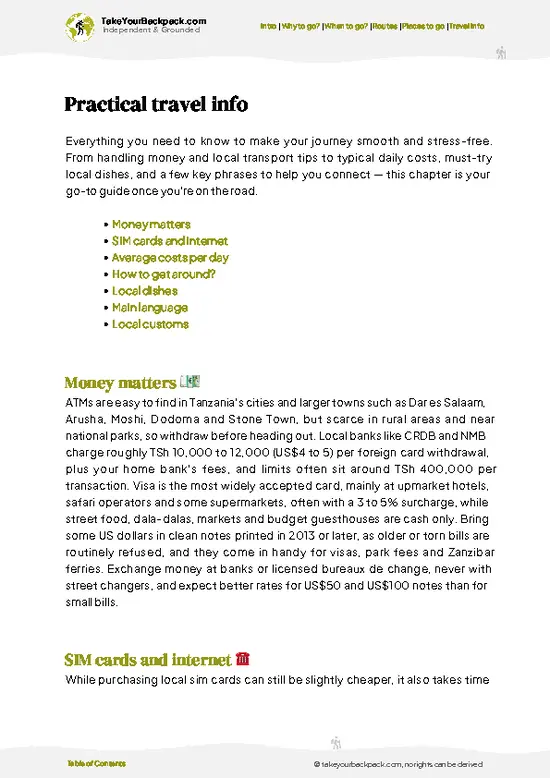
example page 2 from our offline Travel Guide for Tanzania
example page 3 from our offline Travel Guide for Tanzania
example page 4 from our offline Travel Guide for Tanzania
example page 5 from our offline Travel Guide for Tanzania
example page 6 from our offline Travel Guide for Tanzania
example page 7 from our offline Travel Guide for Tanzania
Loading the map 🌍
CLICK TO FILTER
cities
towns
landmarks
national parks
hikes
beaches
attractions
festivals
regions
SHOW COUNTRY’S BESTSHOW ALL

✨ Why go?
Ranked #1 festival in Tanzania
What sets this place apart

Sauti za Busara pulls backpackers because it puts live music from all over the continent in one walled courtyard, with a ticket price that is modest next to big European or South African festivals. The Old Fort amphitheater keeps everyone close to the stage, so you end up dancing next to strangers from three continents and swapping tips on your next border crossing. Because the festival sits in Stone Town, you sleep in a guesthouse with a rooftop rather than in a tent, and you eat at the Forodhani Gardens night food market between sets. That makes it far easier than a field festival if you are traveling light. It also fits a longer East Africa route neatly. Many people land in Dar es Salaam, spend the festival on the island, then continue to the beaches, spice farms and south coast. The timing … read more 👉
Sauti za Busara pulls backpackers because it puts live music from all over the continent in one walled courtyard, with a ticket price that is modest next to big European or South African festivals. The Old Fort amphitheater keeps everyone close to the stage, so you end up dancing next to strangers from three continents and swapping tips on your next border crossing. Because the festival sits in Stone Town, you sleep in a guesthouse with a rooftop rather than in a tent, and you eat at the Forodhani Gardens night food market between sets. That makes it far easier than a field festival if you are traveling light. It also fits a longer East Africa route neatly. Many people land in Dar es Salaam, spend the festival on the island, then continue to the beaches, spice farms and south coast. The timing falls in the hot, dry stretch of the year, so you can build a whole trip around it.

💡 HighlightsKey sights and experiences for travelers

  1. Main stage at the Old Fort (Ngome Kongwe): The festival is best known for its big nightly shows in this 17th-century Omani fortress. The stone ramparts and open courtyard create a packed, intimate setting where headliners and unknowns share the same stage.
  2. Taarab and Zanzibari acts: Local orchestras, with oud, qanun, violins and sweeping vocals, bring Swahili coast sound that you rarely hear well live elsewhere. Look for the Zanzibari groups that often open the evening sets.
  3. Pan-African headliners: Artists travel from West, Central, Southern and East Africa, so one night can move from Malian guitar to Congolese rumba to Afro-fusion. Few festivals in the region bring this range together.
  4. Daytime events and the Festival Village: Film screenings, workshops and talks happen around Stone Town, giving
… read more 👉
  1. Main stage at the Old Fort (Ngome Kongwe): The festival is best known for its big nightly shows in this 17th-century Omani fortress. The stone ramparts and open courtyard create a packed, intimate setting where headliners and unknowns share the same stage.
  2. Taarab and Zanzibari acts: Local orchestras, with oud, qanun, violins and sweeping vocals, bring Swahili coast sound that you rarely hear well live elsewhere. Look for the Zanzibari groups that often open the evening sets.
  3. Pan-African headliners: Artists travel from West, Central, Southern and East Africa, so one night can move from Malian guitar to Congolese rumba to Afro-fusion. Few festivals in the region bring this range together.
  4. Daytime events and the Festival Village: Film screenings, workshops and talks happen around Stone Town, giving you something to do before the music starts and a chance to meet musicians up close.
  5. Street parade through Stone Town: The festival opens with a musical street procession through the narrow lanes, with drummers and dancers pulling in locals along the way. It is free and a good way to learn the town's layout.
Start with the street parade, because it is free, happens before the main shows and shows you the festival's mood and the walking route to the fort.
Spotted a mistake or missing something? Contact us.

Things to do around Sauti za Busara

Ratings based on Tripadvisor reviews. When you book through this link, you support our work at no extra cost to you.

🌤️ When to go?When is the celebration of Sauti za Busara?

Sauti za Busara is held every February in Stone Town, Zanzibar, over four days (usually Thursday to Sunday), with the dates shifting each year, and the main stage sits inside the Old Fort (Ngome Kongwe) on the waterfront.
  • Best day: Friday and Saturday carry the biggest lineups and the loudest crowds. Thursday opening night is easier to move around in, and Sunday closing has a loose, dance-until-it-stops feel.
  • Weather: February is hot and humid, around 30 to 33°C (86 to 91°F) by day and 25°C (77°F) at night, with only the odd short shower. Bring a refillable bottle, a light rain layer, sunscreen, a hat and earplugs for the front rows.
  • Booking: Reserve beds two to three months ahead. Rooms in Stone Town can cost 30 to 60 percent more over the festival weekend.
  • Arrival and departure: Ferries from
… read more 👉
Sauti za Busara is held every February in Stone Town, Zanzibar, over four days (usually Thursday to Sunday), with the dates shifting each year, and the main stage sits inside the Old Fort (Ngome Kongwe) on the waterfront.
  • Best day: Friday and Saturday carry the biggest lineups and the loudest crowds. Thursday opening night is easier to move around in, and Sunday closing has a loose, dance-until-it-stops feel.
  • Weather: February is hot and humid, around 30 to 33°C (86 to 91°F) by day and 25°C (77°F) at night, with only the odd short shower. Bring a refillable bottle, a light rain layer, sunscreen, a hat and earplugs for the front rows.
  • Booking: Reserve beds two to three months ahead. Rooms in Stone Town can cost 30 to 60 percent more over the festival weekend.
  • Arrival and departure: Ferries from Dar es Salaam and flights fill up on the Thursday before and the Monday after, so travel a day early or late.
Arrive on Wednesday to settle in before the gates open.


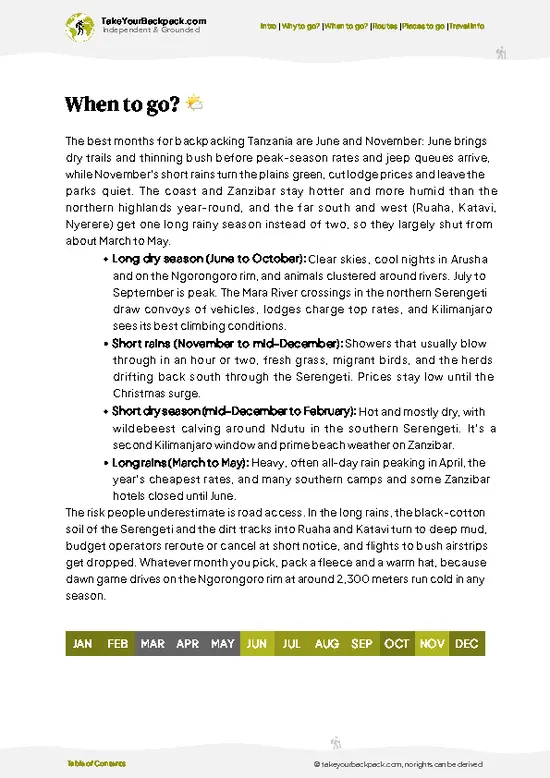
source: climatestotravel.comJANJanuary: not recommended for travelingFEBFebruary: excellent for travelingMARMarch: not recommended for travelingAPRApril: not recommended for travelingMAYMay: not recommended for travelingJUNJune: not recommended for travelingJULJuly: not recommended for travelingAUGAugust: not recommended for travelingSEPSeptember: not recommended for travelingOCTOctober: not recommended for travelingNOVNovember: not recommended for travelingDECDecember: not recommended for traveling

✈️ The backpacker research shortcutTanzania Travel Guide

An offline-friendly backpacking guide with optimized travel routes, ranked highlights, transport advice, and the best areas to stay.
example page 0 from our offline Travel Guide for Tanzania
example page 1 from our offline Travel Guide for Tanzania
example page 2 from our offline Travel Guide for Tanzania
example page 3 from our offline Travel Guide for Tanzania
example page 4 from our offline Travel Guide for Tanzania
example page 5 from our offline Travel Guide for Tanzania
example page 6 from our offline Travel Guide for Tanzania
example page 7 from our offline Travel Guide for Tanzania
The digital guide (396 pages) contains:
✅ 103 highlights, ranked by travel appeal
✅ Optimized 7, 14 & 21-day travel routes
✅ Cities, national parks, landmarks, beaches
✅ How to get around
✅ Offline-friendly for travel without Wi-Fi
👉 Click to see all 30+ guide features

📅 Plan smarter in minutes, not weeks
✅ Month by month travel advice
✅ Festivals & national holidays
✅ Budget expectations

🗺️ Go to the right places, skip the overrated ones
✅ Honest pros & cons of destinations
✅ Top hikes, parks & viewpoints
✅ Lesser-known places most travelers miss
✅ Clear “worth it vs skip it” guidance

🛏️ Travel smoothly without rookie mistakes
✅ Best areas to stay
✅ Transport systems explained simply
✅ Common scams & safety advice
✅ SIM cards, money & practical tips

🌍 Understand the country, not just visit it
✅ Culture & traditions
✅ 52 Essential phrases & customs
✅ Festivals worth planning around
✅ Traveler-friendly historical context
✅ Insights that make places more meaningful

📱 Built for real travel conditions
✅ Fully downloadable PDF
✅ Works completely offline
✅ Optimized for phone use
✅ Useful in remote areas & buses
✅ Everything in one place
Stop searching, start planning
Get instant access to your full guide. 30‑day money-back guarantee.
+ Add another guide for just

By proceeding you agree to our terms.
Sent to your inbox immediately after payment • 100% Secure Checkout
Best Backpacking Travel Advisor 2025 tourism awardBest Backpacking
Travel Advisor
2025
What others say about Take Your Backpack Guides:
⭐⭐⭐⭐⭐
Fantastic, amazing amount of information!
⭐⭐⭐⭐⭐
My goodness this is amazing, it's what I've been looking for hats off too you!
⭐⭐⭐⭐⭐
I think this is absolutely BRILLIANT
⭐⭐⭐⭐
Very complete and informative. It's still missing places, but I gotta to commend you
⭐⭐⭐⭐⭐
This is truly amazing, thank you, can't wait to explore it with my kids!
⭐⭐⭐⭐⭐
Awesome resource, thank you!
⭐⭐⭐⭐⭐
This is amazing! Can't wait to explore the ones I haven't seen
⭐⭐⭐⭐
I love this! Well done, great idea.
⭐⭐⭐⭐⭐
Thanks for taking the time to make this gem!
⭐⭐⭐⭐⭐
This might be the best website I've ever seen.
⭐⭐⭐⭐⭐
Congratulations, and thank you so much for your work; it's incredibly valuable.
⭐⭐⭐⭐
In all seriousness I think you did a great job pointing out the important spots
⭐⭐⭐⭐⭐
10/10 very good
⭐⭐⭐⭐⭐
As someone who's only just starting to visit regularly this is awesome, thank you.
⭐⭐⭐⭐
Thank you very much! I'm going to visit my dad, it's going to be very useful!
⭐⭐⭐⭐⭐
This is really cool! We'll be travelling for the first time and this definitely come in handy.
⭐⭐⭐⭐⭐
You are now our minister of culture, congratulations 👨‍💼
⭐⭐⭐⭐⭐
Just wanted to tell you that this is a pearl! Going to follow your recommendations.
⭐⭐⭐⭐⭐
This is so cool. I'll definitely be using the resource for my travels soon.
⭐⭐⭐⭐⭐
This is very impressive! Good work.
⭐⭐⭐⭐⭐
This is an amazing and informative site. Very well done!

🛏️ Where to stay?How to pick the right area

Stone Town is the place to stay, and within it the lanes around Shangani, Kiponda and the Forodhani waterfront put you within a five to ten minute walk of the Old Fort. Shangani is the most social pick. It has the densest cluster of budget guesthouses and dorm-style stays, plus cafes, rooftop bars and late-night food stalls, so you meet fellow festival-goers at breakfast. Walking back after the last act is straightforward here because the streets stay busy and well lit near the sea front.
Kiponda and the area toward Mkunazini feel more residential and quieter. Rooms are often cheaper, and you will … read more 👉
Stone Town is the place to stay, and within it the lanes around Shangani, Kiponda and the Forodhani waterfront put you within a five to ten minute walk of the Old Fort. Shangani is the most social pick. It has the densest cluster of budget guesthouses and dorm-style stays, plus cafes, rooftop bars and late-night food stalls, so you meet fellow festival-goers at breakfast. Walking back after the last act is straightforward here because the streets stay busy and well lit near the sea front.
Kiponda and the area toward Mkunazini feel more residential and quieter. Rooms are often cheaper, and you will hear neighbors rather than other tourists, which suits solo travelers who want sleep between shows. The tangle of alleys is confusing after dark, so walk back in a group or take the main roads.
Malindi, on the harbor side toward the ferry port, is handy for arriving by boat and has plenty of low-cost rooms. It is a little rougher around the edges at night, so stick to the main streets.
Staying outside town, on the east coast at Paje or Jambiani, means a long taxi or dala-dala ride each way, and late-night rides are pricey and limited. Skip that unless you want beach days between shows. Book early, since festival weekend fills the budget end first.

👛 Costs (as of 22 October 2026)Typical daily expenses

Sauti za Busara costs roughly US$25 to 55 a day for an independent traveler during festival weekend, with a total daily budget of US$115 that covers a mid-range dorm or simple room, street food and a ticket.
CategoryBudget RangeLocal Reality
Festival ticketsUS$25 to 55 per day; multi-day passes cost less per dayPrices are higher for non-residents than for East African residents, and gate sales cost more than advance tickets. Tanzanian residents pay much less.
AccommodationUS$15 to 30 in a dorm (low season); US$30 to 60 in festival weekend high seasonSimple private rooms in Stone Town rise sharply during the festival and sell out early.
Local transportUS$2 to 8Most venues in Stone Town are walkable. Short taxi rides cost US$3 to 8, and airport transfers cost around US$10 to 20. Ferries from Dar
… read more 👉
Sauti za Busara costs roughly US$25 to 55 a day for an independent traveler during festival weekend, with a total daily budget of US$115 that covers a mid-range dorm or simple room, street food and a ticket.
CategoryBudget RangeLocal Reality
Festival ticketsUS$25 to 55 per day; multi-day passes cost less per dayPrices are higher for non-residents than for East African residents, and gate sales cost more than advance tickets. Tanzanian residents pay much less.
AccommodationUS$15 to 30 in a dorm (low season); US$30 to 60 in festival weekend high seasonSimple private rooms in Stone Town rise sharply during the festival and sell out early.
Local transportUS$2 to 8Most venues in Stone Town are walkable. Short taxi rides cost US$3 to 8, and airport transfers cost around US$10 to 20. Ferries from Dar es Salaam cost about US$35 to 40 one way.
Food & drinksUS$10 to 20Street grills and Zanzibar pizza cost US$1 to 4. Beer inside the venue costs around US$2 to 3, and a sit-down meal about US$6 to 10.
Miscellaneous expensesUS$3 to 8Earplugs, sunscreen, water, tips and a festival souvenir. Pay in cash, since card use is limited.
Total Daily BudgetUS$115Based on high-season accommodation, one day's ticket and average spending.
⚠️ Prices can change and everyone travels differently, so take this as a rough guide. Hope it helps you plan your adventure!

🍲 FoodLocal Cuisine & Drinks

The Old Fort courtyard has a ring of food stalls serving Swahili street staples, and the smell of charcoal smoke drifts across the crowd all night. Look for grilled seafood skewers, mishkaki (marinated beef or chicken on sticks), samosas, chipsi mayai (a fries-and-egg omelet) and urojo, the tangy Zanzibar mix soup. Fresh sugarcane juice with lime and ginger is the best daytime refuel, and spiced tea and coffee show up later.
For the real thing, walk five minutes to the Forodhani Gardens night market, where the Zanzibar pizza (a folded, pan-fried parcel stuffed with minced meat, egg and cheese) is worth a late snack between acts. Grab octopus and fish from the grills, and finish with a sweet mango or coconut treat.
Inside the venue, beer, soft drinks and water are sold from bars, and lines build … read more 👉
The Old Fort courtyard has a ring of food stalls serving Swahili street staples, and the smell of charcoal smoke drifts across the crowd all night. Look for grilled seafood skewers, mishkaki (marinated beef or chicken on sticks), samosas, chipsi mayai (a fries-and-egg omelet) and urojo, the tangy Zanzibar mix soup. Fresh sugarcane juice with lime and ginger is the best daytime refuel, and spiced tea and coffee show up later.
For the real thing, walk five minutes to the Forodhani Gardens night market, where the Zanzibar pizza (a folded, pan-fried parcel stuffed with minced meat, egg and cheese) is worth a late snack between acts. Grab octopus and fish from the grills, and finish with a sweet mango or coconut treat.
Inside the venue, beer, soft drinks and water are sold from bars, and lines build up between sets, so buy before a headliner starts. Portions are usually snack-sized, which makes sharing a plate with new friends easy and a good way to taste more.
Carry cash in small notes, as most stalls do not take cards, and agree on prices before ordering at the waterfront. Stone Town is mostly Muslim, so dress modestly when eating in town and respect that alcohol is limited to licensed venues.

FAQTraveler FAQ

Sauti za Busara takes place every February in Stone Town, Zanzibar, over four days, usually Thursday to Sunday. The exact dates move each year, so check the festival calendar before booking. The main stage is the Old Fort on the waterfront, and most visitors arrive by ferry from Dar es Salaam (about two hours) or by air.
Sauti za Busara tickets typically cost around US$25 to 55 per day for international visitors, with multi-day passes cheaper per day. Tanzanian and East African residents pay a much lower rate. Budget about US$10 to 20 a day on food and drink, and expect festival-weekend beds in Stone Town to cost US$30 to 60.
Advance tickets for Sauti za Busara are strongly recommended, since they are cheaper than gate prices and you skip the queue at the Old Fort. Multi-day passes are sold online and at local outlets in Stone Town. Rooms near the venue sell out two to three months ahead, so book accommodation at the same time.
⚠️ Things can change over time, so always validate details locally before you go.

Other Tanzanian festivals near Sauti za Busara

Explore more nearby:


💡 Not sure where to go next?
Create a personalized itinerary for Tanzania including Sauti za Busara and the places that fit your trip.

Generate my itinerary

👉 Discover all festivals

Or checkout all Tanzania has to offer (think cities, towns, villages, national parks, hikes, beaches, festivals)
Country photo of Tanzania

We 💚 feedbackIs it worth it?

Sauti za Busara works best as the centerpiece of a Zanzibar stay, so I would book a guesthouse inside Stone Town and spend the days before or after on the east coast beaches or a spice farm tour. Bring earplugs and a light layer for the late-night walk home.

✍️ Help improve this page!
The information on this page is based on in-depth research, insights shared by experienced travelers, and feedback from the local travel community in Tanzania. While every effort is made to keep the information accurate and current, conditions can change — so if you spot anything incorrect or outdated, please get in touch.


🙋‍♂️ Give feedback

👋 Meet the founderWho’s Behind Take Your Backpack?

Johan, backpacker and founder of TakeYourBackpackHi, I’m Johan (Netherlands 🇳🇱), the creator of TakeYourBackpack. Over the past 3 decades, I’ve backpacked through 90+ countries across six continents, gaining extensive experience with independent travel, long-term trips, and overland routes.

This site is built on a combination of firsthand travel experience and carefully curated insights from other backpackers. Many guides are based on places I’ve personally visited, while others bring together tips, observations, and practical advice shared by trusted travelers I’ve met along the way.

The goal is to provide realistic, experience-driven guidance — not generic itineraries — so you can explore destinations with better context, clearer expectations, and more confidence.