×
Serengeti National Park

Tanzania🇹🇿 | national parksSerengeti National ParkMigration crossings, Seronera leopards, kopjes, balloon flights | things to do and best time to go

Explore Nyerere National ParkExplore Tarangire National Park

Backpacking in Serengeti
UNESCO World Heritage site
🏆 Top picknational park ranked #1
By Johan Kruseman 🇳🇱 | Updated October 22, 2026

Serengeti National Park hands you one of the planet's densest wildlife shows without a single permit hurdle beyond the gate. It sits in the north of Tanzania, a few hours' drive west of Ngorongoro and running up to the Kenyan border, where it continues as the Maasai Mara. Here is how it works: walking is banned inside the park because lions, buffalo and elephants roam freely, so you explore by vehicle. Experienced travelers split a safari jeep with other budget travelers from Arusha instead of paying for a private one. The plains stretch flat and gold, with granite kopjes breaking the horizon, and the wildebeest herds follow the rains in a loop you can chase. Roads are rough, distances are large, and the main circuits get crowded with vehicles around big sightings. Go quiet in the north or west to escape them. You will love it if you crave big cats and open sky. Skip it if you need hiking trails or hate long, dusty drives.

Discover everything you want to know in the 📖 Tanzania Travel Guide.


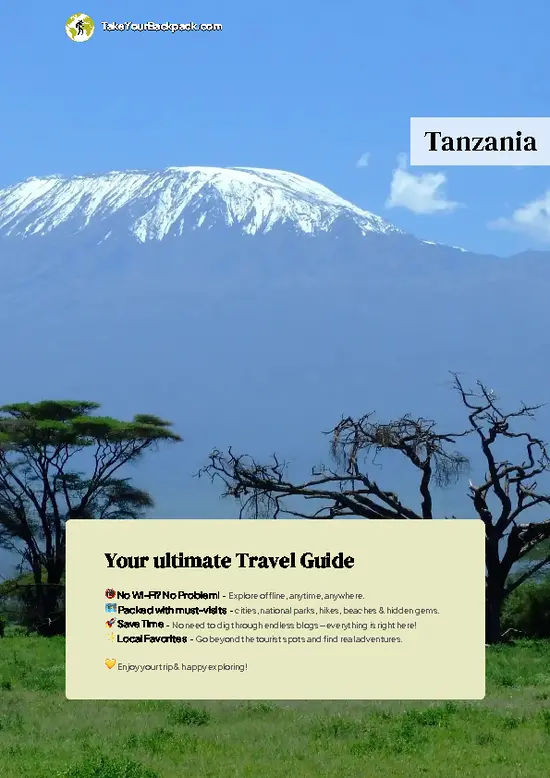
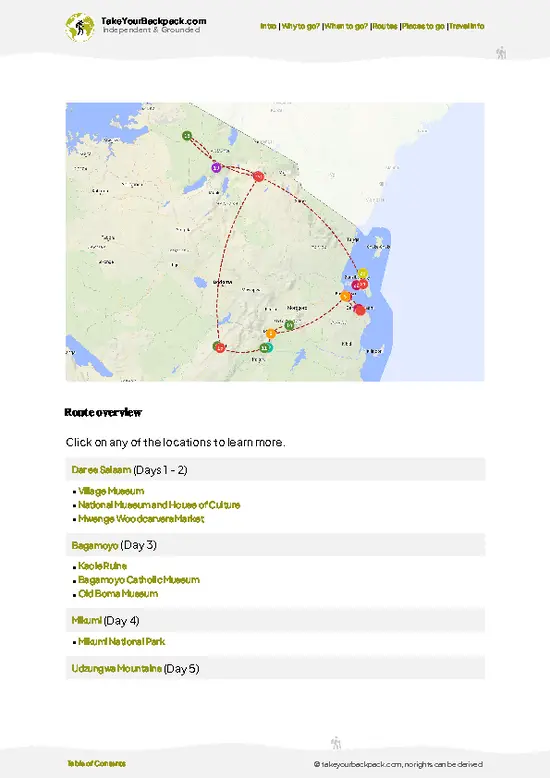
example page 0 from our offline Travel Guide for Tanzania
example page 1 from our offline Travel Guide for Tanzania
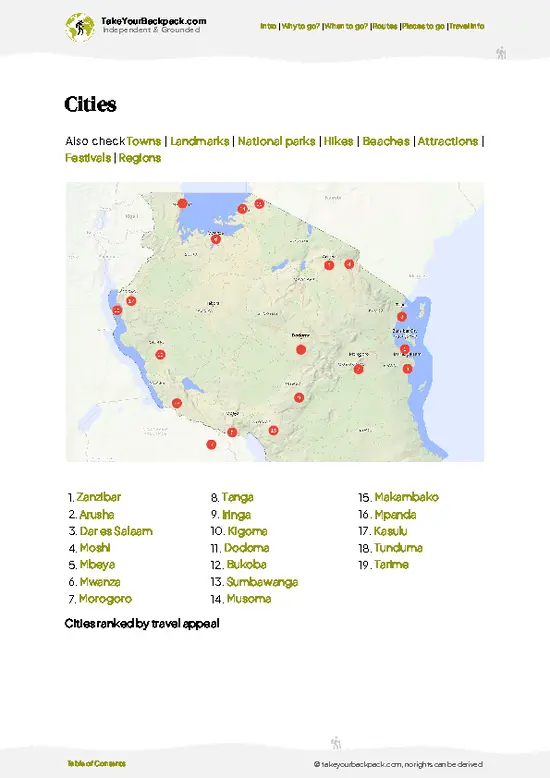
example page 2 from our offline Travel Guide for Tanzania
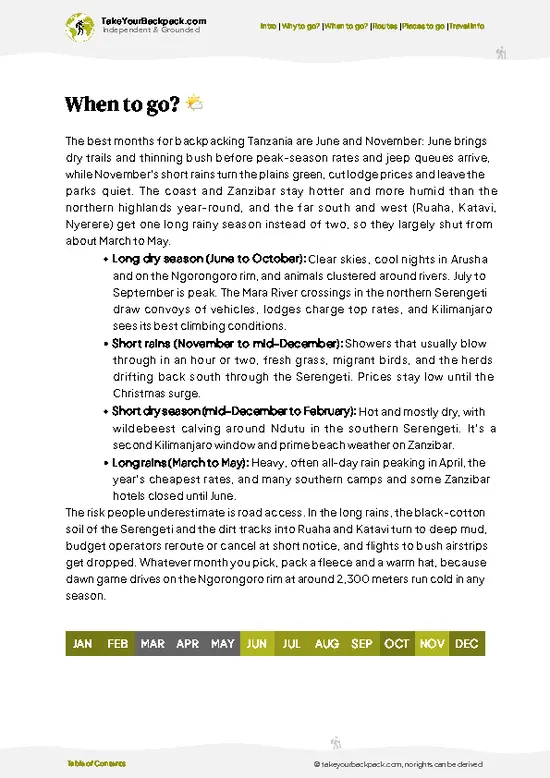
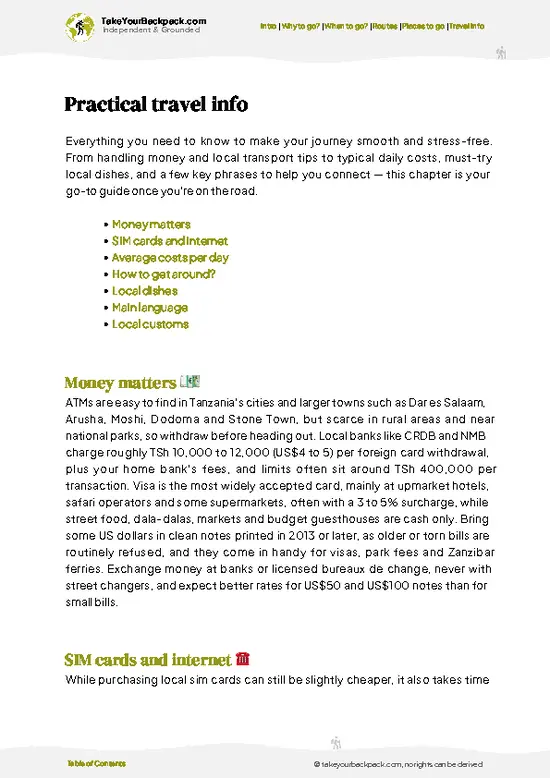
example page 3 from our offline Travel Guide for Tanzania
example page 4 from our offline Travel Guide for Tanzania
example page 5 from our offline Travel Guide for Tanzania
example page 6 from our offline Travel Guide for Tanzania
example page 7 from our offline Travel Guide for Tanzania
Loading the map 🌍
CLICK TO FILTER
cities
towns
landmarks
national parks
hikes
beaches
attractions
festivals
regions
SHOW COUNTRY’S BESTSHOW ALL

✨ Why go?
Ranked #1 national park in Tanzania
Reasons people choose to explore here

Serengeti National Park gives independent-minded backpackers something rare in East Africa: a world-class wildlife area where a shared, budget-friendly camping safari is a normal way to visit. Groups of four to six travelers regularly pool into one jeep, and public campsites let you sleep a few hundred meters from where hyenas whoop after dark. That is the budget route, and it works.

The second reason is movement. The Great Migration of roughly 1.5 million wildebeest, plus zebras and gazelles, circles the ecosystem all year, so you can pick a region to match the season: calving on the southern plains, the Grumeti River crossings in the west, the Mara River crossings in the north. Few places let you plan a trip around a herd's schedule.

The third is variety on four wheels. Within a short … read more 👉
Serengeti National Park gives independent-minded backpackers something rare in East Africa: a world-class wildlife area where a shared, budget-friendly camping safari is a normal way to visit. Groups of four to six travelers regularly pool into one jeep, and public campsites let you sleep a few hundred meters from where hyenas whoop after dark. That is the budget route, and it works.

The second reason is movement. The Great Migration of roughly 1.5 million wildebeest, plus zebras and gazelles, circles the ecosystem all year, so you can pick a region to match the season: calving on the southern plains, the Grumeti River crossings in the west, the Mara River crossings in the north. Few places let you plan a trip around a herd's schedule.

The third is variety on four wheels. Within a short drive you move from short-grass plains to the acacia woodland of Seronera and the rocky outcrops of Moru Kopjes, which hold rhinos and ancient Maasai rock paintings. Self-guided driving is not possible without your own vehicle and a guide is required, so the value lies in choosing your operator carefully.

💡 HighlightsDon't-miss highlights and experiences

  1. The Great Migration river crossings: Herds of wildebeest and zebra plunge into the Mara River in the northern Serengeti, usually between roughly July and October, while crocodiles wait below. It is chaotic, loud and the single most searched sight in the park.
  2. Seronera Valley: The central hub has the highest odds of leopards resting in sausage trees and lions on the riverbanks. Game drives here are productive all year, and most visitors pass through it.
  3. Southern calving plains: Between about January and March, hundreds of thousands of calves are born on the short-grass plains near Ndutu, drawing cheetahs and hyenas in numbers you can watch for hours.
  4. Moru Kopjes: These granite outcrops rise from the plains and shelter some of the park's few black rhinos, along with Maasai rock gong stones and
… read more 👉
  1. The Great Migration river crossings: Herds of wildebeest and zebra plunge into the Mara River in the northern Serengeti, usually between roughly July and October, while crocodiles wait below. It is chaotic, loud and the single most searched sight in the park.
  2. Seronera Valley: The central hub has the highest odds of leopards resting in sausage trees and lions on the riverbanks. Game drives here are productive all year, and most visitors pass through it.
  3. Southern calving plains: Between about January and March, hundreds of thousands of calves are born on the short-grass plains near Ndutu, drawing cheetahs and hyenas in numbers you can watch for hours.
  4. Moru Kopjes: These granite outcrops rise from the plains and shelter some of the park's few black rhinos, along with Maasai rock gong stones and faded paintings.
  5. Gol Kopjes: Lone boulders in the eastern plains where cheetahs climb for lookout points, set against a horizon that seems to have no end.
  6. Retina Hippo Pool: Dozens of hippos pack into one pool near Seronera, and a designated spot lets you step out of the vehicle to watch them from a short distance.
  7. Grumeti River: The western corridor has dense riverine forest with black-and-white colobus monkeys and large crocodiles, and it hosts the early, less-crowded crossings of the migration.
  8. Hot air balloon flight: A dawn flight over the Seronera area is the splurge worth considering, drifting above herds and acacias before a bush breakfast.
Serengeti National Park needs at least three full days to cover these highlights, and four or five lets you reach the north or west without rushing.
Spotted a mistake or missing something? Contact us.

Things to do around Serengeti National Park

Ratings based on Tripadvisor reviews. When you book through this link, you support our work at no extra cost to you.

🌤️ When to go?When to go for the best experience

  • Late June to October: Dry season brings the best game viewing, with animals clustering near the Mara and Grumeti rivers and the Great Migration usually crossing into the northern Serengeti (Kogatende) from roughly July to September. Days run 25 to 29°C (77 to 84°F), nights drop to 12 to 15°C (54 to 59°F). Lodges and camps charge peak rates, and book-ahead is wise.
  • November to December: Short rains turn the plains green and herds drift south. Expect 22 to 28°C (72 to 82°F), afternoon storms, fewer vehicles and lower prices.
  • January to March: Calving season on the southern Ndutu plains, usually peaking in February, with predators hunting close to the road. Warm, 24 to 30°C (75 to 86°F), with showers.
  • April to May: Long rains. Roads turn to mud, many camps close, and rates fall the most. Cloud hangs
… read more 👉
  • Late June to October: Dry season brings the best game viewing, with animals clustering near the Mara and Grumeti rivers and the Great Migration usually crossing into the northern Serengeti (Kogatende) from roughly July to September. Days run 25 to 29°C (77 to 84°F), nights drop to 12 to 15°C (54 to 59°F). Lodges and camps charge peak rates, and book-ahead is wise.
  • November to December: Short rains turn the plains green and herds drift south. Expect 22 to 28°C (72 to 82°F), afternoon storms, fewer vehicles and lower prices.
  • January to March: Calving season on the southern Ndutu plains, usually peaking in February, with predators hunting close to the road. Warm, 24 to 30°C (75 to 86°F), with showers.
  • April to May: Long rains. Roads turn to mud, many camps close, and rates fall the most. Cloud hangs low and the park is nearly empty.
Daylight stays close to 12 hours all year, so game drives start at dawn regardless of season. For the river crossings, aim for August or September and spend at least two nights in the north.


source: climatestotravel.comJANJanuary: good for travelingFEBFebruary: good for travelingMARMarch: good for travelingAPRApril: fair for travelingMAYMay: fair for travelingJUNJune: highly recommended for travelingJULJuly: excellent for travelingAUGAugust: excellent for travelingSEPSeptember: excellent for travelingOCTOctober: highly recommended for travelingNOVNovember: fair for travelingDECDecember: fair for traveling
Tanzania - Serengeti National Park

✈️ The backpacker research shortcutTanzania Travel Guide

An offline-friendly backpacking guide with optimized travel routes, ranked highlights, transport advice, and the best areas to stay.
example page 0 from our offline Travel Guide for Tanzania
example page 1 from our offline Travel Guide for Tanzania
example page 2 from our offline Travel Guide for Tanzania
example page 3 from our offline Travel Guide for Tanzania
example page 4 from our offline Travel Guide for Tanzania
example page 5 from our offline Travel Guide for Tanzania
example page 6 from our offline Travel Guide for Tanzania
example page 7 from our offline Travel Guide for Tanzania
The digital guide (396 pages) contains:
✅ 103 highlights, ranked by travel appeal
✅ Optimized 7, 14 & 21-day travel routes
✅ Cities, national parks, landmarks, beaches
✅ How to get around
✅ Offline-friendly for travel without Wi-Fi
👉 Click to see all 30+ guide features

📅 Plan smarter in minutes, not weeks
✅ Month by month travel advice
✅ Festivals & national holidays
✅ Budget expectations

🗺️ Go to the right places, skip the overrated ones
✅ Honest pros & cons of destinations
✅ Top hikes, parks & viewpoints
✅ Lesser-known places most travelers miss
✅ Clear “worth it vs skip it” guidance

🛏️ Travel smoothly without rookie mistakes
✅ Best areas to stay
✅ Transport systems explained simply
✅ Common scams & safety advice
✅ SIM cards, money & practical tips

🌍 Understand the country, not just visit it
✅ Culture & traditions
✅ 52 Essential phrases & customs
✅ Festivals worth planning around
✅ Traveler-friendly historical context
✅ Insights that make places more meaningful

📱 Built for real travel conditions
✅ Fully downloadable PDF
✅ Works completely offline
✅ Optimized for phone use
✅ Useful in remote areas & buses
✅ Everything in one place
Stop searching, start planning
Get instant access to your full guide. 30‑day money-back guarantee.
+ Add another guide for just

By proceeding you agree to our terms.
Sent to your inbox immediately after payment • 100% Secure Checkout
Best Backpacking Travel Advisor 2025 tourism awardBest Backpacking
Travel Advisor
2025
What others say about Take Your Backpack Guides:
⭐⭐⭐⭐⭐
Fantastic, amazing amount of information!
⭐⭐⭐⭐⭐
My goodness this is amazing, it's what I've been looking for hats off too you!
⭐⭐⭐⭐⭐
I think this is absolutely BRILLIANT
⭐⭐⭐⭐
Very complete and informative. It's still missing places, but I gotta to commend you
⭐⭐⭐⭐⭐
This is truly amazing, thank you, can't wait to explore it with my kids!
⭐⭐⭐⭐⭐
Awesome resource, thank you!
⭐⭐⭐⭐⭐
This is amazing! Can't wait to explore the ones I haven't seen
⭐⭐⭐⭐
I love this! Well done, great idea.
⭐⭐⭐⭐⭐
Thanks for taking the time to make this gem!
⭐⭐⭐⭐⭐
This might be the best website I've ever seen.
⭐⭐⭐⭐⭐
Congratulations, and thank you so much for your work; it's incredibly valuable.
⭐⭐⭐⭐
In all seriousness I think you did a great job pointing out the important spots
⭐⭐⭐⭐⭐
10/10 very good
⭐⭐⭐⭐⭐
As someone who's only just starting to visit regularly this is awesome, thank you.
⭐⭐⭐⭐
Thank you very much! I'm going to visit my dad, it's going to be very useful!
⭐⭐⭐⭐⭐
This is really cool! We'll be travelling for the first time and this definitely come in handy.
⭐⭐⭐⭐⭐
You are now our minister of culture, congratulations 👨‍💼
⭐⭐⭐⭐⭐
Just wanted to tell you that this is a pearl! Going to follow your recommendations.
⭐⭐⭐⭐⭐
This is so cool. I'll definitely be using the resource for my travels soon.
⭐⭐⭐⭐⭐
This is very impressive! Good work.
⭐⭐⭐⭐⭐
This is an amazing and informative site. Very well done!

🛏️ Where to stay?How to pick the right area

Inside Serengeti National Park, backpackers have two realistic options: public campsites run by Tanzania National Parks (TANAPA) and a handful of budget-friendly lodges. The public campsites at Seronera, Lobo, Kogatende and Ndutu cost roughly US$30 per person per night in park fees, and you bring a tent or book one through your safari operator. Facilities at Seronera are basic (toilets, cold showers, a dining shelter), and hyenas wander through at night, so keep food locked in the vehicle. Seronera Wildlife Lodge and Serengeti Serena are comfortable, but they cost far more than most shoestring … read more 👉
Inside Serengeti National Park, backpackers have two realistic options: public campsites run by Tanzania National Parks (TANAPA) and a handful of budget-friendly lodges. The public campsites at Seronera, Lobo, Kogatende and Ndutu cost roughly US$30 per person per night in park fees, and you bring a tent or book one through your safari operator. Facilities at Seronera are basic (toilets, cold showers, a dining shelter), and hyenas wander through at night, so keep food locked in the vehicle. Seronera Wildlife Lodge and Serengeti Serena are comfortable, but they cost far more than most shoestring budgets allow.

Most backpackers actually sleep outside the park and join a camping safari. Arusha is the main hub, with hostels and guesthouses from US$10 to 25 a night, plus dozens of safari operators to compare in person. Moshi is a calmer alternative closer to Kilimanjaro. Karatu, near the Ngorongoro rim, has lodges and campsites from US$10 to 40, and works well on the road in. On the western side, Mwanza on Lake Victoria offers cheap guesthouses (US$12 to 30) and access to the Ndabaka and Kleins gates. Book your Arusha bed for the night before and after your safari, since pickups start early.

👛 Costs (as of 22 October 2026)Travel costs and budget guide for Serengeti

A realistic budget for Serengeti National Park runs about US$240 to 411 per person per day on a group camping safari, with the park fees making up most of it. The table shows the main categories.
CategoryBudget RangeLocal Reality
Park entrance feeUS$70 to 83Charged per 24 hours for non-resident adults, with a lower rate for children aged 5 to 15. Paid by card through the operator or at the gate.
Camping feeUS$30 to 60Public campsites cost about US$30 per person per night. Special campsites cost more.
Accommodation, high seasonUS$30 to 60Budget camping or tented camps outside the park suit this range. Lodges inside cost several times more.
Accommodation, low seasonUS$20 to 40Discounts apply from April to May, with some camps closed.
Safari vehicle and guideUS$80 to 150Group-share budget safaris include
… read more 👉
A realistic budget for Serengeti National Park runs about US$240 to 411 per person per day on a group camping safari, with the park fees making up most of it. The table shows the main categories.
CategoryBudget RangeLocal Reality
Park entrance feeUS$70 to 83Charged per 24 hours for non-resident adults, with a lower rate for children aged 5 to 15. Paid by card through the operator or at the gate.
Camping feeUS$30 to 60Public campsites cost about US$30 per person per night. Special campsites cost more.
Accommodation, high seasonUS$30 to 60Budget camping or tented camps outside the park suit this range. Lodges inside cost several times more.
Accommodation, low seasonUS$20 to 40Discounts apply from April to May, with some camps closed.
Safari vehicle and guideUS$80 to 150Group-share budget safaris include a 4x4 with a pop-up roof, a driver-guide and a cook. Cost per person drops with more people.
Food and waterUS$15 to 30Budget operators include meals. Extras like soft drinks and beer cost US$1 to 3 at park shops.
TipsUS$15 to 25Guides and cooks usually receive tips at the end of the trip, split per group.
Total Daily BudgetUS$240 to 411Roughly US$290 to 400 for most travelers.


source: tanzaniaparks.go.tz
⚠️ Prices can change and everyone travels differently, so take this as a rough guide. Hope it helps you plan your adventure!

🥾 TrailsWhere to hike in Serengeti: trails for every level

Serengeti National Park does not have a network of marked hiking trails, because lions, leopards, buffalo and elephants move freely across open ground, so almost all exploring happens from a safari vehicle with a driver-guide. Walking is limited and tightly controlled.

  • Game drives: Typically half-day or full-day circuits from Seronera, lasting 4 to 8 hours over rough dirt tracks, easy physically but dusty and bumpy, with plains, riverine forest and kopjes.
  • Retina Hippo Pool walk: A short, flat stroll of a few minutes from the parking area to a viewing spot, easy, with hippos in the water and crocodiles
… read more 👉
Serengeti National Park does not have a network of marked hiking trails, because lions, leopards, buffalo and elephants move freely across open ground, so almost all exploring happens from a safari vehicle with a driver-guide. Walking is limited and tightly controlled.

  • Game drives: Typically half-day or full-day circuits from Seronera, lasting 4 to 8 hours over rough dirt tracks, easy physically but dusty and bumpy, with plains, riverine forest and kopjes.
  • Retina Hippo Pool walk: A short, flat stroll of a few minutes from the parking area to a viewing spot, easy, with hippos in the water and crocodiles nearby.
  • Kopje stops: Brief walks around Moru or Gol Kopjes with your guide, easy to moderate on uneven rock, ideal for rock paintings, hyraxes and lizards.
  • Guided walking safaris: Offered by a few lodges and operators in selected zones, usually 2 to 3 hours with an armed ranger, easy pace, focusing on tracks, insects and smaller wildlife, often at dawn.
  • Balloon flights: A one-hour dawn flight over the plains, entirely passive, popular for aerial views of herds.
Getting there is easiest from Arusha, either by a long, bumpy road via Ngorongoro or by a short flight to airstrips such as Seronera. Public buses do not enter the park, so you need a vehicle, normally booked through an operator. Entry is paid per person per 24 hours, and the fee is high, around US$70 or more for adults, plus separate charges for camping and vehicles. Crowds are heaviest around Seronera and the Mara River crossings in peak months, while the far north, west and Ndutu quiet down with a little planning.
⚠️ Hiking info can sometimes be outdated or inaccurate. Before you hit the trail, check the latest conditions with locals. If you do spot anything that's off, I'd love to hear from you, so I can update it for fellow travelers.

🛡️ SafetyScams, Hazards, and Annoyances

Serengeti National Park is well managed, and the main risks come from wildlife and the sun rather than crime. Walking is not permitted away from camps and designated areas, so most of your time is spent in a safari vehicle with a licensed guide. Stay inside it, keep your arms and cameras in, and never step out for a photo, even when lions look asleep. At public campsites, hyenas, hippos and the occasional elephant pass through at night. Zip your tent, keep food in the vehicle, and use a headlamp if you need the toilet. Walk with a companion and give any animal a wide berth.

Midday heat and dust are tougher than most first-timers expect, so bring a hat, sunscreen, and at least 3 liters of water a day. Nights are cold, especially July and August. Tsetse flies are common in the woodland near … read more 👉
Serengeti National Park is well managed, and the main risks come from wildlife and the sun rather than crime. Walking is not permitted away from camps and designated areas, so most of your time is spent in a safari vehicle with a licensed guide. Stay inside it, keep your arms and cameras in, and never step out for a photo, even when lions look asleep. At public campsites, hyenas, hippos and the occasional elephant pass through at night. Zip your tent, keep food in the vehicle, and use a headlamp if you need the toilet. Walk with a companion and give any animal a wide berth.

Midday heat and dust are tougher than most first-timers expect, so bring a hat, sunscreen, and at least 3 liters of water a day. Nights are cold, especially July and August. Tsetse flies are common in the woodland near Seronera, so wear neutral colors. Malaria exists here, so talk to a travel clinic about prophylaxis well before you leave. Rainy-season tracks can bog down vehicles, so travel with an experienced operator.

FAQCommon questions from travelers

Plan on 3 to 4 days for Serengeti National Park if you want a proper sense of it. That gives you a full day around Seronera for big cats, and a day or two in the north near Kogatende for the Mara River crossings from roughly July to September. The park spans about 14,750 square kilometers, and most roads are slow, so a one-night visit feels rushed.
Visiting Serengeti National Park without a car is possible only through a tour, because you cannot self-drive on foot or by public transport inside the park. Most backpackers join a group safari from Arusha, Moshi or Karatu, typically 3 to 5 days at around US$250 to 400 per person per day. You can also fly into airstrips such as Seronera on scheduled flights from Arusha, but this costs far more than a road safari.
Yes, Serengeti National Park charges an entrance fee, and you need no separate permit for ordinary game drives. Non-resident adults pay about US$70 to 83 per 24 hours, with lower rates for children aged 5 to 15, plus camping fees from about US$30 per person per night. Your operator normally handles payment, and TANAPA takes cards only, so cash is not accepted at the gates.
⚠️ Things can change over time, so always validate details locally before you go.

Other Tanzanian national parks near Serengeti

Explore more nearby:


💡 Not sure where to go next?
Create a personalized itinerary for Tanzania including Serengeti and the places that fit your trip.

Generate my itinerary

👉 Discover all national parks

Or checkout all Tanzania has to offer (think cities, towns, villages, national parks, hikes, beaches, festivals)
Country photo of Tanzania

We 💚 feedbackFinal thoughts on exploring Serengeti

Serengeti National Park punishes the traveler who tries to see it all in two days. The usual mistake is booking a short safari, then spending most of it driving between the southern plains and the northern Mara River, with sore backs and few sightings. I would pick one region, stay at least three nights, and let the rangers and your driver follow the herds nearby. Bring binoculars, a dust scarf and patience. The lions will not hurry, and neither should you.

✍️ Help improve this page!
The information on this page is based on in-depth research, insights shared by experienced travelers, and feedback from the local travel community in Tanzania. While every effort is made to keep the information accurate and current, conditions can change — so if you spot anything incorrect or outdated, please get in touch.


🙋‍♂️ Give feedback

👋 Meet the founderWho’s Behind Take Your Backpack?

Johan, backpacker and founder of TakeYourBackpackHi, I’m Johan (Netherlands 🇳🇱), the creator of TakeYourBackpack. Over the past 3 decades, I’ve backpacked through 90+ countries across six continents, gaining extensive experience with independent travel, long-term trips, and overland routes.

This site is built on a combination of firsthand travel experience and carefully curated insights from other backpackers. Many guides are based on places I’ve personally visited, while others bring together tips, observations, and practical advice shared by trusted travelers I’ve met along the way.

The goal is to provide realistic, experience-driven guidance — not generic itineraries — so you can explore destinations with better context, clearer expectations, and more confidence.