
×

Timor-Leste🇹🇱 | regionsAtauro IslandWall-reef snorkeling, Beloi ferry landing, village guesthouses, Manucoco climb | things to do and best time to go

Explore Maubisse National ParkExplore Oecusse

Backpacking in Atauro Island
🏆 Top pickregion ranked #1
By Johan Kruseman 🇳🇱 | Updated October 15, 2026

Not long ago Atauro was a name on a map that most outsiders knew only as the island across the water from Dili, a place for fishing families and the odd dive boat. Today it is still quiet, but a handful of beach lodges and community guesthouses have turned it into the country’s best-known escape. The island lies north of Dili in Timor-Leste, and its reef is the draw: walls drop steeply a few meters offshore, so snorkeling from the sand beats many boat trips elsewhere. Days smell of woodsmoke and salt, nights are loud with insects and rooster-led dawns, and the sun is hard on bare shoulders by 9 a.m. Roads are rough, electricity is limited, and food is simple fish, rice and greens. Choose the slow public ferry if you have time to spare, since it is far cheaper and costs you only a few extra hours of swaying on a crowded deck. The fast boat saves time but costs more, and the better value for most backpackers is the slow one. Book a bed ahead, because options are few.

Part of Backpacking in Timor-Leste: all 46 places on one map, with routes and the best time to go.
Discover everything you want to know in the 📖 Timor-Leste Travel Guide.
Loading the map 🌍
CLICK TO FILTER
cities
towns
villages
national parks
hikes
beaches
attractions
festivals
regions
SHOW COUNTRY’S BESTSHOW ALL

✨ Why go?
Ranked #1 region in Timor-Leste
What makes it a must-see region

Backpackers come to Atauro for one thing the mainland rarely offers: reef you can reach by walking into the water. Beach lodges along the coast put you minutes from coral that supports some of the highest fish diversity measured anywhere, so a mask and fins can fill whole days without a single transfer. That keeps your pace slow and your costs low.

The second reason is people. Several communities run village-owned guesthouses, so your bed money stays with the families who cook your dinner and guide your walks. Evenings are spent on porches talking with hosts and sharing a meal of grilled fish.

The third is the interior. The island is steep, and the trails up toward Mount Manucoco climb through dry forest to wide views back across the strait to the mainland. You can swim in the morning, hike … read more 👉
Backpackers come to Atauro for one thing the mainland rarely offers: reef you can reach by walking into the water. Beach lodges along the coast put you minutes from coral that supports some of the highest fish diversity measured anywhere, so a mask and fins can fill whole days without a single transfer. That keeps your pace slow and your costs low.

The second reason is people. Several communities run village-owned guesthouses, so your bed money stays with the families who cook your dinner and guide your walks. Evenings are spent on porches talking with hosts and sharing a meal of grilled fish.

The third is the interior. The island is steep, and the trails up toward Mount Manucoco climb through dry forest to wide views back across the strait to the mainland. You can swim in the morning, hike in the afternoon and still have time to watch fishermen haul in nets at dusk. Few places this small let you combine reef, ridge and village life without ever needing a vehicle for long.

💡 HighlightsPlaces and moments you shouldn't skip

  1. Beloi Beach and Village: the arrival point where the ferry lands, with black-and-gray sand, fishing boats and the island’s main market stalls. Walk the shore at dawn when catches come in.
  2. Adara Village Reef: a long coast of coral drop-offs reachable by snorkeling from the beach. Visibility is often excellent and the fish are dense.
  3. Manucoco Summit Trail: a steep climb through dry forest to the island’s high point at roughly 999 meters. Start before sunrise and carry plenty of water, because shade thins out near the top.
  4. Wall Dives: walls and slopes around the island, popular with divers for turtles, reef sharks and large schools. Operators are based at local lodges.
  5. Makili Village: a quiet community on the eastern side with community lodging and sea views, a good base for those who want village
… read more 👉
  1. Beloi Beach and Village: the arrival point where the ferry lands, with black-and-gray sand, fishing boats and the island’s main market stalls. Walk the shore at dawn when catches come in.
  2. Adara Village Reef: a long coast of coral drop-offs reachable by snorkeling from the beach. Visibility is often excellent and the fish are dense.
  3. Manucoco Summit Trail: a steep climb through dry forest to the island’s high point at roughly 999 meters. Start before sunrise and carry plenty of water, because shade thins out near the top.
  4. Wall Dives: walls and slopes around the island, popular with divers for turtles, reef sharks and large schools. Operators are based at local lodges.
  5. Makili Village: a quiet community on the eastern side with community lodging and sea views, a good base for those who want village life rather than a resort feel.
  6. Atauro Weaving Cooperatives: women’s groups who make baskets, mats and tais cloth from local fibers. Buying direct costs a few dollars and the money stays in the village.
  7. Dolphin and Whale Boat Trips: local boats head into the deep channel between the island and the mainland, where spinner dolphins and, in season, larger whales pass through.
  8. Biqueli Village Viewpoints: lookouts above the northern shore that frame the dry hills and the faint outline of the mainland. Go in late afternoon for warm light.
  9. Vila Village Walks: guided paths linking small hamlets, with chances to see traditional houses, gardens and local coffee drying in the sun.
Most visitors skip the early morning on the beach at Beloi, when fishing crews haul in their nets.
Spotted a mistake or missing something? Contact us.

Things to do near Atauro Island

Ratings based on Tripadvisor reviews. When you book through this link, you support our work at no extra cost to you.

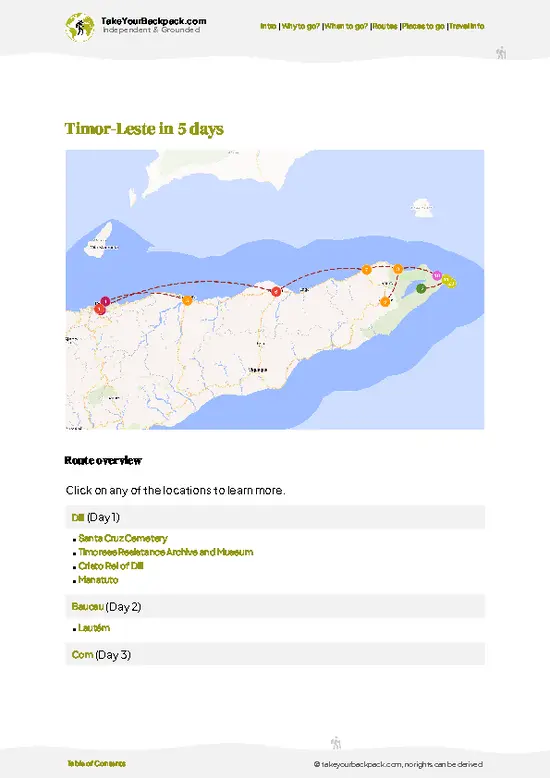
⌛️ 5 daysA smart one-week plan

Day 1: Beloi: Start at the Dili waterfront early, because the slow ferry leaves in the morning and the sea is calmest before midday winds. Arrive at Beloi, drop your bag at a beach lodge and spend the afternoon snorkeling the house reef. The crossing sets the pace for everything: boats are limited, so you plan the whole stay around departure days.

Day 2: Adara: Move along the coast to Adara by local truck or motorbike taxi, as roads are rough and vehicles scarce. Spend the day on the reef here, where the coral starts almost at your feet, and finish with a village dinner. Staying put limits transport hassle and gives you the best underwater time.

Day 3: Manucoco: Leave before dawn with a local guide to climb toward the ridge, then descend to rest. The early start avoids the heat, and the … read more 👉
Day 1: Beloi: Start at the Dili waterfront early, because the slow ferry leaves in the morning and the sea is calmest before midday winds. Arrive at Beloi, drop your bag at a beach lodge and spend the afternoon snorkeling the house reef. The crossing sets the pace for everything: boats are limited, so you plan the whole stay around departure days.

Day 2: Adara: Move along the coast to Adara by local truck or motorbike taxi, as roads are rough and vehicles scarce. Spend the day on the reef here, where the coral starts almost at your feet, and finish with a village dinner. Staying put limits transport hassle and gives you the best underwater time.

Day 3: Manucoco: Leave before dawn with a local guide to climb toward the ridge, then descend to rest. The early start avoids the heat, and the views over the strait justify the effort. Return by afternoon for a swim and a nap in the shade.

Day 4: Makili: Head east to Makili for a slower day of village walks, weaving visits and sunset on the water.

Day 5: Return to Dili: Take the morning boat back with enough buffer for delays, since schedules shift with weather. Buy any crafts before you leave so the money stays on the island.

If you can only keep one day, keep Day 2 at Adara: the reef right off the beach is the reason this island is worth the crossing.

🌤️ When to go?When to go for the best experience

  • Dry Season (May to November): Calm seas and the clearest water make these the best months for diving and snorkeling off Atauro. Days reach 29 to 32°C (84 to 90°F), nights drop to 22 to 24°C (72 to 75°F). Daylight runs roughly 6am to 6pm all year.
  • Peak Months (July to October): The ferry fills with weekend visitors and expats from Dili, and eco-lodges book out. Prices stay modest, but beds on the beach are scarce.
  • Wet Season (December to March): Rain arrives in heavy bursts, at 27 to 31°C (81 to 88°F) with thick humidity. Swells can cancel crossings, trails to Manucoco turn slick, and many lodges run quiet and offer lower rates.
  • Transition (April and November): Showers fade or build, seas are mostly workable, and you often get empty trails with decent visibility.
  • Whale Migration (October and November):
… read more 👉
  • Dry Season (May to November): Calm seas and the clearest water make these the best months for diving and snorkeling off Atauro. Days reach 29 to 32°C (84 to 90°F), nights drop to 22 to 24°C (72 to 75°F). Daylight runs roughly 6am to 6pm all year.
  • Peak Months (July to October): The ferry fills with weekend visitors and expats from Dili, and eco-lodges book out. Prices stay modest, but beds on the beach are scarce.
  • Wet Season (December to March): Rain arrives in heavy bursts, at 27 to 31°C (81 to 88°F) with thick humidity. Swells can cancel crossings, trails to Manucoco turn slick, and many lodges run quiet and offer lower rates.
  • Transition (April and November): Showers fade or build, seas are mostly workable, and you often get empty trails with decent visibility.
  • Whale Migration (October and November): Sperm whales and blue whales pass through the Wetar Strait, and you may see them from the ferry.
Book your return crossing before you leave Dili, since seats vanish on holiday weekends.


source: climatestotravel.comJANJanuary: fair for travelingFEBFebruary: fair for travelingMARMarch: fair for travelingAPRApril: good for travelingMAYMay: highly recommended for travelingJUNJune: excellent for travelingJULJuly: excellent for travelingAUGAugust: excellent for travelingSEPSeptember: highly recommended for travelingOCTOctober: highly recommended for travelingNOVNovember: fair for travelingDECDecember: fair for traveling
when-to-go

✈️ The backpacker research shortcutTimor-Leste Travel Guide

What the free pages can't give you: ready-made routes, every place ranked, and it works offline. All in 1 guide.
example page 0 from our offline Travel Guide for Timor-Leste
example page 1 from our offline Travel Guide for Timor-Leste
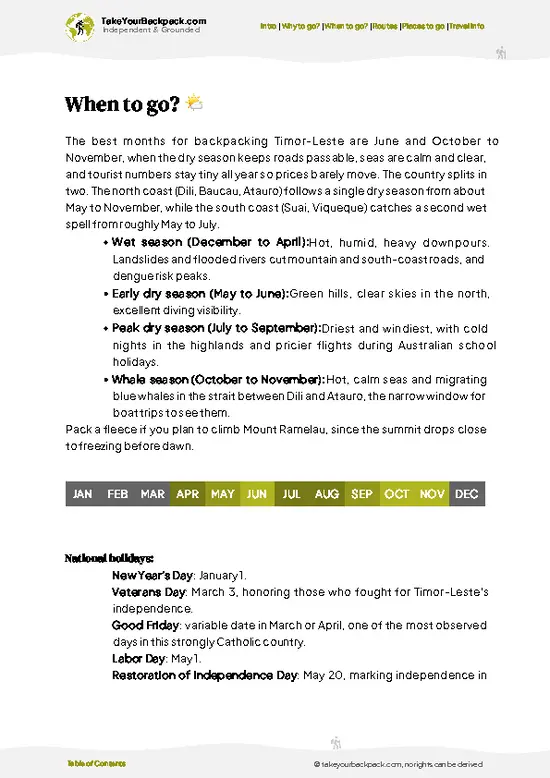
example page 2 from our offline Travel Guide for Timor-Leste
example page 3 from our offline Travel Guide for Timor-Leste
example page 4 from our offline Travel Guide for Timor-Leste
example page 5 from our offline Travel Guide for Timor-Leste
example page 6 from our offline Travel Guide for Timor-Leste
example page 7 from our offline Travel Guide for Timor-Leste
The digital guide (171 pages) contains:
✅ Ready-made 2, 3 & 5-day routes
✅ All 46 places ranked, so you skip the overrated ones
✅ Works offline, all in 1 guide
✅ Cities, national parks, landmarks, beaches
✅ How to get around
👉 Click to see all 30+ guide features

📅 Plan smarter in minutes, not weeks
✅ Month by month travel advice
✅ Festivals & national holidays
✅ Budget expectations

🗺️ Go to the right places, skip the overrated ones
✅ Honest pros & cons of destinations
✅ Top hikes, parks & viewpoints
✅ Lesser-known places most travelers miss
✅ Clear “worth it vs skip it” guidance

🛏️ Travel smoothly without rookie mistakes
✅ Best areas to stay
✅ Transport systems explained simply
✅ Common scams & safety advice
✅ SIM cards, money & practical tips

🌍 Understand the country, not just visit it
✅ Culture & traditions
✅ 52 Essential phrases & customs
✅ Festivals worth planning around
✅ Traveler-friendly historical context
✅ Insights that make places more meaningful

📱 Built for real travel conditions
✅ Fully downloadable PDF
✅ Works completely offline
✅ Optimized for phone use
✅ Useful in remote areas & buses
✅ All in 1 guide
Stop searching, start planning
Get instant access to your full guide. 30‑day money-back guarantee.
+ Add another guide for just

By proceeding you agree to our terms.
Sent to your inbox immediately after payment • 100% Secure Checkout
Best Backpacking Travel Advisor 2025 tourism awardBest Backpacking
Travel Advisor
2025
What others say about Take Your Backpack Guides:
⭐⭐⭐⭐⭐
Fantastic, amazing amount of information!
⭐⭐⭐⭐⭐
My goodness this is amazing, it's what I've been looking for hats off too you!
⭐⭐⭐⭐⭐
I think this is absolutely BRILLIANT
⭐⭐⭐⭐
Very complete and informative. It's still missing places, but I gotta to commend you
⭐⭐⭐⭐⭐
This is truly amazing, thank you, can't wait to explore it with my kids!
⭐⭐⭐⭐⭐
Awesome resource, thank you!
⭐⭐⭐⭐⭐
This is amazing! Can't wait to explore the ones I haven't seen
⭐⭐⭐⭐
I love this! Well done, great idea.
⭐⭐⭐⭐⭐
Thanks for taking the time to make this gem!
⭐⭐⭐⭐⭐
This might be the best website I've ever seen.
⭐⭐⭐⭐⭐
Congratulations, and thank you so much for your work; it's incredibly valuable.
⭐⭐⭐⭐
In all seriousness I think you did a great job pointing out the important spots
⭐⭐⭐⭐⭐
10/10 very good
⭐⭐⭐⭐⭐
As someone who's only just starting to visit regularly this is awesome, thank you.
⭐⭐⭐⭐
Thank you very much! I'm going to visit my dad, it's going to be very useful!
⭐⭐⭐⭐⭐
This is really cool! We'll be travelling for the first time and this definitely come in handy.
⭐⭐⭐⭐⭐
You are now our minister of culture, congratulations 👨‍💼
⭐⭐⭐⭐⭐
Just wanted to tell you that this is a pearl! Going to follow your recommendations.
⭐⭐⭐⭐⭐
This is so cool. I'll definitely be using the resource for my travels soon.
⭐⭐⭐⭐⭐
This is very impressive! Good work.
⭐⭐⭐⭐⭐
This is an amazing and informative site. Very well done!

🛏️ Where to stay?Choosing the right base

Beloi and the beaches just south of it are the easiest places to stay on Atauro, because the ferry lands there and lodges sit within a few minutes' walk. This is where most backpackers end up, with simple bungalows, shared dinners and calm water for snorkeling right off the sand.

Adjacent coastal stretches toward Adara and Mau-Meta offer the same beach-hut feel with fewer people. Reefs here are close to shore, so you can walk in with a mask after breakfast. Evenings are social in a low-key way: a communal table, a generator hum, a few other travelers comparing fish sightings.

Vila, the island's … read more 👉
Beloi and the beaches just south of it are the easiest places to stay on Atauro, because the ferry lands there and lodges sit within a few minutes' walk. This is where most backpackers end up, with simple bungalows, shared dinners and calm water for snorkeling right off the sand.

Adjacent coastal stretches toward Adara and Mau-Meta offer the same beach-hut feel with fewer people. Reefs here are close to shore, so you can walk in with a mask after breakfast. Evenings are social in a low-key way: a communal table, a generator hum, a few other travelers comparing fish sightings.

Vila, the island's main settlement, suits a short stop. It has the market, basic shops and the only real chance to buy supplies, plus a lived-in local feel with roosters, schoolkids and wood smoke at dawn. Few travelers sleep here, so it is quieter and cheaper in spirit.

For hikers, villages near the trailheads to Manucoco, the highest point, make sense. Homestays and community-run guesthouses put you close to a dawn start and in touch with local families, and your money stays in the village.

Safety is rarely an issue on the island. The island runs on daylight, so plan to arrive before dark, and bring cash since there are no ATMs.

🚌 Getting aroundHow to get around Atauro Island

From the Beloi ferry pier, you walk or hop on a motorbike a few hundred meters up to the main road, where the coast road runs north and south. Beloi is the arrival point, and there is no bus station on the island, so getting around is improvised and slower than the map suggests. Expect dust, coconut smoke and the thump of a diesel engine in your ears.
  • Ferry from Dili: The Berlin Nakroma ferry takes about 2 to 3 hours and costs roughly US$4 to 10 depending on class. It runs a few days a week, and the open deck, with salt spray and views of Dili's hills, is the best seat. It is the cheapest way over and the most comfortable for the money.
  • Fast boats: Private speedboats and charters from Dili take about 1 to 1.5 hours and cost far more, around US$20 to 40 per person on shared trips. You win time,
… read more 👉
From the Beloi ferry pier, you walk or hop on a motorbike a few hundred meters up to the main road, where the coast road runs north and south. Beloi is the arrival point, and there is no bus station on the island, so getting around is improvised and slower than the map suggests. Expect dust, coconut smoke and the thump of a diesel engine in your ears.
  • Ferry from Dili: The Berlin Nakroma ferry takes about 2 to 3 hours and costs roughly US$4 to 10 depending on class. It runs a few days a week, and the open deck, with salt spray and views of Dili's hills, is the best seat. It is the cheapest way over and the most comfortable for the money.
  • Fast boats: Private speedboats and charters from Dili take about 1 to 1.5 hours and cost far more, around US$20 to 40 per person on shared trips. You win time, lose cash, and it is a bumpy, wet ride in rough seas. Worth it only if the ferry schedule fails you.
  • Shared microlet trucks: Open-backed trucks haul people and sacks of rice along the rough coastal road between Beloi, Vila and the villages, costing about US$1 to 3. They run irregularly and can be slow, so you wait in the shade of a tamarind tree, but you meet half the island on the bench. They give the best value for short hops.
  • Motorbike taxis (ojek): Riders will take you along the steep, rutted tracks for around US$3 to 10 per trip depending on distance. They are quick and flexible, but you hold on tight through dust and potholes, and rain turns the tracks to mud.
  • Walking: Trails link villages and beaches in 1 to 4 hours, with hot, bright light on bare ridges and the smell of dry grass. It costs nothing and gives you the island at its quietest.
Ask your lodge to phone ahead for a truck or rider the night before, since you will rarely flag one down on the quieter stretches.

🍲 FoodLocal Cuisine & Drinks

Fresh grilled fish is the island's anchor: tuna, snapper or mackerel, charred over coals and served with white rice, a squeeze of lime and a fiery sambal that bites back. Lodges usually serve set meals with sautéed greens such as cassava leaves or papaya flowers, plus corn and sweet potato. Expect smoky, salty, and a little sweet.

For drinks, Timorese coffee is strong, dark and often sweetened with condensed milk, and the beans are grown in the mountains of the mainland. Fresh coconut water is cut from the tree in front of you. Locals also make tua sabu, a palm liquor, and a sip is plenty.

For eating, the Vila market and roadside stalls sell fried bananas, boiled cassava, and small packets of rice with fish for around US$1 to 3. Lodges serve breakfast and dinner, usually included or around … read more 👉
Fresh grilled fish is the island's anchor: tuna, snapper or mackerel, charred over coals and served with white rice, a squeeze of lime and a fiery sambal that bites back. Lodges usually serve set meals with sautéed greens such as cassava leaves or papaya flowers, plus corn and sweet potato. Expect smoky, salty, and a little sweet.

For drinks, Timorese coffee is strong, dark and often sweetened with condensed milk, and the beans are grown in the mountains of the mainland. Fresh coconut water is cut from the tree in front of you. Locals also make tua sabu, a palm liquor, and a sip is plenty.

For eating, the Vila market and roadside stalls sell fried bananas, boiled cassava, and small packets of rice with fish for around US$1 to 3. Lodges serve breakfast and dinner, usually included or around US$4 to 8, and you order ahead because kitchens cook to headcount. Only a handful of tiny shops exist, so carry snacks.

Eat with your right hand or a spoon, and wait for the host to invite you to start. Accept a coffee when it is offered, since refusing can feel curt. Bring cash and small notes.

FAQCommon questions from travelers

Three to four days is a comfortable stay on Atauro, with two as the bare minimum after the ferry from Dili. That gives you time to snorkel the reefs off Beloi, take a day hike toward Manucoco, and visit Vila's market and local art workshops. Five days or more suits divers and slow walkers.
Without a car you rely on the ferry from Dili (2 to 3 hours, about US$4 to 10), then shared trucks for roughly US$1 to 3 and motorbike taxis for around US$3 to 10 per trip. Trucks run irregularly, so ask your lodge to arrange transfers in advance. Walking between nearby villages and beaches takes 1 to 4 hours.
Atauro is known for some of the most diverse coral reefs in the world, with excellent snorkeling and diving just offshore at Beloi and Adara. It also has community-run eco-lodges, local woodcarving and weaving, and the hike up Manucoco. From October to November, whales migrate through the strait, and you can sometimes spot them from the ferry.
⚠️ Things can change over time, so always validate details locally before you go.

Other Timorese regions near Atauro Island

Explore more nearby:

  • Ermera—Shade-grown coffee, Gleno market, Letefoho ridges, misty homestays| 70 km away
  • Oecusse—Lifau landing site, Pante Makasar waterfront, tais looms, Sakato border| 163 km away

💡 Not sure where to go next?
Create a personalized itinerary for Timor-Leste including Atauro Island and the places that fit your trip.

Generate my itinerary

👉 Discover all regions

Or checkout all Timor-Leste has to offer (think cities, towns, villages, national parks, hikes, beaches, festivals)
Country photo of Timor-Leste

We 💚 feedbackIs it worth it?

Most first-timers rush straight to the reef and ignore the early morning on the beach, when fishing crews haul in nets and the light is soft. Wake up for it. I would also bring cash in small bills, since there are no banks and guesthouses rarely give change for large notes. Pack a reef-safe sunscreen and a headlamp for the dark walks to dinner.

✍️ Help improve this page!
The information on this page is based on in-depth research, insights shared by experienced travelers, and feedback from the local travel community in Timor-Leste. While every effort is made to keep the information accurate and current, conditions can change — so if you spot anything incorrect or outdated, please get in touch.


🙋‍♂️ Give feedback

👋 Meet the founderWho’s Behind Take Your Backpack?

Johan, backpacker and founder of TakeYourBackpackHi, I’m Johan (Netherlands 🇳🇱), the creator of TakeYourBackpack. Over the past 25 years, I’ve backpacked through 88 countries across six continents, gaining extensive experience with independent travel, long-term trips, and overland routes.

This site is built on a combination of firsthand travel experience and carefully curated insights from other backpackers. Many guides are based on places I’ve personally visited, while others bring together tips, observations, and practical advice shared by trusted travelers I’ve met along the way.

The goal is to provide realistic, experience-driven guidance — not generic itineraries — so you can explore destinations with better context, clearer expectations, and more confidence.