×

Timor-Leste🇹🇱 | regionsOecusseLifau landing site, Pante Makasar waterfront, tais looms, Sakato border | things to do and best time to go

Explore Atauro IslandExplore Ermera

Backpacking in Oecusse
🌟 Highlightregion ranked #2
By Johan Kruseman 🇳🇱 | Updated October 15, 2026

Most people come to Oecusse for Lifau, the beach where the Portuguese first landed in 1515, and for the strangeness of reaching a Timorese enclave by crossing Indonesian West Timor. What gets overlooked is how few foreigners ever arrive, so the market, the road and the weaving all run at local pace. Oecusse sits on the northwest coast of the island, a Timor-Leste exclave about half a day west of Dili by road, wrapped by Indonesia on its land sides. Expect dusty roads, heat that presses on your shoulders by 9 a.m., roadside stalls grilling corn and the slap of looms from village porches. You get empty black-sand coves, old Portuguese graves and a border crossing with paperwork. Tourist infrastructure is thin, and some new developments look oddly empty. Curious, patient travelers who like quiet will love it. Anyone who wants nightlife or fast logistics will not.

Part of Backpacking in Timor-Leste: all 46 places on one map, with routes and the best time to go.
Discover everything you want to know in the 📖 Timor-Leste Travel Guide.
Loading the map 🌍
CLICK TO FILTER
cities
towns
villages
national parks
hikes
beaches
attractions
festivals
regions
SHOW COUNTRY’S BESTSHOW ALL

✨ Why go?
Ranked #2 region in Timor-Leste
What makes it a must-see region

Backpackers spend time in Oecusse because it is the one corner of Timor-Leste where history, weaving and coast sit within a short ride of each other, and because the journey itself is part of the story. The Lifau landing site and the site of the old Portuguese capital give the colonial chapter a physical place, while villages around Pante Makasar still produce tais woven in Oecusse’s own Atoni patterns, which differ from the cloth sold in Dili. Base yourself in Pante Makasar and hire a motorbike or a local driver, and you can cover beach, mountain and market in a few unhurried days with no repacking. Then there is the border. Coming overland from Dili through West Timor means you clear four border posts, two Timorese and two Indonesian, before you arrive, which feels like a small expedition … read more 👉
Backpackers spend time in Oecusse because it is the one corner of Timor-Leste where history, weaving and coast sit within a short ride of each other, and because the journey itself is part of the story. The Lifau landing site and the site of the old Portuguese capital give the colonial chapter a physical place, while villages around Pante Makasar still produce tais woven in Oecusse’s own Atoni patterns, which differ from the cloth sold in Dili. Base yourself in Pante Makasar and hire a motorbike or a local driver, and you can cover beach, mountain and market in a few unhurried days with no repacking. Then there is the border. Coming overland from Dili through West Timor means you clear four border posts, two Timorese and two Indonesian, before you arrive, which feels like a small expedition and filters out casual visitors. That leaves the beaches, trails and tables to you and the locals.

💡 HighlightsThe experiences that define the visit

  1. Lifau Beach and Landing Site: A black-sand cove with a monument marking the first Portuguese landing, with waves that wash straight up to the memorial and few other visitors.
  2. Site of the Old Portuguese Capital at Lifau: The earliest colonial seat on the island; its fort was razed in 1769 and an old cannon is about all that remains.
  3. Pante Makasar Old Town: Faded Portuguese-era buildings along the waterfront, plus a morning walk past the old church and the town’s main market.
  4. Pante Makasar Market: Sellers lay out betel, vegetables, dried fish and cloth on tarps, and prices move with a smile and a bit of Indonesian or Tetun.
  5. Tais Weaving Villages: Women weave Oecusse’s own motifs on back-strap looms, and buying direct from a porch beats any shop in Dili.
  6. Pasar Tono: A big weekly market on Tuesdays
… read more 👉
  1. Lifau Beach and Landing Site: A black-sand cove with a monument marking the first Portuguese landing, with waves that wash straight up to the memorial and few other visitors.
  2. Site of the Old Portuguese Capital at Lifau: The earliest colonial seat on the island; its fort was razed in 1769 and an old cannon is about all that remains.
  3. Pante Makasar Old Town: Faded Portuguese-era buildings along the waterfront, plus a morning walk past the old church and the town’s main market.
  4. Pante Makasar Market: Sellers lay out betel, vegetables, dried fish and cloth on tarps, and prices move with a smile and a bit of Indonesian or Tetun.
  5. Tais Weaving Villages: Women weave Oecusse’s own motifs on back-strap looms, and buying direct from a porch beats any shop in Dili.
  6. Pasar Tono: A big weekly market on Tuesdays where villagers from across the enclave trade produce, livestock and cloth.
  7. Oesilo Highlands: Winding mountain roads with cooler air, terraced gardens and wide views back toward the sea.
  8. Citrana Coastal Road: A ride along the cliffs with quiet fishing hamlets, sea views and almost no traffic.
  9. Mahata Beach: A quiet beach about 2 kilometers east of Pante Macassar with a reef close to shore for snorkeling.
  10. Border Crossing at Sakato: A small, human-scale frontier where you can watch traders carry goods between Timor-Leste and Indonesia.
Most visitors skip the weaving villages, yet an hour on a porch watching a pattern grow thread by thread is the best thing you can do here.
Spotted a mistake or missing something? Contact us.

⌛️ 5 daysHow to make the most of Oecusse

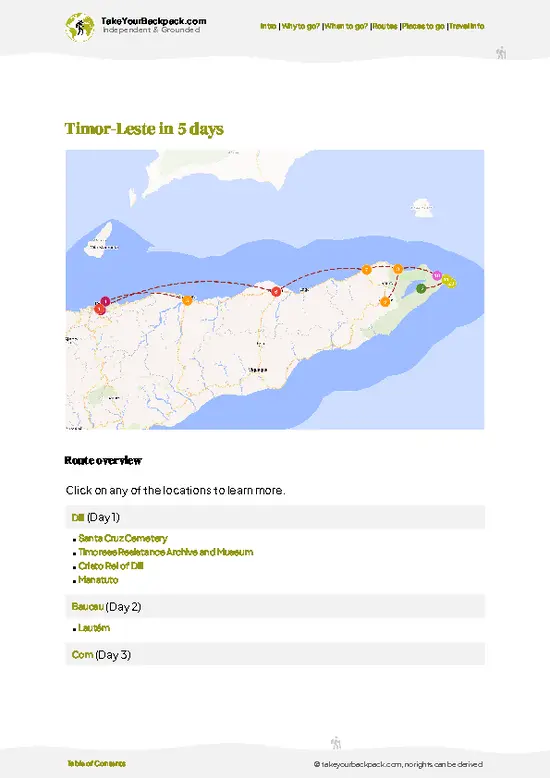
Day 1: Pante Macassar: Start the morning in Pante Macassar, the enclave’s main town, because everything else radiates from here and you need cash, fuel and a motorbike or hired car sorted before heading out. Oecusse has no regular public bus network worth planning around, so microlets (shared minibuses) run on a loose schedule and your pace depends on whoever is willing to drive you. Walk the waterfront, look at the old Portuguese-era Lifau landing story in context, and eat grilled fish at a seafront warung while you arrange transport for the next days.
Day 2: Lifau: Head west along the coast road to Lifau, where the Portuguese first landed on the island of Timor in the 16th century. The Lifau monument and the beach are quiet, with black-grey sand and water that changes color through the afternoon. … read more 👉
Day 1: Pante Macassar: Start the morning in Pante Macassar, the enclave’s main town, because everything else radiates from here and you need cash, fuel and a motorbike or hired car sorted before heading out. Oecusse has no regular public bus network worth planning around, so microlets (shared minibuses) run on a loose schedule and your pace depends on whoever is willing to drive you. Walk the waterfront, look at the old Portuguese-era Lifau landing story in context, and eat grilled fish at a seafront warung while you arrange transport for the next days.
Day 2: Lifau: Head west along the coast road to Lifau, where the Portuguese first landed on the island of Timor in the 16th century. The Lifau monument and the beach are quiet, with black-grey sand and water that changes color through the afternoon. Going early means cooler air and an empty shore. Return to town by midday to avoid the hottest hours on the road, then spend the late afternoon at the Pante Macassar market, where vendors sell tais woven cloth and fresh produce.
Day 3: Oesilo and the Highlands: Turn inland toward Oesilo and the hills, because the enclave’s character shifts from salty coast to dry terraced slopes dotted with Atoni villages. Roads here are rougher and slower, so plan for a full day with a driver who knows the turns. You get round houses with thatched roofs, a view over the Savu Sea and conversations that depend on a few words of Indonesian or Tetum.
Day 4: Detour to Citrana and Nitibe: Make a detour west to Nitibe and Citrana, near the border with Indonesian West Timor. It adds a lot because you see the working edge of the enclave, with border traffic, rice fields and small roadside stalls, without leaving your base. Keep your passport on you and finish before dusk, since the roads have little lighting.
Day 5: Back to the Coast: Use the last day to loop back to Pante Macassar and take a slow swim or walk at a quiet beach near town, then sort your onward travel, whether the road back across Indonesian territory or a flight or ferry to Dili.
The day that justifies the whole trip is Day 3. The highlands show Oecusse as it really is, far from the town, with the best views and the most human encounters.

🌤️ When to go?Choosing the right time of year

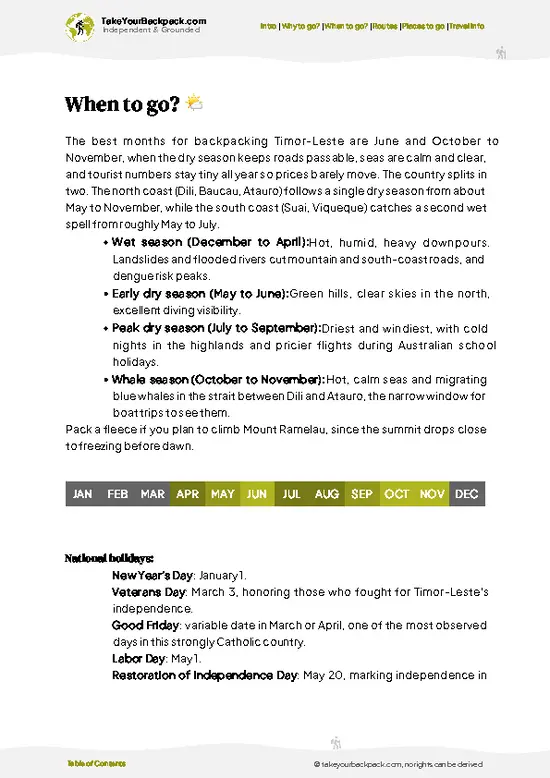
  • Dry Season (May to November): Oecusse’s driest stretch brings almost no rain, hot days of 30 to 35°C (86 to 95°F) and nights near 23 to 25°C (73 to 77°F). Roads and beaches are at their easiest, and daylight runs roughly 6am to 6pm.
  • Peak Heat (September to November): The land turns brown and the air is dry and dusty. Afternoons feel punishing, so plan walks for early morning.
  • Wet Season (December to April): Rain arrives in heavy bursts, mostly January to March, with temperatures around 27 to 33°C (81 to 91°F) and humid air. Dirt tracks turn slick, and the road in from West Timor can be disrupted by flooding or washouts.
  • Festivals and Crowds: Oecusse never gets crowded. Easter processions in Lifau and Pante Macassar draw the most visitors, and guesthouse prices barely move at any time of year.
… read more 👉
  • Dry Season (May to November): Oecusse’s driest stretch brings almost no rain, hot days of 30 to 35°C (86 to 95°F) and nights near 23 to 25°C (73 to 77°F). Roads and beaches are at their easiest, and daylight runs roughly 6am to 6pm.
  • Peak Heat (September to November): The land turns brown and the air is dry and dusty. Afternoons feel punishing, so plan walks for early morning.
  • Wet Season (December to April): Rain arrives in heavy bursts, mostly January to March, with temperatures around 27 to 33°C (81 to 91°F) and humid air. Dirt tracks turn slick, and the road in from West Timor can be disrupted by flooding or washouts.
  • Festivals and Crowds: Oecusse never gets crowded. Easter processions in Lifau and Pante Macassar draw the most visitors, and guesthouse prices barely move at any time of year.
Aim for June to August, when the heat is manageable and the sea is calm enough for snorkeling.


source: climatestotravel.comJANJanuary: fair for travelingFEBFebruary: fair for travelingMARMarch: fair for travelingAPRApril: fair for travelingMAYMay: highly recommended for travelingJUNJune: excellent for travelingJULJuly: excellent for travelingAUGAugust: excellent for travelingSEPSeptember: excellent for travelingOCTOctober: highly recommended for travelingNOVNovember: fair for travelingDECDecember: fair for traveling

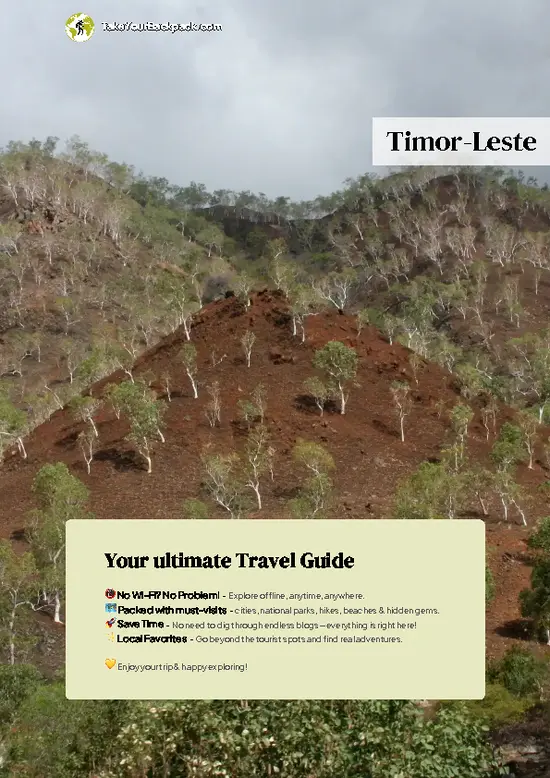
✈️ The backpacker research shortcutTimor-Leste Travel Guide

What the free pages can't give you: ready-made routes, every place ranked, and it works offline. All in 1 guide.
example page 0 from our offline Travel Guide for Timor-Leste
example page 1 from our offline Travel Guide for Timor-Leste
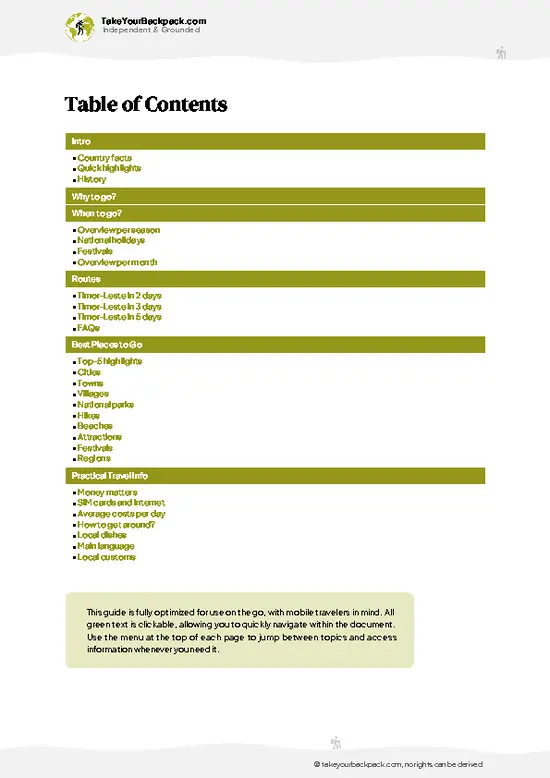
example page 2 from our offline Travel Guide for Timor-Leste
example page 3 from our offline Travel Guide for Timor-Leste
example page 4 from our offline Travel Guide for Timor-Leste
example page 5 from our offline Travel Guide for Timor-Leste
example page 6 from our offline Travel Guide for Timor-Leste
example page 7 from our offline Travel Guide for Timor-Leste
The digital guide (171 pages) contains:
✅ Ready-made 2, 3 & 5-day routes
✅ All 46 places ranked, so you skip the overrated ones
✅ Works offline, all in 1 guide
✅ Cities, national parks, landmarks, beaches
✅ How to get around
👉 Click to see all 30+ guide features

📅 Plan smarter in minutes, not weeks
✅ Month by month travel advice
✅ Festivals & national holidays
✅ Budget expectations

🗺️ Go to the right places, skip the overrated ones
✅ Honest pros & cons of destinations
✅ Top hikes, parks & viewpoints
✅ Lesser-known places most travelers miss
✅ Clear “worth it vs skip it” guidance

🛏️ Travel smoothly without rookie mistakes
✅ Best areas to stay
✅ Transport systems explained simply
✅ Common scams & safety advice
✅ SIM cards, money & practical tips

🌍 Understand the country, not just visit it
✅ Culture & traditions
✅ 52 Essential phrases & customs
✅ Festivals worth planning around
✅ Traveler-friendly historical context
✅ Insights that make places more meaningful

📱 Built for real travel conditions
✅ Fully downloadable PDF
✅ Works completely offline
✅ Optimized for phone use
✅ Useful in remote areas & buses
✅ All in 1 guide
Stop searching, start planning
Get instant access to your full guide. 30‑day money-back guarantee.
+ Add another guide for just

By proceeding you agree to our terms.
Sent to your inbox immediately after payment • 100% Secure Checkout
Best Backpacking Travel Advisor 2025 tourism awardBest Backpacking
Travel Advisor
2025
What others say about Take Your Backpack Guides:
⭐⭐⭐⭐⭐
Fantastic, amazing amount of information!
⭐⭐⭐⭐⭐
My goodness this is amazing, it's what I've been looking for hats off too you!
⭐⭐⭐⭐⭐
I think this is absolutely BRILLIANT
⭐⭐⭐⭐
Very complete and informative. It's still missing places, but I gotta to commend you
⭐⭐⭐⭐⭐
This is truly amazing, thank you, can't wait to explore it with my kids!
⭐⭐⭐⭐⭐
Awesome resource, thank you!
⭐⭐⭐⭐⭐
This is amazing! Can't wait to explore the ones I haven't seen
⭐⭐⭐⭐
I love this! Well done, great idea.
⭐⭐⭐⭐⭐
Thanks for taking the time to make this gem!
⭐⭐⭐⭐⭐
This might be the best website I've ever seen.
⭐⭐⭐⭐⭐
Congratulations, and thank you so much for your work; it's incredibly valuable.
⭐⭐⭐⭐
In all seriousness I think you did a great job pointing out the important spots
⭐⭐⭐⭐⭐
10/10 very good
⭐⭐⭐⭐⭐
As someone who's only just starting to visit regularly this is awesome, thank you.
⭐⭐⭐⭐
Thank you very much! I'm going to visit my dad, it's going to be very useful!
⭐⭐⭐⭐⭐
This is really cool! We'll be travelling for the first time and this definitely come in handy.
⭐⭐⭐⭐⭐
You are now our minister of culture, congratulations 👨‍💼
⭐⭐⭐⭐⭐
Just wanted to tell you that this is a pearl! Going to follow your recommendations.
⭐⭐⭐⭐⭐
This is so cool. I'll definitely be using the resource for my travels soon.
⭐⭐⭐⭐⭐
This is very impressive! Good work.
⭐⭐⭐⭐⭐
This is an amazing and informative site. Very well done!

🛏️ Where to stay?Choosing the right base

Pante Macassar is the one place to stay in Oecusse, because it holds nearly all the guesthouses, the market, the waterfront and the few cafés. Expect simple rooms for around US$20 to 40 a night, with fans or air-conditioning and the odd power cut. It is a small, quiet town where everyone greets you, and walking after dark feels relaxed, though a flashlight helps on unlit streets.
The old quarter near the waterfront is the most atmospheric corner. You wake to church bells and fishing boats, and Lifau beach and the historic landing site of the Portuguese are a short motorbike ride away. Stay here … read more 👉
Pante Macassar is the one place to stay in Oecusse, because it holds nearly all the guesthouses, the market, the waterfront and the few cafés. Expect simple rooms for around US$20 to 40 a night, with fans or air-conditioning and the odd power cut. It is a small, quiet town where everyone greets you, and walking after dark feels relaxed, though a flashlight helps on unlit streets.
The old quarter near the waterfront is the most atmospheric corner. You wake to church bells and fishing boats, and Lifau beach and the historic landing site of the Portuguese are a short motorbike ride away. Stay here if you want to reach the sea and the market on foot.
The area toward the main road and the market suits you if you rely on microlets, since they gather there in the morning. It is louder, with roosters and engines before dawn, but handy for early departures.
Nitibe, near the West Timor border, has only very basic lodging and is better as a day trip than a base. The social side of Oecusse is small: you meet NGO staff, a few travelers and curious locals at the town’s handful of eateries, so bring a book and patience.

🚌 Getting aroundTransportation options and practical tips

From the Pante Macassar bus stop and market area, the waterfront and most guesthouses are a 5 to 10 minute walk along sun-baked streets, with the sea breeze and smell of grilled fish pulling you toward the coast. Beyond town, getting around Oecusse means shared minibuses called microlets, motorbikes and the occasional hired car. Services are informal and sparse, so you work around the locals’ schedules and not the other way round.
  • Microlets: These shared minivans run between Pante Macassar, Nitibe and the villages along the coast for roughly US$1 to 3 per ride. They leave when they fill, usually mornings, and you share the seat with sacks of rice and chickens. The reward is a front-row view of dry hills dropping to turquoise sea.
  • Motorbike rental: Expect US$15 to 25 a day if your guesthouse
… read more 👉
From the Pante Macassar bus stop and market area, the waterfront and most guesthouses are a 5 to 10 minute walk along sun-baked streets, with the sea breeze and smell of grilled fish pulling you toward the coast. Beyond town, getting around Oecusse means shared minibuses called microlets, motorbikes and the occasional hired car. Services are informal and sparse, so you work around the locals’ schedules and not the other way round.
  • Microlets: These shared minivans run between Pante Macassar, Nitibe and the villages along the coast for roughly US$1 to 3 per ride. They leave when they fill, usually mornings, and you share the seat with sacks of rice and chickens. The reward is a front-row view of dry hills dropping to turquoise sea.
  • Motorbike rental: Expect US$15 to 25 a day if your guesthouse can arrange one, and you need a license and a helmet. The roads around Pante Macassar are mostly paved and quiet, and you can reach Lifau beach at your own pace, with the wind full of salt and dust. Gravel patches and wandering goats keep you alert.
  • Private car with driver: About US$50 to 80 a day gets you to remote spots such as Oesilo or the border area, where microlets rarely go. The air-conditioning helps when the afternoon heat hits 35°C (95°F). You get a local who explains the villages en route.
  • Ferry and flights from Dili: The ferry from Dili takes about 12 hours overnight, with fares around US$10 to 15 depending on class, and it arrives to a sunrise over Pante Macassar’s harbor. Small flights are faster, at about 40 minutes, but seats are limited and prices vary.
  • Walking: Pante Macassar’s old quarter is small enough to cover on foot in an hour or two. You hear church bells, smell woodsmoke and pass the colonial-era buildings in the early light.
Carry cash in small US dollar bills, fill the tank whenever you see fuel, and start early, since the best light and the coolest hours are before 10am.

🍲 FoodWhat to Eat & Drink

Oecusse eats like a coastal borderland: grilled fish straight off the boats, charred over coconut husks and served with rice and a sharp sambal that clears your sinuses. Look for ikan bakar, corn and cassava boiled or roasted, and pumpkin leaves sautéed with garlic. Smoky pork is common, and the Atoni Pah Meto community has its own dishes, including se’i-style smoked meat from the West Timor side that turns up at gatherings.
For drinks, a cold Timor coffee is dark, slightly bitter and often sweetened with condensed milk. You also see tuak, a sweet palm drink, offered at village events, mildly alcoholic and cloudy. Fresh coconut water from roadside stalls is the best answer to the 35°C (95°F) afternoons.
Backpackers eat at the central market in Pante Macassar, where mornings bring stacks of bananas, … read more 👉
Oecusse eats like a coastal borderland: grilled fish straight off the boats, charred over coconut husks and served with rice and a sharp sambal that clears your sinuses. Look for ikan bakar, corn and cassava boiled or roasted, and pumpkin leaves sautéed with garlic. Smoky pork is common, and the Atoni Pah Meto community has its own dishes, including se’i-style smoked meat from the West Timor side that turns up at gatherings.
For drinks, a cold Timor coffee is dark, slightly bitter and often sweetened with condensed milk. You also see tuak, a sweet palm drink, offered at village events, mildly alcoholic and cloudy. Fresh coconut water from roadside stalls is the best answer to the 35°C (95°F) afternoons.
Backpackers eat at the central market in Pante Macassar, where mornings bring stacks of bananas, tiny tomatoes and piles of dried fish, and at small warungs along the waterfront, where a plate of rice, fish and vegetables costs roughly US$2 to 4. Cafés are few, and evening choices thin out early, so eat before 8pm.
Customs are easy: eat with a spoon and fork or your right hand, share dishes, accept a coffee when offered, and expect a slow pace. Pork is common, so ask if you avoid it.

FAQFrequently asked questions about Oecusse

Three to four days is enough for Oecusse, and a week suits you if you want slow beach time. Spend a day around Pante Macassar’s old quarter and market, another at Lifau beach and its historic landing site, and a third heading toward Nitibe and the border area. Add a night or two if you travel by the 12-hour ferry from Dili and want to rest.
Without a car, you rely on shared microlets, which cost roughly US$1 to 3 and run mostly in the mornings between Pante Macassar, Nitibe and coastal villages. Motorbike rental at US$15 to 25 a day gives much more freedom, and a car with driver costs about US$50 to 80 for remote areas. Pante Macassar itself is small enough to cover on foot in an hour or two.
Oecusse is known as a Timor-Leste enclave on the north coast of West Timor, surrounded by Indonesia, with Pante Macassar as its main town. It is also known for Lifau, where the Portuguese first landed on Timor in the 16th century, and for its quiet beaches and traditional weaving from Atoni communities. The ferry from Dili takes about 12 hours, and the main border crossing to West Timor is at Sakato, east of Pante Macassar.
⚠️ Things can change over time, so always validate details locally before you go.

Other Timorese regions near Oecusse

Explore more nearby:

  • Ermera—Shade-grown coffee, Gleno market, Letefoho ridges, misty homestays| 110 km away
  • Atauro Island—Wall-reef snorkeling, Beloi ferry landing, village guesthouses, Manucoco climb| 163 km away

💡 Not sure where to go next?
Create a personalized itinerary for Timor-Leste including Oecusse and the places that fit your trip.

Generate my itinerary

👉 Discover all regions

Or checkout all Timor-Leste has to offer (think cities, towns, villages, national parks, hikes, beaches, festivals)
Country photo of Timor-Leste

We 💚 feedbackFinal thoughts on visiting Oecusse

Oecusse suits patient travelers who like wide empty horizons, handwoven cloth and a story to tell about getting there. Bring small bills, a good hat and extra time for border paperwork. I would skip any rushed itinerary and spend a full unhurried afternoon at Lifau, when the heat softens and the black sand turns warm gold.

✍️ Help improve this page!
The information on this page is based on in-depth research, insights shared by experienced travelers, and feedback from the local travel community in Timor-Leste. While every effort is made to keep the information accurate and current, conditions can change — so if you spot anything incorrect or outdated, please get in touch.


🙋‍♂️ Give feedback

👋 Meet the founderWho’s Behind Take Your Backpack?

Johan, backpacker and founder of TakeYourBackpackHi, I’m Johan (Netherlands 🇳🇱), the creator of TakeYourBackpack. Over the past 25 years, I’ve backpacked through 88 countries across six continents, gaining extensive experience with independent travel, long-term trips, and overland routes.

This site is built on a combination of firsthand travel experience and carefully curated insights from other backpackers. Many guides are based on places I’ve personally visited, while others bring together tips, observations, and practical advice shared by trusted travelers I’ve met along the way.

The goal is to provide realistic, experience-driven guidance — not generic itineraries — so you can explore destinations with better context, clearer expectations, and more confidence.