×

Timor-Leste🇹🇱 | festivalsTour de TimorMulti-day road race, Dili start, Maubisse climbs, village roadsides | things to do and best time to go

Explore BaucauExplore Timor-Leste Coffee Festival

Backpacking in Tour de Timor
🏆 Top pickfestival ranked #1

📅 Next: August 2027
By Johan Kruseman 🇳🇱 | Updated October 15, 2026

Tour de Timor is a competitive multi-day mountain bike stage race, with no festival ground, gate or ticket office, and most of the action happens on public roads. It runs through Timor-Leste, starting from the capital Dili and climbing into the mountains. Teams from Australia, Asia and Europe ride beside local cyclists, and the crowds are children in school uniforms, farmers and families lining the verges. Expect diesel exhaust, wet tarmac steam, roadside grilled corn and dust. Costs catch people out because rooms in mountain towns fill early, so book lodging well ahead. Delays come from road closures and landslide repairs, so keep your schedule loose and carry cash in small bills because rural ATMs are rare. The classic mistake is trying to chase every stage in one day. Pick one stage and stay put. Your first day could be an early walk along the Dili waterfront, a coffee while riders warm up, then a seat on a curb near the start.

Part of Backpacking in Timor-Leste: all 46 places on one map, with routes and the best time to go.
Discover everything you want to know in the 📖 Timor-Leste Travel Guide.
Loading the map 🌍
CLICK TO FILTER
cities
towns
villages
national parks
hikes
beaches
attractions
festivals
regions
SHOW COUNTRY’S BESTSHOW ALL

✨ Why go?
Ranked #1 festival in Timor-Leste
Why Tour de Timor should be on your travel list

Backpackers plan around this race because it turns an already unhurried country into a moving party. There is no wristband and no barrier, so you stand a meter from riders grinding up switchbacks and trade nods with the villagers beside you. That access is rare in cycling anywhere. The social energy is roadside, village by village, with kids sprinting alongside the peloton and families dragging out plastic chairs. Volunteers, team staff and riders eat at the same small restaurants as travelers, so conversations start easily over rice and grilled fish. It also fits neatly into a longer route. The race passes through places many visitors skip, such as the climb through Aileu toward Maubisse, so following it gives you a reason to see the mountain interior rather than only Dili’s beaches and dive … read more 👉
Backpackers plan around this race because it turns an already unhurried country into a moving party. There is no wristband and no barrier, so you stand a meter from riders grinding up switchbacks and trade nods with the villagers beside you. That access is rare in cycling anywhere. The social energy is roadside, village by village, with kids sprinting alongside the peloton and families dragging out plastic chairs. Volunteers, team staff and riders eat at the same small restaurants as travelers, so conversations start easily over rice and grilled fish. It also fits neatly into a longer route. The race passes through places many visitors skip, such as the climb through Aileu toward Maubisse, so following it gives you a reason to see the mountain interior rather than only Dili’s beaches and dive sites. Compared with a European race weekend, spectating costs almost nothing and the crowds stay small. Afterward you can head on to Baucau, Atauro or the Ramelau trailhead with a few new friends and a better feel for the country.

💡 HighlightsMust-see experiences and standout moments

  1. The Central Highland Climbs: This is what the race is known for. Riders grind up from the coast through the mountain roads around Aileu and Maubisse, where switchbacks run through cool cloud and pine-scented air, then drop on fast descents with rough patches of broken asphalt. Even if you only watch, the spectacle of strung-out riders against the green ridgelines is the heart of the event.
  2. The Start in Dili: The race opens at the capital’s waterfront, with the sea breeze, the hum of motorbikes and teams sorting bikes in the early light. It is the easiest place to meet riders and organizers, and to see just how mixed the field is, from serious racers to weekend riders on borrowed bikes.
  3. Roadside Villages and Crowds: Along the route, children run alongside riders, families gather outside tin-roofed
… read more 👉
  1. The Central Highland Climbs: This is what the race is known for. Riders grind up from the coast through the mountain roads around Aileu and Maubisse, where switchbacks run through cool cloud and pine-scented air, then drop on fast descents with rough patches of broken asphalt. Even if you only watch, the spectacle of strung-out riders against the green ridgelines is the heart of the event.
  2. The Start in Dili: The race opens at the capital’s waterfront, with the sea breeze, the hum of motorbikes and teams sorting bikes in the early light. It is the easiest place to meet riders and organizers, and to see just how mixed the field is, from serious racers to weekend riders on borrowed bikes.
  3. Roadside Villages and Crowds: Along the route, children run alongside riders, families gather outside tin-roofed houses, and rooster crows mix with shouts of encouragement. Kids will high-five passing cyclists, and a wave back goes a long way. This is where the race feels most like Timor-Leste rather than a sports event.
  4. Maubisse Highland Stopover: The mountain town of Maubisse sits high enough that mornings are chilly and mist hangs in the valleys. The cool air, the roadside stalls selling vegetables and the old Portuguese-era pousada (a colonial-era guesthouse) make it a natural rest point for riders and spectators. Pack a light jacket for the early hours.
  5. Cristo Rei of Dili: The 27-meter statue of Christ on Cape Fatucama is the classic post-race recovery climb, with some 570 steps up from the base. Aching legs make it harder, but the view over the bay and the long beach below is worth the effort. Go early, before the heat builds.
Most visitors skip the coffee farms in the Ermera highlands, where smallholders still hand-sort beans under shade trees, and a short visit gives you a cup far better than anything served in town.
Spotted a mistake or missing something? Contact us.

Things to do near Tour de Timor

Ratings based on Tripadvisor reviews. When you book through this link, you support our work at no extra cost to you.

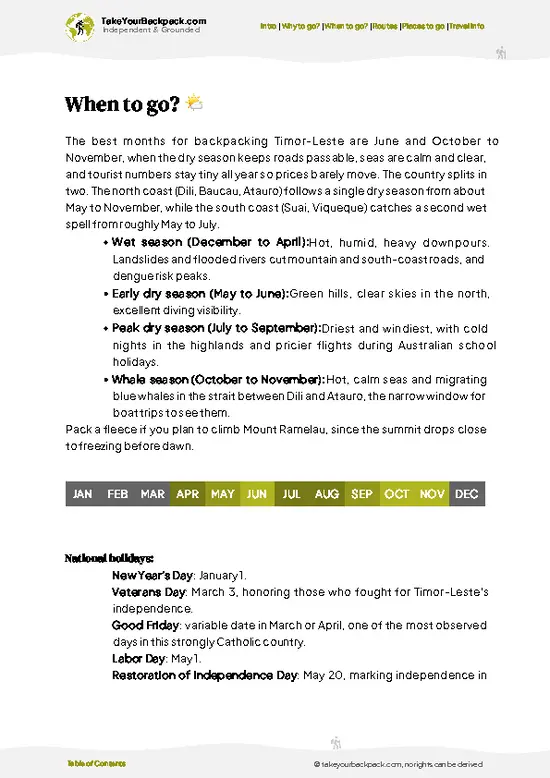
🌤️ When to go?When is the celebration of Tour de Timor?

Tour de Timor is a multi-day mountain bike stage race, traditionally held in late August or September, usually running about five days, with the route starting and finishing in Dili. Dates vary: the 2024 edition ran in May.
  • Best day: The opening stage in Dili gives you the start-line buzz, but the mountain stages in the highlands, where the peloton strings out on switchbacks, are the ones locals line the roads to watch.
  • Weather: Dry season, with coastal days around 30 to 33°C (86 to 91°F) and highland mornings near 15 to 20°C (59 to 68°F). Bring a hat, sunscreen, a light rain shell for mountain afternoons and a refillable bottle.
  • Booking: Watching is free, so only lodging matters. Reserve Dili beds two to four weeks ahead; rates for riders and officials can rise 20 to 40 percent.
  • Crowds and roads:
… read more 👉
Tour de Timor is a multi-day mountain bike stage race, traditionally held in late August or September, usually running about five days, with the route starting and finishing in Dili. Dates vary: the 2024 edition ran in May.
  • Best day: The opening stage in Dili gives you the start-line buzz, but the mountain stages in the highlands, where the peloton strings out on switchbacks, are the ones locals line the roads to watch.
  • Weather: Dry season, with coastal days around 30 to 33°C (86 to 91°F) and highland mornings near 15 to 20°C (59 to 68°F). Bring a hat, sunscreen, a light rain shell for mountain afternoons and a refillable bottle.
  • Booking: Watching is free, so only lodging matters. Reserve Dili beds two to four weeks ahead; rates for riders and officials can rise 20 to 40 percent.
  • Crowds and roads: Roads close for stages, so leave early, arrive at your viewing spot two hours before the riders and expect long waits afterward.
Pick one mountain stage and base yourself near its finish town the night before.


source: climatestotravel.comJANJanuary: not recommended for travelingFEBFebruary: not recommended for travelingMARMarch: not recommended for travelingAPRApril: not recommended for travelingMAYMay: not recommended for travelingJUNJune: not recommended for travelingJULJuly: not recommended for travelingAUGAugust: excellent for travelingSEPSeptember: not recommended for travelingOCTOctober: not recommended for travelingNOVNovember: not recommended for travelingDECDecember: not recommended for traveling

✈️ The backpacker research shortcutTimor-Leste Travel Guide

What the free pages can't give you: ready-made routes, every place ranked, and it works offline. All in 1 guide.
example page 0 from our offline Travel Guide for Timor-Leste
example page 1 from our offline Travel Guide for Timor-Leste
example page 2 from our offline Travel Guide for Timor-Leste
example page 3 from our offline Travel Guide for Timor-Leste
example page 4 from our offline Travel Guide for Timor-Leste
example page 5 from our offline Travel Guide for Timor-Leste
example page 6 from our offline Travel Guide for Timor-Leste
example page 7 from our offline Travel Guide for Timor-Leste
The digital guide (171 pages) contains:
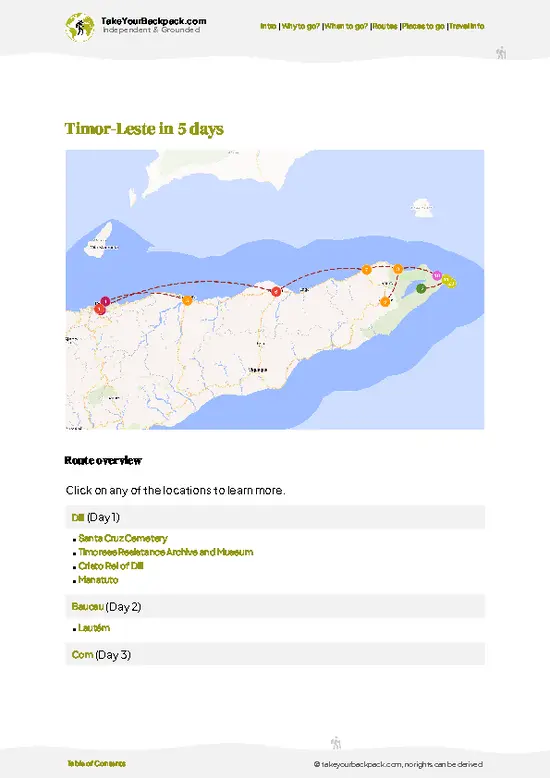
✅ Ready-made 2, 3 & 5-day routes
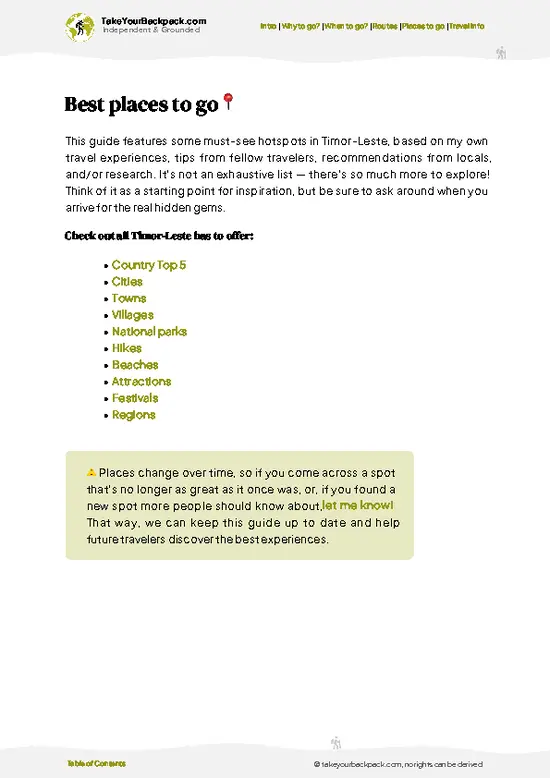
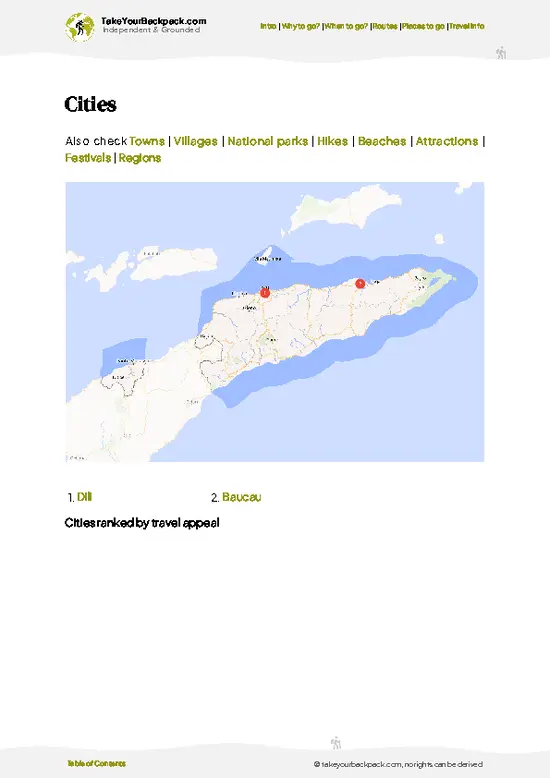
✅ All 46 places ranked, so you skip the overrated ones
✅ Works offline, all in 1 guide
✅ Cities, national parks, landmarks, beaches
✅ How to get around
👉 Click to see all 30+ guide features

📅 Plan smarter in minutes, not weeks
✅ Month by month travel advice
✅ Festivals & national holidays
✅ Budget expectations

🗺️ Go to the right places, skip the overrated ones
✅ Honest pros & cons of destinations
✅ Top hikes, parks & viewpoints
✅ Lesser-known places most travelers miss
✅ Clear “worth it vs skip it” guidance

🛏️ Travel smoothly without rookie mistakes
✅ Best areas to stay
✅ Transport systems explained simply
✅ Common scams & safety advice
✅ SIM cards, money & practical tips

🌍 Understand the country, not just visit it
✅ Culture & traditions
✅ 52 Essential phrases & customs
✅ Festivals worth planning around
✅ Traveler-friendly historical context
✅ Insights that make places more meaningful

📱 Built for real travel conditions
✅ Fully downloadable PDF
✅ Works completely offline
✅ Optimized for phone use
✅ Useful in remote areas & buses
✅ All in 1 guide
Stop searching, start planning
Get instant access to your full guide. 30‑day money-back guarantee.
+ Add another guide for just

By proceeding you agree to our terms.
Sent to your inbox immediately after payment • 100% Secure Checkout
Best Backpacking Travel Advisor 2025 tourism awardBest Backpacking
Travel Advisor
2025
What others say about Take Your Backpack Guides:
⭐⭐⭐⭐⭐
Fantastic, amazing amount of information!
⭐⭐⭐⭐⭐
My goodness this is amazing, it's what I've been looking for hats off too you!
⭐⭐⭐⭐⭐
I think this is absolutely BRILLIANT
⭐⭐⭐⭐
Very complete and informative. It's still missing places, but I gotta to commend you
⭐⭐⭐⭐⭐
This is truly amazing, thank you, can't wait to explore it with my kids!
⭐⭐⭐⭐⭐
Awesome resource, thank you!
⭐⭐⭐⭐⭐
This is amazing! Can't wait to explore the ones I haven't seen
⭐⭐⭐⭐
I love this! Well done, great idea.
⭐⭐⭐⭐⭐
Thanks for taking the time to make this gem!
⭐⭐⭐⭐⭐
This might be the best website I've ever seen.
⭐⭐⭐⭐⭐
Congratulations, and thank you so much for your work; it's incredibly valuable.
⭐⭐⭐⭐
In all seriousness I think you did a great job pointing out the important spots
⭐⭐⭐⭐⭐
10/10 very good
⭐⭐⭐⭐⭐
As someone who's only just starting to visit regularly this is awesome, thank you.
⭐⭐⭐⭐
Thank you very much! I'm going to visit my dad, it's going to be very useful!
⭐⭐⭐⭐⭐
This is really cool! We'll be travelling for the first time and this definitely come in handy.
⭐⭐⭐⭐⭐
You are now our minister of culture, congratulations 👨‍💼
⭐⭐⭐⭐⭐
Just wanted to tell you that this is a pearl! Going to follow your recommendations.
⭐⭐⭐⭐⭐
This is so cool. I'll definitely be using the resource for my travels soon.
⭐⭐⭐⭐⭐
This is very impressive! Good work.
⭐⭐⭐⭐⭐
This is an amazing and informative site. Very well done!

🛏️ Where to stay?Best areas to stay in Timor-Leste

Dili is the smartest base for Tour de Timor, because the race starts and finishes there and nearly every backpacker-friendly bed in the country sits within a few kilometers of the waterfront.

The Dili waterfront and Farol area is the easiest choice. It is flat, walkable and lit at night, with cafes and bars along the seafront promenade where cyclists, volunteers and other travelers swap notes over cold Bintang. Solo travelers will find it the safest place to walk back after dark, and motorcycle taxis (ojek) and microlets are always nearby.

The Colmera and old town side suits tighter budgets. … read more 👉
Dili is the smartest base for Tour de Timor, because the race starts and finishes there and nearly every backpacker-friendly bed in the country sits within a few kilometers of the waterfront.

The Dili waterfront and Farol area is the easiest choice. It is flat, walkable and lit at night, with cafes and bars along the seafront promenade where cyclists, volunteers and other travelers swap notes over cold Bintang. Solo travelers will find it the safest place to walk back after dark, and motorcycle taxis (ojek) and microlets are always nearby.

The Colmera and old town side suits tighter budgets. Guesthouses are simpler, markets are close, and you can walk to the finish area on race days without needing transport. It is lively in the daytime and quieter after dark, so take a taxi late at night.

The Bidau and Lecidere stretch east and west of the center offers mid-range guesthouses with shared kitchens and rooftop space, handy for meeting other travelers and for early starts.

For mountain stages, a night in a highland town such as Maubisse or Aileu places you on the route itself. Stays there are basic homestay style, cooler and quiet, with few social options, so go in a small group. Book early because capacity is limited when the race passes through.

👛 Costs (as of 15 October 2026)Typical daily expenses

A realistic budget for following Tour de Timor is US$40 to 95 a day, mostly spent on beds and transport to stages.
CategoryBudget RangeLocal Reality
Festival ticketsUS$0Watching from the roadside is free. Some official events in Dili may have no charge either.
AccommodationUS$15 to 40Dorms and basic guesthouse rooms in Dili run at the low end. Race week and highland homestays push rates toward the top.
Local transportUS$10 to 25Microlets in Dili cost about US$0.25 to 0.50 per ride. Shared minibuses to towns cost roughly US$3 to 10, and a rented motorbike or car with driver costs much more.
Food & drinksUS$10 to 20Warung meals cost US$2 to 5, and coffee about US$1 to 2. Waterfront restaurants in Dili charge US$8 to 15 a plate, and beer is US$2 to 4.
Miscellaneous expensesUS$5 to 10Water, snacks,
… read more 👉
A realistic budget for following Tour de Timor is US$40 to 95 a day, mostly spent on beds and transport to stages.
CategoryBudget RangeLocal Reality
Festival ticketsUS$0Watching from the roadside is free. Some official events in Dili may have no charge either.
AccommodationUS$15 to 40Dorms and basic guesthouse rooms in Dili run at the low end. Race week and highland homestays push rates toward the top.
Local transportUS$10 to 25Microlets in Dili cost about US$0.25 to 0.50 per ride. Shared minibuses to towns cost roughly US$3 to 10, and a rented motorbike or car with driver costs much more.
Food & drinksUS$10 to 20Warung meals cost US$2 to 5, and coffee about US$1 to 2. Waterfront restaurants in Dili charge US$8 to 15 a plate, and beer is US$2 to 4.
Miscellaneous expensesUS$5 to 10Water, snacks, sunscreen, a SIM card and small tips. ATMs are scarce outside Dili, so carry cash.
Total Daily BudgetUS$40 to 95Per person, per day, in high season.
⚠️ Prices can change and everyone travels differently, so take this as a rough guide. Hope it helps you plan your adventure!

🍲 FoodLocal Cuisine & Drinks

Food at Tour de Timor is roadside and village food, not a curated festival court, so expect to eat where the race stops.

In Dili, grilled fish with rice, tempeh and spicy sambal are staples at the waterfront warungs. Along the route, villages sell ikan sabuko (tuna cooked with tamarind and chili) and batar da’an, a hearty corn and bean stew that makes a good cheap lunch. In the highlands, look for pao (fresh bread) sold from baskets and fruit stands with bananas, mandarins and papaya.

For drinks, Timorese coffee is the one to try. Highland coffee is grown in the Ermera and Maubisse hills, and small cups come strong and often sweet. Bottled water is everywhere. Bintang beer and Sagres show up in Dili, while tua sabu, palm wine, appears in villages and is best tried in small tastes.

Finally, … read more 👉
Food at Tour de Timor is roadside and village food, not a curated festival court, so expect to eat where the race stops.

In Dili, grilled fish with rice, tempeh and spicy sambal are staples at the waterfront warungs. Along the route, villages sell ikan sabuko (tuna cooked with tamarind and chili) and batar da’an, a hearty corn and bean stew that makes a good cheap lunch. In the highlands, look for pao (fresh bread) sold from baskets and fruit stands with bananas, mandarins and papaya.

For drinks, Timorese coffee is the one to try. Highland coffee is grown in the Ermera and Maubisse hills, and small cups come strong and often sweet. Bottled water is everywhere. Bintang beer and Sagres show up in Dili, while tua sabu, palm wine, appears in villages and is best tried in small tastes.

Finally, a few quirks. Carry small US dollar bills and coins, because Timor-Leste uses the US dollar and cards are rare outside Dili. Portions are filling, and stalls near finish lines sell out by early afternoon, so eat early. Sharing a table with locals is normal, and a friendly greeting goes a long way. Wash hands, or carry sanitizer, before eating.

FAQTraveler FAQ

Tour de Timor has usually run in September over about five days, though the 2024 edition was held in May. The race starts and finishes in Dili and runs through highland stretches around Aileu and Maubisse. Exact dates shift each year, so confirm the stage schedule a few weeks before you fly.
Watching is free, so your main costs are lodging and transport. Plan on US$45 to 95 a day, with Dili guesthouse beds at about US$15 to 40 a night. Shared minibuses to highland towns cost roughly US$3 to 10, and local meals US$2 to 5.
No tickets are needed to watch, since the stages run on public roads and you can stand at the roadside for free. What you should book early is a bed, ideally two to four weeks ahead in Dili, and sooner for highland towns like Maubisse. Registering as a rider requires entry with the organizers and a fee.
⚠️ Things can change over time, so always validate details locally before you go.

Other Timorese festivals near Tour de Timor

Explore more nearby:

  • Dili International Film Festival—Timorese films, plastic-chair screenings, director Q&As, waterfront evenings| 1 km away
  • Dili Carnival—Dili seafront parade, homemade costumes, brass and drums, neighborhood teams| 2 km away
  • Lafaek Diak Festival—Crocodile legend, Tetum-language crowd, Avenida de Portugal, tais stalls| 2 km away

💡 Not sure where to go next?
Create a personalized itinerary for Timor-Leste including Tour de Timor and the places that fit your trip.

Generate my itinerary

👉 Discover all festivals

Or checkout all Timor-Leste has to offer (think cities, towns, villages, national parks, hikes, beaches, festivals)
Country photo of Timor-Leste

We 💚 feedbackIs it worth it?

Give it three or four days, not the whole week. That is enough to watch the start in Dili, spend a night in the mountains for the climbs, and still have time to recover. Stay two nights in one highland town rather than chasing every stage, and bring a light rain jacket, because mountain weather turns fast.

✍️ Help improve this page!
The information on this page is based on in-depth research, insights shared by experienced travelers, and feedback from the local travel community in Timor-Leste. While every effort is made to keep the information accurate and current, conditions can change — so if you spot anything incorrect or outdated, please get in touch.


🙋‍♂️ Give feedback

👋 Meet the founderWho’s Behind Take Your Backpack?

Johan, backpacker and founder of TakeYourBackpackHi, I’m Johan (Netherlands 🇳🇱), the creator of TakeYourBackpack. Over the past 25 years, I’ve backpacked through 88 countries across six continents, gaining extensive experience with independent travel, long-term trips, and overland routes.

This site is built on a combination of firsthand travel experience and carefully curated insights from other backpackers. Many guides are based on places I’ve personally visited, while others bring together tips, observations, and practical advice shared by trusted travelers I’ve met along the way.

The goal is to provide realistic, experience-driven guidance — not generic itineraries — so you can explore destinations with better context, clearer expectations, and more confidence.