

×

Tonga🇹🇴 | townsNeiafuPort of Refuge, yacht moorings, whale swims, Talau summit | things to do and best time to go

Explore HavelulotoExplore Nuku’alofa

Backpacking in Neiafu
🌟 Highlighttown ranked #2
By Johan Kruseman 🇳🇱 | Updated October 16, 2026

Neiafu suits sailors, divers, whale-watchers and slow travelers who like a working harbor town as a launch pad. If you want white-sand beaches at your doorstep, nightlife or polished sights, you will find it less rewarding. It sits in the north of Tonga, on Vava’u’s main island, on the edge of Port of Refuge, a deep, sheltered harbor. Mornings smell of diesel, frying doughnuts and wet rope; the light turns the water jade by mid-morning. The town itself is a few streets of shops, a produce market and yacht-crew cafés, so spend your time on the water, not on the pavement. Flights from the capital and a ferry make it easy to reach. Evenings are social but gentle, with hostel decks and waterfront bars, and meeting other travelers is simple. Unlike Ha’apai, which is quieter and sparser, Neiafu has real infrastructure and a steady stream of boats.

Discover everything you want to know in the 📖 Tonga Travel Guide.


example page 0 from our offline Travel Guide for Tonga
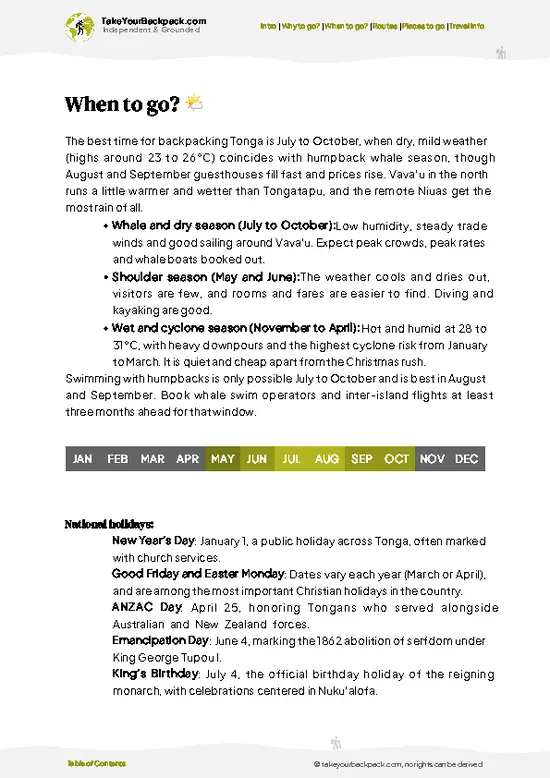
example page 1 from our offline Travel Guide for Tonga
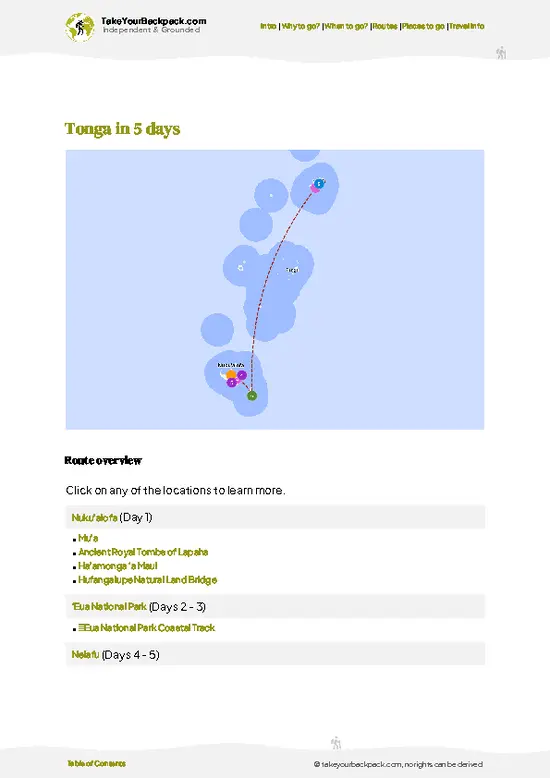
example page 2 from our offline Travel Guide for Tonga
example page 3 from our offline Travel Guide for Tonga
example page 4 from our offline Travel Guide for Tonga
example page 5 from our offline Travel Guide for Tonga
example page 6 from our offline Travel Guide for Tonga
example page 7 from our offline Travel Guide for Tonga
Loading the map 🌍
CLICK TO FILTER
towns
villages
landmarks
national parks
hikes
beaches
attractions
festivals
regions
SHOW COUNTRY’S BESTSHOW ALL

✨ Why go?
Ranked #2 town in Tonga
What makes this town worth visiting

Neiafu is where Vava’u’s archipelago of 40-odd islands becomes reachable. Kayak tours, snorkel trips, sailing charters and dive boats all leave from the harbor, so you can book an outing in the morning and be out by noon. That convenience is the main draw, and it is why the town works best for people who want to be on the water daily rather than sightseeing in town.

From roughly July to October, humpback whales come to calve, and Neiafu becomes one of the few places where you can legally swim with them. Even outside the season, the sheltered anchorages and coral gardens keep trips worthwhile.

Most travelers stay three to five days, and many linger longer because the pace is slow and guesthouses are small and friendly. Solo travelers do well here, since shared boat days and harbor-side bars … read more 👉
Neiafu is where Vava’u’s archipelago of 40-odd islands becomes reachable. Kayak tours, snorkel trips, sailing charters and dive boats all leave from the harbor, so you can book an outing in the morning and be out by noon. That convenience is the main draw, and it is why the town works best for people who want to be on the water daily rather than sightseeing in town.

From roughly July to October, humpback whales come to calve, and Neiafu becomes one of the few places where you can legally swim with them. Even outside the season, the sheltered anchorages and coral gardens keep trips worthwhile.

Most travelers stay three to five days, and many linger longer because the pace is slow and guesthouses are small and friendly. Solo travelers do well here, since shared boat days and harbor-side bars make conversation easy. Hikers get Mount Talau for a short climb with a view. If you need nightlife, big shopping or surf, take a shorter stop.

💡 HighlightsKey sights and experiences for travelers

  1. Mount Talau National Park: A short, steep trail climbs through forest to a flat-topped summit with a sweeping view over the harbor and islands. Go early or late for cooler air and softer light. Entry is usually free or by small donation, and the walk takes 1 to 1.5 hours round trip.
  2. Port of Refuge Harbor: The waterfront is the town’s center, with yachts at moorings, dinghies, and boat operators selling day trips. Sunset is best, when the water goes copper and the bar decks fill. Walking it is free and takes 30 to 60 minutes.
  3. Neiafu Produce Market: Stalls pile up with taro, cassava, bananas, tomatoes and handicrafts. Early morning is best, before the heat and the best produce disappear. Entry is free, and a browse takes about an hour. Buy fruit for the boat.
  4. St. Joseph’s Cathedral and the town
… read more 👉
  1. Mount Talau National Park: A short, steep trail climbs through forest to a flat-topped summit with a sweeping view over the harbor and islands. Go early or late for cooler air and softer light. Entry is usually free or by small donation, and the walk takes 1 to 1.5 hours round trip.
  2. Port of Refuge Harbor: The waterfront is the town’s center, with yachts at moorings, dinghies, and boat operators selling day trips. Sunset is best, when the water goes copper and the bar decks fill. Walking it is free and takes 30 to 60 minutes.
  3. Neiafu Produce Market: Stalls pile up with taro, cassava, bananas, tomatoes and handicrafts. Early morning is best, before the heat and the best produce disappear. Entry is free, and a browse takes about an hour. Buy fruit for the boat.
  4. St. Joseph’s Cathedral and the town churches: Neiafu’s churches, including the hilltop Catholic church of St. Joseph, draw full congregations on Sundays with powerful hymn singing. Attend Sunday morning in modest dress, covering your shoulders and knees. Free, about one hour.
  5. Whale-watching and swim tours: Operators in town run half-day trips in season, July to October, when mothers and calves rest in sheltered water. Expect roughly US$150 to 250 per person (TOP$350 to 600) and 4 to 5 hours. Book a few days ahead.
Day trips from town include the sea caves at Swallows Cave and Mariner’s Cave, the beaches of Hunga and Ofu, and the island of Kapa, with its calm anchorages and snorkeling.

Most visitors miss the Anglican and Wesleyan graveyards around town, where bright quilts and shell-lined mounds cover the graves.
Spotted a mistake or missing something? Contact us.

🏘️ NeighborhoodsNeighborhood guide to Neiafu

Neiafu is small enough to walk end to end in twenty minutes, so the areas below are really three stretches of one harbor-hugging town, each with its own pace.
  • Waterfront and Main Street (Fatafehi Road): This is the part worth your time. Moored yachts rock in Port of Refuge, diesel and frying oil drift off the boats and cafés, and the harbor light turns copper by late afternoon. Cafés, dive shops, whale-watching offices and a few bars sit along one flat strip. Evenings get loud with yacht crews and live music, never rowdy for long. Fully walkable.
  • Public Market and Central Town: Skip the souvenir shops and go early to the market, where pandanus mats, taro, papaya and fish are laid out on concrete tables by about 7 am. Small bakeries sell warm coconut buns. Dusty, a little chaotic, entirely worth
… read more 👉
Neiafu is small enough to walk end to end in twenty minutes, so the areas below are really three stretches of one harbor-hugging town, each with its own pace.
  • Waterfront and Main Street (Fatafehi Road): This is the part worth your time. Moored yachts rock in Port of Refuge, diesel and frying oil drift off the boats and cafés, and the harbor light turns copper by late afternoon. Cafés, dive shops, whale-watching offices and a few bars sit along one flat strip. Evenings get loud with yacht crews and live music, never rowdy for long. Fully walkable.
  • Public Market and Central Town: Skip the souvenir shops and go early to the market, where pandanus mats, taro, papaya and fish are laid out on concrete tables by about 7 am. Small bakeries sell warm coconut buns. Dusty, a little chaotic, entirely worth an hour. Walkable, though the midday sun is punishing.
  • Tapana Island view and Mt Talau side: The road climbs behind town toward Mount Talau, a short hike of about 30 to 45 minutes to a lookout across the Vava’u islands. Go for the view, not for the walk itself, which is steep and muddy after rain. Roosters, church singing on Sundays and little else.
  • Leimatua and the outer harbor road: Quiet residential stretches with pigs, gardens and small churches. Pleasant if you want a slow stroll, but there is little to see, so do not plan a day around it. A bike or short taxi ride covers it.

⌛️ 1 dayWhat you can realistically do in a day

7:30 AM: Neiafu Produce Market Start with a market morning at the stalls, where taro, bananas and fresh bread are cheap and the best picks go early. Buy fruit and a baked snack, then wander uphill toward the trailhead.

9:00 AM: Mount Talau Climb the steep forest path to the summit while the air is still cool. The view of the harbor and the scattered islands is clearest before haze builds. Take your time coming down.

11:30 AM: Harbor cafés Walk down to the waterfront for coffee and a cold drink on a deck over the water. Listen for the clink of rigging and watch yachts swing on their moorings.

1:00 PM: Lunch on the waterfront Pick a harbor-side spot for fish or a simple plate, then use the afternoon heat to rest or book tomorrow’s boat trip with one of the operators nearby.

3:00 PM: Neiafu’s … read more 👉
7:30 AM: Neiafu Produce Market Start with a market morning at the stalls, where taro, bananas and fresh bread are cheap and the best picks go early. Buy fruit and a baked snack, then wander uphill toward the trailhead.

9:00 AM: Mount Talau Climb the steep forest path to the summit while the air is still cool. The view of the harbor and the scattered islands is clearest before haze builds. Take your time coming down.

11:30 AM: Harbor cafés Walk down to the waterfront for coffee and a cold drink on a deck over the water. Listen for the clink of rigging and watch yachts swing on their moorings.

1:00 PM: Lunch on the waterfront Pick a harbor-side spot for fish or a simple plate, then use the afternoon heat to rest or book tomorrow’s boat trip with one of the operators nearby.

3:00 PM: Neiafu’s hillside graveyards Few visitors come here. Walk the quiet lanes past the churches and look at the colorful graves, decorated with quilts, flowers and shells. Keep your voice low and do not step on the mounds.

5:30 PM: Sunset at Port of Refuge Return to the water as the light turns gold, then take a seat at a bar deck. Stay for dinner and conversation with sailors and fellow travelers.

🌤️ When to go?Weather, crowds, and seasonal trade-offs

May to October is the best window, with the humpback whale season running roughly July to October.
  • Dry Season (May to October): Highs of 24 to 27°C (75 to 81°F), cooler nights near 19°C (66°F), and lower humidity. Daylight lasts about 11 hours in June. Whale swimming tours run from about July and sell out, and prices for boats and rooms climb.
  • Wet Season (November to April): Hot and sticky at 28 to 31°C (82 to 88°F) with heavy afternoon downpours. Daylight stretches to about 13 hours in December. Cyclones can occur, mainly January to March, and some places close, but sailing crowds thin and rooms are cheaper.
  • Festivals: The Vava’u Regatta Festival in September fills the harbor with yachts and nightly events, so book ahead.
Book whale tours at least a few weeks ahead for August and September.

source: climatestotravel.comJANJanuary: fair for travelingFEBFebruary: fair for travelingMARMarch: fair for travelingAPRApril: fair for travelingMAYMay: highly recommended for travelingJUNJune: excellent for travelingJULJuly: excellent for travelingAUGAugust: excellent for travelingSEPSeptember: excellent for travelingOCTOctober: highly recommended for travelingNOVNovember: fair for travelingDECDecember: fair for traveling
when-to-go

✈️ The backpacker research shortcutTonga Travel Guide

An offline-friendly backpacking guide with optimized travel routes, ranked highlights, transport advice, and the best areas to stay.
example page 0 from our offline Travel Guide for Tonga
example page 1 from our offline Travel Guide for Tonga
example page 2 from our offline Travel Guide for Tonga
example page 3 from our offline Travel Guide for Tonga
example page 4 from our offline Travel Guide for Tonga
example page 5 from our offline Travel Guide for Tonga
example page 6 from our offline Travel Guide for Tonga
example page 7 from our offline Travel Guide for Tonga
The digital guide (128 pages) contains:
✅ 31 highlights, ranked by travel appeal
✅ Optimized 2, 3 & 5-day travel routes
✅ Cities, national parks, landmarks, beaches
✅ How to get around
✅ Offline-friendly for travel without Wi-Fi
👉 Click to see all 30+ guide features

📅 Plan smarter in minutes, not weeks
✅ Month by month travel advice
✅ Festivals & national holidays
✅ Budget expectations

🗺️ Go to the right places, skip the overrated ones
✅ Honest pros & cons of destinations
✅ Top hikes, parks & viewpoints
✅ Lesser-known places most travelers miss
✅ Clear “worth it vs skip it” guidance

🛏️ Travel smoothly without rookie mistakes
✅ Best areas to stay
✅ Transport systems explained simply
✅ Common scams & safety advice
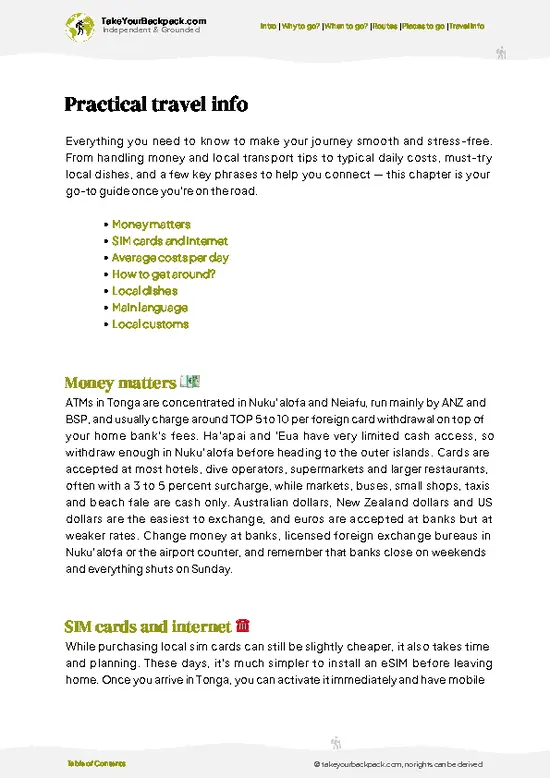
✅ SIM cards, money & practical tips

🌍 Understand the country, not just visit it
✅ Culture & traditions
✅ 52 Essential phrases & customs
✅ Festivals worth planning around
✅ Traveler-friendly historical context
✅ Insights that make places more meaningful

📱 Built for real travel conditions
✅ Fully downloadable PDF
✅ Works completely offline
✅ Optimized for phone use
✅ Useful in remote areas & buses
✅ Everything in one place
Stop searching, start planning
Get instant access to your full guide. 30‑day money-back guarantee.
+ Add another guide for just

By proceeding you agree to our terms.
Sent to your inbox immediately after payment • 100% Secure Checkout
Best Backpacking Travel Advisor 2025 tourism awardBest Backpacking
Travel Advisor
2025
What others say about Take Your Backpack Guides:
⭐⭐⭐⭐⭐
Fantastic, amazing amount of information!
⭐⭐⭐⭐⭐
My goodness this is amazing, it's what I've been looking for hats off too you!
⭐⭐⭐⭐⭐
I think this is absolutely BRILLIANT
⭐⭐⭐⭐
Very complete and informative. It's still missing places, but I gotta to commend you
⭐⭐⭐⭐⭐
This is truly amazing, thank you, can't wait to explore it with my kids!
⭐⭐⭐⭐⭐
Awesome resource, thank you!
⭐⭐⭐⭐⭐
This is amazing! Can't wait to explore the ones I haven't seen
⭐⭐⭐⭐
I love this! Well done, great idea.
⭐⭐⭐⭐⭐
Thanks for taking the time to make this gem!
⭐⭐⭐⭐⭐
This might be the best website I've ever seen.
⭐⭐⭐⭐⭐
Congratulations, and thank you so much for your work; it's incredibly valuable.
⭐⭐⭐⭐
In all seriousness I think you did a great job pointing out the important spots
⭐⭐⭐⭐⭐
10/10 very good
⭐⭐⭐⭐⭐
As someone who's only just starting to visit regularly this is awesome, thank you.
⭐⭐⭐⭐
Thank you very much! I'm going to visit my dad, it's going to be very useful!
⭐⭐⭐⭐⭐
This is really cool! We'll be travelling for the first time and this definitely come in handy.
⭐⭐⭐⭐⭐
You are now our minister of culture, congratulations 👨‍💼
⭐⭐⭐⭐⭐
Just wanted to tell you that this is a pearl! Going to follow your recommendations.
⭐⭐⭐⭐⭐
This is so cool. I'll definitely be using the resource for my travels soon.
⭐⭐⭐⭐⭐
This is very impressive! Good work.
⭐⭐⭐⭐⭐
This is an amazing and informative site. Very well done!

🛏️ Where to stay?Best areas and accommodation options

The waterfront and the streets just behind it are the best places for a budget bed in Neiafu, with dorms and simple guesthouse rooms mostly in the T$40 to 90 (US$17 to 38) range per person.
Staying near the harbor puts cafés, tour offices, the dock and the market within a five to ten minute walk, so you rarely need a taxi. Bed numbers are limited compared with larger backpacker towns, and the few dorm beds fill fast from July to October, so reserve ahead in whale season. Nights near the main strip can be lively when yacht crews are in town, with music into the late evening, but it tends to wind … read more 👉
The waterfront and the streets just behind it are the best places for a budget bed in Neiafu, with dorms and simple guesthouse rooms mostly in the T$40 to 90 (US$17 to 38) range per person.
Staying near the harbor puts cafés, tour offices, the dock and the market within a five to ten minute walk, so you rarely need a taxi. Bed numbers are limited compared with larger backpacker towns, and the few dorm beds fill fast from July to October, so reserve ahead in whale season. Nights near the main strip can be lively when yacht crews are in town, with music into the late evening, but it tends to wind down by midnight. Walking back after dark is generally comfortable, though the lighting on some side roads is dim, so carry a small torch.
The second option is the hillside above town, on the roads rising toward Mount Talau. It costs about the same or a little less, and you get sea views, breezes and the dawn chorus of roosters. The tradeoff is steep walking, especially back with a pack in the heat, and taxis for late returns. It suits travelers who want quiet over convenience.
Avoid sleeping far out on the island unless you have a bike or scooter, since transport back to town is thin and taxis add up.

🚌 Getting aroundHow to get around Neiafu

Your own feet are the easiest way around Neiafu, because the center is flat along the harbor and takes about 20 minutes to cross. Traffic is light, with a few pickups and taxis rattling past, and the real challenge is midday heat and potholed side roads. Public transport is thin, so for anything beyond town you rely on taxis, rentals or boats.
  • Walking: Free and the best choice for the waterfront, market and cafés. Carry water and a hat, and expect no sidewalks on some stretches. Mount Talau is a steep 30 to 45 minute climb on foot.
  • Taxis: Plain cars and vans, usually unmetered, so agree on the fare first. Rides in town run about T$5 to 10 (US$2 to 4), and trips to beaches or Ano Beach cost roughly T$15 to 30 (US$6 to 12). Calling a driver by phone through your guesthouse works best after dark,
… read more 👉
Your own feet are the easiest way around Neiafu, because the center is flat along the harbor and takes about 20 minutes to cross. Traffic is light, with a few pickups and taxis rattling past, and the real challenge is midday heat and potholed side roads. Public transport is thin, so for anything beyond town you rely on taxis, rentals or boats.
  • Walking: Free and the best choice for the waterfront, market and cafés. Carry water and a hat, and expect no sidewalks on some stretches. Mount Talau is a steep 30 to 45 minute climb on foot.
  • Taxis: Plain cars and vans, usually unmetered, so agree on the fare first. Rides in town run about T$5 to 10 (US$2 to 4), and trips to beaches or Ano Beach cost roughly T$15 to 30 (US$6 to 12). Calling a driver by phone through your guesthouse works best after dark, when few cruise.
  • Bike and scooter rental: Bikes cost about T$20 to 35 (US$8 to 14) a day, scooters a bit more. Roads toward Hunga and Ano are mostly paved but holey, and rain makes the clay slick. Worth it for coastal viewpoints, less so in the afternoon heat.
  • Boats and water taxis: Islands are the real highway here. Day charters and shared tours run roughly T$100 to 200 (US$40 to 80) per person, and local ferries to nearby islands cost far less but run on irregular schedules, often leaving in the morning. Ask at the harbor the day before.
  • Local pickup trucks and buses: A few buses and shared trucks run to villages on Vava’u island for about T$2 to 5 (US$1 to 2). They are cheap and cheerful, packed with produce, but there is no reliable timetable and most stop by late afternoon.
For flexibility, mix walking in town with a rented bike for a day and boats for the islands. Skip a rental car unless you are splitting it among several people.

👛 Costs (as of 16 October 2026)Money, prices, and spending tips

Expect to spend about US$55 to 115 per day in Neiafu, including a dorm bed in high season.
CategoryBudget RangeLocal Reality
Dorm accommodationUS$17 to 38Few dorm beds exist, so basic guesthouse rooms often set the price; higher in whale season.
MealsUS$15 to 28Market snacks and bakery buns are cheap, while café mains cost US$10 to 18.
Local transportUS$4 to 10Short taxi rides and occasional bike rental; most of town is walkable.
Basic activities/entry feesUS$12 to 25Cave boat trips, snorkeling and a shared island hop; whale swims cost extra.
Miscellaneous expensesUS$7 to 14Sunscreen, water, a beer or two and occasional laundry.
Total Daily BudgetUS$55 to 115Lower end for market meals and walking; higher for tours.
Buying fruit, bread and fish at the morning market and cooking at a guesthouse kitchen cuts food costs noticeably.
⚠️ Prices can change and everyone travels differently, so take this as a rough guide. Hope it helps you plan your adventure!

🚌 Day tripsShort trips worth adding

Neiafu works very well as a base, because most of the best experiences in Vava’u are a boat or short drive away and return by dinner.
Swallows Cave and Mariner’s Cave:
A half-day boat run (about 3 to 5 hours) into blue-lit sea caves, with a swim and snorkeling over bright reef. Expect around T$100 to 150 (US$40 to 60) shared. Go on a calm morning, since swells can cancel Mariner’s Cave entry. A common mistake is skipping a rash vest or sunscreen on the open boat.

Humpback whale swimming:
From July to October, small boats take small groups to swim with humpbacks and their calves. A tour costs about T$350 to 500 (US$150 to 215) for around 6 hours. It is the splurge worth making. First-timers often book only one day, but an extra trip raises your chances of a good encounter.

Ano Beach:
A 15 … read more 👉
Neiafu works very well as a base, because most of the best experiences in Vava’u are a boat or short drive away and return by dinner.
Swallows Cave and Mariner’s Cave:
A half-day boat run (about 3 to 5 hours) into blue-lit sea caves, with a swim and snorkeling over bright reef. Expect around T$100 to 150 (US$40 to 60) shared. Go on a calm morning, since swells can cancel Mariner’s Cave entry. A common mistake is skipping a rash vest or sunscreen on the open boat.

Humpback whale swimming:
From July to October, small boats take small groups to swim with humpbacks and their calves. A tour costs about T$350 to 500 (US$150 to 215) for around 6 hours. It is the splurge worth making. First-timers often book only one day, but an extra trip raises your chances of a good encounter.

Ano Beach:
A 15 to 20 minute taxi or bike ride gives you white sand, clear shallows and good snorkeling just offshore. Cost is about T$15 to 30 (US$6 to 12) by taxi, plus a simple lunch, and it is best between April and October when the water is clearer. Many people arrive late and miss the calmest morning light.

Port of Refuge and Island hopping:
Shared or chartered boats can drop you at islands with sheltered beaches such as Hunga or Kapa, taking 20 to 45 minutes each way. Budget T$80 to 200 (US$35 to 80) for the day. Bring water and food, since most stops have little or nothing.

🛡️ SafetyStaying Safe: What Travelers Should Know

Neiafu is a relaxed, low-crime town where most problems are minor and avoidable. Petty theft from unattended bags on beaches or boats happens occasionally, so keep valuables locked up and out of sight. Walking at night on the main strip is generally fine, but side roads have few streetlights, so carry a small torch and go with others if you have been drinking. Solo travelers, including women, report few issues, although respectful dress in villages and on Sundays avoids unwanted attention. Stray dogs roam some areas, and a calm walk away is usually enough. Sunday is a legal rest day, so shops close and swimming or loud activity in villages is frowned on. The biggest real risks are sunburn, strong currents when snorkeling off open beaches and rough seas on small boats. Wear a life vest, check … read more 👉
Neiafu is a relaxed, low-crime town where most problems are minor and avoidable. Petty theft from unattended bags on beaches or boats happens occasionally, so keep valuables locked up and out of sight. Walking at night on the main strip is generally fine, but side roads have few streetlights, so carry a small torch and go with others if you have been drinking. Solo travelers, including women, report few issues, although respectful dress in villages and on Sundays avoids unwanted attention. Stray dogs roam some areas, and a calm walk away is usually enough. Sunday is a legal rest day, so shops close and swimming or loud activity in villages is frowned on. The biggest real risks are sunburn, strong currents when snorkeling off open beaches and rough seas on small boats. Wear a life vest, check weather with operators, and avoid cyclone season for boat plans.

FAQFrequently asked questions about Neiafu

Yes, Neiafu is worth visiting for its own sake, especially for sailing, snorkeling and whale season from July to October. The harbor, Mount Talau lookout and nearby sea caves are all within a short boat or walk. Humpback swims cost about T$350 to 500 (US$150 to 215), making it a destination rather than a stopover.
Plan on three to five days. Two days cover the town, Mount Talau and Ano Beach, and another one or two suit boat trips to caves and outer islands. In whale season, add a day for a second swim.
Not realistically. Neiafu is on Vava’u, a separate island group from the capital Nuku’alofa, so reaching it needs a domestic flight of about an hour or a long ferry of around 20 to 24 hours. Stay at least two nights to make the trip worthwhile.
⚠️ Things can change over time, so always validate details locally before you go.

Other Tongan towns near Neiafu

Explore more nearby:

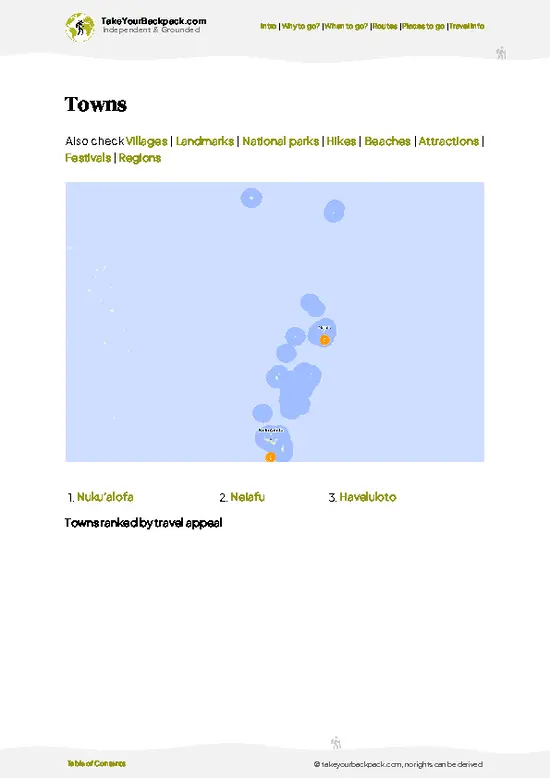
  • Nuku’alofa—Royal palace, Talamahu stalls, Centenary Chapel, Vuna Road| 304 km away
  • Haveluloto—Sunday hymns, umu ovens, lagoon mudflats, village lanes| 307 km away

💡 Not sure where to go next?
Create a personalized itinerary for Tonga including Neiafu and the places that fit your trip.

Generate my itinerary

👉 Discover all towns

Or checkout all Tonga has to offer (think cities, towns, villages, national parks, hikes, beaches, festivals)
Country photo of Tonga

We 💚 feedbackKey takeaways before you go

Neiafu will suit you best if you are happy to let boats and tides set your schedule, and if a quiet harbor evening sounds better than a club. Book your water trips for the morning, when the sea is calmer. Bring a reef-safe sunscreen and cash, and plan on Sunday being closed, so stock up on Saturday.

✍️ Help improve this page!
The information on this page is based on in-depth research, insights shared by experienced travelers, and feedback from the local travel community in Tonga. While every effort is made to keep the information accurate and current, conditions can change — so if you spot anything incorrect or outdated, please get in touch.


🙋‍♂️ Give feedback

👋 Meet the founderWho’s Behind Take Your Backpack?

Johan, backpacker and founder of TakeYourBackpackHi, I’m Johan (Netherlands 🇳🇱), the creator of TakeYourBackpack. Over the past 3 decades, I’ve backpacked through 90+ countries across six continents, gaining extensive experience with independent travel, long-term trips, and overland routes.

This site is built on a combination of firsthand travel experience and carefully curated insights from other backpackers. Many guides are based on places I’ve personally visited, while others bring together tips, observations, and practical advice shared by trusted travelers I’ve met along the way.

The goal is to provide realistic, experience-driven guidance — not generic itineraries — so you can explore destinations with better context, clearer expectations, and more confidence.