×

Tonga🇹🇴 | townsNuku’alofaRoyal palace, Talamahu stalls, Centenary Chapel, Vuna Road | things to do and best time to go

Explore Tafahi IslandExplore Neiafu

Backpacking in Nuku’alofa
🏆 Top picktown ranked #1
By Johan Kruseman 🇳🇱 | Updated October 16, 2026

By law, Sunday here is a day of rest, so shops, restaurants and most transport shut down, and even swimming and sport are frowned on. Nuku’alofa sits on the north coast of Tongatapu island. It is Tonga’s capital, and it runs on church time. Buy food and book transport by Saturday, because the guesthouse kitchen may be your only option on Sunday. The town is low and flat, with salt air, roosters at dawn and hymns drifting out of open church doors. Heat sits heavy by midday, so do errands early. It is easy to reach by air and sea, and it is the hub for onward trips to other island groups. Hostels are small and sociable, and you will meet other travelers over kava or at the waterfront cafés. Evenings are slow, not wild. Even so, the mornings smell of frying doughnuts and ripe mango from the market stalls.

Part of Backpacking in Tonga: all 31 places on one map, with routes and the best time to go.
Discover everything you want to know in the 📖 Tonga Travel Guide.


example page 0 from our offline Travel Guide for Tonga
example page 1 from our offline Travel Guide for Tonga
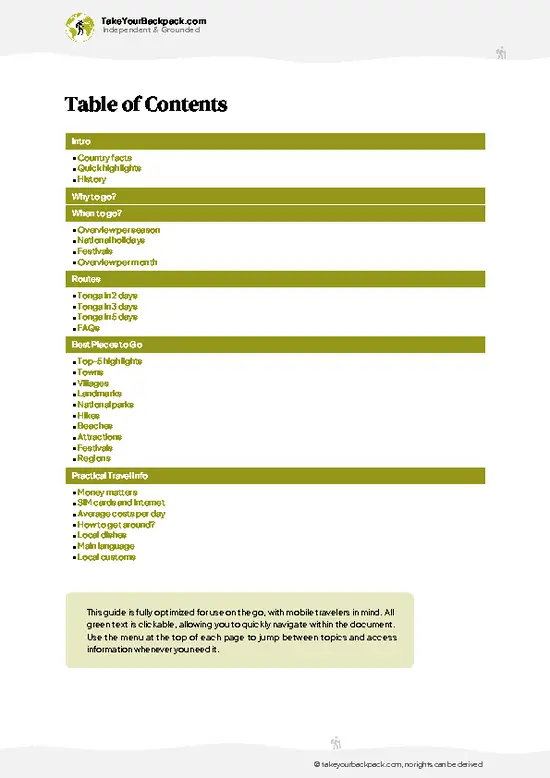
example page 2 from our offline Travel Guide for Tonga
example page 3 from our offline Travel Guide for Tonga
example page 4 from our offline Travel Guide for Tonga
example page 5 from our offline Travel Guide for Tonga
example page 6 from our offline Travel Guide for Tonga
example page 7 from our offline Travel Guide for Tonga
Loading the map 🌍
CLICK TO FILTER
towns
villages
landmarks
national parks
hikes
beaches
attractions
festivals
regions
SHOW COUNTRY’S BESTSHOW ALL

✨ Why go?
Ranked #1 town in Tonga
Why visitors keep coming back

Nuku’alofa earns its place as the hinge of any Tonga trip. Every flight and ferry to the outer islands starts here, and it is the only place with a real choice of supplies, banks and tour operators. Most backpackers stay two or three nights, then move on to Ha’apai or Vava’u, but slower travelers use it for a week of day trips across Tongatapu. The big draw is Talamahu Market, where you can eat cheaply, buy woven mats and tapa cloth, and watch daily Tongan life without a tour group in sight. The second is the royal and church heritage, from the Royal Palace on the seafront to the Sunday choirs, which are worth hearing even if you never go to church back home. Nightlife is modest, and a few bars and kava gatherings are as wild as it gets. This suits solo travelers, culture-minded visitors and … read more 👉
Nuku’alofa earns its place as the hinge of any Tonga trip. Every flight and ferry to the outer islands starts here, and it is the only place with a real choice of supplies, banks and tour operators. Most backpackers stay two or three nights, then move on to Ha’apai or Vava’u, but slower travelers use it for a week of day trips across Tongatapu. The big draw is Talamahu Market, where you can eat cheaply, buy woven mats and tapa cloth, and watch daily Tongan life without a tour group in sight. The second is the royal and church heritage, from the Royal Palace on the seafront to the Sunday choirs, which are worth hearing even if you never go to church back home. Nightlife is modest, and a few bars and kava gatherings are as wild as it gets. This suits solo travelers, culture-minded visitors and anyone who likes a place with its own rhythm. If you want beaches and snorkeling above all, treat it as a quick stop and head offshore.

💡 HighlightsEssential experiences to have while visiting Nuku’alofa

  1. Royal Palace: The white timber Victorian Gothic palace on the seafront dates to the 1860s and is the town’s best-known landmark. The grounds are closed to visitors, but the fence and the lawn across Vuna Road give a clear view. Late afternoon light turns the red roof gold. Free, 15 to 30 minutes.
  2. Talamahu Market: The main produce and handicraft market sells taro, cassava, papaya, coconuts, baskets, woven pandanus mats and tapa cloth. Come early, ideally before 9 AM, when the stalls are full and the heat is mild. It closes on Sunday. Entry is free, and it takes 1 to 1.5 hours with a snack.
  3. Centenary Chapel: The Free Wesleyan Church’s main chapel is the center of Tongan worship, and the royal family attends. Visitors are welcome at Sunday services if they dress modestly, meaning a knee-length
… read more 👉
  1. Royal Palace: The white timber Victorian Gothic palace on the seafront dates to the 1860s and is the town’s best-known landmark. The grounds are closed to visitors, but the fence and the lawn across Vuna Road give a clear view. Late afternoon light turns the red roof gold. Free, 15 to 30 minutes.
  2. Talamahu Market: The main produce and handicraft market sells taro, cassava, papaya, coconuts, baskets, woven pandanus mats and tapa cloth. Come early, ideally before 9 AM, when the stalls are full and the heat is mild. It closes on Sunday. Entry is free, and it takes 1 to 1.5 hours with a snack.
  3. Centenary Chapel: The Free Wesleyan Church’s main chapel is the center of Tongan worship, and the royal family attends. Visitors are welcome at Sunday services if they dress modestly, meaning a knee-length skirt or a wraparound and covered shoulders. The harmony singing is the reason to go. Free, 1 to 1.5 hours.
  4. Mala’ekula Royal Tombs: The royal burial ground in the center of town is a grassy plot with stepped tomb mounds, holding Tonga’s monarchs since the 19th century. Visitors view it from the roadside, so quiet respect matters. Free, 15 minutes, best in the morning.
  5. Vuna Road waterfront: This is the seafront strip with views over the reef and the lagoon, with fishing boats and a sea breeze that cools the day. It is a good place for a sunset walk, when locals come out to stroll and play. Free, about 45 minutes.
Beyond town, the most worthwhile day trips are the Ha’amonga ‘a Maui trilithon, the Mapu’a ‘a Vaea blowholes at Houma, the Lapaha royal tombs and the island resorts of Pangaimotu and Fafa for snorkeling. All five highlights fit comfortably into a single full day on foot or by taxi.
Spotted a mistake or missing something? Contact us.

🏘️ NeighborhoodsHow different areas shape the experience

Nuku’alofa is small enough to cover on foot or by bike in a day, and the areas differ more in mood than in distance. Heat and midday glare are why locals move early and rest between noon and 3 pm, so do your walking before then.
  • Downtown and Vuna Road waterfront: The grid around Taufa’ahau Road holds the Talamahu Market, bank branches, bakeries and the Friendly Islands bus terminal. Mornings smell of frying doughnuts (keke), ripe papaya and diesel. Vendors sell fish, yams and woven mats from dawn, and the best stock is gone by 10 am, so arrive early. Everything is within a 15 minute walk, though shade is thin.
  • Royal Palace and Centenary Chapel area: The white wooden palace with its red roof sits behind lawns and Norfolk pines, and you view it from the gate only. Tongan Sunday is the reason to
… read more 👉
Nuku’alofa is small enough to cover on foot or by bike in a day, and the areas differ more in mood than in distance. Heat and midday glare are why locals move early and rest between noon and 3 pm, so do your walking before then.
  • Downtown and Vuna Road waterfront: The grid around Taufa’ahau Road holds the Talamahu Market, bank branches, bakeries and the Friendly Islands bus terminal. Mornings smell of frying doughnuts (keke), ripe papaya and diesel. Vendors sell fish, yams and woven mats from dawn, and the best stock is gone by 10 am, so arrive early. Everything is within a 15 minute walk, though shade is thin.
  • Royal Palace and Centenary Chapel area: The white wooden palace with its red roof sits behind lawns and Norfolk pines, and you view it from the gate only. Tongan Sunday is the reason to plan ahead: nearly everything shuts and church choirs carry across the streets. Experienced travelers stock up Saturday and attend a service at the chapel for the singing, dressing modestly.
  • Fisherman’s wharf and Faua Jetty: Boats clank against the pier, the air is salty and the cafes by the harbor catch the evening breeze. Come at sunset for grilled fish and cold Ikale beer. Hard to find after dark without a light, so carry a small torch.
  • Tofoa and Vaini suburbs: Residential, dusty, quiet and loud with roosters and wandering pigs. Small shops sell tinned fish and cheap rice plates. Walkable, but a short bus or taxi ride gets you there faster than the heat allows.
  • Ha’atafu and the Fua’amotu side: Beyond town lie reef beaches and rural villages, best reached by hired bike or scooter.

⌛️ 1 day1-day itinerary for Nuku’alofa

7:30 AM, Talamahu Market: Start with the produce stalls while they are full. Try a fresh coconut or a fried doughnut, then browse the handicraft section for woven mats and tapa cloth. Prices are low, and vendors seldom push. Leave before the heat builds.
9:30 AM, Mala’ekula Royal Tombs: Walk a few minutes into the center to the royal burial ground. The mounds are viewed from the edge, so just look quietly and read the setting. It shows the monarchy’s importance more clearly than any museum label.
10:30 AM, Centenary Chapel: Stroll past the church compound, a landmark of Tongan Christianity. Outside Sunday service times, the exterior and grounds are enough for a short stop. Sunday is the day to hear the choirs.
12:00 PM, Lunch near the harbor: Eat fish, taro and lu at a simple local place, or … read more 👉
7:30 AM, Talamahu Market: Start with the produce stalls while they are full. Try a fresh coconut or a fried doughnut, then browse the handicraft section for woven mats and tapa cloth. Prices are low, and vendors seldom push. Leave before the heat builds.
9:30 AM, Mala’ekula Royal Tombs: Walk a few minutes into the center to the royal burial ground. The mounds are viewed from the edge, so just look quietly and read the setting. It shows the monarchy’s importance more clearly than any museum label.
10:30 AM, Centenary Chapel: Stroll past the church compound, a landmark of Tongan Christianity. Outside Sunday service times, the exterior and grounds are enough for a short stop. Sunday is the day to hear the choirs.
12:00 PM, Lunch near the harbor: Eat fish, taro and lu at a simple local place, or have a café meal as the sea breeze comes up. Rest during the hottest hours.
2:30 PM, Tu’imatamoana harbor and fishing wharf: Skip the main sights and walk to the working harbor. This is where inter-island boats and local fishermen come in, and it is a quiet stop that most visitors never see. Watch the unloading, the gulls and the reef-edge light.
4:30 PM, Royal Palace and Vuna Road: Walk the seafront to the white palace, view it from the fence, then follow the shore road as the light turns amber. Families gather near the water at this hour.
6:30 PM, Sunset and dinner: Pick a waterfront spot for sunset, then end with a relaxed meal and a kava session if a hostel invites you.

🌤️ When to go?Seasonal considerations and timing

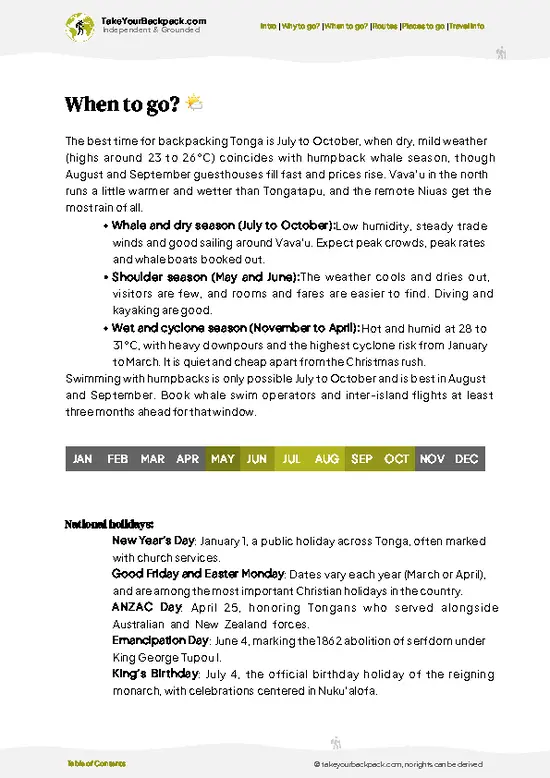
May to October is the most comfortable window, with daytime highs of 24 to 27°C (75 to 81°F), cooler evenings near 18 to 20°C (64 to 68°F) and lower humidity.
  • Dry Season (May to October): Clearer skies and steady breezes. Humpback whales arrive from July to October, which pushes up boat prices and fills the better guesthouses. Daylight runs roughly 11 hours in June.
  • Wet Season (November to April): Hot, sticky days at 28 to 31°C (82 to 88°F) with heavy downpours. Cyclone risk peaks January to March. Flights and rooms are cheaper and crowds thin, but boat trips cancel more often. Daylight stretches near 13.5 hours in December.
  • Festival Week (early July): The Heilala Festival brings parades, dancing and sports around the King’s birthday, with fuller dorms and higher prices.
Book whale trips and rooms … read more 👉
May to October is the most comfortable window, with daytime highs of 24 to 27°C (75 to 81°F), cooler evenings near 18 to 20°C (64 to 68°F) and lower humidity.
  • Dry Season (May to October): Clearer skies and steady breezes. Humpback whales arrive from July to October, which pushes up boat prices and fills the better guesthouses. Daylight runs roughly 11 hours in June.
  • Wet Season (November to April): Hot, sticky days at 28 to 31°C (82 to 88°F) with heavy downpours. Cyclone risk peaks January to March. Flights and rooms are cheaper and crowds thin, but boat trips cancel more often. Daylight stretches near 13.5 hours in December.
  • Festival Week (early July): The Heilala Festival brings parades, dancing and sports around the King’s birthday, with fuller dorms and higher prices.
Book whale trips and rooms at least a month ahead if you travel in August or September.


source: climatestotravel.comJANJanuary: fair for travelingFEBFebruary: fair for travelingMARMarch: fair for travelingAPRApril: fair for travelingMAYMay: highly recommended for travelingJUNJune: excellent for travelingJULJuly: excellent for travelingAUGAugust: excellent for travelingSEPSeptember: excellent for travelingOCTOctober: highly recommended for travelingNOVNovember: fair for travelingDECDecember: fair for traveling
when-to-go

✈️ The backpacker research shortcutTonga Travel Guide

What the free pages can't give you: ready-made routes, every place ranked, and it works offline. All in 1 guide.
example page 0 from our offline Travel Guide for Tonga
example page 1 from our offline Travel Guide for Tonga
example page 2 from our offline Travel Guide for Tonga
example page 3 from our offline Travel Guide for Tonga
example page 4 from our offline Travel Guide for Tonga
example page 5 from our offline Travel Guide for Tonga
example page 6 from our offline Travel Guide for Tonga
example page 7 from our offline Travel Guide for Tonga
The digital guide (128 pages) contains:-page digital guide:
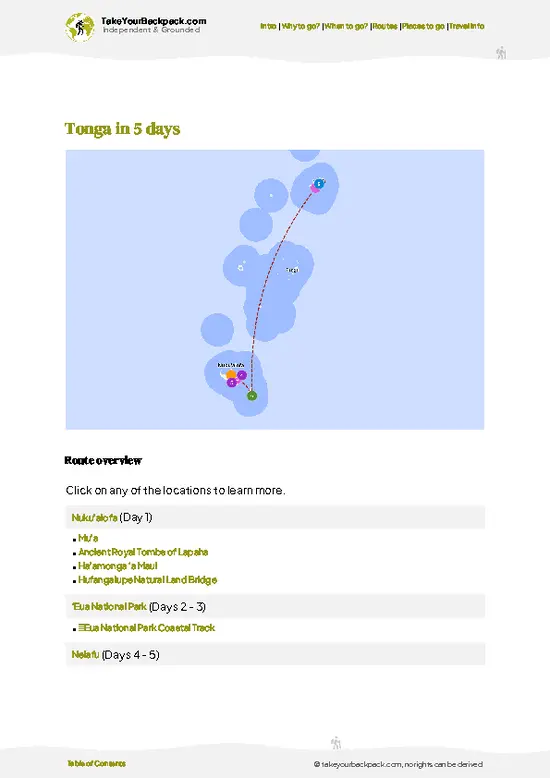
✅ Ready-made 2, 3 & 5-day routes
✅ All 31 places ranked, so you skip the overrated ones
✅ Works offline, all in 1 guide
✅ Cities, national parks, landmarks, beaches
✅ How to get around
👉 Click to see all 30+ guide features

📅 Plan smarter in minutes, not weeks
✅ Month by month travel advice
✅ Festivals & national holidays
✅ Budget expectations

🗺️ Go to the right places, skip the overrated ones
✅ Honest pros & cons of destinations
✅ Top hikes, parks & viewpoints
✅ Lesser-known places most travelers miss
✅ Clear “worth it vs skip it” guidance

🛏️ Travel smoothly without rookie mistakes
✅ Best areas to stay
✅ Transport systems explained simply
✅ Common scams & safety advice
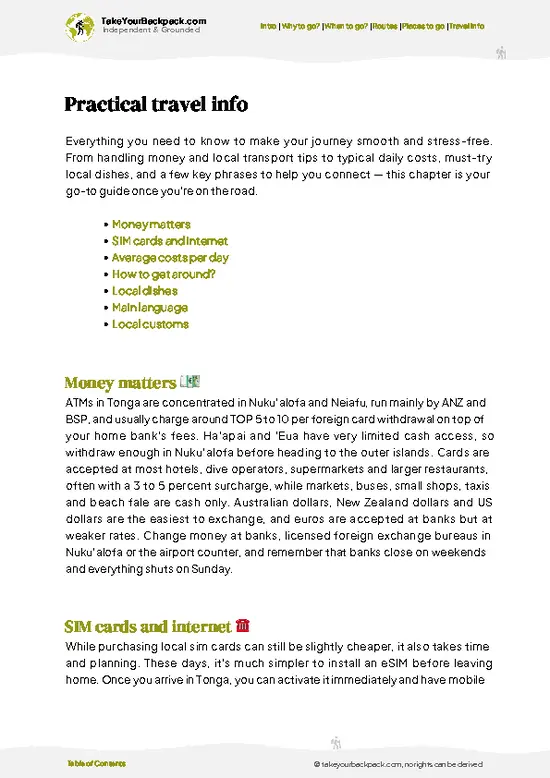
✅ SIM cards, money & practical tips

🌍 Understand the country, not just visit it
✅ Culture & traditions
✅ 52 Essential phrases & customs
✅ Festivals worth planning around
✅ Traveler-friendly historical context
✅ Insights that make places more meaningful

📱 Built for real travel conditions
✅ Fully downloadable PDF
✅ Works completely offline
✅ Optimized for phone use
✅ Useful in remote areas & buses
✅ All in 1 guide
Stop searching, start planning
Get instant access to your full guide. 30‑day money-back guarantee.


By proceeding you agree to our terms.
Sent to your inbox immediately after payment • 100% Secure Checkout
Best Backpacking Travel Advisor 2025 tourism awardBest Backpacking
Travel Advisor
2025
What others say about Take Your Backpack Guides:
⭐⭐⭐⭐⭐
Fantastic, amazing amount of information!
⭐⭐⭐⭐⭐
My goodness this is amazing, it's what I've been looking for hats off too you!
⭐⭐⭐⭐⭐
I think this is absolutely BRILLIANT
⭐⭐⭐⭐
Very complete and informative. It's still missing places, but I gotta to commend you
⭐⭐⭐⭐⭐
This is truly amazing, thank you, can't wait to explore it with my kids!
⭐⭐⭐⭐⭐
Awesome resource, thank you!
⭐⭐⭐⭐⭐
This is amazing! Can't wait to explore the ones I haven't seen
⭐⭐⭐⭐
I love this! Well done, great idea.
⭐⭐⭐⭐⭐
Thanks for taking the time to make this gem!
⭐⭐⭐⭐⭐
This might be the best website I've ever seen.
⭐⭐⭐⭐⭐
Congratulations, and thank you so much for your work; it's incredibly valuable.
⭐⭐⭐⭐
In all seriousness I think you did a great job pointing out the important spots
⭐⭐⭐⭐⭐
10/10 very good
⭐⭐⭐⭐⭐
As someone who's only just starting to visit regularly this is awesome, thank you.
⭐⭐⭐⭐
Thank you very much! I'm going to visit my dad, it's going to be very useful!
⭐⭐⭐⭐⭐
This is really cool! We'll be travelling for the first time and this definitely come in handy.
⭐⭐⭐⭐⭐
You are now our minister of culture, congratulations 👨‍💼
⭐⭐⭐⭐⭐
Just wanted to tell you that this is a pearl! Going to follow your recommendations.
⭐⭐⭐⭐⭐
This is so cool. I'll definitely be using the resource for my travels soon.
⭐⭐⭐⭐⭐
This is very impressive! Good work.
⭐⭐⭐⭐⭐
This is an amazing and informative site. Very well done!

🛏️ Where to stay?Best areas to stay in Tonga

The waterfront and downtown strip along Vuna Road and Taufa’ahau Road is the best place for a budget bed, with a handful of hostels and guesthouses within a 10 minute walk of the market and ferry wharf. Dorms are limited, so book ahead in whale season, and expect to pay roughly TOP 40 to 70 (US$17 to 30) for a bed, with simple private rooms costing more.
Being central means you can walk to food, ATMs and the bus terminal without a taxi, which saves money. Evenings are quiet by Southeast Asian standards. The noise you will notice is roosters from before dawn and Saturday night church rehearsals, … read more 👉
The waterfront and downtown strip along Vuna Road and Taufa’ahau Road is the best place for a budget bed, with a handful of hostels and guesthouses within a 10 minute walk of the market and ferry wharf. Dorms are limited, so book ahead in whale season, and expect to pay roughly TOP 40 to 70 (US$17 to 30) for a bed, with simple private rooms costing more.
Being central means you can walk to food, ATMs and the bus terminal without a taxi, which saves money. Evenings are quiet by Southeast Asian standards. The noise you will notice is roosters from before dawn and Saturday night church rehearsals, not bars. Bring earplugs and choose a room away from the road. Streets are lit in the main strip and generally safe to walk after dark, though a taxi is wiser after 10 pm when side streets get dim.
The second option is the quieter residential edge toward Vaiola and Tofoa, where guesthouses are slightly cheaper and have kitchens and more space. The drawback is distance. You will rely on taxis or a rented bike, and buses stop early and do not run Sundays. Pick this area if you are staying a week or more and want to cook your own food.

🚌 Getting aroundMoving around without the hassle

From the main bus terminal beside Talamahu Market you are already in the center, so there is nothing to ride; walk out into the shade of the stalls and you are on Taufa’ahau Road within two minutes. That is how most of Nuku’alofa works. The grid is flat and compact, traffic is slow and mixed with dogs, horses and the odd pig, and public transport is informal, so plan around it rather than expecting a timetable.
  • Walking: Free and the best way to see downtown. Why: distances are short, most sights lie within 2 km. Experienced travelers go before 10 am or after 4 pm because the sun on pale concrete is brutal and shade is limited.
  • Local buses: Small blue and yellow minibuses run from the market terminal to villages across Tongatapu. Fares are roughly TOP 1 to 4 (about US$0.40 to 1.70), paid to the
… read more 👉
From the main bus terminal beside Talamahu Market you are already in the center, so there is nothing to ride; walk out into the shade of the stalls and you are on Taufa’ahau Road within two minutes. That is how most of Nuku’alofa works. The grid is flat and compact, traffic is slow and mixed with dogs, horses and the odd pig, and public transport is informal, so plan around it rather than expecting a timetable.
  • Walking: Free and the best way to see downtown. Why: distances are short, most sights lie within 2 km. Experienced travelers go before 10 am or after 4 pm because the sun on pale concrete is brutal and shade is limited.
  • Local buses: Small blue and yellow minibuses run from the market terminal to villages across Tongatapu. Fares are roughly TOP 1 to 4 (about US$0.40 to 1.70), paid to the driver. Services are frequent early, thin by mid-afternoon and mostly stop by about 5 pm, and nothing runs on Sunday. Ask the driver where to catch the return before you step off.
  • Taxis: Unmetered, so agree the price first. A hop around town costs about TOP 5 to 10 (US$2 to 4), and a trip to the airport about TOP 40 to 60 (US$17 to 25). Taxis are the sensible choice after dark, when walking unlit roads is harder and buses have stopped. Hostels will usually call a reliable driver.
  • Bike or scooter rental: Rentals run about TOP 20 to 30 (US$8 to 13) a day for bikes and more for scooters, with a valid license needed for motorbikes. Roads are flat and the lagoon-side lanes are pleasant in the cooler morning air. Watch for loose dogs and potholes, and carry water, since shops thin out in villages.
  • Day hire with driver: About TOP 150 to 250 (US$65 to 105) for a car around the island, which splits well among three or four people and reaches the blowholes at Mapu’a ‘a Vaea and the coastal arches.

👛 Costs (as of 16 October 2026)Travel costs and budget guide for Nuku’alofa

Budget about US$41 to 93 a day in Nuku’alofa, and the high-season total in the table below comes to US$68. Prices are in Tongan pa’anga locally, but everything here is converted to US dollars. Tonga is an island nation that imports most goods, so groceries and packaged food cost more than you might expect, while market produce and bakery snacks keep the bill down.
CategoryBudget RangeLocal Reality
Dorm accommodationUS$15 to 25 (high season US$22)Dorm beds are limited, so private rooms in guesthouses (US$30 to 50) are common and a shared room splits the cost. Low season is often a few dollars cheaper.
MealsUS$15 to 25 (US$20)Bakery pies and buns cost US$1 to 2, a plate at a local takeaway US$4 to 7, and a restaurant dinner US$12 to 20. Fresh fish and root crops at Talamahu Market are the cheapest
… read more 👉
Budget about US$41 to 93 a day in Nuku’alofa, and the high-season total in the table below comes to US$68. Prices are in Tongan pa’anga locally, but everything here is converted to US dollars. Tonga is an island nation that imports most goods, so groceries and packaged food cost more than you might expect, while market produce and bakery snacks keep the bill down.
CategoryBudget RangeLocal Reality
Dorm accommodationUS$15 to 25 (high season US$22)Dorm beds are limited, so private rooms in guesthouses (US$30 to 50) are common and a shared room splits the cost. Low season is often a few dollars cheaper.
MealsUS$15 to 25 (US$20)Bakery pies and buns cost US$1 to 2, a plate at a local takeaway US$4 to 7, and a restaurant dinner US$12 to 20. Fresh fish and root crops at Talamahu Market are the cheapest good food.
Local transportUS$2 to 8 (US$5)Local buses run about US$0.50 to 1 a ride and taxis around town cost US$3 to 6. Buses are scarce on Sundays, when most things stop.
Basic activities/entry feesUS$5 to 25 (US$15)Most sights around town, such as the Royal Tombs exterior and the waterfront, are free. Snorkel trips, island tours and cultural shows push the figure up.
Miscellaneous expensesUS$4 to 10 (US$6)Bottled water, a SIM card with data, laundry and the odd cold drink. Cash is useful for markets and small shops.
Total Daily BudgetUS$41 to 93US$68 on a typical high-season day
To save money, shop at Talamahu Market in the morning for fruit and vegetables and eat a big takeaway lunch, then keep dinner light. Cooking in a guesthouse kitchen helps even more, since restaurant evenings are the biggest single drain.
⚠️ Prices can change and everyone travels differently, so take this as a rough guide. Hope it helps you plan your adventure!

🚌 Day tripsBest day trips from Nuku’alofa

Nuku’alofa works well as a base for day trips because Tongatapu is small, and most sights lie within 45 minutes of town by road.
Blowholes at Houma and the south coast:
The Mapu’a ‘a Vaea blowholes fire seawater up to 30 m through the coral shelf along nearly 5 km of coast. It takes about 30 to 40 minutes by local bus or car, with bus fare under TOP 5 and a hired driver around TOP 150 to 250 for the day. Come on a rising tide with a good swell, and go in the morning for photos. A common mistake is arriving at low tide when little happens.

Ha’amonga ‘a Maui Trilithon:
This coral limestone gateway, built around the 13th century, stands in a clearing on the northeast side of the island about 40 minutes away. Entry is minimal and the site is quiet, often with no other visitors. Combine it with … read more 👉
Nuku’alofa works well as a base for day trips because Tongatapu is small, and most sights lie within 45 minutes of town by road.
Blowholes at Houma and the south coast:
The Mapu’a ‘a Vaea blowholes fire seawater up to 30 m through the coral shelf along nearly 5 km of coast. It takes about 30 to 40 minutes by local bus or car, with bus fare under TOP 5 and a hired driver around TOP 150 to 250 for the day. Come on a rising tide with a good swell, and go in the morning for photos. A common mistake is arriving at low tide when little happens.

Ha’amonga ‘a Maui Trilithon:
This coral limestone gateway, built around the 13th century, stands in a clearing on the northeast side of the island about 40 minutes away. Entry is minimal and the site is quiet, often with no other visitors. Combine it with the Lapita site at Nukuleka on the same northeast coast. Take a bike only if you are fit, since the heat is heavy by midday.

Ha’atafu Beach and the western reef:
A reef-protected coast about 30 minutes west, with calm pools for snorkeling and surfers further out. Take your own mask because hire is limited, plus water and food. Visit April to October for clearer water, and check the tide, since the lagoon can be shallow at low water.
👉 Explore Ha’atafu Beach
‘Eua Island:
A day trip is possible by the 10 minute flight or the ferry (about 2 to 3 hours), but ferry schedules change and delays can strand you. Most budget travelers should only attempt it if the return is confirmed. The cliffs and caves on the east coast justify the effort.

🛡️ SafetyTraveler Safety Guide

Nuku’alofa is broadly safe, and most problems are small ones. Opportunistic theft from unattended bags on beaches or in guesthouses occurs, so keep valuables on you or locked and do not leave a phone on a table. After dark, take a taxi on the unlit streets away from the waterfront, especially if you are alone, and avoid groups of drunk people near bars on weekends. Solo women generally report friendly treatment, but modest dress (covered shoulders and knees, a wraparound skirt called a tupenu for many) avoids unwanted attention and respects local custom. Scams are rare. Agree taxi fares before getting in and carry small change. Dogs roam loose and can be aggressive at night, so walk with a torch and avoid sprinting past them. Sunday rules are strictly kept, so swimming or noisy activity in … read more 👉
Nuku’alofa is broadly safe, and most problems are small ones. Opportunistic theft from unattended bags on beaches or in guesthouses occurs, so keep valuables on you or locked and do not leave a phone on a table. After dark, take a taxi on the unlit streets away from the waterfront, especially if you are alone, and avoid groups of drunk people near bars on weekends. Solo women generally report friendly treatment, but modest dress (covered shoulders and knees, a wraparound skirt called a tupenu for many) avoids unwanted attention and respects local custom. Scams are rare. Agree taxi fares before getting in and carry small change. Dogs roam loose and can be aggressive at night, so walk with a torch and avoid sprinting past them. Sunday rules are strictly kept, so swimming or noisy activity in public may offend. The bigger daily risks are sun, dehydration and reef cuts, so use reef shoes and drink bottled or boiled water.

FAQTraveler FAQ

Nuku’alofa is worth two or three days, though many people treat it as a gateway to the outer islands of Ha’apai and Vava’u. The Royal Palace, Talamahu Market and the south coast blowholes fill a day or two easily. Whale swimming season from July to October is the main draw, with trips costing around US$150 to 250. If you only want beaches, Vava’u offers more.
Two to three days covers the town and the island of Tongatapu at an easy pace. Spend one day around the market, palace and wharf, and another on a driver or bike loop to the Ha’amonga ‘a Maui Trilithon, blowholes and Ha’atafu Beach. Add a third day if you plan a day trip to ‘Eua or a Sunday church service. Longer stays suit those working with volunteer projects or diving.
Yes, but only from within Tonga, since there is no larger nearby city. Flights from Fiji or New Zealand arrive at Fua’amotu airport about 20 to 30 minutes from town, and a day visit from Fiji is not practical. From Nuku’alofa itself, the sights of Tongatapu are easy day trips, taking 30 to 45 minutes each way. ‘Eua can also be done in a day by a 10 minute flight, though most prefer to stay overnight.
⚠️ Things can change over time, so always validate details locally before you go.

Other Tongan towns near Nuku’alofa

Explore more nearby:

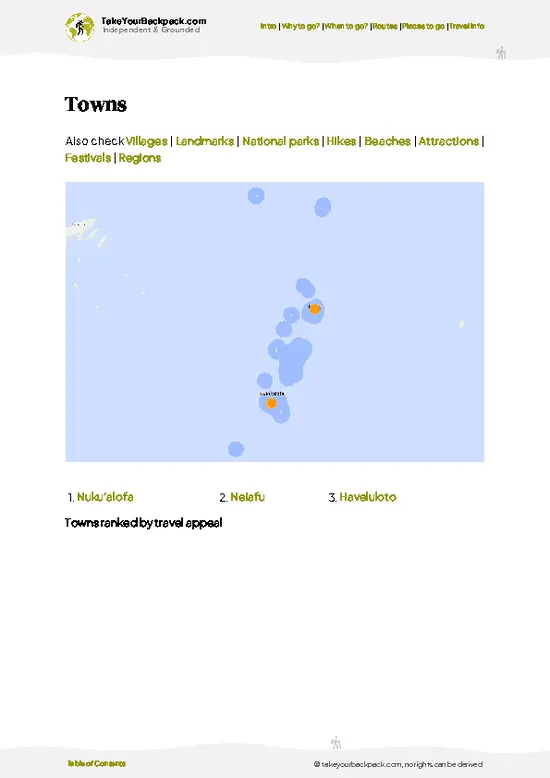
  • Haveluloto—Sunday hymns, umu ovens, lagoon mudflats, village lanes| 3 km away
  • Neiafu—Port of Refuge, yacht moorings, whale swims, Talau summit| 304 km away

💡 Not sure where to go next?
Create a personalized itinerary for Tonga including Nuku’alofa and the places that fit your trip.

Generate my itinerary

👉 Discover all towns

Or checkout all Tonga has to offer (think cities, towns, villages, national parks, hikes, beaches, festivals)
Country photo of Tonga

We 💚 feedbackWhat to keep in mind

Be here on a Saturday morning, when Talamahu Market is at its loudest and fullest, then stay for the quiet Sunday. I would book a spot at a morning church service, wear a wraparound and sit near the back. The singing alone beats most tours. Bring cash, a hat and a reusable bottle, because the heat comes quickly and little is open once the bells ring.

✍️ Help improve this page!
The information on this page is based on in-depth research, insights shared by experienced travelers, and feedback from the local travel community in Tonga. While every effort is made to keep the information accurate and current, conditions can change — so if you spot anything incorrect or outdated, please get in touch.


🙋‍♂️ Give feedback

👋 Meet the founderWho’s Behind Take Your Backpack?

Johan, backpacker and founder of TakeYourBackpackHi, I’m Johan (Netherlands 🇳🇱), the creator of TakeYourBackpack. Over the past 30 years, I’ve backpacked through 88 countries across six continents, gaining extensive experience with independent travel, long-term trips, and overland routes.

This site is built on a combination of firsthand travel experience and carefully curated insights from other backpackers. Many guides are based on places I’ve personally visited, while others bring together tips, observations, and practical advice shared by trusted travelers I’ve met along the way.

The goal is to provide realistic, experience-driven guidance — not generic itineraries — so you can explore destinations with better context, clearer expectations, and more confidence.