
×

Tonga🇹🇴 | regionsTafahi IslandVolcanic cone, kava slopes, surf landing | things to do and best time to go

Explore NiuatoputapuExplore Vava’u

Backpacking in Tafahi Island
👀 For curious travelersregion ranked #7
By Johan Kruseman 🇳🇱 | Updated October 15, 2026

Tafahi has no airstrip, no guesthouse and no road network, so it is a day or overnight visit by boat from its neighbor, not a place you fly into. It sits in the far north of Tonga, in the Niua group, just across the water from Niuatoputapu. From the sea it is a near-perfect green cone, and you notice it long before you land. The landing is the first test: surf, a rocky shore and a hand from the boatmen. The reward is a village of a few families, coconut husks cracking underfoot, kava roots drying in the sun and a steep trail through wet forest to the summit. It is quiet, remote and very unpolished. Come for the climb and the welcome. At the top, trade winds flatten the grass and the whole Niua horizon lies below you.

Discover everything you want to know in the 📖 Tonga Travel Guide.


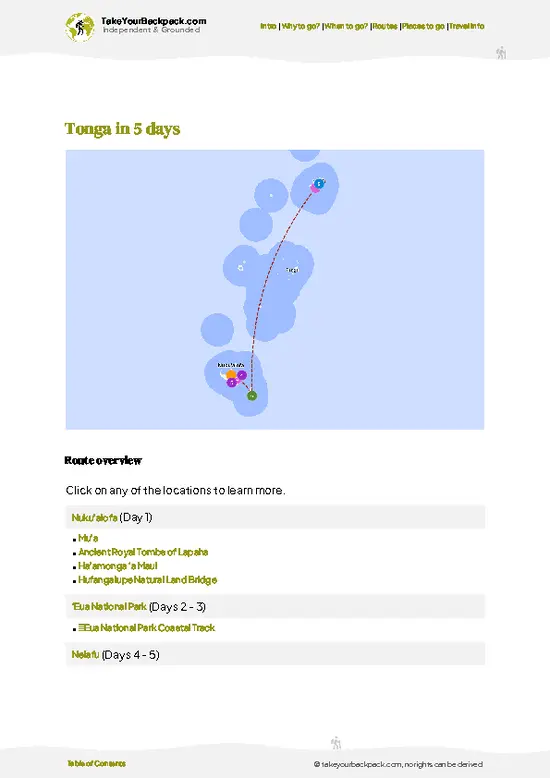
example page 0 from our offline Travel Guide for Tonga
example page 1 from our offline Travel Guide for Tonga
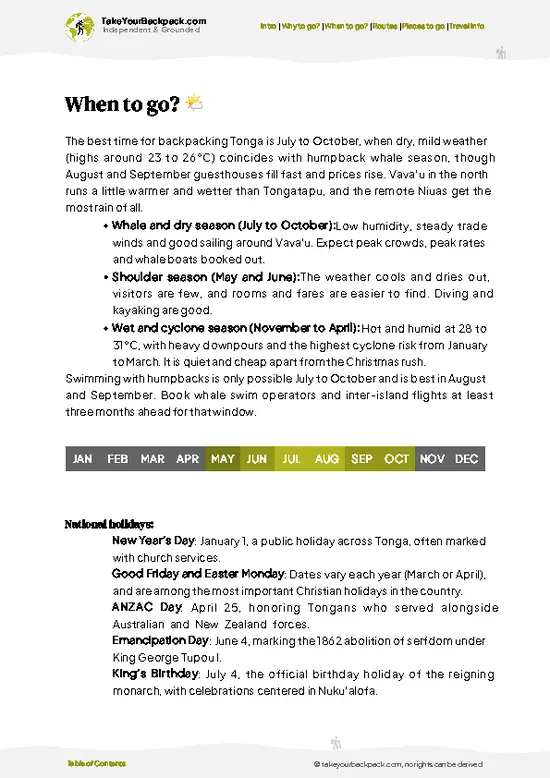
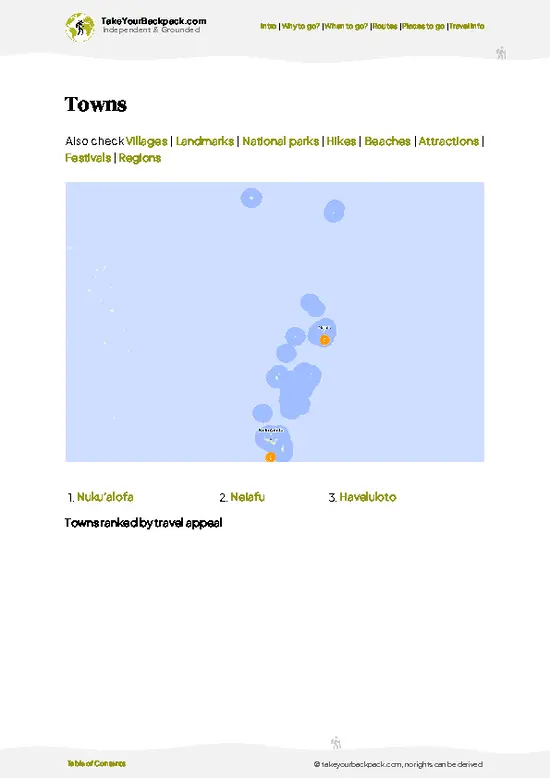
example page 2 from our offline Travel Guide for Tonga
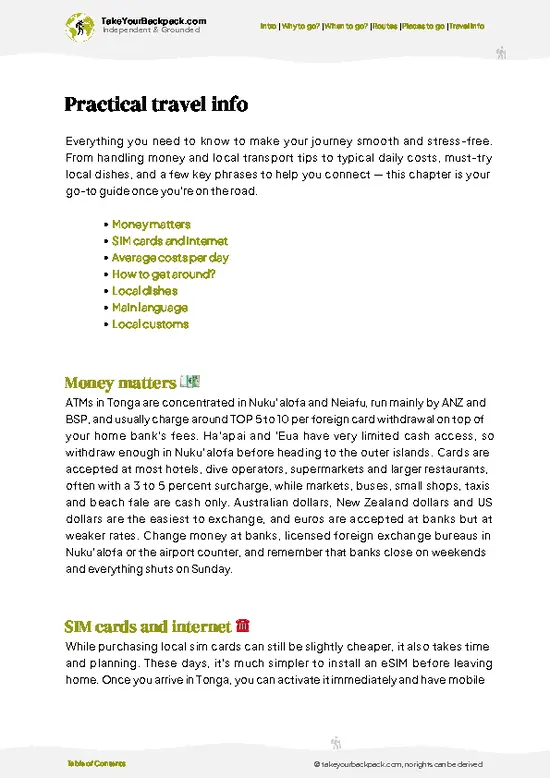
example page 3 from our offline Travel Guide for Tonga
example page 4 from our offline Travel Guide for Tonga
example page 5 from our offline Travel Guide for Tonga
example page 6 from our offline Travel Guide for Tonga
example page 7 from our offline Travel Guide for Tonga
Loading the map 🌍
CLICK TO FILTER
towns
villages
landmarks
national parks
hikes
beaches
attractions
festivals
regions
SHOW COUNTRY’S BESTSHOW ALL

✨ Why go?
Ranked #7 region in Tonga
Why Tafahi Island should be on your travel list

Tafahi gives you a rare combination: a volcanic cone rising almost straight from the sea and a community small enough that you will meet most of it. Nothing here is staged for visitors, so a conversation over a bowl of kava or a plate of home-cooked taro is the real attraction, and it comes without a ticket.

The island also makes sense as part of a slow northern loop. The crossing from Niuatoputapu is a short open-boat ride, so one base covers both islands and you only relocate by water, which suits travelers who like their transport informal and weather-dependent.

Tafahi is also famous across Tonga for its kava, grown on the volcano’s fertile slopes and prized well beyond the Niuas. Walking through the plots that produce it explains why the island punches well above its size in local conversation. … read more 👉
Tafahi gives you a rare combination: a volcanic cone rising almost straight from the sea and a community small enough that you will meet most of it. Nothing here is staged for visitors, so a conversation over a bowl of kava or a plate of home-cooked taro is the real attraction, and it comes without a ticket.

The island also makes sense as part of a slow northern loop. The crossing from Niuatoputapu is a short open-boat ride, so one base covers both islands and you only relocate by water, which suits travelers who like their transport informal and weather-dependent.

Tafahi is also famous across Tonga for its kava, grown on the volcano’s fertile slopes and prized well beyond the Niuas. Walking through the plots that produce it explains why the island punches well above its size in local conversation. For a mix of hiking, farming culture and ocean views, few places in Tonga are this concentrated.

💡 HighlightsTop highlights of Tafahi Island

  1. Tafahi volcano summit: the signature climb, steep and slippery through forest to open grass. The top gives a sweeping view over the Niua group and the open Pacific.
  2. Tafahi village: the island’s small settlement, where you can meet families, see how daily life runs without shops or traffic and be offered food. Bring something to share.
  3. Kava plantations on the lower slopes: lesser known to visitors, but this is why the island has a name in Tonga. Ask permission and a farmer may show you how the roots are grown and dried.
  4. The boat landing: the crossing and the surf landing from Niuatoputapu are an experience in themselves, with the cone growing larger the closer you get.
  5. Black volcanic shoreline: rough rocks, tide pools and coconut groves around the coast, quiet enough that you may have it to yourself.
… read more 👉
  1. Tafahi volcano summit: the signature climb, steep and slippery through forest to open grass. The top gives a sweeping view over the Niua group and the open Pacific.
  2. Tafahi village: the island’s small settlement, where you can meet families, see how daily life runs without shops or traffic and be offered food. Bring something to share.
  3. Kava plantations on the lower slopes: lesser known to visitors, but this is why the island has a name in Tonga. Ask permission and a farmer may show you how the roots are grown and dried.
  4. The boat landing: the crossing and the surf landing from Niuatoputapu are an experience in themselves, with the cone growing larger the closer you get.
  5. Black volcanic shoreline: rough rocks, tide pools and coconut groves around the coast, quiet enough that you may have it to yourself.
  6. Coconut and copra groves: little visited, these groves behind the village show the island’s traditional livelihood, with husking and drying done by hand.
  7. Sunrise or sunset from the shore: with no lights beyond the village, the sky fills with stars after dark.
A fit hiker can see all of it in one long day, though an overnight stay with a host family gives you the sunset and the village at its quietest.
Spotted a mistake or missing something? Contact us.

⌛️ 5 days5-day itinerary for Tafahi Island

Day 1: Niuatoputapu: Arrive on the island that holds the airstrip and the only real services in the Niuas. Everything northern runs through here, and the boats to Tafahi depend on weather and local arrangement, so you spend the first day settling in, meeting your host and asking about the sea conditions. Walk the coast to stretch your legs.

Day 2: Tafahi Island: Take the earliest calm-water crossing. Land, greet the village and start the climb while the air is cool, since the forest trail steepens fast and gets slick after rain. Reach the summit by midday for the clearest view over the group. Descend slowly, because loose footing is harder going down than up.

Day 3: Tafahi Island: Stay a night if the host family agrees. This day is slow on purpose. Visit the kava plots, help with husking if … read more 👉
Day 1: Niuatoputapu: Arrive on the island that holds the airstrip and the only real services in the Niuas. Everything northern runs through here, and the boats to Tafahi depend on weather and local arrangement, so you spend the first day settling in, meeting your host and asking about the sea conditions. Walk the coast to stretch your legs.

Day 2: Tafahi Island: Take the earliest calm-water crossing. Land, greet the village and start the climb while the air is cool, since the forest trail steepens fast and gets slick after rain. Reach the summit by midday for the clearest view over the group. Descend slowly, because loose footing is harder going down than up.

Day 3: Tafahi Island: Stay a night if the host family agrees. This day is slow on purpose. Visit the kava plots, help with husking if invited and swim off the rocks. If the sea turns rough the extra day also protects your return crossing.

Day 4: Niuatoputapu: Return by boat and use the flexible day for the detour: walk or ride to the quiet villages on the far side of Niuatoputapu, where the coastline is calm and visitors are rare. It adds depth without needing another boat.

Day 5: Niuatoputapu: Keep this day open for your onward flight, since schedules here shift. If you do get a free morning, rest and eat with your host.

The one day that justifies the whole trip is Day 2, when you stand on the summit above the sea.

🌤️ When to go?Best time to visit Tafahi Island

May to October is the best window for Tafahi, with drier air and calmer seas for the boat crossing from Niuatoputapu.
  • Dry Season (May to October): Highs sit around 26 to 29°C (79 to 84°F), nights drop to 20 to 22°C (68 to 72°F), and showers are short. Sunrise comes near 7:00 am and sunset near 6:10 pm. Trails up the volcano cone are firmest now.
  • Wet Season (November to April): Expect 28 to 32°C (82 to 90°F), heavy humidity and downpours that turn the climb to mud. Cyclones can hit between January and March, and flights and boats get canceled. Days run longer, with sunset near 7:05 pm.
  • Whale Season (July to October): Humpbacks pass the waters between the island and Niuatoputapu. Prices on the island barely move, since visitors are rare all year, but transport seats fill earlier.
Book transport … read more 👉
May to October is the best window for Tafahi, with drier air and calmer seas for the boat crossing from Niuatoputapu.
  • Dry Season (May to October): Highs sit around 26 to 29°C (79 to 84°F), nights drop to 20 to 22°C (68 to 72°F), and showers are short. Sunrise comes near 7:00 am and sunset near 6:10 pm. Trails up the volcano cone are firmest now.
  • Wet Season (November to April): Expect 28 to 32°C (82 to 90°F), heavy humidity and downpours that turn the climb to mud. Cyclones can hit between January and March, and flights and boats get canceled. Days run longer, with sunset near 7:05 pm.
  • Whale Season (July to October): Humpbacks pass the waters between the island and Niuatoputapu. Prices on the island barely move, since visitors are rare all year, but transport seats fill earlier.
Book transport a few weeks ahead and leave a spare day or two, since weather decides departures.


source: climatestotravel.comJANJanuary: below average for travelingFEBFebruary: below average for travelingMARMarch: below average for travelingAPRApril: fair for travelingMAYMay: excellent for travelingJUNJune: excellent for travelingJULJuly: excellent for travelingAUGAugust: excellent for travelingSEPSeptember: excellent for travelingOCTOctober: excellent for travelingNOVNovember: fair for travelingDECDecember: fair for traveling
when-to-go

✈️ The backpacker research shortcutTonga Travel Guide

An offline-friendly backpacking guide with optimized travel routes, ranked highlights, transport advice, and the best areas to stay.
example page 0 from our offline Travel Guide for Tonga
example page 1 from our offline Travel Guide for Tonga
example page 2 from our offline Travel Guide for Tonga
example page 3 from our offline Travel Guide for Tonga
example page 4 from our offline Travel Guide for Tonga
example page 5 from our offline Travel Guide for Tonga
example page 6 from our offline Travel Guide for Tonga
example page 7 from our offline Travel Guide for Tonga
The digital guide (128 pages) contains:
✅ 31 highlights, ranked by travel appeal
✅ Optimized 2, 3 & 5-day travel routes
✅ Cities, national parks, landmarks, beaches
✅ How to get around
✅ Offline-friendly for travel without Wi-Fi
👉 Click to see all 30+ guide features

📅 Plan smarter in minutes, not weeks
✅ Month by month travel advice
✅ Festivals & national holidays
✅ Budget expectations

🗺️ Go to the right places, skip the overrated ones
✅ Honest pros & cons of destinations
✅ Top hikes, parks & viewpoints
✅ Lesser-known places most travelers miss
✅ Clear “worth it vs skip it” guidance

🛏️ Travel smoothly without rookie mistakes
✅ Best areas to stay
✅ Transport systems explained simply
✅ Common scams & safety advice
✅ SIM cards, money & practical tips

🌍 Understand the country, not just visit it
✅ Culture & traditions
✅ 52 Essential phrases & customs
✅ Festivals worth planning around
✅ Traveler-friendly historical context
✅ Insights that make places more meaningful

📱 Built for real travel conditions
✅ Fully downloadable PDF
✅ Works completely offline
✅ Optimized for phone use
✅ Useful in remote areas & buses
✅ Everything in one place
Stop searching, start planning
Get instant access to your full guide. 30‑day money-back guarantee.
+ Add another guide for just

By proceeding you agree to our terms.
Sent to your inbox immediately after payment • 100% Secure Checkout
Best Backpacking Travel Advisor 2025 tourism awardBest Backpacking
Travel Advisor
2025
What others say about Take Your Backpack Guides:
⭐⭐⭐⭐⭐
Fantastic, amazing amount of information!
⭐⭐⭐⭐⭐
My goodness this is amazing, it's what I've been looking for hats off too you!
⭐⭐⭐⭐⭐
I think this is absolutely BRILLIANT
⭐⭐⭐⭐
Very complete and informative. It's still missing places, but I gotta to commend you
⭐⭐⭐⭐⭐
This is truly amazing, thank you, can't wait to explore it with my kids!
⭐⭐⭐⭐⭐
Awesome resource, thank you!
⭐⭐⭐⭐⭐
This is amazing! Can't wait to explore the ones I haven't seen
⭐⭐⭐⭐
I love this! Well done, great idea.
⭐⭐⭐⭐⭐
Thanks for taking the time to make this gem!
⭐⭐⭐⭐⭐
This might be the best website I've ever seen.
⭐⭐⭐⭐⭐
Congratulations, and thank you so much for your work; it's incredibly valuable.
⭐⭐⭐⭐
In all seriousness I think you did a great job pointing out the important spots
⭐⭐⭐⭐⭐
10/10 very good
⭐⭐⭐⭐⭐
As someone who's only just starting to visit regularly this is awesome, thank you.
⭐⭐⭐⭐
Thank you very much! I'm going to visit my dad, it's going to be very useful!
⭐⭐⭐⭐⭐
This is really cool! We'll be travelling for the first time and this definitely come in handy.
⭐⭐⭐⭐⭐
You are now our minister of culture, congratulations 👨‍💼
⭐⭐⭐⭐⭐
Just wanted to tell you that this is a pearl! Going to follow your recommendations.
⭐⭐⭐⭐⭐
This is so cool. I'll definitely be using the resource for my travels soon.
⭐⭐⭐⭐⭐
This is very impressive! Good work.
⭐⭐⭐⭐⭐
This is an amazing and informative site. Very well done!

🛏️ Where to stay?Where staying makes the most sense

Stay in Tafahi village itself, because it is the only settlement on the island, with only 14 residents at the 2021 census. A homestay with a village family is the only option, usually US$25 to 50 a night, often with meals included. Nobody plans a dorm scene here. Socializing happens at the family table, over kava in the evening, or when your host walks you to the plantations.

The village is quiet and safe, with children, chickens and the low hum of generators after dark. Many travelers instead base on Niuatoputapu, the larger neighboring island, where Hihifo has more guesthouses, a few small … read more 👉
Stay in Tafahi village itself, because it is the only settlement on the island, with only 14 residents at the 2021 census. A homestay with a village family is the only option, usually US$25 to 50 a night, often with meals included. Nobody plans a dorm scene here. Socializing happens at the family table, over kava in the evening, or when your host walks you to the plantations.

The village is quiet and safe, with children, chickens and the low hum of generators after dark. Many travelers instead base on Niuatoputapu, the larger neighboring island, where Hihifo has more guesthouses, a few small shops and easier access to the airstrip. That gives you a better chance of meeting other travelers, and you can cross to Tafahi as a day trip when the sea allows. Sleeping on Tafahi pays off if you want the volcano at dawn and the silence at night.

🚌 Getting aroundGetting around like a local

Tafahi has no bus or train station, so you arrive at the small reef opening on the island's northwest side and climb a steep staircase up to the village. Nobody runs a timetable here. Most backpackers reach Tafahi by small boat from Niuatoputapu and then cover the island on foot, which is dependable only when the sea behaves.
  • Boat from Niuatoputapu: Locals run small open boats across the roughly 9 km channel, taking 15 to 30 minutes and costing about T$50 to 100 (US$20 to 40) per trip, often shared. You get soaked by spray, and then the green cone rises right over you.
  • Walking: The island is about 3 km across, and its dirt paths link the village, plantations and the volcano trail. Expect warm soil, the smell of cut copra and pigs rustling in the undergrowth. The summit climb takes 2 to 3 hours
… read more 👉
Tafahi has no bus or train station, so you arrive at the small reef opening on the island's northwest side and climb a steep staircase up to the village. Nobody runs a timetable here. Most backpackers reach Tafahi by small boat from Niuatoputapu and then cover the island on foot, which is dependable only when the sea behaves.
  • Boat from Niuatoputapu: Locals run small open boats across the roughly 9 km channel, taking 15 to 30 minutes and costing about T$50 to 100 (US$20 to 40) per trip, often shared. You get soaked by spray, and then the green cone rises right over you.
  • Walking: The island is about 3 km across, and its dirt paths link the village, plantations and the volcano trail. Expect warm soil, the smell of cut copra and pigs rustling in the undergrowth. The summit climb takes 2 to 3 hours return and ends with a view over the whole channel and Niuatoputapu.
  • Flight to Niuatoputapu: Reaching the area at all usually means a Real Tonga flight from Tongatapu, around T$400 to 900 (US$170 to 380) one way, with irregular schedules. You land on a short strip with the cone of Tafahi on the horizon.
  • Hitching or local trucks on Niuatoputapu: Rides to the wharf cost little, often T$5 to 10 (US$2 to 4) or nothing, and a bumpy ride in a truck bed gives you the chance to chat with villagers.
Arrange your boat the day before through your host on Niuatoputapu, and ask the crew to confirm the return time, because a rising swell can strand you for a night.

🍲 FoodLocal Flavors for Backpackers

Food on Tafahi is whatever the island grows and the sea gives, so expect taro, cassava and breadfruit beside fresh reef fish. Tafahi is known for its good taro and root crops, and meals often arrive as lu, with corned beef or fish baked in taro leaves and coconut cream, steaming from an underground umu oven. Smoky, salty and soft, it's a Sunday staple.

There are no restaurants. You eat with your host family, usually included in the room price, or from the small village store, which has noodles, crackers and canned fish. Bring snacks from Niuatoputapu. Drink coconut water cut straight from the tree, sweet and faintly grassy, and expect evening kava, earthy and numbing on the tongue.

Wait for grace and for elders to start before you eat. Sunday is for church and rest, so little is cooked for … read more 👉
Food on Tafahi is whatever the island grows and the sea gives, so expect taro, cassava and breadfruit beside fresh reef fish. Tafahi is known for its good taro and root crops, and meals often arrive as lu, with corned beef or fish baked in taro leaves and coconut cream, steaming from an underground umu oven. Smoky, salty and soft, it's a Sunday staple.

There are no restaurants. You eat with your host family, usually included in the room price, or from the small village store, which has noodles, crackers and canned fish. Bring snacks from Niuatoputapu. Drink coconut water cut straight from the tree, sweet and faintly grassy, and expect evening kava, earthy and numbing on the tongue.

Wait for grace and for elders to start before you eat. Sunday is for church and rest, so little is cooked for sale. Accept seconds, since refusing everything can seem rude.

FAQCommon questions from travelers

Plan 2 to 3 days on Tafahi if you want to climb the volcano and still absorb village life. The summit hike takes 2 to 3 hours return, and a boat crossing from Niuatoputapu takes 15 to 30 minutes. Add a spare day for bad weather, since rough seas can delay your return.
Walking is the only way to get around, because the island is about 3 km across and has no public transport. The sandy tracks link the landing, the village and the volcano trail, and you can cover most of them in a morning. To reach the island, take a shared local boat from Niuatoputapu, costing roughly T$50 to 100 (US$20 to 40).
Tafahi is known for its near-perfect volcanic cone rising about 546 m straight from the sea, and for its rich soil, which produces some of Tonga's best taro and root crops. Fewer than 100 people live here, in a single village. Visitors come for the steep summit hike, quiet homestays and humpback whales passing between July and October.
⚠️ Things can change over time, so always validate details locally before you go.

Other Tongan regions near Tafahi Island

Explore more nearby:

  • Niuatoputapu—Far-north lagoon, Falehau wharf, plantation walks| 12 km away
  • Vava’u—Neiafu harbor, sea caves, sheltered channels, whale swimming| 312 km away
  • Ha’apai—Whale swims, Lifuka-Foa cycling, Uoleva beach fales, Tofua crater| 438 km away

💡 Not sure where to go next?
Create a personalized itinerary for Tonga including Tafahi Island and the places that fit your trip.

Generate my itinerary

👉 Discover all regions

Or checkout all Tonga has to offer (think cities, towns, villages, national parks, hikes, beaches, festivals)
Country photo of Tonga

We 💚 feedbackSumming up the experience

Give Tafahi two days if the sea allows, one for the climb and one to sit with the village. A day trip works, but the crossing eats your margin. Bring small gifts of food or kava for your hosts, and pack for rain on the trail.

✍️ Help improve this page!
The information on this page is based on in-depth research, insights shared by experienced travelers, and feedback from the local travel community in Tonga. While every effort is made to keep the information accurate and current, conditions can change — so if you spot anything incorrect or outdated, please get in touch.


🙋‍♂️ Give feedback

👋 Meet the founderWho’s Behind Take Your Backpack?

Johan, backpacker and founder of TakeYourBackpackHi, I’m Johan (Netherlands 🇳🇱), the creator of TakeYourBackpack. Over the past 3 decades, I’ve backpacked through 90+ countries across six continents, gaining extensive experience with independent travel, long-term trips, and overland routes.

This site is built on a combination of firsthand travel experience and carefully curated insights from other backpackers. Many guides are based on places I’ve personally visited, while others bring together tips, observations, and practical advice shared by trusted travelers I’ve met along the way.

The goal is to provide realistic, experience-driven guidance — not generic itineraries — so you can explore destinations with better context, clearer expectations, and more confidence.