×

Tonga🇹🇴 | regionsTongatapu IslandCoral blowholes, stone trilithon, royal langi tombs, Talamahu market | things to do and best time to go

Explore Vava’uExplore Pangaimotu Island

Backpacking in Tongatapu Island
🏆 Top pickregion ranked #2
By Johan Kruseman 🇳🇱 | Updated October 15, 2026

Most travelers decide whether to stay on Tongatapu or use it only as a hop to Ha’apai and Vava’u, and the pull of the outer islands usually wins. Give the main island at least three nights anyway. It lies in the south of Tonga, and Nuku’alofa sits on its north shore. Land is flat coral limestone, so you get blowholes, sea cliffs, ancient stone monuments and roadside stalls of watermelon and taro instead of mountains. Mornings smell of woodsmoke and frying doughnuts, Sunday is silent apart from hymns drifting from churches, and the midday sun is hard on bare shoulders. Beaches are thin and many shores are rocky, so swimming plans need adjusting: experienced travelers skip the town waterfront and head to resort-island reef pockets or the sheltered south shore at high tide, because low tide leaves shallow mud and coral. Buses are cheap but thin out by afternoon, so rent a bike or share a taxi for the east and south. Sunday shuts nearly everything, so shop on Saturday.

Discover everything you want to know in the 📖 Tonga Travel Guide.


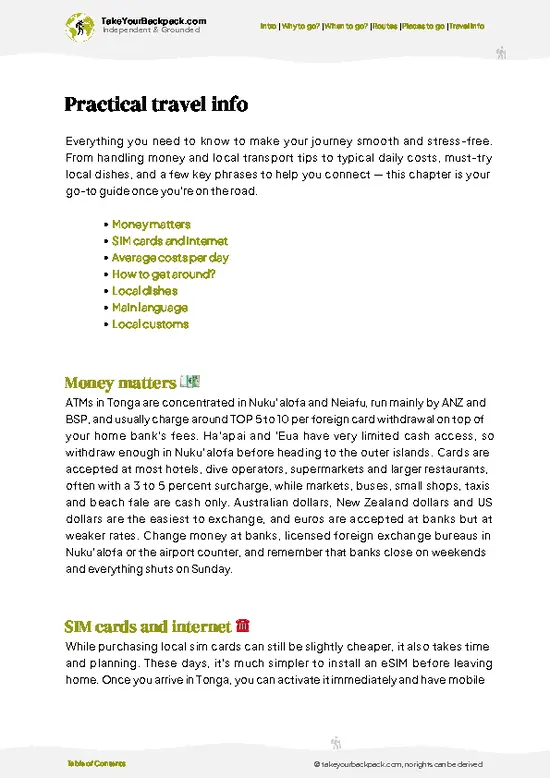
example page 0 from our offline Travel Guide for Tonga
example page 1 from our offline Travel Guide for Tonga
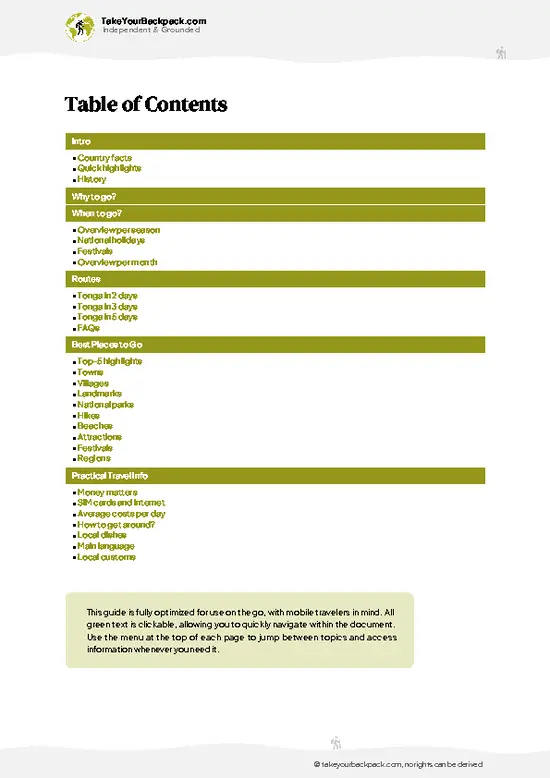
example page 2 from our offline Travel Guide for Tonga
example page 3 from our offline Travel Guide for Tonga
example page 4 from our offline Travel Guide for Tonga
example page 5 from our offline Travel Guide for Tonga
example page 6 from our offline Travel Guide for Tonga
example page 7 from our offline Travel Guide for Tonga
Loading the map 🌍
CLICK TO FILTER
towns
villages
landmarks
national parks
hikes
beaches
attractions
festivals
regions
SHOW COUNTRY’S BESTSHOW ALL

✨ Why go?
Ranked #2 region in Tonga
What makes this region worth visiting

Tongatapu gives you a whole island's worth of variety from one base, which is why backpackers stay longer than they planned. A coastal road loop around the south shore links the Mapu’a ‘a Vaea blowholes, where surf shoots up through coral shelves along several kilometers of coast, with the sea caves and swimming holes of the east and west. You can see most of it in day trips, so you unpack once and never haul a pack across an ocean.

Transport is simple and flexible. Local buses run out from Nuku’alofa's market terminal, shared taxis fill gaps, and renting a bike or scooter suits the flat terrain. Distances are short, so you can chase the weather: snorkel on a calm morning, swap to the villages on a showery one.

Culture and nature sit side by side. The Ha’amonga ‘a Maui trilithon, a 13th-century … read more 👉
Tongatapu gives you a whole island's worth of variety from one base, which is why backpackers stay longer than they planned. A coastal road loop around the south shore links the Mapu’a ‘a Vaea blowholes, where surf shoots up through coral shelves along several kilometers of coast, with the sea caves and swimming holes of the east and west. You can see most of it in day trips, so you unpack once and never haul a pack across an ocean.

Transport is simple and flexible. Local buses run out from Nuku’alofa's market terminal, shared taxis fill gaps, and renting a bike or scooter suits the flat terrain. Distances are short, so you can chase the weather: snorkel on a calm morning, swap to the villages on a showery one.

Culture and nature sit side by side. The Ha’amonga ‘a Maui trilithon, a 13th-century coral limestone gateway, stands in bush a short ride from fishing villages, and Sunday church singing carries across the lagoon-side settlements. The island's pace is slow by design (shops close on Sunday), so you fall into it quickly, and the Ha’atafu reef on the northwest coast makes an easy place to float away an afternoon.

💡 HighlightsKey sights and experiences for travelers

  1. Mapu’a ʻa Vaea Blowholes: Seawater is forced through holes in the coral cliff along the south coast and shoots skyward, loudest on a rising tide with a southeast swell. Free to visit, give it an hour.
  2. Ha’amonga ʻa Maui Trilithon: A 5-meter-tall stone gateway of three coral limestone slabs near Niutoua in the northeast. Its purpose is debated, though many think it tracked the solstices.
  3. Lapaha Royal Tombs: Stepped, stone-faced burial mounds (langi) of old Tuʻi Tonga rulers, set in quiet grass near Mu’a village.
  4. Talamahu Market: Nuku’alofa’s main market, with stacked taro, yams, vanilla beans, coconut oil and woven pandanus mats. Go early, before noon heat.
  5. Royal Palace: A white timber Victorian-style building with red roofing on the waterfront, photographed from the fence since the interior is
… read more 👉
  1. Mapu’a ʻa Vaea Blowholes: Seawater is forced through holes in the coral cliff along the south coast and shoots skyward, loudest on a rising tide with a southeast swell. Free to visit, give it an hour.
  2. Ha’amonga ʻa Maui Trilithon: A 5-meter-tall stone gateway of three coral limestone slabs near Niutoua in the northeast. Its purpose is debated, though many think it tracked the solstices.
  3. Lapaha Royal Tombs: Stepped, stone-faced burial mounds (langi) of old Tuʻi Tonga rulers, set in quiet grass near Mu’a village.
  4. Talamahu Market: Nuku’alofa’s main market, with stacked taro, yams, vanilla beans, coconut oil and woven pandanus mats. Go early, before noon heat.
  5. Royal Palace: A white timber Victorian-style building with red roofing on the waterfront, photographed from the fence since the interior is closed. A ten-minute stop.
  6. Hufangalupe Natural Bridge: A collapsed sea cave left a stone arch over churning surf on the southeast coast, reached by a short walk. Dramatic at high tide.
  7. Oholei Beach and Hina Cave: A Tongan cultural evening is held here on Friday nights, with a feast and dances, and the cave sits beside the beach on the east side of the island.
  8. Abel Tasman Landing Site at Ha’atafu: A small marker at the old landing site recalling the Dutch explorer’s 1643 visit. Unflashy, but it ties into the surrounding heritage sites.
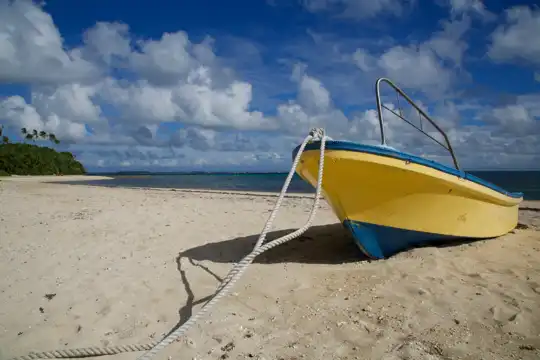
  9. Fua’amotu Beach and Coast Lanes: A quiet shoreline with local fishing boats and few visitors, good for a bike ride past plantations.
  10. Atata Island Reef: A small island off the north coast with calm water and snorkeling over healthy coral, reached by boat from Nuku’alofa.
The item most visitors miss is the Abel Tasman marker at Ha’atafu, on the northwest coast.
Spotted a mistake or missing something? Contact us.

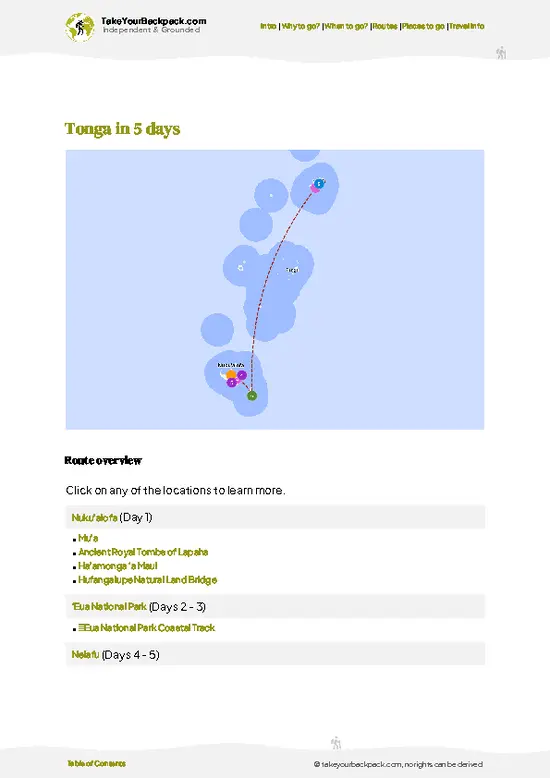
⌛️ 5 daysWhat you can realistically do in a week

Day 1: Nuku’alofa: Spend the first day on foot. The waterfront, Royal Palace and Talamahu Market are within a short walk of each other, and the flat grid makes a bicycle unnecessary. Buses run from the central terminal and thin out after midday, so plan day trips for the morning and save errands for later.
Day 2: Mu’a and Niutoua: Head east in the morning. Start with the Lapaha tombs at Mu’a, then continue to the Ha’amonga ʻa Maui trilithon. Public buses are slow and infrequent on this route, so a shared taxi or hired driver for the day saves hours, and the roads are quiet enough for a rented bike if you start early.
Day 3: South Coast: Go to the Mapu’a ʻa Vaea blowholes and Hufangalupe. Time it for rising tide, when the blowholes fire hardest and the arch is loudest. Carry water, since there … read more 👉
Day 1: Nuku’alofa: Spend the first day on foot. The waterfront, Royal Palace and Talamahu Market are within a short walk of each other, and the flat grid makes a bicycle unnecessary. Buses run from the central terminal and thin out after midday, so plan day trips for the morning and save errands for later.
Day 2: Mu’a and Niutoua: Head east in the morning. Start with the Lapaha tombs at Mu’a, then continue to the Ha’amonga ʻa Maui trilithon. Public buses are slow and infrequent on this route, so a shared taxi or hired driver for the day saves hours, and the roads are quiet enough for a rented bike if you start early.
Day 3: South Coast: Go to the Mapu’a ʻa Vaea blowholes and Hufangalupe. Time it for rising tide, when the blowholes fire hardest and the arch is loudest. Carry water, since there is almost no shade along the cliffs.
Day 4: Detour to Atata Island: Take a boat north for snorkeling and an easy beach day. It adds a swim and a quiet afternoon without moving your bed, since you return to Nuku’alofa by evening. Check sea conditions the day before.
Day 5: Oholei: Spend a slow day loafing on the east side, then end at Oholei Beach for the Friday cultural evening if the calendar matches. If not, visit the beach lanes at Fua’amotu and prepare for onward travel.

If you have only one day to justify the trip, make it Day 3: the blowholes at high tide are loud, wet and unlike anything else in the Pacific I would send you to.

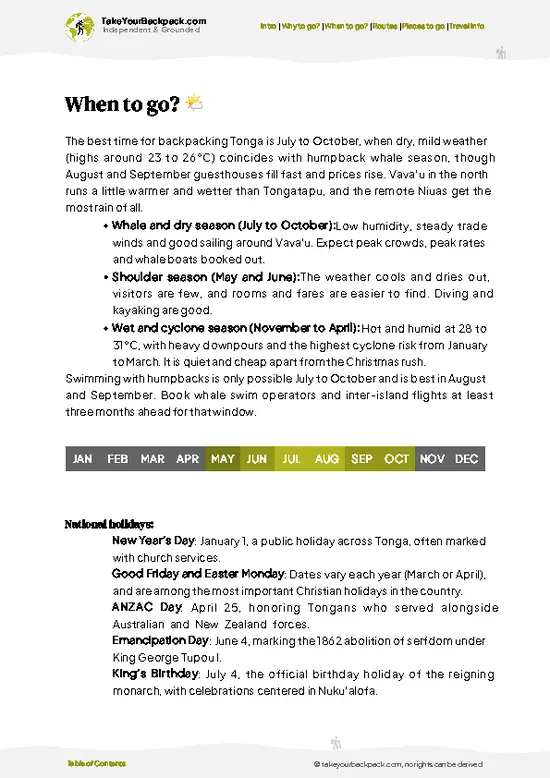
🌤️ When to go?Choosing the right time of year

May to October is the best window for Tongatapu, with dry, breezy days and the lowest rainfall of the year.
  • Dry Season (May to October): Days run 24 to 27°C (75 to 81°F), nights dip to 17 to 20°C (63 to 68°F), and the trade winds keep the air light. Daylight lasts about 11 hours. Humpback whales arrive from July to October, so whale swimming tours book up and prices rise.
  • Wet Season (November to April): Expect 27 to 31°C (81 to 88°F), heavy humidity, and sudden downpours that turn dirt roads to red mud. Daylight stretches to about 13 hours. Cyclones are possible, mostly January to March. Guesthouses are quiet and often discount rooms.
  • Festival Weeks: The Heilala Festival in July fills Nuku’alofa with brass bands, parades, and sports, and beds get scarce.
Book whale swims and July lodging at least … read more 👉
May to October is the best window for Tongatapu, with dry, breezy days and the lowest rainfall of the year.
  • Dry Season (May to October): Days run 24 to 27°C (75 to 81°F), nights dip to 17 to 20°C (63 to 68°F), and the trade winds keep the air light. Daylight lasts about 11 hours. Humpback whales arrive from July to October, so whale swimming tours book up and prices rise.
  • Wet Season (November to April): Expect 27 to 31°C (81 to 88°F), heavy humidity, and sudden downpours that turn dirt roads to red mud. Daylight stretches to about 13 hours. Cyclones are possible, mostly January to March. Guesthouses are quiet and often discount rooms.
  • Festival Weeks: The Heilala Festival in July fills Nuku’alofa with brass bands, parades, and sports, and beds get scarce.
Book whale swims and July lodging at least a month ahead, or visit in May or November for emptier beaches and softer prices.


source: climatestotravel.comJANJanuary: below average for travelingFEBFebruary: below average for travelingMARMarch: below average for travelingAPRApril: good for travelingMAYMay: excellent for travelingJUNJune: excellent for travelingJULJuly: excellent for travelingAUGAugust: excellent for travelingSEPSeptember: excellent for travelingOCTOctober: excellent for travelingNOVNovember: fair for travelingDECDecember: fair for traveling
when-to-go

✈️ The backpacker research shortcutTonga Travel Guide

An offline-friendly backpacking guide with optimized travel routes, ranked highlights, transport advice, and the best areas to stay.
example page 0 from our offline Travel Guide for Tonga
example page 1 from our offline Travel Guide for Tonga
example page 2 from our offline Travel Guide for Tonga
example page 3 from our offline Travel Guide for Tonga
example page 4 from our offline Travel Guide for Tonga
example page 5 from our offline Travel Guide for Tonga
example page 6 from our offline Travel Guide for Tonga
example page 7 from our offline Travel Guide for Tonga
The digital guide (128 pages) contains:
✅ 31 highlights, ranked by travel appeal
✅ Optimized 2, 3 & 5-day travel routes
✅ Cities, national parks, landmarks, beaches
✅ How to get around
✅ Offline-friendly for travel without Wi-Fi
👉 Click to see all 30+ guide features

📅 Plan smarter in minutes, not weeks
✅ Month by month travel advice
✅ Festivals & national holidays
✅ Budget expectations

🗺️ Go to the right places, skip the overrated ones
✅ Honest pros & cons of destinations
✅ Top hikes, parks & viewpoints
✅ Lesser-known places most travelers miss
✅ Clear “worth it vs skip it” guidance

🛏️ Travel smoothly without rookie mistakes
✅ Best areas to stay
✅ Transport systems explained simply
✅ Common scams & safety advice
✅ SIM cards, money & practical tips

🌍 Understand the country, not just visit it
✅ Culture & traditions
✅ 52 Essential phrases & customs
✅ Festivals worth planning around
✅ Traveler-friendly historical context
✅ Insights that make places more meaningful

📱 Built for real travel conditions
✅ Fully downloadable PDF
✅ Works completely offline
✅ Optimized for phone use
✅ Useful in remote areas & buses
✅ Everything in one place
Stop searching, start planning
Get instant access to your full guide. 30‑day money-back guarantee.
+ Add another guide for just

By proceeding you agree to our terms.
Sent to your inbox immediately after payment • 100% Secure Checkout
Best Backpacking Travel Advisor 2025 tourism awardBest Backpacking
Travel Advisor
2025
What others say about Take Your Backpack Guides:
⭐⭐⭐⭐⭐
Fantastic, amazing amount of information!
⭐⭐⭐⭐⭐
My goodness this is amazing, it's what I've been looking for hats off too you!
⭐⭐⭐⭐⭐
I think this is absolutely BRILLIANT
⭐⭐⭐⭐
Very complete and informative. It's still missing places, but I gotta to commend you
⭐⭐⭐⭐⭐
This is truly amazing, thank you, can't wait to explore it with my kids!
⭐⭐⭐⭐⭐
Awesome resource, thank you!
⭐⭐⭐⭐⭐
This is amazing! Can't wait to explore the ones I haven't seen
⭐⭐⭐⭐
I love this! Well done, great idea.
⭐⭐⭐⭐⭐
Thanks for taking the time to make this gem!
⭐⭐⭐⭐⭐
This might be the best website I've ever seen.
⭐⭐⭐⭐⭐
Congratulations, and thank you so much for your work; it's incredibly valuable.
⭐⭐⭐⭐
In all seriousness I think you did a great job pointing out the important spots
⭐⭐⭐⭐⭐
10/10 very good
⭐⭐⭐⭐⭐
As someone who's only just starting to visit regularly this is awesome, thank you.
⭐⭐⭐⭐
Thank you very much! I'm going to visit my dad, it's going to be very useful!
⭐⭐⭐⭐⭐
This is really cool! We'll be travelling for the first time and this definitely come in handy.
⭐⭐⭐⭐⭐
You are now our minister of culture, congratulations 👨‍💼
⭐⭐⭐⭐⭐
Just wanted to tell you that this is a pearl! Going to follow your recommendations.
⭐⭐⭐⭐⭐
This is so cool. I'll definitely be using the resource for my travels soon.
⭐⭐⭐⭐⭐
This is very impressive! Good work.
⭐⭐⭐⭐⭐
This is an amazing and informative site. Very well done!

🛏️ Where to stay?Choosing the right base

Nuku’alofa is the best base on Tongatapu, because it holds nearly every budget bed, the bus terminal, the market, and the boat harbor in one flat, walkable area.
Staying here puts you within a short walk of the Talamahu Market, cheap bakeries, bars, and tour agents who run whale swims and island trips. Solo travelers meet others easily at shared guesthouse kitchens and at the waterfront cafés along Vuna Road. Nights are quiet and the town is generally safe, though it is wise to use a taxi after dark on unlit streets and keep valuables out of sight.
The Kolovai and Ha’atafu area on the west coast … read more 👉
Nuku’alofa is the best base on Tongatapu, because it holds nearly every budget bed, the bus terminal, the market, and the boat harbor in one flat, walkable area.
Staying here puts you within a short walk of the Talamahu Market, cheap bakeries, bars, and tour agents who run whale swims and island trips. Solo travelers meet others easily at shared guesthouse kitchens and at the waterfront cafés along Vuna Road. Nights are quiet and the town is generally safe, though it is wise to use a taxi after dark on unlit streets and keep valuables out of sight.
The Kolovai and Ha’atafu area on the west coast suits you if you want surf, calmer beaches, and fruit bat colonies. It is quiet and social in a small way, with a handful of beach stays where you often share dinner with other guests. You will want a rented bike or occasional taxi, since shops are few.
The Hihifo area is also an option for a night or two if you like peace and stars over town lights. Most backpackers stay in Nuku’alofa for the first few nights and then move west for a beach break, using day trips to see the south coast.

🚌 Getting aroundHow to get around Tongatapu Island

From the main bus terminal beside the Talamahu Market in Nuku’alofa, the waterfront and most guesthouses are a flat 5 to 15 minute walk, so you can skip a taxi and enjoy the smell of fried doughnuts and diesel as you go.
Tongatapu is small, about 40 km (25 miles) across at its longest, and nearly everything is reachable by cheap buses or taxis. Reliability is loose. Schedules are more suggestion than timetable, and service fades in the late afternoon and on Sundays.
  • Local buses: Fares are roughly TOP$1 to 3 (US$0.40 to 1.25), with boomy island music and open windows. Buses run on long loops from the terminal because the island has few trunk roads, and drivers work to loose timings. Go in the morning, and ask the driver for the last return before you get off.
  • Taxis: They are everywhere in Nuku’alofa
… read more 👉
From the main bus terminal beside the Talamahu Market in Nuku’alofa, the waterfront and most guesthouses are a flat 5 to 15 minute walk, so you can skip a taxi and enjoy the smell of fried doughnuts and diesel as you go.
Tongatapu is small, about 40 km (25 miles) across at its longest, and nearly everything is reachable by cheap buses or taxis. Reliability is loose. Schedules are more suggestion than timetable, and service fades in the late afternoon and on Sundays.
  • Local buses: Fares are roughly TOP$1 to 3 (US$0.40 to 1.25), with boomy island music and open windows. Buses run on long loops from the terminal because the island has few trunk roads, and drivers work to loose timings. Go in the morning, and ask the driver for the last return before you get off.
  • Taxis: They are everywhere in Nuku’alofa and are the practical choice for the airport (about 25 minutes, roughly TOP$30 to 40, or US$12 to 17). Meters are rare, so agree the price before you climb in. Fares are fixed by habit, and negotiating a half-day tour by taxi (about TOP$100 to 150) beats waiting for buses.
  • Rental car or scooter: Expect roughly US$40 to 70 a day for a car. You need a local driving permit from the police station in Nuku’alofa (a few dollars) plus your home license. Roads are potholed and pigs, chickens and dogs wander across, so drive slowly. Sharing a car among travelers is a smart way to reach the blowholes at Houma and the Mapu’a ‘a Vaea coast.
  • Bicycle: Rentals cost about US$8 to 15 a day. The terrain is flat and the road past the lagoon is warm and salty. Ride early, since the midday sun is heavy and shade is rare.
  • Boats: Small boats and tours leave from the harbor for the nearby islands like Pangaimotu, about 10 to 15 minutes away, and cost roughly TOP$30 to 50 return.
For an efficient day, start before 9 a.m., take a bus out, and flag a taxi back, because taxis can be found at any village crossroads while the last bus cannot.

🍲 FoodEating & Drinking in Tongatapu Island

Tongan food is built on root crops, coconut, and the sea, and the best meals are shared and slow.
Try ‘ota ika, raw fish cured in lime juice and finished with coconut cream, sharp and cool on a hot afternoon. Lu pulu is corned beef baked in taro leaves with coconut milk, earthy and rich. On Sundays, families cook an ‘umu, an underground oven, and the smoky smell drifts across villages. Sweet pineapple, papaya, and coconut water are sold roadside for a dollar or two.
For cheap meals, head to the Talamahu Market, where women sell fried doughnuts (keke Tonga), cassava, and plates of chicken and taro for about TOP$5 to 12 (US$2 to 5). Small bakeries open early, and casual waterfront cafés serve fish and chips and fresh juice. For a drink, try kava, a muddy, peppery, numbing brew shared in a circle … read more 👉
Tongan food is built on root crops, coconut, and the sea, and the best meals are shared and slow.
Try ‘ota ika, raw fish cured in lime juice and finished with coconut cream, sharp and cool on a hot afternoon. Lu pulu is corned beef baked in taro leaves with coconut milk, earthy and rich. On Sundays, families cook an ‘umu, an underground oven, and the smoky smell drifts across villages. Sweet pineapple, papaya, and coconut water are sold roadside for a dollar or two.
For cheap meals, head to the Talamahu Market, where women sell fried doughnuts (keke Tonga), cassava, and plates of chicken and taro for about TOP$5 to 12 (US$2 to 5). Small bakeries open early, and casual waterfront cafés serve fish and chips and fresh juice. For a drink, try kava, a muddy, peppery, numbing brew shared in a circle at evening kava clubs. Local beer is cold and easy.
On Sundays nearly everything is closed because of church, and shops and many restaurants shut. Buy food on Saturday. If invited into a home, wait to be told to eat, accept what is offered, and expect to leave with a bag of leftovers.

FAQFrequently asked questions about Tongatapu Island

Four to five days is enough to see Tongatapu without rushing. Spend one day in Nuku’alofa around the Royal Palace and Talamahu Market, one on the south coast for the Mapu’a ‘a Vaea blowholes and Hufangalupe arch, one in the northeast for the Ha’amonga ‘a Maui trilithon, and one or two on the beaches or whale swimming from July to October.
Use local buses from the Nuku’alofa terminal, which cost roughly TOP$1 to 3 (US$0.40 to 1.25) and run best before midday. Taxis are easy to find and a half-day island tour runs about TOP$100 to 150, while bicycles rent for about US$8 to 15 a day on the flat roads. Most sights lie within 30 to 45 minutes of town.
Tongatapu is known for being the home of Nuku’alofa, the Royal Palace, and the monarchy that has never been colonized. It also has the Ha’amonga ‘a Maui trilithon from around the 13th century, the Mapu’a ‘a Vaea blowholes that spray along the south coast, and flying fox colonies at Kolovai. From July to October, you can swim with humpback whales offshore, and the Sunday church singing is famous.
⚠️ Things can change over time, so always validate details locally before you go.

Other Tongan regions near Tongatapu Island

Explore more nearby:

  • Pangaimotu Island—Big Mama’s bar, sand-floor beach, barge wreck, casuarina shade| 1 km away
  • Uoleva Island—Beach fale stays, no roads, lantern dinners, humpback season| 163 km away
  • Lifuka—Pangai wharf, Taufa’ahau Road, church choirs, Hihifo reef edge| 170 km away

💡 Not sure where to go next?
Create a personalized itinerary for Tonga including Tongatapu Island and the places that fit your trip.

Generate my itinerary

👉 Discover all regions

Or checkout all Tonga has to offer (think cities, towns, villages, national parks, hikes, beaches, festivals)
Country photo of Tonga

We 💚 feedbackFinal thoughts on visiting Tongatapu Island

Pair Tongatapu with Vava’u or Ha’apai, not instead of them: use it for the history, the ferry connections and a Sunday church service, then push north for whales or empty reef. Plan your arrival so you are not stuck in town over a Sunday, and bring cash, since many rural stops take nothing else.

✍️ Help improve this page!
The information on this page is based on in-depth research, insights shared by experienced travelers, and feedback from the local travel community in Tonga. While every effort is made to keep the information accurate and current, conditions can change — so if you spot anything incorrect or outdated, please get in touch.


🙋‍♂️ Give feedback

👋 Meet the founderWho’s Behind Take Your Backpack?

Johan, backpacker and founder of TakeYourBackpackHi, I’m Johan (Netherlands 🇳🇱), the creator of TakeYourBackpack. Over the past 3 decades, I’ve backpacked through 90+ countries across six continents, gaining extensive experience with independent travel, long-term trips, and overland routes.

This site is built on a combination of firsthand travel experience and carefully curated insights from other backpackers. Many guides are based on places I’ve personally visited, while others bring together tips, observations, and practical advice shared by trusted travelers I’ve met along the way.

The goal is to provide realistic, experience-driven guidance — not generic itineraries — so you can explore destinations with better context, clearer expectations, and more confidence.