
×

Trinidad and Tobago🇹🇹 | national parksCaroni Bird SanctuaryScarlet ibis dusk roost, mangrove channels, tree boas, flat-bottomed boats | things to do and best time to go

Explore Paria BayExplore Tobago Main Ridge Forest Reserve

Backpacking in Caroni Bird Sanctuary
🌟 Highlightnational park ranked #4
By Johan Kruseman 🇳🇱 | Updated October 22, 2026

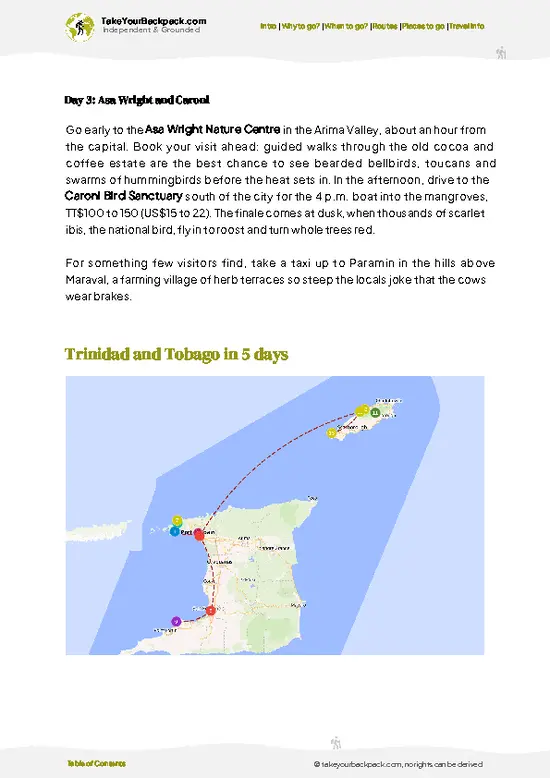
Most first-timers assume the scarlet ibis show is something you watch from the shore, but the only way in is by boat, and the tours run in the late afternoon. Caroni Bird Sanctuary sits in the Caroni Swamp, just south of Port of Spain on the west coast of Trinidad. There are no hiking trails to speak of. You sit in a flat-bottomed boat, duck under mangrove roots, and learn that a tree full of white egrets is merely the opening act. Silky anteaters, tree boas and cayman turn up on the way, and then the ibis arrive at dusk, turning bare green branches a shocking red. Crowds are real, and so are mosquitoes. Compared with the more remote Nariva Swamp on the east coast, Caroni is far easier to reach and far more polished, but you give up solitude for it.

Discover everything you want to know in the 📖 Trinidad and Tobago Travel Guide.


example page 0 from our offline Travel Guide for Trinidad and Tobago
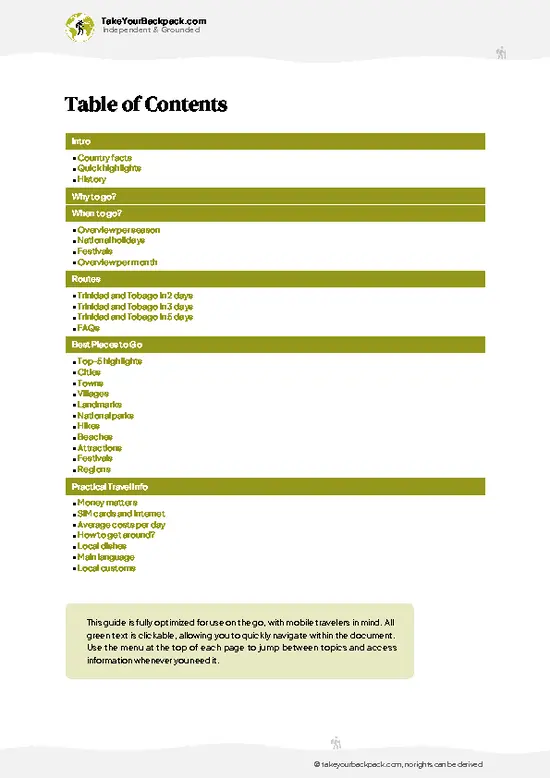
example page 1 from our offline Travel Guide for Trinidad and Tobago
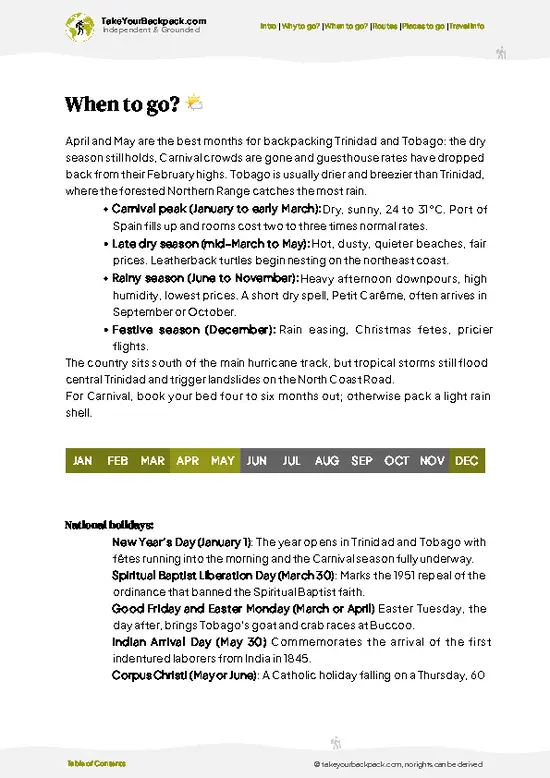
example page 2 from our offline Travel Guide for Trinidad and Tobago
example page 3 from our offline Travel Guide for Trinidad and Tobago
example page 4 from our offline Travel Guide for Trinidad and Tobago
example page 5 from our offline Travel Guide for Trinidad and Tobago
example page 6 from our offline Travel Guide for Trinidad and Tobago
example page 7 from our offline Travel Guide for Trinidad and Tobago
Loading the map 🌍
CLICK TO FILTER
cities
towns
villages
landmarks
national parks
hikes
beaches
attractions
festivals
regions
SHOW COUNTRY’S BESTSHOW ALL

✨ Why go?
Ranked #4 national park in Trinidad and Tobago
The unique appeal for travelers

Caroni Bird Sanctuary is a rare case where the tour is the point, and backpackers choose it because the guided boat is the only practical way to see the scarlet ibis roosting at dusk, Trinidad’s national bird. Independent exploration here means picking your own operator and your own day. Several small boatmen work the swamp, and haggling over a shared boat can leave a lone traveler paying less than a private charter would cost. The sanctuary also suits people without a car, because the departure points sit close to the main highway and a short taxi ride covers the rest. Nothing else on the island puts so much wildlife in one slow, quiet loop through the mangrove channels of the Caroni Swamp. Bring a camera with a decent zoom, and you leave with photographs that look like you hired a professional. … read more 👉
Caroni Bird Sanctuary is a rare case where the tour is the point, and backpackers choose it because the guided boat is the only practical way to see the scarlet ibis roosting at dusk, Trinidad’s national bird. Independent exploration here means picking your own operator and your own day. Several small boatmen work the swamp, and haggling over a shared boat can leave a lone traveler paying less than a private charter would cost. The sanctuary also suits people without a car, because the departure points sit close to the main highway and a short taxi ride covers the rest. Nothing else on the island puts so much wildlife in one slow, quiet loop through the mangrove channels of the Caroni Swamp. Bring a camera with a decent zoom, and you leave with photographs that look like you hired a professional. It is also a good first outing before you head to the island’s rainforest and north coast.

💡 HighlightsKey sights and experiences for travelers

  1. Scarlet ibis roost at dusk: The reason most people come. Hundreds of birds fly in low from their feeding grounds and settle on small mangrove islands, turning the greenery bright red.
  2. Mangrove channels by boat: Narrow waterways wind between red mangrove roots, and the boatman cuts the engine so you can hear the swamp.
  3. Snowy and great egrets: White birds crowd the trees along the route, and they make a striking backdrop before the ibis appear.
  4. Tree boas: Guides know where the boas coil in branches overhead, and they will point them out with a pole.
  5. Silky anteater: A small golden, nocturnal mammal that guides sometimes find curled in a tree during the day.
  6. Caiman and water life: Spectacled caiman lie in the shallows, and oysters cling to the mangrove roots.
  7. Herons and other waders: Tricolored herons,
… read more 👉
  1. Scarlet ibis roost at dusk: The reason most people come. Hundreds of birds fly in low from their feeding grounds and settle on small mangrove islands, turning the greenery bright red.
  2. Mangrove channels by boat: Narrow waterways wind between red mangrove roots, and the boatman cuts the engine so you can hear the swamp.
  3. Snowy and great egrets: White birds crowd the trees along the route, and they make a striking backdrop before the ibis appear.
  4. Tree boas: Guides know where the boas coil in branches overhead, and they will point them out with a pole.
  5. Silky anteater: A small golden, nocturnal mammal that guides sometimes find curled in a tree during the day.
  6. Caiman and water life: Spectacled caiman lie in the shallows, and oysters cling to the mangrove roots.
  7. Herons and other waders: Tricolored herons, little blue herons and other waders feed along the channel edges before dusk.
The boat ride and the dusk ibis return pair naturally in a single afternoon, since the tour is built around both.
Spotted a mistake or missing something? Contact us.

Things to do around Caroni Bird Sanctuary

Ratings based on Tripadvisor reviews. When you book through this link, you support our work at no extra cost to you.

🌤️ When to go?Best time to explore Caroni Bird Sanctuary

  • Dry Season (January to May): Low water and clear skies make this the easiest window, with highs of 31 to 33°C (88 to 91°F) and lows near 22°C (72°F). Daylight runs roughly 11 to 12 hours, so boat tours leave late afternoon and still finish in the light. Scarlet ibis numbers are steady but can shift with feeding patterns.
  • Wet Season (June to December): Afternoon downpours are common, with similar temperatures of 30 to 32°C (86 to 90°F) and heavy humidity. Mosquitoes multiply and some tours get cancelled in storms. Rain is usually short, and birds still return to roost at dusk.
  • Carnival Period (February or March): Crowds and prices in Port of Spain jump, and tour operators book out sooner. Boat departures are not affected, but nearby rooms cost more.
  • Weekdays versus Weekends: Weekday tours are
… read more 👉
  • Dry Season (January to May): Low water and clear skies make this the easiest window, with highs of 31 to 33°C (88 to 91°F) and lows near 22°C (72°F). Daylight runs roughly 11 to 12 hours, so boat tours leave late afternoon and still finish in the light. Scarlet ibis numbers are steady but can shift with feeding patterns.
  • Wet Season (June to December): Afternoon downpours are common, with similar temperatures of 30 to 32°C (86 to 90°F) and heavy humidity. Mosquitoes multiply and some tours get cancelled in storms. Rain is usually short, and birds still return to roost at dusk.
  • Carnival Period (February or March): Crowds and prices in Port of Spain jump, and tour operators book out sooner. Boat departures are not affected, but nearby rooms cost more.
  • Weekdays versus Weekends: Weekday tours are quieter, and tour prices stay the same all year.
Book a tour that leaves about 90 minutes before dusk, because the ibis flights into the mangrove roosts are the whole show.


source: climatestotravel.comJANJanuary: excellent for travelingFEBFebruary: excellent for travelingMARMarch: excellent for travelingAPRApril: highly recommended for travelingMAYMay: highly recommended for travelingJUNJune: fair for travelingJULJuly: fair for travelingAUGAugust: fair for travelingSEPSeptember: fair for travelingOCTOctober: fair for travelingNOVNovember: fair for travelingDECDecember: good for traveling
trinidad-and-tobago-national-park-caroni-bird-sanctuary
© Google | Markanthonyr23

✈️ The backpacker research shortcutTrinidad and Tobago Travel Guide

An offline-friendly backpacking guide with optimized travel routes, ranked highlights, transport advice, and the best areas to stay.
example page 0 from our offline Travel Guide for Trinidad and Tobago
example page 1 from our offline Travel Guide for Trinidad and Tobago
example page 2 from our offline Travel Guide for Trinidad and Tobago
example page 3 from our offline Travel Guide for Trinidad and Tobago
example page 4 from our offline Travel Guide for Trinidad and Tobago
example page 5 from our offline Travel Guide for Trinidad and Tobago
example page 6 from our offline Travel Guide for Trinidad and Tobago
example page 7 from our offline Travel Guide for Trinidad and Tobago
The digital guide (222 pages) contains:
✅ 58 highlights, ranked by travel appeal
✅ Optimized 2, 3 & 5-day travel routes
✅ Cities, national parks, landmarks, beaches
✅ How to get around
✅ Offline-friendly for travel without Wi-Fi
👉 Click to see all 30+ guide features

📅 Plan smarter in minutes, not weeks
✅ Month by month travel advice
✅ Festivals & national holidays
✅ Budget expectations

🗺️ Go to the right places, skip the overrated ones
✅ Honest pros & cons of destinations
✅ Top hikes, parks & viewpoints
✅ Lesser-known places most travelers miss
✅ Clear “worth it vs skip it” guidance

🛏️ Travel smoothly without rookie mistakes
✅ Best areas to stay
✅ Transport systems explained simply
✅ Common scams & safety advice
✅ SIM cards, money & practical tips

🌍 Understand the country, not just visit it
✅ Culture & traditions
✅ Local customs
✅ Festivals worth planning around
✅ Traveler-friendly historical context
✅ Insights that make places more meaningful

📱 Built for real travel conditions
✅ Fully downloadable PDF
✅ Works completely offline
✅ Optimized for phone use
✅ Useful in remote areas & buses
✅ Everything in one place
Stop searching, start planning
Get instant access to your full guide. 30‑day money-back guarantee.
+ Add another guide for just

By proceeding you agree to our terms.
Sent to your inbox immediately after payment • 100% Secure Checkout
Best Backpacking Travel Advisor 2025 tourism awardBest Backpacking
Travel Advisor
2025
What others say about Take Your Backpack Guides:
⭐⭐⭐⭐⭐
Fantastic, amazing amount of information!
⭐⭐⭐⭐⭐
My goodness this is amazing, it's what I've been looking for hats off too you!
⭐⭐⭐⭐⭐
I think this is absolutely BRILLIANT
⭐⭐⭐⭐
Very complete and informative. It's still missing places, but I gotta to commend you
⭐⭐⭐⭐⭐
This is truly amazing, thank you, can't wait to explore it with my kids!
⭐⭐⭐⭐⭐
Awesome resource, thank you!
⭐⭐⭐⭐⭐
This is amazing! Can't wait to explore the ones I haven't seen
⭐⭐⭐⭐
I love this! Well done, great idea.
⭐⭐⭐⭐⭐
Thanks for taking the time to make this gem!
⭐⭐⭐⭐⭐
This might be the best website I've ever seen.
⭐⭐⭐⭐⭐
Congratulations, and thank you so much for your work; it's incredibly valuable.
⭐⭐⭐⭐
In all seriousness I think you did a great job pointing out the important spots
⭐⭐⭐⭐⭐
10/10 very good
⭐⭐⭐⭐⭐
As someone who's only just starting to visit regularly this is awesome, thank you.
⭐⭐⭐⭐
Thank you very much! I'm going to visit my dad, it's going to be very useful!
⭐⭐⭐⭐⭐
This is really cool! We'll be travelling for the first time and this definitely come in handy.
⭐⭐⭐⭐⭐
You are now our minister of culture, congratulations 👨‍💼
⭐⭐⭐⭐⭐
Just wanted to tell you that this is a pearl! Going to follow your recommendations.
⭐⭐⭐⭐⭐
This is so cool. I'll definitely be using the resource for my travels soon.
⭐⭐⭐⭐⭐
This is very impressive! Good work.
⭐⭐⭐⭐⭐
This is an amazing and informative site. Very well done!

🛏️ Where to stay?Choosing the right base

The best base for Caroni Bird Sanctuary is Port of Spain or nearby Chaguanas, because nothing inside the sanctuary offers beds and the roosting boat tours leave from a landing off the Uriah Butler Highway. Port of Spain is about 20 to 30 minutes away by car, depending on traffic, and has the widest range, from guesthouses at US$40 to 70 a night to mid-range hotels at US$90 to 150. St. James and Woodbrook are the practical neighborhoods, with plenty of restaurants and a short taxi ride for late returns. Dorms are rare in Trinidad, so solo backpackers typically rent a private room in a guesthouse … read more 👉
The best base for Caroni Bird Sanctuary is Port of Spain or nearby Chaguanas, because nothing inside the sanctuary offers beds and the roosting boat tours leave from a landing off the Uriah Butler Highway. Port of Spain is about 20 to 30 minutes away by car, depending on traffic, and has the widest range, from guesthouses at US$40 to 70 a night to mid-range hotels at US$90 to 150. St. James and Woodbrook are the practical neighborhoods, with plenty of restaurants and a short taxi ride for late returns. Dorms are rare in Trinidad, so solo backpackers typically rent a private room in a guesthouse or on Airbnb for US$30 to 60.
Chaguanas, a commercial town in central Trinidad, is closer and cheaper, with simple hotels at roughly US$45 to 80, though it has fewer evening options. Some travelers also stay near Piarco Airport, about 30 to 40 minutes by road, if arriving or leaving at odd hours. Because tours finish after dark, choose a place with a driver or taxi arranged ahead rather than relying on public transport.

👛 Costs (as of 22 October 2026)How expensive it really is

A day at Caroni Bird Sanctuary typically costs about US$65 to 130 for a backpacker, driven mostly by the boat tour and transport from Port of Spain.
CategoryBudget RangeLocal Reality
Boat TourUS$15 to 25Roughly two hours at dusk, usually with a guide, and often priced per person with a minimum group.
Accommodation (high season)US$30 to 60Private guesthouse or budget room in Port of Spain or Chaguanas.
Local TransportUS$10 to 25Maxi-taxi to the highway then a short taxi, or a private taxi round trip for evening tours.
Food and SuppliesUS$10 to 20Doubles, roti, and street snacks are cheap, and a sit-down meal costs more. Add water and repellent.
Total Daily BudgetUS$65 to 130About US$90 for most visitors, with a taxi making up the biggest swing.
⚠️ Prices can change and everyone travels differently, so take this as a rough guide. Hope it helps you plan your adventure!

🥾 TrailsDiscover Caroni Bird Sanctuary's top trails and natural wonders

Caroni Bird Sanctuary has no hiking trails, so the walking is limited to a short boardwalk and the jetty, and the real exploring happens from the water.
  • Boat tour: The standard trip lasts about two to three hours in a covered, flat-bottomed boat holding up to about 20 people, with a guide who steers through narrow mangrove channels. Difficulty is nil, though you sit still for a long time.
  • Terrain: A flat, brackish swamp of red and white mangroves, open lagoons and shallow channels. The boardwalk near the start is short and level.
  • Wildlife: Scarlet ibis, egrets, herons, tree boas, caiman, silky anteaters,
… read more 👉
Caroni Bird Sanctuary has no hiking trails, so the walking is limited to a short boardwalk and the jetty, and the real exploring happens from the water.
  • Boat tour: The standard trip lasts about two to three hours in a covered, flat-bottomed boat holding up to about 20 people, with a guide who steers through narrow mangrove channels. Difficulty is nil, though you sit still for a long time.
  • Terrain: A flat, brackish swamp of red and white mangroves, open lagoons and shallow channels. The boardwalk near the start is short and level.
  • Wildlife: Scarlet ibis, egrets, herons, tree boas, caiman, silky anteaters, fiddler crabs and mangrove oysters are the usual sightings.
  • Lagoon stop: The boat idles in an open lagoon near the ibis roost, so you watch the birds arrive without disturbing them.
Caroni Bird Sanctuary is easy to reach from Port of Spain by maxi-taxi or route taxi toward the highway, followed by a short walk or ride to the departure point, though a taxi from the capital saves time after dark. Tours run in the late afternoon, and weekends and holiday periods draw the largest groups. Book ahead in peak season and ask for a seat at the front or side of the boat for better views. Entry is paid as part of the boat tour, not at a gate. Wear long sleeves and bring strong repellent, because mosquitoes get active as the light fades.
⚠️ Hiking info can sometimes be outdated or inaccurate. Before you hit the trail, check the latest conditions with locals. If you do spot anything that's off, I'd love to hear from you, so I can update it for fellow travelers.

🛡️ SafetyStaying Safe: What Travelers Should Know

Caroni Bird Sanctuary is straightforward when visited on a guided boat tour, and the main discomforts are insects and sun rather than danger. Mosquitoes and sandflies gather around dusk in the mangroves, so bring long sleeves, repellent, and lightweight trousers. Wear a hat and sunscreen for the earlier part of the tour, and carry water. Boats are shallow and stable; stay seated and keep hands inside, since caimans and snakes live in the channels, though they rarely bother passengers. Do not feed or try to touch wildlife, and keep voices low near roosts so the ibis settle. Rain can arrive quickly in the wet season, so a light poncho helps. The area around the landing is quiet after dark, and petty theft from parked vehicles occurs in Trinidad, so leave nothing visible in a car and arrange … read more 👉
Caroni Bird Sanctuary is straightforward when visited on a guided boat tour, and the main discomforts are insects and sun rather than danger. Mosquitoes and sandflies gather around dusk in the mangroves, so bring long sleeves, repellent, and lightweight trousers. Wear a hat and sunscreen for the earlier part of the tour, and carry water. Boats are shallow and stable; stay seated and keep hands inside, since caimans and snakes live in the channels, though they rarely bother passengers. Do not feed or try to touch wildlife, and keep voices low near roosts so the ibis settle. Rain can arrive quickly in the wet season, so a light poncho helps. The area around the landing is quiet after dark, and petty theft from parked vehicles occurs in Trinidad, so leave nothing visible in a car and arrange a reliable ride back. Only go with a licensed operator.

FAQCommon questions from travelers

One evening is enough for Caroni Bird Sanctuary, since the boat tour lasts about two hours and ends after the ibis fly in to roost. Add a second day if you want to combine it with nearby sights in central Trinidad. Most travelers fit it in after a day in Port of Spain, about 30 minutes away.
Caroni Bird Sanctuary is hard to reach without a car, but a tour or taxi works well. Tours often include pickup from hotels in Port of Spain, with prices around US$25 to 45 including transport. Maxi-taxis run along the highway, though the landing needs a short taxi, and returning after dark is easier with a pre-arranged ride.
Caroni Bird Sanctuary has no separate park permit, but you pay for a boat tour, usually US$15 to 25 per person. Operators handle access to the mangrove channels, so you should book with a licensed guide in advance. Prices can be a bit higher for private groups, and tours run most days at dusk.
⚠️ Things can change over time, so always validate details locally before you go.

Other Trinidadian and Tobagonian national parks near Caroni Bird Sanctuary

Explore more nearby:

  • Maracas National Park—mountain rainforest, river pools, scenic drive| 19 km away
  • Chaguaramas National Park—Gasparee limestone cave, Tucker Valley birding, Edith Falls trail, Bocas island views| 22 km away
  • La Brea—industrial heritage, asphalt mining, village life| 43 km away

💡 Not sure where to go next?
Create a personalized itinerary for Trinidad and Tobago including Caroni Bird Sanctuary and the places that fit your trip.

Generate my itinerary

👉 Discover all national parks

Or checkout all Trinidad and Tobago has to offer (think cities, towns, villages, national parks, hikes, beaches, festivals)
Country photo of Trinidad and Tobago

We 💚 feedbackParting advice and final tips

Caroni Bird Sanctuary suits bird lovers, photographers and anyone who wants wildlife without hiking, and it is a perfect rest-day outing between harder trips. I would pick a boat with fewer people, bring repellent and a zoom lens, and wear dark, quiet clothing so you do not spook the birds.

✍️ Help improve this page!
The information on this page is based on in-depth research, insights shared by experienced travelers, and feedback from the local travel community in Trinidad and Tobago. While every effort is made to keep the information accurate and current, conditions can change — so if you spot anything incorrect or outdated, please get in touch.


🙋‍♂️ Give feedback

👋 Meet the founderWho’s Behind Take Your Backpack?

Johan, backpacker and founder of TakeYourBackpackHi, I’m Johan (Netherlands 🇳🇱), the creator of TakeYourBackpack. Over the past 3 decades, I’ve backpacked through 90+ countries across six continents, gaining extensive experience with independent travel, long-term trips, and overland routes.

This site is built on a combination of firsthand travel experience and carefully curated insights from other backpackers. Many guides are based on places I’ve personally visited, while others bring together tips, observations, and practical advice shared by trusted travelers I’ve met along the way.

The goal is to provide realistic, experience-driven guidance — not generic itineraries — so you can explore destinations with better context, clearer expectations, and more confidence.