×

Tunisia🇹🇳 | landmarksAmphitheatre of El JemThree-tier arcades, underground passages, broken outer wall, olive-grove views | things to do and best time to go

Explore GhomrassenExplore Bulla Regia

Backpacking in Amphitheatre of El Jem
UNESCO World Heritage site
🏆 Top pickunique site ranked #1
By Johan Kruseman 🇳🇱 | Updated October 22, 2026

The arena floor at El Jem is missing, and that is the detail worth walking toward: the underground passages where gladiators and animals waited are open to the sky and you can walk through them, and the tunnels still carry the cool, damp smell of old stone. The Amphitheatre of El Jem stands in the middle of a small town in the east of Tunisia, in the Sahel, and it is huge, easily seen from the train platform. The scale is real, the photos are easy, and the ticket is modest. Crowds thin out fast outside tour-bus hours, though souvenir sellers will politely test your resolve. Skip the shop-lined approach road and spend your time in the substructures and on the upper tiers, where the view across olive country is the best part. History buffs get a lot; anyone wanting interpretive signs gets very little. Compared with the amphitheater at Dougga-area ruins and the smaller Roman sites nearby, El Jem is far more complete, and you see it from the street without any hike.

Discover everything you want to know in the 📖 Tunisia Travel Guide.


example page 0 from our offline Travel Guide for Tunisia
example page 1 from our offline Travel Guide for Tunisia
example page 2 from our offline Travel Guide for Tunisia
example page 3 from our offline Travel Guide for Tunisia
example page 4 from our offline Travel Guide for Tunisia
example page 5 from our offline Travel Guide for Tunisia
example page 6 from our offline Travel Guide for Tunisia
example page 7 from our offline Travel Guide for Tunisia
Loading the map 🌍
CLICK TO FILTER
cities
towns
villages
landmarks
national parks
hikes
beaches
attractions
festivals
regions
SHOW COUNTRY’S BESTSHOW ALL

✨ Why go?
Ranked #1 unique site in Tunisia
What sets this place apart

The Amphitheatre of El Jem is one of the best-preserved Roman monuments anywhere, and you can climb, wander and crawl through it with almost none of the roped-off feeling of Rome’s Colosseum. That alone justifies the detour for most backpackers. The structure held roughly 35,000 spectators by most estimates, which puts it among the largest arenas in the Roman world, and standing on the upper tier gives you a sense of that capacity no photo manages. It also costs little and takes a couple of hours, so it doesn’t demand a big chunk of your itinerary.
The other draw is how easily it fits a route. The town sits on the main rail line and road between Sousse, Monastir and Sfax, so you can drop off bags, see the arena and move on the same day. Pair it with the Archaeological Museum of El Jem, which … read more 👉
The Amphitheatre of El Jem is one of the best-preserved Roman monuments anywhere, and you can climb, wander and crawl through it with almost none of the roped-off feeling of Rome’s Colosseum. That alone justifies the detour for most backpackers. The structure held roughly 35,000 spectators by most estimates, which puts it among the largest arenas in the Roman world, and standing on the upper tier gives you a sense of that capacity no photo manages. It also costs little and takes a couple of hours, so it doesn’t demand a big chunk of your itinerary.
The other draw is how easily it fits a route. The town sits on the main rail line and road between Sousse, Monastir and Sfax, so you can drop off bags, see the arena and move on the same day. Pair it with the Archaeological Museum of El Jem, which shows mosaics from the Roman villas of ancient Thysdrus, and you get the full story of the town rather than just a famous shell. The pace here is relaxed, the cafés near the arena are fine for a mint tea, and the stones are yours to explore.

💡 HighlightsMust-see experiences and standout moments

  1. The Main Arena and Upper Tiers: The elliptical building is about 148 by 122 meters, and three levels of arcades survive. Climb the stairs to the top for a sweep over the town and surrounding olive groves.
  2. The Underground Substructures: Beneath the arena floor, corridors and chambers once held gladiators, animals and lifting gear. You can walk through them, and the dim, cool passages are the most atmospheric part of the visit.
  3. The Vomitoria and Entrance Arcades: These passages let crowds enter and exit quickly. Walk through one and notice how the engineering moved tens of thousands of people.
  4. The Broken Outer Wall: A large gap on one side was blasted open in the 17th century, reportedly during a campaign against rebels who sheltered inside. It shows the construction in cross-section and makes
… read more 👉
  1. The Main Arena and Upper Tiers: The elliptical building is about 148 by 122 meters, and three levels of arcades survive. Climb the stairs to the top for a sweep over the town and surrounding olive groves.
  2. The Underground Substructures: Beneath the arena floor, corridors and chambers once held gladiators, animals and lifting gear. You can walk through them, and the dim, cool passages are the most atmospheric part of the visit.
  3. The Vomitoria and Entrance Arcades: These passages let crowds enter and exit quickly. Walk through one and notice how the engineering moved tens of thousands of people.
  4. The Broken Outer Wall: A large gap on one side was blasted open in the 17th century, reportedly during a campaign against rebels who sheltered inside. It shows the construction in cross-section and makes a strong photo.
  5. The Imperial Box Area: Look for the zone where officials sat and consider how the seating was arranged by rank. It helps you read the building as a social machine.
  6. Archaeological Museum of El Jem: A short walk away, it holds fine Roman floor mosaics found in local villas, including scenes with animals, gods and daily life.
  7. The Small Second Amphitheater Ruins: On the edge of town are the scant remains of an earlier, smaller arena, an easy way to understand how Thysdrus grew.
The Amphitheatre of El Jem sells its tickets at the gate with no advance booking needed, and the museum uses a separate ticket.
Spotted a mistake or missing something? Contact us.

Things to do near Amphitheatre of El Jem

Ratings based on Tripadvisor reviews. When you book through this link, you support our work at no extra cost to you.

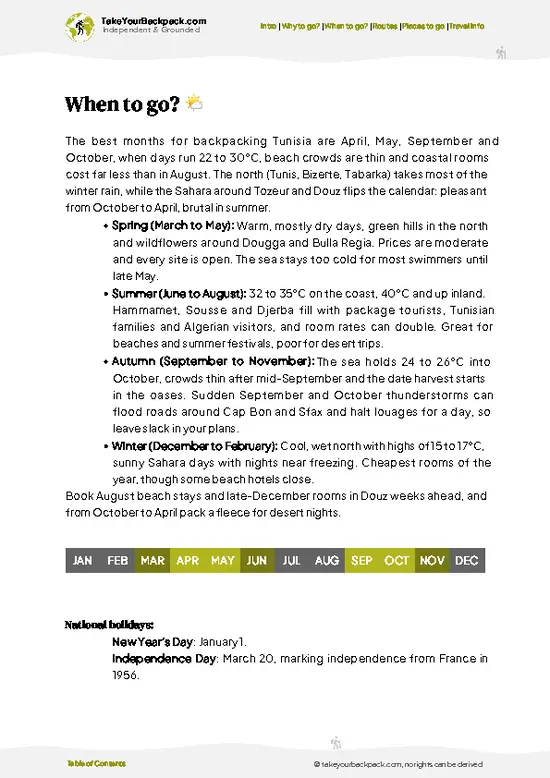
🌤️ When to go?When to go for the best experience

  • Spring (March to May): Daytime highs of 18 to 27°C (64 to 81°F) make the climb up the tiers comfortable, and wildflowers edge the fields around town. Tour groups from Sousse and Mahdia arrive in the late morning, so expect some crowds at midday.
  • Summer (June to August): Highs reach 33 to 38°C (91 to 100°F), and the limestone arena has almost no shade. Daylight stretches past 14 hours, which helps, but the heat from noon to 4 pm is punishing. The International Festival of Symphonic Music has typically been held here in July or August, with concerts inside the arena, and beds in town fill up.
  • Autumn (September to November): Highs of 20 to 31°C (68 to 88°F), thinner crowds and softer light make this a strong window. Rain becomes more likely from late October.
  • Winter (December to February): Highs
… read more 👉
  • Spring (March to May): Daytime highs of 18 to 27°C (64 to 81°F) make the climb up the tiers comfortable, and wildflowers edge the fields around town. Tour groups from Sousse and Mahdia arrive in the late morning, so expect some crowds at midday.
  • Summer (June to August): Highs reach 33 to 38°C (91 to 100°F), and the limestone arena has almost no shade. Daylight stretches past 14 hours, which helps, but the heat from noon to 4 pm is punishing. The International Festival of Symphonic Music has typically been held here in July or August, with concerts inside the arena, and beds in town fill up.
  • Autumn (September to November): Highs of 20 to 31°C (68 to 88°F), thinner crowds and softer light make this a strong window. Rain becomes more likely from late October.
  • Winter (December to February): Highs of 12 to 17°C (54 to 63°F), nights near 5°C (41°F), and short days of roughly 10 hours. Showers pass through, but you often get the arena nearly to yourself, and prices stay at their lowest.
Arrive when the gate opens, since the stone is cool and the tour buses are still on the coast.


source: climatestotravel.comJANJanuary: highly recommended for travelingFEBFebruary: highly recommended for travelingMARMarch: highly recommended for travelingAPRApril: excellent for travelingMAYMay: excellent for travelingJUNJune: good for travelingJULJuly: fair for travelingAUGAugust: fair for travelingSEPSeptember: excellent for travelingOCTOctober: excellent for travelingNOVNovember: highly recommended for travelingDECDecember: highly recommended for traveling
when-to-go

✈️ The backpacker research shortcutTunisia Travel Guide

An offline-friendly backpacking guide with optimized travel routes, ranked highlights, transport advice, and the best areas to stay.
example page 0 from our offline Travel Guide for Tunisia
example page 1 from our offline Travel Guide for Tunisia
example page 2 from our offline Travel Guide for Tunisia
example page 3 from our offline Travel Guide for Tunisia
example page 4 from our offline Travel Guide for Tunisia
example page 5 from our offline Travel Guide for Tunisia
example page 6 from our offline Travel Guide for Tunisia
example page 7 from our offline Travel Guide for Tunisia
The digital guide (355 pages) contains:
✅ 90 highlights, ranked by travel appeal
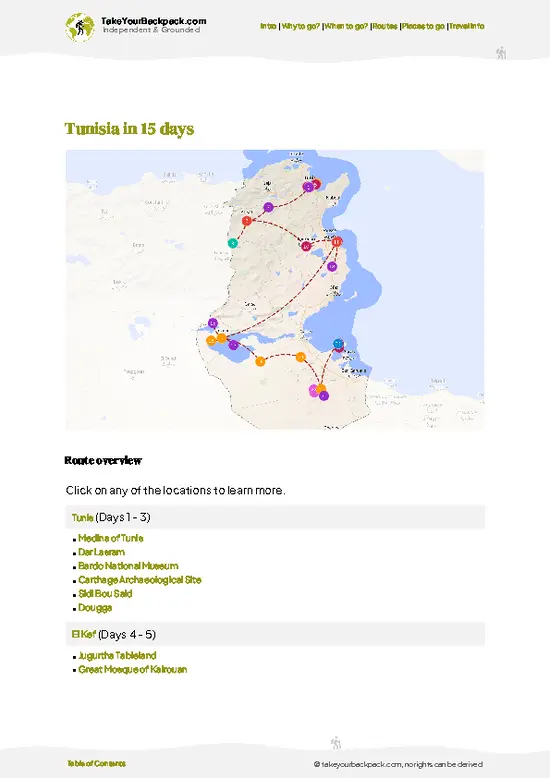
✅ Optimized 5, 10 & 15-day travel routes
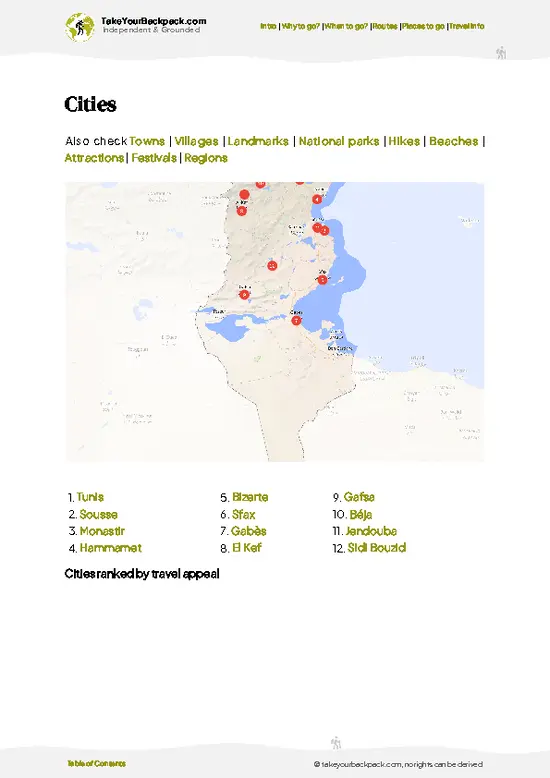
✅ Cities, national parks, landmarks, beaches
✅ How to get around
✅ Offline-friendly for travel without Wi-Fi
👉 Click to see all 30+ guide features

📅 Plan smarter in minutes, not weeks
✅ Month by month travel advice
✅ Festivals & national holidays
✅ Budget expectations

🗺️ Go to the right places, skip the overrated ones
✅ Honest pros & cons of destinations
✅ Top hikes, parks & viewpoints
✅ Lesser-known places most travelers miss
✅ Clear “worth it vs skip it” guidance

🛏️ Travel smoothly without rookie mistakes
✅ Best areas to stay
✅ Transport systems explained simply
✅ Common scams & safety advice
✅ SIM cards, money & practical tips

🌍 Understand the country, not just visit it
✅ Culture & traditions
✅ 52 Essential phrases & customs
✅ Festivals worth planning around
✅ Traveler-friendly historical context
✅ Insights that make places more meaningful

📱 Built for real travel conditions
✅ Fully downloadable PDF
✅ Works completely offline
✅ Optimized for phone use
✅ Useful in remote areas & buses
✅ Everything in one place
Stop searching, start planning
Get instant access to your full guide. 30‑day money-back guarantee.
+ Add another guide for just

By proceeding you agree to our terms.
Sent to your inbox immediately after payment • 100% Secure Checkout
Best Backpacking Travel Advisor 2025 tourism awardBest Backpacking
Travel Advisor
2025
What others say about Take Your Backpack Guides:
⭐⭐⭐⭐⭐
Fantastic, amazing amount of information!
⭐⭐⭐⭐⭐
My goodness this is amazing, it's what I've been looking for hats off too you!
⭐⭐⭐⭐⭐
I think this is absolutely BRILLIANT
⭐⭐⭐⭐
Very complete and informative. It's still missing places, but I gotta to commend you
⭐⭐⭐⭐⭐
This is truly amazing, thank you, can't wait to explore it with my kids!
⭐⭐⭐⭐⭐
Awesome resource, thank you!
⭐⭐⭐⭐⭐
This is amazing! Can't wait to explore the ones I haven't seen
⭐⭐⭐⭐
I love this! Well done, great idea.
⭐⭐⭐⭐⭐
Thanks for taking the time to make this gem!
⭐⭐⭐⭐⭐
This might be the best website I've ever seen.
⭐⭐⭐⭐⭐
Congratulations, and thank you so much for your work; it's incredibly valuable.
⭐⭐⭐⭐
In all seriousness I think you did a great job pointing out the important spots
⭐⭐⭐⭐⭐
10/10 very good
⭐⭐⭐⭐⭐
As someone who's only just starting to visit regularly this is awesome, thank you.
⭐⭐⭐⭐
Thank you very much! I'm going to visit my dad, it's going to be very useful!
⭐⭐⭐⭐⭐
This is really cool! We'll be travelling for the first time and this definitely come in handy.
⭐⭐⭐⭐⭐
You are now our minister of culture, congratulations 👨‍💼
⭐⭐⭐⭐⭐
Just wanted to tell you that this is a pearl! Going to follow your recommendations.
⭐⭐⭐⭐⭐
This is so cool. I'll definitely be using the resource for my travels soon.
⭐⭐⭐⭐⭐
This is very impressive! Good work.
⭐⭐⭐⭐⭐
This is an amazing and informative site. Very well done!

🛏️ Where to stay?Best areas and accommodation options

Stay in El Jem itself, in the small grid of streets around the arena and the train station. Everything is walkable, and it is the only area that puts you within a few minutes of the amphitheater. The town is small, quiet and safe for solo travelers, but nightlife is close to nonexistent. Expect a few modest guesthouses and simple hotels, a handful of cafés where locals play cards, and grill spots near the main square. Social energy is low, so you meet other travelers mostly at breakfast or on the arena steps rather than in lively common rooms. Staying overnight lets you see the arena after the … read more 👉
Stay in El Jem itself, in the small grid of streets around the arena and the train station. Everything is walkable, and it is the only area that puts you within a few minutes of the amphitheater. The town is small, quiet and safe for solo travelers, but nightlife is close to nonexistent. Expect a few modest guesthouses and simple hotels, a handful of cafés where locals play cards, and grill spots near the main square. Social energy is low, so you meet other travelers mostly at breakfast or on the arena steps rather than in lively common rooms. Staying overnight lets you see the arena after the tour groups leave and again at opening, when the light is best for photos.

The alternative is Sousse, roughly 65 km (40 miles) north, where the medina area has the densest cluster of budget hostels and the easiest social scene. Trains and louages link it to El Jem in about 1.5 hours, which makes it workable for a long day trip. Mahdia, about 40 km (25 miles) to the northeast, is calmer, with a fishing port, beaches and a small old town, and suits those who want sea air over nightlife. Sfax, to the south, is a working port city with fewer backpacker amenities. For a first visit, sleep in El Jem if you want the arena at dawn, and use Sousse if you want company.

👛 Costs (as of 22 October 2026)Travel costs and budget guide for Amphitheatre of El Jem

A day at the Amphitheatre of El Jem costs about US$40 for a backpacker, including entry, a bed, meals and local transport. The table below breaks it down, with everything paid in Tunisian dinars.
CategoryBudget RangeLocal Reality
Entry ticketUS$4 to 6Foreign visitors pay more than residents. A small extra fee applies for a camera in some cases, and the on-site museum is separate or bundled depending on the ticket.
Accommodation (high season)US$15 to 25Simple guesthouses and basic hotels in town. Low season runs closer to US$12 to 20. Sousse hostel dorms cost about US$10 to 15.
FoodUS$6 to 10Grilled meat sandwiches, couscous and lablabi at local cafés cost US$2 to 4 each. A sit-down dinner is US$6 to 9.
Local transportUS$1 to 3Walking covers the whole town. Short taxi rides are cheap, and tourist-oriented
… read more 👉
A day at the Amphitheatre of El Jem costs about US$40 for a backpacker, including entry, a bed, meals and local transport. The table below breaks it down, with everything paid in Tunisian dinars.
CategoryBudget RangeLocal Reality
Entry ticketUS$4 to 6Foreign visitors pay more than residents. A small extra fee applies for a camera in some cases, and the on-site museum is separate or bundled depending on the ticket.
Accommodation (high season)US$15 to 25Simple guesthouses and basic hotels in town. Low season runs closer to US$12 to 20. Sousse hostel dorms cost about US$10 to 15.
FoodUS$6 to 10Grilled meat sandwiches, couscous and lablabi at local cafés cost US$2 to 4 each. A sit-down dinner is US$6 to 9.
Local transportUS$1 to 3Walking covers the whole town. Short taxi rides are cheap, and tourist-oriented drivers may quote high, so agree the price first.
Intercity transportUS$3 to 6Louages or trains from Sousse or Mahdia cost a few dollars each way. The fare from Sfax is similar.
ExtrasUS$2 to 5Mint tea, water and small souvenirs. Guides at the gate may ask US$10 to 15 for a private tour.
Total Daily BudgetUS$31 to 55Roughly US$40 for a typical day.
⚠️ Prices can change and everyone travels differently, so take this as a rough guide. Hope it helps you plan your adventure!

FAQCommon questions from travelers

The Amphitheatre of El Jem is a Roman arena built in the 3rd century AD, listed by UNESCO, and one of the best preserved in the world. It could seat around 35,000 spectators, which is only slightly less than the Colosseum in Rome. You can walk through the underground passages and climb the upper tiers for views over the town, for an entry fee of about US$4 to 6.
Plan on 1.5 to 2 hours for the Amphitheatre of El Jem itself, including the tiers, the underground corridors and photos. Add another hour if you also visit the El Jem Archaeological Museum, which holds mosaics from local Roman villas and sits about 1 km (0.6 miles) from the arena. Most travelers visit as part of a long day from Sousse or Mahdia, though staying overnight lets you see the arena in quieter light.
The Amphitheatre of El Jem sits in the center of El Jem town, about 200 km (125 miles) south of Tunis. Trains from Sousse take about 1 to 1.5 hours and from Tunis about 3 to 3.5 hours, with fares roughly US$3 to 10 depending on class. Shared louages run from Sousse, Mahdia and Sfax for US$3 to 6, and the arena is a 5 to 10 minute walk from the station and louage stop.
⚠️ Things can change over time, so always validate details locally before you go.

Other Tunisian landmarks near Amphitheatre of El Jem

Explore more nearby:

  • Gerade Mosque of Kairouan—massive minaret, fortified walls, prayer courtyard| 69 km away
  • Zaghouan Water Temple—Spring-fed nymphaeum, aqueduct arches, mountain trails, whitewashed lanes| 132 km away
  • Sufetula—Capitoline temples, forum arch, Byzantine baptisteries, bathhouse channels| 144 km away

💡 Not sure where to go next?
Create a personalized itinerary for Tunisia including Amphitheatre of El Jem and the places that fit your trip.

Generate my itinerary

👉 Discover all landmarks

Or checkout all Tunisia has to offer (think cities, towns, villages, national parks, hikes, beaches, festivals)
Country photo of Tunisia

We 💚 feedbackFinal thoughts on visiting Amphitheatre of El Jem

The Amphitheatre of El Jem works best as a mid-route pause between Sousse or Monastir and Sfax, or as a stop on the way south to Tataouine and the desert. I would pair it with the nearby museum for its mosaics, and skip the souvenir strip. Bring a hat, because the arena has little shade, and let the underground tunnels cool you down.

✍️ Help improve this page!
The information on this page is based on in-depth research, insights shared by experienced travelers, and feedback from the local travel community in Tunisia. While every effort is made to keep the information accurate and current, conditions can change — so if you spot anything incorrect or outdated, please get in touch.


🙋‍♂️ Give feedback

👋 Meet the founderWho’s Behind Take Your Backpack?

Johan, backpacker and founder of TakeYourBackpackHi, I’m Johan (Netherlands 🇳🇱), the creator of TakeYourBackpack. Over the past 3 decades, I’ve backpacked through 90+ countries across six continents, gaining extensive experience with independent travel, long-term trips, and overland routes.

This site is built on a combination of firsthand travel experience and carefully curated insights from other backpackers. Many guides are based on places I’ve personally visited, while others bring together tips, observations, and practical advice shared by trusted travelers I’ve met along the way.

The goal is to provide realistic, experience-driven guidance — not generic itineraries — so you can explore destinations with better context, clearer expectations, and more confidence.