×

Tunisia🇹🇳 | national parksBouhedma National ParkAcacia savanna, ostriches, addax and oryx enclosures, ranger drives | things to do and best time to go

Explore El FeijaExplore Chambi National Park

Backpacking in Bouhedma
🌟 Highlightnational park ranked #5
By Johan Kruseman 🇳🇱 | Updated October 22, 2026

Bouhedma National Park was created in 1980 to protect a patch of Saharan-style acacia savanna, and it is one of the few places in Tunisia where you can see ostriches, addax and oryx roaming freely. It sits in the center-south of Tunisia, inland from Gabès and Sfax, in the Gafsa and Sidi Bouzid area. Public transport stops well short of the gate, so the classic mistake is arriving by louage with no onward ride and discovering that “a short walk” means hours of dust. Arrange a driver or a rental car in advance, and carry your own water and food. Entry needs a permit, so ask in the nearest town before setting out rather than negotiating at a closed barrier. Walking is possible but fairly flat and shadeless, so go prepared. Unlike Chambi, which is a mountain park of pine and juniper, Bouhedma is about open plains and flat-topped acacia trees.

Discover everything you want to know in the 📖 Tunisia Travel Guide.


example page 0 from our offline Travel Guide for Tunisia
example page 1 from our offline Travel Guide for Tunisia
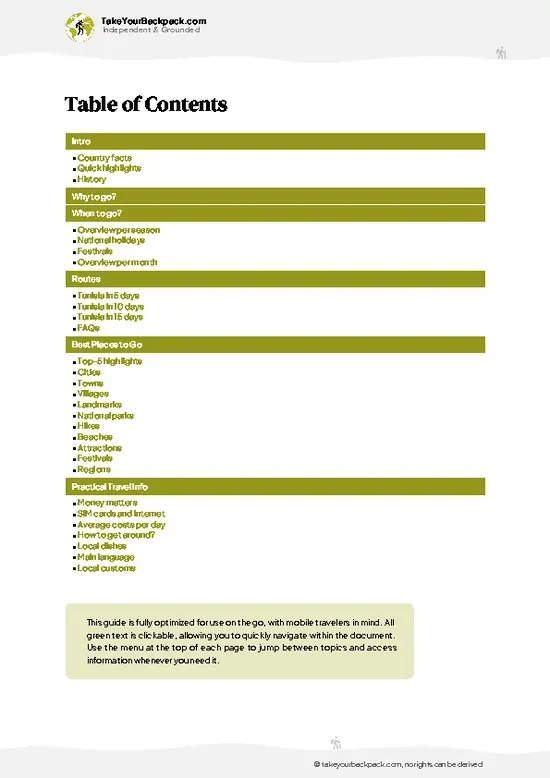
example page 2 from our offline Travel Guide for Tunisia
example page 3 from our offline Travel Guide for Tunisia
example page 4 from our offline Travel Guide for Tunisia
example page 5 from our offline Travel Guide for Tunisia
example page 6 from our offline Travel Guide for Tunisia
example page 7 from our offline Travel Guide for Tunisia
Loading the map 🌍
CLICK TO FILTER
cities
towns
villages
landmarks
national parks
hikes
beaches
attractions
festivals
regions
SHOW COUNTRY’S BESTSHOW ALL

✨ Why go?
Ranked #5 national park in Tunisia
What makes this national park worth exploring

Bouhedma National Park suits backpackers who like to piece a trip together themselves, because the reason to come is the animals, and they reward patience more than a tour schedule. The park protects acacia savanna that looks like East Africa, which is a strange thing to find in a country better known for Roman ruins and Sahara dunes. Reintroduced species such as addax, oryx and dama gazelle live in fenced enclosures, while ostriches and gazelles move around more freely, and you can watch them on your own pace without a group waiting at the car. Because few foreigners come here, the place stays quiet, and rangers tend to be generous with advice if you show up curious. Independence has a cost, since you need to organize transport and supplies yourself. Still, for anyone building a route through … read more 👉
Bouhedma National Park suits backpackers who like to piece a trip together themselves, because the reason to come is the animals, and they reward patience more than a tour schedule. The park protects acacia savanna that looks like East Africa, which is a strange thing to find in a country better known for Roman ruins and Sahara dunes. Reintroduced species such as addax, oryx and dama gazelle live in fenced enclosures, while ostriches and gazelles move around more freely, and you can watch them on your own pace without a group waiting at the car. Because few foreigners come here, the place stays quiet, and rangers tend to be generous with advice if you show up curious. Independence has a cost, since you need to organize transport and supplies yourself. Still, for anyone building a route through the south and wanting a break from medinas and ruins, it is a refreshing change of pace.

💡 HighlightsDon't-miss highlights and experiences

  1. Acacia savanna: The park’s signature landscape, with wide plains dotted by flat-topped acacia trees that resemble an African savanna and give the park its unusual look.
  2. Ostriches: Reintroduced to Tunisia here, they are among the most photographed animals and often visible from the track.
  3. Addax and oryx enclosures: Rare desert antelopes protected in fenced areas, so you have a good chance of seeing species that are almost extinct in the wild.
  4. Dama gazelles: Slender, pale gazelles that share the plains and are best spotted when cooler hours bring them out to graze.
  5. Jebel Bouhedma viewpoints: The low ridge gives a wider look over the savanna and surrounding steppe, handy for orienting yourself and photographing the plain.
  6. Birdlife and small desert fauna: Look for raptors overhead, lizards on warm
… read more 👉
  1. Acacia savanna: The park’s signature landscape, with wide plains dotted by flat-topped acacia trees that resemble an African savanna and give the park its unusual look.
  2. Ostriches: Reintroduced to Tunisia here, they are among the most photographed animals and often visible from the track.
  3. Addax and oryx enclosures: Rare desert antelopes protected in fenced areas, so you have a good chance of seeing species that are almost extinct in the wild.
  4. Dama gazelles: Slender, pale gazelles that share the plains and are best spotted when cooler hours bring them out to graze.
  5. Jebel Bouhedma viewpoints: The low ridge gives a wider look over the savanna and surrounding steppe, handy for orienting yourself and photographing the plain.
  6. Birdlife and small desert fauna: Look for raptors overhead, lizards on warm stones and tracks of foxes and jackals in the sand.
  7. Ranger-guided drives: A local guide knows where animals gather and can open enclosures that casual visitors would not find alone.
All of it fits comfortably into half a day, or a full day if you want slow wildlife watching.
Spotted a mistake or missing something? Contact us.

Things to do near Bouhedma National Park

Ratings based on Tripadvisor reviews. When you book through this link, you support our work at no extra cost to you.

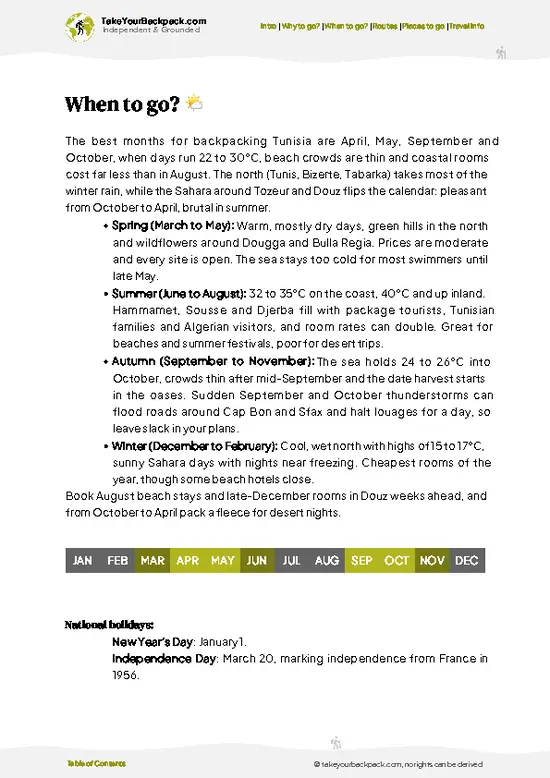
🌤️ When to go?When to go for the best experience

  • Spring (March to May): Daytime highs run 20 to 28°C (68 to 82°F) and the steppe is briefly green, which is when you are most likely to spot addax, oryx and dorcas gazelle grazing. Days stretch to roughly 12 to 14 hours of light. Wildflowers peak in March and April.
  • Summer (June to September): Highs of 36 to 42°C (97 to 108°F) with almost no shade make walking miserable after mid-morning. Animals hide in acacia thickets and you will see far less. Nights stay warm at 22 to 26°C (72 to 79°F).
  • Autumn (October and November): Highs ease to 24 to 30°C (75 to 86°F), the light is softer and visitor numbers stay low.
  • Winter (December to February): Days of 14 to 19°C (57 to 66°F), nights close to 3 to 6°C (37 to 43°F), and short days of about 10 hours of light. Rain is occasional and rooms are easy to find
… read more 👉
  • Spring (March to May): Daytime highs run 20 to 28°C (68 to 82°F) and the steppe is briefly green, which is when you are most likely to spot addax, oryx and dorcas gazelle grazing. Days stretch to roughly 12 to 14 hours of light. Wildflowers peak in March and April.
  • Summer (June to September): Highs of 36 to 42°C (97 to 108°F) with almost no shade make walking miserable after mid-morning. Animals hide in acacia thickets and you will see far less. Nights stay warm at 22 to 26°C (72 to 79°F).
  • Autumn (October and November): Highs ease to 24 to 30°C (75 to 86°F), the light is softer and visitor numbers stay low.
  • Winter (December to February): Days of 14 to 19°C (57 to 66°F), nights close to 3 to 6°C (37 to 43°F), and short days of about 10 hours of light. Rain is occasional and rooms are easy to find at modest rates.
Bouhedma is quiet all year, so book the park guide a day ahead and aim for March, April or October.


source: climatestotravel.comJANJanuary: fair for travelingFEBFebruary: fair for travelingMARMarch: excellent for travelingAPRApril: excellent for travelingMAYMay: excellent for travelingJUNJune: fair for travelingJULJuly: below average for travelingAUGAugust: below average for travelingSEPSeptember: excellent for travelingOCTOctober: excellent for travelingNOVNovember: highly recommended for travelingDECDecember: fair for traveling
tunisia-national-park-bouhedma-national-park
© Google |

✈️ The backpacker research shortcutTunisia Travel Guide

An offline-friendly backpacking guide with optimized travel routes, ranked highlights, transport advice, and the best areas to stay.
example page 0 from our offline Travel Guide for Tunisia
example page 1 from our offline Travel Guide for Tunisia
example page 2 from our offline Travel Guide for Tunisia
example page 3 from our offline Travel Guide for Tunisia
example page 4 from our offline Travel Guide for Tunisia
example page 5 from our offline Travel Guide for Tunisia
example page 6 from our offline Travel Guide for Tunisia
example page 7 from our offline Travel Guide for Tunisia
The digital guide (355 pages) contains:
✅ 90 highlights, ranked by travel appeal
✅ Optimized 5, 10 & 15-day travel routes
✅ Cities, national parks, landmarks, beaches
✅ How to get around
✅ Offline-friendly for travel without Wi-Fi
👉 Click to see all 30+ guide features

📅 Plan smarter in minutes, not weeks
✅ Month by month travel advice
✅ Festivals & national holidays
✅ Budget expectations

🗺️ Go to the right places, skip the overrated ones
✅ Honest pros & cons of destinations
✅ Top hikes, parks & viewpoints
✅ Lesser-known places most travelers miss
✅ Clear “worth it vs skip it” guidance

🛏️ Travel smoothly without rookie mistakes
✅ Best areas to stay
✅ Transport systems explained simply
✅ Common scams & safety advice
✅ SIM cards, money & practical tips

🌍 Understand the country, not just visit it
✅ Culture & traditions
✅ 52 Essential phrases & customs
✅ Festivals worth planning around
✅ Traveler-friendly historical context
✅ Insights that make places more meaningful

📱 Built for real travel conditions
✅ Fully downloadable PDF
✅ Works completely offline
✅ Optimized for phone use
✅ Useful in remote areas & buses
✅ Everything in one place
Stop searching, start planning
Get instant access to your full guide. 30‑day money-back guarantee.
+ Add another guide for just

By proceeding you agree to our terms.
Sent to your inbox immediately after payment • 100% Secure Checkout
Best Backpacking Travel Advisor 2025 tourism awardBest Backpacking
Travel Advisor
2025
What others say about Take Your Backpack Guides:
⭐⭐⭐⭐⭐
Fantastic, amazing amount of information!
⭐⭐⭐⭐⭐
My goodness this is amazing, it's what I've been looking for hats off too you!
⭐⭐⭐⭐⭐
I think this is absolutely BRILLIANT
⭐⭐⭐⭐
Very complete and informative. It's still missing places, but I gotta to commend you
⭐⭐⭐⭐⭐
This is truly amazing, thank you, can't wait to explore it with my kids!
⭐⭐⭐⭐⭐
Awesome resource, thank you!
⭐⭐⭐⭐⭐
This is amazing! Can't wait to explore the ones I haven't seen
⭐⭐⭐⭐
I love this! Well done, great idea.
⭐⭐⭐⭐⭐
Thanks for taking the time to make this gem!
⭐⭐⭐⭐⭐
This might be the best website I've ever seen.
⭐⭐⭐⭐⭐
Congratulations, and thank you so much for your work; it's incredibly valuable.
⭐⭐⭐⭐
In all seriousness I think you did a great job pointing out the important spots
⭐⭐⭐⭐⭐
10/10 very good
⭐⭐⭐⭐⭐
As someone who's only just starting to visit regularly this is awesome, thank you.
⭐⭐⭐⭐
Thank you very much! I'm going to visit my dad, it's going to be very useful!
⭐⭐⭐⭐⭐
This is really cool! We'll be travelling for the first time and this definitely come in handy.
⭐⭐⭐⭐⭐
You are now our minister of culture, congratulations 👨‍💼
⭐⭐⭐⭐⭐
Just wanted to tell you that this is a pearl! Going to follow your recommendations.
⭐⭐⭐⭐⭐
This is so cool. I'll definitely be using the resource for my travels soon.
⭐⭐⭐⭐⭐
This is very impressive! Good work.
⭐⭐⭐⭐⭐
This is an amazing and informative site. Very well done!

🛏️ Where to stay?Best areas and accommodation options

The best base for Bouhedma National Park is Gafsa or the small town of Mezzouna, since lodging inside the park is very limited. Check ahead at the park office near the entrance for any basic forest-service lodging or camping, and do not count on it. Most backpackers sleep outside the boundary.

Gafsa, roughly 60 to 90 minutes by road to the north-west, has the widest choice: simple city hotels at US$20 to 35 a night for a double, plus a couple of mid-range places around US$45 to 70. It also has the louis (shared taxi) station and cafes open late.

Sidi Bouzid, about an hour north, works as an … read more 👉
The best base for Bouhedma National Park is Gafsa or the small town of Mezzouna, since lodging inside the park is very limited. Check ahead at the park office near the entrance for any basic forest-service lodging or camping, and do not count on it. Most backpackers sleep outside the boundary.

Gafsa, roughly 60 to 90 minutes by road to the north-west, has the widest choice: simple city hotels at US$20 to 35 a night for a double, plus a couple of mid-range places around US$45 to 70. It also has the louis (shared taxi) station and cafes open late.

Sidi Bouzid, about an hour north, works as an alternative with budget hotels at US$15 to 30. Gabes, on the coast roughly 90 minutes to the south-east, suits anyone linking the park with the oasis and the sea, with hotels from US$20 to 50.

Mezzouna and the villages along the road near the park offer a few guesthouses and family rooms for US$15 to 25, and you eat where the locals do. Sfax is a farther option for a bigger selection. Arrange a driver or the park guide in advance wherever you sleep, because evening transport near the gate is scarce.

👛 Costs (as of 22 October 2026)Typical daily expenses

Bouhedma National Park costs roughly US$47 to 105 per person per day for a backpacker, counting a guide, a shared ride and a basic room. Prices are paid in Tunisian dinars and shift a little with the season.
CategoryBudget RangeLocal Reality
Entrance feeUS$1 to 3A small fee is usually collected at the gate. Rules change, so keep some cash.
Guide or rangerUS$10 to 25A guided visit is the usual way to find the animals, and the price depends on the group size.
Accommodation (low season)US$15 to 30Guesthouses and simple hotels in Gafsa, Mezzouna or Gabes.
Accommodation (high season)US$20 to 40Spring is busier, so book ahead near the park.
Local transportUS$8 to 25Shared taxis (louages) get you to nearby towns. A private driver from Gafsa or Gabes costs more.
Food and suppliesUS$8 to 12Sandwiches, couscous
… read more 👉
Bouhedma National Park costs roughly US$47 to 105 per person per day for a backpacker, counting a guide, a shared ride and a basic room. Prices are paid in Tunisian dinars and shift a little with the season.
CategoryBudget RangeLocal Reality
Entrance feeUS$1 to 3A small fee is usually collected at the gate. Rules change, so keep some cash.
Guide or rangerUS$10 to 25A guided visit is the usual way to find the animals, and the price depends on the group size.
Accommodation (low season)US$15 to 30Guesthouses and simple hotels in Gafsa, Mezzouna or Gabes.
Accommodation (high season)US$20 to 40Spring is busier, so book ahead near the park.
Local transportUS$8 to 25Shared taxis (louages) get you to nearby towns. A private driver from Gafsa or Gabes costs more.
Food and suppliesUS$8 to 12Sandwiches, couscous and grilled meat cost US$2 to 6. Stock up on water in town.
Total Daily BudgetUS$47 to 105Splitting a private vehicle or guide lowers the cost.
⚠️ Prices can change and everyone travels differently, so take this as a rough guide. Hope it helps you plan your adventure!

🥾 TrailsWhere to hike in Bouhedma: trails for every level

Bouhedma National Park is best explored by combining short walks with slow driving along its tracks, since there are few formally named, signposted trails and the terrain is mostly flat. The ground is a mix of hard-packed earth, sand and scattered stones, with little shade, so effort is low but heat and sun exposure are the real challenges.
  • Savanna walk: A gentle ramble of roughly 1 to 3 hours from the entrance area across the acacia plain, easy and flat, with the best chance of spotting gazelles and birds.
  • Enclosure circuit: A loop by track or on foot past the fenced zones for addax and oryx, easy,
… read more 👉
Bouhedma National Park is best explored by combining short walks with slow driving along its tracks, since there are few formally named, signposted trails and the terrain is mostly flat. The ground is a mix of hard-packed earth, sand and scattered stones, with little shade, so effort is low but heat and sun exposure are the real challenges.
  • Savanna walk: A gentle ramble of roughly 1 to 3 hours from the entrance area across the acacia plain, easy and flat, with the best chance of spotting gazelles and birds.
  • Enclosure circuit: A loop by track or on foot past the fenced zones for addax and oryx, easy, about 1 to 2 hours depending on how long you watch.
  • Ridge walk: A modest climb on the low hills for views over the plain, moderate because of loose stones and sun, about 2 to 3 hours return.
  • Wildlife: Ostriches, gazelles, oryx and addax are the main draws, along with foxes, reptiles and birds of prey.
Getting here without a vehicle is the main challenge, because public transport only reaches nearby towns and you will need a taxi or arranged driver for the last stretch. The park is quiet, with very few other visitors on most days. Entry arrangements and any fee are best confirmed locally with the park authorities, and you should carry plenty of water, a hat and sun protection, as there is little shade and no shops inside.
⚠️ Hiking info can sometimes be outdated or inaccurate. Before you hit the trail, check the latest conditions with locals. If you do spot anything that's off, I'd love to hear from you, so I can update it for fellow travelers.

🛡️ SafetyTraveler Safety Guide

Bouhedma is a calm, low-risk park, and the main hazards are heat and distance. In summer, temperatures above 40°C (104°F) with little shade make midday walking risky, so start at dawn, carry at least 3 liters of water per person, and wear a hat. Winter nights drop close to freezing, so pack a warm layer.

Tracks across the flat steppe are easy underfoot, yet they look alike and can be sandy or rutted after rain. Download an offline map and tell your guide or hotel where you are headed. Mobile signal is patchy.

The wildlife is mostly gentle: addax, oryx, gazelle and ostrich keep their distance, so watch quietly from afar and never chase them. Snakes and scorpions exist, so look before you sit and keep your boots on. Most visits happen with a ranger or guided vehicle, which is the simplest way to see the animals and stay oriented.

FAQTraveler FAQ

One full day is enough for Bouhedma National Park, and two days works better if you want a dawn and a dusk drive. A guided circuit through the acacia steppe takes about 3 to 5 hours. Nearby Gafsa and Gabes make easy overnight bases, and spring is the best season for animal sightings.
Reaching Bouhedma National Park without a car is possible but slow, so plan on a private driver or a shared taxi (louage) to the nearest town, then a hired ride. Gafsa and Gabes are each roughly 60 to 90 minutes away, and a driver typically costs US$25 to 50 for the round trip. Public buses do not run to the gate.
Bouhedma National Park charges a small entrance fee, usually around US$1 to 3 per person, and a guide or ranger is normally arranged at the park office for about US$10 to 25. No special hiking permit is generally required for a standard visit. Carry cash in Tunisian dinars, since card payment is rarely available at the gate.
⚠️ Things can change over time, so always validate details locally before you go.

Other Tunisian national parks near Bouhedma

Explore more nearby:

  • Mghilla National Park—Aleppo pine slopes, Barbary macaques, thyme-scented tracks, steppe views| 103 km away
  • Chambi National Park—Tunisia’s highest peak, pine and juniper forest, soaring eagles, Kasserine plain| 111 km away
  • Jebel Serj National Park—Limestone crest, Siliana farmland, raptor cliffs, Makthar ruins| 161 km away

💡 Not sure where to go next?
Create a personalized itinerary for Tunisia including Bouhedma and the places that fit your trip.

Generate my itinerary

👉 Discover all national parks

Or checkout all Tunisia has to offer (think cities, towns, villages, national parks, hikes, beaches, festivals)
Country photo of Tunisia

We 💚 feedbackIs it worth it?

Bouhedma National Park works best as a pause between the coast and the desert south, paired with Gabès, the oases of Tozeur or Matmata’s cave houses. I would bring more water than seems sensible and ask a ranger to point you toward the animals, since they will not come to you.

✍️ Help improve this page!
The information on this page is based on in-depth research, insights shared by experienced travelers, and feedback from the local travel community in Tunisia. While every effort is made to keep the information accurate and current, conditions can change — so if you spot anything incorrect or outdated, please get in touch.


🙋‍♂️ Give feedback

👋 Meet the founderWho’s Behind Take Your Backpack?

Johan, backpacker and founder of TakeYourBackpackHi, I’m Johan (Netherlands 🇳🇱), the creator of TakeYourBackpack. Over the past 3 decades, I’ve backpacked through 90+ countries across six continents, gaining extensive experience with independent travel, long-term trips, and overland routes.

This site is built on a combination of firsthand travel experience and carefully curated insights from other backpackers. Many guides are based on places I’ve personally visited, while others bring together tips, observations, and practical advice shared by trusted travelers I’ve met along the way.

The goal is to provide realistic, experience-driven guidance — not generic itineraries — so you can explore destinations with better context, clearer expectations, and more confidence.