×

Tunisia🇹🇳 | national parksIchkeul National ParkLake and marsh, wintering waterfowl, water buffalo, limestone lookout | things to do and best time to go

Explore Boukornine National ParkExplore Jebel Serj National Park

Backpacking in Ichkeul
UNESCO World Heritage site
🏆 Top picknational park ranked #1
By Johan Kruseman 🇳🇱 | Updated October 22, 2026

Ichkeul is a lake and marshland park, so anyone arriving with a mountain-trek itinerary is in for a small surprise: the high point, Djebel Ichkeul, tops out at about 511 meters. The park sits in the north of Tunisia, west of the coast near Bizerte and roughly inland from the capital's northern side. The ground reality is a wide, flat shoreline road, a single modest mountain, and a lake that mixes fresh and salt water depending on the season. Walkers get a quiet summit with views across the water and the Bizerte lagoon. In winter, tens of thousands of ducks, geese and coots arrive, and the flamingos make an appearance too, which is a lot of birdwatching for a place with no queues. The downsides are plain: no real trail network, scant shade, and little public transport. Some of the old water-buffalo herds still graze the marsh, looking deeply unbothered by you. Bring your own water and food, because the small visitor area near the foot of the mountain offers little beyond a modest museum and a view.

Discover everything you want to know in the 📖 Tunisia Travel Guide.


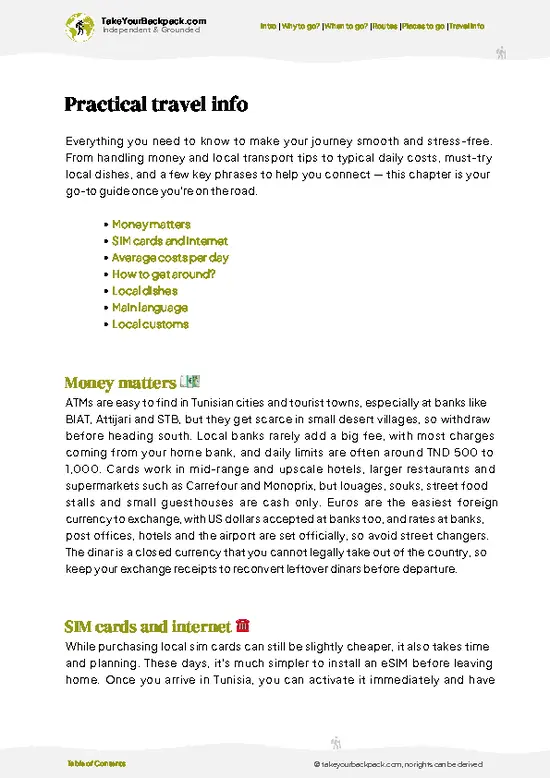
example page 0 from our offline Travel Guide for Tunisia
example page 1 from our offline Travel Guide for Tunisia
example page 2 from our offline Travel Guide for Tunisia
example page 3 from our offline Travel Guide for Tunisia
example page 4 from our offline Travel Guide for Tunisia
example page 5 from our offline Travel Guide for Tunisia
example page 6 from our offline Travel Guide for Tunisia
example page 7 from our offline Travel Guide for Tunisia
Loading the map 🌍
CLICK TO FILTER
cities
towns
villages
landmarks
national parks
hikes
beaches
attractions
festivals
regions
SHOW COUNTRY’S BESTSHOW ALL

✨ Why go?
Ranked #1 national park in Tunisia
What sets this place apart

Backpackers choose Ichkeul National Park because it is a UNESCO World Heritage wetland that you can handle entirely on your own, with no guide mandatory and no tour group in sight. The main outing is the walk up Djebel Ichkeul, where you pass old quarry workings and the stone ruins of a former lookout, then reach summit views over the lake, the marshes and the Bizerte lagoon beyond. It is a manageable half-day for anyone with decent shoes, which makes it a good first hike for nervous beginners and a pleasant change of pace for veterans tired of big-ticket mountains.

The second reason is timing. From late autumn through winter, the lake becomes a major stopover for migrating waterfowl, so a pair of binoculars turns a simple stroll into a serious wildlife day. In quieter months you get silence, … read more 👉
Backpackers choose Ichkeul National Park because it is a UNESCO World Heritage wetland that you can handle entirely on your own, with no guide mandatory and no tour group in sight. The main outing is the walk up Djebel Ichkeul, where you pass old quarry workings and the stone ruins of a former lookout, then reach summit views over the lake, the marshes and the Bizerte lagoon beyond. It is a manageable half-day for anyone with decent shoes, which makes it a good first hike for nervous beginners and a pleasant change of pace for veterans tired of big-ticket mountains.

The second reason is timing. From late autumn through winter, the lake becomes a major stopover for migrating waterfowl, so a pair of binoculars turns a simple stroll into a serious wildlife day. In quieter months you get silence, wide horizons and the odd herd of water buffalo wandering the marsh edge. It suits independent travelers who like to set their own pace, pack a picnic and stop whenever something interesting lands on the water.

💡 HighlightsPlaces and moments you shouldn't skip

  1. Djebel Ichkeul summit: the park's signature walk climbs a limestone ridge to a lookout above the lake and surrounding marshes. On clear days you can see the Bizerte lagoon, and the sweep of water below is the reason most people come.
  2. Lake Ichkeul wintering birds: from roughly November to February the shallows fill with greylag geese, wigeon, pochard and coots in huge numbers. Flamingos sometimes join them, and a patient hour with binoculars beats most guided outings.
  3. Water buffalo herds: Ichkeul is known for its free-grazing buffalo, which wade through the wet meadows along the foot of the mountain. They are calm, photogenic and best admired from a respectful distance.
  4. Ichkeul Ecomuseum: a small museum near the park entrance explains how the lake’s freshwater and saltwater cycle drives the whole
… read more 👉
  1. Djebel Ichkeul summit: the park's signature walk climbs a limestone ridge to a lookout above the lake and surrounding marshes. On clear days you can see the Bizerte lagoon, and the sweep of water below is the reason most people come.
  2. Lake Ichkeul wintering birds: from roughly November to February the shallows fill with greylag geese, wigeon, pochard and coots in huge numbers. Flamingos sometimes join them, and a patient hour with binoculars beats most guided outings.
  3. Water buffalo herds: Ichkeul is known for its free-grazing buffalo, which wade through the wet meadows along the foot of the mountain. They are calm, photogenic and best admired from a respectful distance.
  4. Ichkeul Ecomuseum: a small museum near the park entrance explains how the lake’s freshwater and saltwater cycle drives the whole ecosystem. It is brief but useful context before you head out on the trail.
  5. Old quarry and ruins on the mountain: along the climb you pass traces of past stone extraction and old structures, a reminder that people have worked this landscape for a very long time.
  6. Marsh edge and shoreline road: the flat track around the base of the mountain is ideal for slow wandering, with reed beds, grazing animals and open sky. It is the easiest wildlife viewing in the park.
  7. Picnic viewpoints on the lower slopes: several spots along the approach give lake views without any climbing. They suit lunch stops and sunset-adjacent light for photographers.
The Djebel Ichkeul summit walk and the shoreline road around the marsh combine easily in one day, with the climb in the cooler hours and a slow wildlife stroll afterward.
Spotted a mistake or missing something? Contact us.

Things to do near Ichkeul National Park

Ratings based on Tripadvisor reviews. When you book through this link, you support our work at no extra cost to you.

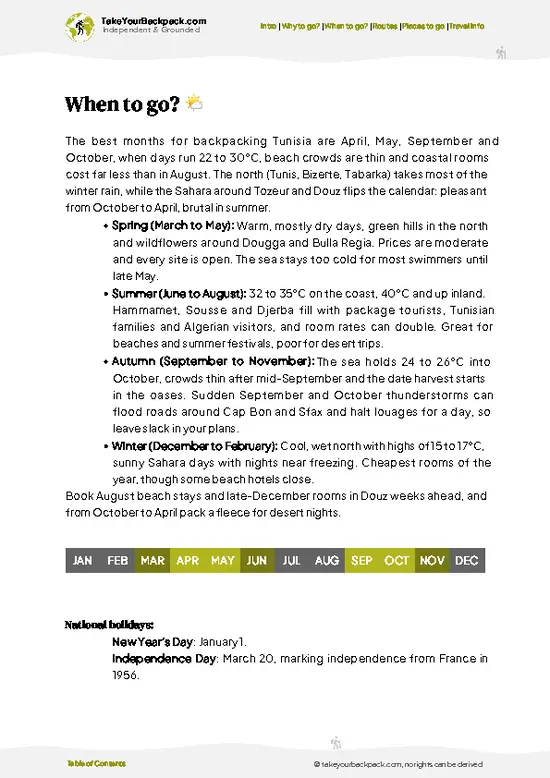
🌤️ When to go?Weather, crowds, and seasonal trade-offs

  • Winter (December to February): Ichkeul’s lake fills and the wintering birds arrive, with greylag geese, wigeon, coots and flamingos often present in the thousands. Days run 8 to 15°C (46 to 59°F), nights drop to 4 to 7°C (39 to 45°F), and rain is frequent. Daylight lasts about 10 hours. The visitor center and trails are quiet, and prices stay low.
  • Spring (March to May): This is the greenest stretch, with wildflowers on Jebel Ichkeul and highs of 17 to 26°C (63 to 79°F). Daylight stretches to 13 or 14 hours. School groups and weekend families raise crowd levels in April and May, but the trails never feel full.
  • Summer (June to September): Hot and dry at 28 to 35°C (82 to 95°F), with little shade on the lake flats. The lake shrinks and most migrants are gone, so birding is thin. Daylight lasts
… read more 👉
  • Winter (December to February): Ichkeul’s lake fills and the wintering birds arrive, with greylag geese, wigeon, coots and flamingos often present in the thousands. Days run 8 to 15°C (46 to 59°F), nights drop to 4 to 7°C (39 to 45°F), and rain is frequent. Daylight lasts about 10 hours. The visitor center and trails are quiet, and prices stay low.
  • Spring (March to May): This is the greenest stretch, with wildflowers on Jebel Ichkeul and highs of 17 to 26°C (63 to 79°F). Daylight stretches to 13 or 14 hours. School groups and weekend families raise crowd levels in April and May, but the trails never feel full.
  • Summer (June to September): Hot and dry at 28 to 35°C (82 to 95°F), with little shade on the lake flats. The lake shrinks and most migrants are gone, so birding is thin. Daylight lasts up to 14.5 hours. Beach-bound Tunisian holidaymakers push up bed prices in nearby Bizerte.
  • Autumn (October to November): Highs of 19 to 27°C (66 to 81°F) and the first returning birds. Showers begin in November, and rates drop again.
Aim for late January or February if birds are your priority, and go on a weekday for the quietest trails.


source: climatestotravel.comJANJanuary: fair for travelingFEBFebruary: fair for travelingMARMarch: highly recommended for travelingAPRApril: excellent for travelingMAYMay: excellent for travelingJUNJune: fair for travelingJULJuly: below average for travelingAUGAugust: below average for travelingSEPSeptember: highly recommended for travelingOCTOctober: excellent for travelingNOVNovember: highly recommended for travelingDECDecember: fair for traveling
when-to-go

✈️ The backpacker research shortcutTunisia Travel Guide

An offline-friendly backpacking guide with optimized travel routes, ranked highlights, transport advice, and the best areas to stay.
example page 0 from our offline Travel Guide for Tunisia
example page 1 from our offline Travel Guide for Tunisia
example page 2 from our offline Travel Guide for Tunisia
example page 3 from our offline Travel Guide for Tunisia
example page 4 from our offline Travel Guide for Tunisia
example page 5 from our offline Travel Guide for Tunisia
example page 6 from our offline Travel Guide for Tunisia
example page 7 from our offline Travel Guide for Tunisia
The digital guide (355 pages) contains:
✅ 90 highlights, ranked by travel appeal
✅ Optimized 5, 10 & 15-day travel routes
✅ Cities, national parks, landmarks, beaches
✅ How to get around
✅ Offline-friendly for travel without Wi-Fi
👉 Click to see all 30+ guide features

📅 Plan smarter in minutes, not weeks
✅ Month by month travel advice
✅ Festivals & national holidays
✅ Budget expectations

🗺️ Go to the right places, skip the overrated ones
✅ Honest pros & cons of destinations
✅ Top hikes, parks & viewpoints
✅ Lesser-known places most travelers miss
✅ Clear “worth it vs skip it” guidance

🛏️ Travel smoothly without rookie mistakes
✅ Best areas to stay
✅ Transport systems explained simply
✅ Common scams & safety advice
✅ SIM cards, money & practical tips

🌍 Understand the country, not just visit it
✅ Culture & traditions
✅ 52 Essential phrases & customs
✅ Festivals worth planning around
✅ Traveler-friendly historical context
✅ Insights that make places more meaningful

📱 Built for real travel conditions
✅ Fully downloadable PDF
✅ Works completely offline
✅ Optimized for phone use
✅ Useful in remote areas & buses
✅ Everything in one place
Stop searching, start planning
Get instant access to your full guide. 30‑day money-back guarantee.
+ Add another guide for just

By proceeding you agree to our terms.
Sent to your inbox immediately after payment • 100% Secure Checkout
Best Backpacking Travel Advisor 2025 tourism awardBest Backpacking
Travel Advisor
2025
What others say about Take Your Backpack Guides:
⭐⭐⭐⭐⭐
Fantastic, amazing amount of information!
⭐⭐⭐⭐⭐
My goodness this is amazing, it's what I've been looking for hats off too you!
⭐⭐⭐⭐⭐
I think this is absolutely BRILLIANT
⭐⭐⭐⭐
Very complete and informative. It's still missing places, but I gotta to commend you
⭐⭐⭐⭐⭐
This is truly amazing, thank you, can't wait to explore it with my kids!
⭐⭐⭐⭐⭐
Awesome resource, thank you!
⭐⭐⭐⭐⭐
This is amazing! Can't wait to explore the ones I haven't seen
⭐⭐⭐⭐
I love this! Well done, great idea.
⭐⭐⭐⭐⭐
Thanks for taking the time to make this gem!
⭐⭐⭐⭐⭐
This might be the best website I've ever seen.
⭐⭐⭐⭐⭐
Congratulations, and thank you so much for your work; it's incredibly valuable.
⭐⭐⭐⭐
In all seriousness I think you did a great job pointing out the important spots
⭐⭐⭐⭐⭐
10/10 very good
⭐⭐⭐⭐⭐
As someone who's only just starting to visit regularly this is awesome, thank you.
⭐⭐⭐⭐
Thank you very much! I'm going to visit my dad, it's going to be very useful!
⭐⭐⭐⭐⭐
This is really cool! We'll be travelling for the first time and this definitely come in handy.
⭐⭐⭐⭐⭐
You are now our minister of culture, congratulations 👨‍💼
⭐⭐⭐⭐⭐
Just wanted to tell you that this is a pearl! Going to follow your recommendations.
⭐⭐⭐⭐⭐
This is so cool. I'll definitely be using the resource for my travels soon.
⭐⭐⭐⭐⭐
This is very impressive! Good work.
⭐⭐⭐⭐⭐
This is an amazing and informative site. Very well done!

🛏️ Where to stay?How to pick the right area

The best base for Ichkeul National Park is Bizerte, about 25 km (15 miles) northeast, where budget guesthouses and small hotels cost roughly US$20 to 45 a night. Nobody can sleep inside the park, and camping is not permitted, so you will be staying outside the boundary either way.
Bizerte has the most choice. The old port area has simple hotels and a few renovated guesthouses within walking distance of the Kasbah, fish restaurants and the louage (shared taxi) stand. It makes a pleasant evening after a day of birdwatching, with cafés along the harbor.
Mateur, a farming town about 15 km (9 miles) … read more 👉
The best base for Ichkeul National Park is Bizerte, about 25 km (15 miles) northeast, where budget guesthouses and small hotels cost roughly US$20 to 45 a night. Nobody can sleep inside the park, and camping is not permitted, so you will be staying outside the boundary either way.
Bizerte has the most choice. The old port area has simple hotels and a few renovated guesthouses within walking distance of the Kasbah, fish restaurants and the louage (shared taxi) stand. It makes a pleasant evening after a day of birdwatching, with cafés along the harbor.
Mateur, a farming town about 15 km (9 miles) southwest of the park, is the closest option to the entrance. Accommodation there is very basic and limited, and few travelers use it, though it suits anyone wanting an early start on the trails at Ichkeul. Louages run regularly from Mateur to Bizerte and Tunis.
Tunis is a feasible alternative, roughly 80 km (50 miles) southeast, with far more hostels and mid-range hotels from about US$15 to 30 for a dorm or budget room. It adds a long transfer to each day, so it works best if you have already booked a tour or a driver.
For most backpackers, I would choose Bizerte. Book ahead in July and August, when Tunisian families fill the coast.

👛 Costs (as of 22 October 2026)What things cost and how to budget

A day at Ichkeul National Park costs roughly US$39 to 75 for a backpacker based in Bizerte, with the park itself being very cheap. Prices are in Tunisian dinars, converted here to US dollars, and they shift slightly with the season.
CategoryBudget RangeLocal Reality
Entrance feeUS$1 to 3A small ticket sold at the entrance; the museum may be charged separately at a similar low rate.
Accommodation (high season)US$20 to 35Simple guesthouse or budget hotel in Bizerte; low season runs about US$15 to 25.
Transport to the parkUS$10 to 20No regular public service reaches the gate. A louage to Mateur or the main road plus a taxi, or a negotiated round trip from Bizerte, is the usual way.
Food and suppliesUS$8 to 12Sandwiches, grilled fish or a plain meal in Bizerte; buy water and snacks in town because
… read more 👉
A day at Ichkeul National Park costs roughly US$39 to 75 for a backpacker based in Bizerte, with the park itself being very cheap. Prices are in Tunisian dinars, converted here to US dollars, and they shift slightly with the season.
CategoryBudget RangeLocal Reality
Entrance feeUS$1 to 3A small ticket sold at the entrance; the museum may be charged separately at a similar low rate.
Accommodation (high season)US$20 to 35Simple guesthouse or budget hotel in Bizerte; low season runs about US$15 to 25.
Transport to the parkUS$10 to 20No regular public service reaches the gate. A louage to Mateur or the main road plus a taxi, or a negotiated round trip from Bizerte, is the usual way.
Food and suppliesUS$8 to 12Sandwiches, grilled fish or a plain meal in Bizerte; buy water and snacks in town because the park has little to offer.
Guide or extrasUS$0 to 5Hiking is possible without a guide, though a tip for staff is appreciated.
Total Daily BudgetUS$39 to 75About US$57 is a realistic middle figure.
⚠️ Prices can change and everyone travels differently, so take this as a rough guide. Hope it helps you plan your adventure!

🥾 TrailsExploring Ichkeul: trails, terrain, and views

Ichkeul National Park has a short, simple hiking setup built around one mountain and a flat shoreline, so you can cover the main routes in a single day without any heavy planning. Terrain is rocky limestone on the ridge and flat dirt or gravel by the lake, with very little shade throughout.

  • Djebel Ichkeul ascent: the main walk climbs from the foot of the mountain to the summit lookout, passing old quarry traces and ruins. Expect around two to three hours return at a relaxed pace. Difficulty is easy to moderate, with loose rock and a steady incline in places.
  • Lakeshore and marsh walk: the flat
… read more 👉
Ichkeul National Park has a short, simple hiking setup built around one mountain and a flat shoreline, so you can cover the main routes in a single day without any heavy planning. Terrain is rocky limestone on the ridge and flat dirt or gravel by the lake, with very little shade throughout.

  • Djebel Ichkeul ascent: the main walk climbs from the foot of the mountain to the summit lookout, passing old quarry traces and ruins. Expect around two to three hours return at a relaxed pace. Difficulty is easy to moderate, with loose rock and a steady incline in places.
  • Lakeshore and marsh walk: the flat route along the base of the mountain follows the water's edge past reed beds and wet meadows. It takes one to two hours depending on how often you stop for birds. Difficulty is easy, and this is where buffalo and waterfowl are most visible.
  • Visitor area and ecomuseum stroll: a short wander around the entrance area, with the museum and a few viewpoints. Allow under an hour. Difficulty is very easy and suits any fitness level.

Wildlife is the highlight. Winter brings enormous flocks of ducks, geese and coots, along with raptors and the occasional flamingo, while the buffalo graze year-round. Spring brings wildflowers on the slopes and milder walking weather. Summer is hot and exposed, and the lake can shrink noticeably, so start early and carry plenty of water.

Getting there without a car takes effort. Buses and shared taxis run to the nearby town of Mateur or to Bizerte, and from there you need a local taxi or a negotiated ride to the park entrance. Hitching a lift is possible but slow. Driving or hiring a taxi for the day is the simplest approach, and drivers will usually wait while you walk.

Crowds are rarely an issue. Weekdays are very quiet, with the occasional school group or birdwatching party on weekends in winter. A small entrance fee is charged at the gate, paid in cash in the local currency, and it is modest by international standards. There are few services inside the park, so pack food, water, sun protection and binoculars before you arrive.
⚠️ Hiking info can sometimes be outdated or inaccurate. Before you hit the trail, check the latest conditions with locals. If you do spot anything that's off, I'd love to hear from you, so I can update it for fellow travelers.

🛡️ SafetySafety Tips and Common Scams in Ichkeul

Ichkeul National Park is a low-risk, well-managed park, and most problems come from weather and sun rather than terrain. The main hike is the climb up Jebel Ichkeul from the eco-museum, a rocky, uneven track of a few kilometers with a modest elevation gain, so sturdy shoes matter more than technical gear. Footing turns slick and muddy after winter rain, and the lowland tracks can flood.
Shade is scarce on the lake flats. From May to September, carry at least 2 liters of water per person, a hat and sunscreen, and walk early, because temperatures regularly pass 30°C (86°F). Winter brings wind and sudden showers, so pack a light waterproof layer.
Wildlife is easy going. Water buffalo graze freely near the lake and are placid when left alone, but keep your distance and never walk between a calf … read more 👉
Ichkeul National Park is a low-risk, well-managed park, and most problems come from weather and sun rather than terrain. The main hike is the climb up Jebel Ichkeul from the eco-museum, a rocky, uneven track of a few kilometers with a modest elevation gain, so sturdy shoes matter more than technical gear. Footing turns slick and muddy after winter rain, and the lowland tracks can flood.
Shade is scarce on the lake flats. From May to September, carry at least 2 liters of water per person, a hat and sunscreen, and walk early, because temperatures regularly pass 30°C (86°F). Winter brings wind and sudden showers, so pack a light waterproof layer.
Wildlife is easy going. Water buffalo graze freely near the lake and are placid when left alone, but keep your distance and never walk between a calf and its mother. Jackals and wild boar are shy and mostly nocturnal. Stay on marked paths, and keep your voice low near the birds.
Mobile signal can be patchy, so download an offline map. Telling the staff at the entrance your route is sensible, since few people hike on weekdays.

FAQCommon questions from travelers

One full day is enough for Ichkeul National Park, and two days suit keen birders or photographers. The main sights are the eco-museum, the lakeside tracks and the 511 m (1,677 ft) Jebel Ichkeul climb, which takes about 2 to 3 hours round trip. Add a second day if you want to combine it with Bizerte’s old port and Kasbah, about 25 km (15 miles) away.
Ichkeul National Park is hard to reach without a car, but doable. Take a louage (shared taxi) from Bizerte or Tunis to Mateur, then a local taxi for the roughly 15 km (9 miles) to the entrance, about US$10 to 20 round trip if you agree on a waiting time. Hitchhiking and cycling from Mateur are also options, and bus and louage services are infrequent after midday. A private driver from Bizerte is the simplest choice.
Ichkeul National Park charges a small entrance fee, generally about US$1 to 3, paid at the gate in Tunisian dinars. No special hiking permit is needed for the marked tracks. The eco-museum may carry a separate low ticket, and opening hours are shorter in winter, so check ahead if you arrive on a weekday morning.
⚠️ Things can change over time, so always validate details locally before you go.

Other Tunisian national parks near Ichkeul

Explore more nearby:


💡 Not sure where to go next?
Create a personalized itinerary for Tunisia including Ichkeul and the places that fit your trip.

Generate my itinerary

👉 Discover all national parks

Or checkout all Tunisia has to offer (think cities, towns, villages, national parks, hikes, beaches, festivals)
Country photo of Tunisia

We 💚 feedbackKey takeaways before you go

Ichkeul National Park suits birders, slow walkers and anyone who likes empty landscapes more than famous ones. Go in winter when the lake is crowded with waterfowl, and bring binoculars, a windproof layer and your own lunch. If you want dramatic peaks or a lively scene, skip it and pick somewhere else.

✍️ Help improve this page!
The information on this page is based on in-depth research, insights shared by experienced travelers, and feedback from the local travel community in Tunisia. While every effort is made to keep the information accurate and current, conditions can change — so if you spot anything incorrect or outdated, please get in touch.


🙋‍♂️ Give feedback

👋 Meet the founderWho’s Behind Take Your Backpack?

Johan, backpacker and founder of TakeYourBackpackHi, I’m Johan (Netherlands 🇳🇱), the creator of TakeYourBackpack. Over the past 3 decades, I’ve backpacked through 90+ countries across six continents, gaining extensive experience with independent travel, long-term trips, and overland routes.

This site is built on a combination of firsthand travel experience and carefully curated insights from other backpackers. Many guides are based on places I’ve personally visited, while others bring together tips, observations, and practical advice shared by trusted travelers I’ve met along the way.

The goal is to provide realistic, experience-driven guidance — not generic itineraries — so you can explore destinations with better context, clearer expectations, and more confidence.