×

Tunisia🇹🇳 | national parksJebel Zaghouan National ParkRoman spring temple, aqueduct arches, antenna summit, pale cliffs | things to do and best time to go

Explore Jebel Chitana-Cap Négro National ParkExplore Mghilla National Park

Backpacking in Jebel Zaghouan
👍 Recommendednational park ranked #7
By Johan Kruseman 🇳🇱 | Updated October 22, 2026

The Roman temple in Zaghouan town is not the park; the park is the limestone massif rising behind it. Jebel Zaghouan National Park sits in the north of Tunisia, south of Tunis, and the ridge shows on the horizon long before you arrive. Most visitors photograph the temple, eat something and leave, which keeps the upper slopes pleasantly empty. Trails are rough and thinly signed, so you carry a offline map instead of trusting an arrow that may have faded years ago. Shade is scarce above the pines, so you bring more water than seems sensible. Wildlife is shy, with boar and jackal mostly leaving tracks and raptors doing the showing off. Public transport gets you to town, not onto the mountain. The summit carries a cluster of antennas, a very modern crown for such an ancient spring.

Discover everything you want to know in the 📖 Tunisia Travel Guide.


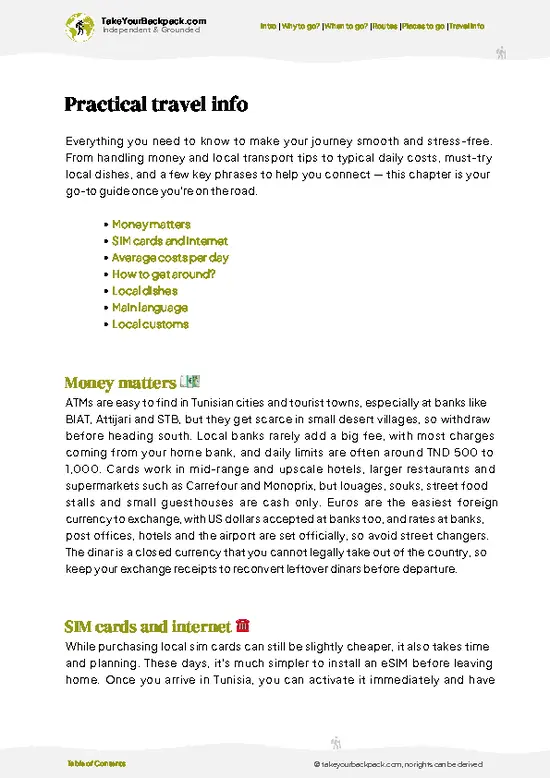
example page 0 from our offline Travel Guide for Tunisia
example page 1 from our offline Travel Guide for Tunisia
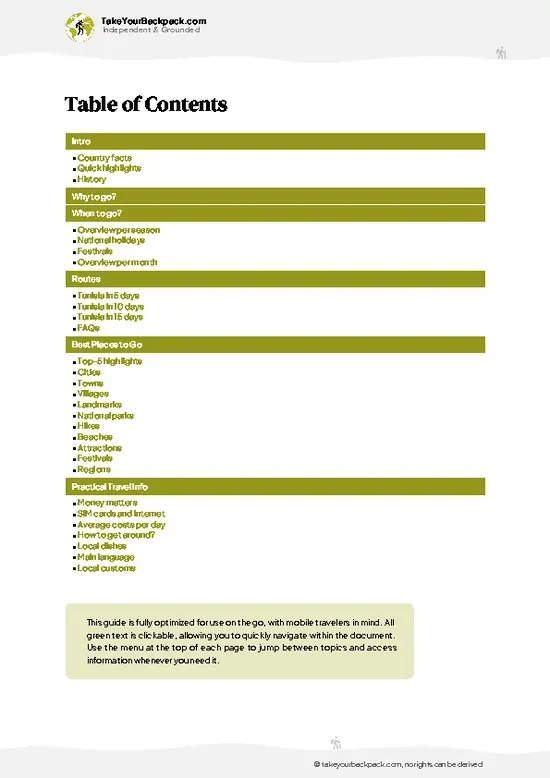
example page 2 from our offline Travel Guide for Tunisia
example page 3 from our offline Travel Guide for Tunisia
example page 4 from our offline Travel Guide for Tunisia
example page 5 from our offline Travel Guide for Tunisia
example page 6 from our offline Travel Guide for Tunisia
example page 7 from our offline Travel Guide for Tunisia
Loading the map 🌍
CLICK TO FILTER
cities
towns
villages
landmarks
national parks
hikes
beaches
attractions
festivals
regions
SHOW COUNTRY’S BESTSHOW ALL

✨ Why go?
Ranked #7 national park in Tunisia
What sets this place apart

Jebel Zaghouan National Park suits backpackers who like to wander without a guide and a schedule. The mountain tops out around 1,295 meters, and a day on its rocky slopes costs nothing beyond water and snacks, with a town of cafes and simple lodgings at the bottom. The big draw is the layering of history on a hike: the Temple of Waters, built to celebrate the spring that fed Carthage, marks your start, and long runs of the Roman aqueduct still stride across the plain below. Few tour groups go further than the temple, so once you climb you share the ridge with birds of prey and the occasional shepherd. Go self-guided, because the route-finding is part of the fun and nobody is selling a package for it.

💡 HighlightsThe experiences that define the visit

  1. Temple of Waters (Temple des Eaux): The Roman nymphaeum at the spring, with a semicircular colonnaded plan and a basin where water still gathers. It is the sight people search for, and the best viewpoint over Zaghouan town.
  2. Roman Aqueduct of Zaghouan: The channel that once carried water to Carthage over a very long route. Arched stretches survive across the plain below the mountain, and the section nearest the spring is easiest to reach.
  3. Summit of Jebel Zaghouan: The high point of the massif, with views over the Tunisian plains and, on clear days, toward the Gulf of Tunis. The antennas are ugly, the panorama is not.
  4. Aleppo pine and holm oak slopes: The forested lower and middle flanks, scented and shaded, where walking is easiest and birdsong is constant.
  5. Limestone cliffs and ridgeline: Pale rock
… read more 👉
  1. Temple of Waters (Temple des Eaux): The Roman nymphaeum at the spring, with a semicircular colonnaded plan and a basin where water still gathers. It is the sight people search for, and the best viewpoint over Zaghouan town.
  2. Roman Aqueduct of Zaghouan: The channel that once carried water to Carthage over a very long route. Arched stretches survive across the plain below the mountain, and the section nearest the spring is easiest to reach.
  3. Summit of Jebel Zaghouan: The high point of the massif, with views over the Tunisian plains and, on clear days, toward the Gulf of Tunis. The antennas are ugly, the panorama is not.
  4. Aleppo pine and holm oak slopes: The forested lower and middle flanks, scented and shaded, where walking is easiest and birdsong is constant.
  5. Limestone cliffs and ridgeline: Pale rock faces and scree above the tree line, good for scrambling and for spotting eagles and other raptors wheeling on the thermals.
  6. Old town of Zaghouan: Andalusian-influenced lanes with whitewashed houses at the foot of the mountain, handy for a coffee after the descent.
  7. Wildlife watching: Wild boar, jackals and porcupines leave signs on the trails, and dawn walkers sometimes catch the animals themselves.
Jebel Zaghouan National Park needs no ticket or advance booking for any of these, and the walks are self-guided.
Spotted a mistake or missing something? Contact us.

Things to do near Jebel Zaghouan National Park

Ratings based on Tripadvisor reviews. When you book through this link, you support our work at no extra cost to you.

🌤️ When to go?Best time to explore Jebel Zaghouan

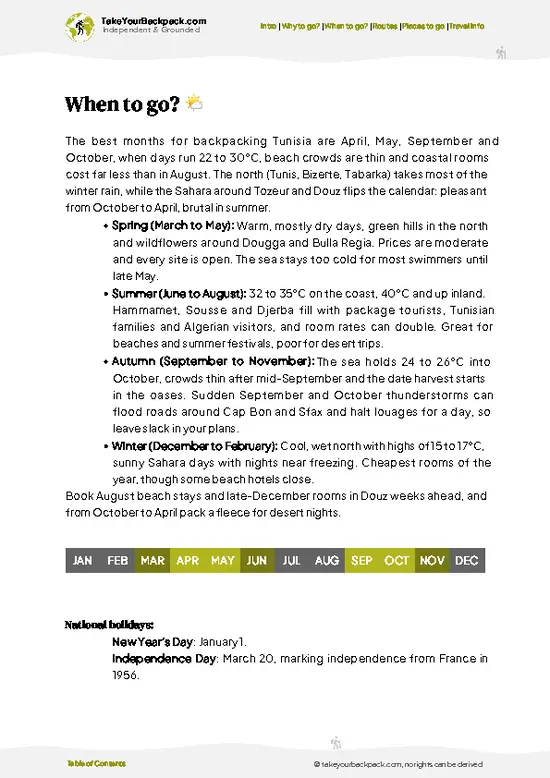
Spring (March to May) and autumn (October and November) give the most comfortable hiking on Jebel Zaghouan, with daytime highs of 18 to 26°C (64 to 79°F) and clear views toward the Gulf of Tunis.
  • Spring: Wildflowers and green slopes, with cool mornings near 10°C (50°F). Days run long enough for a full ridge loop. Local school groups appear on weekends.
  • Summer (June to August): Highs reach 33 to 38°C (91 to 100°F), the limestone gives no shade and water runs out fast. Start at dawn or skip it. Lodging near Zaghouan town stays quiet and cheap midweek.
  • Autumn: Warm days of 22 to 28°C (72 to 82°F), cooling toward November. Hazy light, fewer people and steady prices.
  • Winter (December to February): Highs of 11 to 15°C (52 to 59°F), nights near 3 to 5°C (37 to 41°F), and rain turns clay paths slick.
… read more 👉
Spring (March to May) and autumn (October and November) give the most comfortable hiking on Jebel Zaghouan, with daytime highs of 18 to 26°C (64 to 79°F) and clear views toward the Gulf of Tunis.
  • Spring: Wildflowers and green slopes, with cool mornings near 10°C (50°F). Days run long enough for a full ridge loop. Local school groups appear on weekends.
  • Summer (June to August): Highs reach 33 to 38°C (91 to 100°F), the limestone gives no shade and water runs out fast. Start at dawn or skip it. Lodging near Zaghouan town stays quiet and cheap midweek.
  • Autumn: Warm days of 22 to 28°C (72 to 82°F), cooling toward November. Hazy light, fewer people and steady prices.
  • Winter (December to February): Highs of 11 to 15°C (52 to 59°F), nights near 3 to 5°C (37 to 41°F), and rain turns clay paths slick. Daylight is short, about 9.5 hours. Rooms are at their lowest rates.
Aim for a weekday in April or October and you get the best light with the thinnest crowds.


source: climatestotravel.comJANJanuary: fair for travelingFEBFebruary: fair for travelingMARMarch: highly recommended for travelingAPRApril: excellent for travelingMAYMay: excellent for travelingJUNJune: fair for travelingJULJuly: below average for travelingAUGAugust: below average for travelingSEPSeptember: highly recommended for travelingOCTOctober: excellent for travelingNOVNovember: highly recommended for travelingDECDecember: fair for traveling
when-to-go

✈️ The backpacker research shortcutTunisia Travel Guide

An offline-friendly backpacking guide with optimized travel routes, ranked highlights, transport advice, and the best areas to stay.
example page 0 from our offline Travel Guide for Tunisia
example page 1 from our offline Travel Guide for Tunisia
example page 2 from our offline Travel Guide for Tunisia
example page 3 from our offline Travel Guide for Tunisia
example page 4 from our offline Travel Guide for Tunisia
example page 5 from our offline Travel Guide for Tunisia
example page 6 from our offline Travel Guide for Tunisia
example page 7 from our offline Travel Guide for Tunisia
The digital guide (355 pages) contains:
✅ 90 highlights, ranked by travel appeal
✅ Optimized 5, 10 & 15-day travel routes
✅ Cities, national parks, landmarks, beaches
✅ How to get around
✅ Offline-friendly for travel without Wi-Fi
👉 Click to see all 30+ guide features

📅 Plan smarter in minutes, not weeks
✅ Month by month travel advice
✅ Festivals & national holidays
✅ Budget expectations

🗺️ Go to the right places, skip the overrated ones
✅ Honest pros & cons of destinations
✅ Top hikes, parks & viewpoints
✅ Lesser-known places most travelers miss
✅ Clear “worth it vs skip it” guidance

🛏️ Travel smoothly without rookie mistakes
✅ Best areas to stay
✅ Transport systems explained simply
✅ Common scams & safety advice
✅ SIM cards, money & practical tips

🌍 Understand the country, not just visit it
✅ Culture & traditions
✅ 52 Essential phrases & customs
✅ Festivals worth planning around
✅ Traveler-friendly historical context
✅ Insights that make places more meaningful

📱 Built for real travel conditions
✅ Fully downloadable PDF
✅ Works completely offline
✅ Optimized for phone use
✅ Useful in remote areas & buses
✅ Everything in one place
Stop searching, start planning
Get instant access to your full guide. 30‑day money-back guarantee.
+ Add another guide for just

By proceeding you agree to our terms.
Sent to your inbox immediately after payment • 100% Secure Checkout
Best Backpacking Travel Advisor 2025 tourism awardBest Backpacking
Travel Advisor
2025
What others say about Take Your Backpack Guides:
⭐⭐⭐⭐⭐
Fantastic, amazing amount of information!
⭐⭐⭐⭐⭐
My goodness this is amazing, it's what I've been looking for hats off too you!
⭐⭐⭐⭐⭐
I think this is absolutely BRILLIANT
⭐⭐⭐⭐
Very complete and informative. It's still missing places, but I gotta to commend you
⭐⭐⭐⭐⭐
This is truly amazing, thank you, can't wait to explore it with my kids!
⭐⭐⭐⭐⭐
Awesome resource, thank you!
⭐⭐⭐⭐⭐
This is amazing! Can't wait to explore the ones I haven't seen
⭐⭐⭐⭐
I love this! Well done, great idea.
⭐⭐⭐⭐⭐
Thanks for taking the time to make this gem!
⭐⭐⭐⭐⭐
This might be the best website I've ever seen.
⭐⭐⭐⭐⭐
Congratulations, and thank you so much for your work; it's incredibly valuable.
⭐⭐⭐⭐
In all seriousness I think you did a great job pointing out the important spots
⭐⭐⭐⭐⭐
10/10 very good
⭐⭐⭐⭐⭐
As someone who's only just starting to visit regularly this is awesome, thank you.
⭐⭐⭐⭐
Thank you very much! I'm going to visit my dad, it's going to be very useful!
⭐⭐⭐⭐⭐
This is really cool! We'll be travelling for the first time and this definitely come in handy.
⭐⭐⭐⭐⭐
You are now our minister of culture, congratulations 👨‍💼
⭐⭐⭐⭐⭐
Just wanted to tell you that this is a pearl! Going to follow your recommendations.
⭐⭐⭐⭐⭐
This is so cool. I'll definitely be using the resource for my travels soon.
⭐⭐⭐⭐⭐
This is very impressive! Good work.
⭐⭐⭐⭐⭐
This is an amazing and informative site. Very well done!

🛏️ Where to stay?Best areas and accommodation options

Zaghouan town, at the foot of the mountain, is the best base, and there are no hotels or campsites inside the park itself.
The town sits right beside the trailheads and the Roman Water Temple, so you can walk to the start of most routes. Expect a handful of small guesthouses and modest hotels, typically US$25 to 50 a night for a double, with simpler rooms sometimes lower. A few places have gardens with views of the ridge, and the town has cafes and a weekly market for supplies. Dedicated hostels are rare, so book ahead for spring weekends.
For more choice, stay in Hammamet, about 45 minutes away … read more 👉
Zaghouan town, at the foot of the mountain, is the best base, and there are no hotels or campsites inside the park itself.
The town sits right beside the trailheads and the Roman Water Temple, so you can walk to the start of most routes. Expect a handful of small guesthouses and modest hotels, typically US$25 to 50 a night for a double, with simpler rooms sometimes lower. A few places have gardens with views of the ridge, and the town has cafes and a weekly market for supplies. Dedicated hostels are rare, so book ahead for spring weekends.
For more choice, stay in Hammamet, about 45 minutes away by road, where beach hotels and a few hostels run US$12 to 20 for a dorm bed and US$40 to 90 for private rooms. Tunis is roughly an hour away and has the widest range of hostels and budget hotels, with buses and louages running toward Zaghouan. If you want to wild camp on the slopes, ask locally first and carry all your water.

👛 Costs (as of 22 October 2026)Typical daily expenses

Jebel Zaghouan National Park costs roughly US$44 to 75 per day for a backpacker, with a total daily budget of US$65 when staying in a mid-priced guesthouse. Prices are paid in Tunisian dinars.
CategoryBudget RangeLocal Reality
Entrance feeUS$0Trails are open with no ticket office at the main access points, so hiking costs nothing.
Accommodation (high season)US$25 to 40Small guesthouses and hotels in Zaghouan town; Hammamet dorm beds cost less but add transport.
Accommodation (low season)US$18 to 30Winter and midsummer rooms are easier to negotiate.
Local transportUS$3 to 10Shared louages and buses from Tunis run about US$2 to 4 each way; short taxis in town cost a few dollars.
Food and suppliesUS$8 to 15Sandwiches, grilled meat plates and cafe meals are cheap; stock up on water and fruit at the
… read more 👉
Jebel Zaghouan National Park costs roughly US$44 to 75 per day for a backpacker, with a total daily budget of US$65 when staying in a mid-priced guesthouse. Prices are paid in Tunisian dinars.
CategoryBudget RangeLocal Reality
Entrance feeUS$0Trails are open with no ticket office at the main access points, so hiking costs nothing.
Accommodation (high season)US$25 to 40Small guesthouses and hotels in Zaghouan town; Hammamet dorm beds cost less but add transport.
Accommodation (low season)US$18 to 30Winter and midsummer rooms are easier to negotiate.
Local transportUS$3 to 10Shared louages and buses from Tunis run about US$2 to 4 each way; short taxis in town cost a few dollars.
Food and suppliesUS$8 to 15Sandwiches, grilled meat plates and cafe meals are cheap; stock up on water and fruit at the market.
Guide (optional)US$0 to 20Most hikers go without; a local guide for a summit day costs more.
Total Daily BudgetUS$65Includes high-season lodging, food and transport.
⚠️ Prices can change and everyone travels differently, so take this as a rough guide. Hope it helps you plan your adventure!

🥾 TrailsHiking Jebel Zaghouan national park: highlights and difficulty

Jebel Zaghouan National Park is a day-hike destination with rugged limestone terrain, pine woods lower down and open rock higher up. The paths I would use are informal tracks rather than polished routes, so download a map beforehand.
  • Temple of Waters to the upper slopes: Starts at the spring above town, climbs through pine and holm oak, and takes roughly 2 to 3 hours return to the mid-level viewpoints. Moderate, with loose stones underfoot.
  • Summit ascent: A longer, steeper push past the tree line to the ridge and antennas, around 4 to 6 hours return depending on fitness. Difficult in the final stretch,
… read more 👉
Jebel Zaghouan National Park is a day-hike destination with rugged limestone terrain, pine woods lower down and open rock higher up. The paths I would use are informal tracks rather than polished routes, so download a map beforehand.
  • Temple of Waters to the upper slopes: Starts at the spring above town, climbs through pine and holm oak, and takes roughly 2 to 3 hours return to the mid-level viewpoints. Moderate, with loose stones underfoot.
  • Summit ascent: A longer, steeper push past the tree line to the ridge and antennas, around 4 to 6 hours return depending on fitness. Difficult in the final stretch, with almost no shade and exposure to wind.
  • Aqueduct walk: A flat, easy stroll along surviving arches below the mountain, 1 to 2 hours, good for photographers and for tired legs.
  • Wildlife and views: Raptors circle the cliffs, boar and jackal are mostly heard or tracked, and the panorama over the plains opens above the pines.
For access, buses and shared taxis run from Tunis to Zaghouan town, and you walk from there to the temple. The park is rarely crowded, and weekends bring local families only to the lower temple area. Carry plenty of water, wear sturdy shoes and expect little or no signage.
⚠️ Hiking info can sometimes be outdated or inaccurate. Before you hit the trail, check the latest conditions with locals. If you do spot anything that's off, I'd love to hear from you, so I can update it for fellow travelers.

🛡️ SafetySafety Tips and Common Scams in Jebel Zaghouan

Jebel Zaghouan is a straightforward mountain, and the main hazards are sun, heat and loose limestone rather than wildlife or remote terrain.
The summit sits near 1,295 meters, so the climb is steady but not technical. Paths above the Water Temple are rocky and can be indistinct, and footing turns slippery on scree and after rain, so wear shoes with real grip and download an offline map. There is almost no shade and no water on the slopes. Carry at least 2 to 3 liters per person in warm months, plus a hat and sunscreen. Wind can pick up on the ridge and fog sometimes covers the top. Wild boar and stray dogs live around the lower slopes. Keep your distance and your food packed away. Go with a companion and tell your host your route. Telecom signal is usually decent near town.

FAQFrequently asked questions about Jebel Zaghouan

One full day is enough for Jebel Zaghouan National Park, and two days suit you if you want both the summit and the Roman Water Temple area at an easy pace. The summit loop takes roughly 5 to 7 hours round trip depending on your route and fitness. The temple and the old aqueduct that carried water to Carthage take another 1 to 2 hours. Add a half day if you plan to see the town of Zaghouan itself.
Yes, Jebel Zaghouan National Park is easy to reach without a car, since the trailheads lie close to Zaghouan town. Buses and shared louages run from Tunis (about 1 hour, roughly US$2 to 4) and from Hammamet. From the town center the Water Temple is a short walk or a cheap taxi ride of a few dollars. Return transport thins out in the late afternoon, so start early.
No, Jebel Zaghouan National Park has no formal entrance fee or permit for ordinary day hiking, and the main trails are open year round. You may meet forestry staff in some areas, so carry ID. Guides are optional and cost roughly US$10 to 20 for a summit day. Check locally before camping, since overnight stays on the slopes are not set up with official sites.
⚠️ Things can change over time, so always validate details locally before you go.

Other Tunisian national parks near Jebel Zaghouan

Explore more nearby:


💡 Not sure where to go next?
Create a personalized itinerary for Tunisia including Jebel Zaghouan and the places that fit your trip.

Generate my itinerary

👉 Discover all national parks

Or checkout all Tunisia has to offer (think cities, towns, villages, national parks, hikes, beaches, festivals)
Country photo of Tunisia

We 💚 feedbackParting advice and final tips

Give Jebel Zaghouan National Park one full day and a night in town, which is enough for the summit hike and a slow wander through the old quarter. If you have a second day, spend it on the aqueduct arches instead of repeating the climb. I would start the climb early and carry more water than feels necessary.

✍️ Help improve this page!
The information on this page is based on in-depth research, insights shared by experienced travelers, and feedback from the local travel community in Tunisia. While every effort is made to keep the information accurate and current, conditions can change — so if you spot anything incorrect or outdated, please get in touch.


🙋‍♂️ Give feedback

👋 Meet the founderWho’s Behind Take Your Backpack?

Johan, backpacker and founder of TakeYourBackpackHi, I’m Johan (Netherlands 🇳🇱), the creator of TakeYourBackpack. Over the past 3 decades, I’ve backpacked through 90+ countries across six continents, gaining extensive experience with independent travel, long-term trips, and overland routes.

This site is built on a combination of firsthand travel experience and carefully curated insights from other backpackers. Many guides are based on places I’ve personally visited, while others bring together tips, observations, and practical advice shared by trusted travelers I’ve met along the way.

The goal is to provide realistic, experience-driven guidance — not generic itineraries — so you can explore destinations with better context, clearer expectations, and more confidence.