v2.webp)
- Zitouna Mosque: The mosque at the center of the old city, founded in the 8th century and rebuilt in the 9th. Non-Muslims cannot enter the prayer hall, but you can step into the courtyard for a small fee and admire the colonnades and the square minaret from the 19th century.
- Souk el Attarine: The perfumers’ market beside the mosque, where rose water, jasmine essence and amber oils are sold in tiny booths. It is the most atmospheric stretch of the covered lanes.
- Souk des Chechias: The red felt cap makers still shape and dye the traditional chechia here. Watch the craftsmen at work and expect to be offered a hat.
- Dar Ben Abdallah Museum: A restored 18th-century house with painted ceilings, tiled courtyards and mannequins in period dress. It gives a quick look at how wealthy Tunisian families lived.
- Zitouna Mosque: The mosque at the center of the old city, founded in the 8th century and rebuilt in the 9th. Non-Muslims cannot enter the prayer hall, but you can step into the courtyard for a small fee and admire the colonnades and the square minaret from the 19th century.
- Souk el Attarine: The perfumers’ market beside the mosque, where rose water, jasmine essence and amber oils are sold in tiny booths. It is the most atmospheric stretch of the covered lanes.
- Souk des Chechias: The red felt cap makers still shape and dye the traditional chechia here. Watch the craftsmen at work and expect to be offered a hat.
- Dar Ben Abdallah Museum: A restored 18th-century house with painted ceilings, tiled courtyards and mannequins in period dress. It gives a quick look at how wealthy Tunisian families lived.
- Tourbet el Bey: The burial place of the Husseinid beys, with marble tombs, tiled walls and a quiet courtyard. Few visitors come here, so it is calm.
- Dar Hussein: A palace-turned-heritage-center near the Kasbah, with carved plasterwork and a calm interior garden. Expect exhibitions and good photos.
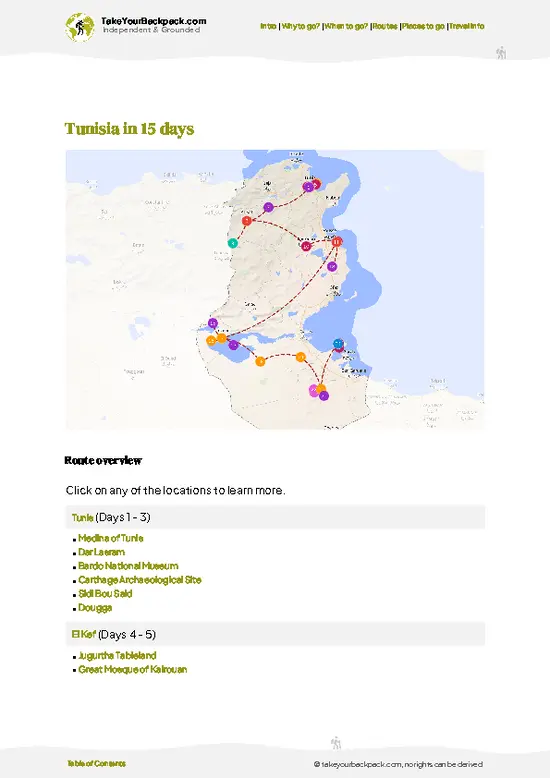
- Bab el Bhar: The old Porte de France, the stone gate that separates the French-built boulevards from the medina. It is the standard entry, and a good meeting point.
- Rooftop terraces near the Zitouna Mosque: Several shops and cafés let you climb up for views over the domes, minarets and a patchwork of flat roofs. Buy a tea or a small purchase in return.
Spotted a mistake or missing something? Contact us.

VIP transfer between Tunis Carthage Airport and a hotel in Tunis

07 -Guided day Tour Tunisia Monumental

10 Day Historical and Cultural Tour of Tunisia

8 Days Tunisia Essential Discovery Private Tour

Bizerte Utique Day and Cape Angela the Far North of Africa

Explore Tunisia in Depth:The Private Grand Tour in 8 Days

Half-Day Traditional Tunisian Cuisine Cooking Class in Tunis

3 Day Tunisian Desert Adventure Dunes, Oases and Bedouin Nights

Private Tour to Kairouan, El Jem and Sousse


 Best Backpacking
.jpg) Hi, I’m Johan (Netherlands 🇳🇱), the creator of TakeYourBackpack. Over the past 3 decades, I’ve backpacked through 90+ countries across six continents, gaining extensive experience with independent travel, long-term trips, and overland routes.
Hi, I’m Johan (Netherlands 🇳🇱), the creator of TakeYourBackpack. Over the past 3 decades, I’ve backpacked through 90+ countries across six continents, gaining extensive experience with independent travel, long-term trips, and overland routes.