×

Tunisia🇹🇳 | attractionsSousse Archaeological MuseumByzantine mosaics, underground crypts, kasbah setting | things to do and best time to go

Explore Kairouan Great Mosque and Medina MonumentsExplore National Theatre of Tunis

Backpacking in Sousse Archaeological Museum
🌟 Highlightattraction ranked #6
By Johan Kruseman 🇳🇱 | Updated May 22, 2026

Here’s what nobody tells you until you’re standing in front of a Roman mosaic with your jaw on the floor: the Sousse Archaeological Museum is the single best shortcut to Tunisia’s ancient soul, and—here’s the kicker—you’ll get closer to the art than you ever will in Tunis or Carthage. Sousse sits on the country’s Mediterranean coast, about two hours south of Tunis, tucked inside the old kasbah walls like a secret the tour buses haven’t quite cracked. Backpackers chasing the “real” Tunisia will find both a blessing and a curse here. Yes, you’ll dodge the worst of the crowds that mob El Jem or the Bardo, and the entry fee is refreshingly reasonable for what you get. But don’t expect solitude; local school groups and cruise-day trippers do show up, especially midday. The mosaics are the main event—raw, vivid, and displayed with a kind of casual intimacy that feels almost illicit. It’s not polished or over-produced, but that’s the charm: you’re in a fortress, not a theme park.

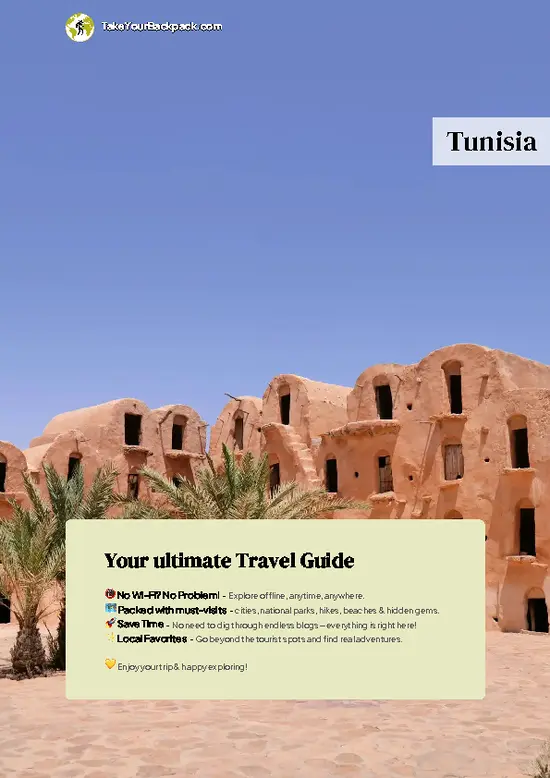
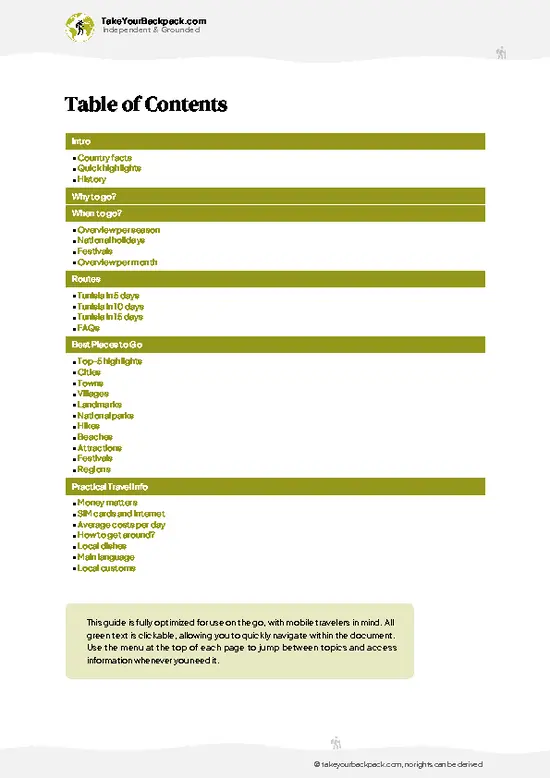
Discover everything you want to know in the 📖 Tunisia Travel Guide.


Get your Tunisia guide
97 ranked highlights, routes & tips, works offline (372 pages)
Loading the map 🌍
CLICK TO FILTER
cities
towns
villages
landmarks
national parks
hikes
beaches
attractions
festivals
regions
SHOW COUNTRY’S BESTSHOW ALL

✨ Why go?
Ranked #6 attraction in Tunisia
Why visitors keep coming back

The Sousse Archaeological Museum isn’t some flashy Instagram backdrop where you snap a quick selfie and move on. It’s a heavyweight in Tunisia’s cultural lineup, demanding your time because it holds the keys to understanding the country’s layered past. Sure, the crowds can swell, especially in peak season, and the entry fee isn’t pocket change for a backpacker on a shoestring. But here’s the kicker: this place is a vault of Roman mosaics that are not just old—they’re masterpieces of ancient craftsmanship, vivid enough to make you forget you’re staring at stones.

This museum isn’t just about artifacts; it’s a gateway to Tunisia’s identity, bridging Phoenician, Roman, and early Christian histories in a way few other sites do. For anyone trekking the Mediterranean coast, it’s a milestone that … read more 👉
The Sousse Archaeological Museum isn’t some flashy Instagram backdrop where you snap a quick selfie and move on. It’s a heavyweight in Tunisia’s cultural lineup, demanding your time because it holds the keys to understanding the country’s layered past. Sure, the crowds can swell, especially in peak season, and the entry fee isn’t pocket change for a backpacker on a shoestring. But here’s the kicker: this place is a vault of Roman mosaics that are not just old—they’re masterpieces of ancient craftsmanship, vivid enough to make you forget you’re staring at stones.

This museum isn’t just about artifacts; it’s a gateway to Tunisia’s identity, bridging Phoenician, Roman, and early Christian histories in a way few other sites do. For anyone trekking the Mediterranean coast, it’s a milestone that rewards effort with a deep dive into the region’s soul. The adrenaline here isn’t from adrenaline sports but from the thrill of standing face-to-face with history that shaped entire civilizations. If you’re serious about grasping Tunisia beyond the beaches and markets, skipping Sousse Archaeological Museum means missing the backbone of the country’s story. It’s a tough ticket, but the payoff is a rare kind of magic—one that sticks with you long after you’ve left.
Want to include Sousse Archaeological Museum in your Tunisia route?
Create a personalized Tunisia itinerary that includes Sousse Archaeological Museum and the places that fit your trip — based on your travel style, budget, and available time. Get your route in seconds.

Generate my trip

💡 HighlightsEssential experiences to have while visiting Sousse Archaeological Museum

The Mosaic Hall
Forget the Instagrammed fragments—this is the heavyweight championship of Roman mosaics. The Sousse Museum doesn’t just have a few pretty tiles; it’s a full-on riot of color and storytelling, with entire floors and walls covered in scenes that range from mythological drama to daily life. You’ll see Neptune riding his chariot, Medusa glaring with all her snaky menace, and a wild party of sea creatures that would make any modern pool party look tame. The sheer scale and preservation here put most European collections to shame. Stand in the middle of the hall and let your eyes adjust—there’s a reason scholars and artists make pilgrimages here.


The Medusa Mosaic
This isn’t just another Medusa. The Sousse version is a psychological thriller in stone and glass. Her eyes follow you, … read more 👉
The Mosaic Hall
Forget the Instagrammed fragments—this is the heavyweight championship of Roman mosaics. The Sousse Museum doesn’t just have a few pretty tiles; it’s a full-on riot of color and storytelling, with entire floors and walls covered in scenes that range from mythological drama to daily life. You’ll see Neptune riding his chariot, Medusa glaring with all her snaky menace, and a wild party of sea creatures that would make any modern pool party look tame. The sheer scale and preservation here put most European collections to shame. Stand in the middle of the hall and let your eyes adjust—there’s a reason scholars and artists make pilgrimages here.


The Medusa Mosaic
This isn’t just another Medusa. The Sousse version is a psychological thriller in stone and glass. Her eyes follow you, her hair writhes, and the craftsmanship is so sharp you can almost feel the tension. It’s not tucked away behind glass; you’re face-to-face with a piece of ancient horror-movie magic. If you want to see how Roman artists could make a myth feel dangerous and alive, this is your moment.


The Punic and Early Christian Artifacts
Most people come for the Roman stuff, but the museum’s Punic and early Christian rooms are where you get the real plot twists. You’ll find steles, amulets, and everyday objects that survived Carthaginian conquest, Roman rule, and the dawn of Christianity. These aren’t just relics—they’re the fingerprints of civilizations that refused to be erased. The contrast between the pagan and Christian iconography is a crash course in Tunisia’s layered identity, and it’s all laid out without the usual museum sugarcoating.


The Roman Sarcophagi
If you think sarcophagi are just stone boxes, you haven’t seen these. The Sousse collection is carved with scenes that are equal parts epic and intimate—banquets, battles, and even family pets. There’s a rawness to the detail that makes you forget you’re looking at funerary art. It’s a reminder that the Romans didn’t just want to be remembered—they wanted to be immortalized in style.


The Setting: Inside the Kasbah
Here’s the twist Instagram never tells you: the museum itself is inside a medieval fortress. You’ll climb stone steps, pass through echoing halls, and get hit with panoramic views of Sousse’s medina and the Mediterranean. The fortress setting isn’t just a backdrop—it’s a living part of the experience. You’re not shuffling through sterile galleries; you’re exploring a space that’s been a seat of power, a military outpost, and now, a vault for Tunisia’s greatest treasures. The sense of place is unbeatable.


The Everyday Objects
Skip the gold and jewels—what really lands are the oil lamps, combs, and children’s toys. These are the artifacts that make the ancient world feel close enough to touch. You’ll see the fingerprints of real people, not just emperors and gods. It’s a quiet thrill, but it’s the kind that sticks with you long after you’ve left the fortress walls.
Spotted a mistake or missing something? Contact us.

Things to do around Sousse Archaeological Museum

Ratings based on Tripadvisor reviews. When you book through this link, you support our work at no extra cost to you.

🌤️ When to go?When to go for the best experience


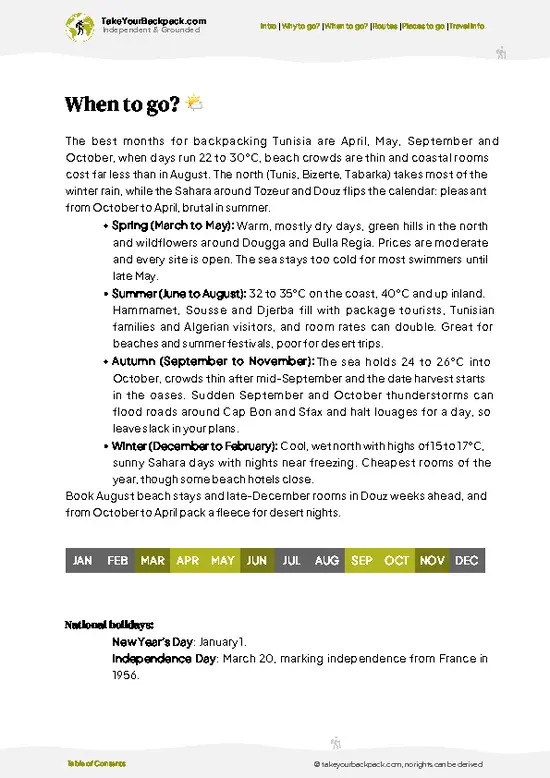
  • Weather: The best weather hits between March and May or September to November. You’ll dodge the brutal summer heat that can spike above 35°C (95°F), making museum visits sweaty and miserable. Spring and fall bring mild, dry days perfect for wandering without overheating.

  • Temperature: Expect comfortable highs around 20-25°C (68-77°F) in spring and autumn. Winters (December to February) can be cooler, dipping to 10°C (50°F) at night, but still bearable. Summer’s relentless sun can push temps to 38°C (100°F) or more, which drains energy fast.

  • Daylight Hours: Longer days from April to September give you more time to explore. In winter, daylight shrinks to about 10 hours, which limits your window for sightseeing and can make the museum feel a bit more cramped with visitors during those hours.
read more 👉

  • Weather: The best weather hits between March and May or September to November. You’ll dodge the brutal summer heat that can spike above 35°C (95°F), making museum visits sweaty and miserable. Spring and fall bring mild, dry days perfect for wandering without overheating.

  • Temperature: Expect comfortable highs around 20-25°C (68-77°F) in spring and autumn. Winters (December to February) can be cooler, dipping to 10°C (50°F) at night, but still bearable. Summer’s relentless sun can push temps to 38°C (100°F) or more, which drains energy fast.

  • Daylight Hours: Longer days from April to September give you more time to explore. In winter, daylight shrinks to about 10 hours, which limits your window for sightseeing and can make the museum feel a bit more cramped with visitors during those hours.

  • Crowds: Peak tourist season is July and August, when the museum and town swell with visitors. If you want elbow room and a quieter vibe, aim for shoulder seasons—April, May, September, or October—when the crowds thin but the museum is fully operational.

  • Seasonal Activities: Spring and fall bring local festivals and markets nearby, adding layers to your visit beyond the museum walls. Summer’s heat often pushes locals indoors, so you miss out on that authentic street buzz.

  • Price Fluctuations: Entrance fees stay fairly stable year-round, but accommodation and flights spike in summer. Visiting off-peak means better deals on lodging and fewer tourists competing for the same experience.


Pro-tip: Visit in late April or early October to balance perfect weather, manageable crowds, and a richer cultural scene around the museum.


source: climatestotravel.comJANJanuary: good for travelingFEBFebruary: good for travelingMARMarch: highly recommended for travelingAPRApril: excellent for travelingMAYMay: excellent for travelingJUNJune: good for travelingJULJuly: fair for travelingAUGAugust: fair for travelingSEPSeptember: excellent for travelingOCTOctober: excellent for travelingNOVNovember: highly recommended for travelingDECDecember: good for traveling
when-to-go

✈️ The backpacker research shortcutTunisia Travel Guide

An offline-friendly backpacking guide with optimized travel routes, ranked highlights, transport advice, and the best areas to stay.
example page 0 from our offline Travel Guide for Tunisia
example page 1 from our offline Travel Guide for Tunisia
example page 2 from our offline Travel Guide for Tunisia
example page 3 from our offline Travel Guide for Tunisia
example page 4 from our offline Travel Guide for Tunisia
example page 5 from our offline Travel Guide for Tunisia
example page 6 from our offline Travel Guide for Tunisia
example page 7 from our offline Travel Guide for Tunisia
The digital guide (372 pages) contains:
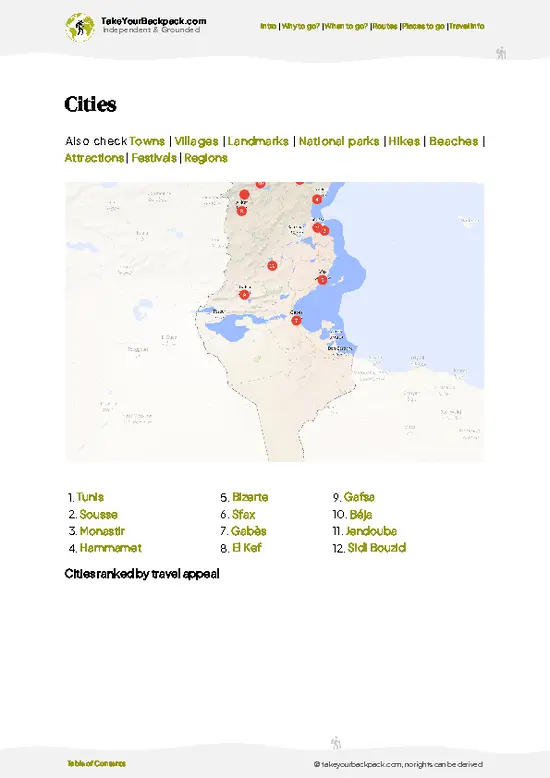
97 highlights, ranked by travel appeal
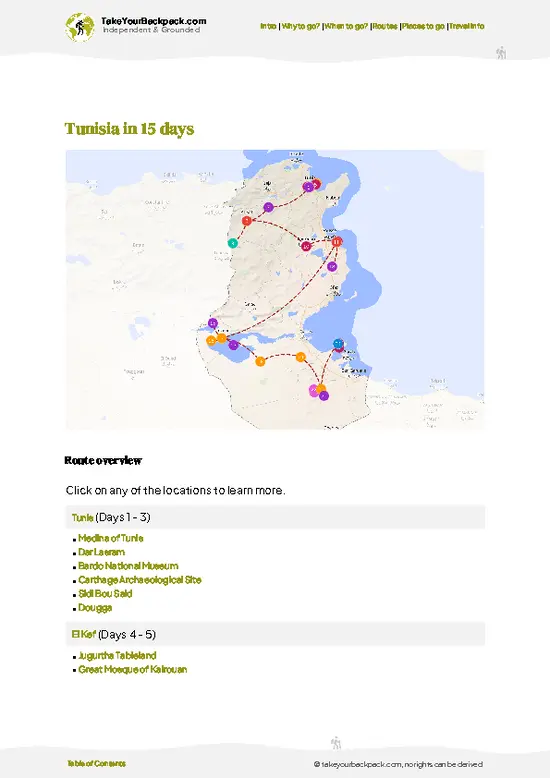
Optimized 5, 10 & 15-day travel routes
Cities, national parks, landmarks, beaches
How to get around
Offline-friendly for travel without Wi-Fi
👉 Click to see all 30+ guide features

📅 Plan smarter in minutes, not weeks
Month by month travel advice
Festivals & national holidays
Budget expectations

🗺️ Go to the right places, skip the overrated ones
Honest pros & cons of destinations
Top hikes, parks & viewpoints
Lesser-known places most travelers miss
Clear “worth it vs skip it” guidance

🛏️ Travel smoothly without rookie mistakes
Best areas to stay
Transport systems explained simply
Common scams & safety advice
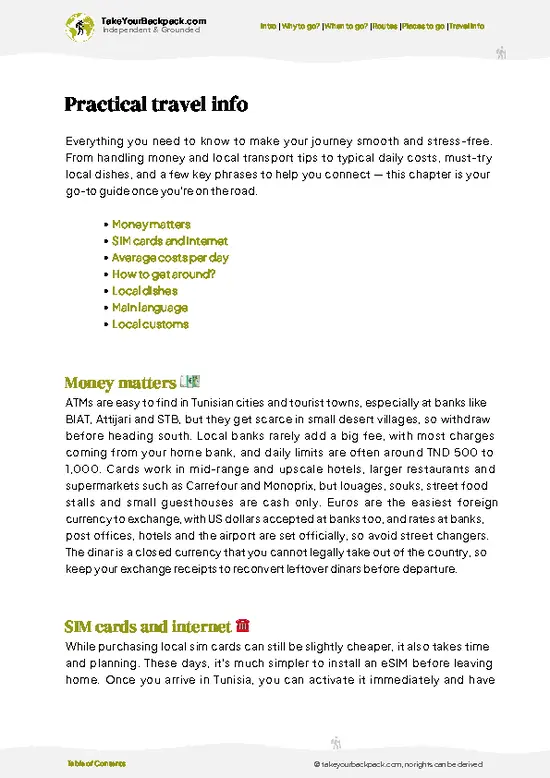
SIM cards, money & practical tips

🌍 Understand the country, not just visit it
Culture & traditions
52 Essential phrases & customs
Festivals worth planning around
Traveler-friendly historical context
Insights that make places more meaningful

📱 Built for real travel conditions
Fully downloadable PDF
Works completely offline
Optimized for phone use
Useful in remote areas & buses
Everything in one place
Save weeks of stressful planning
Get instant access to your full guide. 30‑day money-back guarantee.


By proceeding you agree to our terms.
Sent to your inbox immediately after payment • 100% Secure Checkout
Best Backpacking Travel Advisor 2025 tourism awardBest Backpacking
Travel Advisor
2025
What others say about Take Your Backpack Guides:
⭐⭐⭐⭐⭐
Fantastic, amazing amount of information!
⭐⭐⭐⭐⭐
My goodness this is amazing, it's what I've been looking for hats off too you!
⭐⭐⭐⭐⭐
I think this is absolutely BRILLIANT
⭐⭐⭐⭐
Very complete and informative. It's still missing places, but I gotta to commend you
⭐⭐⭐⭐⭐
This is truly amazing, thank you, can't wait to explore it with my kids!
⭐⭐⭐⭐⭐
Awesome resource, thank you!
⭐⭐⭐⭐⭐
This is amazing! Can't wait to explore the ones I haven't seen
⭐⭐⭐⭐
I love this! Well done, great idea.
⭐⭐⭐⭐⭐
Thanks for taking the time to make this gem!
⭐⭐⭐⭐⭐
This might be the best website I've ever seen.
⭐⭐⭐⭐⭐
Congratulations, and thank you so much for your work; it's incredibly valuable.
⭐⭐⭐⭐
In all seriousness I think you did a great job pointing out the important spots
⭐⭐⭐⭐⭐
10/10 very good
⭐⭐⭐⭐⭐
As someone who's only just starting to visit regularly this is awesome, thank you.
⭐⭐⭐⭐
Thank you very much! I'm going to visit my dad, it's going to be very useful!
⭐⭐⭐⭐⭐
This is really cool! We'll be travelling for the first time and this definitely come in handy.
⭐⭐⭐⭐⭐
You are now our minister of culture, congratulations 👨‍💼
⭐⭐⭐⭐⭐
Just wanted to tell you that this is a pearl! Going to follow your recommendations.
⭐⭐⭐⭐⭐
This is so cool. I'll definitely be using the resource for my travels soon.
⭐⭐⭐⭐⭐
This is very impressive! Good work.
⭐⭐⭐⭐⭐
This is an amazing and informative site. Very well done!

🛏️ Where to stay?Best areas to stay in Tunisia

If you’re backpacking to see the Sousse Archaeological Museum, you’re in for more than just dusty artifacts. But let’s clear the air first: this place isn’t a quiet, untouched relic. It’s smack in the middle of Sousse’s bustling medina, which means crowds, noise, and a swirl of daily life that’s as chaotic as it is captivating. If you’re expecting serene solitude, you’ll be disappointed. But if you want to dive headfirst into a living, breathing city with history layered in every corner, you’re in the right spot.

For backpackers, the best areas to crash are within or just outside the medina walls. … read more 👉
If you’re backpacking to see the Sousse Archaeological Museum, you’re in for more than just dusty artifacts. But let’s clear the air first: this place isn’t a quiet, untouched relic. It’s smack in the middle of Sousse’s bustling medina, which means crowds, noise, and a swirl of daily life that’s as chaotic as it is captivating. If you’re expecting serene solitude, you’ll be disappointed. But if you want to dive headfirst into a living, breathing city with history layered in every corner, you’re in the right spot.

For backpackers, the best areas to crash are within or just outside the medina walls. Staying inside the medina puts you steps from the museum and the Ribat fortress, but it’s a maze of narrow alleys packed with locals, vendors, and tourists alike. It’s safe, but you need to keep your wits about you—pickpockets can be a thing here. The upside? You’re immersed in authentic street life, with plenty of cheap eats, buzzing cafés, and chances to meet fellow travelers and locals.

If you want a bit more breathing room without losing the vibe, the neighborhoods just outside the medina—like near the beachfront or the Ville Nouvelle—offer safer, quieter streets with hostels and guesthouses that attract solo backpackers. These spots are social hubs where you can swap stories over mint tea or a cold beer after a day of museum-hopping.

Bottom line: don’t come here expecting polished tourist traps. Come ready to embrace the noise, the crowds, and the real pulse of Sousse. That’s where the magic lives.

👛 Costs (as of 21 May 2025)Typical daily expenses

As of the most recent estimates, the entrance fee for the Sousse Archaeological Museum is approximately €3 for adults and €1.50 for students. Photography inside the museum may incur an additional fee of €0.30. The museum is open daily from 9:00 AM to 5:00 PM, except on Mondays when it is closed.
⚠️ Prices can change and everyone travels differently, so take this as a rough guide. Hope it helps you plan your adventure!

Other Tunisian attractions near Sousse Archaeological Museum

Explore more nearby:


💡 Not sure where to go next?
Create a personalized itinerary for Tunisia including Sousse Archaeological Museum and the places that fit your trip.

Generate my itinerary

👉 Discover all attractions

Or checkout all Tunisia has to offer (think cities, towns, villages, national parks, hikes, beaches, festivals)
Country photo of Tunisia

We 💚 feedbackWhat to keep in mind

The Sousse Archaeological Museum isn’t some quiet, off-the-beaten-path relic—expect a steady stream of tourists, especially midday. But here’s the kicker: once you tune out the crowd, the sheer scale of Roman mosaics and the way the light hits those ancient stones hits different. It’s not just history; it’s a raw, tactile connection to a world that shaped the Mediterranean. If you’re into genuine, gritty encounters with the past, this place punches way above its weight. Just go early, grab a guide if you can, and soak it in without the rush.

✍️ Help improve this page!
The information on this page is based on in-depth research, insights shared by experienced travelers, and feedback from the local travel community in Tunisia. While every effort is made to keep the information accurate and current, conditions can change — so if you spot anything incorrect or outdated, please get in touch.


🙋‍♂️ Give feedback

👋 Meet the founderWho’s Behind Take Your Backpack?

Johan, backpacker and founder of TakeYourBackpackHi, I’m Johan (Netherlands 🇳🇱), the creator of TakeYourBackpack. Over the past decade, I’ve backpacked through 80+ countries across six continents, gaining extensive experience with independent travel, long-term trips, and overland routes.

This site is built on a combination of firsthand travel experience and carefully curated insights from other backpackers. Many guides are based on places I’ve personally visited, while others bring together tips, observations, and practical advice shared by trusted travelers I’ve met along the way.

The goal is to provide realistic, experience-driven guidance — not generic itineraries — so you can explore destinations with better context, clearer expectations, and more confidence.

Get full Tunisia guide •
Instant download • 97 highlights • Full Offline guide