×

Tuvalu🇹🇻 | best attractionsBest 3 attractions in Tuvalu

Tuvalu has no ticketed sights, only lagoon, reef and village life on nine tiny atolls. Nearly everything happens on Funafuti, where flights land and guesthouses sit within a short walk of each other. The outer islands cost more in time than money and run on ferry schedules. Independent travelers should plan around tides, flights and the weekly rhythm of island life.

By Johan Kruseman 🇳🇱 | Updated October 18, 2026
Explore the best festivals in Tuvalu

Why go?What Makes Them Special

Tuvalu is one of the smallest and least visited countries on earth, and that shapes everything. Attractions here are lagoons, reefs and community life, with no museums circuit or tour industry to smooth the way. The highest ground sits only a few meters above sea level, so the climate story is visible everywhere, from king tide flooding to eroded shorelines. Expect limited infrastructure: a handful of guesthouses, few flights a week from Fiji, imported food and patchy internet. Bring cash in Australian dollars, the currency Tuvalu uses, since card acceptance is thin. Plan flexibly, because delays are normal and a flight change can reshuffle your whole week. Come for quiet, water and conversation, and you will be well matched.
Why These Made the Cut
The list of best attractions in Tuvalu is created based on cultural significance or entertainment value. If you feel a attraction is missing in this list, please let us know.

When to go?When to Plan Your Trip

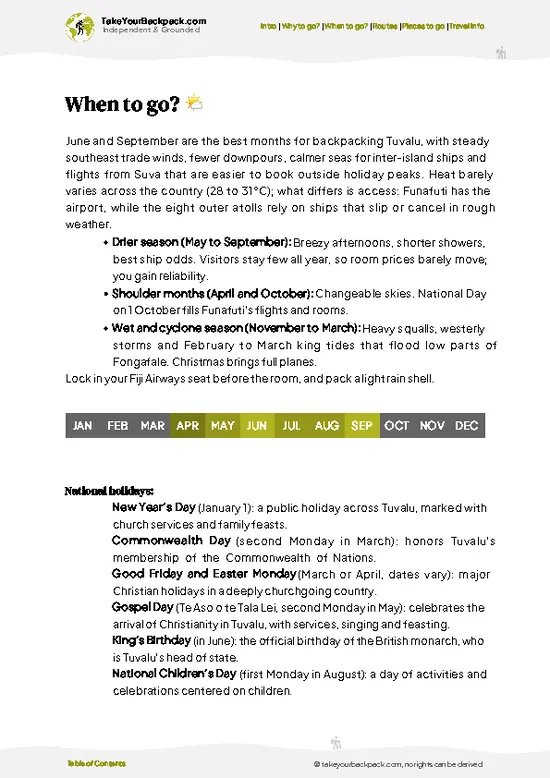
Best months and weather: The best window is May to October, when the dry season brings less rain, lighter humidity and calmer days for lagoon and reef time. Temperatures stay near 28 to 32°C all year, so heat is constant rather than seasonal. Wet season and shoulder months: From November to April rain is heavier, often 250 to 400 mm a month, and cyclone risk rises, mainly between December and March. Flights and boats can be disrupted, so leave slack in your plans. King tides in roughly February and again around the cooler months can flood low areas of Funafuti, which is interesting to witness but awkward for moving about. Crowds are never an issue and prices barely shift by season, so choose by weather and your appetite for flexibility.

attraction hoppingOptimizing Your Multi-Stop Itinerary

Trip length and direction: A trip combining several attractions in Tuvalu needs 7 to 10 days, and more if you add an outer island. Start and finish on Funafuti, because the international flights from Fiji land there and all return connections run through it. Give the capital atoll 2 to 4 days, then add an outer island such as Vaitupu or Nanumea for 3 to 5 days. Pacing and common mistakes: Travel between atolls by the government ferry takes roughly 1 to 2 days each way, and sailings are infrequent. The classic mistake is squeezing in several outer islands, then missing the flight home. Another is booking tight onward connections in Fiji. Build in a buffer of 2 to 3 days, confirm ferry dates on arrival, and keep the last day free.

The ListMust-Visit attractions in Tuvalu

1 Tuvalu Women’s Handicraft Centre

Pandanus mats, woven fans, cowrie necklaces, coconut-fiber cord

Watch women plait dried pandanus into mats, fans and baskets, then pick a piece with a tight, even weave and meet its maker.

tuvalu-attraction-tuvalu-womens-handicraft-centre
© Google |

2 Tuvalu Philatelic Bureau

Themed stamp sheets, first day covers, own-issue coins, postcard counter

Browse reef fish, seabird and shell issues at the source, then write a card and post it at the Funafuti Post Office.

3 Tuvalu National Library and Archives

Tuvalu book collection, colonial-era records, quiet reading room, Vaiaku offices

Read about Tuvaluan history and customs in a shaded, breezy room, then stroll past the ministries that run the country.

Loading the map 🌍

Expert viewExpert Commentary on attractions

How many to visit: I advise 4 to 6 attractions in total. Transport is slow, schedules shift, and a packed list breaks the first time a boat is late. What to prioritize: If you like water, put lagoon and reef time first. If you travel for people, choose community experiences, like village gatherings or church services, where being invited matters more than the activity. Outer islands suit slow travelers with spare days, while Funafuti suits short stays. Budget: Plan US$80 to 150 a day, since imported food and limited lodging keep prices high. Guesthouses cost about US$50 to 100 a night, meals US$10 to 25, and a lagoon boat trip with a local guide roughly US$30 to 80 per person depending on group size. Outer island ferries and flights cost extra and vary, so carry Australian dollars in cash. … read more 👉
How many to visit: I advise 4 to 6 attractions in total. Transport is slow, schedules shift, and a packed list breaks the first time a boat is late. What to prioritize: If you like water, put lagoon and reef time first. If you travel for people, choose community experiences, like village gatherings or church services, where being invited matters more than the activity. Outer islands suit slow travelers with spare days, while Funafuti suits short stays. Budget: Plan US$80 to 150 a day, since imported food and limited lodging keep prices high. Guesthouses cost about US$50 to 100 a night, meals US$10 to 25, and a lagoon boat trip with a local guide roughly US$30 to 80 per person depending on group size. Outer island ferries and flights cost extra and vary, so carry Australian dollars in cash. Most community sights have no fixed entry fee, but a small gift or donation of about US$5 to 10 is appreciated. Safety: Crime is low, but sea conditions are the real risk. Currents flow strongly through reef passes, so swim only with local advice and never alone. Cover up from the sun, and carry plenty of drinking water because rainwater supplies are limited. Culture: Tuvalu is a deeply Christian and community-led society. Dress modestly away from the beach, with shoulders and knees covered. Sunday is rest and church, so expect almost no activities. Ask before photographing people or ceremonies, and accept invitations to a meal or a fatele dance night with a small contribution to the host. Land and lagoon often belong to families, so check with your guesthouse before wandering or fishing.

✈️ The backpacker research shortcutTuvalu Travel Guide

An offline-friendly backpacking guide with optimized travel routes, ranked highlights, transport advice, and the best areas to stay.
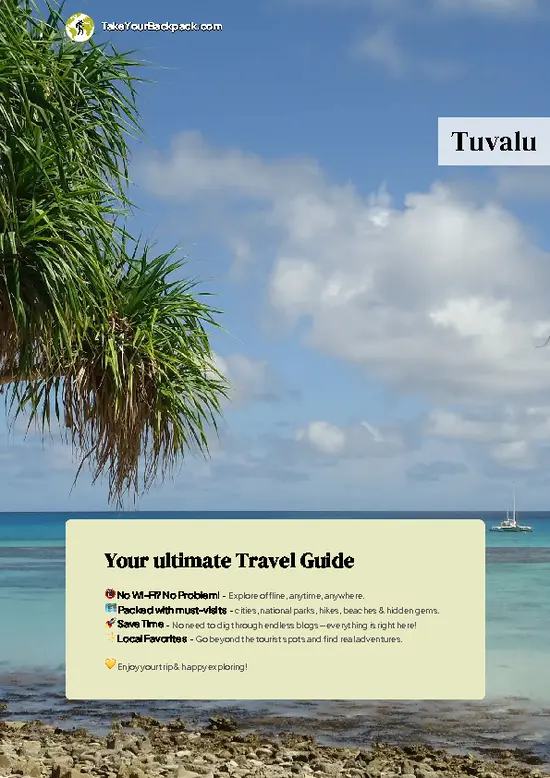
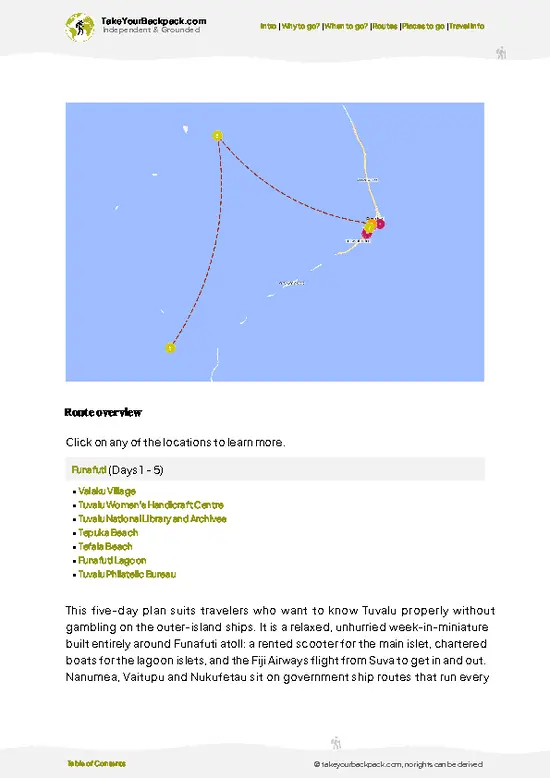
example page 0 from our offline Travel Guide for Tuvalu
example page 1 from our offline Travel Guide for Tuvalu
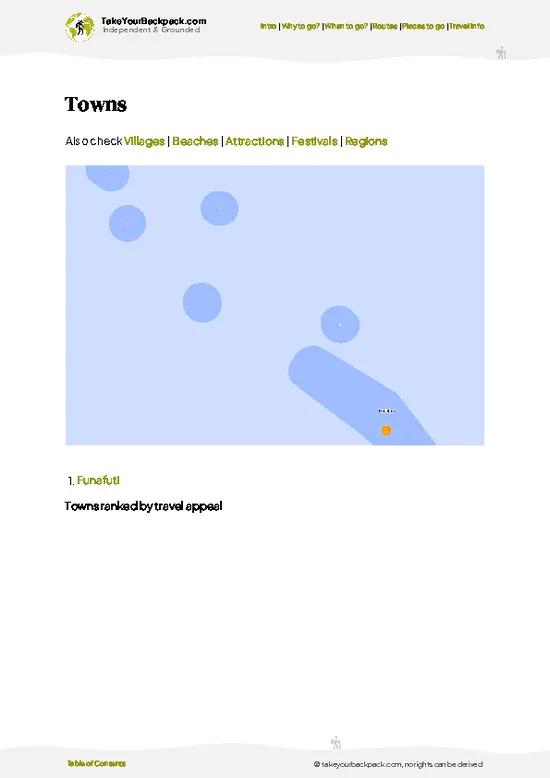
example page 2 from our offline Travel Guide for Tuvalu
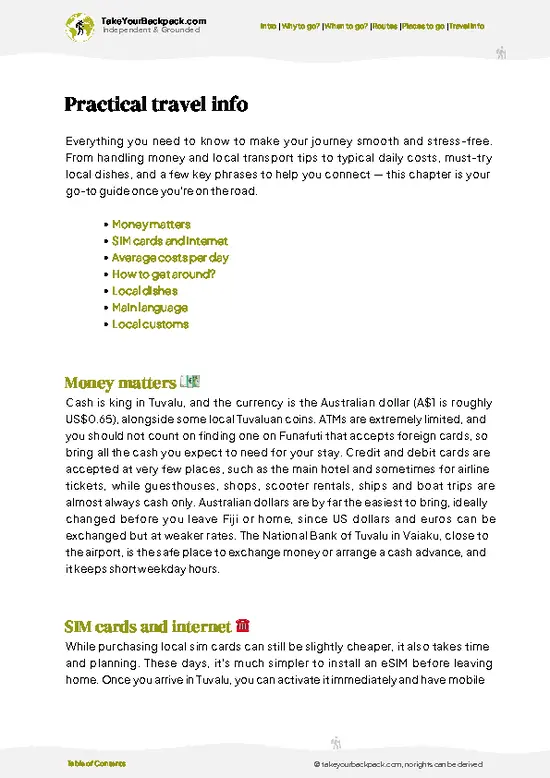
example page 3 from our offline Travel Guide for Tuvalu
example page 4 from our offline Travel Guide for Tuvalu
example page 5 from our offline Travel Guide for Tuvalu
example page 6 from our offline Travel Guide for Tuvalu
example page 7 from our offline Travel Guide for Tuvalu
The digital guide (97 pages) contains:
✅ 20 highlights, ranked by travel appeal
✅ Optimized 2, 3 & 5-day travel routes
✅ Cities, national parks, landmarks, beaches
✅ How to get around
✅ Offline-friendly for travel without Wi-Fi
👉 Click to see all 30+ guide features

📅 Plan smarter in minutes, not weeks
✅ Month by month travel advice
✅ Festivals & national holidays
✅ Budget expectations

🗺️ Go to the right places, skip the overrated ones
✅ Honest pros & cons of destinations
✅ Top hikes, parks & viewpoints
✅ Lesser-known places most travelers miss
✅ Clear “worth it vs skip it” guidance

🛏️ Travel smoothly without rookie mistakes
✅ Best areas to stay
✅ Transport systems explained simply
✅ Common scams & safety advice
✅ SIM cards, money & practical tips

🌍 Understand the country, not just visit it
✅ Culture & traditions
✅ 52 Essential phrases & customs
✅ Festivals worth planning around
✅ Traveler-friendly historical context
✅ Insights that make places more meaningful

📱 Built for real travel conditions
✅ Fully downloadable PDF
✅ Works completely offline
✅ Optimized for phone use
✅ Useful in remote areas & buses
✅ Everything in one place
Stop searching, start planning
Get instant access to your full guide. 30‑day money-back guarantee.
+ Add another guide for just

By proceeding you agree to our terms.
Sent to your inbox immediately after payment • 100% Secure Checkout
Best Backpacking Travel Advisor 2025 tourism awardBest Backpacking
Travel Advisor
2025
What others say about Take Your Backpack Guides:
⭐⭐⭐⭐⭐
Fantastic, amazing amount of information!
⭐⭐⭐⭐⭐
My goodness this is amazing, it's what I've been looking for hats off too you!
⭐⭐⭐⭐⭐
I think this is absolutely BRILLIANT
⭐⭐⭐⭐
Very complete and informative. It's still missing places, but I gotta to commend you
⭐⭐⭐⭐⭐
This is truly amazing, thank you, can't wait to explore it with my kids!
⭐⭐⭐⭐⭐
Awesome resource, thank you!
⭐⭐⭐⭐⭐
This is amazing! Can't wait to explore the ones I haven't seen
⭐⭐⭐⭐
I love this! Well done, great idea.
⭐⭐⭐⭐⭐
Thanks for taking the time to make this gem!
⭐⭐⭐⭐⭐
This might be the best website I've ever seen.
⭐⭐⭐⭐⭐
Congratulations, and thank you so much for your work; it's incredibly valuable.
⭐⭐⭐⭐
In all seriousness I think you did a great job pointing out the important spots
⭐⭐⭐⭐⭐
10/10 very good
⭐⭐⭐⭐⭐
As someone who's only just starting to visit regularly this is awesome, thank you.
⭐⭐⭐⭐
Thank you very much! I'm going to visit my dad, it's going to be very useful!
⭐⭐⭐⭐⭐
This is really cool! We'll be travelling for the first time and this definitely come in handy.
⭐⭐⭐⭐⭐
You are now our minister of culture, congratulations 👨‍💼
⭐⭐⭐⭐⭐
Just wanted to tell you that this is a pearl! Going to follow your recommendations.
⭐⭐⭐⭐⭐
This is so cool. I'll definitely be using the resource for my travels soon.
⭐⭐⭐⭐⭐
This is very impressive! Good work.
⭐⭐⭐⭐⭐
This is an amazing and informative site. Very well done!

🛏️ Where to stay?Where to Stay: Tuvalu Edition

Tuvalu has no true hostels, so budget travel here means small family guesthouses and a few simple lodges on Funafuti, typically A$60 to 150 (about US$40 to 100) a night for a private room, often with shared bathrooms. Vaiaku, the central stretch facing the lagoon, has the most options and puts you a short walk from the airport, government offices, shops and the island’s handful of bars, though evenings bring motorbike noise and crowds playing sport on the runway. The quieter village areas further along Fongafale islet, plus basic homestays on outer islands such as Nanumea or Nukulaelae, trade convenience for calm, very safe nights and a real look at village life, but you will need a scooter … read more 👉
Tuvalu has no true hostels, so budget travel here means small family guesthouses and a few simple lodges on Funafuti, typically A$60 to 150 (about US$40 to 100) a night for a private room, often with shared bathrooms. Vaiaku, the central stretch facing the lagoon, has the most options and puts you a short walk from the airport, government offices, shops and the island’s handful of bars, though evenings bring motorbike noise and crowds playing sport on the runway. The quieter village areas further along Fongafale islet, plus basic homestays on outer islands such as Nanumea or Nukulaelae, trade convenience for calm, very safe nights and a real look at village life, but you will need a scooter on Funafuti and patience with the infrequent boats to the outer islands.

If you enjoy meeting fellow travelers, consider choosing hostels with high ratings for atmosphere. On the other hand, if you prefer having your own space, a hotel might be a better option.

TuvaluExplore Beyond This Category

👋 Meet the founderWho’s Behind Take Your Backpack?

Johan, backpacker and founder of TakeYourBackpackHi, I’m Johan (Netherlands 🇳🇱), the creator of TakeYourBackpack. Over the past 3 decades, I’ve backpacked through 90+ countries across six continents, gaining extensive experience with independent travel, long-term trips, and overland routes.

This site is built on a combination of firsthand travel experience and carefully curated insights from other backpackers. Many guides are based on places I’ve personally visited, while others bring together tips, observations, and practical advice shared by trusted travelers I’ve met along the way.

The goal is to provide realistic, experience-driven guidance — not generic itineraries — so you can explore destinations with better context, clearer expectations, and more confidence.