×

Tuvalu🇹🇻 | attractionsTuvalu Philatelic BureauThemed stamp sheets, first day covers, own-issue coins, postcard counter | things to do and best time to go

Explore Tuvalu Women’s Handicraft CentreExplore Tuvalu National Library and Archives

Backpacking in Tuvalu Philatelic Bureau
🌟 Highlightattraction ranked #2
By Johan Kruseman 🇳🇱 | Updated October 15, 2026

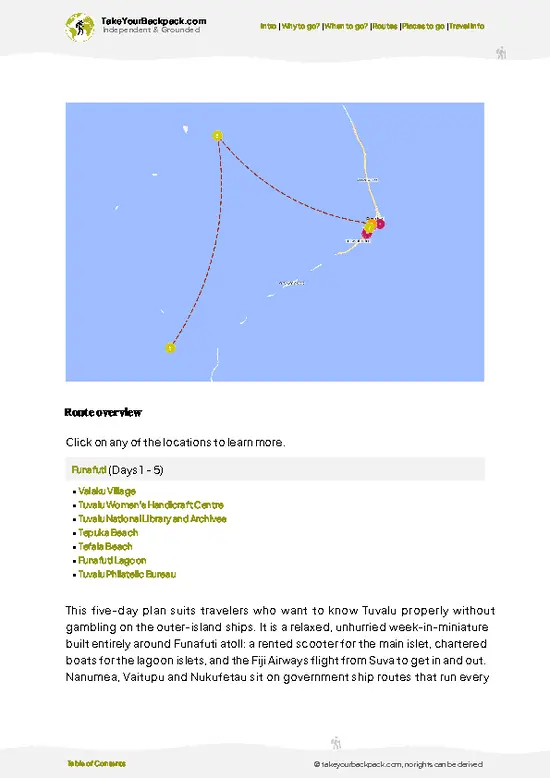
Stamps are the draw: sheets, first day covers and collector sets covered in Tuvalu’s reef fish, seabirds and shells, bought at the counter where they originate. What travelers overlook is that the bureau is the quickest lesson in how a nation of roughly 11,000 people spread over nine tiny atolls earns money from the outside world. It sits in the Vaiaku area of Funafuti, in Tuvalu’s capital, a few minutes on foot from the airstrip. Give it thirty to forty minutes. That is plenty, and I would not plan a half day around it. If you don’t collect, still go, because a postcard stamped here beats any souvenir shop trinket. Go on a weekday morning, before the heat settles and while the counter is staffed. Your first day could run like this: drop your bags, stroll over mid-morning, buy stamps, post a card, then walk the runway at dusk.

Discover everything you want to know in the 📖 Tuvalu Travel Guide.


example page 0 from our offline Travel Guide for Tuvalu
example page 1 from our offline Travel Guide for Tuvalu
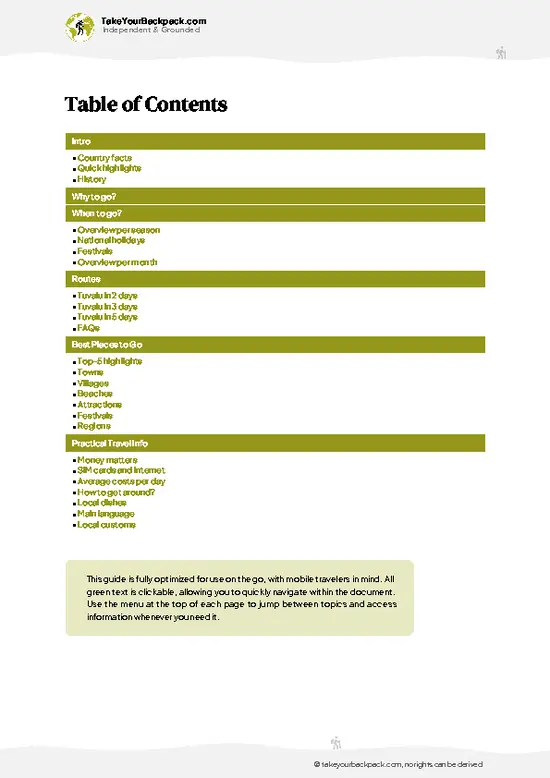
example page 2 from our offline Travel Guide for Tuvalu
example page 3 from our offline Travel Guide for Tuvalu
example page 4 from our offline Travel Guide for Tuvalu
example page 5 from our offline Travel Guide for Tuvalu
example page 6 from our offline Travel Guide for Tuvalu
example page 7 from our offline Travel Guide for Tuvalu
Loading the map 🌍
CLICK TO FILTER
towns
villages
beaches
attractions
festivals
regions
SHOW COUNTRY’S BESTSHOW ALL

✨ Why go?
Ranked #2 attraction in Tuvalu
Why Tuvalu Philatelic Bureau should be on your travel list

Tuvalu has few conventional sights, so the places that explain the country carry extra weight, and this is one of them. Tuvalu’s own stamps have been issued since the islands separated from the Gilbert Islands in the 1970s, and they have become a small national export that reaches collectors in dozens of countries. Standing at the source, you can see how a country with almost no land area and no big industry presents itself to the world: its marine life, its canoes, its dances, its politics.

The second reason is practical. Mail is the one souvenir that proves you got here. A card with Tuvalu postmarks and local stamps is rarer than anything in a gift shop, and it costs very little to send. The third is pacing. Funafuti’s days are slow, and an errand with a purpose, a counter, a clerk and … read more 👉
Tuvalu has few conventional sights, so the places that explain the country carry extra weight, and this is one of them. Tuvalu’s own stamps have been issued since the islands separated from the Gilbert Islands in the 1970s, and they have become a small national export that reaches collectors in dozens of countries. Standing at the source, you can see how a country with almost no land area and no big industry presents itself to the world: its marine life, its canoes, its dances, its politics.

The second reason is practical. Mail is the one souvenir that proves you got here. A card with Tuvalu postmarks and local stamps is rarer than anything in a gift shop, and it costs very little to send. The third is pacing. Funafuti’s days are slow, and an errand with a purpose, a counter, a clerk and a real conversation, gives you an easy way to meet people who work in town. Pair it with the post office next door, then spend the rest of your day on the lagoon.

💡 HighlightsTop highlights of Tuvalu Philatelic Bureau

  1. The Bureau’s stamp counter: The main event. Current and recent issues are laid out by theme, and staff will talk you through what is new. Marine life, birds and shells tend to be the most eye-catching sets.
  2. First day covers: Envelopes carrying a new issue with the day’s cancellation. They are the neatest keepsake here, light, flat and easy to carry in a daypack for the rest of your trip.
  3. Mint sheets and miniature sheets: Full sheets show the artwork at a size you can actually appreciate. Collectors tend to prize the miniature sheets, which often carry a scene across the whole panel.
  4. Tuvaluan coins: Tuvalu uses the Australian dollar, but it also issues its own coins, and the bureau is the place to ask about them. They make an unusual keepsake for anyone who likes small objects with a story.
  5. Posting
… read more 👉
  1. The Bureau’s stamp counter: The main event. Current and recent issues are laid out by theme, and staff will talk you through what is new. Marine life, birds and shells tend to be the most eye-catching sets.
  2. First day covers: Envelopes carrying a new issue with the day’s cancellation. They are the neatest keepsake here, light, flat and easy to carry in a daypack for the rest of your trip.
  3. Mint sheets and miniature sheets: Full sheets show the artwork at a size you can actually appreciate. Collectors tend to prize the miniature sheets, which often carry a scene across the whole panel.
  4. Tuvaluan coins: Tuvalu uses the Australian dollar, but it also issues its own coins, and the bureau is the place to ask about them. They make an unusual keepsake for anyone who likes small objects with a story.
  5. Posting a card at the Funafuti Post Office: Buy stamps, write the card on the spot, and drop it in the box. It is a small ritual, but it lets you see the stamps do their job. Cards can take a while to reach home, so expect to arrive after you do.
  6. Funafuti International Airport runway: A short walk from the bureau, the airstrip doubles as the town’s public space. In the late afternoon people play sport and sit on its edges, and then everyone clears off when a flight is due.
  7. Funafuti Conservation Area: Across the lagoon, this protected reserve covers islets, coral and nesting seabirds. Once you have seen the reef on a stamp, the real thing gives the artwork context. Arrange a boat through your accommodation.
For a first visit, start at the stamp counter and let the staff steer you to the newest issue, since that is where the bureau’s own story is clearest.
Spotted a mistake or missing something? Contact us.

🌤️ When to go?Best time to visit Tuvalu Philatelic Bureau

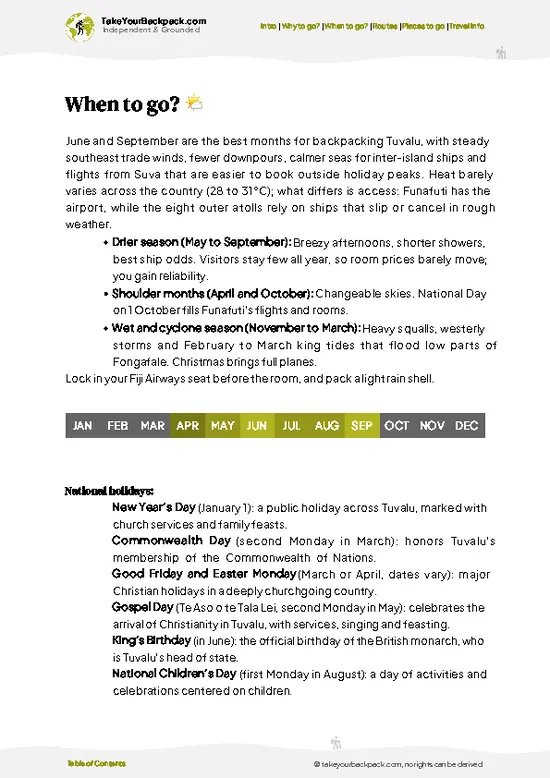
May to October is the easiest window for a visit to the Philatelic Bureau on Funafuti, with drier air and steadier trade winds.
  • Drier Season (May to October): Daytime highs run 29 to 31°C (84 to 88°F), nights around 26°C (79°F), and showers are shorter. Flights from Fiji are less likely to be disrupted, and the walk from the airstrip area is comfortable by mid-morning.
  • Wetter Season (November to April): Expect heavy downpours, humidity that makes shirts stick, and the cyclone risk peaks from roughly December to March. Highs are similar, 30 to 32°C (86 to 90°F). Flights can be delayed or canceled and king tides in February and March flood low streets.
  • Daylight and Crowds: Sunrise and sunset sit close to 6 am and 6 pm all year. The bureau is a small government office, so you will see few other
… read more 👉
May to October is the easiest window for a visit to the Philatelic Bureau on Funafuti, with drier air and steadier trade winds.
  • Drier Season (May to October): Daytime highs run 29 to 31°C (84 to 88°F), nights around 26°C (79°F), and showers are shorter. Flights from Fiji are less likely to be disrupted, and the walk from the airstrip area is comfortable by mid-morning.
  • Wetter Season (November to April): Expect heavy downpours, humidity that makes shirts stick, and the cyclone risk peaks from roughly December to March. Highs are similar, 30 to 32°C (86 to 90°F). Flights can be delayed or canceled and king tides in February and March flood low streets.
  • Daylight and Crowds: Sunrise and sunset sit close to 6 am and 6 pm all year. The bureau is a small government office, so you will see few other visitors in any month.
  • Prices: Flights and rooms barely change by season, though seats fill around December holidays when families return home.
Visit on a weekday morning, since the bureau keeps office hours and closes on weekends and public holidays.


source: climatestotravel.comJANJanuary: fair for travelingFEBFebruary: fair for travelingMARMarch: fair for travelingAPRApril: fair for travelingMAYMay: excellent for travelingJUNJune: excellent for travelingJULJuly: highly recommended for travelingAUGAugust: highly recommended for travelingSEPSeptember: excellent for travelingOCTOctober: excellent for travelingNOVNovember: fair for travelingDECDecember: fair for traveling
when-to-go

✈️ The backpacker research shortcutTuvalu Travel Guide

An offline-friendly backpacking guide with optimized travel routes, ranked highlights, transport advice, and the best areas to stay.
example page 0 from our offline Travel Guide for Tuvalu
example page 1 from our offline Travel Guide for Tuvalu
example page 2 from our offline Travel Guide for Tuvalu
example page 3 from our offline Travel Guide for Tuvalu
example page 4 from our offline Travel Guide for Tuvalu
example page 5 from our offline Travel Guide for Tuvalu
example page 6 from our offline Travel Guide for Tuvalu
example page 7 from our offline Travel Guide for Tuvalu
The digital guide (97 pages) contains:
✅ 20 highlights, ranked by travel appeal
✅ Optimized 2, 3 & 5-day travel routes
✅ Cities, national parks, landmarks, beaches
✅ How to get around
✅ Offline-friendly for travel without Wi-Fi
👉 Click to see all 30+ guide features

📅 Plan smarter in minutes, not weeks
✅ Month by month travel advice
✅ Festivals & national holidays
✅ Budget expectations

🗺️ Go to the right places, skip the overrated ones
✅ Honest pros & cons of destinations
✅ Top hikes, parks & viewpoints
✅ Lesser-known places most travelers miss
✅ Clear “worth it vs skip it” guidance

🛏️ Travel smoothly without rookie mistakes
✅ Best areas to stay
✅ Transport systems explained simply
✅ Common scams & safety advice
✅ SIM cards, money & practical tips

🌍 Understand the country, not just visit it
✅ Culture & traditions
✅ 52 Essential phrases & customs
✅ Festivals worth planning around
✅ Traveler-friendly historical context
✅ Insights that make places more meaningful

📱 Built for real travel conditions
✅ Fully downloadable PDF
✅ Works completely offline
✅ Optimized for phone use
✅ Useful in remote areas & buses
✅ Everything in one place
Stop searching, start planning
Get instant access to your full guide. 30‑day money-back guarantee.
+ Add another guide for just

By proceeding you agree to our terms.
Sent to your inbox immediately after payment • 100% Secure Checkout
Best Backpacking Travel Advisor 2025 tourism awardBest Backpacking
Travel Advisor
2025
What others say about Take Your Backpack Guides:
⭐⭐⭐⭐⭐
Fantastic, amazing amount of information!
⭐⭐⭐⭐⭐
My goodness this is amazing, it's what I've been looking for hats off too you!
⭐⭐⭐⭐⭐
I think this is absolutely BRILLIANT
⭐⭐⭐⭐
Very complete and informative. It's still missing places, but I gotta to commend you
⭐⭐⭐⭐⭐
This is truly amazing, thank you, can't wait to explore it with my kids!
⭐⭐⭐⭐⭐
Awesome resource, thank you!
⭐⭐⭐⭐⭐
This is amazing! Can't wait to explore the ones I haven't seen
⭐⭐⭐⭐
I love this! Well done, great idea.
⭐⭐⭐⭐⭐
Thanks for taking the time to make this gem!
⭐⭐⭐⭐⭐
This might be the best website I've ever seen.
⭐⭐⭐⭐⭐
Congratulations, and thank you so much for your work; it's incredibly valuable.
⭐⭐⭐⭐
In all seriousness I think you did a great job pointing out the important spots
⭐⭐⭐⭐⭐
10/10 very good
⭐⭐⭐⭐⭐
As someone who's only just starting to visit regularly this is awesome, thank you.
⭐⭐⭐⭐
Thank you very much! I'm going to visit my dad, it's going to be very useful!
⭐⭐⭐⭐⭐
This is really cool! We'll be travelling for the first time and this definitely come in handy.
⭐⭐⭐⭐⭐
You are now our minister of culture, congratulations 👨‍💼
⭐⭐⭐⭐⭐
Just wanted to tell you that this is a pearl! Going to follow your recommendations.
⭐⭐⭐⭐⭐
This is so cool. I'll definitely be using the resource for my travels soon.
⭐⭐⭐⭐⭐
This is very impressive! Good work.
⭐⭐⭐⭐⭐
This is an amazing and informative site. Very well done!

🛏️ Where to stay?Where staying makes the most sense

Stay on Funafuti itself, ideally along the central strip between the airstrip and the government area, because the bureau sits within a few minutes of everything on the main road.
Funafuti is the only place with real accommodation on the island group that connects by regular flight, and the lodging is a handful of small guesthouses and family-run lodges rather than hostels. Nothing here is a party scene. The social side comes from sharing meals with government workers, aid consultants and the occasional sailor, and from chatting with hosts who know everyone.
The area near the airstrip is the most … read more 👉
Stay on Funafuti itself, ideally along the central strip between the airstrip and the government area, because the bureau sits within a few minutes of everything on the main road.
Funafuti is the only place with real accommodation on the island group that connects by regular flight, and the lodging is a handful of small guesthouses and family-run lodges rather than hostels. Nothing here is a party scene. The social side comes from sharing meals with government workers, aid consultants and the occasional sailor, and from chatting with hosts who know everyone.
The area near the airstrip is the most practical. You can walk to the bureau, the post office, the main shops and the Fongafale waterfront in under 15 minutes, and a rented scooter or a bicycle covers the rest. The island is only a few hundred meters wide in most places, so no neighborhood is far from anything.
Safety is a non-issue by backpacker standards. Streets are quiet, people greet you, and the main hazards are stray dogs at night and uneven roads. Bring a flashlight for walking after dark, since lighting is patchy. Book ahead, because rooms are few and flights bring surges of arrivals.

👛 Costs (as of 15 October 2026)How expensive it really is

Expect to spend roughly US$83 to 170 a day in Tuvalu, with the Philatelic Bureau itself costing almost nothing, since browsing and buying stamps is the only spend.
CategoryBudget RangeLocal Reality
Bureau EntryFreeWalk-in access to the counter during office hours, no ticket needed.
Stamps and SouvenirsUS$5 to 25Mint sheets, first-day covers and coins. Prices are in Australian dollars, which Tuvalu uses, so card or cash conversion matters.
Accommodation (High Season)US$60 to 100Guesthouses and small lodges on Funafuti. Few options, so rooms book out around flight days.
FoodUS$15 to 35Fish, rice and taro at local cafes, with imported groceries priced high because everything arrives by ship.
Local TransportUS$3 to 10Scooter rental or taxi hops. The island is narrow, and you can also walk or cycle.
Total
… read more 👉
Expect to spend roughly US$83 to 170 a day in Tuvalu, with the Philatelic Bureau itself costing almost nothing, since browsing and buying stamps is the only spend.
CategoryBudget RangeLocal Reality
Bureau EntryFreeWalk-in access to the counter during office hours, no ticket needed.
Stamps and SouvenirsUS$5 to 25Mint sheets, first-day covers and coins. Prices are in Australian dollars, which Tuvalu uses, so card or cash conversion matters.
Accommodation (High Season)US$60 to 100Guesthouses and small lodges on Funafuti. Few options, so rooms book out around flight days.
FoodUS$15 to 35Fish, rice and taro at local cafes, with imported groceries priced high because everything arrives by ship.
Local TransportUS$3 to 10Scooter rental or taxi hops. The island is narrow, and you can also walk or cycle.
Total Daily BudgetUS$83 to 170Per person, per day, in high season.
Cash is practical because card acceptance is limited and ATMs are scarce. Getting to Tuvalu is the real expense, with flights from Fiji costing extra and not included in these daily figures.
⚠️ Prices can change and everyone travels differently, so take this as a rough guide. Hope it helps you plan your adventure!

FAQFrequently asked questions about Tuvalu Philatelic Bureau

Allow 30 to 60 minutes for the bureau itself, which is a small counter-based office. If you want to browse stamp series, ask about first-day covers and coins, then add time to see the nearby post office and airstrip area. Most travelers combine it with a half day of Funafuti sightseeing.
Entry is free, so the question is whether the stamps are worth buying. Tuvalu stamps and coins are sought by collectors worldwide, and sheets cost roughly US$5 to 25, which makes them an affordable keepsake. If you are not a collector, a quick 30-minute stop to see the designs is still an inexpensive way to spend a morning on Funafuti.
Fly into Funafuti International Airport, with scheduled flights from Suva and Nadi in Fiji, taking about 2 to 3 hours and running about five times a week. The bureau is on Funafuti, a few minutes from the airstrip by taxi, scooter or a walk of about 10 to 20 minutes. Cargo ships from Fiji also call but take several days and run irregularly.
⚠️ Things can change over time, so always validate details locally before you go.

Other Tuvaluan attractions near Tuvalu Philatelic Bureau

Explore more nearby:


💡 Not sure where to go next?
Create a personalized itinerary for Tuvalu including Tuvalu Philatelic Bureau and the places that fit your trip.

Generate my itinerary

👉 Discover all attractions

Or checkout all Tuvalu has to offer (think cities, towns, villages, national parks, hikes, beaches, festivals)
Country photo of Tuvalu

We 💚 feedbackFinal thoughts on visiting Tuvalu Philatelic Bureau

Look at the stamps themselves before you buy anything. Tuvalu’s issues run to small, oddly specific subjects, and the designs are printed for collectors, so a single sheet makes a better keepsake than a postcard. I’d go early in the working day, when the counter in Funafuti is quiet and nobody is rushing you. Bring small bills in Australian dollars (the currency used in Tuvalu) and a stiff envelope to keep the sheets flat in your pack. Then mail one home from the post office.

✍️ Help improve this page!
The information on this page is based on in-depth research, insights shared by experienced travelers, and feedback from the local travel community in Tuvalu. While every effort is made to keep the information accurate and current, conditions can change — so if you spot anything incorrect or outdated, please get in touch.


🙋‍♂️ Give feedback

👋 Meet the founderWho’s Behind Take Your Backpack?

Johan, backpacker and founder of TakeYourBackpackHi, I’m Johan (Netherlands 🇳🇱), the creator of TakeYourBackpack. Over the past 3 decades, I’ve backpacked through 90+ countries across six continents, gaining extensive experience with independent travel, long-term trips, and overland routes.

This site is built on a combination of firsthand travel experience and carefully curated insights from other backpackers. Many guides are based on places I’ve personally visited, while others bring together tips, observations, and practical advice shared by trusted travelers I’ve met along the way.

The goal is to provide realistic, experience-driven guidance — not generic itineraries — so you can explore destinations with better context, clearer expectations, and more confidence.