
×

Tuvalu🇹🇻 | regionsNiutaoCentral brackish lake, pulaka pits, coastal loop, round island | things to do and best time to go

Explore Tuvalu Independence DayExplore Nui

Backpacking in Niutao
👀 For curious travelersregion ranked #5
By Johan Kruseman 🇳🇱 | Updated October 15, 2026

Niutao is a single island with two villages, Kulia and Teava, and travelers often assume it has a lagoon like Funafuti. It has a shut-in, brackish lake in the middle instead, with taro pits and breadfruit around it. The island sits in the north of Tuvalu, roughly 210 miles (340 km) from Funafuti, and the only way in is the cargo ship. Plan for a stay of days, not hours, since the ship schedule sets your exit. Evenings are quiet: kerosene and solar lights, fish and pulaka on the table, church singing drifting over the paths, early nights. You will meet locals long before other backpackers, so bring small gifts and ask before wandering. Compared with Nanumea, Niutao is a tight, round island you can walk end to end in an easy afternoon.

Discover everything you want to know in the 📖 Tuvalu Travel Guide.


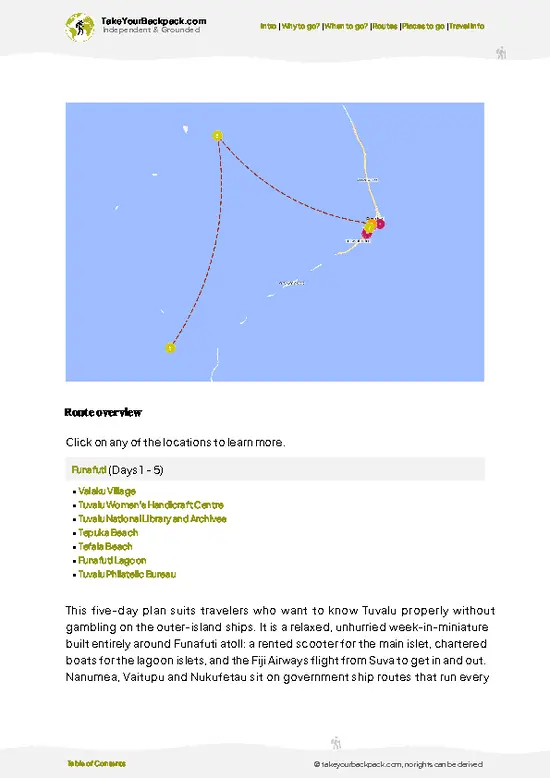
example page 0 from our offline Travel Guide for Tuvalu
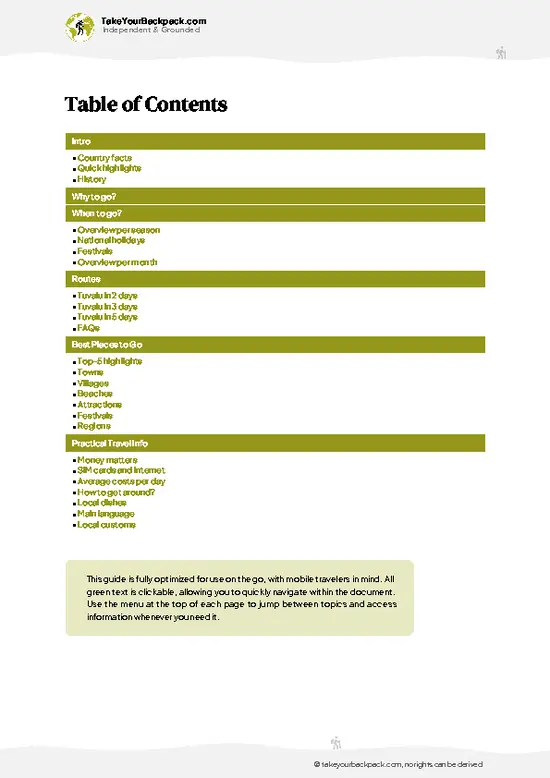
example page 1 from our offline Travel Guide for Tuvalu
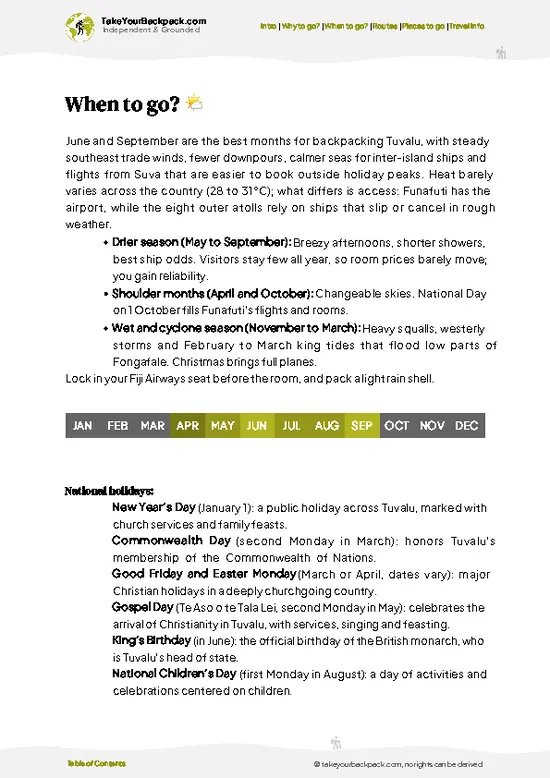
example page 2 from our offline Travel Guide for Tuvalu
example page 3 from our offline Travel Guide for Tuvalu
example page 4 from our offline Travel Guide for Tuvalu
example page 5 from our offline Travel Guide for Tuvalu
example page 6 from our offline Travel Guide for Tuvalu
example page 7 from our offline Travel Guide for Tuvalu
Loading the map 🌍
CLICK TO FILTER
towns
villages
beaches
attractions
festivals
regions
SHOW COUNTRY’S BESTSHOW ALL

✨ Why go?
Ranked #5 region in Tuvalu
Reasons people choose to visit here

Backpackers come to Niutao for one reason: it is among the few places in Tuvalu where daily life runs without a tourism layer on top. You will not find a hostel strip or a menu in English. You will find a community of roughly 550 people who share fish, sing in church, and still dig taro in the central pits that ring the island’s inner lake. It suits slow travelers, solo wanderers who like being invited rather than sold things, and anyone who has already done the busier atolls and wants the quiet version. Stay long, because the ship timetable decides your departure and a rushed visit wastes the effort of getting here. Walk the coast road at dawn, swim off the reef edge at the right tide, and accept that evenings mean conversation, not entertainment. If you need Wi-Fi, cafes and nightlife, this … read more 👉
Backpackers come to Niutao for one reason: it is among the few places in Tuvalu where daily life runs without a tourism layer on top. You will not find a hostel strip or a menu in English. You will find a community of roughly 550 people who share fish, sing in church, and still dig taro in the central pits that ring the island’s inner lake. It suits slow travelers, solo wanderers who like being invited rather than sold things, and anyone who has already done the busier atolls and wants the quiet version. Stay long, because the ship timetable decides your departure and a rushed visit wastes the effort of getting here. Walk the coast road at dawn, swim off the reef edge at the right tide, and accept that evenings mean conversation, not entertainment. If you need Wi-Fi, cafes and nightlife, this is the wrong stop. If you want to be a guest in a village, it is a good one, and Niutao’s dance tradition adds a lively note when a celebration is on.

💡 HighlightsThe experiences that define the visit

  1. The Central Lake and Taro Pits: The island’s defining feature is the inland body of brackish water ringed by swampy pulaka (giant swamp taro) pits tended by families. Go in the early morning when it is cool and people are working. A walk around the edge takes 1 to 2 hours. There is no entry fee, though asking a local to guide you is polite and a small gift is appreciated.
  2. The Village Maneapa: The meeting hall is the social heart of Niutao, where councils, feasts and dance practice take place. Visit when invited or when something is happening, usually in the late afternoon or evening, and plan for 1 to 2 hours. Dress modestly, sit when shown where, and bring a small contribution of food or store goods. There is no ticket, only manners.
  3. The Ocean Reef Shoreline and Coastal Path: A track runs around
… read more 👉
  1. The Central Lake and Taro Pits: The island’s defining feature is the inland body of brackish water ringed by swampy pulaka (giant swamp taro) pits tended by families. Go in the early morning when it is cool and people are working. A walk around the edge takes 1 to 2 hours. There is no entry fee, though asking a local to guide you is polite and a small gift is appreciated.
  2. The Village Maneapa: The meeting hall is the social heart of Niutao, where councils, feasts and dance practice take place. Visit when invited or when something is happening, usually in the late afternoon or evening, and plan for 1 to 2 hours. Dress modestly, sit when shown where, and bring a small contribution of food or store goods. There is no ticket, only manners.
  3. The Ocean Reef Shoreline and Coastal Path: A track runs around the island past coconut groves, old church buildings and fishing spots, with the open Pacific on one side. Walk it at low tide near sunrise or sunset for cooler air and for seeing fishermen head out or return. The full loop takes around 2 to 3 hours at a relaxed pace and costs nothing. Swim only where locals say the current is safe.
For a first visit, start with the lake and taro pits, since a morning there explains how the island feeds itself and usually leads to your first invitation. Day trips off island are not practical without a boat, but the northern atoll of Nanumea is one place to see if your ship schedule allows a stop.
Spotted a mistake or missing something? Contact us.

⌛️ 5 days5-day itinerary for Niutao

Day 1: Landing and the village: Mornings here move at walking pace, and the heat after midday pushes everyone under a roof until the afternoon breeze arrives. Nothing on Niutao is far, so you walk or borrow a bicycle. Your arrival depends on the ship from Funafuti, which sets the rhythm of the whole trip, so use the first day to settle in with your host family and wander the single village lane, past the maneapa (the meeting hall) and the neat coral-stone paths.
Day 2: Inland lakes and taro pits: Go early, before the sun climbs. The island is a reef platform with lakes inside it, and the freshwater edges, swamp taro pits and coconut groves make a loop you can finish on foot by late morning. Rest through the hottest hours, then return to the lakeside as the light softens and people head out … read more 👉
Day 1: Landing and the village: Mornings here move at walking pace, and the heat after midday pushes everyone under a roof until the afternoon breeze arrives. Nothing on Niutao is far, so you walk or borrow a bicycle. Your arrival depends on the ship from Funafuti, which sets the rhythm of the whole trip, so use the first day to settle in with your host family and wander the single village lane, past the maneapa (the meeting hall) and the neat coral-stone paths.
Day 2: Inland lakes and taro pits: Go early, before the sun climbs. The island is a reef platform with lakes inside it, and the freshwater edges, swamp taro pits and coconut groves make a loop you can finish on foot by late morning. Rest through the hottest hours, then return to the lakeside as the light softens and people head out to tend their plots.
Day 3: Reef side and fishing: The ocean side is where the island's food comes from. Walk the coast road and the reef edge with a local who knows where the tide pools and the drop-off lie. This is a day for slow looking, not for swimming far, because the reef edge drops into deep water quickly.
Day 4: Detour to the island's quiet ends: Cycle or walk to the far ends of the island, where houses thin out and the only sounds are surf and frigatebirds. It adds a lot and costs nothing in logistics, since you return to the village by evening.
Day 5: Church, feast and departure: Because ships keep their own schedule, keep this day loose. If it falls on a Sunday, the service and the singing in the church are the reason to stay put. I would plan the whole trip around Day 3: the reef, the catch and the walk home with it justify every hour on the ship.

🌤️ When to go?When to go for the best experience

May to October is the easiest window for visiting Niutao, with steadier trade winds, less rain and calmer seas for the ship crossing.
  • Drier Season (May to October): Days run about 28 to 31°C (82 to 88°F), with breezes that take the edge off the heat. Rain falls in short showers. Sunrise and sunset stay close to 6 am and 6 pm all year.
  • Wetter Season (November to April): Expect heavier downpours, humid air and nights around 26 to 27°C (79 to 81°F). Cyclone risk is highest from roughly November to April, and supply boats can be delayed or canceled.
  • Crowds and Prices: There are almost no other visitors in any month. Prices barely move, but a delayed ship can add nights of lodging and meals.
  • Local Events: Christmas and New Year bring feasting, dancing and returning islanders, so beds can be tight then.
… read more 👉
May to October is the easiest window for visiting Niutao, with steadier trade winds, less rain and calmer seas for the ship crossing.
  • Drier Season (May to October): Days run about 28 to 31°C (82 to 88°F), with breezes that take the edge off the heat. Rain falls in short showers. Sunrise and sunset stay close to 6 am and 6 pm all year.
  • Wetter Season (November to April): Expect heavier downpours, humid air and nights around 26 to 27°C (79 to 81°F). Cyclone risk is highest from roughly November to April, and supply boats can be delayed or canceled.
  • Crowds and Prices: There are almost no other visitors in any month. Prices barely move, but a delayed ship can add nights of lodging and meals.
  • Local Events: Christmas and New Year bring feasting, dancing and returning islanders, so beds can be tight then.
Build in at least two spare days around your return ship, whatever the month.


source: climatestotravel.comJANJanuary: fair for travelingFEBFebruary: fair for travelingMARMarch: fair for travelingAPRApril: fair for travelingMAYMay: highly recommended for travelingJUNJune: excellent for travelingJULJuly: excellent for travelingAUGAugust: excellent for travelingSEPSeptember: excellent for travelingOCTOctober: highly recommended for travelingNOVNovember: fair for travelingDECDecember: fair for traveling
when-to-go

✈️ The backpacker research shortcutTuvalu Travel Guide

An offline-friendly backpacking guide with optimized travel routes, ranked highlights, transport advice, and the best areas to stay.
example page 0 from our offline Travel Guide for Tuvalu
example page 1 from our offline Travel Guide for Tuvalu
example page 2 from our offline Travel Guide for Tuvalu
example page 3 from our offline Travel Guide for Tuvalu
example page 4 from our offline Travel Guide for Tuvalu
example page 5 from our offline Travel Guide for Tuvalu
example page 6 from our offline Travel Guide for Tuvalu
example page 7 from our offline Travel Guide for Tuvalu
The digital guide (97 pages) contains:
✅ 20 highlights, ranked by travel appeal
✅ Optimized 2, 3 & 5-day travel routes
✅ Cities, national parks, landmarks, beaches
✅ How to get around
✅ Offline-friendly for travel without Wi-Fi
👉 Click to see all 30+ guide features

📅 Plan smarter in minutes, not weeks
✅ Month by month travel advice
✅ Festivals & national holidays
✅ Budget expectations

🗺️ Go to the right places, skip the overrated ones
✅ Honest pros & cons of destinations
✅ Top hikes, parks & viewpoints
✅ Lesser-known places most travelers miss
✅ Clear “worth it vs skip it” guidance

🛏️ Travel smoothly without rookie mistakes
✅ Best areas to stay
✅ Transport systems explained simply
✅ Common scams & safety advice
✅ SIM cards, money & practical tips

🌍 Understand the country, not just visit it
✅ Culture & traditions
✅ 52 Essential phrases & customs
✅ Festivals worth planning around
✅ Traveler-friendly historical context
✅ Insights that make places more meaningful

📱 Built for real travel conditions
✅ Fully downloadable PDF
✅ Works completely offline
✅ Optimized for phone use
✅ Useful in remote areas & buses
✅ Everything in one place
Stop searching, start planning
Get instant access to your full guide. 30‑day money-back guarantee.
+ Add another guide for just

By proceeding you agree to our terms.
Sent to your inbox immediately after payment • 100% Secure Checkout
Best Backpacking Travel Advisor 2025 tourism awardBest Backpacking
Travel Advisor
2025
What others say about Take Your Backpack Guides:
⭐⭐⭐⭐⭐
Fantastic, amazing amount of information!
⭐⭐⭐⭐⭐
My goodness this is amazing, it's what I've been looking for hats off too you!
⭐⭐⭐⭐⭐
I think this is absolutely BRILLIANT
⭐⭐⭐⭐
Very complete and informative. It's still missing places, but I gotta to commend you
⭐⭐⭐⭐⭐
This is truly amazing, thank you, can't wait to explore it with my kids!
⭐⭐⭐⭐⭐
Awesome resource, thank you!
⭐⭐⭐⭐⭐
This is amazing! Can't wait to explore the ones I haven't seen
⭐⭐⭐⭐
I love this! Well done, great idea.
⭐⭐⭐⭐⭐
Thanks for taking the time to make this gem!
⭐⭐⭐⭐⭐
This might be the best website I've ever seen.
⭐⭐⭐⭐⭐
Congratulations, and thank you so much for your work; it's incredibly valuable.
⭐⭐⭐⭐
In all seriousness I think you did a great job pointing out the important spots
⭐⭐⭐⭐⭐
10/10 very good
⭐⭐⭐⭐⭐
As someone who's only just starting to visit regularly this is awesome, thank you.
⭐⭐⭐⭐
Thank you very much! I'm going to visit my dad, it's going to be very useful!
⭐⭐⭐⭐⭐
This is really cool! We'll be travelling for the first time and this definitely come in handy.
⭐⭐⭐⭐⭐
You are now our minister of culture, congratulations 👨‍💼
⭐⭐⭐⭐⭐
Just wanted to tell you that this is a pearl! Going to follow your recommendations.
⭐⭐⭐⭐⭐
This is so cool. I'll definitely be using the resource for my travels soon.
⭐⭐⭐⭐⭐
This is very impressive! Good work.
⭐⭐⭐⭐⭐
This is an amazing and informative site. Very well done!

🛏️ Where to stay?Where staying makes the most sense

Niutao has no hostels or hotels, so you will stay with a local family or in a basic guesthouse arranged through the island council (kaupule) or a contact in Funafuti. Expect to pay roughly A$30 to 60 (US$20 to 40) a night, usually with simple meals included. Confirm the price and what it covers before you sail, since the island has few places to buy food.
Rooms are plain: a mattress or sleeping mat, a mosquito net, and a fan if the power is running. Bathing is often by bucket from a rainwater tank, and toilets may be shared. Bring a small towel, a headlamp and insect repellent. Electricity and … read more 👉
Niutao has no hostels or hotels, so you will stay with a local family or in a basic guesthouse arranged through the island council (kaupule) or a contact in Funafuti. Expect to pay roughly A$30 to 60 (US$20 to 40) a night, usually with simple meals included. Confirm the price and what it covers before you sail, since the island has few places to buy food.
Rooms are plain: a mattress or sleeping mat, a mosquito net, and a fan if the power is running. Bathing is often by bucket from a rainwater tank, and toilets may be shared. Bring a small towel, a headlamp and insect repellent. Electricity and signal can be patchy, so carry a power bank.
Staying with a family is the real draw. Meals tend to center on fish, coconut, taro and pulaka, and you will likely be invited to community events. Bring gifts of rice, tinned goods, sugar or flour to share, which is welcomed since all supplies arrive by ship. Dress modestly, keep shoulders and knees covered in the village, and ask before photographing people. The whole village is walkable in minutes, so location within it hardly matters.

🚌 Getting aroundMoving around without the hassle

Your own feet get you around Niutao, and that is plenty, because the island is a small reef island with one road running along its length, flat and shaded by coconut palms. Getting to Niutao is the real journey: it is reached only by ship from Funafuti, with no flights and no airstrip. Sailings are infrequent and the schedule shifts with weather and cargo, so treat dates as soft and keep your onward plans loose.
  • Walking: Free, and the island is small enough to cross in well under an hour at a dawdle. Go early, before the heat builds, when pigs are rooting, kids are heading to school and the path to the inland lakes is cool underfoot. You end up at the water with the taro pits all to yourself.
  • Bicycle: Locals ride everywhere, and borrowing a bike from your host is often possible for a small thank-you
… read more 👉
Your own feet get you around Niutao, and that is plenty, because the island is a small reef island with one road running along its length, flat and shaded by coconut palms. Getting to Niutao is the real journey: it is reached only by ship from Funafuti, with no flights and no airstrip. Sailings are infrequent and the schedule shifts with weather and cargo, so treat dates as soft and keep your onward plans loose.
  • Walking: Free, and the island is small enough to cross in well under an hour at a dawdle. Go early, before the heat builds, when pigs are rooting, kids are heading to school and the path to the inland lakes is cool underfoot. You end up at the water with the taro pits all to yourself.
  • Bicycle: Locals ride everywhere, and borrowing a bike from your host is often possible for a small thank-you of around US$2 to 5. The track is flat sand and crushed coral, so a slow roll beats any speed. Late afternoon is best, when you pass open-sided meeting houses and people wave you into a chat.
  • Motorbike ride: A handful of motorbikes buzz along the main road, and neighbors will often give you a lift if you are carrying bags from the landing. Offer a few dollars for fuel, about US$1 to 3. You arrive at your guesthouse with a story and an invitation to dinner.
  • Inter-island ship from Funafuti: The only way on or off the island. The passage runs roughly a day and a night, a deck or basic cabin fare in the range of US$40 to 80 each way, and the sea can be rough, so bring motion-sickness tablets. Cargo is unloaded by small boats at the reef, which means you watch the whole village turn out to meet the ship.
  • Boat across the reef: A local fisherman can sometimes take you along the shore for a modest fee, roughly US$10 to 20. You see the island from the water, with the palms in a long green line and the reef edge breaking white.
Buy your return ship ticket in Funafuti before you leave and ask your host to listen for the ship’s arrival, since that is the one thing worth setting your day around.

🚌 Day tripsEasy escapes and nearby places

Niutao is a single small island, so day trips mean walking or cycling around the island itself rather than leaving by transport; nothing else is reachable in a day.
Walk the Island Loop:
The island is tiny, and a full lap on foot or by bike takes about one to two hours at an easy pace. Go early, before the heat builds, and again near sunset when the light on the reef turns amber. It costs nothing. First-timers often forget to carry water and a hat, and shops are few and often closed in the afternoon.

Reef Edge:
Niutao has no open lagoon, only inland brackish lakes, and the fringing reef around the island has strong surf and currents. Ask your host about tides and safe spots before entering, because the drop-off is close to shore. Plan a half day, bring your own mask, and budget nothing beyond … read more 👉
Niutao is a single small island, so day trips mean walking or cycling around the island itself rather than leaving by transport; nothing else is reachable in a day.
Walk the Island Loop:
The island is tiny, and a full lap on foot or by bike takes about one to two hours at an easy pace. Go early, before the heat builds, and again near sunset when the light on the reef turns amber. It costs nothing. First-timers often forget to carry water and a hat, and shops are few and often closed in the afternoon.

Reef Edge:
Niutao has no open lagoon, only inland brackish lakes, and the fringing reef around the island has strong surf and currents. Ask your host about tides and safe spots before entering, because the drop-off is close to shore. Plan a half day, bring your own mask, and budget nothing beyond a small thank-you if someone guides you. The drier months give better visibility.

Fishing with Locals:
If your host or neighbors are heading out, a morning trip on a small boat is the best way to see daily life. Trips run two to five hours depending on the catch and weather. Offer to contribute fuel money, roughly A$10 to 20 (US$7 to 13), and keep the fish you help catch for dinner. Seas are calmest from May to October. Do not assume a trip will happen; it depends on wind.

Village Church and Meeting House:
The village center, with its church and maneapa (community hall), takes about an hour to visit. Sunday services feature powerful singing and visitors are welcome if dressed modestly in long skirts or trousers and a collared shirt. Many first-timers plan activities on Sunday, when most things stop.

🍲 FoodLocal Flavors for Backpackers

Food on Niutao is built from the sea and the coconut palm. Expect fresh tuna grilled over coals or raw in coconut cream, flying fish and reef fish fried crisp, and pulaka, the giant swamp taro grown in pits, boiled or baked until dense and slightly sweet. Coconut crab sometimes shows up at feasts, and fekei, a pudding of grated pulaka and coconut cream, tastes of smoke and sweet milk. Drink fresh coconut water cracked open in front of you, or toddy, the sap tapped from the palm, which is milky and lightly sweet when fresh.

There are no restaurants to speak of. Most meals come through your guesthouse host, plus a couple of tiny shops stocking rice, tinned fish and noodles. Bring snacks and coffee from Funafuti. Evenings revolve around the village meeting house, where feasts are laid out on … read more 👉
Food on Niutao is built from the sea and the coconut palm. Expect fresh tuna grilled over coals or raw in coconut cream, flying fish and reef fish fried crisp, and pulaka, the giant swamp taro grown in pits, boiled or baked until dense and slightly sweet. Coconut crab sometimes shows up at feasts, and fekei, a pudding of grated pulaka and coconut cream, tastes of smoke and sweet milk. Drink fresh coconut water cracked open in front of you, or toddy, the sap tapped from the palm, which is milky and lightly sweet when fresh.

There are no restaurants to speak of. Most meals come through your guesthouse host, plus a couple of tiny shops stocking rice, tinned fish and noodles. Bring snacks and coffee from Funafuti. Evenings revolve around the village meeting house, where feasts are laid out on mats.

Eat what you are given, accept a second helping, and wait for elders to begin. Sharing is the rule, so bringing a bag of rice or sugar as a gift goes down very well.

FAQTraveler FAQ

There are no domestic flights and Niutao has no airstrip, so take the supply ship from Funafuti, which takes about 1 to 2 days and runs irregularly, so schedules can be hard to pin down.
Yes, if you want a place with almost no tourism and daily life largely unchanged by visitors. You will spend your time walking the island in 1 to 2 hours, swimming off the reef, joining fishing trips and eating with a host family. There are no restaurants, ATMs or nightlife, so it suits a stay of 3 to 5 days, and you should bring cash in Australian dollars.
No, because the supply ship from Funafuti takes a day or more and runs irregularly, so a same-day return is not practical. Plan at least one night, and more realistically several days until the next ship. Budget roughly A$30 to 60 (US$20 to 40) per night for a homestay with meals, and carry extra cash in case schedules slip.
⚠️ Things can change over time, so always validate details locally before you go.

Other Tuvaluan regions near Niutao

Explore more nearby:

  • Nui—Lagoon islets, sandy track, swamp taro gardens, Nui dance| 128 km away
  • Nanumea Atoll—Seabee airfield ruins, Lakena Islet, pulaka pits, far-north atoll| 145 km away
  • Vaitupu—Asau settlement, boarding school, reef flat, thatch maneapa| 212 km away

💡 Not sure where to go next?
Create a personalized itinerary for Tuvalu including Niutao and the places that fit your trip.

Generate my itinerary

👉 Discover all regions

Or checkout all Tuvalu has to offer (think cities, towns, villages, national parks, hikes, beaches, festivals)
Country photo of Tuvalu

We 💚 feedbackIs it worth it?

The classic mistake is arriving on the ship with no plan and treating the island like a stopover. Slow down instead. Bring food gifts such as rice, tinned fish or sugar, introduce yourself to the island leaders on day one, and ask who can host you. I would also pack a good book and extra patience for the return ship.

✍️ Help improve this page!
The information on this page is based on in-depth research, insights shared by experienced travelers, and feedback from the local travel community in Tuvalu. While every effort is made to keep the information accurate and current, conditions can change — so if you spot anything incorrect or outdated, please get in touch.


🙋‍♂️ Give feedback

👋 Meet the founderWho’s Behind Take Your Backpack?

Johan, backpacker and founder of TakeYourBackpackHi, I’m Johan (Netherlands 🇳🇱), the creator of TakeYourBackpack. Over the past 3 decades, I’ve backpacked through 90+ countries across six continents, gaining extensive experience with independent travel, long-term trips, and overland routes.

This site is built on a combination of firsthand travel experience and carefully curated insights from other backpackers. Many guides are based on places I’ve personally visited, while others bring together tips, observations, and practical advice shared by trusted travelers I’ve met along the way.

The goal is to provide realistic, experience-driven guidance — not generic itineraries — so you can explore destinations with better context, clearer expectations, and more confidence.