×

Uganda🇺🇬 | national parksKibale Forest National Park
chimpanzee encounters, tropical hardwoods, forest canopy | things to do and best time to go

Explore Bwindi Impenetrable National ParkExplore Kidepo Valley National Park

Backpacking in Kibale Forest
🌟 Highlightnational park ranked #5
By Johan Kruseman 🇳🇱 | last update: 7 April, 2026

The first real fork in the road at Kibale Forest National Park is whether to pay for the chimpanzee tracking permit or stick to the standard forest hikes. That choice isn’t just about money—it’s about how close you want to get to the park’s real stars, and how much patience you have for bureaucracy and crowds. Kibale sits in western Uganda, just south of Fort Portal, wedged between tea plantations and crater lakes. For backpackers, it’s a place of contrasts: the forest is dense and alive, with more primate species than anywhere else in East Africa, but the price tag for chimp tracking is steep and the main trails can feel busy in peak season. Hiking here is rewarding, especially if you’re into birding or want to see monkeys without a zoo fence, but don’t expect solitude. Camping is possible but basic; budget lodges cluster outside the gate. Compared to Queen Elizabeth or Murchison Falls, Kibale is smaller, less dramatic in landscape, but richer in close-up wildlife encounters—if you’re willing to pay for them.

Discover everything you want to know in the 📖 Uganda Travel Guide.
Loading the map 🌍
CLICK TO FILTER
city
town
unique site
national park
hike
beach
attraction
festival
region
SHOW COUNTRY‘S BESTSHOW ALL

✨ Why go?
Ranked #5 national park in Uganda
What makes this national park worth exploring

Kibale Forest National Park attracts backpackers for several compelling reasons. First, the independent exploration opportunities are vast. You can wander through diverse trails, from dense rainforest to open grasslands, spotting primates and unique bird species along the way. This park is particularly friendly for self-guided travelers; while guided tours are available, many trails are accessible without a guide, allowing you to set your own pace.

Budget-conscious adventurers will appreciate the camping and hostel options nearby. Affordable accommodations let you save money for experiences that matter, like a night walk to see nocturnal wildlife. The park’s trail variety caters to different skill levels, ensuring that whether you’re a seasoned hiker or a casual walker, there’s something … read more 👉
Kibale Forest National Park attracts backpackers for several compelling reasons. First, the independent exploration opportunities are vast. You can wander through diverse trails, from dense rainforest to open grasslands, spotting primates and unique bird species along the way. This park is particularly friendly for self-guided travelers; while guided tours are available, many trails are accessible without a guide, allowing you to set your own pace.

Budget-conscious adventurers will appreciate the camping and hostel options nearby. Affordable accommodations let you save money for experiences that matter, like a night walk to see nocturnal wildlife. The park’s trail variety caters to different skill levels, ensuring that whether you’re a seasoned hiker or a casual walker, there’s something for you.

However, be mindful of the hidden costs. Park entry fees can add up, especially if you opt for additional activities. Planning ahead can help you avoid surprises and keep your budget intact, allowing you to focus on the rich experiences Kibale has to offer.
Get the complete Travel Guide for Uganda
Everything organized for offline planning — routes, highlights, costs & tips

See what’s inside 👉

Get the Travel Guide -
  1. Chimpanzee trekking (Kanyanchu and Sebitoli) — personal favorite: Early-morning treks into the forest to find habituated chimp groups are Kibale’s headline act. The chimps are loud, curious, and often close enough to watch grooming, play and eating—raw, messy primate life. Kanyanchu is the classic starting point; Sebitoli can be quieter and great if you want fewer tourists.
  2. Ngogo chimp research site / habituation experience: Home to one of the largest studied chimp communities in the world, Ngogo gives you a front-row seat to long-term research. Habituation visits are rarer and longer, so you see deeper social behaviour than on a standard trek.
  3. Primate diversity on the forest trails: Kibale isn’t just chimps — expect to bump into red colobus, L’Hoest’s monkeys, grey-cheeked mangabeys,
  4. read more 👉
  1. Chimpanzee trekking (Kanyanchu and Sebitoli) — personal favorite: Early-morning treks into the forest to find habituated chimp groups are Kibale’s headline act. The chimps are loud, curious, and often close enough to watch grooming, play and eating—raw, messy primate life. Kanyanchu is the classic starting point; Sebitoli can be quieter and great if you want fewer tourists.
  2. Ngogo chimp research site / habituation experience: Home to one of the largest studied chimp communities in the world, Ngogo gives you a front-row seat to long-term research. Habituation visits are rarer and longer, so you see deeper social behaviour than on a standard trek.
  3. Primate diversity on the forest trails: Kibale isn’t just chimps — expect to bump into red colobus, L’Hoest’s monkeys, grey-cheeked mangabeys, black-and-white colobus, blue monkeys and several more. On a single walk you can tick off multiple species; that density of primates is what makes the forest special.
  4. Bigodi Wetland Sanctuary (community-run): A short walk from the park, Bigodi’s boardwalks through swamp and papyrus are brilliant for birding and quiet primate encounters. It’s run by the local community, so visiting helps the village and gives you a different, wetter side of Kibale’s ecosystems.
  5. Forest hiking and scenic trails: The Kanyanchu and Sebitoli trail networks offer easy-to-moderate loops under a thick canopy — dappled light, huge buttress roots and the occasional primate chorus. Trails are great for photographers and anyone who likes slow, concentrated nature time.
  6. Birdwatching — forest specialists: Kibale hosts 300-350+ species, including forest specialists you won’t easily find in open savanna. Think turacos, broadbills and chorus-like passerines; it’s a top spot for people who take birds seriously (or want to start).
  7. Nocturnal walks at the forest edge: Night walks near the park’s fringes can turn up pottos, galagos (bushbabies), nightjars and owls. Different vibe to daytime treks — quiet, a little spooky, and very rewarding if you want wildlife that only comes out after dark.
Spotted a mistake or missing something? Contact me.

🌤️ When to go?Weather, crowds, and seasonal trade-offs


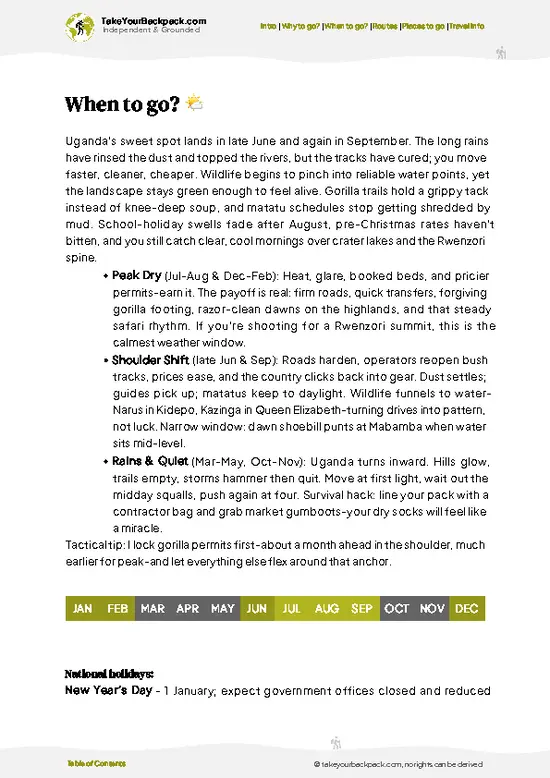
  • Topic: Weather – Kibale Forest sees heavy rains mainly from March to May and again in October and November. These wet months turn trails muddy and slippery, which can slow you down and soak your gear. The drier months, June to September and December to February, offer more reliable trekking conditions.

  • Topic: Temperature – Expect daytime highs around 22-27°C (72-81°F) year-round, with cooler nights dropping to 13-16°C (55-61°F). The temperature is fairly stable, but humidity spikes during rainy seasons can make it feel hotter and more exhausting.

  • Topic: Daylight Hours – Near the equator, daylight is consistent, roughly 12 hours daily. Sunrise and sunset times don’t shift much, so you can plan your hikes without worrying about losing daylight unexpectedly.

  • Topic: Crowds – Peak tourist
  • read more 👉

  • Topic: Weather – Kibale Forest sees heavy rains mainly from March to May and again in October and November. These wet months turn trails muddy and slippery, which can slow you down and soak your gear. The drier months, June to September and December to February, offer more reliable trekking conditions.

  • Topic: Temperature – Expect daytime highs around 22-27°C (72-81°F) year-round, with cooler nights dropping to 13-16°C (55-61°F). The temperature is fairly stable, but humidity spikes during rainy seasons can make it feel hotter and more exhausting.

  • Topic: Daylight Hours – Near the equator, daylight is consistent, roughly 12 hours daily. Sunrise and sunset times don’t shift much, so you can plan your hikes without worrying about losing daylight unexpectedly.

  • Topic: Crowds – Peak tourist season aligns with the dry months, especially July and August, when gorilla trekking permits and accommodations fill up fast. Visiting just before or after this window means fewer people and a quieter forest experience.

  • Topic: Seasonal Activities – Dry months are best for chimpanzee tracking and birdwatching, as animals are easier to spot and trails are accessible. The rainy season limits these activities and can close some trails for safety.

  • Topic: Price Fluctuations – Expect higher prices for permits, guides, and lodging during the dry season’s peak months. Booking off-peak can save money but be ready for occasional rain and tougher trail conditions.


Pro-tip: Aim for the shoulder months of June or September to balance manageable weather, fewer crowds, and better prices—keeping your energy and budget intact for the real forest magic.


source: climatestotravel.comJANJanuary: highly recommended for travelingFEBFebruary: highly recommended for travelingMARMarch: fair for travelingAPRApril: fair for travelingMAYMay: fair for travelingJUNJune: highly recommended for travelingJULJuly: excellent for travelingAUGAugust: excellent for travelingSEPSeptember: highly recommended for travelingOCTOctober: fair for travelingNOVNovember: fair for travelingDECDecember: highly recommended for traveling
when-to-go

✈️ The ultimate backpacker shortcutUganda Travel Guide

Skip weeks of research and hit the road with confidence. Get 351 pages of proven routes, transport advice, and real safety insights—built for your phone and 100% offline-ready.
example page 0 from our offline Travel Guide for Ugandaexample page 1 from our offline Travel Guide for Ugandaexample page 2 from our offline Travel Guide for Ugandaexample page 3 from our offline Travel Guide for Ugandaexample page 4 from our offline Travel Guide for Uganda
🎒 Your 351-page offline travel companion
5, 10 & 15-day routes paced for real travel
109 ranked highlights with honest skip-it advice
Logistics solved: Best areas to stay & transport
Safety blueprints: Common local scams to avoid
No Wi-Fi? No problem: Phone-optimized offline PDF
👉 See all 30+ guide features

📅 Plan smarter in minutes, not weeks
Realistic travel times & pacing
Best months per region
Festivals & national holidays
Budget expectations

🗺️ Go to the right places, skip the overrated ones
109 ranked highlights across the country
Hidden gems beyond the tourist trail
Honest pros & cons of destinations
Top hikes, parks & viewpoints
Lesser-known places most travelers miss
Clear “worth it vs skip it” guidance

🛏️ Travel smoothly without rookie mistakes
Best areas to stay
Transport systems explained simply
Local transport tradeoffs
Common scams & safety advice
SIM cards, money & practical tips
What to expect before arrival

🌍 Understand the country, not just visit it
Culture & traditions
52 Essential phrases & customs
Festivals worth planning around
Traveler-friendly historical context
Insights that make places more meaningful

📱 Built for real travel conditions
Fully downloadable PDF
Works completely offline
Optimized for phone use
Useful in remote areas & buses
Everything in one place
Save weeks of stressful planning
Get instant access to the full guide directly. 30-day money-back guarantee.


Sent to your inbox immediately after payment • 100% Secure Checkout
Best Backpacking Travel Advisor 2025 tourism awardBest Backpacking
Travel Advisor
2025
What others say about Take Your Backpack Guides:
⭐⭐⭐⭐⭐
Fantastic, amazing amount of information!
⭐⭐⭐⭐⭐
My goodness this is amazing, it's what I've been looking for hats off too you!
⭐⭐⭐⭐⭐
I think this is absolutely BRILLIANT
⭐⭐⭐⭐
Very complete and informative. It's still missing places, but I gotta to commend you
⭐⭐⭐⭐⭐
This is truly amazing, thank you, can't wait to explore it with my kids!
⭐⭐⭐⭐⭐
Awesome resource, thank you!
⭐⭐⭐⭐⭐
This is amazing! Can't wait to explore the ones I haven't seen
⭐⭐⭐⭐
I love this! Well done, great idea.
⭐⭐⭐⭐⭐
Thanks for taking the time to make this gem!
⭐⭐⭐⭐⭐
This might be the best website I've ever seen.
⭐⭐⭐⭐⭐
Congratulations, and thank you so much for your work; it's incredibly valuable.
⭐⭐⭐⭐
In all seriousness I think you did a great job pointing out the important spots
⭐⭐⭐⭐⭐
10/10 very good
⭐⭐⭐⭐⭐
As someone who's only just starting to visit regularly this is awesome, thank you.
⭐⭐⭐⭐
Thank you very much! I'm going to visit my dad, it's going to be very useful!
⭐⭐⭐⭐⭐
This is really cool! We'll be travelling for the first time and this definitely come in handy.
⭐⭐⭐⭐⭐
You are now our minister of culture, congratulations 👨‍💼
⭐⭐⭐⭐⭐
Just wanted to tell you that this is a pearl! Going to follow your recommendations.
⭐⭐⭐⭐⭐
This is so cool. I'll definitely be using the resource for my travels soon.
⭐⭐⭐⭐⭐
This is very impressive! Good work.
⭐⭐⭐⭐⭐
This is an amazing and informative site. Very well done!

🛏️ Where to stay?Best areas and accommodation options

Kibale Forest National Park is a treasure for backpackers, but choosing where to stay can make or break your experience. Inside the park, options are limited. The Kibale Forest Lodge offers a comfortable stay with a touch of luxury, but it comes at a price. If you’re looking for something more budget-friendly, consider the nearby Kanyanchu Visitor Center area.

In the nearby town of Fort Portal, you’ll find several hostels and guesthouses that cater to backpackers. Places like the Chimpanzee Forest Guesthouse provide a cozy atmosphere without breaking the bank. Staying in Fort Portal gives you … read more 👉
Kibale Forest National Park is a treasure for backpackers, but choosing where to stay can make or break your experience. Inside the park, options are limited. The Kibale Forest Lodge offers a comfortable stay with a touch of luxury, but it comes at a price. If you’re looking for something more budget-friendly, consider the nearby Kanyanchu Visitor Center area.

In the nearby town of Fort Portal, you’ll find several hostels and guesthouses that cater to backpackers. Places like the Chimpanzee Forest Guesthouse provide a cozy atmosphere without breaking the bank. Staying in Fort Portal gives you access to local markets and eateries, which can save you money on meals.

Be mindful of transportation costs if you stay outside the park. Daily entrance fees can add up, so factor that into your budget. Also, consider the time it takes to travel back and forth. The park is best explored early in the morning, so staying nearby can maximize your time with the wildlife. Prioritize convenience and comfort, and you’ll set yourself up for a rewarding adventure.

👛 Costs (as of 25 April 2026)Travel costs and budget guide for Kibale Forest

Kibale Forest National Park is a treasure for wildlife enthusiasts, especially for chimpanzee tracking. However, understanding the costs involved is crucial to avoid surprises.

Entry fees for the park are around $40 USD per person for foreign non-residents. If you’re a foreign resident, expect to pay about $20 USD. These fees contribute to conservation efforts, so they’re worth it.

Chimpanzee tracking permits are an additional cost. They typically range from $150 to $200 USD per person. These permits are limited and often sell out, so booking in advance is essential.

Guided tours can vary widely. A half-day tour might cost around $50 to $100 USD, depending on the guide’s experience and the group size. Full-day tours, which may include additional activities like bird watching, can go up … read more 👉
Kibale Forest National Park is a treasure for wildlife enthusiasts, especially for chimpanzee tracking. However, understanding the costs involved is crucial to avoid surprises.

Entry fees for the park are around $40 USD per person for foreign non-residents. If you’re a foreign resident, expect to pay about $20 USD. These fees contribute to conservation efforts, so they’re worth it.

Chimpanzee tracking permits are an additional cost. They typically range from $150 to $200 USD per person. These permits are limited and often sell out, so booking in advance is essential.

Guided tours can vary widely. A half-day tour might cost around $50 to $100 USD, depending on the guide’s experience and the group size. Full-day tours, which may include additional activities like bird watching, can go up to $200 USD.

Accommodation options near the park range from budget hostels at about $15 to $30 USD per night to mid-range lodges costing $100 to $200 USD. Luxury lodges can exceed $300 USD, but they often provide a unique experience.

Transportation is another factor. If you’re hiring a vehicle, expect to pay around $50 to $100 USD per day, plus fuel. Public transport is cheaper but less reliable.

Plan for meals as well. Local eateries offer meals for $5 to $10 USD, while more upscale dining can cost $20 to $50 USD per person.

In summary, budgeting around $300 to $600 USD per person for a two-day visit, including entry fees, permits, accommodation, meals, and transportation, will give you a comfortable experience without breaking the bank.


source: ugandawildlife.org
⚠️ Prices can change and everyone travels differently, so take this as a rough guide. Hope it helps you plan your adventure!

🥾 TrailsHiking Kibale Forest national park: highlights and difficulty

Kibale Forest National Park is a gem for hikers, offering a mix of lush rainforest and stunning landscapes. The terrain varies from flat paths to slightly hilly areas, making it accessible yet adventurous. One of the standout features is the chance to see primates, including the famous chimpanzees, swinging through the trees. The sounds of the forest are just as captivating as the sights, with birds and other wildlife adding to the experience.

One of the designated trails to check out is Chimpanzee Tracking Trail. Here are some details:
  • Length: 12 km
  • Estimated Duration: 3-4 hours
  • Difficulty Level:
  • read more 👉
Kibale Forest National Park is a gem for hikers, offering a mix of lush rainforest and stunning landscapes. The terrain varies from flat paths to slightly hilly areas, making it accessible yet adventurous. One of the standout features is the chance to see primates, including the famous chimpanzees, swinging through the trees. The sounds of the forest are just as captivating as the sights, with birds and other wildlife adding to the experience.

One of the designated trails to check out is Chimpanzee Tracking Trail. Here are some details:
  • Length: 12 km
  • Estimated Duration: 3-4 hours
  • Difficulty Level: Moderate
  • Key Features: Chimpanzee sightings, diverse bird species, lush vegetation
  • Terrain: Mix of flat paths and gentle slopes

Another option is the Bigodi Wetland Sanctuary Trail, which offers a different vibe:
  • Length: 8 km
  • Estimated Duration: 2-3 hours
  • Difficulty Level: Easy
  • Key Features: Birdwatching, swamp views, local community interaction
  • Terrain: Flat with boardwalks through wetlands

Getting to Kibale isn’t too tricky. You can hop on a bus from Kampala to Fort Portal, which takes about 5-6 hours. From Fort Portal, you can grab a taxi or a boda-boda to the park entrance. It’s worth noting that the park can get busy, especially during peak tourist season, so it’s a good idea to book any guided tours in advance. As for the entrance fee, it’s reasonable, but do check the latest rates online before you go, as they can change.
⚠️ Hiking info can sometimes be outdated or inaccurate. Before you hit the trail, check the latest conditions with locals. If you do spot anything that's off, I'd love to hear from you, so I can update it for fellow travelers.

🛡️ SafetyStaying Safe: What Travelers Should Know

Kibale Forest National Park offers a rewarding experience, but a few practical considerations can enhance your adventure. The weather can shift quickly; expect rain, especially during the wet season. A good rain jacket and quick-drying gear are essential.

The trails are generally well-maintained, but some areas can be steep or muddy. Good hiking boots with solid grip will help you navigate the terrain without slipping. Pay attention to your footing, especially during river crossings; it’s best to take your time here.

Wildlife encounters are a highlight, particularly with chimpanzees. Keep a respectful distance and avoid feeding them. This not only protects you but also the animals.

Lastly, don’t underestimate the importance of timing. Early morning hikes are cooler and often more rewarding … read more 👉
Kibale Forest National Park offers a rewarding experience, but a few practical considerations can enhance your adventure. The weather can shift quickly; expect rain, especially during the wet season. A good rain jacket and quick-drying gear are essential.

The trails are generally well-maintained, but some areas can be steep or muddy. Good hiking boots with solid grip will help you navigate the terrain without slipping. Pay attention to your footing, especially during river crossings; it’s best to take your time here.

Wildlife encounters are a highlight, particularly with chimpanzees. Keep a respectful distance and avoid feeding them. This not only protects you but also the animals.

Lastly, don’t underestimate the importance of timing. Early morning hikes are cooler and often more rewarding in terms of wildlife activity. Prepare well, and you’ll preserve your energy for the moments that truly matter.

Other Ugandan national parks near Kibale Forest

Explore more nearby:


👉 Discover all national parks

Or checkout all Uganda has to offer (think cities, towns, villages, national parks, hikes, beaches, festivals)
Country photo of Uganda

I 💚 feedbackSumming up the experience

Kibale Forest National Park is a treasure for primate lovers; the chance to see chimpanzees swinging through the trees is a thrill that sticks with you. But be prepared for the humidity—it can sap your energy faster than you think. Bring plenty of water and plan your hikes for early morning or late afternoon. This way, you’ll savor the experience without feeling drained. Prioritize your comfort; it makes all the difference.

✈️ When did I visit Uganda?
In September 2019 I have done a backpacking trip through Uganda. Seeing gorilla’s in the wild from up close was a pure unexpected highlight!

✍️ Help improve this page!
The information on this page is based on my own backpacking experience in Uganda, supplemented with up-to-date research and feedback from other travelers. Travel details can change, so if you notice anything outdated or incomplete, feel free to let me know.


🙋‍♂️ Give feedback

👋 Meet the authorWho’s Behind Take Your Backpack?

Johan, backpacker and founder of TakeYourBackpackHi, I’m Johan (Netherlands 🇳🇱), the creator of TakeYourBackpack. Over the past decade, I’ve backpacked through 80+ countries across six continents, gaining extensive experience with independent travel, long-term trips, and overland routes.

This site is built on a combination of firsthand travel experience and carefully curated insights from other backpackers. Many guides are based on places I’ve personally visited, while others bring together tips, observations, and practical advice shared by trusted travelers I’ve met along the way.

The goal is to provide realistic, experience-driven guidance — not generic itineraries — so you can explore destinations with better context, clearer expectations, and more confidence.

Get Full Country Guide |
Instant download • 109 highlights • Full Offline guide