×

Uganda🇺🇬 | national parksKibale National ParkKanyanchu chimps, 13 primates, Bigodi swamp, crater lakes | things to do and best time to go

Explore Bwindi Impenetrable National ParkExplore Kidepo Valley National Park

Backpacking in Kibale
🌟 Highlightnational park ranked #5
By Johan Kruseman 🇳🇱 | Updated October 22, 2026

Kibale National Park holds one of the highest primate densities on Earth, 13 species, yet the chimpanzee permits sell out in peak months, so book weeks ahead or you will watch other people go. The park sits in western Uganda, south of Fort Portal, across rolling forest and tea country. Expect lush trails, loud mornings and chimps that actually show up. The downsides are mud, hovering crowds at popular sightings and sparse public transport at the gate. I once showed up at the trailhead without gaiters and spent the briefing picking driver ants off my ankles, which taught me to wear tucked-in socks every time. Book permits early, pack rain gear, and arrive for the first briefing slot. Somewhere above you, a red colobus crashes through the canopy.

Discover everything you want to know in the 📖 Uganda Travel Guide.
Safety warning

The current risk level for Uganda is high. Check the advice before going.


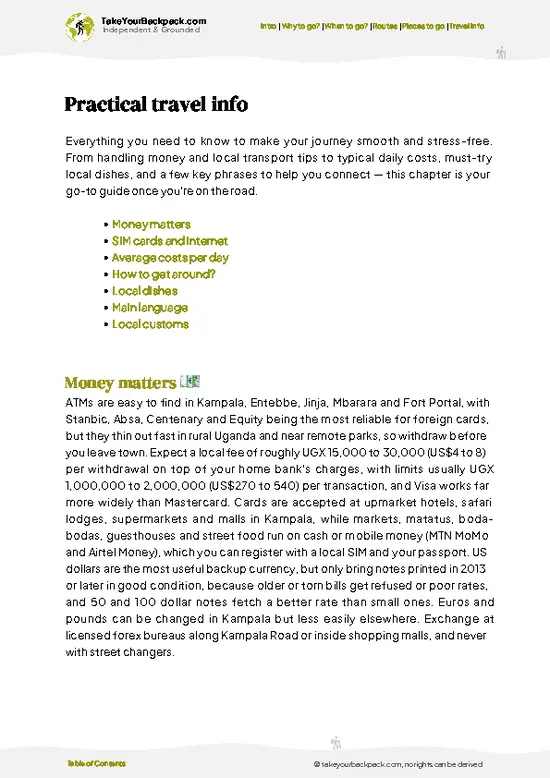
example page 0 from our offline Travel Guide for Uganda
example page 1 from our offline Travel Guide for Uganda
example page 2 from our offline Travel Guide for Uganda
example page 3 from our offline Travel Guide for Uganda
example page 4 from our offline Travel Guide for Uganda
example page 5 from our offline Travel Guide for Uganda
example page 6 from our offline Travel Guide for Uganda
example page 7 from our offline Travel Guide for Uganda
Loading the map 🌍
CLICK TO FILTER
cities
towns
landmarks
national parks
hikes
beaches
attractions
festivals
regions
SHOW COUNTRY’S BESTSHOW ALL

✨ Why go?
Ranked #5 national park in Uganda
Why Kibale should be on your travel list

Kibale National Park rewards the traveler who likes doing things in the right order: permit first, then forest. The main draw is the chimpanzee tracking from Kanyanchu, where the community is habituated and sightings are frequent, plus the longer chimpanzee habituation experience, which lets you stay with the apes for hours instead of one. Both run on a fixed schedule, so independent travelers can slot them into a loose itinerary without joining a tour package.

The second reason is the trail variety outside the primate hours. The Bigodi Wetland Sanctuary next door is run by the local community and walked on foot with a guide, so you can fill a spare afternoon cheaply. Between the two, you get apes, monkeys, birds and swamp boardwalk without needing a vehicle of your own. Self-guided wandering … read more 👉
Kibale National Park rewards the traveler who likes doing things in the right order: permit first, then forest. The main draw is the chimpanzee tracking from Kanyanchu, where the community is habituated and sightings are frequent, plus the longer chimpanzee habituation experience, which lets you stay with the apes for hours instead of one. Both run on a fixed schedule, so independent travelers can slot them into a loose itinerary without joining a tour package.

The second reason is the trail variety outside the primate hours. The Bigodi Wetland Sanctuary next door is run by the local community and walked on foot with a guide, so you can fill a spare afternoon cheaply. Between the two, you get apes, monkeys, birds and swamp boardwalk without needing a vehicle of your own. Self-guided wandering inside the forest is not allowed, so the independence here comes from how you arrange your days, not from going off alone.

💡 HighlightsEssential experiences to have while exploring Kibale

  1. Chimpanzee tracking at Kanyanchu: The park’s best-known experience. Guides lead small groups into the forest to find a habituated community of chimps, and sightings are reliable. Expect hooting, fig trees and a lot of neck craning.
  2. Chimpanzee habituation experience: A full-day version where you follow chimps from their morning nests onward. It costs more and demands stamina, but the time with the apes is far longer.
  3. Bigodi Wetland Sanctuary: A swamp walk on boardwalks and mud paths just outside the park. Great for grey-cheeked mangabeys, red-tailed monkeys and the great blue turaco.
  4. Red colobus and black-and-white colobus monkeys: Troops are easy to spot on the forest walks, leaping between branches overhead.
  5. Night walks: Guided after-dark walks pick out bushbabies, pottos and nocturnal sounds
… read more 👉
  1. Chimpanzee tracking at Kanyanchu: The park’s best-known experience. Guides lead small groups into the forest to find a habituated community of chimps, and sightings are reliable. Expect hooting, fig trees and a lot of neck craning.
  2. Chimpanzee habituation experience: A full-day version where you follow chimps from their morning nests onward. It costs more and demands stamina, but the time with the apes is far longer.
  3. Bigodi Wetland Sanctuary: A swamp walk on boardwalks and mud paths just outside the park. Great for grey-cheeked mangabeys, red-tailed monkeys and the great blue turaco.
  4. Red colobus and black-and-white colobus monkeys: Troops are easy to spot on the forest walks, leaping between branches overhead.
  5. Night walks: Guided after-dark walks pick out bushbabies, pottos and nocturnal sounds that the day hides.
  6. Birdwatching in the forest: The park holds hundreds of bird species, including the African pitta in season, which draws specialists.
  7. Crater lakes near the park: The cluster around Fort Portal offers viewpoints and swims in a landscape of volcanic bowls and tea plantations.
Kibale National Park pairs well in a single day when you track chimps in the morning at Kanyanchu and walk the Bigodi Wetland Sanctuary in the afternoon.
Spotted a mistake or missing something? Contact us.

Things to do near Kibale National Park

Ratings based on Tripadvisor reviews. When you book through this link, you support our work at no extra cost to you.

🌤️ When to go?Best time to explore Kibale

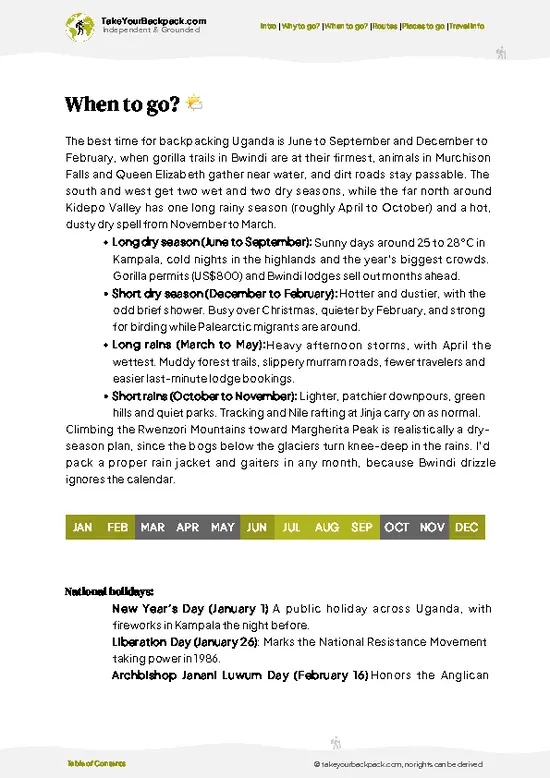
  • Long dry spell (June to August): Trails stay firmest and chimp tracking is easiest on the legs. Days reach 23 to 27°C (73 to 81°F), mornings in the forest start near 15°C (59°F). Permits sell out, so book ahead.
  • Short dry spell (December to February): Similar sunshine, slightly hotter at 25 to 28°C (77 to 82°F). Peak holiday crowds mean lodges raise rates.
  • Wet seasons (March to May, September to November): Expect afternoon downpours, muddy slopes and leeches, with 18 to 25°C (64 to 77°F). Fruiting trees pull chimps low, and the forest turns thick and green. Lodges drop rates and permits are easy to get.
  • Daylight: Close to the equator, the sun rises and sets at nearly the same hour all year, so plan on roughly 12 hours of light and tracking starts at 8 am or 2 pm.
Book your chimpanzee permit two … read more 👉
  • Long dry spell (June to August): Trails stay firmest and chimp tracking is easiest on the legs. Days reach 23 to 27°C (73 to 81°F), mornings in the forest start near 15°C (59°F). Permits sell out, so book ahead.
  • Short dry spell (December to February): Similar sunshine, slightly hotter at 25 to 28°C (77 to 82°F). Peak holiday crowds mean lodges raise rates.
  • Wet seasons (March to May, September to November): Expect afternoon downpours, muddy slopes and leeches, with 18 to 25°C (64 to 77°F). Fruiting trees pull chimps low, and the forest turns thick and green. Lodges drop rates and permits are easy to get.
  • Daylight: Close to the equator, the sun rises and sets at nearly the same hour all year, so plan on roughly 12 hours of light and tracking starts at 8 am or 2 pm.
Book your chimpanzee permit two to three months ahead for June to August and December.


source: climatestotravel.comJANJanuary: highly recommended for travelingFEBFebruary: highly recommended for travelingMARMarch: fair for travelingAPRApril: fair for travelingMAYMay: fair for travelingJUNJune: highly recommended for travelingJULJuly: excellent for travelingAUGAugust: excellent for travelingSEPSeptember: highly recommended for travelingOCTOctober: fair for travelingNOVNovember: fair for travelingDECDecember: highly recommended for traveling
when-to-go

✈️ The backpacker research shortcutUganda Travel Guide

An offline-friendly backpacking guide with optimized travel routes, ranked highlights, transport advice, and the best areas to stay.
example page 0 from our offline Travel Guide for Uganda
example page 1 from our offline Travel Guide for Uganda
example page 2 from our offline Travel Guide for Uganda
example page 3 from our offline Travel Guide for Uganda
example page 4 from our offline Travel Guide for Uganda
example page 5 from our offline Travel Guide for Uganda
example page 6 from our offline Travel Guide for Uganda
example page 7 from our offline Travel Guide for Uganda
The digital guide (372 pages) contains:
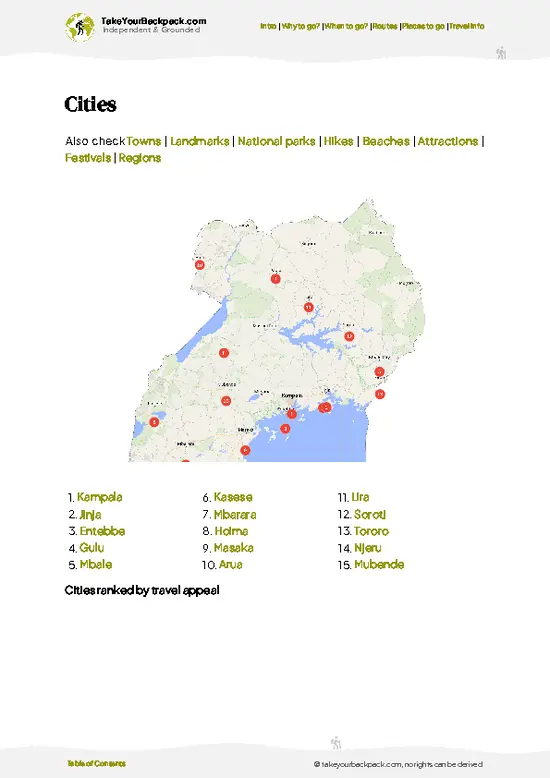
✅ 96 highlights, ranked by travel appeal
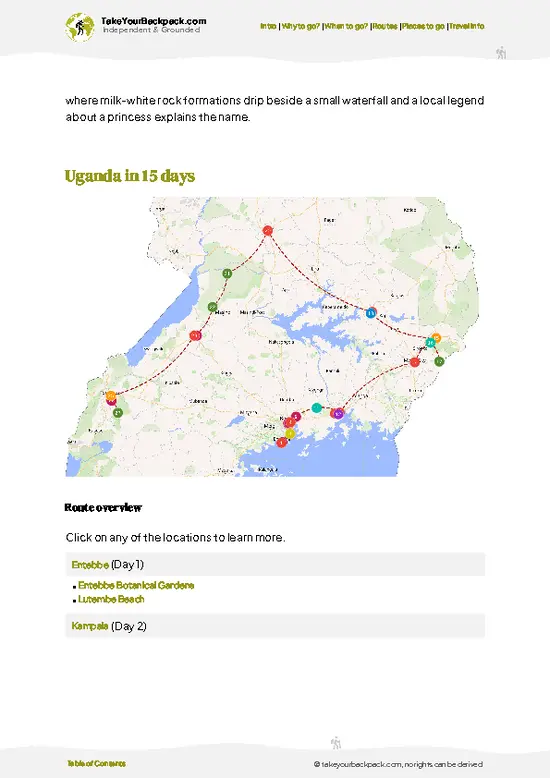
✅ Optimized 5, 10 & 15-day travel routes
✅ Cities, national parks, landmarks, beaches
✅ How to get around
✅ Offline-friendly for travel without Wi-Fi
👉 Click to see all 30+ guide features

📅 Plan smarter in minutes, not weeks
✅ Month by month travel advice
✅ Festivals & national holidays
✅ Budget expectations

🗺️ Go to the right places, skip the overrated ones
✅ Honest pros & cons of destinations
✅ Top hikes, parks & viewpoints
✅ Lesser-known places most travelers miss
✅ Clear “worth it vs skip it” guidance

🛏️ Travel smoothly without rookie mistakes
✅ Best areas to stay
✅ Transport systems explained simply
✅ Common scams & safety advice
✅ SIM cards, money & practical tips

🌍 Understand the country, not just visit it
✅ Culture & traditions
✅ 52 Essential phrases & customs
✅ Festivals worth planning around
✅ Traveler-friendly historical context
✅ Insights that make places more meaningful

📱 Built for real travel conditions
✅ Fully downloadable PDF
✅ Works completely offline
✅ Optimized for phone use
✅ Useful in remote areas & buses
✅ Everything in one place
Stop searching, start planning
Get instant access to your full guide. 30‑day money-back guarantee.
+ Add another guide for just

By proceeding you agree to our terms.
Sent to your inbox immediately after payment • 100% Secure Checkout
Best Backpacking Travel Advisor 2025 tourism awardBest Backpacking
Travel Advisor
2025
What others say about Take Your Backpack Guides:
⭐⭐⭐⭐⭐
Fantastic, amazing amount of information!
⭐⭐⭐⭐⭐
My goodness this is amazing, it's what I've been looking for hats off too you!
⭐⭐⭐⭐⭐
I think this is absolutely BRILLIANT
⭐⭐⭐⭐
Very complete and informative. It's still missing places, but I gotta to commend you
⭐⭐⭐⭐⭐
This is truly amazing, thank you, can't wait to explore it with my kids!
⭐⭐⭐⭐⭐
Awesome resource, thank you!
⭐⭐⭐⭐⭐
This is amazing! Can't wait to explore the ones I haven't seen
⭐⭐⭐⭐
I love this! Well done, great idea.
⭐⭐⭐⭐⭐
Thanks for taking the time to make this gem!
⭐⭐⭐⭐⭐
This might be the best website I've ever seen.
⭐⭐⭐⭐⭐
Congratulations, and thank you so much for your work; it's incredibly valuable.
⭐⭐⭐⭐
In all seriousness I think you did a great job pointing out the important spots
⭐⭐⭐⭐⭐
10/10 very good
⭐⭐⭐⭐⭐
As someone who's only just starting to visit regularly this is awesome, thank you.
⭐⭐⭐⭐
Thank you very much! I'm going to visit my dad, it's going to be very useful!
⭐⭐⭐⭐⭐
This is really cool! We'll be travelling for the first time and this definitely come in handy.
⭐⭐⭐⭐⭐
You are now our minister of culture, congratulations 👨‍💼
⭐⭐⭐⭐⭐
Just wanted to tell you that this is a pearl! Going to follow your recommendations.
⭐⭐⭐⭐⭐
This is so cool. I'll definitely be using the resource for my travels soon.
⭐⭐⭐⭐⭐
This is very impressive! Good work.
⭐⭐⭐⭐⭐
This is an amazing and informative site. Very well done!

🛏️ Where to stay?Best areas and accommodation options

Most backpackers sleep in Fort Portal, about 35 kilometers north of the park, or in the village of Kanyanchu and nearby Bigodi, which sit right at the forest edge. Inside the park, Uganda Wildlife Authority runs the Kanyanchu tourism center, where simple bandas and a campsite cost roughly US$15 to 40 a night. Camping with your own tent is the cheapest option. Rooms are basic, with shared bathrooms and a canteen that serves rice, beans and eggs.
Bigodi is the better budget choice if you want community-run lodging. Homestays and small guesthouses there charge around US$10 to 25, and the village sits … read more 👉
Most backpackers sleep in Fort Portal, about 35 kilometers north of the park, or in the village of Kanyanchu and nearby Bigodi, which sit right at the forest edge. Inside the park, Uganda Wildlife Authority runs the Kanyanchu tourism center, where simple bandas and a campsite cost roughly US$15 to 40 a night. Camping with your own tent is the cheapest option. Rooms are basic, with shared bathrooms and a canteen that serves rice, beans and eggs.
Bigodi is the better budget choice if you want community-run lodging. Homestays and small guesthouses there charge around US$10 to 25, and the village sits beside Bigodi Wetland Sanctuary, good for monkeys and birds. Several eco-lodges near the park gate offer dorm beds or budget rooms from about US$20 to 50.
Fort Portal has the widest choice, from hostels with dorm beds at US$8 to 15 to guesthouses with private rooms at US$15 to 35. It has restaurants, ATMs and shared taxis. Reaching Kanyanchu from town takes about 45 minutes to an hour by private hire or by minibus along the Kamwenge road. Chimp tracking begins early, so staying near the gate saves a pre-dawn scramble.

👛 Costs (as of 22 October 2026)Travel costs and budget guide for Kibale

Kibale National Park costs a backpacker about US$215 to 260 a day when chimp tracking is included, or around US$60 to 80 on days without a permit. The permit is the major expense. Everything else is cheap.
CategoryBudget RangeLocal Reality
Park entranceUS$40 to 45Charged per 24 hours for foreign non-residents, and covers forest walks.
Chimpanzee tracking permitUS$150 to 250Roughly US$200 in peak months, and discounts sometimes apply in the wet season. Not needed every day.
Accommodation (high season)US$10 to 40Camping, homestays in Bigodi and Fort Portal dorm beds sit at the low end. Park bandas are higher.
Local transportUS$3 to 15Minibus from Fort Portal to the park is cheap. A private car or boda-boda for early starts costs more.
Food and suppliesUS$6 to 15Rice, beans, chapati and rolex are cheap.
… read more 👉
Kibale National Park costs a backpacker about US$215 to 260 a day when chimp tracking is included, or around US$60 to 80 on days without a permit. The permit is the major expense. Everything else is cheap.
CategoryBudget RangeLocal Reality
Park entranceUS$40 to 45Charged per 24 hours for foreign non-residents, and covers forest walks.
Chimpanzee tracking permitUS$150 to 250Roughly US$200 in peak months, and discounts sometimes apply in the wet season. Not needed every day.
Accommodation (high season)US$10 to 40Camping, homestays in Bigodi and Fort Portal dorm beds sit at the low end. Park bandas are higher.
Local transportUS$3 to 15Minibus from Fort Portal to the park is cheap. A private car or boda-boda for early starts costs more.
Food and suppliesUS$6 to 15Rice, beans, chapati and rolex are cheap. Lodge meals cost more.
Total Daily BudgetUS$229Includes one permit day. Skip the permit and the figure drops sharply.


source: ugandawildlife.org
⚠️ Prices can change and everyone travels differently, so take this as a rough guide. Hope it helps you plan your adventure!

🥾 TrailsDiscover Kibale's top trails and natural wonders

Kibale National Park is mostly walked with a ranger, on forest tracks that range from easy flat paths to muddy slopes with tangled roots. Fitness demands are modest, but the humidity and trail slickness can tire you out.
  • Chimpanzee tracking: Starts from Kanyanchu after a morning briefing. Groups are small, the walk can last 2 to 5 hours depending on where the chimps are, and the terrain is mostly moderate. You get up to one hour with the apes once found.
  • Chimpanzee habituation experience: A full-day outing that begins before dawn. It is moderate to demanding, with hours on foot over uneven ground,
… read more 👉
Kibale National Park is mostly walked with a ranger, on forest tracks that range from easy flat paths to muddy slopes with tangled roots. Fitness demands are modest, but the humidity and trail slickness can tire you out.
  • Chimpanzee tracking: Starts from Kanyanchu after a morning briefing. Groups are small, the walk can last 2 to 5 hours depending on where the chimps are, and the terrain is mostly moderate. You get up to one hour with the apes once found.
  • Chimpanzee habituation experience: A full-day outing that begins before dawn. It is moderate to demanding, with hours on foot over uneven ground, but the time spent with the chimps is far longer.
  • Primate walk: A guided forest walk of around 2 to 3 hours that looks for colobus, red-tailed monkeys and other species. It is easy to moderate and suits those who prefer a gentler pace.
  • Bigodi Wetland Sanctuary: A guided swamp walk of around 3 hours on boardwalks and soft paths. It is easy and good for birds and monkeys.
  • Night walk: A short guided walk after dark to look for nocturnal animals. Easy terrain but bring a headlamp.
Wildlife includes chimpanzees, red colobus, L’Hoest’s monkeys, forest elephants in small numbers and a long bird list. Rain is frequent, so expect mud and carry a waterproof layer. Wear long trousers tucked into socks against ants and nettles.

Getting to the park by public transport means reaching Fort Portal first, then continuing by shared taxi or a boda-boda toward Kanyanchu, usually with a hired ride for the last stretch. Visitor numbers are highest in the main dry months, so permits for chimp activities can sell out. An entrance fee and separate activity permits apply, paid in US dollars.
⚠️ Hiking info can sometimes be outdated or inaccurate. Before you hit the trail, check the latest conditions with locals. If you do spot anything that's off, I'd love to hear from you, so I can update it for fellow travelers.

🛡️ SafetyTraveler Safety Guide

Kibale is a well-run park where guides handle nearly every risk, so the real issues are mud, heat and fatigue. Chimp tracking and forest walks are always done with an armed ranger, who leads you off flat tracks onto steep, slippery slopes. Wear boots with grip, long trousers tucked into socks against safari ants, and a rain jacket, as downpours come with little warning. Gaiters help in wet months. Chimps can be unpredictable, so keep at least 8 meters back, stay quiet, and never eat in front of them. Forest elephants occasionally wander near paths and trails, and your ranger will decide when to move. Do not visit with a cold or flu, since you can pass illness to the primates, and rangers may turn you away. Carry a liter or two of water, and wear a hat for the sticky heat. Malaria is present … read more 👉
Kibale is a well-run park where guides handle nearly every risk, so the real issues are mud, heat and fatigue. Chimp tracking and forest walks are always done with an armed ranger, who leads you off flat tracks onto steep, slippery slopes. Wear boots with grip, long trousers tucked into socks against safari ants, and a rain jacket, as downpours come with little warning. Gaiters help in wet months. Chimps can be unpredictable, so keep at least 8 meters back, stay quiet, and never eat in front of them. Forest elephants occasionally wander near paths and trails, and your ranger will decide when to move. Do not visit with a cold or flu, since you can pass illness to the primates, and rangers may turn you away. Carry a liter or two of water, and wear a hat for the sticky heat. Malaria is present in the area, so take prophylaxis and use repellent at dusk. Fitness requirements are moderate, though tracking can last two to five hours.

FAQCommon questions from travelers

Two days is the comfortable minimum for Kibale National Park, with one morning or afternoon for chimp tracking and another for a forest walk or the Bigodi Wetland Sanctuary. Three days lets you add the night walk, crater lakes near Fort Portal and a bit of buffer in case rain delays things. Tracking itself takes two to five hours.
Yes, Kibale National Park is reachable without a car. Shared minibuses run from Fort Portal toward Kamwenge and drop you at Kanyanchu in roughly 45 minutes to an hour, for a few dollars. Boda-bodas and hired cars from town cost more, and staying at Kanyanchu or Bigodi removes the need for transport on tracking days.
Yes, Kibale National Park charges an entrance fee of about US$40 to 45 per 24 hours for foreign non-residents, payable to Uganda Wildlife Authority. Chimpanzee tracking needs a separate permit at roughly US$150 to 250, depending on season. Book through the authority or a tour operator, especially for June to August and December.
⚠️ Things can change over time, so always validate details locally before you go.

Other Ugandan national parks near Kibale

Explore more nearby:


💡 Not sure where to go next?
Create a personalized itinerary for Uganda including Kibale and the places that fit your trip.

Generate my itinerary

👉 Discover all national parks

Or checkout all Uganda has to offer (think cities, towns, villages, national parks, hikes, beaches, festivals)
Country photo of Uganda

We 💚 feedbackWhat to keep in mind

Kibale National Park deserves two nights at minimum. One day goes to chimp tracking and the next to the Bigodi swamp or the habituation experience, which adds a second look at the apes. Skip rushing through in a single morning. I would book the permit first, then build the rest of the trip around it, and pack gaiters.

✈️ When did I visit Uganda?
In September 2019 I have done a backpacking trip through Uganda. Seeing gorillas in the wild from up close was a pure unexpected highlight!

✍️ Help improve this page!
The information on this page is based on my own backpacking experience in Uganda, supplemented with up-to-date research and feedback from other travelers. Travel details can change, so if you notice anything outdated or incomplete, feel free to let me know.


🙋‍♂️ Give feedback

👋 Meet the founderWho’s Behind Take Your Backpack?

Johan, backpacker and founder of TakeYourBackpackHi, I’m Johan (Netherlands 🇳🇱), the creator of TakeYourBackpack. Over the past 3 decades, I’ve backpacked through 90+ countries across six continents, gaining extensive experience with independent travel, long-term trips, and overland routes.

This site is built on a combination of firsthand travel experience and carefully curated insights from other backpackers. Many guides are based on places I’ve personally visited, while others bring together tips, observations, and practical advice shared by trusted travelers I’ve met along the way.

The goal is to provide realistic, experience-driven guidance — not generic itineraries — so you can explore destinations with better context, clearer expectations, and more confidence.