×
Yosemite National Park

the USA🇺🇸 | national parksYosemite National ParkGranite walls, Yosemite Falls, Half Dome cables, giant sequoias | things to do and best time to go

Explore Yellowstone National ParkExplore Zion National Park

Backpacking in Yosemite
UNESCO World Heritage site
🏆 Top picknational park ranked #3
By Johan Kruseman 🇳🇱 | Updated October 22, 2026

Yosemite National Park packs granite walls, huge waterfalls and a free shuttle into one valley, so once you park you can stop spending money on wheels. It sits in the Sierra Nevada of eastern California, in the United States, well east of San Francisco. The valley floor is a traffic jam with trees, so arrive early, park once and stop circling for a closer space. Campsites and backcountry permits vanish within minutes of release, so book the day the window opens, not the week before. Tioga Road closes for winter, so check its status before building a high country route around it. I connect this place with the sound of Lower Yosemite Fall in May, a low roar that reaches you in the parking lot long before the mist does. Unlike Sequoia and Kings Canyon to the south, Yosemite crowds its headline sights into one valley, while those parks spread out and stay quieter.

Discover everything you want to know in the 📖 the USA Travel Guide.


example page 0 from our offline Travel Guide for United States
example page 1 from our offline Travel Guide for United States
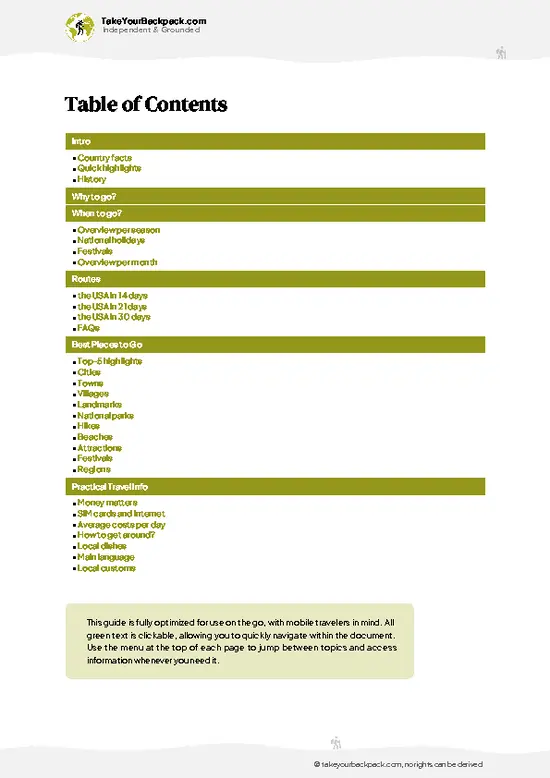
example page 2 from our offline Travel Guide for United States
example page 3 from our offline Travel Guide for United States
example page 4 from our offline Travel Guide for United States
example page 5 from our offline Travel Guide for United States
example page 6 from our offline Travel Guide for United States
example page 7 from our offline Travel Guide for United States
Loading the map 🌍
CLICK TO FILTER
cities
towns
villages
landmarks
national parks
hikes
beaches
attractions
festivals
regions
SHOW COUNTRY’S BESTSHOW ALL

✨ Why go?
Ranked #3 national park in the USA
Why Yosemite should be on your travel list

Yosemite National Park suits backpackers because the best of it needs boots, not a tour seat. The valley shuttle, a network of trails that start from its stops and a long list of backcountry routes let you build your own days. Nothing is guided unless you want it to be.
The trail variety is the real draw. In a single week you can climb the Mist Trail beside Vernal and Nevada Falls, walk granite domes above Tuolumne Meadows and hike among the sequoias of Mariposa Grove. If you have the stamina and a permit, Half Dome’s cable route gives you the one climb that people in this park talk about for years.
The park also rewards flexibility. Camping in the valley is popular and hard to land, but wilderness permits get you into quiet basins that day visitors never reach. Carry a bear canister, bring … read more 👉
Yosemite National Park suits backpackers because the best of it needs boots, not a tour seat. The valley shuttle, a network of trails that start from its stops and a long list of backcountry routes let you build your own days. Nothing is guided unless you want it to be.
The trail variety is the real draw. In a single week you can climb the Mist Trail beside Vernal and Nevada Falls, walk granite domes above Tuolumne Meadows and hike among the sequoias of Mariposa Grove. If you have the stamina and a permit, Half Dome’s cable route gives you the one climb that people in this park talk about for years.
The park also rewards flexibility. Camping in the valley is popular and hard to land, but wilderness permits get you into quiet basins that day visitors never reach. Carry a bear canister, bring a paper map for the high country and plan a few nights away from the valley floor. The crowds drop sharply once you are a few miles up any trail.

💡 HighlightsDon't-miss highlights and experiences

  1. Half Dome: The granite dome rising about 4,700 feet (1,430 meters) above the valley floor is the park’s signature shape. Seen from the valley it is a sheer, sliced face. Climbing it is a 14 to 16 mile (23 to 26 km) round trip that ends on steel cables, and a permit is required.
  2. El Capitan: A 3,000 foot (900 meter) vertical wall that draws climbers from around the world. From El Capitan Meadow you can often spot climbers hanging on the face with binoculars.
  3. Yosemite Falls: At 2,425 feet (739 meters) it is among the tallest waterfalls in North America, falling in three sections. It peaks in volume in May and can dwindle to almost nothing by late summer.
  4. Mist Trail to Vernal and Nevada Falls: A stepped granite staircase beside two thundering falls, soaking hikers with spray. Vernal Fall is a short
… read more 👉
  1. Half Dome: The granite dome rising about 4,700 feet (1,430 meters) above the valley floor is the park’s signature shape. Seen from the valley it is a sheer, sliced face. Climbing it is a 14 to 16 mile (23 to 26 km) round trip that ends on steel cables, and a permit is required.
  2. El Capitan: A 3,000 foot (900 meter) vertical wall that draws climbers from around the world. From El Capitan Meadow you can often spot climbers hanging on the face with binoculars.
  3. Yosemite Falls: At 2,425 feet (739 meters) it is among the tallest waterfalls in North America, falling in three sections. It peaks in volume in May and can dwindle to almost nothing by late summer.
  4. Mist Trail to Vernal and Nevada Falls: A stepped granite staircase beside two thundering falls, soaking hikers with spray. Vernal Fall is a short climb, and Nevada Fall is a bigger day that rewards you with open views.
  5. Glacier Point: A viewpoint 3,200 feet (975 meters) above the valley, looking straight at Half Dome and across the high country. The road is open roughly from late spring to the first big snow.
  6. Tunnel View: The classic pull-out at the east end of the Wawona Tunnel, framing El Capitan, Bridalveil Fall and Half Dome in a single view. It gets crowded, but the view justifies it.
  7. Tuolumne Meadows: A subalpine meadow at about 8,600 feet (2,620 meters) beside the Tuolumne River, ringed by granite domes. It is cooler and calmer than the valley, and Tioga Road to it is open roughly from June to October.
  8. Mariposa Grove of Giant Sequoias: Around 500 mature giant sequoias grow here, including the Grizzly Giant, which is thought to be over 2,000 years old. Walking among trunks this wide is quiet and humbling.
Yosemite National Park is easiest to read if you start at Tunnel View, because that one pull-out shows you the valley’s layout and lets you pick which of the other sights you want next.
Spotted a mistake or missing something? Contact us.

Things to do around Yosemite National Park

Ratings based on Tripadvisor reviews. When you book through this link, you support our work at no extra cost to you.

🌤️ When to go?When to go for the best experience

  • Summer (June to August): Tioga Road and Glacier Point Road are open and the high country is snow-free. Valley highs run 30 to 35°C (86 to 95°F), Tuolumne Meadows 20 to 27°C (68 to 80°F), with long daylight and the heaviest crowds and prices. Waterfalls are thin by August.
  • Fall (September to October): Crowds thin, nights drop to near freezing up high, and days stay 15 to 25°C (59 to 77°F). Tioga Road can close after an early storm.
  • Winter (November to March): Valley highs of 8 to 12°C (46 to 54°F), lows around -2 to 0°C (28 to 32°F), and short days. Tioga Road is closed, backcountry needs snowshoes or skis, and lodging rates drop outside holidays.
  • Spring (April to early June): Snowmelt peaks in May and Yosemite Falls and Bridalveil roar at 12 to 22°C (54 to 72°F). Rain is common and high trails
… read more 👉
  • Summer (June to August): Tioga Road and Glacier Point Road are open and the high country is snow-free. Valley highs run 30 to 35°C (86 to 95°F), Tuolumne Meadows 20 to 27°C (68 to 80°F), with long daylight and the heaviest crowds and prices. Waterfalls are thin by August.
  • Fall (September to October): Crowds thin, nights drop to near freezing up high, and days stay 15 to 25°C (59 to 77°F). Tioga Road can close after an early storm.
  • Winter (November to March): Valley highs of 8 to 12°C (46 to 54°F), lows around -2 to 0°C (28 to 32°F), and short days. Tioga Road is closed, backcountry needs snowshoes or skis, and lodging rates drop outside holidays.
  • Spring (April to early June): Snowmelt peaks in May and Yosemite Falls and Bridalveil roar at 12 to 22°C (54 to 72°F). Rain is common and high trails stay snowed in.
Book Valley camping and permits months ahead for any weekend from May to September; midweek visits cut both crowds and cost.


source: climatestotravel.comJANJanuary: below average for travelingFEBFebruary: below average for travelingMARMarch: fair for travelingAPRApril: highly recommended for travelingMAYMay: excellent for travelingJUNJune: excellent for travelingJULJuly: highly recommended for travelingAUGAugust: highly recommended for travelingSEPSeptember: highly recommended for travelingOCTOctober: excellent for travelingNOVNovember: fair for travelingDECDecember: below average for traveling
United States - Yosemite National Park

✈️ The backpacker research shortcutthe USA Travel Guide

An offline-friendly backpacking guide with optimized travel routes, ranked highlights, transport advice, and the best areas to stay.
example page 0 from our offline Travel Guide for United States
example page 1 from our offline Travel Guide for United States
example page 2 from our offline Travel Guide for United States
example page 3 from our offline Travel Guide for United States
example page 4 from our offline Travel Guide for United States
example page 5 from our offline Travel Guide for United States
example page 6 from our offline Travel Guide for United States
example page 7 from our offline Travel Guide for United States
The digital guide (451 pages) contains:
✅ 159 highlights, ranked by travel appeal
✅ Optimized 14, 21 & 30-day travel routes
✅ Cities, national parks, landmarks, beaches
✅ How to get around
✅ Offline-friendly for travel without Wi-Fi
👉 Click to see all 30+ guide features

📅 Plan smarter in minutes, not weeks
✅ Month by month travel advice
✅ Festivals & national holidays
✅ Budget expectations

🗺️ Go to the right places, skip the overrated ones
✅ Honest pros & cons of destinations
✅ Top hikes, parks & viewpoints
✅ Lesser-known places most travelers miss
✅ Clear “worth it vs skip it” guidance

🛏️ Travel smoothly without rookie mistakes
✅ Best areas to stay
✅ Transport systems explained simply
✅ Common scams & safety advice
✅ SIM cards, money & practical tips

🌍 Understand the country, not just visit it
✅ Culture & traditions
✅ Local customs
✅ Festivals worth planning around
✅ Traveler-friendly historical context
✅ Insights that make places more meaningful

📱 Built for real travel conditions
✅ Fully downloadable PDF
✅ Works completely offline
✅ Optimized for phone use
✅ Useful in remote areas & buses
✅ Everything in one place
Stop searching, start planning
Get instant access to your full guide. 30‑day money-back guarantee.
+ Add another guide for just

By proceeding you agree to our terms.
Sent to your inbox immediately after payment • 100% Secure Checkout
Best Backpacking Travel Advisor 2025 tourism awardBest Backpacking
Travel Advisor
2025
What others say about Take Your Backpack Guides:
⭐⭐⭐⭐⭐
Fantastic, amazing amount of information!
⭐⭐⭐⭐⭐
My goodness this is amazing, it's what I've been looking for hats off too you!
⭐⭐⭐⭐⭐
I think this is absolutely BRILLIANT
⭐⭐⭐⭐
Very complete and informative. It's still missing places, but I gotta to commend you
⭐⭐⭐⭐⭐
This is truly amazing, thank you, can't wait to explore it with my kids!
⭐⭐⭐⭐⭐
Awesome resource, thank you!
⭐⭐⭐⭐⭐
This is amazing! Can't wait to explore the ones I haven't seen
⭐⭐⭐⭐
I love this! Well done, great idea.
⭐⭐⭐⭐⭐
Thanks for taking the time to make this gem!
⭐⭐⭐⭐⭐
This might be the best website I've ever seen.
⭐⭐⭐⭐⭐
Congratulations, and thank you so much for your work; it's incredibly valuable.
⭐⭐⭐⭐
In all seriousness I think you did a great job pointing out the important spots
⭐⭐⭐⭐⭐
10/10 very good
⭐⭐⭐⭐⭐
As someone who's only just starting to visit regularly this is awesome, thank you.
⭐⭐⭐⭐
Thank you very much! I'm going to visit my dad, it's going to be very useful!
⭐⭐⭐⭐⭐
This is really cool! We'll be travelling for the first time and this definitely come in handy.
⭐⭐⭐⭐⭐
You are now our minister of culture, congratulations 👨‍💼
⭐⭐⭐⭐⭐
Just wanted to tell you that this is a pearl! Going to follow your recommendations.
⭐⭐⭐⭐⭐
This is so cool. I'll definitely be using the resource for my travels soon.
⭐⭐⭐⭐⭐
This is very impressive! Good work.
⭐⭐⭐⭐⭐
This is an amazing and informative site. Very well done!

🛏️ Where to stay?Choosing the right base

Camp in Yosemite Valley if you can get a spot, otherwise sleep just outside the gates. Inside the park, Curry Village has canvas tent cabins (roughly US$150 to 200 a night), and Housekeeping Camp offers basic concrete-and-canvas units. Valley campgrounds such as Upper Pines, Lower Pines and North Pines cost about US$36 a night and book out within minutes on Recreation.gov, five months ahead in monthly releases. Camp 4 is the walk-in backpacker site at about US$10 per person, reserved on Recreation.gov a week ahead from mid-April through October and first come, first served in winter, with sharing … read more 👉
Camp in Yosemite Valley if you can get a spot, otherwise sleep just outside the gates. Inside the park, Curry Village has canvas tent cabins (roughly US$150 to 200 a night), and Housekeeping Camp offers basic concrete-and-canvas units. Valley campgrounds such as Upper Pines, Lower Pines and North Pines cost about US$36 a night and book out within minutes on Recreation.gov, five months ahead in monthly releases. Camp 4 is the walk-in backpacker site at about US$10 per person, reserved on Recreation.gov a week ahead from mid-April through October and first come, first served in winter, with sharing required. Tuolumne Meadows and Crane Flat campgrounds suit summer visits to the high country. Wilderness permits cover backcountry nights.

Outside the park, Mariposa (about 45 minutes from the Valley via Highway 140) has motels and hostel-style rooms from roughly US$100 to 160. El Portal, closer to the gate, has a few lodges. On the east side, Lee Vining has budget motels near Tioga Pass, and Groveland on Highway 120 west serves the Hetch Hetchy side. Fresno, Merced and Oakhurst are cheaper bases for the south entrance via Highway 41, but they add a longer drive. Mariposa and Lee Vining are the most practical for backpackers without a car, thanks to YARTS buses.

👛 Costs (as of 22 October 2026)How expensive it really is

A backpacker on a tight plan can expect to spend about US$85 to 100 a day at Yosemite National Park, with the entrance fee and lodging driving most of that.
CategoryBudget RangeLocal Reality
Entrance feeUS$10 to 35US$35 per vehicle, US$20 per person on foot, bike or bus, valid seven days; nonresidents aged 16 and over pay an extra US$100 each; the America the Beautiful pass is US$80 a year for US residents and US$250 for nonresidents. Divided across a group, the vehicle fee is cheaper per head.
Camping (high season)US$10 to 36Camp 4 is about US$10 per person; Valley campgrounds about US$36 a site. Tent cabins at Curry Village run US$150 or more.
Accommodation (low season)US$80 to 140Motels in Mariposa or Lee Vining drop in winter and midweek.
Wilderness permitUS$6 to 10Reservation fee of about
… read more 👉
A backpacker on a tight plan can expect to spend about US$85 to 100 a day at Yosemite National Park, with the entrance fee and lodging driving most of that.
CategoryBudget RangeLocal Reality
Entrance feeUS$10 to 35US$35 per vehicle, US$20 per person on foot, bike or bus, valid seven days; nonresidents aged 16 and over pay an extra US$100 each; the America the Beautiful pass is US$80 a year for US residents and US$250 for nonresidents. Divided across a group, the vehicle fee is cheaper per head.
Camping (high season)US$10 to 36Camp 4 is about US$10 per person; Valley campgrounds about US$36 a site. Tent cabins at Curry Village run US$150 or more.
Accommodation (low season)US$80 to 140Motels in Mariposa or Lee Vining drop in winter and midweek.
Wilderness permitUS$6 to 10Reservation fee of about US$6 plus roughly US$5 per person; Half Dome permits need a lottery application.
Local transportUS$0 to 20The Valley shuttle is free. YARTS buses from Mariposa cost around US$10 to 15 round trip, and fares include the park entry.
Food and suppliesUS$25 to 45Groceries from Mariposa or Oakdale are far cheaper than Valley cafeterias, where a meal runs US$12 to 18. Bear canisters can be rented for about US$5 to 10.
Total Daily BudgetUS$85 to 100Based on a walk-in entry, one high-season campsite night, shuttle use and self-catered food.


source: nps.gov
⚠️ Prices can change and everyone travels differently, so take this as a rough guide. Hope it helps you plan your adventure!

🥾 TrailsExploring Yosemite: trails, terrain, and views

Yosemite National Park offers everything from paved loops to multi-day backcountry routes, and nearly every trail climbs granite, so expect steps, switchbacks and exposure. Most day hikes begin in Yosemite Valley or along Tioga Road, and wildlife includes black bears, mule deer, coyotes and peregrine falcons.
  • Lower Yosemite Fall Trail: A 1 mile (1.6 km) loop of about 30 minutes on a flat, paved path. Easy, and the fastest way to get under the spray in spring.
  • Mist Trail: About 3 miles (4.8 km) round trip to the top of Vernal Fall, or roughly 5.4 miles (8.7 km) including Nevada Fall. Allow 3 to 6
… read more 👉
Yosemite National Park offers everything from paved loops to multi-day backcountry routes, and nearly every trail climbs granite, so expect steps, switchbacks and exposure. Most day hikes begin in Yosemite Valley or along Tioga Road, and wildlife includes black bears, mule deer, coyotes and peregrine falcons.
  • Lower Yosemite Fall Trail: A 1 mile (1.6 km) loop of about 30 minutes on a flat, paved path. Easy, and the fastest way to get under the spray in spring.
  • Mist Trail: About 3 miles (4.8 km) round trip to the top of Vernal Fall, or roughly 5.4 miles (8.7 km) including Nevada Fall. Allow 3 to 6 hours. Strenuous, with wet granite steps and slippery sections.
  • Upper Yosemite Fall Trail: About 7.2 miles (11.6 km) round trip with some 3,200 feet (975 meters) of climbing, taking 6 to 8 hours. Strenuous, with switchbacks that give you views across the valley.
  • Four Mile Trail: Roughly 4.8 miles (7.7 km) one way from the valley floor to Glacier Point. Strenuous, around 3 to 4 hours up. The descent is easier if you take the bus up.
  • Half Dome Trail: About 14 to 16 miles (23 to 26 km) round trip and 10 to 14 hours. Very strenuous, with a permit required for the final cable section.
  • Cathedral Lakes Trail: About 7 to 8 miles (11 to 13 km) round trip from Tuolumne Meadows, taking 4 to 5 hours. Moderate, passing through forest to two alpine lakes.
  • Sentinel Dome: About 2.2 miles (3.5 km) round trip, taking 1.5 hours. Easy to moderate, with a 360-degree summit.
On the practical side, Yosemite National Park is reachable by public transport through YARTS buses from Merced and Mariposa, and the free valley shuttle covers most trailheads in Yosemite Valley. Summer weekends are crowded, and parking in the valley fills early. The entrance fee is US$35 per vehicle or US$20 per person on foot or bike, valid for seven days, plus a US$100 nonresident fee per person for nonresidents aged 16 and over. Overnight trips need a wilderness permit and a bear canister.
⚠️ Hiking info can sometimes be outdated or inaccurate. Before you hit the trail, check the latest conditions with locals. If you do spot anything that's off, I'd love to hear from you, so I can update it for fellow travelers.

🛡️ SafetyTraveler Safety Guide

Yosemite is well managed, and most trouble comes from underestimating the terrain and the weather. Granite is slick when wet, and Half Dome’s cables, Mist Trail steps and Four Mile Trail catch hikers in bad shoes or with too little water. Carry 2 to 3 liters, start early, and turn around if afternoon thunderstorms build over the high country. Altitude matters: Tuolumne Meadows sits near 2,600 meters (8,600 feet), so give yourself a day to adjust. Spring snowmelt makes the Merced and Tuolumne rivers dangerously cold and fast, so stay off rocks above falls. Black bears are active here, and storing all food and scented items in the provided metal lockers or a bear canister is mandatory. Never leave food in a parked car. Keep 45 meters (50 yards) from bears. Cell coverage is patchy, so download … read more 👉
Yosemite is well managed, and most trouble comes from underestimating the terrain and the weather. Granite is slick when wet, and Half Dome’s cables, Mist Trail steps and Four Mile Trail catch hikers in bad shoes or with too little water. Carry 2 to 3 liters, start early, and turn around if afternoon thunderstorms build over the high country. Altitude matters: Tuolumne Meadows sits near 2,600 meters (8,600 feet), so give yourself a day to adjust. Spring snowmelt makes the Merced and Tuolumne rivers dangerously cold and fast, so stay off rocks above falls. Black bears are active here, and storing all food and scented items in the provided metal lockers or a bear canister is mandatory. Never leave food in a parked car. Keep 45 meters (50 yards) from bears. Cell coverage is patchy, so download maps and tell someone your route. Winter driving can require chains.

FAQTraveler FAQ

Three to four days covers Yosemite National Park well. That gives you a day for Yosemite Valley’s waterfalls and Mist Trail, one for Glacier Point and Mariposa Grove, and another for Tuolumne Meadows on Tioga Road (open roughly June to October). Add two or three more days if you plan an overnight backcountry loop or the Half Dome hike, which takes 10 to 14 hours.
Yes, Yosemite National Park works without a car if you plan around YARTS buses. They run from Mariposa, Merced and Mammoth Lakes into Yosemite Valley (about 2 hours from Merced, 1.5 hours from Mariposa), and Highway 120 service from Lee Vining is seasonal in summer. Inside the Valley, free shuttles reach trailheads, campgrounds and lodges, though Tuolumne Meadows and Glacier Point need a seasonal bus or tour.
Yes, Yosemite National Park charges US$35 per private vehicle, US$30 per motorcycle or US$20 per person on foot, bike or bus, valid for seven days. Nonresidents aged 16 and over also pay a US$100 nonresident fee each unless they hold an annual pass, and the America the Beautiful pass costs US$80 for US residents and US$250 for nonresidents. Overnight backcountry trips require a wilderness permit, with a reservation fee of about US$6 plus roughly US$5 per person. Half Dome requires a separate permit won via lottery, and peak-season reservations are required for some entries in summer.
⚠️ Things can change over time, so always validate details locally before you go.

Other American national parks near Yosemite

Explore more nearby:


💡 Not sure where to go next?
Create a personalized itinerary for the USA including Yosemite and the places that fit your trip.

Generate my itinerary

👉 Discover all national parks

Or checkout all the USA has to offer (think cities, towns, villages, national parks, hikes, beaches, festivals)
Country photo of the USA

We 💚 feedbackParting advice and final tips

Yosemite National Park punishes travelers who show up in summer expecting to wing a campsite or valley parking. Book the moment reservation windows open, park once and ride the free shuttle. I would also spend one day up high on Tioga Road, where the crowds thin considerably. Use the metal food lockers at trailheads and campsites, since the bears have learned what a cooler looks like.

✈️ When did I visit the USA?
In January 2023 I visited New York. Many years before, before digital cameras existed, I discovered most of the national parks in the West.

✍️ Help improve this page!
The information on this page is based on my own backpacking experience in the USA, supplemented with up-to-date research and feedback from other travelers. Travel details can change, so if you notice anything outdated or incomplete, feel free to let me know.


🙋‍♂️ Give feedback

👋 Meet the founderWho’s Behind Take Your Backpack?

Johan, backpacker and founder of TakeYourBackpackHi, I’m Johan (Netherlands 🇳🇱), the creator of TakeYourBackpack. Over the past 3 decades, I’ve backpacked through 90+ countries across six continents, gaining extensive experience with independent travel, long-term trips, and overland routes.

This site is built on a combination of firsthand travel experience and carefully curated insights from other backpackers. Many guides are based on places I’ve personally visited, while others bring together tips, observations, and practical advice shared by trusted travelers I’ve met along the way.

The goal is to provide realistic, experience-driven guidance — not generic itineraries — so you can explore destinations with better context, clearer expectations, and more confidence.