×

Uruguay🇺🇾 | national parksSanta TeresaStar-shaped fortress, Playa Grande, granite shore, forest campground | things to do and best time to go

Explore Parque Nacional San MiguelExplore Laguna de Rocha

Backpacking in Santa Teresa
🏆 Top picknational park ranked #1
By Johan Kruseman 🇳🇱 | Updated October 19, 2026

Santa Teresa National Park holds a restored 18th-century Portuguese fortress, and the park also has a large collection of palms, so a beach day can double as a history stop. The park lies on the Atlantic coast of Uruguay, in Rocha department, roughly 300 km east of Montevideo near the Brazilian border. It spreads over about 3,000 hectares of eucalyptus and pine woods, wetlands, granite outcrops and long, empty beaches. Hiking is gentle: flat sandy tracks and short paths, good for easy walking rather than serious trekking. Wildlife is modest but real, with rheas, capybaras, coypu and many birds around the lagoons. Crowds are the main drawback. January turns the beaches and campground into a loud, packed holiday camp, and the rest of the year is quiet, sometimes almost deserted. Public transport thins out outside summer, which is why experienced travelers go in shoulder months, when buses still run and space is easy. Before going, buy food and cash in town, because services inside the park are limited and mostly closed off-season.

Discover everything you want to know in the 📖 Uruguay Travel Guide.


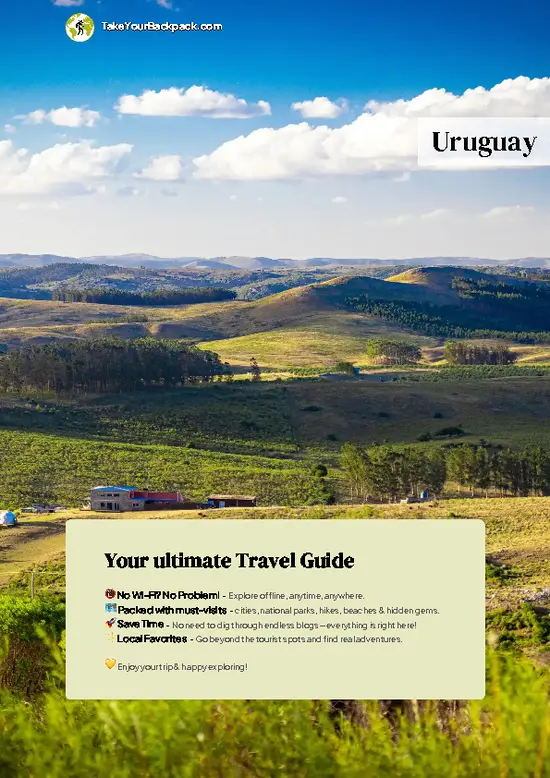
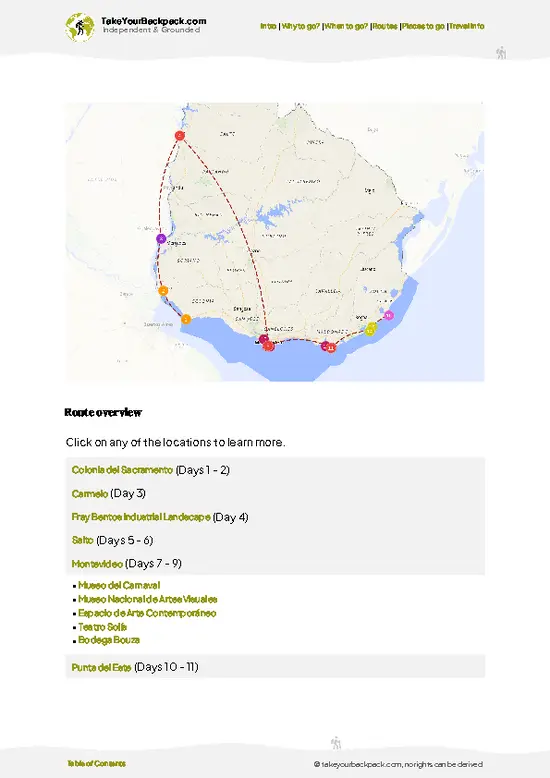
example page 0 from our offline Travel Guide for Uruguay
example page 1 from our offline Travel Guide for Uruguay
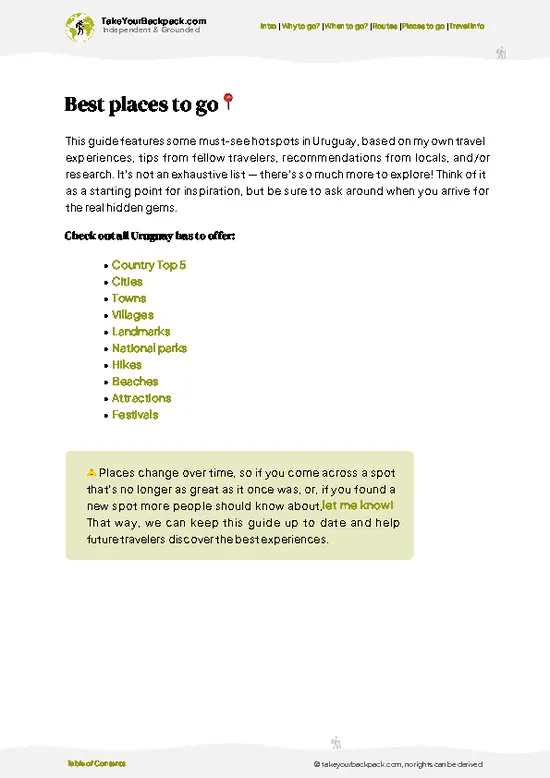
example page 2 from our offline Travel Guide for Uruguay
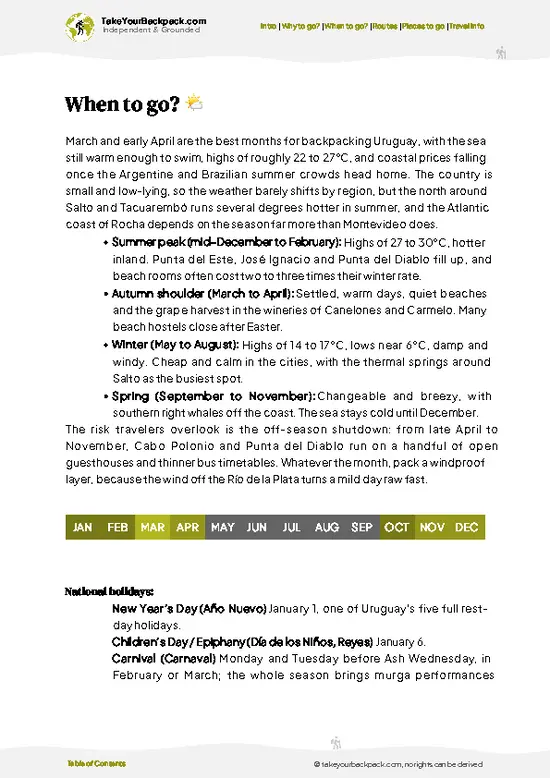
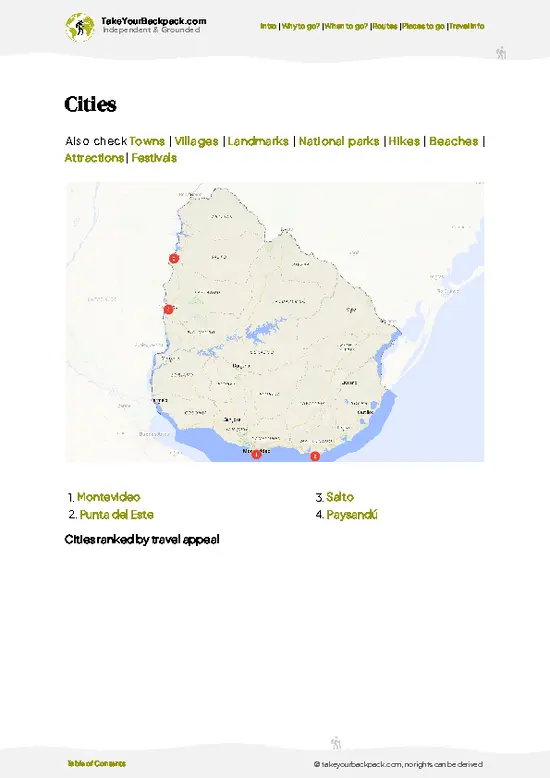
example page 3 from our offline Travel Guide for Uruguay
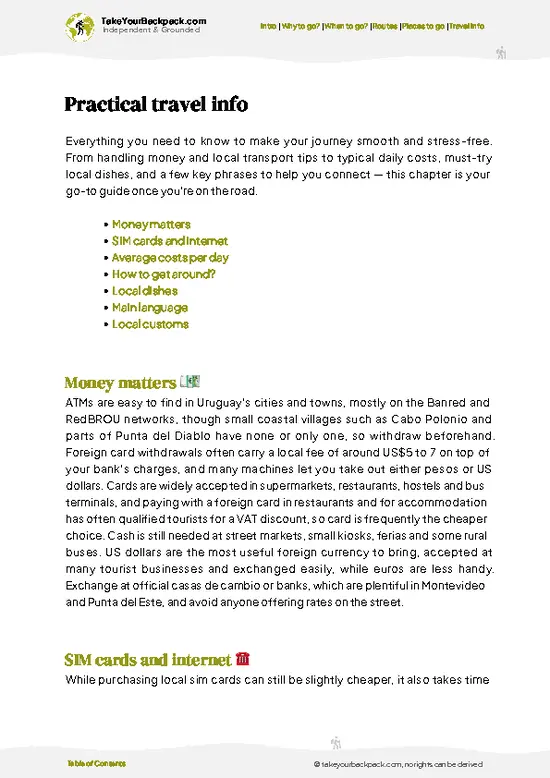
example page 4 from our offline Travel Guide for Uruguay
example page 5 from our offline Travel Guide for Uruguay
example page 6 from our offline Travel Guide for Uruguay
example page 7 from our offline Travel Guide for Uruguay
Loading the map 🌍
CLICK TO FILTER
cities
towns
villages
landmarks
national parks
hikes
beaches
attractions
festivals
SHOW COUNTRY’S BESTSHOW ALL

✨ Why go?
Ranked #1 national park in Uruguay
Why Santa Teresa should be on your travel list

Santa Teresa suits backpackers who like to arrange a few days around their own pace. Camping sits right behind the sand, so you can wake up, walk to the water and spend the day without paying for a single tour. The park is flat and easy to cover on foot, and there is no need for a guide to find the main sights. The fortress of Fortaleza de Santa Teresa, begun by the Portuguese in 1762 and later taken by Spanish forces, makes a clear anchor for a walk, with walls and a moat you can wander freely. Trails also reach the shore of Laguna Negra, where birdwatching works well at dawn without special gear. Beyond the park, the beach town and nearby Punta del Diablo give you cheap hostels, simple food and a social scene if you want one. Most people come on their own, camp, cook on a small stove and … read more 👉
Santa Teresa suits backpackers who like to arrange a few days around their own pace. Camping sits right behind the sand, so you can wake up, walk to the water and spend the day without paying for a single tour. The park is flat and easy to cover on foot, and there is no need for a guide to find the main sights. The fortress of Fortaleza de Santa Teresa, begun by the Portuguese in 1762 and later taken by Spanish forces, makes a clear anchor for a walk, with walls and a moat you can wander freely. Trails also reach the shore of Laguna Negra, where birdwatching works well at dawn without special gear. Beyond the park, the beach town and nearby Punta del Diablo give you cheap hostels, simple food and a social scene if you want one. Most people come on their own, camp, cook on a small stove and slide between beaches, forest and lagoon with no schedule. That mix of easy logistics and open space is the draw.

💡 HighlightsTop highlights of Santa Teresa

  1. Fortaleza de Santa Teresa: The park’s best-known sight, a star-shaped stone fortress started by the Portuguese in 1762 and captured by Spanish forces in 1762 to 1763 after a siege. Walls, a moat, a chapel and the old barracks can be walked at your own pace, and the museum on the grounds explains the colonial border fights.
  2. Playa Grande: A long open Atlantic beach with strong waves and almost no buildings. In summer it fills with camps, but outside peak weeks you can walk for an hour and see few people.
  3. Laguna Negra shoreline: The big freshwater lagoon on the edge of the park, lined with reeds. Swans, herons and other waterbirds feed here, and the sunrises over the water are quiet.
  4. Vivero and palm groves: The park grew from a planted forest and holds large stands of pine, eucalyptus and butia
… read more 👉
  1. Fortaleza de Santa Teresa: The park’s best-known sight, a star-shaped stone fortress started by the Portuguese in 1762 and captured by Spanish forces in 1762 to 1763 after a siege. Walls, a moat, a chapel and the old barracks can be walked at your own pace, and the museum on the grounds explains the colonial border fights.
  2. Playa Grande: A long open Atlantic beach with strong waves and almost no buildings. In summer it fills with camps, but outside peak weeks you can walk for an hour and see few people.
  3. Laguna Negra shoreline: The big freshwater lagoon on the edge of the park, lined with reeds. Swans, herons and other waterbirds feed here, and the sunrises over the water are quiet.
  4. Vivero and palm groves: The park grew from a planted forest and holds large stands of pine, eucalyptus and butia palms. Shaded sandy tracks give the best walking in hot weather.
  5. Granite coast at Playa del Barco: Rounded rock outcrops break the sand near the sea, good for scrambling and tide pools, and a good spot for watching waves crash.
  6. Wildlife viewing: Rheas, capybaras, coypu and foxes show up along quiet tracks, mostly early or late. Binoculars help more than a long hike.
  7. Camping area: The large camping ground sits in the trees behind the beach, with shared facilities and a social atmosphere in summer, and a calm one in other months.
Start with the fortress in the morning, before the sun is high and the tour groups arrive, then spend the afternoon on the beach.
Spotted a mistake or missing something? Contact us.

🌤️ When to go?Best time to explore Santa Teresa

  • Summer (December to February): Santa Teresa is at its busiest, with daytime highs of 26 to 30°C (79 to 86°F) and nights near 17 to 20°C (63 to 68°F). The beaches and campground fill up, especially from Christmas to mid-February, and prices peak. Long evenings give you plenty of light for walks along Playa Grande.
  • Autumn (March to May): Highs of 18 to 24°C (64 to 75°F), calm crowds and cheaper beds. The sea is still swimmable in March.
  • Winter (June to August): Highs of 13 to 17°C (55 to 63°F) and nights that drop to 5 to 8°C (41 to 46°F). Many shops close, the campground is nearly empty, and the days are short. Rain and wind off the Atlantic are common.
  • Spring (September to November): Highs of 17 to 23°C (63 to 73°F), good for hiking the forest trails and the Fortaleza de Santa Teresa without
… read more 👉
  • Summer (December to February): Santa Teresa is at its busiest, with daytime highs of 26 to 30°C (79 to 86°F) and nights near 17 to 20°C (63 to 68°F). The beaches and campground fill up, especially from Christmas to mid-February, and prices peak. Long evenings give you plenty of light for walks along Playa Grande.
  • Autumn (March to May): Highs of 18 to 24°C (64 to 75°F), calm crowds and cheaper beds. The sea is still swimmable in March.
  • Winter (June to August): Highs of 13 to 17°C (55 to 63°F) and nights that drop to 5 to 8°C (41 to 46°F). Many shops close, the campground is nearly empty, and the days are short. Rain and wind off the Atlantic are common.
  • Spring (September to November): Highs of 17 to 23°C (63 to 73°F), good for hiking the forest trails and the Fortaleza de Santa Teresa without heat or crowds. Whale sightings from the coast are possible in September and October.
Aim for the first half of March or late November for warm days, open services and low prices.


source: climatestotravel.comJANJanuary: highly recommended for travelingFEBFebruary: highly recommended for travelingMARMarch: good for travelingAPRApril: excellent for travelingMAYMay: excellent for travelingJUNJune: good for travelingJULJuly: fair for travelingAUGAugust: fair for travelingSEPSeptember: excellent for travelingOCTOctober: excellent for travelingNOVNovember: highly recommended for travelingDECDecember: highly recommended for traveling
when-to-go

✈️ The backpacker research shortcutUruguay Travel Guide

An offline-friendly backpacking guide with optimized travel routes, ranked highlights, transport advice, and the best areas to stay.
example page 0 from our offline Travel Guide for Uruguay
example page 1 from our offline Travel Guide for Uruguay
example page 2 from our offline Travel Guide for Uruguay
example page 3 from our offline Travel Guide for Uruguay
example page 4 from our offline Travel Guide for Uruguay
example page 5 from our offline Travel Guide for Uruguay
example page 6 from our offline Travel Guide for Uruguay
example page 7 from our offline Travel Guide for Uruguay
The digital guide (198 pages) contains:
✅ 56 highlights, ranked by travel appeal
✅ Optimized 5, 10 & 15-day travel routes
✅ Cities, national parks, landmarks, beaches
✅ How to get around
✅ Offline-friendly for travel without Wi-Fi
👉 Click to see all 30+ guide features

📅 Plan smarter in minutes, not weeks
✅ Month by month travel advice
✅ Festivals & national holidays
✅ Budget expectations

🗺️ Go to the right places, skip the overrated ones
✅ Honest pros & cons of destinations
✅ Top hikes, parks & viewpoints
✅ Lesser-known places most travelers miss
✅ Clear “worth it vs skip it” guidance

🛏️ Travel smoothly without rookie mistakes
✅ Best areas to stay
✅ Transport systems explained simply
✅ Common scams & safety advice
✅ SIM cards, money & practical tips

🌍 Understand the country, not just visit it
✅ Culture & traditions
✅ 52 Essential phrases & customs
✅ Festivals worth planning around
✅ Traveler-friendly historical context
✅ Insights that make places more meaningful

📱 Built for real travel conditions
✅ Fully downloadable PDF
✅ Works completely offline
✅ Optimized for phone use
✅ Useful in remote areas & buses
✅ Everything in one place
Stop searching, start planning
Get instant access to your full guide. 30‑day money-back guarantee.
+ Add another guide for just

By proceeding you agree to our terms.
Sent to your inbox immediately after payment • 100% Secure Checkout
Best Backpacking Travel Advisor 2025 tourism awardBest Backpacking
Travel Advisor
2025
What others say about Take Your Backpack Guides:
⭐⭐⭐⭐⭐
Fantastic, amazing amount of information!
⭐⭐⭐⭐⭐
My goodness this is amazing, it's what I've been looking for hats off too you!
⭐⭐⭐⭐⭐
I think this is absolutely BRILLIANT
⭐⭐⭐⭐
Very complete and informative. It's still missing places, but I gotta to commend you
⭐⭐⭐⭐⭐
This is truly amazing, thank you, can't wait to explore it with my kids!
⭐⭐⭐⭐⭐
Awesome resource, thank you!
⭐⭐⭐⭐⭐
This is amazing! Can't wait to explore the ones I haven't seen
⭐⭐⭐⭐
I love this! Well done, great idea.
⭐⭐⭐⭐⭐
Thanks for taking the time to make this gem!
⭐⭐⭐⭐⭐
This might be the best website I've ever seen.
⭐⭐⭐⭐⭐
Congratulations, and thank you so much for your work; it's incredibly valuable.
⭐⭐⭐⭐
In all seriousness I think you did a great job pointing out the important spots
⭐⭐⭐⭐⭐
10/10 very good
⭐⭐⭐⭐⭐
As someone who's only just starting to visit regularly this is awesome, thank you.
⭐⭐⭐⭐
Thank you very much! I'm going to visit my dad, it's going to be very useful!
⭐⭐⭐⭐⭐
This is really cool! We'll be travelling for the first time and this definitely come in handy.
⭐⭐⭐⭐⭐
You are now our minister of culture, congratulations 👨‍💼
⭐⭐⭐⭐⭐
Just wanted to tell you that this is a pearl! Going to follow your recommendations.
⭐⭐⭐⭐⭐
This is so cool. I'll definitely be using the resource for my travels soon.
⭐⭐⭐⭐⭐
This is very impressive! Good work.
⭐⭐⭐⭐⭐
This is an amazing and informative site. Very well done!

🛏️ Where to stay?Best areas to stay in Uruguay

The best base for most backpackers is the village of Santa Teresa itself, since the park’s campground sits right beside it and the beach is a short walk away. Inside the park, the large campground behind Playa Grande has shaded sites among eucalyptus and palms, plus basic cabins for groups of four to six (about US$40 to 80 a night). Tent sites cost roughly US$8 to 14 per person in high season, and there are showers, toilets and a small shop. Book ahead for January and February, when it fills completely.

In the village, you will find simple hostels and family-run posadas, with dorm beds around … read more 👉
The best base for most backpackers is the village of Santa Teresa itself, since the park’s campground sits right beside it and the beach is a short walk away. Inside the park, the large campground behind Playa Grande has shaded sites among eucalyptus and palms, plus basic cabins for groups of four to six (about US$40 to 80 a night). Tent sites cost roughly US$8 to 14 per person in high season, and there are showers, toilets and a small shop. Book ahead for January and February, when it fills completely.

In the village, you will find simple hostels and family-run posadas, with dorm beds around US$18 to 30 and private rooms from US$45 to 90 in summer. Many places close or cut hours between May and September.

If Santa Teresa is full or shut, the nearby town of La Paloma, about 95 km southwest, has more hostels and year-round services. Punta del Diablo, right at the park’s southern edge, is a livelier alternative with a stronger backpacker scene, more restaurants and more night life. Chuy, on the Brazilian border, is the practical choice for onward transport and cheaper beds.

👛 Costs (as of 19 October 2026)How expensive it really is

A backpacker should plan on roughly US$31 to 75 per day in Santa Teresa in high season, with camping as the cheapest way to stay.
CategoryBudget RangeLocal Reality
Entrance feesUS$2 to 5Entry to the park itself is free; campers pay for their site.
Accommodation (high season)US$10 to 25Campsites run about US$8 to 14 per person, hostel dorms about US$18 to 30. Prices drop by a third or more outside summer.
Local transportUS$4 to 10Buses on the coastal route cost a few dollars per leg. Getting around the village on foot costs nothing, while a taxi or shuttle to a nearby beach is a few dollars.
Food and suppliesUS$15 to 25Groceries come from small village shops, which are pricier than in Chuy or Rocha. A simple restaurant meal costs US$8 to 15. Cooking at the campground saves the most.
ActivitiesUS$0
… read more 👉
A backpacker should plan on roughly US$31 to 75 per day in Santa Teresa in high season, with camping as the cheapest way to stay.
CategoryBudget RangeLocal Reality
Entrance feesUS$2 to 5Entry to the park itself is free; campers pay for their site.
Accommodation (high season)US$10 to 25Campsites run about US$8 to 14 per person, hostel dorms about US$18 to 30. Prices drop by a third or more outside summer.
Local transportUS$4 to 10Buses on the coastal route cost a few dollars per leg. Getting around the village on foot costs nothing, while a taxi or shuttle to a nearby beach is a few dollars.
Food and suppliesUS$15 to 25Groceries come from small village shops, which are pricier than in Chuy or Rocha. A simple restaurant meal costs US$8 to 15. Cooking at the campground saves the most.
ActivitiesUS$0 to 10Beaches, forest trails and the fortress are free or cheap. Horseback rides and surf lessons add extra.
Total Daily BudgetUS$31 to 75Lower end if you camp and cook; upper end with hostel beds and restaurant meals. Travelers pay in Uruguayan pesos, though cards are widely accepted in peak season.


source: turismo.gub.uy
⚠️ Prices can change and everyone travels differently, so take this as a rough guide. Hope it helps you plan your adventure!

🥾 TrailsScenic routes and wildlife spotting in Santa Teresa

Santa Teresa is a walking park of flat sand and forest tracks, with no steep climbs and no named trail system to follow. Most people do a few simple routes, and none needs more than basic fitness and water.
  • Fortress loop: Start at the fortress entrance and walk the walls and the moat, then continue on a short track through palms. Allow 1 to 2 hours; easy, flat, mainly grass and stone.
  • Beach walk along Playa Grande: Follow the shoreline north or south from the campground. Distance is up to you, usually 1 to 3 hours return; easy but soft sand slows you, and wind can be strong.
  • Forest tracks: Sandy
… read more 👉
Santa Teresa is a walking park of flat sand and forest tracks, with no steep climbs and no named trail system to follow. Most people do a few simple routes, and none needs more than basic fitness and water.
  • Fortress loop: Start at the fortress entrance and walk the walls and the moat, then continue on a short track through palms. Allow 1 to 2 hours; easy, flat, mainly grass and stone.
  • Beach walk along Playa Grande: Follow the shoreline north or south from the campground. Distance is up to you, usually 1 to 3 hours return; easy but soft sand slows you, and wind can be strong.
  • Forest tracks: Sandy paths among pines, eucalyptus and butia palms link the camping area with the fortress. Expect 1 to 2 hours of easy walking, shaded and good for birds and small mammals.
  • Lagoon edge: Walk to the shore of Laguna Negra for waterbirds, reeds and quiet. About 2 hours return, easy, with soft and sometimes wet ground.
  • Rocky coast: Scramble over granite outcrops near the beach for tide pools and views. Allow about an hour; easy to moderate, with slippery rocks in wet weather.
Wildlife is easiest to see early in the morning and late in the day, when rheas, capybaras and coypu move around the edges of the wetlands. Bring insect repellent, because mosquitoes and ticks are common in warm months, and carry water because shade is limited on the beaches.
The park is reached by road from the coastal highway, with buses from Montevideo and nearby towns running to the town of Santa Teresa, from where the park is a short walk. Service is much thinner outside summer. The park is most crowded in January and around Carnival and Easter weeks, and quiet the rest of the year. Entry to the park is free, and campers pay for their site.
⚠️ Hiking info can sometimes be outdated or inaccurate. Before you hit the trail, check the latest conditions with locals. If you do spot anything that's off, I'd love to hear from you, so I can update it for fellow travelers.

🛡️ SafetyScams, Hazards, and Annoyances

Santa Teresa is a low-risk park for hikers, with flat or gently rolling trails through coastal forest, rocky headlands and sand. The main hazards are the sea and the sun. Atlantic currents and rip tides are strong off Playa Grande and the rocky points, and lifeguards are only present in peak summer, so swim in the supervised areas and avoid the water after storms. Summer sun on open beaches is intense, so bring a hat, sunscreen and at least 2 liters of water for longer walks.

Ticks and mosquitoes are common in grassy and wooded sections, so wear long trousers and check yourself after walks. Wildlife is mild. You may see capybaras, rheas and coatis; keep your distance and never feed them. Snakes exist but rarely show themselves on marked paths.

Winter brings wind and rain, so pack a proper … read more 👉
Santa Teresa is a low-risk park for hikers, with flat or gently rolling trails through coastal forest, rocky headlands and sand. The main hazards are the sea and the sun. Atlantic currents and rip tides are strong off Playa Grande and the rocky points, and lifeguards are only present in peak summer, so swim in the supervised areas and avoid the water after storms. Summer sun on open beaches is intense, so bring a hat, sunscreen and at least 2 liters of water for longer walks.

Ticks and mosquitoes are common in grassy and wooded sections, so wear long trousers and check yourself after walks. Wildlife is mild. You may see capybaras, rheas and coatis; keep your distance and never feed them. Snakes exist but rarely show themselves on marked paths.

Winter brings wind and rain, so pack a proper shell. Keep valuables out of sight in your tent or car, since petty theft from campsites and parked vehicles does happen in high season.

FAQTraveler FAQ

Two to three days is enough for Santa Teresa if you want beach time, a walk through the forest and a visit to the 18th-century Fortaleza de Santa Teresa. Add a fourth day if you plan to surf or day-trip to Punta del Diablo, just south of the park. A single day is possible from a nearby base, but you would only skim the main sights.
Santa Teresa is doable without a car, though it takes planning. Buses run from Montevideo to the Santa Teresa turnoff on Route 9 (about 4 to 5 hours, around US$15 to 25), after which you need a local transfer or taxi for the last few kilometers. Once inside the village, the beach, campground and fortress are all within walking distance. Services are thinner outside summer, so check schedules in advance.
Entry to Santa Teresa National Park is free. Campers pay for their site, which runs about US$8 to 14 per person in summer. No special hiking permit is needed for the marked trails, but booking a campsite ahead is wise in January and February.
⚠️ Things can change over time, so always validate details locally before you go.

Other Uruguayan national parks near Santa Teresa

Explore more nearby:


💡 Not sure where to go next?
Create a personalized itinerary for Uruguay including Santa Teresa and the places that fit your trip.

Generate my itinerary

👉 Discover all national parks

Or checkout all Uruguay has to offer (think cities, towns, villages, national parks, hikes, beaches, festivals)
Country photo of Uruguay

We 💚 feedbackIs it worth it?

Santa Teresa sits just north of Punta del Diablo, with Cabo Polonio further southwest, so I would use it as a quiet stop on a coast run toward Chuy. Come outside January, bring a stove and warm layers for the evening wind, and skip the fortress at midday.

✍️ Help improve this page!
The information on this page is based on in-depth research, insights shared by experienced travelers, and feedback from the local travel community in Uruguay. While every effort is made to keep the information accurate and current, conditions can change — so if you spot anything incorrect or outdated, please get in touch.


🙋‍♂️ Give feedback

👋 Meet the founderWho’s Behind Take Your Backpack?

Johan, backpacker and founder of TakeYourBackpackHi, I’m Johan (Netherlands 🇳🇱), the creator of TakeYourBackpack. Over the past 3 decades, I’ve backpacked through 90+ countries across six continents, gaining extensive experience with independent travel, long-term trips, and overland routes.

This site is built on a combination of firsthand travel experience and carefully curated insights from other backpackers. Many guides are based on places I’ve personally visited, while others bring together tips, observations, and practical advice shared by trusted travelers I’ve met along the way.

The goal is to provide realistic, experience-driven guidance — not generic itineraries — so you can explore destinations with better context, clearer expectations, and more confidence.