v2.webp)
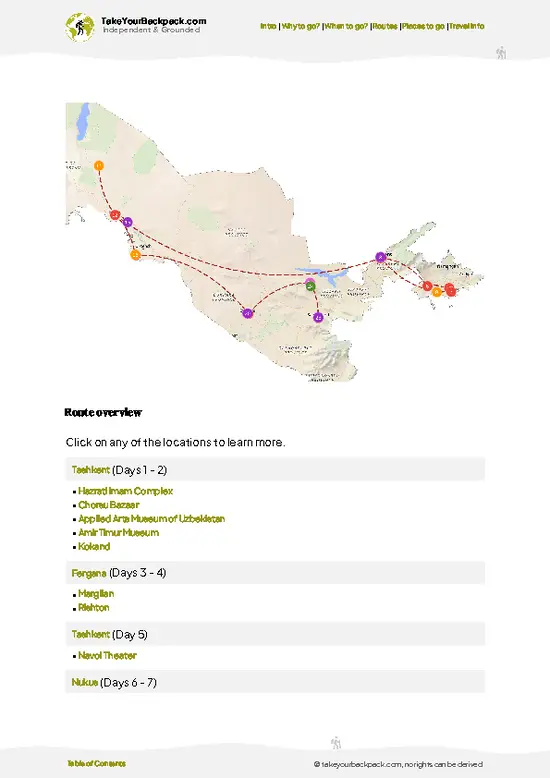
- Khudoyar Khan Palace, Kokand: The 19th-century residence of the khans has a long tiled facade and dozens of rooms around courtyards, with painted ceilings that survived Soviet use. Entry is a small fee and an hour is enough.
- Yodgorlik Silk Factory, Margilan: Cocoons are boiled, silk is reeled and ikat is dyed and woven by hand. You can follow the whole process in one visit, and the shop sells directly.
- Rishton Ceramics Workshops: Master potters such as the Nazirov family show how local clay and ishkor glaze make the deep blue pieces. You can try the wheel yourself.
- Kumtepa Bazaar, Margilan: The big Thursday and Sunday market on the edge of town sells livestock, textiles and produce. Arrive early, as it thins out by late morning.
- Jami Mosque, Kokand: Its hall of around a hundred carved wooden columns
- Khudoyar Khan Palace, Kokand: The 19th-century residence of the khans has a long tiled facade and dozens of rooms around courtyards, with painted ceilings that survived Soviet use. Entry is a small fee and an hour is enough.
- Yodgorlik Silk Factory, Margilan: Cocoons are boiled, silk is reeled and ikat is dyed and woven by hand. You can follow the whole process in one visit, and the shop sells directly.
- Rishton Ceramics Workshops: Master potters such as the Nazirov family show how local clay and ishkor glaze make the deep blue pieces. You can try the wheel yourself.
- Kumtepa Bazaar, Margilan: The big Thursday and Sunday market on the edge of town sells livestock, textiles and produce. Arrive early, as it thins out by late morning.
- Jami Mosque, Kokand: Its hall of around a hundred carved wooden columns gives a cool, quiet pause from the street.
- Narbutabey Madrasa, Kokand: A late 18th-century madrasa named after the Kokand ruler Narbuta Bey, next to the Dahmai Shohon necropolis and far less visited than the palace.
- Said Ahmad Khoja Madrasa, Margilan: A modest complex tucked in the old quarter, which locals use as a neighborhood landmark.
- Dahmai Shohon Necropolis, Kokand: A quiet cemetery of khans with ornate gravestones, ignored by most visitors.
- Pir Siddiq Complex, Margilan: An 18th-century mosque, minaret and shrine known locally as the pigeon complex for the birds that nest around its dome. Few foreigners appear.
- Fergana City Promenade: Tree-lined avenues from the Russian era, good for evening walks and tea in small courtyards.
Spotted a mistake or missing something? Contact us.


 Best Backpacking
.jpg) Hi, I’m Johan (Netherlands 🇳🇱), the creator of TakeYourBackpack. Over the past 3 decades, I’ve backpacked through 90+ countries across six continents, gaining extensive experience with independent travel, long-term trips, and overland routes.
Hi, I’m Johan (Netherlands 🇳🇱), the creator of TakeYourBackpack. Over the past 3 decades, I’ve backpacked through 90+ countries across six continents, gaining extensive experience with independent travel, long-term trips, and overland routes.