×

Uzbekistan🇺🇿 | regionsKyzylkum Desertsand dunes, steppe wildlife, remote caravanserais | things to do and best time to go

Explore Fergana ValleyExplore Western Tien-Shan

Backpacking in Kyzylkum Desert
👌 Worth visitingregion ranked #5
By Johan Kruseman 🇳🇱 | Updated October 15, 2026

The decision most travelers face is whether to book a one-night yurt camp or push for two nights, and the second night usually wins. The Kyzylkum Desert covers much of central Uzbekistan, between the Amu Darya and Syr Darya rivers, with the camps most visitors reach lying northwest of Bukhara and around Lake Aydarkul near Nurata. Camps sit far from city light, so the stars are the main event, but the sleep is basic and the sand is only part of the picture. Most travelers arrive on a short tour from Bukhara or Samarkand, which is easy but rushed; a smarter move is to arrange the stay directly with a camp and keep a late dinner and sunrise for yourself. Bring layers, because nights get cold. Unlike the Karakum next door in Turkmenistan, this desert is easy to enter and has real infrastructure, with camel rides, a lake and village homestays.

Discover everything you want to know in the 📖 Uzbekistan Travel Guide.


example page 0 from our offline Travel Guide for Uzbekistan
example page 1 from our offline Travel Guide for Uzbekistan
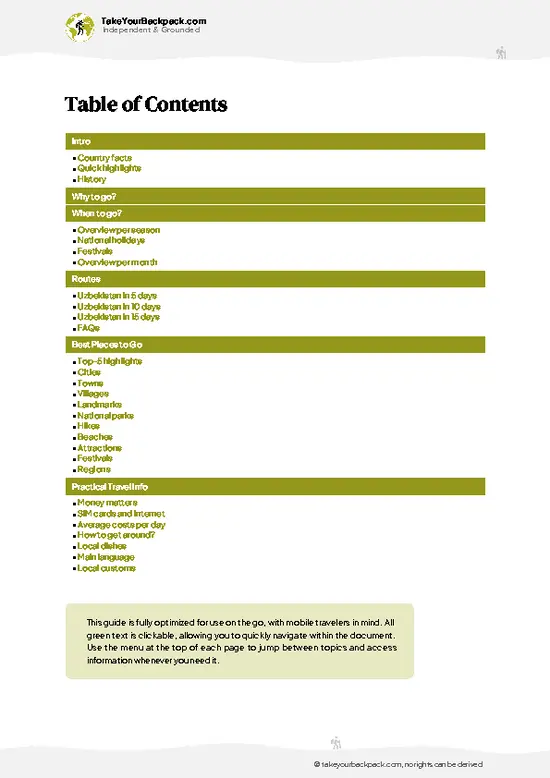
example page 2 from our offline Travel Guide for Uzbekistan
example page 3 from our offline Travel Guide for Uzbekistan
example page 4 from our offline Travel Guide for Uzbekistan
example page 5 from our offline Travel Guide for Uzbekistan
example page 6 from our offline Travel Guide for Uzbekistan
example page 7 from our offline Travel Guide for Uzbekistan
Loading the map 🌍
CLICK TO FILTER
cities
towns
villages
landmarks
national parks
hikes
beaches
attractions
festivals
regions
SHOW COUNTRY’S BESTSHOW ALL

✨ Why go?
Ranked #5 region in Uzbekistan
What sets this place apart

Backpackers come for the contrast between the busy old towns of the Silk Road and a place with almost no one in it. Bukhara and Samarkand are both close enough that you can leave your big pack at a hostel and carry only a daypack, then rejoin the Registan-and-bazaar circuit the next day. That makes the desert a two-day pause rather than a detour.

The second reason is variety packed into a small area. At Lake Aydarkul you can swim in water that appeared in the 1960s after floodwaters from the Syr Darya were diverted, then sleep in a yurt camp with a communal dinner by a fire. The third is the Nurata area, where a spring-fed pond with sacred carp, a ruined fortress attributed to Alexander the Great and village life give the sand some culture. Slow travel works here, because nobody is hurrying you anywhere.

💡 HighlightsThe experiences that define the visit

  1. Aydarkul Yurt Camps: The classic stay, with felt yurts on the lake shore, plov or laghman dinner, and a sky with no streetlights. Sunset over the water is the sight people search for.
  2. Lake Aydarkul: A huge, salty, man-made lake you can swim in, with a calm shoreline and almost no development.
  3. Camel Rides on the Dunes: Short rides at the camps last about an hour and are best at sunset, when the sand turns copper.
  4. Nurata Fortress: Mud-brick ruins on a hill above the town, traditionally linked to Alexander the Great, with views of the oasis and desert beyond.
  5. Chashma Spring and Mosque: A sacred pool in Nurata with a mosque beside it, where large fish drift in clear water. Pilgrims come to drink and pray.
  6. Nurata Bazaar and Suzani Workshops: Local women embroider silk wall hangings here, and you can
… read more 👉
  1. Aydarkul Yurt Camps: The classic stay, with felt yurts on the lake shore, plov or laghman dinner, and a sky with no streetlights. Sunset over the water is the sight people search for.
  2. Lake Aydarkul: A huge, salty, man-made lake you can swim in, with a calm shoreline and almost no development.
  3. Camel Rides on the Dunes: Short rides at the camps last about an hour and are best at sunset, when the sand turns copper.
  4. Nurata Fortress: Mud-brick ruins on a hill above the town, traditionally linked to Alexander the Great, with views of the oasis and desert beyond.
  5. Chashma Spring and Mosque: A sacred pool in Nurata with a mosque beside it, where large fish drift in clear water. Pilgrims come to drink and pray.
  6. Nurata Bazaar and Suzani Workshops: Local women embroider silk wall hangings here, and you can buy directly from the makers at lower prices than in Bukhara.
  7. Sarmysh Gorge Petroglyphs: Thousands of rock carvings of hunters and animals in the Nuratau hills, a lesser-known stop that needs a guide and a 4x4.
  8. Nuratau Mountain Villages (Sentob, Hayat): Homestays at the desert’s edge, with walnut orchards, bread from clay ovens and hiking among the ridges.
  9. Kyzylkum Dawn Walk: Climb the nearest dune before sunrise, when the sand is firm and cool and tracks of beetles and lizards are still fresh.
  10. Rabat-i Malik Caravanserai: The ruined 11th-century caravanserai on the old Bukhara to Samarkand road near Navoi, with its surviving brick portal and a domed water cistern (sardoba) across the road.
For a first visit, the Aydarkul yurt camp covers the lake, camel ride and stars in one overnight.
Spotted a mistake or missing something? Contact us.

Things to do near Kyzylkum Desert

Ratings based on Tripadvisor reviews. When you book through this link, you support our work at no extra cost to you.

⌛️ 5 daysWhat you can realistically do in a week

Day 1: Aydarkul: Start at the lake, because the yurt camp is what you came for, and arriving by early afternoon gives you time for a swim, a camel ride and sunset. Roads are long and drivers are scarce, so a private car or shared taxi from Bukhara or Samarkand sets the pace, and a daytime arrival avoids dusty, slow evening driving. Dinner is communal and the stars come out by nine.
Day 2: Nurata: After a sunrise dune walk, head to Nurata. Buses and shared taxis run here from the main cities, so you can continue without a tour. Visit the Chashma spring, climb the fortress and browse the suzani workshops, then sleep in town where hot water is easier to find.
Days 3 and 4: Nuratau Villages: Spend two days in a homestay in Sentob or Hayat. Without much transport, you walk, and that is the point. … read more 👉
Day 1: Aydarkul: Start at the lake, because the yurt camp is what you came for, and arriving by early afternoon gives you time for a swim, a camel ride and sunset. Roads are long and drivers are scarce, so a private car or shared taxi from Bukhara or Samarkand sets the pace, and a daytime arrival avoids dusty, slow evening driving. Dinner is communal and the stars come out by nine.
Day 2: Nurata: After a sunrise dune walk, head to Nurata. Buses and shared taxis run here from the main cities, so you can continue without a tour. Visit the Chashma spring, climb the fortress and browse the suzani workshops, then sleep in town where hot water is easier to find.
Days 3 and 4: Nuratau Villages: Spend two days in a homestay in Sentob or Hayat. Without much transport, you walk, and that is the point. Hike between orchards, eat at a family table and let your legs recover from the sand.
Day 5: Sarmysh Gorge detour: Hire a 4x4 with a local guide for a morning at the petroglyphs. It adds ancient art without changing your path, because you return to Nurata and then head onward to Bukhara or Samarkand in the afternoon.

If one day justifies the trip, it is Day 1: sunset on the lake, a camel silhouette and then a sky full of stars.

🌤️ When to go?Best time to visit Kyzylkum Desert

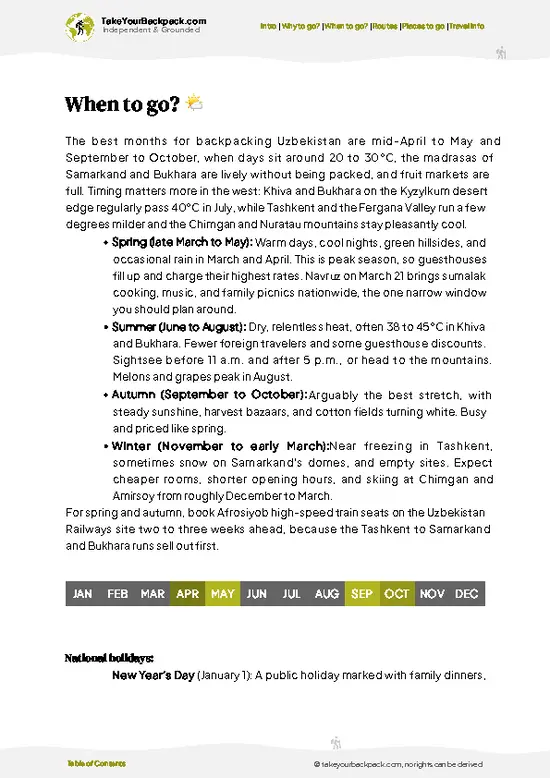
Late March to May and late September to October give the Kyzylkum its kindest conditions, with daytime highs of 20 to 30°C (68 to 86°F).
  • Spring (March to May): Days run 15 to 30°C (59 to 86°F), the sand is dotted with green and flowering tulips and poppies, and yurt camps open. Rain is possible in March and April. This is the busiest window, so camps and drivers cost the most.
  • Summer (June to August): Highs reach 40 to 45°C (104 to 113°F), and the sand is hot enough to burn bare feet at midday. Daylight lasts about 14 to 15 hours. Camps are quiet and cheaper, but only dawn and dusk are comfortable.
  • Autumn (September to October): Warm days of 22 to 32°C (72 to 90°F), cool nights and clear skies make it ideal for stargazing.
  • Winter (November to February): Highs are 3 to 10°C (37 to 50°F), nights
… read more 👉
Late March to May and late September to October give the Kyzylkum its kindest conditions, with daytime highs of 20 to 30°C (68 to 86°F).
  • Spring (March to May): Days run 15 to 30°C (59 to 86°F), the sand is dotted with green and flowering tulips and poppies, and yurt camps open. Rain is possible in March and April. This is the busiest window, so camps and drivers cost the most.
  • Summer (June to August): Highs reach 40 to 45°C (104 to 113°F), and the sand is hot enough to burn bare feet at midday. Daylight lasts about 14 to 15 hours. Camps are quiet and cheaper, but only dawn and dusk are comfortable.
  • Autumn (September to October): Warm days of 22 to 32°C (72 to 90°F), cool nights and clear skies make it ideal for stargazing.
  • Winter (November to February): Highs are 3 to 10°C (37 to 50°F), nights drop below freezing, and daylight is about 9 to 10 hours. Few camps stay open, but prices are low.
Book a camp for a new-moon night if you want the Milky Way.


source: climatestotravel.comJANJanuary: fair for travelingFEBFebruary: fair for travelingMARMarch: good for travelingAPRApril: excellent for travelingMAYMay: excellent for travelingJUNJune: good for travelingJULJuly: below average for travelingAUGAugust: below average for travelingSEPSeptember: excellent for travelingOCTOctober: excellent for travelingNOVNovember: good for travelingDECDecember: fair for traveling
when-to-go

✈️ The backpacker research shortcutUzbekistan Travel Guide

An offline-friendly backpacking guide with optimized travel routes, ranked highlights, transport advice, and the best areas to stay.
example page 0 from our offline Travel Guide for Uzbekistan
example page 1 from our offline Travel Guide for Uzbekistan
example page 2 from our offline Travel Guide for Uzbekistan
example page 3 from our offline Travel Guide for Uzbekistan
example page 4 from our offline Travel Guide for Uzbekistan
example page 5 from our offline Travel Guide for Uzbekistan
example page 6 from our offline Travel Guide for Uzbekistan
example page 7 from our offline Travel Guide for Uzbekistan
The digital guide (246 pages) contains:
✅ 74 highlights, ranked by travel appeal
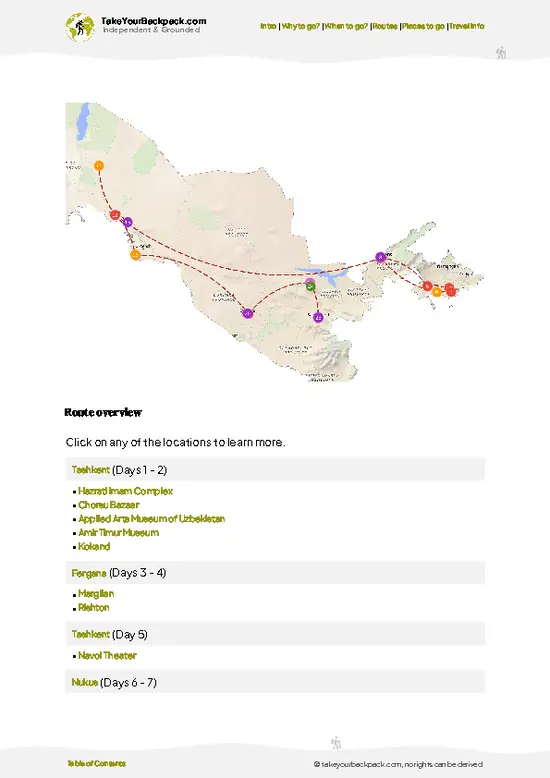
✅ Optimized 5, 10 & 15-day travel routes
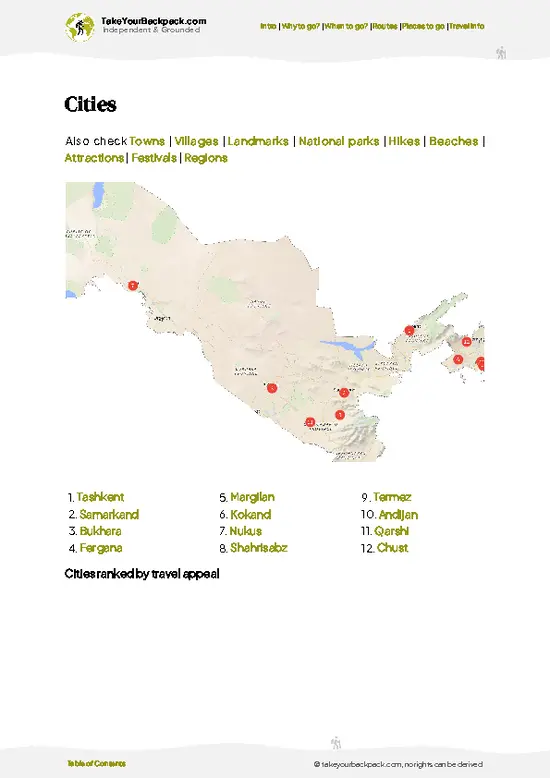
✅ Cities, national parks, landmarks, beaches
✅ How to get around
✅ Offline-friendly for travel without Wi-Fi
👉 Click to see all 30+ guide features

📅 Plan smarter in minutes, not weeks
✅ Month by month travel advice
✅ Festivals & national holidays
✅ Budget expectations

🗺️ Go to the right places, skip the overrated ones
✅ Honest pros & cons of destinations
✅ Top hikes, parks & viewpoints
✅ Lesser-known places most travelers miss
✅ Clear “worth it vs skip it” guidance

🛏️ Travel smoothly without rookie mistakes
✅ Best areas to stay
✅ Transport systems explained simply
✅ Common scams & safety advice
✅ SIM cards, money & practical tips

🌍 Understand the country, not just visit it
✅ Culture & traditions
✅ 52 Essential phrases & customs
✅ Festivals worth planning around
✅ Traveler-friendly historical context
✅ Insights that make places more meaningful

📱 Built for real travel conditions
✅ Fully downloadable PDF
✅ Works completely offline
✅ Optimized for phone use
✅ Useful in remote areas & buses
✅ Everything in one place
Stop searching, start planning
Get instant access to your full guide. 30‑day money-back guarantee.
+ Add another guide for just

By proceeding you agree to our terms.
Sent to your inbox immediately after payment • 100% Secure Checkout
Best Backpacking Travel Advisor 2025 tourism awardBest Backpacking
Travel Advisor
2025
What others say about Take Your Backpack Guides:
⭐⭐⭐⭐⭐
Fantastic, amazing amount of information!
⭐⭐⭐⭐⭐
My goodness this is amazing, it's what I've been looking for hats off too you!
⭐⭐⭐⭐⭐
I think this is absolutely BRILLIANT
⭐⭐⭐⭐
Very complete and informative. It's still missing places, but I gotta to commend you
⭐⭐⭐⭐⭐
This is truly amazing, thank you, can't wait to explore it with my kids!
⭐⭐⭐⭐⭐
Awesome resource, thank you!
⭐⭐⭐⭐⭐
This is amazing! Can't wait to explore the ones I haven't seen
⭐⭐⭐⭐
I love this! Well done, great idea.
⭐⭐⭐⭐⭐
Thanks for taking the time to make this gem!
⭐⭐⭐⭐⭐
This might be the best website I've ever seen.
⭐⭐⭐⭐⭐
Congratulations, and thank you so much for your work; it's incredibly valuable.
⭐⭐⭐⭐
In all seriousness I think you did a great job pointing out the important spots
⭐⭐⭐⭐⭐
10/10 very good
⭐⭐⭐⭐⭐
As someone who's only just starting to visit regularly this is awesome, thank you.
⭐⭐⭐⭐
Thank you very much! I'm going to visit my dad, it's going to be very useful!
⭐⭐⭐⭐⭐
This is really cool! We'll be travelling for the first time and this definitely come in handy.
⭐⭐⭐⭐⭐
You are now our minister of culture, congratulations 👨‍💼
⭐⭐⭐⭐⭐
Just wanted to tell you that this is a pearl! Going to follow your recommendations.
⭐⭐⭐⭐⭐
This is so cool. I'll definitely be using the resource for my travels soon.
⭐⭐⭐⭐⭐
This is very impressive! Good work.
⭐⭐⭐⭐⭐
This is an amazing and informative site. Very well done!

🛏️ Where to stay?Best areas to stay in Uzbekistan

Bukhara is the best base for the southern Kyzylkum, with the most hostels, easy tour booking and the easiest meeting of other travelers. Its old town is compact and safe to walk at night, and a rooftop dinner is the usual way to find people to share a desert jeep. Dorm beds run roughly US$8 to 15.

Nurata is the quieter option on the northern side, a small town below the ruined fortress attributed to Alexander the Great, with homestays for about US$15 to 30 including dinner and breakfast. It is the gateway to the Nurata Mountains, the holy spring and the Aydarkul lake region, and you will mostly … read more 👉
Bukhara is the best base for the southern Kyzylkum, with the most hostels, easy tour booking and the easiest meeting of other travelers. Its old town is compact and safe to walk at night, and a rooftop dinner is the usual way to find people to share a desert jeep. Dorm beds run roughly US$8 to 15.

Nurata is the quieter option on the northern side, a small town below the ruined fortress attributed to Alexander the Great, with homestays for about US$15 to 30 including dinner and breakfast. It is the gateway to the Nurata Mountains, the holy spring and the Aydarkul lake region, and you will mostly meet small groups and hikers rather than crowds.

Samarkand works as a second base if you come from the east, with a bigger hostel scene and plenty of drivers offering desert trips.

For the real thing, spend a night in a yurt camp near Aydarkul Lake. Expect felt tents with shared or basic beds, dinner by the fire, camel rides and a sky with almost no light pollution, usually US$25 to 50 with meals. Evenings are social, with groups sharing one long table.

🚌 Getting aroundMoving around without the hassle

Reaching the Aydarkul camps takes about 3 to 4 hours by road from Bukhara or Samarkand, and the desert itself has no public transport. Paved roads cross it, but the dunes, camps and lakes sit down sand tracks, so almost every backpacker goes with a driver, and that works smoothly once you book.
  • Organized jeep or minivan transfer: Camps in the Aydarkul and Nurata areas usually arrange transfers from Bukhara, Samarkand or Nurata, typically US$60 to 120 per vehicle each way. Split it with three or four people you meet at your hostel, because the price is per car, not per seat.
  • Shared taxi: These run between Bukhara, Navoi, Nurata and Samarkand for about US$5 to 12 a seat and leave when full, so go in the morning when drivers are waiting. Ask to be dropped at a turnoff, then have your camp pick
… read more 👉
Reaching the Aydarkul camps takes about 3 to 4 hours by road from Bukhara or Samarkand, and the desert itself has no public transport. Paved roads cross it, but the dunes, camps and lakes sit down sand tracks, so almost every backpacker goes with a driver, and that works smoothly once you book.
  • Organized jeep or minivan transfer: Camps in the Aydarkul and Nurata areas usually arrange transfers from Bukhara, Samarkand or Nurata, typically US$60 to 120 per vehicle each way. Split it with three or four people you meet at your hostel, because the price is per car, not per seat.
  • Shared taxi: These run between Bukhara, Navoi, Nurata and Samarkand for about US$5 to 12 a seat and leave when full, so go in the morning when drivers are waiting. Ask to be dropped at a turnoff, then have your camp pick you up.
  • Train: The fast Afrosiyob and slower trains link Samarkand, Navoi and Bukhara in about 1.5 to 3 hours for US$10 to 25. Book on the official railway site or app a few days ahead, since tickets sell out in spring and fall.
  • Camel trek: Camps run short rides of 30 minutes to a few hours for roughly US$10 to 30. Go near sunset, when the sand cools and the light turns copper.
Carry at least 2 liters of water per person and a power bank, as there is no signal or shade for long stretches. Travel the long tracks at dawn, before the heat builds.

🍲 FoodEating & Drinking in Kyzylkum Desert

Desert food here is built on lamb, bread and fire. Look for shurpa, a peppery lamb and vegetable broth, and kazan kabob, meat and potatoes crisped in a cauldron. Camps often serve plov cooked over open flames, so the rice carries a faint smoke.

At Aydarkul, freshwater fish is grilled or fried, and the lakeside camps serve it with onions and fresh non flatbread, torn and still warm. Nurata is known for kurt, salty dried yogurt balls that taste sharp and tangy, and for sheep’s milk products. The drink to order is green tea, poured from a pot in small bowls, sometimes with shubat, a fizzy sour camel milk that is an acquired taste.

Backpackers mostly eat at camp and homestay tables, where dinner is included, and in Nurata’s bazaar, where you can buy bread, apricots, nuts and melons for a few … read more 👉
Desert food here is built on lamb, bread and fire. Look for shurpa, a peppery lamb and vegetable broth, and kazan kabob, meat and potatoes crisped in a cauldron. Camps often serve plov cooked over open flames, so the rice carries a faint smoke.

At Aydarkul, freshwater fish is grilled or fried, and the lakeside camps serve it with onions and fresh non flatbread, torn and still warm. Nurata is known for kurt, salty dried yogurt balls that taste sharp and tangy, and for sheep’s milk products. The drink to order is green tea, poured from a pot in small bowls, sometimes with shubat, a fizzy sour camel milk that is an acquired taste.

Backpackers mostly eat at camp and homestay tables, where dinner is included, and in Nurata’s bazaar, where you can buy bread, apricots, nuts and melons for a few dollars. Bring snacks for long drives.

Customs are simple. Meals are shared from communal plates, bread is never put upside down, and your host will keep refilling your tea bowl. Tip the last pour back and forth if you want a refill, or cover the bowl with your hand to decline. Alcohol is rarely served at camps, so bring your own.

FAQTraveler FAQ

One night is enough for a camel ride, a sunset on the dunes and a night under the stars, but two nights let you slow down, hike the Nurata Mountains or paddle on Aydarkul Lake. Most trips start in Bukhara or Samarkand, which are about 3 to 4 hours by road from the main camps.
Without a car, join a shared jeep or minivan arranged by your hostel or camp, which costs roughly US$60 to 120 per vehicle each way and is cheaper when split among several people. You can also take a train or shared taxi to Nurata or Navoi for about US$5 to 25, then have your camp collect you. Public buses do not reach the dune areas, so book the last leg in advance.
The Kyzylkum is known for its red sands, which cover roughly 300,000 square kilometers across Uzbekistan and Kazakhstan, and for yurt camps near Aydarkul Lake, where the night sky is very clear. Travelers also come for camel rides, shurpa and fish dinners by the fire, and the ruined fortress and holy spring at Nurata. Spring brings wildflowers, while autumn is best for stargazing.
⚠️ Things can change over time, so always validate details locally before you go.

Other Uzbek regions near Kyzylkum Desert

Explore more nearby:

  • Xorazm—fortified cities, mudbrick walls, desert oases| 284 km away
  • Jizzakh—foothill villages, fruit orchards, Silk Road traces| 384 km away
  • Karakalpakstan—Aral Sea remnants, Nukus museums, steppe horizons| 437 km away

💡 Not sure where to go next?
Create a personalized itinerary for Uzbekistan including Kyzylkum Desert and the places that fit your trip.

Generate my itinerary

👉 Discover all regions

Or checkout all Uzbekistan has to offer (think cities, towns, villages, national parks, hikes, beaches, festivals)
Country photo of Uzbekistan

We 💚 feedbackFinal thoughts on visiting Kyzylkum Desert

Two nights is the right length. One night feels like a tour stop, and by the second evening you’ve stopped checking your phone and started talking to the camp family. Skip the third night unless you add the Nuratau villages. The surprise is how cold it gets after dark, even in early fall, so pack a real jacket and a warm hat.

✍️ Help improve this page!
The information on this page is based on in-depth research, insights shared by experienced travelers, and feedback from the local travel community in Uzbekistan. While every effort is made to keep the information accurate and current, conditions can change — so if you spot anything incorrect or outdated, please get in touch.


🙋‍♂️ Give feedback

👋 Meet the founderWho’s Behind Take Your Backpack?

Johan, backpacker and founder of TakeYourBackpackHi, I’m Johan (Netherlands 🇳🇱), the creator of TakeYourBackpack. Over the past 3 decades, I’ve backpacked through 90+ countries across six continents, gaining extensive experience with independent travel, long-term trips, and overland routes.

This site is built on a combination of firsthand travel experience and carefully curated insights from other backpackers. Many guides are based on places I’ve personally visited, while others bring together tips, observations, and practical advice shared by trusted travelers I’ve met along the way.

The goal is to provide realistic, experience-driven guidance — not generic itineraries — so you can explore destinations with better context, clearer expectations, and more confidence.