×

Venezuela🇻🇪 | regionsGran SabanaRed jasper creeks, tepui views, walk-behind waterfalls, Pemón villages | things to do and best time to go

Explore Ciénagas del Catatumbo National ParkExplore Andes venezolanos

Backpacking in Gran Sabana
👌 Worth visitingregion ranked #4
By Johan Kruseman 🇳🇱 | Updated October 19, 2026

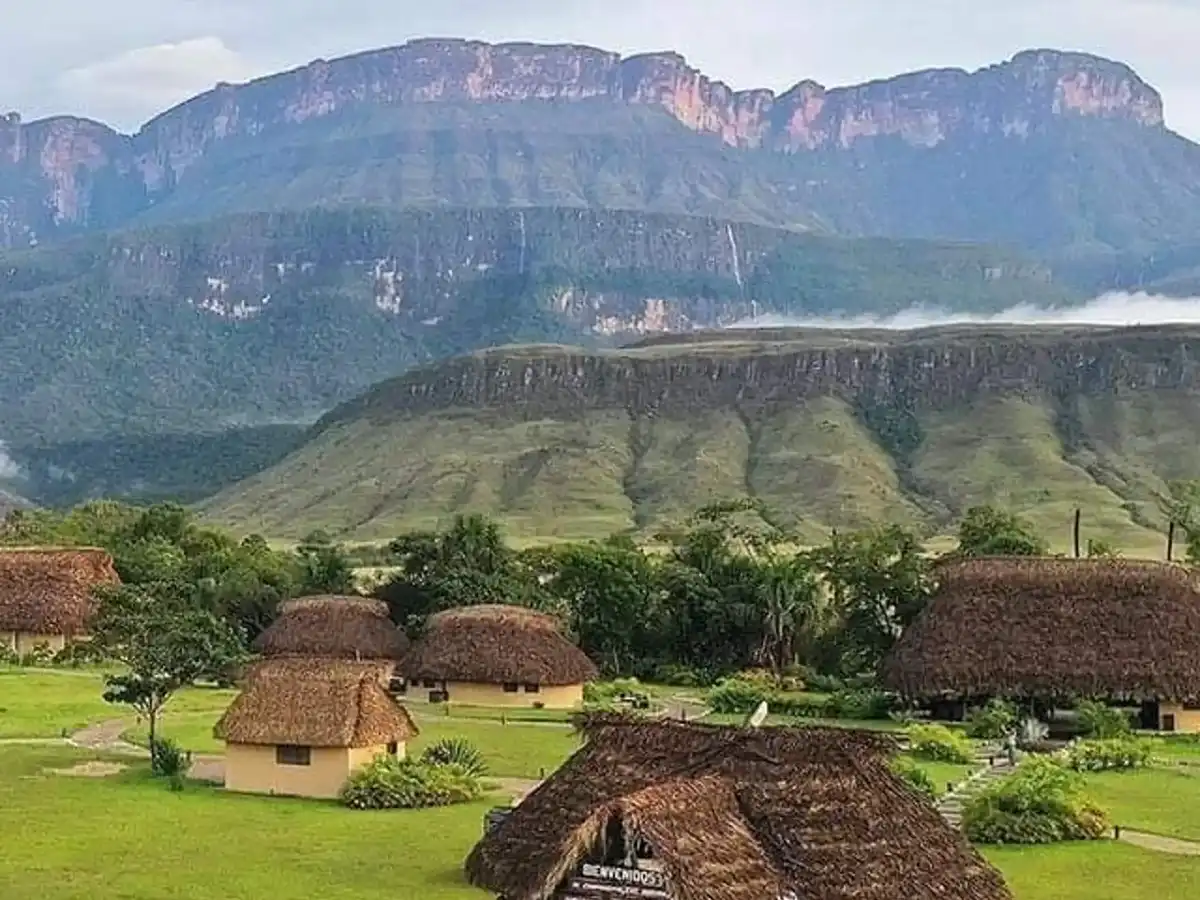
Gran Sabana hands you a dozen waterfalls and tepui views from one paved road, so you can see most of it without a tour. It sits in the southeast of Venezuela, in Bolívar state, along the highway from El Dorado toward the Brazilian border at Santa Elena de Uairén. The scenery is rolling grassland broken by flat-topped mountains, red-water streams and falls you can walk behind. The sights are scattered, so you will spend hours on the road, and some roadside stops are only a gift stand and a muddy parking area. Skip those. Back the Quebrada de Jaspe, Salto Kama and the Kavanayén track, where you get jasper riverbeds, a short walk to a cascade, and quiet. The vibe is Pemón communities, simple posadas and almost no crowds. Before you go, carry cash in US dollars, because fuel and card payments are unreliable.

Discover everything you want to know in the 📖 Venezuela Travel Guide.
Best time to go: November - April
Duration: 7 to 10 days
Distance: 100 kilometers
Total ascent: 1,200 meters
Safety warning

The current risk level for Venezuela is high. Check the advice before going.


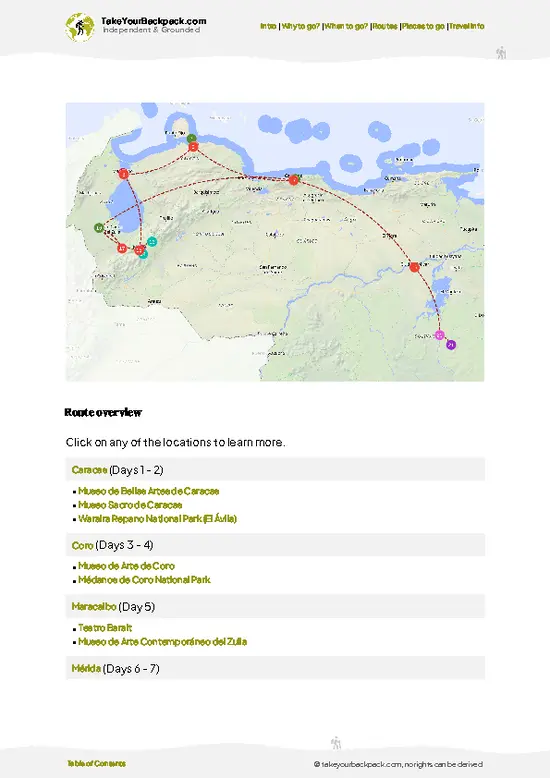
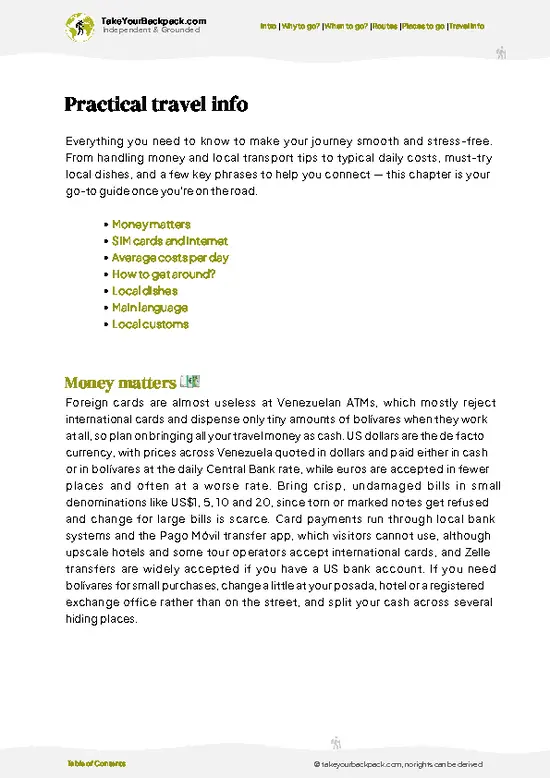
example page 0 from our offline Travel Guide for Venezuela
example page 1 from our offline Travel Guide for Venezuela
example page 2 from our offline Travel Guide for Venezuela
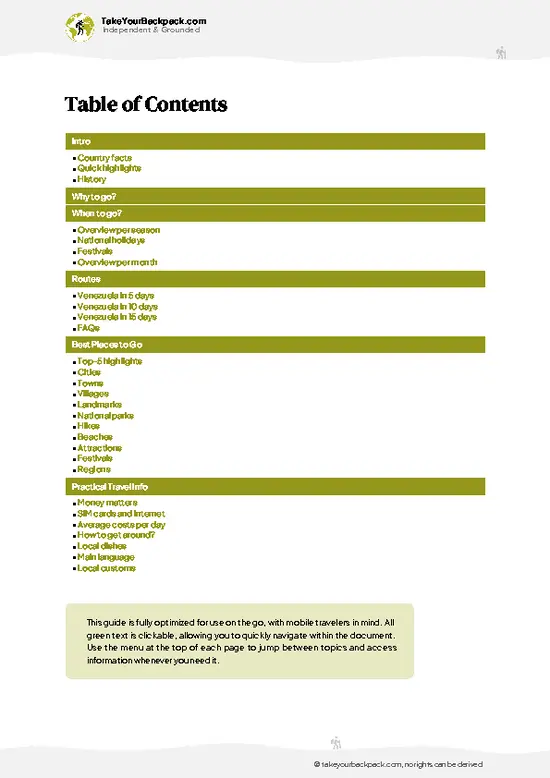
example page 3 from our offline Travel Guide for Venezuela
example page 4 from our offline Travel Guide for Venezuela
example page 5 from our offline Travel Guide for Venezuela
example page 6 from our offline Travel Guide for Venezuela
example page 7 from our offline Travel Guide for Venezuela
Loading the map 🌍
CLICK TO FILTER
cities
towns
villages
landmarks
national parks
hikes
beaches
attractions
festivals
regions
SHOW COUNTRY’S BESTSHOW ALL

✨ Why go?
Ranked #4 region in Venezuela
The unique appeal for travelers

Gran Sabana works for backpackers because everything hangs off one highway, so you can hop between trailheads by shared taxi, hitching or a hired jeep without changing base. The scenery changes every hour. Grassland gives way to cloud forest, and then Roraima’s sheer cliffs appear from Paraitepuí, the starting point for the multi-day tepui trek. Rivers run the color of tea, and at the Quebrada de Jaspe the bed is polished red stone. Cultural contact comes naturally. Pemón guides run the treks, the camps and many of the swimming spots, so the money you spend lands in the communities. The pace is slow. You can pair a morning waterfall walk with an afternoon at a village posada, then wake up near the next trail. Few places in South America let you mix this much big landscape with so little crowd management.

💡 HighlightsWhat this place is best known for

  1. Quebrada de Jaspe (Kako Paru, “fire creek”) is a creek flowing over a bed of red jasper at km 273 of the highway, between San Francisco de Yuruaní and Santa Elena. You wade ankle-deep across polished rust-colored rock, and the water glows. Entry is about US$2 to 5.
  2. Salto Kamá (Kamá-Merú) drops about 50 meters. A short trail leads to a pool and a rock where you can stand behind the curtain.
  3. Quebrada Pacheco is a small cascade and pool beside the highway. It is a quick swim stop for a cold, tea-colored plunge.
  4. Salto Aponwao is a fall of about 105 meters reached by a long forest walk through a Pemón community area. Few outsiders arrive, so you often have the viewpoint alone.
  5. Mirador Cuquenán looks toward Mount Kukenán, a flat-topped tepui with a sheer cliff. At dusk its wall catches the last light.
… read more 👉
  1. Quebrada de Jaspe (Kako Paru, “fire creek”) is a creek flowing over a bed of red jasper at km 273 of the highway, between San Francisco de Yuruaní and Santa Elena. You wade ankle-deep across polished rust-colored rock, and the water glows. Entry is about US$2 to 5.
  2. Salto Kamá (Kamá-Merú) drops about 50 meters. A short trail leads to a pool and a rock where you can stand behind the curtain.
  3. Quebrada Pacheco is a small cascade and pool beside the highway. It is a quick swim stop for a cold, tea-colored plunge.
  4. Salto Aponwao is a fall of about 105 meters reached by a long forest walk through a Pemón community area. Few outsiders arrive, so you often have the viewpoint alone.
  5. Mirador Cuquenán looks toward Mount Kukenán, a flat-topped tepui with a sheer cliff. At dusk its wall catches the last light.
  6. Salto Yuruaní is a broad, brown-red cascade near Yuruaní village, with easy access and a good place to meet Pemón guides.
  7. Roraima base camp trailhead at Paraitepuy is where the multi-day Roraima trek starts. Even if you skip the summit, the village and the first stretch of savanna show the tepui rising in front of you.
  8. Kavanayén is a quiet Capuchin mission village with a stone church and Pemón families. Cross the savanna for a slow evening and simple local meals.
  9. Salto Kamá-Merú pools and Santa Elena de Uairén market give a lively closing stop, where fruit, cassava bread and Brazilian goods change hands near the border.
Kavanayén and Aponwao are the items most people never reach, and they are the best evidence of how empty and calm the savanna can be.
Spotted a mistake or missing something? Contact us.
⌛️ 5 daysHow to make the most of Gran Sabana

Day 1: Santa Elena de Uairén: Start in Santa Elena in the morning, because it is the only real hub for supplies, cash exchange and booking Pemón guides. The Troncal 10 highway is the single artery through Gran Sabana, and shared taxis and buses run along it on loose schedules, so you pace yourself by what passes. Spend the rest of the day sorting supplies and a guide in town.
Day 2: Quebrada de Jaspe and Salto Kamá: Head north early and flag a ride, or hire a driver, to hit the red creek and falls before midday crowds. Tour jeeps share the road, so a driver gives flexibility for roadside stops like Quebrada Pacheco.
Day 3: Paraitepuy and Yuruaní: Move to the Roraima trailhead zone to see the tepui and arrange a trek if you have time. Sleep in a simple village posada, where the early start comes … read more 👉
Day 1: Santa Elena de Uairén: Start in Santa Elena in the morning, because it is the only real hub for supplies, cash exchange and booking Pemón guides. The Troncal 10 highway is the single artery through Gran Sabana, and shared taxis and buses run along it on loose schedules, so you pace yourself by what passes. Spend the rest of the day sorting supplies and a guide in town.
Day 2: Quebrada de Jaspe and Salto Kamá: Head north early and flag a ride, or hire a driver, to hit the red creek and falls before midday crowds. Tour jeeps share the road, so a driver gives flexibility for roadside stops like Quebrada Pacheco.
Day 3: Paraitepuy and Yuruaní: Move to the Roraima trailhead zone to see the tepui and arrange a trek if you have time. Sleep in a simple village posada, where the early start comes naturally.
Day 4: Detour to Kavanayén and Aponwao: This detour leaves the highway on a rough track, so a hired 4x4 is the practical choice. You get the mission church, quiet savanna and a wide waterfall almost alone.
Day 5: Back to Santa Elena: Drift south on the highway, stopping at Mirador Cuquenán for the late view and ending at the market.

The one day that justifies the trip is Day 4, because the empty track, the church and Aponwao show a Gran Sabana without tour traffic.

🌤️ When to go?Choosing the right time of year

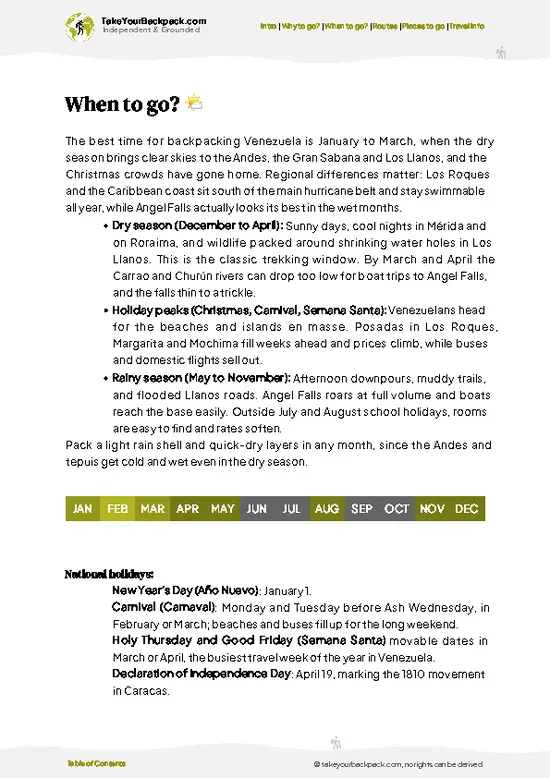
  • Dry Season (December to April): Gran Sabana is easiest to hike in these months. Days run 24 to 30°C (75 to 86°F), nights on the plateau drop to 15 to 18°C (59 to 64°F), and trails to Quebrada de Jaspe and the Roraima base are firm. Venezuelans travel around Christmas, Carnival and Easter, so jeeps and tour slots fill and prices climb.
  • Early Wet Season (May to July): Afternoon downpours arrive, rivers rise and waterfalls such as Salto Kamá thunder. Temperatures hold at 22 to 28°C (72 to 82°F). Crowds thin and guides will bargain.
  • Peak Rains (August to November): Expect cloud on the tepuis, muddy tracks and swollen river crossings. Sandflies (jejenes) are worst in these months. Roraima summit views are a gamble.
  • Daylight: Close to the equator, days stay at about 12 hours all year.
Go in January … read more 👉
  • Dry Season (December to April): Gran Sabana is easiest to hike in these months. Days run 24 to 30°C (75 to 86°F), nights on the plateau drop to 15 to 18°C (59 to 64°F), and trails to Quebrada de Jaspe and the Roraima base are firm. Venezuelans travel around Christmas, Carnival and Easter, so jeeps and tour slots fill and prices climb.
  • Early Wet Season (May to July): Afternoon downpours arrive, rivers rise and waterfalls such as Salto Kamá thunder. Temperatures hold at 22 to 28°C (72 to 82°F). Crowds thin and guides will bargain.
  • Peak Rains (August to November): Expect cloud on the tepuis, muddy tracks and swollen river crossings. Sandflies (jejenes) are worst in these months. Roraima summit views are a gamble.
  • Daylight: Close to the equator, days stay at about 12 hours all year.
Go in January or February for the clearest tepui views, and book tours a week ahead if you want the Christmas or Carnival weeks.


source: climatestotravel.comJANJanuary: excellent for travelingFEBFebruary: excellent for travelingMARMarch: excellent for travelingAPRApril: good for travelingMAYMay: fair for travelingJUNJune: fair for travelingJULJuly: fair for travelingAUGAugust: fair for travelingSEPSeptember: fair for travelingOCTOctober: fair for travelingNOVNovember: good for travelingDECDecember: excellent for traveling

✈️ The backpacker research shortcutVenezuela Travel Guide

An offline-friendly backpacking guide with optimized travel routes, ranked highlights, transport advice, and the best areas to stay.
example page 0 from our offline Travel Guide for Venezuela
example page 1 from our offline Travel Guide for Venezuela
example page 2 from our offline Travel Guide for Venezuela
example page 3 from our offline Travel Guide for Venezuela
example page 4 from our offline Travel Guide for Venezuela
example page 5 from our offline Travel Guide for Venezuela
example page 6 from our offline Travel Guide for Venezuela
example page 7 from our offline Travel Guide for Venezuela
The digital guide (290 pages) contains:
✅ 91 highlights, ranked by travel appeal
✅ Optimized 5, 10 & 15-day travel routes
✅ Cities, national parks, landmarks, beaches
✅ How to get around
✅ Offline-friendly for travel without Wi-Fi
👉 Click to see all 30+ guide features

📅 Plan smarter in minutes, not weeks
✅ Month by month travel advice
✅ Festivals & national holidays
✅ Budget expectations

🗺️ Go to the right places, skip the overrated ones
✅ Honest pros & cons of destinations
✅ Top hikes, parks & viewpoints
✅ Lesser-known places most travelers miss
✅ Clear “worth it vs skip it” guidance

🛏️ Travel smoothly without rookie mistakes
✅ Best areas to stay
✅ Transport systems explained simply
✅ Common scams & safety advice
✅ SIM cards, money & practical tips

🌍 Understand the country, not just visit it
✅ Culture & traditions
✅ 52 Essential phrases & customs
✅ Festivals worth planning around
✅ Traveler-friendly historical context
✅ Insights that make places more meaningful

📱 Built for real travel conditions
✅ Fully downloadable PDF
✅ Works completely offline
✅ Optimized for phone use
✅ Useful in remote areas & buses
✅ Everything in one place
Stop searching, start planning
Get instant access to your full guide. 30‑day money-back guarantee.
+ Add another guide for just

By proceeding you agree to our terms.
Sent to your inbox immediately after payment • 100% Secure Checkout
Best Backpacking Travel Advisor 2025 tourism awardBest Backpacking
Travel Advisor
2025
What others say about Take Your Backpack Guides:
⭐⭐⭐⭐⭐
Fantastic, amazing amount of information!
⭐⭐⭐⭐⭐
My goodness this is amazing, it's what I've been looking for hats off too you!
⭐⭐⭐⭐⭐
I think this is absolutely BRILLIANT
⭐⭐⭐⭐
Very complete and informative. It's still missing places, but I gotta to commend you
⭐⭐⭐⭐⭐
This is truly amazing, thank you, can't wait to explore it with my kids!
⭐⭐⭐⭐⭐
Awesome resource, thank you!
⭐⭐⭐⭐⭐
This is amazing! Can't wait to explore the ones I haven't seen
⭐⭐⭐⭐
I love this! Well done, great idea.
⭐⭐⭐⭐⭐
Thanks for taking the time to make this gem!
⭐⭐⭐⭐⭐
This might be the best website I've ever seen.
⭐⭐⭐⭐⭐
Congratulations, and thank you so much for your work; it's incredibly valuable.
⭐⭐⭐⭐
In all seriousness I think you did a great job pointing out the important spots
⭐⭐⭐⭐⭐
10/10 very good
⭐⭐⭐⭐⭐
As someone who's only just starting to visit regularly this is awesome, thank you.
⭐⭐⭐⭐
Thank you very much! I'm going to visit my dad, it's going to be very useful!
⭐⭐⭐⭐⭐
This is really cool! We'll be travelling for the first time and this definitely come in handy.
⭐⭐⭐⭐⭐
You are now our minister of culture, congratulations 👨‍💼
⭐⭐⭐⭐⭐
Just wanted to tell you that this is a pearl! Going to follow your recommendations.
⭐⭐⭐⭐⭐
This is so cool. I'll definitely be using the resource for my travels soon.
⭐⭐⭐⭐⭐
This is very impressive! Good work.
⭐⭐⭐⭐⭐
This is an amazing and informative site. Very well done!

🛏️ Where to stay?Best areas and accommodation options

Santa Elena de Uairén is the best base for most backpackers in Gran Sabana, with a dozen budget guesthouses, ATMs of uncertain reliability, tour agencies and a lively plaza. Dorm beds and simple rooms run about US$8 to 20. You meet other travelers over breakfast, and jeep shares for day trips come together easily here. It is also close to the Brazilian border, which helps if you are crossing.
San Francisco de Yuruaní is the village to sleep in if you are heading up Roraima. Posadas and camps are about US$10 to 25 a night, the setting is rural and quiet, and the tepui looms over the village. Most … read more 👉
Santa Elena de Uairén is the best base for most backpackers in Gran Sabana, with a dozen budget guesthouses, ATMs of uncertain reliability, tour agencies and a lively plaza. Dorm beds and simple rooms run about US$8 to 20. You meet other travelers over breakfast, and jeep shares for day trips come together easily here. It is also close to the Brazilian border, which helps if you are crossing.
San Francisco de Yuruaní is the village to sleep in if you are heading up Roraima. Posadas and camps are about US$10 to 25 a night, the setting is rural and quiet, and the tepui looms over the village. Most Roraima groups gather here the night before the hike.
Paraitepuy, the last village before the trailhead, has basic Pemón-run lodging and camping from about US$5 to 15. It is far smaller and more rustic, but you will wake up closer to the trail and meet your porters and guides.
Kavanayén offers a few simple Pemón-run options for those who want silence, though few travelers stay overnight.

🚌 Getting aroundGetting around like a local

The easiest way to get around Gran Sabana is to ride shared jeeps and buses along the single paved highway (Troncal 10) between El Dorado and Santa Elena de Uairén, then hire a local jeep for side tracks. That road is the spine of everything, and the drive itself is the show: red-earth tracks, flat-topped tepuis rising out of grassland, and waterfalls you can see from the window. Buses are cheap but irregular, and fuel shortages can disrupt schedules, so build slack into your plans.
  • Long-distance bus: Buses from Ciudad Bolívar to Santa Elena take roughly 10 to 12 hours and cost about US$10 to 20, and they pass most of the park. They stop at roadside points on request. You get the full sweep of the plateau at dawn from a window seat on the right side.
  • Por puesto (shared car or minibus): Santa
… read more 👉
The easiest way to get around Gran Sabana is to ride shared jeeps and buses along the single paved highway (Troncal 10) between El Dorado and Santa Elena de Uairén, then hire a local jeep for side tracks. That road is the spine of everything, and the drive itself is the show: red-earth tracks, flat-topped tepuis rising out of grassland, and waterfalls you can see from the window. Buses are cheap but irregular, and fuel shortages can disrupt schedules, so build slack into your plans.
  • Long-distance bus: Buses from Ciudad Bolívar to Santa Elena take roughly 10 to 12 hours and cost about US$10 to 20, and they pass most of the park. They stop at roadside points on request. You get the full sweep of the plateau at dawn from a window seat on the right side.
  • Por puesto (shared car or minibus): Santa Elena to Kavanayén, San Francisco de Yuruaní or the falls is about US$2 to 10 depending on distance. They leave when full, so waiting is normal. You get the cheapest ride and conversation with locals.
  • Hired 4x4 jeep with driver: This is the one worth paying for. A day trip to Quebrada de Jaspe, Salto Kamá and Salto Aponwao costs about US$60 to 120 per vehicle, split among passengers. Many sights sit down rutted side tracks that buses skip, and you stop where the light is good.
  • Hitchhiking: Rides along Troncal 10 are common and often free or for a small tip. Traffic is thin, so a wait of an hour is normal. You may end up in a pickup bed with a view of Roraima.
Skip walking the highway between sights. Distances are long, shade is scarce and the sun is fierce by midday. Start at dawn, carry two liters of water, and fill a jeep with other travelers in Santa Elena to cut the cost.

🍲 FoodLocal Flavors for Backpackers

Eating in Gran Sabana means Pemón cooking and the food of eastern Venezuela. The staple is casabe, a crisp flatbread of bitter cassava, often with fish from the rivers grilled over wood smoke. Cachapas (sweet corn pancakes folded around salty cheese) and arepas stuffed with shredded beef or black beans turn up at nearly every roadside stand. Pemón kitchens also make tumá and manicuera, a sweet cassava juice. Cheap fruit juices of mango, passion fruit and guanábana taste strongly after a long jeep day.
In Santa Elena, the market and small comedores serve a set lunch (almuerzo) for about US$2 to 5, usually soup, rice, plantain and a meat or fish. Panaderías sell warm pastries for breakfast, and Brazilian influence brings pão de queijo-style snacks and churrasco grills in the evenings. Beer is … read more 👉
Eating in Gran Sabana means Pemón cooking and the food of eastern Venezuela. The staple is casabe, a crisp flatbread of bitter cassava, often with fish from the rivers grilled over wood smoke. Cachapas (sweet corn pancakes folded around salty cheese) and arepas stuffed with shredded beef or black beans turn up at nearly every roadside stand. Pemón kitchens also make tumá and manicuera, a sweet cassava juice. Cheap fruit juices of mango, passion fruit and guanábana taste strongly after a long jeep day.
In Santa Elena, the market and small comedores serve a set lunch (almuerzo) for about US$2 to 5, usually soup, rice, plantain and a meat or fish. Panaderías sell warm pastries for breakfast, and Brazilian influence brings pão de queijo-style snacks and churrasco grills in the evenings. Beer is cold and about US$1 to 2.
Greet with a quick buenos días before ordering. Small kitchens run out of dishes, so eat early. Carry cash in small bills, and bring your own snacks for trailside days since few stalls exist outside the villages.

🛡️ SafetyStaying Safe: What Travelers Should Know

Gran Sabana is a breathtaking expanse, but it demands respect. Weather can shift rapidly; sunny skies can morph into sudden downpours. Be prepared with a waterproof jacket and quick-drying gear. The trails are rugged, often steep and rocky, so sturdy footwear is non-negotiable. Navigation can be tricky; download offline maps and keep your compass handy.

Altitude can sap your energy, so pace yourself, especially on the ascents. Take breaks to hydrate and soak in the views—trust me, they’re worth it. River crossings can be a challenge, especially after rain, so scout for the safest spots and don’t rush.

Wildlife is part of the experience. Keep a respectful distance from creatures like snakes or the occasional jaguar. Stay calm and back away slowly if you encounter them.

Preparation is … read more 👉
Gran Sabana is a breathtaking expanse, but it demands respect. Weather can shift rapidly; sunny skies can morph into sudden downpours. Be prepared with a waterproof jacket and quick-drying gear. The trails are rugged, often steep and rocky, so sturdy footwear is non-negotiable. Navigation can be tricky; download offline maps and keep your compass handy.

Altitude can sap your energy, so pace yourself, especially on the ascents. Take breaks to hydrate and soak in the views—trust me, they’re worth it. River crossings can be a challenge, especially after rain, so scout for the safest spots and don’t rush.

Wildlife is part of the experience. Keep a respectful distance from creatures like snakes or the occasional jaguar. Stay calm and back away slowly if you encounter them.

Preparation is key. First-timers often underestimate the need for snacks and water. Carry enough to fuel your adventure. Embrace the grit of the trails, and the rewards will be all the sweeter.

FAQTraveler FAQ

Plan on 3 to 5 days for Gran Sabana if you only want the road sights. That gives you time for Quebrada de Jaspe, Salto Kamá, Salto Aponwao and the village of Kavanayén from a Santa Elena base. Climbing Roraima adds a further 5 to 6 days and is usually done as a guided trek.
Without a car, Gran Sabana is covered by buses and por puestos along Troncal 10 plus hired jeeps for side tracks. A bus from Ciudad Bolívar to Santa Elena takes about 10 to 12 hours and costs roughly US$10 to 20. A day-long jeep tour of the main falls costs about US$60 to 120 per vehicle, split among passengers, and hitchhiking is also common.
Gran Sabana is known for its tepuis, the flat-topped sandstone mountains such as Roraima, which rises to about 2,810 meters. It also has red jasper riverbeds at Quebrada de Jaspe, waterfalls like Salto Kamá and Salto Aponwao, and Pemón communities. Most of it lies within Canaima National Park, a UNESCO World Heritage Site.
⚠️ Things can change over time, so always validate details locally before you go.

Other Venezuelan regions near Gran Sabana

Explore more nearby:

  • Isla Margarita—Wind-sport beaches, mangrove lagoon, Spanish forts, dry Macanao| 668 km away
  • Andes venezolanos—Páramo lakes, cable car, stone chapels, frailejón passes| 1085 km away

💡 Not sure where to go next?
Create a personalized itinerary for Venezuela including Gran Sabana and the places that fit your trip.

Generate my itinerary

👉 Discover all regions

Or checkout all Venezuela has to offer (think cities, towns, villages, national parks, hikes, beaches, festivals)
Country photo of Venezuela

We 💚 feedbackIs it worth it?

Many travelers cram Gran Sabana into a rushed two-day loop and spend most of it in a jeep. Give it four or five days, hire a Pemón guide for the side tracks, and bring cash in small US dollar bills, since cards rarely work. Pack rain gear and insect repellent too, because sandflies and sudden showers are routine.

✍️ Help improve this page!
The information on this page is based on in-depth research, insights shared by experienced travelers, and feedback from the local travel community in Venezuela. While every effort is made to keep the information accurate and current, conditions can change — so if you spot anything incorrect or outdated, please get in touch.


🙋‍♂️ Give feedback

👋 Meet the founderWho’s Behind Take Your Backpack?

Johan, backpacker and founder of TakeYourBackpackHi, I’m Johan (Netherlands 🇳🇱), the creator of TakeYourBackpack. Over the past 3 decades, I’ve backpacked through 90+ countries across six continents, gaining extensive experience with independent travel, long-term trips, and overland routes.

This site is built on a combination of firsthand travel experience and carefully curated insights from other backpackers. Many guides are based on places I’ve personally visited, while others bring together tips, observations, and practical advice shared by trusted travelers I’ve met along the way.

The goal is to provide realistic, experience-driven guidance — not generic itineraries — so you can explore destinations with better context, clearer expectations, and more confidence.