
×

Western Sahara🇪🇭 | best citiesYour Guide to the 2 Best cities in Western Sahara

Cities in Western Sahara are few, spread far apart, and mostly administered by Morocco. Expect wide, low-rise streets, desert light and long gaps between towns. The Atlantic coast is cooler and easier to reach than the inland desert. Larger centers have flights, banks and hostels, while smaller towns offer little beyond a café and a bus stop. Independent travelers find prices low and crowds thin.

By Johan Kruseman 🇳🇱 | Updated October 23, 2026
Explore the best landmarks in Western Sahara

Why go?What Makes Them Special

Western Sahara has few cities because it is mostly hamada and sand desert with almost no rain. Settlement follows the Atlantic coast, where fishing and ports exist, and a handful of inland oasis and military towns. Most urban growth is recent, so expect modern grids and concrete rather than old medinas.
The territory is disputed, and the Moroccan-administered area west of the long sand berm is the part travelers can visit freely. Land east of it is restricted and mined in places. Roads are good, but distances are large, with 250 to 550 km between main towns, so transport shapes every plan. Services are basic. Cash in Moroccan dirhams (MAD) is useful, and the main languages are Hassaniya Arabic, Arabic and Spanish or French in daily use. Politics is a sensitive subject, and visitors do best by listening more than opining.
How the List Was Created
The list of best cities in Western Sahara is created based on culture, vibe, attractions, transport ease, and local charm. If you feel a city is missing in this list, please let us know.

When to go?Best Time to Visit Western Sahara for cities

Best months: The best months are November to April, when coastal daytime highs sit around 20 to 26°C and nights fall to 10 to 15°C. Rain is rare, usually under 50 mm a year, and falls mostly between November and February in short showers.
Shoulder and summer: May and October are workable, with warmer days and fewer visitors. From June to September, the coast stays at roughly 25 to 30°C because of the cool Atlantic current, but inland towns such as Smara can pass 40°C. Strong trade winds blow on the coast in summer and drive up sand and dust. Dust-laden hot winds can appear at any time of year.
Crowds and prices: Visitor numbers are low all year. Kitesurfing and windsurfing in the south lift accommodation prices by perhaps 20 to 50 percent from roughly July to September and around Christmas. … read more 👉
Best months: The best months are November to April, when coastal daytime highs sit around 20 to 26°C and nights fall to 10 to 15°C. Rain is rare, usually under 50 mm a year, and falls mostly between November and February in short showers.
Shoulder and summer: May and October are workable, with warmer days and fewer visitors. From June to September, the coast stays at roughly 25 to 30°C because of the cool Atlantic current, but inland towns such as Smara can pass 40°C. Strong trade winds blow on the coast in summer and drive up sand and dust. Dust-laden hot winds can appear at any time of year.
Crowds and prices: Visitor numbers are low all year. Kitesurfing and windsurfing in the south lift accommodation prices by perhaps 20 to 50 percent from roughly July to September and around Christmas. During Ramadan, daytime cafés and restaurants often close until sunset.

city hoppingHow to Combine cities Into One Trip

How long to allow: A trip linking several cities in Western Sahara needs 5 to 8 days, because the legs between them are long. The towns cluster along one Atlantic road, so the sensible direction is north to south: enter from Guelmim or Tan-Tan, then finish at the southern airport for a flight out, which avoids a second long drive back.
Time per stop and transfers: Allow 1 to 2 nights at each stop, or 3 where you want desert or coastal excursions. Laayoune to the southern port city is about 540 km and takes 6 to 8 hours by bus or shared taxi. Laayoune to Smara is roughly 3 hours, and Guelmim to Laayoune around 5 hours.
Common planning mistakes: Travelers often plan too many stops in too few days, so most time goes on the road. Night buses save a hotel bill but cost scenery and sleep. Instead, … read more 👉
How long to allow: A trip linking several cities in Western Sahara needs 5 to 8 days, because the legs between them are long. The towns cluster along one Atlantic road, so the sensible direction is north to south: enter from Guelmim or Tan-Tan, then finish at the southern airport for a flight out, which avoids a second long drive back.
Time per stop and transfers: Allow 1 to 2 nights at each stop, or 3 where you want desert or coastal excursions. Laayoune to the southern port city is about 540 km and takes 6 to 8 hours by bus or shared taxi. Laayoune to Smara is roughly 3 hours, and Guelmim to Laayoune around 5 hours.
Common planning mistakes: Travelers often plan too many stops in too few days, so most time goes on the road. Night buses save a hotel bill but cost scenery and sleep. Instead, travel in the morning, keep a day free in the middle, and book flights rather than bus legs when time is short. Allow extra time for checkpoints along the road.

The ListTop cities of Western Sahara

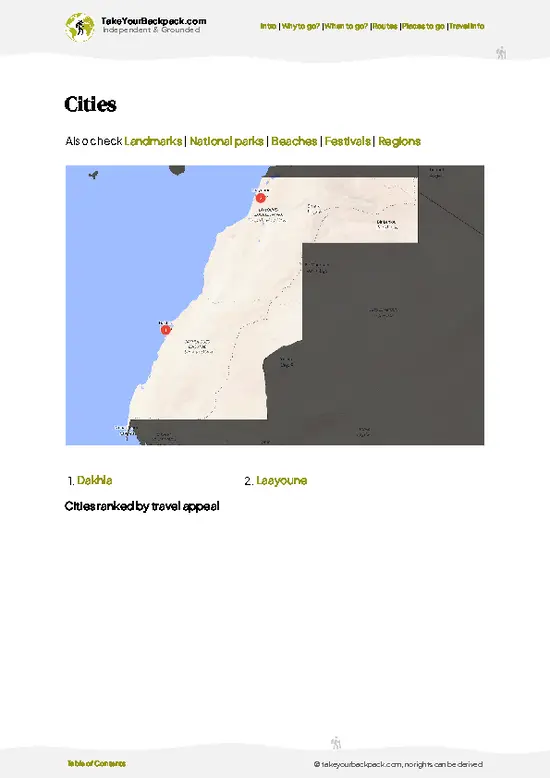
1 Dakhla

Kitesurf lagoon, fish port, thermal pools, peninsula calm

Spend mornings at the harbor as octopus and sole come off the boats, then hand your afternoons to wind, shallow water and lessons on the lagoon.

2 Laayoune

Spanish cathedral, Place Mechouar, Saguia el-Hamra, Sahrawi tea

Wander from a 1950s Spanish church to the central market and a dry riverbed, then settle into three rounds of tea as evening families fill the square.

Loading the map 🌍

Expert viewPro Tips for Exploring the Best

How many cities to visit: Two or three is the sensible number. Distances between towns run from 250 to 550 km, and a stop usually needs a full day to feel worthwhile. Four or more means most of the trip is spent in a bus seat watching flat, stony desert slide past the window, with little to show for it. With two or three, you get time for a slow mint tea on a wide street and a real look at the coast.
Which kind to prioritize: Coastal port cities suit travelers who want fish markets, lagoon or ocean water and the easiest services, and the evening reward is a plate of grilled fish for a few dollars. Inland desert towns suit those who want quiet, caravan history and starry nights, but have fewer places to stay. Travelers with limited time should pick one of each.
What it costs: Budget US$25 to … read more 👉
How many cities to visit: Two or three is the sensible number. Distances between towns run from 250 to 550 km, and a stop usually needs a full day to feel worthwhile. Four or more means most of the trip is spent in a bus seat watching flat, stony desert slide past the window, with little to show for it. With two or three, you get time for a slow mint tea on a wide street and a real look at the coast.
Which kind to prioritize: Coastal port cities suit travelers who want fish markets, lagoon or ocean water and the easiest services, and the evening reward is a plate of grilled fish for a few dollars. Inland desert towns suit those who want quiet, caravan history and starry nights, but have fewer places to stay. Travelers with limited time should pick one of each.
What it costs: Budget US$25 to 50 a day (about 250 to 500 MAD). A simple guesthouse room runs 150 to 400 MAD (US$15 to 40), a fish meal 40 to 100 MAD (US$4 to 10), and a petit taxi ride 7 to 15 MAD. Intercity buses cost about 100 to 250 MAD (US$10 to 25) per leg. Guided desert or lagoon excursions run roughly 300 to 900 MAD (US$30 to 90) per person, and the payoff is a dune or flamingo-filled shoreline to yourself.
Safety and etiquette: Cities are generally calm, with low street crime. Politics is the sensitive point, so keep views on the territory’s status to yourself. Carry your passport for frequent checkpoints, and do not photograph military or police sites. Stay out of the restricted zone east of the berm and the border minefields. Dress modestly, with covered shoulders and knees, which also keeps blowing sand off your skin. Carry cash, since card acceptance is patchy outside larger hotels.

✈️ The backpacker research shortcutWestern Sahara Travel Guide

An offline-friendly backpacking guide with optimized travel routes, ranked highlights, transport advice, and the best areas to stay.
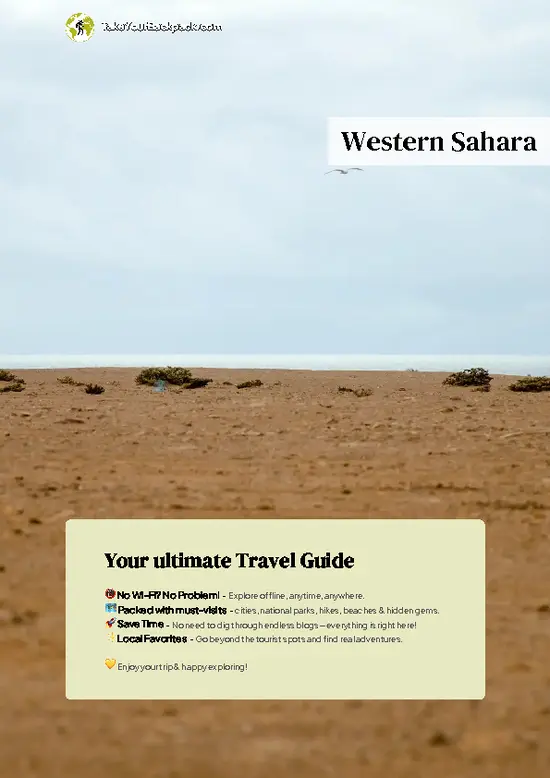
example page 0 from our offline Travel Guide for Western Sahara
example page 1 from our offline Travel Guide for Western Sahara
example page 2 from our offline Travel Guide for Western Sahara
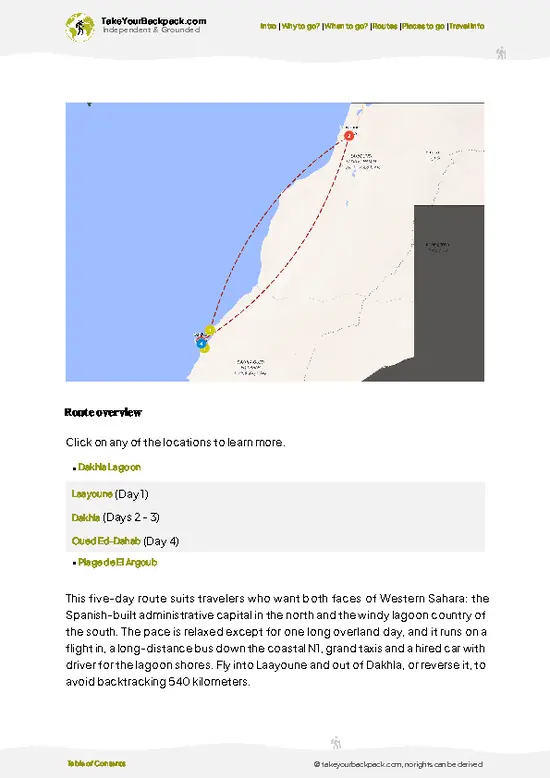
example page 3 from our offline Travel Guide for Western Sahara
example page 4 from our offline Travel Guide for Western Sahara
example page 5 from our offline Travel Guide for Western Sahara
example page 6 from our offline Travel Guide for Western Sahara
example page 7 from our offline Travel Guide for Western Sahara
The digital guide (68 pages) contains:
✅ 9 highlights, ranked by travel appeal
✅ Optimized 2, 3 & 5-day travel routes
✅ Cities, national parks, landmarks, beaches
✅ How to get around
✅ Offline-friendly for travel without Wi-Fi
👉 Click to see all 30+ guide features

📅 Plan smarter in minutes, not weeks
✅ Month by month travel advice
✅ Festivals & national holidays
✅ Budget expectations

🗺️ Go to the right places, skip the overrated ones
✅ Honest pros & cons of destinations
✅ Top hikes, parks & viewpoints
✅ Lesser-known places most travelers miss
✅ Clear “worth it vs skip it” guidance

🛏️ Travel smoothly without rookie mistakes
✅ Best areas to stay
✅ Transport systems explained simply
✅ Common scams & safety advice
✅ SIM cards, money & practical tips

🌍 Understand the country, not just visit it
✅ Culture & traditions
✅ 52 Essential phrases & customs
✅ Festivals worth planning around
✅ Traveler-friendly historical context
✅ Insights that make places more meaningful

📱 Built for real travel conditions
✅ Fully downloadable PDF
✅ Works completely offline
✅ Optimized for phone use
✅ Useful in remote areas & buses
✅ Everything in one place
Stop searching, start planning
Get instant access to your full guide. 30‑day money-back guarantee.
+ Add another guide for just

By proceeding you agree to our terms.
Sent to your inbox immediately after payment • 100% Secure Checkout
Best Backpacking Travel Advisor 2025 tourism awardBest Backpacking
Travel Advisor
2025
What others say about Take Your Backpack Guides:
⭐⭐⭐⭐⭐
Fantastic, amazing amount of information!
⭐⭐⭐⭐⭐
My goodness this is amazing, it's what I've been looking for hats off too you!
⭐⭐⭐⭐⭐
I think this is absolutely BRILLIANT
⭐⭐⭐⭐
Very complete and informative. It's still missing places, but I gotta to commend you
⭐⭐⭐⭐⭐
This is truly amazing, thank you, can't wait to explore it with my kids!
⭐⭐⭐⭐⭐
Awesome resource, thank you!
⭐⭐⭐⭐⭐
This is amazing! Can't wait to explore the ones I haven't seen
⭐⭐⭐⭐
I love this! Well done, great idea.
⭐⭐⭐⭐⭐
Thanks for taking the time to make this gem!
⭐⭐⭐⭐⭐
This might be the best website I've ever seen.
⭐⭐⭐⭐⭐
Congratulations, and thank you so much for your work; it's incredibly valuable.
⭐⭐⭐⭐
In all seriousness I think you did a great job pointing out the important spots
⭐⭐⭐⭐⭐
10/10 very good
⭐⭐⭐⭐⭐
As someone who's only just starting to visit regularly this is awesome, thank you.
⭐⭐⭐⭐
Thank you very much! I'm going to visit my dad, it's going to be very useful!
⭐⭐⭐⭐⭐
This is really cool! We'll be travelling for the first time and this definitely come in handy.
⭐⭐⭐⭐⭐
You are now our minister of culture, congratulations 👨‍💼
⭐⭐⭐⭐⭐
Just wanted to tell you that this is a pearl! Going to follow your recommendations.
⭐⭐⭐⭐⭐
This is so cool. I'll definitely be using the resource for my travels soon.
⭐⭐⭐⭐⭐
This is very impressive! Good work.
⭐⭐⭐⭐⭐
This is an amazing and informative site. Very well done!

🛏️ Where to stay?Where to Stay in Western Sahara

Western Sahara has very few true hostels; budget travel here mostly means simple hotels and guesthouses at roughly MAD 150 to 350 (about US$15 to 35) a night, plus a small number of surf and kite hostels in Dakhla. In Laayoune, the streets around Place du Mechouar and the central avenues have the most cheap rooms, cafés and grand taxi links, though nightlife is almost nonexistent and the call to prayer and traffic start early. In Dakhla, the town center on the southern tip of the peninsula is the cheapest base, with seafront cafés, a walkable layout and a calm feel at night, while the lagoon kite camps north of town put you on the water but cost more and leave you dependent on taxis to reach … read more 👉
Western Sahara has very few true hostels; budget travel here mostly means simple hotels and guesthouses at roughly MAD 150 to 350 (about US$15 to 35) a night, plus a small number of surf and kite hostels in Dakhla. In Laayoune, the streets around Place du Mechouar and the central avenues have the most cheap rooms, cafés and grand taxi links, though nightlife is almost nonexistent and the call to prayer and traffic start early. In Dakhla, the town center on the southern tip of the peninsula is the cheapest base, with seafront cafés, a walkable layout and a calm feel at night, while the lagoon kite camps north of town put you on the water but cost more and leave you dependent on taxis to reach town.

If you enjoy meeting fellow travelers, consider choosing hostels with high ratings for atmosphere. On the other hand, if you prefer having your own space, a hotel might be a better option.

Western SaharaMore of Western Sahara

👋 Meet the founderWho’s Behind Take Your Backpack?

Johan, backpacker and founder of TakeYourBackpackHi, I’m Johan (Netherlands 🇳🇱), the creator of TakeYourBackpack. Over the past 3 decades, I’ve backpacked through 90+ countries across six continents, gaining extensive experience with independent travel, long-term trips, and overland routes.

This site is built on a combination of firsthand travel experience and carefully curated insights from other backpackers. Many guides are based on places I’ve personally visited, while others bring together tips, observations, and practical advice shared by trusted travelers I’ve met along the way.

The goal is to provide realistic, experience-driven guidance — not generic itineraries — so you can explore destinations with better context, clearer expectations, and more confidence.