×

Western Sahara🇪🇭 | best regionsYour Guide to the 2 Best regions in Western Sahara

Western Sahara is a thinly populated Atlantic desert territory, and its regions divide mainly by access. The Moroccan-administered coast and the towns west of the sand wall known as the berm have paved roads, regular buses and hotels at modest prices. The interior and the eastern zone are empty, harder to reach and subject to restrictions. Independent travel here suits people who value space and quiet over sights.

By Johan Kruseman 🇳🇱 | Updated October 23, 2026
Explore the best cities in Western Sahara

Why go?What Makes Them Special

Western Sahara is a disputed territory. Morocco administers most of it, while the Polisario Front holds a strip east of the berm, a roughly 2,700 km sand wall that is heavily mined. The UN lists the territory as non-self-governing, and that status shapes everything from border rules to insurance cover.

The land is hyper-arid, with a long Atlantic coastline and very few people, mostly in a handful of towns along one main coastal highway. That makes distances large and services thin. Sahrawi culture, Hassaniya Arabic and tea poured in three rounds are part of daily life.

Before choosing it, check your government’s travel advice, expect military checkpoints, and stay on established roads. Unexploded ordnance remains outside the main corridors. Nothing here is built around tourism, which is the appeal and the limit.
How the List Was Created
The list of best regions in Western Sahara is created based on landscapes, local culture, attractions, vibes, and overall appeal. If you feel a region is missing in this list, please let us know.

When to go?Best Time to Visit Western Sahara for regions

Best months and weather: October to April is the best window, because coastal daytime highs sit around 20 to 28°C and the inland heat has eased. Rain is negligible, usually under 50 mm a year and falling mostly between November and February.

Shoulder seasons and peaks: May, June and September are workable on the coast, though morning fog and a cold Atlantic keep temperatures moderate. Inland around Smara, summer highs regularly pass 40°C, so desert excursions are best kept to winter. Around Dakhla, strong trade winds blow from roughly July to September, which suits kitesurfers but makes beach days gritty. Moroccan school holidays in July and August push up accommodation prices in Dakhla by about 30 to 50 percent. Winter is quieter and rooms are easier to find at standard rates of MAD 200 to 400 (US$20 to 40).

region hoppingHow to Combine regions Into One Trip

Trip length and direction: A trip combining several regions in Western Sahara needs 7 to 12 days, mostly because of the distances. The sensible direction is south, entering from Tan-Tan or Guelmim and finishing near Dakhla, where the airport allows a flight out instead of a long return drive.

Time per stop and transfers: Allow 2 to 4 days per stop. Laayoune to Smara takes about 2.5 to 3 hours by road, and Laayoune to Dakhla is roughly 540 km, or 7 to 9 hours by bus or shared taxi. Laayoune is the main transport hub, with CTM and Supratours services.

Planning mistakes: The most common error is treating the map as if it were Morocco’s north, where towns sit an hour apart. Here, two stops in one day usually means hours of empty highway. Another is arriving after dark, when onward transport thins … read more 👉
Trip length and direction: A trip combining several regions in Western Sahara needs 7 to 12 days, mostly because of the distances. The sensible direction is south, entering from Tan-Tan or Guelmim and finishing near Dakhla, where the airport allows a flight out instead of a long return drive.

Time per stop and transfers: Allow 2 to 4 days per stop. Laayoune to Smara takes about 2.5 to 3 hours by road, and Laayoune to Dakhla is roughly 540 km, or 7 to 9 hours by bus or shared taxi. Laayoune is the main transport hub, with CTM and Supratours services.

Planning mistakes: The most common error is treating the map as if it were Morocco’s north, where towns sit an hour apart. Here, two stops in one day usually means hours of empty highway. Another is arriving after dark, when onward transport thins out. Plan one long transfer per day, travel in daylight and keep a rest day after each 8-hour leg.

The ListTop regions of Western Sahara

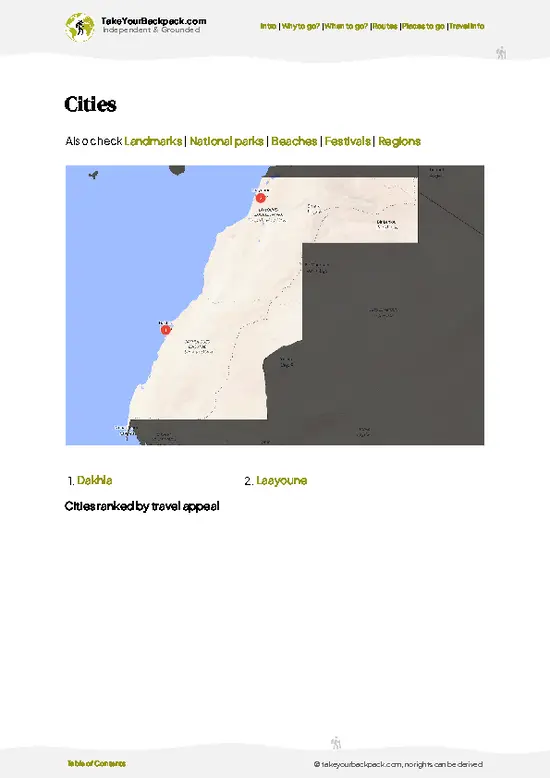
1 Saguia el Hamra

Wadi valley, Smara zawiya, tent-roof cathedral, empty Atlantic strand

Walk dry riverbanks, stone plateau and mud-walled caravan history, with Laayoune as the base and Smara as the quieter inland stop.

2 Oued Ed-Dahab

Kite lagoon, white dune, oyster farms, flamingo shallows

Cross a wind-swept peninsula to flat turquoise water, a dune that spills into the bay, and fresh oysters eaten at the shore.

western-sahara-region-oued-ed-dahab
© Google |
Loading the map 🌍

Expert viewPro Tips for Exploring the Best

How many regions to visit: Two or three regions is the right number. Distances between them run 3 to 9 hours on straight, empty highway, and each stop needs at least two days to feel like more than a bus window. Adding a fourth turns the trip into transit. Two regions suit a week, three suit ten days or more, and the reward is time to sit in a town long enough to be recognized by the tea seller.

Choosing the kind of region: Coastal regions suit most backpackers. They have cafés selling fresh grilled fish, guesthouses, wide Atlantic beaches and wind-sports schools, and the sea air takes the edge off the heat. Inland desert regions suit travelers who want silence and stars, and who will pay for a vehicle and a local driver. There, the payoff is a horizon with no pylons. The eastern zone beyond … read more 👉
How many regions to visit: Two or three regions is the right number. Distances between them run 3 to 9 hours on straight, empty highway, and each stop needs at least two days to feel like more than a bus window. Adding a fourth turns the trip into transit. Two regions suit a week, three suit ten days or more, and the reward is time to sit in a town long enough to be recognized by the tea seller.

Choosing the kind of region: Coastal regions suit most backpackers. They have cafés selling fresh grilled fish, guesthouses, wide Atlantic beaches and wind-sports schools, and the sea air takes the edge off the heat. Inland desert regions suit travelers who want silence and stars, and who will pay for a vehicle and a local driver. There, the payoff is a horizon with no pylons. The eastern zone beyond the berm is not a backpacker destination, since access depends on permission and mines remain.

What it costs: Budget US$30 to 50 a day, or MAD 300 to 500. That covers a simple hotel at MAD 200 to 400 (US$20 to 40) and meals of fish, tagine or grilled meat at MAD 40 to 100 (US$4 to 10) each. Intercity buses cost MAD 100 to 250 (US$10 to 25) per leg. A 4x4 with a driver for a desert day runs MAD 500 to 1,000 (US$50 to 100) per vehicle, so split it with others. Entry fees are minor, as there are few ticketed sites.

Safety and cultural notes: Checkpoints are frequent and routine. Carry your passport and answer questions politely. Keep drones out of the bag, since they are restricted, and avoid photographing military installations. The political status is sensitive, so let locals raise it first and keep opinions quiet. Dress modestly, and accept the first glass of tea, which opens conversation. Fill the fuel tank and water bottles before any long stretch, since stations can be 150 km apart. Stay on tracks, because ordnance lies off them, and never drive at night, when camels cross the road.

✈️ The backpacker research shortcutWestern Sahara Travel Guide

An offline-friendly backpacking guide with optimized travel routes, ranked highlights, transport advice, and the best areas to stay.
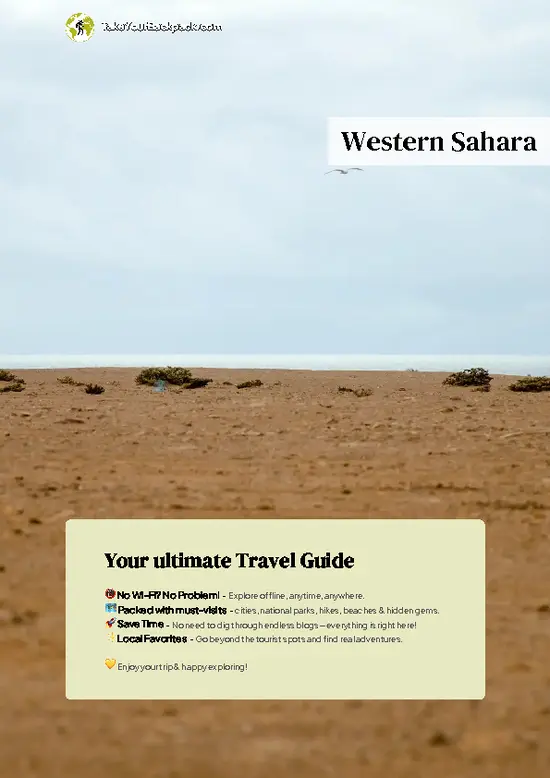
example page 0 from our offline Travel Guide for Western Sahara
example page 1 from our offline Travel Guide for Western Sahara
example page 2 from our offline Travel Guide for Western Sahara
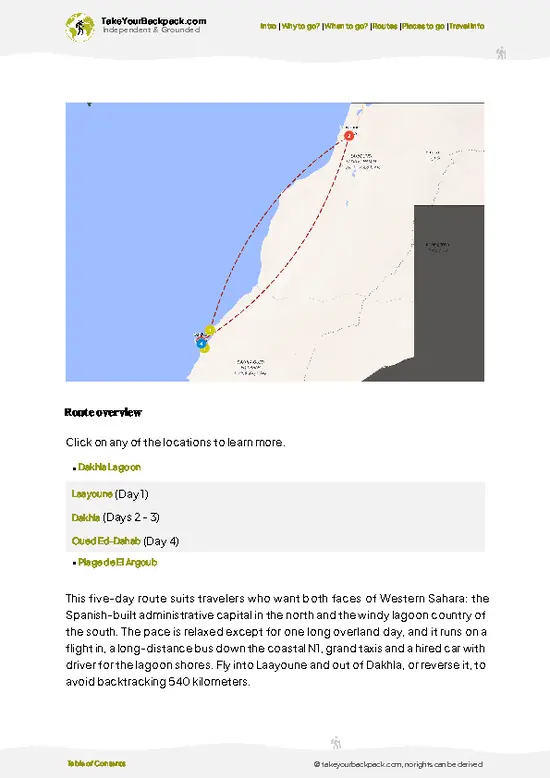
example page 3 from our offline Travel Guide for Western Sahara
example page 4 from our offline Travel Guide for Western Sahara
example page 5 from our offline Travel Guide for Western Sahara
example page 6 from our offline Travel Guide for Western Sahara
example page 7 from our offline Travel Guide for Western Sahara
The digital guide (68 pages) contains:
✅ 9 highlights, ranked by travel appeal
✅ Optimized 2, 3 & 5-day travel routes
✅ Cities, national parks, landmarks, beaches
✅ How to get around
✅ Offline-friendly for travel without Wi-Fi
👉 Click to see all 30+ guide features

📅 Plan smarter in minutes, not weeks
✅ Month by month travel advice
✅ Festivals & national holidays
✅ Budget expectations

🗺️ Go to the right places, skip the overrated ones
✅ Honest pros & cons of destinations
✅ Top hikes, parks & viewpoints
✅ Lesser-known places most travelers miss
✅ Clear “worth it vs skip it” guidance

🛏️ Travel smoothly without rookie mistakes
✅ Best areas to stay
✅ Transport systems explained simply
✅ Common scams & safety advice
✅ SIM cards, money & practical tips

🌍 Understand the country, not just visit it
✅ Culture & traditions
✅ 52 Essential phrases & customs
✅ Festivals worth planning around
✅ Traveler-friendly historical context
✅ Insights that make places more meaningful

📱 Built for real travel conditions
✅ Fully downloadable PDF
✅ Works completely offline
✅ Optimized for phone use
✅ Useful in remote areas & buses
✅ Everything in one place
Stop searching, start planning
Get instant access to your full guide. 30‑day money-back guarantee.
+ Add another guide for just

By proceeding you agree to our terms.
Sent to your inbox immediately after payment • 100% Secure Checkout
Best Backpacking Travel Advisor 2025 tourism awardBest Backpacking
Travel Advisor
2025
What others say about Take Your Backpack Guides:
⭐⭐⭐⭐⭐
Fantastic, amazing amount of information!
⭐⭐⭐⭐⭐
My goodness this is amazing, it's what I've been looking for hats off too you!
⭐⭐⭐⭐⭐
I think this is absolutely BRILLIANT
⭐⭐⭐⭐
Very complete and informative. It's still missing places, but I gotta to commend you
⭐⭐⭐⭐⭐
This is truly amazing, thank you, can't wait to explore it with my kids!
⭐⭐⭐⭐⭐
Awesome resource, thank you!
⭐⭐⭐⭐⭐
This is amazing! Can't wait to explore the ones I haven't seen
⭐⭐⭐⭐
I love this! Well done, great idea.
⭐⭐⭐⭐⭐
Thanks for taking the time to make this gem!
⭐⭐⭐⭐⭐
This might be the best website I've ever seen.
⭐⭐⭐⭐⭐
Congratulations, and thank you so much for your work; it's incredibly valuable.
⭐⭐⭐⭐
In all seriousness I think you did a great job pointing out the important spots
⭐⭐⭐⭐⭐
10/10 very good
⭐⭐⭐⭐⭐
As someone who's only just starting to visit regularly this is awesome, thank you.
⭐⭐⭐⭐
Thank you very much! I'm going to visit my dad, it's going to be very useful!
⭐⭐⭐⭐⭐
This is really cool! We'll be travelling for the first time and this definitely come in handy.
⭐⭐⭐⭐⭐
You are now our minister of culture, congratulations 👨‍💼
⭐⭐⭐⭐⭐
Just wanted to tell you that this is a pearl! Going to follow your recommendations.
⭐⭐⭐⭐⭐
This is so cool. I'll definitely be using the resource for my travels soon.
⭐⭐⭐⭐⭐
This is very impressive! Good work.
⭐⭐⭐⭐⭐
This is an amazing and informative site. Very well done!

🛏️ Where to stay?Accommodation Highlights

Western Sahara has very few true hostels; budget travel here mostly means simple hotels and guesthouses at roughly MAD 150 to 350 (about US$15 to 35) a night, plus a small number of surf and kite hostels in Dakhla. In Laayoune, the streets around Place du Mechouar and the central avenues have the most cheap rooms, cafés and grand taxi links, though nightlife is almost nonexistent and the call to prayer and traffic start early. In Dakhla, the town center on the southern tip of the peninsula is the cheapest base, with seafront cafés, a walkable layout and a calm feel at night, while the lagoon kite camps north of town put you on the water but cost more and leave you dependent on taxis to reach … read more 👉
Western Sahara has very few true hostels; budget travel here mostly means simple hotels and guesthouses at roughly MAD 150 to 350 (about US$15 to 35) a night, plus a small number of surf and kite hostels in Dakhla. In Laayoune, the streets around Place du Mechouar and the central avenues have the most cheap rooms, cafés and grand taxi links, though nightlife is almost nonexistent and the call to prayer and traffic start early. In Dakhla, the town center on the southern tip of the peninsula is the cheapest base, with seafront cafés, a walkable layout and a calm feel at night, while the lagoon kite camps north of town put you on the water but cost more and leave you dependent on taxis to reach town.

If you enjoy meeting fellow travelers, consider choosing hostels with high ratings for atmosphere. On the other hand, if you prefer having your own space, a hotel might be a better option.

Western SaharaSee More of Western Sahara

👋 Meet the founderWho’s Behind Take Your Backpack?

Johan, backpacker and founder of TakeYourBackpackHi, I’m Johan (Netherlands 🇳🇱), the creator of TakeYourBackpack. Over the past 3 decades, I’ve backpacked through 90+ countries across six continents, gaining extensive experience with independent travel, long-term trips, and overland routes.

This site is built on a combination of firsthand travel experience and carefully curated insights from other backpackers. Many guides are based on places I’ve personally visited, while others bring together tips, observations, and practical advice shared by trusted travelers I’ve met along the way.

The goal is to provide realistic, experience-driven guidance — not generic itineraries — so you can explore destinations with better context, clearer expectations, and more confidence.