×

Western Sahara🇪🇭 | festivalsLaayoune MoussemSaharan music, poetry recitals, tribal gatherings | things to do and best time to go

Explore Dakhla FestivalExplore Festival of the Camel

Backpacking in Laayoune Moussem
👍 Recommendedfestival ranked #3
By Johan Kruseman 🇳🇱 | Updated September 3, 2026

Your boots crunch over gravel, the air thick with the scent of grilled lamb and diesel generators, as a line of Sahrawi drummers hammers out a rhythm that rattles your ribcage. This is Laayoune Moussem, pulsing at the edge of the Sahara in Western Sahara’s largest city, Laayoune—closer to the Atlantic than most maps admit. The Moussem is less a festival, more a collision: tribal music, horse parades, and Sufi chants, all tangled with the city’s political tension and raw desert energy. Backpackers drift in for the spectacle—locals outnumber tourists a hundred to one, and the vibe is communal but wary, with families, elders, and the odd UN observer sharing the same dust. It’s not a party for Instagram. It’s a living ritual, lasting several days, where the music is hypnotic, the food is rustic, and the sense of place is unfiltered. Worth it? Only if you want your comfort zone shattered and your senses wide awake.

Discover everything you want to know in the 📖 Western Sahara Travel Guide.
Loading the map 🌍
CLICK TO FILTER
cities
landmarks
hikes
beaches
festivals
regions
SHOW COUNTRY’S BESTSHOW ALL

✨ Why go?
Ranked #3 festival in Western Sahara
What sets this place apart

Backpackers flock to Laayoune Moussem in Western Sahara for a reason: it’s a cultural explosion that transforms the desert into a vibrant hub of social energy. This festival isn’t just an event; it’s a temporary community where you can connect with locals and fellow travelers, sharing stories and laughter over traditional music and dance.

Planning your route around this festival means diving headfirst into cultural immersion. You’ll taste authentic dishes, witness age-old traditions, and feel the pulse of a region often overlooked. Plus, it’s surprisingly affordable compared to similar events elsewhere. You’ll find that the cost of entry, food, and accommodations won’t break the bank, allowing you to save your budget for those epic moments that truly matter.

Integrating the Moussem into … read more 👉
Backpackers flock to Laayoune Moussem in Western Sahara for a reason: it’s a cultural explosion that transforms the desert into a vibrant hub of social energy. This festival isn’t just an event; it’s a temporary community where you can connect with locals and fellow travelers, sharing stories and laughter over traditional music and dance.

Planning your route around this festival means diving headfirst into cultural immersion. You’ll taste authentic dishes, witness age-old traditions, and feel the pulse of a region often overlooked. Plus, it’s surprisingly affordable compared to similar events elsewhere. You’ll find that the cost of entry, food, and accommodations won’t break the bank, allowing you to save your budget for those epic moments that truly matter.

Integrating the Moussem into your travel plans is a savvy move. It serves as a launchpad for exploring the surrounding landscapes, from the stunning dunes to the rugged mountains. Embrace the challenge of navigating this unique experience, and you’ll walk away with memories that resonate long after the last drumbeat fades.
Want to include Laayoune Moussem in your Western Sahara route?
Create a personalized Western Sahara itinerary that includes Laayoune Moussem and the places that fit your trip — based on your travel style, budget, and available time. Get your route in seconds.

Generate my trip

💡 HighlightsKey sights and experiences for travelers

  1. Camel and horse races & desert skill displays: Watching camels and horses compete across open sand feels raw and real — not a polished stadium spectacle but living transport and sport. Riders and handlers show off speed, endurance and desert handling techniques you won’t see in city festivals; it’s part sport, part cultural demonstration of nomadic life.
  2. Sahrawi music and dance performances: Intimate, often trance-like vocal traditions and percussive rhythms take center stage, with call-and-response singing and group dancing that draw everyone in. The soundscape—sparse instruments, strong voices, hand claps—gives the festival a distinct, hypnotic atmosphere that’s very different from pop festivals.
  3. Poetry and oral storytelling: Elders and young people trade poems, genealogies and stories
read more 👉
  1. Camel and horse races & desert skill displays: Watching camels and horses compete across open sand feels raw and real — not a polished stadium spectacle but living transport and sport. Riders and handlers show off speed, endurance and desert handling techniques you won’t see in city festivals; it’s part sport, part cultural demonstration of nomadic life.
  2. Sahrawi music and dance performances: Intimate, often trance-like vocal traditions and percussive rhythms take center stage, with call-and-response singing and group dancing that draw everyone in. The soundscape—sparse instruments, strong voices, hand claps—gives the festival a distinct, hypnotic atmosphere that’s very different from pop festivals.
  3. Poetry and oral storytelling: Elders and young people trade poems, genealogies and stories in Hassaniya dialect, keeping oral history alive. These sessions are more than entertainment; they’re the community’s memory and social glue, and hearing them in person gives real context to the landscapes and people you’re seeing.
  4. Artisan souk and traditional crafts: Stalls packed with woven carpets, leather goods, silver jewelry and nomadic textiles let you buy straight from makers. The craftsmanship is practical and beautiful, and bargaining here is part of the experience — you’re supporting living traditions, not just souvenir shops.
  5. Nighttime campfires, tea ceremonies and communal food: Evenings around fires under big desert skies are where the festival breathes — slow, hospitable tea rituals, shared plates (think slow-roasted meats and flatbreads) and music late into the night. It’s the best place to experience Sahrawi hospitality: relaxed, communal, and unpolished in a good way.
Spotted a mistake or missing something? Contact us.

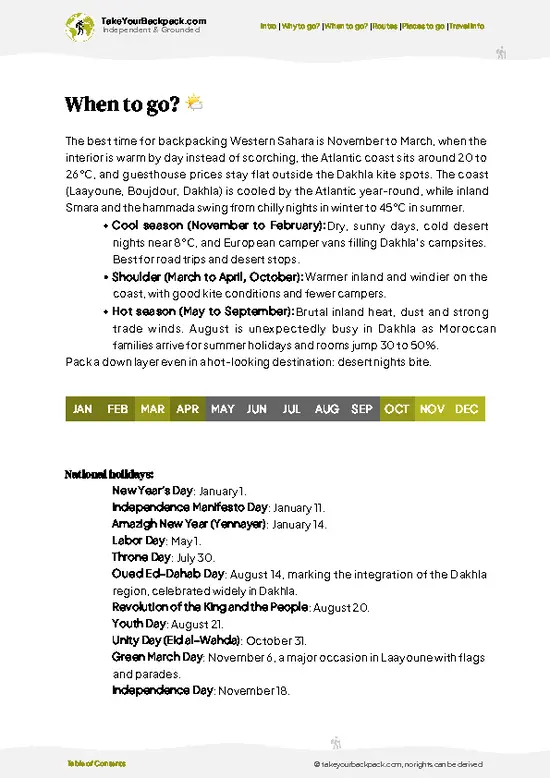
🌤️ When to go?When is the celebration of Laayoune Moussem?


  • Topic: Weather – Aim for late October to early November when temperatures hover between 20-25°C (68-77°F). This window avoids the scorching Saharan heat that can spike above 40°C (104°F) in summer, making trekking and festival activities far more bearable.

  • Topic: Temperature – Nights can dip to around 10°C (50°F), so pack layers. The desert’s sharp temperature swings mean you’ll want to be ready for both warm days and chilly evenings without wasting energy on discomfort.

  • Topic: Daylight Hours – Around the festival time, expect roughly 11-12 hours of daylight. This balance gives you enough light to explore before and after festival events without burning out.

  • Topic: Crowds – The festival draws local tribes and some tourists, but it’s not overrun. Visiting during the main festival days
read more 👉

  • Topic: Weather – Aim for late October to early November when temperatures hover between 20-25°C (68-77°F). This window avoids the scorching Saharan heat that can spike above 40°C (104°F) in summer, making trekking and festival activities far more bearable.

  • Topic: Temperature – Nights can dip to around 10°C (50°F), so pack layers. The desert’s sharp temperature swings mean you’ll want to be ready for both warm days and chilly evenings without wasting energy on discomfort.

  • Topic: Daylight Hours – Around the festival time, expect roughly 11-12 hours of daylight. This balance gives you enough light to explore before and after festival events without burning out.

  • Topic: Crowds – The festival draws local tribes and some tourists, but it’s not overrun. Visiting during the main festival days means vibrant interaction without the crush of peak-season tourist mobs.

  • Topic: Seasonal Activities – The Moussem coincides with traditional camel races, music, and crafts, all best experienced when the weather cooperates. Off-season visits miss these cultural highlights, turning the trip into a dry run.

  • Topic: Price Fluctuations – Expect accommodation and transport costs to spike during the festival. Booking early locks in better rates and saves you from last-minute price gouging.


Pro-tip: Lock your visit to the cooler shoulder season—this is when the desert’s harshness softens, the festival pulses with life, and your stamina stays intact for every moment worth savoring.


source: climatestotravel.comJANJanuary: not recommended for travelingFEBFebruary: not recommended for travelingMARMarch: not recommended for travelingAPRApril: not recommended for travelingMAYMay: not recommended for travelingJUNJune: not recommended for travelingJULJuly: not recommended for travelingAUGAugust: not recommended for travelingSEPSeptember: not recommended for travelingOCTOctober: excellent for travelingNOVNovember: not recommended for travelingDECDecember: not recommended for traveling

✈️ The backpacker research shortcutWestern Sahara Travel Guide

An offline-friendly backpacking guide with optimized travel routes, ranked highlights, transport advice, and the best areas to stay.
example page 0 from our offline Travel Guide for Western Sahara
example page 1 from our offline Travel Guide for Western Sahara
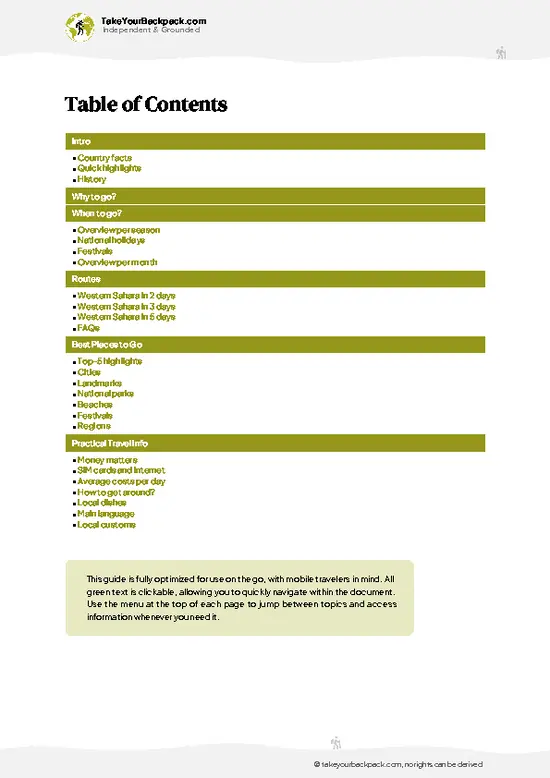
example page 2 from our offline Travel Guide for Western Sahara
example page 3 from our offline Travel Guide for Western Sahara
example page 4 from our offline Travel Guide for Western Sahara
example page 5 from our offline Travel Guide for Western Sahara
example page 6 from our offline Travel Guide for Western Sahara
example page 7 from our offline Travel Guide for Western Sahara
The digital guide (78 pages) contains:
14 highlights, ranked by travel appeal
Optimized 2, 3 & 5-day travel routes
Cities, national parks, landmarks, beaches
How to get around
Offline-friendly for travel without Wi-Fi
👉 Click to see all 30+ guide features

📅 Plan smarter in minutes, not weeks
Month by month travel advice
Festivals & national holidays
Budget expectations

🗺️ Go to the right places, skip the overrated ones
Honest pros & cons of destinations
Top hikes, parks & viewpoints
Lesser-known places most travelers miss
Clear “worth it vs skip it” guidance

🛏️ Travel smoothly without rookie mistakes
Best areas to stay
Transport systems explained simply
Common scams & safety advice
SIM cards, money & practical tips

🌍 Understand the country, not just visit it
Culture & traditions
52 Essential phrases & customs
Festivals worth planning around
Traveler-friendly historical context
Insights that make places more meaningful

📱 Built for real travel conditions
Fully downloadable PDF
Works completely offline
Optimized for phone use
Useful in remote areas & buses
Everything in one place
Save weeks of stressful planning
Get instant access to your full guide. 30‑day money-back guarantee.
+ Add another guide for just €6.50

By proceeding you agree to our terms.
Sent to your inbox immediately after payment • 100% Secure Checkout
Best Backpacking Travel Advisor 2025 tourism awardBest Backpacking
Travel Advisor
2025
What others say about Take Your Backpack Guides:
⭐⭐⭐⭐⭐
Fantastic, amazing amount of information!
⭐⭐⭐⭐⭐
My goodness this is amazing, it's what I've been looking for hats off too you!
⭐⭐⭐⭐⭐
I think this is absolutely BRILLIANT
⭐⭐⭐⭐
Very complete and informative. It's still missing places, but I gotta to commend you
⭐⭐⭐⭐⭐
This is truly amazing, thank you, can't wait to explore it with my kids!
⭐⭐⭐⭐⭐
Awesome resource, thank you!
⭐⭐⭐⭐⭐
This is amazing! Can't wait to explore the ones I haven't seen
⭐⭐⭐⭐
I love this! Well done, great idea.
⭐⭐⭐⭐⭐
Thanks for taking the time to make this gem!
⭐⭐⭐⭐⭐
This might be the best website I've ever seen.
⭐⭐⭐⭐⭐
Congratulations, and thank you so much for your work; it's incredibly valuable.
⭐⭐⭐⭐
In all seriousness I think you did a great job pointing out the important spots
⭐⭐⭐⭐⭐
10/10 very good
⭐⭐⭐⭐⭐
As someone who's only just starting to visit regularly this is awesome, thank you.
⭐⭐⭐⭐
Thank you very much! I'm going to visit my dad, it's going to be very useful!
⭐⭐⭐⭐⭐
This is really cool! We'll be travelling for the first time and this definitely come in handy.
⭐⭐⭐⭐⭐
You are now our minister of culture, congratulations 👨‍💼
⭐⭐⭐⭐⭐
Just wanted to tell you that this is a pearl! Going to follow your recommendations.
⭐⭐⭐⭐⭐
This is so cool. I'll definitely be using the resource for my travels soon.
⭐⭐⭐⭐⭐
This is very impressive! Good work.
⭐⭐⭐⭐⭐
This is an amazing and informative site. Very well done!

🛏️ Where to stay?Best areas to stay in Western Sahara

When you’re gearing up for the Laayoune Moussem, the right place to stay can make or break your experience. Look for accommodations in the heart of Laayoune itself. This bustling city is where the festival vibes pulse strongest. You’ll find a mix of locals and fellow travelers, creating a lively atmosphere that’s perfect for making connections.

Stay near the main square. It’s a hub of activity, with easy access to food stalls and local shops. The energy here is infectious, and you’ll be right in the thick of the festival action. Plus, being close means you can pop back to recharge before diving … read more 👉
When you’re gearing up for the Laayoune Moussem, the right place to stay can make or break your experience. Look for accommodations in the heart of Laayoune itself. This bustling city is where the festival vibes pulse strongest. You’ll find a mix of locals and fellow travelers, creating a lively atmosphere that’s perfect for making connections.

Stay near the main square. It’s a hub of activity, with easy access to food stalls and local shops. The energy here is infectious, and you’ll be right in the thick of the festival action. Plus, being close means you can pop back to recharge before diving back into the festivities.

Consider areas with a reputation for safety and social interaction. Look for spots where backpackers gather—these are often the best places to swap stories and tips. The camaraderie among travelers can elevate your experience, turning solo adventures into shared memories.

Avoid the outskirts. While they might seem quieter, they can lack the vibrant pulse of the festival. You want to be where the action is, where every moment counts, and where you can soak in the culture without the hassle of long commutes.

👛 Costs (as of 3 September 2026)Money, prices, and spending tips

The Laayoune Moussem in Western Sahara is an exhilarating experience, but understanding the costs can keep your adventure smooth and your budget intact.
  • Festival Tickets: Expect to pay around €10 to €20 for entry. This fee usually covers access to various events and performances throughout the festival. Keep an eye out for any special events that might have separate charges.
  • Accommodation: Prices range from €15 for basic hostels to €50 for mid-range hotels. Booking in advance can save you some cash, especially during the festival when demand spikes. Consider camping options if you’re feeling adventurous; they can be cheaper and offer a unique experience.
  • Local Transport: Budget about €5 to €15 for local transport. Shared taxis or buses are your best bet for getting around. They’re
read more 👉
The Laayoune Moussem in Western Sahara is an exhilarating experience, but understanding the costs can keep your adventure smooth and your budget intact.
  • Festival Tickets: Expect to pay around €10 to €20 for entry. This fee usually covers access to various events and performances throughout the festival. Keep an eye out for any special events that might have separate charges.
  • Accommodation: Prices range from €15 for basic hostels to €50 for mid-range hotels. Booking in advance can save you some cash, especially during the festival when demand spikes. Consider camping options if you’re feeling adventurous; they can be cheaper and offer a unique experience.
  • Local Transport: Budget about €5 to €15 for local transport. Shared taxis or buses are your best bet for getting around. They’re affordable and give you a taste of local life. Just be ready for some waiting time during peak hours.
  • Food & Drinks: Plan for around €10 to €25 per day. Street food is your friend here—delicious and budget-friendly. Restaurants can be pricier, especially if you opt for sit-down meals. Always check the menu before you settle in.
  • Miscellaneous Expenses: Set aside €10 to €30 for souvenirs, tips, or unexpected costs. This could include anything from local crafts to a spontaneous excursion. Having a little extra cash on hand can make all the difference.

Navigating these costs with awareness will help you focus on the vibrant experiences that the Laayoune Moussem has to offer.


source: visitmorocco.com
⚠️ Prices can change and everyone travels differently, so take this as a rough guide. Hope it helps you plan your adventure!

🍲 FoodWhat to Eat & Drink

At the Laayoune Moussem, food and drink are as much a part of the experience as the vibrant atmosphere. Dive into local specialties like couscous, often served with tender lamb or chicken, infused with spices that dance on your palate. Don’t miss the tagine, a slow-cooked dish that’s a festival staple, bursting with flavors from fresh vegetables and aromatic herbs.

Stalls line the streets, each offering a taste of Saharan hospitality. Try the harira, a hearty soup that warms you up, especially as the sun sets. For something sweet, grab a piece of baklava or dates stuffed with nuts; they’re a delightful treat that pairs perfectly with mint tea.

When it comes to drinks, fresh juices are a must—think pomegranate or orange, vibrant and refreshing. You’ll find vendors serving traditional tea, … read more 👉
At the Laayoune Moussem, food and drink are as much a part of the experience as the vibrant atmosphere. Dive into local specialties like couscous, often served with tender lamb or chicken, infused with spices that dance on your palate. Don’t miss the tagine, a slow-cooked dish that’s a festival staple, bursting with flavors from fresh vegetables and aromatic herbs.

Stalls line the streets, each offering a taste of Saharan hospitality. Try the harira, a hearty soup that warms you up, especially as the sun sets. For something sweet, grab a piece of baklava or dates stuffed with nuts; they’re a delightful treat that pairs perfectly with mint tea.

When it comes to drinks, fresh juices are a must—think pomegranate or orange, vibrant and refreshing. You’ll find vendors serving traditional tea, a symbol of friendship and hospitality.

A few quirks to keep in mind: sharing is common, so don’t hesitate to offer a taste to your neighbor. Lines can get long, so be patient and enjoy the buzz around you. Cash is king here; card payments might not fly. Serving sizes can be generous, so pace yourself—there’s plenty to savor!

FAQFrequently asked questions about Laayoune Moussem

Laayoune Moussem typically takes place annually in late October or early November, lasting around 3 to 5 days. The exact dates can vary each year based on local scheduling and lunar calendar considerations.
Attending Laayoune Moussem is generally free of charge for most events and public gatherings. However, some specific activities or performances might have small fees, usually under 10 USD.
No, tickets in advance are not usually required for Laayoune Moussem as it is an open festival with public access. It is advisable to arrive early for popular events to secure a good spot.
⚠️ Things can change over time, so always validate details locally before you go.

Other Sahrawi festivals near Laayoune Moussem

Explore more nearby:


💡 Not sure where to go next?
Create a personalized itinerary for Western Sahara including Laayoune Moussem and the places that fit your trip.

Generate my itinerary

👉 Discover all festivals

Or checkout all Western Sahara has to offer (think cities, towns, villages, national parks, hikes, beaches, festivals)
Country photo of Western Sahara

We 💚 feedbackFinal thoughts on celebrating the Laayoune Moussem

The vibe at Laayoune Moussem is electric, a whirlwind of culture and camaraderie. You’ll find yourself swept up in the rhythm of traditional music and the scent of spiced tagines wafting through the air. But here’s the kicker: don’t underestimate the desert heat. Hydrate like it’s your job, or you’ll miss out on the best surprise—those late-night gatherings under the stars. Embrace the challenge; it’s all part of the adventure. Keep your energy for the moments that matter.

✍️ Help improve this page!
The information on this page is based on in-depth research, insights shared by experienced travelers, and feedback from the local travel community in Western Sahara. While every effort is made to keep the information accurate and current, conditions can change — so if you spot anything incorrect or outdated, please get in touch.


🙋‍♂️ Give feedback

👋 Meet the founderWho’s Behind Take Your Backpack?

Johan, backpacker and founder of TakeYourBackpackHi, I’m Johan (Netherlands 🇳🇱), the creator of TakeYourBackpack. Over the past decade, I’ve backpacked through 80+ countries across six continents, gaining extensive experience with independent travel, long-term trips, and overland routes.

This site is built on a combination of firsthand travel experience and carefully curated insights from other backpackers. Many guides are based on places I’ve personally visited, while others bring together tips, observations, and practical advice shared by trusted travelers I’ve met along the way.

The goal is to provide realistic, experience-driven guidance — not generic itineraries — so you can explore destinations with better context, clearer expectations, and more confidence.

Get full country guide •
Instant download • 14 highlights • Full Offline guide