×

Western Sahara🇪🇭 | festivalsAkbar FestivalBoujdour tea circles, Cape Bojador headland, fishing harbor, camels and melhfa | things to do and best time to go

Explore LaayouneExplore Dakhla Festival

Backpacking in Akbar
👍 Recommendedfestival ranked #4
By Johan Kruseman 🇳🇱 | Updated October 22, 2026

Akbar Festival suits the slow, curious traveler who likes Hassani culture, long coastal roads and gatherings with no polish, and who is happy to ask questions over tea. Anyone who needs a fixed schedule, big stages or plenty of nightlife will probably find it thin. It takes place around Boujdour, a small Atlantic town in the north of Western Sahara, where low flat-roofed houses sit between a fishing port and a wide stretch of desert. Streets are quiet and sandy at the edges, the wind carries salt and fish, and you get the feel of a place where people have always lived off the sea and the camel. Expect gatherings built around Sahrawi tradition, tea poured in rounds, and conversation that moves at its own pace. Plan for a few days. It will please travelers who value local texture over spectacle, and disappoint those who want a polished festival.

Discover everything you want to know in the 📖 Western Sahara Travel Guide.


example page 0 from our offline Travel Guide for Western Sahara
example page 1 from our offline Travel Guide for Western Sahara
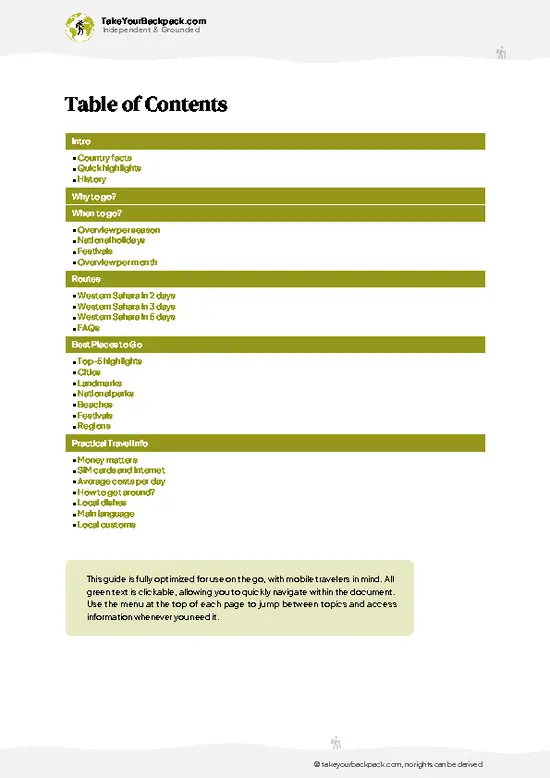
example page 2 from our offline Travel Guide for Western Sahara
example page 3 from our offline Travel Guide for Western Sahara
example page 4 from our offline Travel Guide for Western Sahara
example page 5 from our offline Travel Guide for Western Sahara
example page 6 from our offline Travel Guide for Western Sahara
example page 7 from our offline Travel Guide for Western Sahara
Loading the map 🌍
CLICK TO FILTER
cities
landmarks
national parks
beaches
festivals
regions
SHOW COUNTRY’S BESTSHOW ALL

✨ Why go?
Ranked #4 festival in Western Sahara
What makes this festival worth celebrating

Akbar Festival gives backpackers a reason to head down a coast most routes skip, and the reason is people rather than programming. The Boujdour area has few visitors, so a festival here puts you in the same circle as local families, fishermen and herders rather than in a tour group. Tea is poured three times, conversation stretches across an afternoon, and an invitation to sit is easy to earn with a greeting in Arabic or Spanish.

The second draw is where it fits on a long overland trip. The Atlantic coastal road between Laayoune and Dakhla is one of the emptier stretches in northwest Africa, and the festival gives you a fixed stop that breaks up the drive with a real occasion. Prices stay modest because there is no commercial machine behind it. You pay for a simple room, shared meals and … read more 👉
Akbar Festival gives backpackers a reason to head down a coast most routes skip, and the reason is people rather than programming. The Boujdour area has few visitors, so a festival here puts you in the same circle as local families, fishermen and herders rather than in a tour group. Tea is poured three times, conversation stretches across an afternoon, and an invitation to sit is easy to earn with a greeting in Arabic or Spanish.

The second draw is where it fits on a long overland trip. The Atlantic coastal road between Laayoune and Dakhla is one of the emptier stretches in northwest Africa, and the festival gives you a fixed stop that breaks up the drive with a real occasion. Prices stay modest because there is no commercial machine behind it. You pay for a simple room, shared meals and the odd taxi, and you leave with a clearer sense of Hassani life than any museum offers.

💡 HighlightsPlaces and moments you shouldn't skip

  1. Cape Bojador Lighthouse: The best-known landmark of the area stands on a low, windy headland. The cape is famous in navigation history because Portuguese sailors long feared it, until Gil Eanes rounded it in the fifteenth century. The surf below is loud and the horizon is flat and empty.
  2. Hassani tea gatherings: The heart of any festival here is sitting on a rug while strong green tea is poured in three rounds, each sweeter and gentler than the last. Poetry and conversation fill the pauses, and accepting a glass is how you join in.
  3. Boujdour fishing port: Small boats unload the morning catch beside gulls and a crowd of buyers. It is a plain working harbor, and it gives you fresh fish grilled nearby and a clear view of what feeds the town.
  4. Atlantic beaches and dunes: Pale sand runs right up to the
… read more 👉
  1. Cape Bojador Lighthouse: The best-known landmark of the area stands on a low, windy headland. The cape is famous in navigation history because Portuguese sailors long feared it, until Gil Eanes rounded it in the fifteenth century. The surf below is loud and the horizon is flat and empty.
  2. Hassani tea gatherings: The heart of any festival here is sitting on a rug while strong green tea is poured in three rounds, each sweeter and gentler than the last. Poetry and conversation fill the pauses, and accepting a glass is how you join in.
  3. Boujdour fishing port: Small boats unload the morning catch beside gulls and a crowd of buyers. It is a plain working harbor, and it gives you fresh fish grilled nearby and a clear view of what feeds the town.
  4. Atlantic beaches and dunes: Pale sand runs right up to the ocean along this coast, with dunes behind it. Walk at low tide when the sand is firm, and expect wind, long sightlines and almost no other people.
  5. Camels and Sahrawi dress: Camels are central to local tradition, and gatherings often bring them into view along with the flowing blue and black melhfa worn by women and the daraa by men. You can watch, ask questions and take photographs once you have asked permission.
Akbar Festival costs nothing to wander through, and the beaches and the lighthouse headland are the cheapest items on the list because they need only your feet and a short ride.
Spotted a mistake or missing something? Contact us.

🌤️ When to go?When is the celebration of Akbar Festival?

Akbar Festival is held in late February or early March in Western Sahara, running a few days, with dates that follow local organizers rather than a fixed calendar, and it takes place near Smara in the Sahrawi refugee camps area and surrounding desert.
  • Best day: Go for the opening ceremony or the main day, when camel parades, music and poetry readings draw the biggest crowds.
  • Weather: Days run about 22 to 28°C (72 to 82°F), nights drop to 8 to 12°C (46 to 54°F). Rain is rare, but wind and dust are common. Bring a scarf for your face, sunglasses, sunscreen and a warm layer for the evenings.
  • Booking: Arrange a bed and a driver at least 3 to 4 weeks ahead, since rooms are scarce and prices can rise by 20 to 40 percent.
  • Arrival: Reach town the afternoon before the opening, because desert roads clog
… read more 👉
Akbar Festival is held in late February or early March in Western Sahara, running a few days, with dates that follow local organizers rather than a fixed calendar, and it takes place near Smara in the Sahrawi refugee camps area and surrounding desert.
  • Best day: Go for the opening ceremony or the main day, when camel parades, music and poetry readings draw the biggest crowds.
  • Weather: Days run about 22 to 28°C (72 to 82°F), nights drop to 8 to 12°C (46 to 54°F). Rain is rare, but wind and dust are common. Bring a scarf for your face, sunglasses, sunscreen and a warm layer for the evenings.
  • Booking: Arrange a bed and a driver at least 3 to 4 weeks ahead, since rooms are scarce and prices can rise by 20 to 40 percent.
  • Arrival: Reach town the afternoon before the opening, because desert roads clog with convoys on the first morning and leave the day after the finale.
Confirm the exact dates with local contacts before you lock in transport.


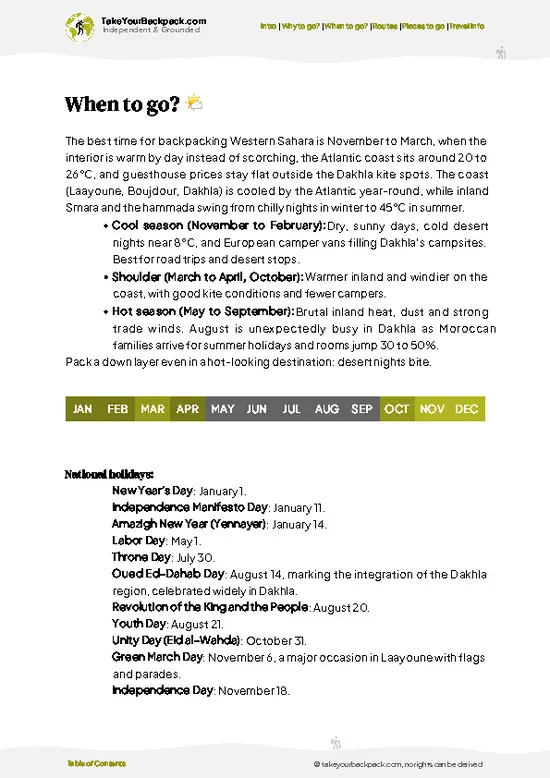
source: climatestotravel.comJANJanuary: not recommended for travelingFEBFebruary: not recommended for travelingMARMarch: highly recommended for travelingAPRApril: highly recommended for travelingMAYMay: not recommended for travelingJUNJune: not recommended for travelingJULJuly: not recommended for travelingAUGAugust: not recommended for travelingSEPSeptember: highly recommended for travelingOCTOctober: highly recommended for travelingNOVNovember: not recommended for travelingDECDecember: not recommended for traveling

✈️ The backpacker research shortcutWestern Sahara Travel Guide

An offline-friendly backpacking guide with optimized travel routes, ranked highlights, transport advice, and the best areas to stay.
example page 0 from our offline Travel Guide for Western Sahara
example page 1 from our offline Travel Guide for Western Sahara
example page 2 from our offline Travel Guide for Western Sahara
example page 3 from our offline Travel Guide for Western Sahara
example page 4 from our offline Travel Guide for Western Sahara
example page 5 from our offline Travel Guide for Western Sahara
example page 6 from our offline Travel Guide for Western Sahara
example page 7 from our offline Travel Guide for Western Sahara
The digital guide (68 pages) contains:
✅ 9 highlights, ranked by travel appeal
✅ Optimized 2, 3 & 5-day travel routes
✅ Cities, national parks, landmarks, beaches
✅ How to get around
✅ Offline-friendly for travel without Wi-Fi
👉 Click to see all 30+ guide features

📅 Plan smarter in minutes, not weeks
✅ Month by month travel advice
✅ Festivals & national holidays
✅ Budget expectations

🗺️ Go to the right places, skip the overrated ones
✅ Honest pros & cons of destinations
✅ Top hikes, parks & viewpoints
✅ Lesser-known places most travelers miss
✅ Clear “worth it vs skip it” guidance

🛏️ Travel smoothly without rookie mistakes
✅ Best areas to stay
✅ Transport systems explained simply
✅ Common scams & safety advice
✅ SIM cards, money & practical tips

🌍 Understand the country, not just visit it
✅ Culture & traditions
✅ 52 Essential phrases & customs
✅ Festivals worth planning around
✅ Traveler-friendly historical context
✅ Insights that make places more meaningful

📱 Built for real travel conditions
✅ Fully downloadable PDF
✅ Works completely offline
✅ Optimized for phone use
✅ Useful in remote areas & buses
✅ Everything in one place
Stop searching, start planning
Get instant access to your full guide. 30‑day money-back guarantee.
+ Add another guide for just

By proceeding you agree to our terms.
Sent to your inbox immediately after payment • 100% Secure Checkout
Best Backpacking Travel Advisor 2025 tourism awardBest Backpacking
Travel Advisor
2025
What others say about Take Your Backpack Guides:
⭐⭐⭐⭐⭐
Fantastic, amazing amount of information!
⭐⭐⭐⭐⭐
My goodness this is amazing, it's what I've been looking for hats off too you!
⭐⭐⭐⭐⭐
I think this is absolutely BRILLIANT
⭐⭐⭐⭐
Very complete and informative. It's still missing places, but I gotta to commend you
⭐⭐⭐⭐⭐
This is truly amazing, thank you, can't wait to explore it with my kids!
⭐⭐⭐⭐⭐
Awesome resource, thank you!
⭐⭐⭐⭐⭐
This is amazing! Can't wait to explore the ones I haven't seen
⭐⭐⭐⭐
I love this! Well done, great idea.
⭐⭐⭐⭐⭐
Thanks for taking the time to make this gem!
⭐⭐⭐⭐⭐
This might be the best website I've ever seen.
⭐⭐⭐⭐⭐
Congratulations, and thank you so much for your work; it's incredibly valuable.
⭐⭐⭐⭐
In all seriousness I think you did a great job pointing out the important spots
⭐⭐⭐⭐⭐
10/10 very good
⭐⭐⭐⭐⭐
As someone who's only just starting to visit regularly this is awesome, thank you.
⭐⭐⭐⭐
Thank you very much! I'm going to visit my dad, it's going to be very useful!
⭐⭐⭐⭐⭐
This is really cool! We'll be travelling for the first time and this definitely come in handy.
⭐⭐⭐⭐⭐
You are now our minister of culture, congratulations 👨‍💼
⭐⭐⭐⭐⭐
Just wanted to tell you that this is a pearl! Going to follow your recommendations.
⭐⭐⭐⭐⭐
This is so cool. I'll definitely be using the resource for my travels soon.
⭐⭐⭐⭐⭐
This is very impressive! Good work.
⭐⭐⭐⭐⭐
This is an amazing and informative site. Very well done!

🛏️ Where to stay?Best areas to stay in Western Sahara

Smara town center is the most practical base, since it keeps you within a short ride of the festival grounds and puts you among guesthouses, cafes and shared taxis. Streets around the main market and the central square are walkable, lit in the evening and used by locals well into the night, which makes solo arrivals feel comfortable. This is also where you will meet other travelers and the few independent guides who run desert transfers, so you can split a 4x4 and cut costs.

If you want a quieter night, look at the residential blocks just off the main avenue. Families rent spare rooms during … read more 👉
Smara town center is the most practical base, since it keeps you within a short ride of the festival grounds and puts you among guesthouses, cafes and shared taxis. Streets around the main market and the central square are walkable, lit in the evening and used by locals well into the night, which makes solo arrivals feel comfortable. This is also where you will meet other travelers and the few independent guides who run desert transfers, so you can split a 4x4 and cut costs.

If you want a quieter night, look at the residential blocks just off the main avenue. Families rent spare rooms during busy weeks, and you get breakfast with tea, bread and olive oil in a home setting. Ask for a room with a lockable door and stay close to the center after dark.

A few travelers choose desert camps outside town for the star-filled nights. They are social around the fire and often include meals, but you depend on the camp for transport, so confirm the return ride to the grounds before you book. Laayoune is a larger fallback city with more choice, but the road to Smara is long, so sleeping there only suits you if rooms in Smara are full.

👛 Costs (as of 22 October 2026)Travel costs and budget guide for Akbar

Akbar Festival costs most independent travelers about US$55 to 95 a day, and a typical high-season day comes to US$75.
CategoryBudget RangeLocal Reality
Festival ticketsUS$0 to 5Entry to most events is free or a small donation, with some special performances charging a small fee.
AccommodationUS$20 to 35 (high season)Simple guesthouse rooms in Smara cost less off-peak at US$15 to 25 but climb sharply during the festival.
Local transportUS$10 to 25Shared taxis run in town, while a 4x4 with a driver to the grounds costs more unless you split it.
Food & drinksUS$10 to 20Stall meals and cafe plates are modest, and tea is often offered free.
Miscellaneous expensesUS$5 to 10Water, a scarf for dust, small crafts and tips for guides.
Total Daily BudgetUS$55 to 95About US$75 for a typical festival day.
⚠️ Prices can change and everyone travels differently, so take this as a rough guide. Hope it helps you plan your adventure!

🍲 FoodWhat to Eat & Drink

Expect the food at Akbar Festival to be Sahrawi desert cooking, served from simple tents and family stalls rather than polished vendors. The drink you will meet first is Sahrawi tea, poured in three rounds from small glasses, strong and bitter at first, then sweeter and minty. Accepting all three is polite, and you will be offered them constantly.

Look for camel meat, grilled or stewed with onions and served with flatbread, plus lamb tagine and couscous on the main days. Fresh camel milk appears at some tents and tastes slightly salty, so try a small cup first. Dates, dried fruit and fried pastries make good walking snacks between performances.

Share big platters with the people beside you, and eat with your right hand when the dish is communal. Lines are loose, so ask politely and wait … read more 👉
Expect the food at Akbar Festival to be Sahrawi desert cooking, served from simple tents and family stalls rather than polished vendors. The drink you will meet first is Sahrawi tea, poured in three rounds from small glasses, strong and bitter at first, then sweeter and minty. Accepting all three is polite, and you will be offered them constantly.

Look for camel meat, grilled or stewed with onions and served with flatbread, plus lamb tagine and couscous on the main days. Fresh camel milk appears at some tents and tastes slightly salty, so try a small cup first. Dates, dried fruit and fried pastries make good walking snacks between performances.

Share big platters with the people beside you, and eat with your right hand when the dish is communal. Lines are loose, so ask politely and wait your turn. Bring small cash in local currency, as cards are rarely accepted, and keep a refillable bottle, because water vendors run out in the afternoon heat. Portions are generous, so splitting a plate with another traveler works well.

FAQFrequently asked questions about Akbar

Akbar Festival usually takes place in late February or early March and lasts a few days. Exact dates are set by local organizers each year, so confirm them before booking. Most travelers base themselves in Smara and arrive the day before the opening ceremony.
Attending Akbar Festival is cheap, with most events free or costing US$0 to 5. Your main costs are a guesthouse bed at roughly US$20 to 35 a night during the festival and transport at US$10 to 25 a day. A realistic daily budget is US$55 to 95 including food and water.
Akbar Festival does not generally require advance tickets, since most events are open or pay at the entrance. Book your bed and a driver 3 to 4 weeks ahead instead, because rooms in Smara fill up and prices rise by 20 to 40 percent. Carry small cash for any entry fees at special shows.
⚠️ Things can change over time, so always validate details locally before you go.

Other Sahrawi festivals near Akbar

Explore more nearby:

  • Laayoune Moussem—Saharan music, poetry recitals, tribal gatherings| 262 km away
  • Dakhla Festival—Hassani drumming, tidinit lute, poetry evenings, desert craft stalls| 280 km away
  • Festival of the Camel—camel parades, desert tents, traditional herding| 288 km away

💡 Not sure where to go next?
Create a personalized itinerary for Western Sahara including Akbar and the places that fit your trip.

Generate my itinerary

👉 Discover all festivals

Or checkout all Western Sahara has to offer (think cities, towns, villages, national parks, hikes, beaches, festivals)
Country photo of Western Sahara

We 💚 feedbackIs it worth it?

Akbar Festival will suit you most if you like quiet places, enjoy sitting through three glasses of tea and can be happy without a schedule. I would bring a scarf for the wind, a few Arabic or Spanish greetings and plenty of patience. Skip it if you want loud music and crowds, and go instead for the conversation.

✍️ Help improve this page!
The information on this page is based on in-depth research, insights shared by experienced travelers, and feedback from the local travel community in Western Sahara. While every effort is made to keep the information accurate and current, conditions can change — so if you spot anything incorrect or outdated, please get in touch.


🙋‍♂️ Give feedback

👋 Meet the founderWho’s Behind Take Your Backpack?

Johan, backpacker and founder of TakeYourBackpackHi, I’m Johan (Netherlands 🇳🇱), the creator of TakeYourBackpack. Over the past 3 decades, I’ve backpacked through 90+ countries across six continents, gaining extensive experience with independent travel, long-term trips, and overland routes.

This site is built on a combination of firsthand travel experience and carefully curated insights from other backpackers. Many guides are based on places I’ve personally visited, while others bring together tips, observations, and practical advice shared by trusted travelers I’ve met along the way.

The goal is to provide realistic, experience-driven guidance — not generic itineraries — so you can explore destinations with better context, clearer expectations, and more confidence.