v2.webp)
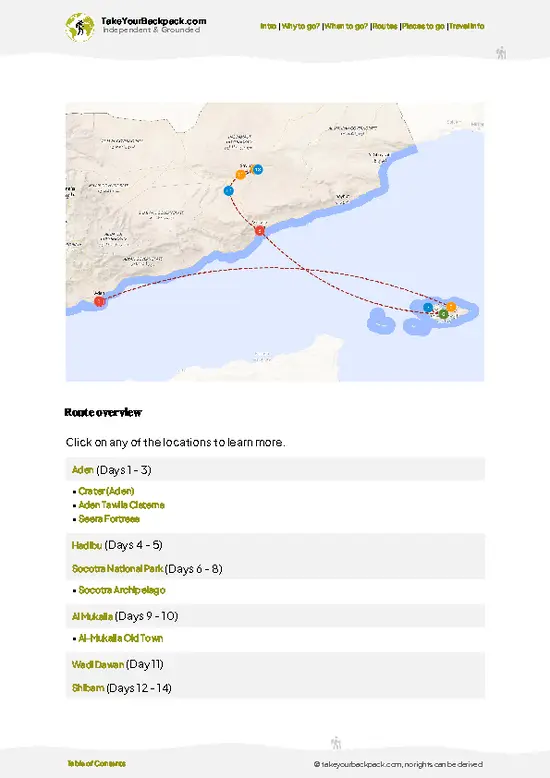
- Al-Qahira Castle (Citadel of Ta’izz) — The city’s skyline piece: a hilltop fortress with old ramparts, spectacular views over Ta’izz and the surrounding terraces, and a real sense of the city’s strategic past.
- Jabal Saber and the Saber Fortress — A short climb up this nearby mountain rewards you with sweeping panoramas, terraced farms and the ruins of small fortifications—great for easy hikes and seeing how people have lived on these slopes for centuries.
- Al-Mudhaffar Mosque — One of Ta’izz’s main historic mosques and a focal point of local religious life; the architecture and the adjacent cemetery/mausoleum areas give a direct human link to the city’s medieval past.
- Ta’izz Regional Museum — Small but useful: artifacts, traditional costumes, and local archaeology that put the highlands’
- Al-Qahira Castle (Citadel of Ta’izz) — The city’s skyline piece: a hilltop fortress with old ramparts, spectacular views over Ta’izz and the surrounding terraces, and a real sense of the city’s strategic past.
- Jabal Saber and the Saber Fortress — A short climb up this nearby mountain rewards you with sweeping panoramas, terraced farms and the ruins of small fortifications—great for easy hikes and seeing how people have lived on these slopes for centuries.
- Al-Mudhaffar Mosque — One of Ta’izz’s main historic mosques and a focal point of local religious life; the architecture and the adjacent cemetery/mausoleum areas give a direct human link to the city’s medieval past.
- Ta’izz Regional Museum — Small but useful: artifacts, traditional costumes, and local archaeology that put the highlands’ history into context—good if you want background before wandering the old streets.
- Ta’izz Old City (Al-Balad) — The maze of narrow alleys, tall stone houses with carved wooden balconies and qamariya (stained-glass) windows—this is where the city’s daily life, architecture and old-world atmosphere still hang together.
- Main Souk / Markets — The central bazaars sell spices, textiles, copperware and the everyday goods that locals rely on; it’s noisy, colorful, and the best place to watch (and join) urban commerce in action.
- Qat Benches & Traditional Coffeehouses — Not a single landmark but a living cultural institution: spending time at a qat circle or a coffeehouse is the quickest way to understand social life here—talks, tea, bargaining and local stories.
- Craftsmen’s Alleys (silversmiths, weavers, brass-workers) — Around the old souk you’ll find working workshops where artisans still hammer, weave and solder in public—great for photos, learning techniques and picking up authentic handicrafts.
- Ta’izz University Quarter — The student neighborhoods have a younger, more energetic side of the city: bookshops, inexpensive cafes, street art and a good pulse of contemporary Yemeni culture.
- Rooftop Terraces & Viewpoints — Scattered across the old city are low-key rooftop cafés and vantage points where residents gather at sunset; they’re perfect for quiet observation, skyline photos and watching city life below.
Spotted a mistake or missing something? Contact us.

 Best Backpacking
.jpg) Hi, I’m Johan (Netherlands 🇳🇱), the creator of TakeYourBackpack. Over the past 3 decades, I’ve backpacked through 90+ countries across six continents, gaining extensive experience with independent travel, long-term trips, and overland routes.
Hi, I’m Johan (Netherlands 🇳🇱), the creator of TakeYourBackpack. Over the past 3 decades, I’ve backpacked through 90+ countries across six continents, gaining extensive experience with independent travel, long-term trips, and overland routes.