×

Yemen🇾🇪 | best citiesBest 10 cities in Yemen

Cities in Yemen are not a casual add-on to a regional loop. They are the reason to come, and they fall into four distinct types. The highland cities sit above 2,000 m, with cool nights, tall mud-brick and stone architecture, and the densest historic fabric. The Red Sea coast is hot, humid and rough around the edges. The southern port cities have a looser, more cosmopolitan feel. The Hadramawt valley offers desert mud-brick towns and quiet streets. Independent backpacking is close to impossible. Access depends on the front lines, permits and a local fixer, so costs run well above regional norms. Skip any plan built around spontaneity. Back the highlands for architecture and Hadramawt for calm.

By Johan Kruseman 🇳🇱 | Updated October 19, 2026
Explore the best towns in Yemen

Why go?Why Travelers Love These Spots

Yemen’s cities exist because of geography. Mountains catch the monsoon, so the highlands could grow grain, coffee and qat. That supported walled settlements that stayed put for centuries. Frankincense and Indian Ocean trade left merchant ports and caravan towns on the coast and inland. The result is the Arabian Peninsula’s most distinctive vernacular architecture: multi-story towers of stone, baked brick and mud, with carved plaster windows. Several old centers are on the UNESCO World Heritage list, and some are also on the List in Danger.

Here is what to know before choosing Yemen for its cities. Since the civil war began in 2014, the country has been split between rival authorities, and most governments advise against all travel. Infrastructure is damaged, power is patchy, ATMs and cards … read more 👉
Yemen’s cities exist because of geography. Mountains catch the monsoon, so the highlands could grow grain, coffee and qat. That supported walled settlements that stayed put for centuries. Frankincense and Indian Ocean trade left merchant ports and caravan towns on the coast and inland. The result is the Arabian Peninsula’s most distinctive vernacular architecture: multi-story towers of stone, baked brick and mud, with carved plaster windows. Several old centers are on the UNESCO World Heritage list, and some are also on the List in Danger.

Here is what to know before choosing Yemen for its cities. Since the civil war began in 2014, the country has been split between rival authorities, and most governments advise against all travel. Infrastructure is damaged, power is patchy, ATMs and cards are mostly useless, and the rial trades at very different rates depending on who controls the area. Do not expect hostels, public transport or walk-in sightseeing. Visits are arranged through a licensed operator with the right permits, a driver and a guide, and checkpoints are a fact of any road journey.

The cities are not worth the effort for anyone who wants easy logistics or nightlife. They are worth it for travelers who value architecture and living history above comfort, and who can tolerate uncertainty and sudden changes of plan.
How the List Was Created
The list of best cities in Yemen is created based on culture, vibe, attractions, transport ease, and local charm. If you feel a city is missing in this list, please let us know.

When to go?Timing Your Visit for the Best Experience

Best months for Yemen’s cities: The best months are October to March, when highland days run about 18 to 26°C, rain is rare, and the coast drops to a tolerable 25 to 32°C. Outside that window, the weather works against you.
Highlands: The high plateau has two wet spells. A short one falls around March to April, and the main monsoon falls around July to September, with afternoon downpours that can flood roads and delay drives. Winter nights get cold, often 0 to 8°C, so pack a proper jacket. May and October are good shoulder months here, with clear skies and mild days.
Coast and desert: The Red Sea and Gulf of Aden coasts are miserable from June to September, with 38 to 45°C heat and humidity that makes midday walking pointless. The Hadramawt interior is similar, dry but regularly above 40°C in … read more 👉
Best months for Yemen’s cities: The best months are October to March, when highland days run about 18 to 26°C, rain is rare, and the coast drops to a tolerable 25 to 32°C. Outside that window, the weather works against you.
Highlands: The high plateau has two wet spells. A short one falls around March to April, and the main monsoon falls around July to September, with afternoon downpours that can flood roads and delay drives. Winter nights get cold, often 0 to 8°C, so pack a proper jacket. May and October are good shoulder months here, with clear skies and mild days.
Coast and desert: The Red Sea and Gulf of Aden coasts are miserable from June to September, with 38 to 45°C heat and humidity that makes midday walking pointless. The Hadramawt interior is similar, dry but regularly above 40°C in summer, and pleasant from November to February. Do not schedule coastal stops in summer for any reason.
Holidays and prices: Yemen has no tourist crowds, so peak season is not a concern. Ramadan is the calendar item that matters. Daytime restaurants close, working hours shrink, and permits and fixers take longer to arrange. The two Eid holidays shut government offices for several days, so avoid them for anything needing paperwork. Operator rates change little by season, so book for weather and paperwork rather than price.

city hoppingHow to Combine cities Into One Trip

How many days to plan: A trip combining several cities in Yemen needs 10 to 14 days, and that includes buffer time for permits, checkpoints and weather. Anything shorter turns into a car-seat marathon.
Which regions go together: Cluster by control zone first and geography second. The highland north and the Tihama coast below it sit together, as do the south coast and the Hadramawt valley. Crossing between these zones means front-line detours, extra permits and sometimes a flight instead of a road, so most trips pick one side. Travel from the highlands down toward the coast, or from the south coast inland, so the longest and hottest drives come when you are freshest.
Time per stop and between regions: Allow 2 to 3 nights in a main city. One night is a wasted drive, and more than three is rarely … read more 👉
How many days to plan: A trip combining several cities in Yemen needs 10 to 14 days, and that includes buffer time for permits, checkpoints and weather. Anything shorter turns into a car-seat marathon.
Which regions go together: Cluster by control zone first and geography second. The highland north and the Tihama coast below it sit together, as do the south coast and the Hadramawt valley. Crossing between these zones means front-line detours, extra permits and sometimes a flight instead of a road, so most trips pick one side. Travel from the highlands down toward the coast, or from the south coast inland, so the longest and hottest drives come when you are freshest.
Time per stop and between regions: Allow 2 to 3 nights in a main city. One night is a wasted drive, and more than three is rarely needed for a city center. Highland to coast drives take roughly 4 to 6 hours. South coast to Hadramawt takes 10 to 14 hours, usually split with an overnight. Count on checkpoints adding 1 to 3 hours per day, and travel only in daylight.
Planning mistakes: The biggest is trying to cover both halves of the country in one trip. Pick one half. The second is a tight schedule with no spare day, since a closed checkpoint or a sudden permit change can stall you. Build one empty day into every five. The third is booking onward flights before permits are confirmed. Hold them until the paperwork is final.

The ListThe Best cities of Yemen

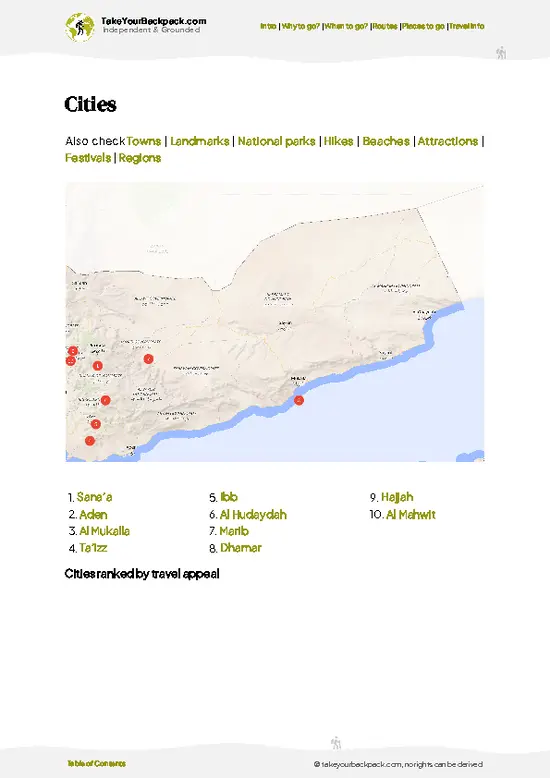
1 Sana’a

tower houses, UNESCO old city, souq labyrinth

Wander through narrow lanes lined with decorated buildings, discovering intricate woodwork and the daily rhythm of Yemen’s capital.

2 Aden

crater district, port views, volcanic peninsula

Trace the city’s layered history through seaside neighborhoods, British-era relics, and the stark landscape shaped by ancient volcanic activity.

3 Al Mukalla

whitewashed facades, Indian Ocean, cliffside roads

Navigate winding streets between sea and cliffs, observing the blend of Hadhrami architecture and the rhythms of a working port.

4 Ta’izz

mountain backdrop, mosques, qat markets

Climb winding streets beneath Jabal Sabir, encountering lively commerce, religious landmarks, and a distinct highland atmosphere.

5 Ibb

green hills, rain-fed valleys, Ottoman relics

Experience a region where abundant rainfall supports lush landscapes and historic buildings from Yemen’s Ottoman past.

6 Al Hudaydah

Red Sea coast, fishing harbors, bustling markets

Experience the pulse of daily life along the waterfront, where fishermen unload catches and narrow alleys fill with the scent of fresh bread.

7 Marib

ancient ruins, desert outskirts, dam site

Survey archaeological remains and modern expansion at the edge of the desert, where the legacy of the Sabaean kingdom still shapes the landscape.

8 Dhamar

volcanic plateau, archaeological sites, livestock market

Explore a town surrounded by ancient ruins and active markets, set on a plateau shaped by volcanic history.

9 Hajjah

mountain ridges, terraced fields, hilltop villages

Ascend steep roads to remote settlements, where panoramic views and agricultural terraces reveal the region’s adaptation to rugged terrain.

10 Al Mahwit

misty highlands, stone houses, qat farms

Travel through cool uplands dotted with traditional homes and fields of qat, where mountain air shapes daily routines.

Loading the map 🌍

Expert viewTips and Advice from Travelers

How many cities to visit: Plan on three or four cities, drawn from one region. Each one needs a permit, a guide-escort arrangement and half a day lost to checkpoints, so adding a fifth buys almost nothing and costs a day of driving. Anything under three barely justifies the visa and logistics effort.
Which kind to prioritize: For architecture and photography, put the highland cities first. They are the densest and best preserved, and the cool climate suits walking. For quiet and desert scenery, choose Hadramawt, where towns are calmer and the drives are long but flat. For port history, pick one southern coastal stop and keep it short. The Red Sea coast is the one to skip for most travelers, since the heat is heavy and the old fabric is thin compared with the highlands.
What it costs: Independent … read more 👉
How many cities to visit: Plan on three or four cities, drawn from one region. Each one needs a permit, a guide-escort arrangement and half a day lost to checkpoints, so adding a fifth buys almost nothing and costs a day of driving. Anything under three barely justifies the visa and logistics effort.
Which kind to prioritize: For architecture and photography, put the highland cities first. They are the densest and best preserved, and the cool climate suits walking. For quiet and desert scenery, choose Hadramawt, where towns are calmer and the drives are long but flat. For port history, pick one southern coastal stop and keep it short. The Red Sea coast is the one to skip for most travelers, since the heat is heavy and the old fabric is thin compared with the highlands.
What it costs: Independent budgeting does not work here. A licensed operator typically charges US$100 to 200 a day per person, covering a driver, vehicle, guide, permits and lodging in guesthouses. A group of three or four brings the rate to the low end. Entry fees to museums and old forts are small, around US$2 to 10 each, but guides and security escorts are a fixed daily line in the quote. Fuel shortages can add surcharges. Budget a further US$10 to 20 a day for meals, which are cheap and filling. Carry clean US dollar bills, since cards fail and rial rates differ by zone. Confirm in writing what the daily rate covers, or surprise charges for escort, permit amendments and vehicle changes will appear.
Delays that catch people out: Permit processing can run 2 to 6 weeks, so apply early and do not buy nonrefundable flights beforehand. Checkpoints can hold you for an hour or more and sometimes turn you back, so never plan a same-day connection. Power cuts and weak internet are routine, so download maps and keep a power bank charged.
Safety and cultural rules: Most governments advise against all travel to Yemen, and standard travel insurance usually excludes it. Arrange specialist cover that includes medical evacuation before you go, and share your route with your embassy if it has a registration system. Never leave the approved route, and follow your escort’s decisions on timing without argument. Do not photograph military sites, checkpoints or soldiers. Ask before photographing people, and avoid women altogether. Dress modestly: long sleeves and trousers for everyone, and a headscarf for women in most areas. Alcohol is not available, and public displays of affection are out. Afternoon qat sessions are a major social ritual, and joining one briefly is a polite way to connect with hosts. During prayer times and on Fridays, many shops close, so plan around them.

✈️ The backpacker research shortcutYemen Travel Guide

An offline-friendly backpacking guide with optimized travel routes, ranked highlights, transport advice, and the best areas to stay.
example page 0 from our offline Travel Guide for Yemen
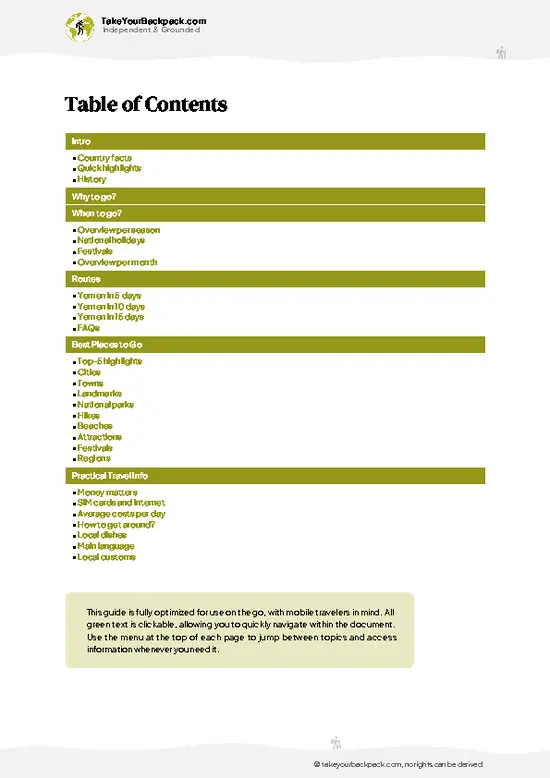
example page 1 from our offline Travel Guide for Yemen
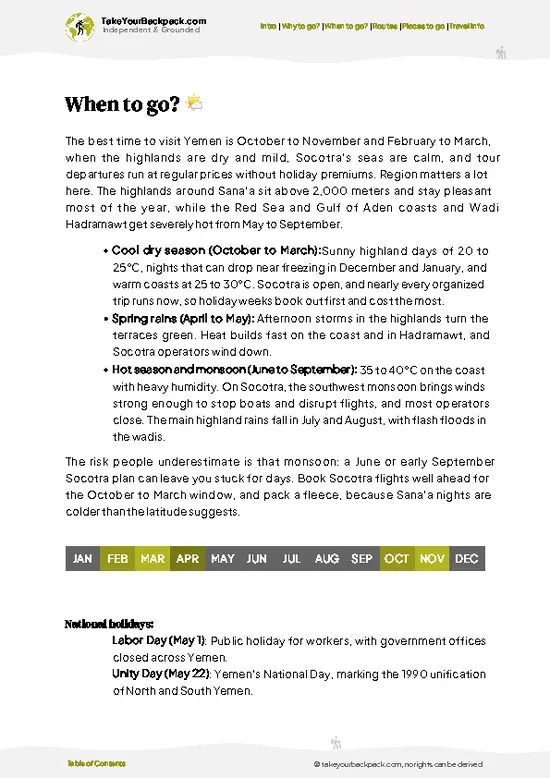
example page 2 from our offline Travel Guide for Yemen
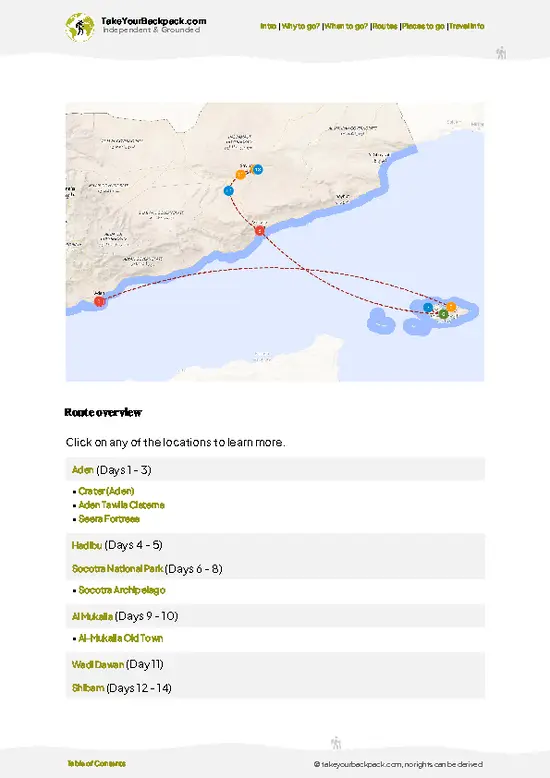
example page 3 from our offline Travel Guide for Yemen
example page 4 from our offline Travel Guide for Yemen
example page 5 from our offline Travel Guide for Yemen
example page 6 from our offline Travel Guide for Yemen
example page 7 from our offline Travel Guide for Yemen
The digital guide (223 pages) contains:
✅ 54 highlights, ranked by travel appeal
✅ Optimized 5, 10 & 15-day travel routes
✅ Cities, national parks, landmarks, beaches
✅ How to get around
✅ Offline-friendly for travel without Wi-Fi
👉 Click to see all 30+ guide features

📅 Plan smarter in minutes, not weeks
✅ Month by month travel advice
✅ Festivals & national holidays
✅ Budget expectations

🗺️ Go to the right places, skip the overrated ones
✅ Honest pros & cons of destinations
✅ Top hikes, parks & viewpoints
✅ Lesser-known places most travelers miss
✅ Clear “worth it vs skip it” guidance

🛏️ Travel smoothly without rookie mistakes
✅ Best areas to stay
✅ Transport systems explained simply
✅ Common scams & safety advice
✅ SIM cards, money & practical tips

🌍 Understand the country, not just visit it
✅ Culture & traditions
✅ 52 Essential phrases & customs
✅ Festivals worth planning around
✅ Traveler-friendly historical context
✅ Insights that make places more meaningful

📱 Built for real travel conditions
✅ Fully downloadable PDF
✅ Works completely offline
✅ Optimized for phone use
✅ Useful in remote areas & buses
✅ Everything in one place
Stop searching, start planning
Get instant access to your full guide. 30‑day money-back guarantee.
+ Add another guide for just

By proceeding you agree to our terms.
Sent to your inbox immediately after payment • 100% Secure Checkout
Best Backpacking Travel Advisor 2025 tourism awardBest Backpacking
Travel Advisor
2025
What others say about Take Your Backpack Guides:
⭐⭐⭐⭐⭐
Fantastic, amazing amount of information!
⭐⭐⭐⭐⭐
My goodness this is amazing, it's what I've been looking for hats off too you!
⭐⭐⭐⭐⭐
I think this is absolutely BRILLIANT
⭐⭐⭐⭐
Very complete and informative. It's still missing places, but I gotta to commend you
⭐⭐⭐⭐⭐
This is truly amazing, thank you, can't wait to explore it with my kids!
⭐⭐⭐⭐⭐
Awesome resource, thank you!
⭐⭐⭐⭐⭐
This is amazing! Can't wait to explore the ones I haven't seen
⭐⭐⭐⭐
I love this! Well done, great idea.
⭐⭐⭐⭐⭐
Thanks for taking the time to make this gem!
⭐⭐⭐⭐⭐
This might be the best website I've ever seen.
⭐⭐⭐⭐⭐
Congratulations, and thank you so much for your work; it's incredibly valuable.
⭐⭐⭐⭐
In all seriousness I think you did a great job pointing out the important spots
⭐⭐⭐⭐⭐
10/10 very good
⭐⭐⭐⭐⭐
As someone who's only just starting to visit regularly this is awesome, thank you.
⭐⭐⭐⭐
Thank you very much! I'm going to visit my dad, it's going to be very useful!
⭐⭐⭐⭐⭐
This is really cool! We'll be travelling for the first time and this definitely come in handy.
⭐⭐⭐⭐⭐
You are now our minister of culture, congratulations 👨‍💼
⭐⭐⭐⭐⭐
Just wanted to tell you that this is a pearl! Going to follow your recommendations.
⭐⭐⭐⭐⭐
This is so cool. I'll definitely be using the resource for my travels soon.
⭐⭐⭐⭐⭐
This is very impressive! Good work.
⭐⭐⭐⭐⭐
This is an amazing and informative site. Very well done!

🛏️ Where to stay?Best Stay Options in Yemen

Yemen has no backpacker hostel scene, so budget travel here means simple local hotels and guesthouses (roughly US$20 to 50 a night for a private room) plus tour-run campsites on Socotra, where most beds sit in Hadibu, the island’s small, quiet main town and the practical base for day trips to the beaches and plateaus. In Aden, Crater puts you among the old markets and the cheapest rooms but feels cramped and noisy, while Khormaksar is calmer, closer to the airport and the seafront, and has the newer, pricier hotels. Further east, Mukalla has the widest spread of mid-range rooms along its seafront corniche, and Seiyun is the best-equipped stop in Hadramawt for reaching Shibam and Tarim, though … read more 👉
Yemen has no backpacker hostel scene, so budget travel here means simple local hotels and guesthouses (roughly US$20 to 50 a night for a private room) plus tour-run campsites on Socotra, where most beds sit in Hadibu, the island’s small, quiet main town and the practical base for day trips to the beaches and plateaus. In Aden, Crater puts you among the old markets and the cheapest rooms but feels cramped and noisy, while Khormaksar is calmer, closer to the airport and the seafront, and has the newer, pricier hotels. Further east, Mukalla has the widest spread of mid-range rooms along its seafront corniche, and Seiyun is the best-equipped stop in Hadramawt for reaching Shibam and Tarim, though nightlife anywhere in the country is limited to evening tea and seafront strolls.

If you enjoy meeting fellow travelers, consider choosing hostels with high ratings for atmosphere. On the other hand, if you prefer having your own space, a hotel might be a better option.

YemenWhere to Go Next

👋 Meet the founderWho’s Behind Take Your Backpack?

Johan, backpacker and founder of TakeYourBackpackHi, I’m Johan (Netherlands 🇳🇱), the creator of TakeYourBackpack. Over the past 3 decades, I’ve backpacked through 90+ countries across six continents, gaining extensive experience with independent travel, long-term trips, and overland routes.

This site is built on a combination of firsthand travel experience and carefully curated insights from other backpackers. Many guides are based on places I’ve personally visited, while others bring together tips, observations, and practical advice shared by trusted travelers I’ve met along the way.

The goal is to provide realistic, experience-driven guidance — not generic itineraries — so you can explore destinations with better context, clearer expectations, and more confidence.