×

Zambia🇿🇲 | national parksLower Zambezi National ParkCanoe safaris, riverside elephants, walking guides, tigerfishing | things to do and best time to go

Explore Lochinvar National ParkExplore Mosi-oa-Tunya National Park

Backpacking in Lower Zambezi
🏆 Top picknational park ranked #2
By Johan Kruseman 🇳🇱 | Updated October 22, 2026

Walking with a licensed guide is allowed here, which is a rare perk in a park this wild, so you can trade the jeep for your own boots. Lower Zambezi National Park sits in the southeast of Zambia, on the north bank of the Zambezi River, opposite Mana Pools in Zimbabwe, with the Zambezi Escarpment rising behind it. Expect elephants wading between islands, hippos grunting at dusk, lions on the floodplain and buffalo herds in the open. The scenery is river, riverine forest and mopane woodland. The catch for backpackers: no independent walking, a rough final stretch of road, and a pricey bill if you book last minute. Avoid surprises by fixing your guide, transfer and camp in advance, and by carrying cash for small extras. Crowds stay thin, and the mood is quiet and wild. Adventurers with a tolerance for planning will love it; anyone wanting cheap, spontaneous, self-drive wandering will not.

Discover everything you want to know in the 📖 Zambia Travel Guide.


example page 0 from our offline Travel Guide for Zambia
example page 1 from our offline Travel Guide for Zambia
example page 2 from our offline Travel Guide for Zambia
example page 3 from our offline Travel Guide for Zambia
example page 4 from our offline Travel Guide for Zambia
example page 5 from our offline Travel Guide for Zambia
example page 6 from our offline Travel Guide for Zambia
example page 7 from our offline Travel Guide for Zambia
Loading the map 🌍
CLICK TO FILTER
cities
towns
landmarks
national parks
hikes
beaches
attractions
festivals
regions
SHOW COUNTRY’S BESTSHOW ALL

✨ Why go?
Ranked #2 national park in Zambia
What makes it a must-see national park

Lower Zambezi National Park rewards travelers who want wildlife without the minibus crowds of bigger parks. Camps are spread along the river and the park holds relatively few visitors, so a sighting of elephants crossing a channel can be yours alone. That intimacy is the main draw.

Then there is the way you explore. Beyond game drives, you can paddle a canoe safari on the Zambezi past hippo pods and crocodiles, or take a guided bush walk among tracks and dung that a vehicle would zoom past. Fishing for tigerfish is another reason people come, and the river itself is the park’s main road.

Budget campers have options too. Basic riverside campsites outside the park gates let you bring your own food and pay only for activities, which keeps costs lower than the fly-in lodges. It is not a park … read more 👉
Lower Zambezi National Park rewards travelers who want wildlife without the minibus crowds of bigger parks. Camps are spread along the river and the park holds relatively few visitors, so a sighting of elephants crossing a channel can be yours alone. That intimacy is the main draw.

Then there is the way you explore. Beyond game drives, you can paddle a canoe safari on the Zambezi past hippo pods and crocodiles, or take a guided bush walk among tracks and dung that a vehicle would zoom past. Fishing for tigerfish is another reason people come, and the river itself is the park’s main road.

Budget campers have options too. Basic riverside campsites outside the park gates let you bring your own food and pay only for activities, which keeps costs lower than the fly-in lodges. It is not a park for fully independent wandering, because guides are required on foot, but the guided formats are the best way to read animal behavior up close. Pick it for river drama and quiet.

💡 HighlightsEssential experiences to have while exploring Lower Zambezi

  1. Canoe safari on the Zambezi: Paddling the braided channels is what the park is best known for. You drift past hippos, elephants swimming between islands and fish eagles on the banks, at a pace that keeps the animals relaxed.
  2. Elephants on the floodplain: Large herds feed along the riverbank, especially in the dry months. Watching them cross water is a signature scene.
  3. Guided walking safaris: On foot with an armed guide, you learn tracks, termite mounds and tree species. The tension of a close buffalo or elephant encounter is intense.
  4. Tigerfishing: Strong, toothy and fast, the tigerfish is a prized catch on catch-and-release trips from the river’s edge.
  5. Sunset river cruises: A slow boat ride gives you hippo pods, crocodiles on sandbars and carmine bee-eaters nesting in the banks in season, as the
… read more 👉
  1. Canoe safari on the Zambezi: Paddling the braided channels is what the park is best known for. You drift past hippos, elephants swimming between islands and fish eagles on the banks, at a pace that keeps the animals relaxed.
  2. Elephants on the floodplain: Large herds feed along the riverbank, especially in the dry months. Watching them cross water is a signature scene.
  3. Guided walking safaris: On foot with an armed guide, you learn tracks, termite mounds and tree species. The tension of a close buffalo or elephant encounter is intense.
  4. Tigerfishing: Strong, toothy and fast, the tigerfish is a prized catch on catch-and-release trips from the river’s edge.
  5. Sunset river cruises: A slow boat ride gives you hippo pods, crocodiles on sandbars and carmine bee-eaters nesting in the banks in season, as the light fades over Mana Pools opposite.
  6. Night drives: Allowed in this park, these reveal leopards, civets, genets and hyenas that disappear by day.
  7. Riverine forest and mopane woodland drives: Inland tracks cross ebony and winterthorn groves where lions, buffalo and eland roam, a change from the river scenery.
  8. Birdlife along the banks: Look for African skimmers, fish eagles, kingfishers and, in late dry season, nesting bee-eater colonies.
All of this fits comfortably into three full days in Lower Zambezi National Park, and most visitors stretch it to four to match the river’s rhythm.
Spotted a mistake or missing something? Contact us.

Things to do near Lower Zambezi National Park

Ratings based on Tripadvisor reviews. When you book through this link, you support our work at no extra cost to you.

🌤️ When to go?When to go for the best experience

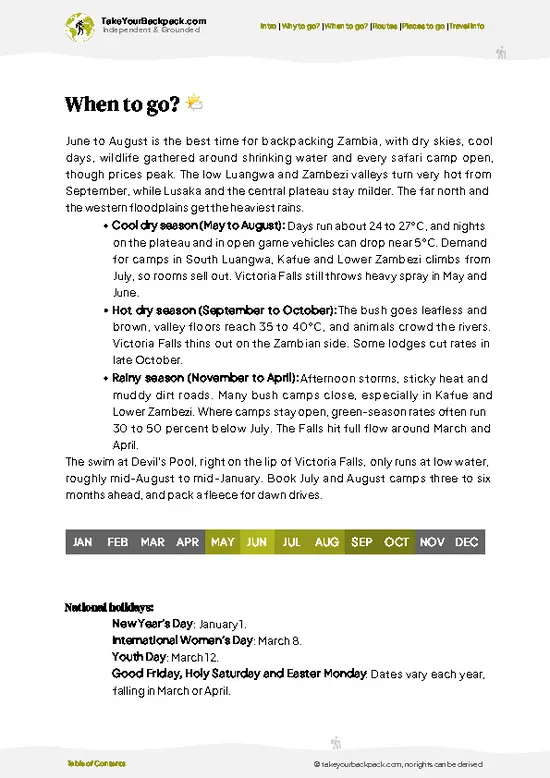
  • Cool Dry Season (May to August): Days reach 25 to 30°C (77 to 86°F) and nights fall to 10 to 15°C (50 to 59°F), so a fleece helps on early boat and canoe trips. Bush is open, game concentrates along the river, and the sun is up for about 11 hours.
  • Hot Dry Season (September to October): Peak wildlife viewing, with elephants and buffalo crowding the floodplain. Afternoons hit 35 to 40°C (95 to 104°F), and lodges charge their highest rates.
  • Early Rains (November to December): Storms break the heat, the park turns green, and birding improves with migrants arriving. Temperatures sit around 30 to 35°C (86 to 95°F). Some tracks turn slick.
  • Green Season (January to April): Heavy rain, humidity, and 28 to 33°C (82 to 91°F). Many camps close, roads can wash out, and rates drop sharply, sometimes by 30
… read more 👉
  • Cool Dry Season (May to August): Days reach 25 to 30°C (77 to 86°F) and nights fall to 10 to 15°C (50 to 59°F), so a fleece helps on early boat and canoe trips. Bush is open, game concentrates along the river, and the sun is up for about 11 hours.
  • Hot Dry Season (September to October): Peak wildlife viewing, with elephants and buffalo crowding the floodplain. Afternoons hit 35 to 40°C (95 to 104°F), and lodges charge their highest rates.
  • Early Rains (November to December): Storms break the heat, the park turns green, and birding improves with migrants arriving. Temperatures sit around 30 to 35°C (86 to 95°F). Some tracks turn slick.
  • Green Season (January to April): Heavy rain, humidity, and 28 to 33°C (82 to 91°F). Many camps close, roads can wash out, and rates drop sharply, sometimes by 30 to 50 percent for those that stay open.
Book June to August a few months ahead, or aim for late April and early May for green bush with lower prices.


source: climatestotravel.comJANJanuary: fair for travelingFEBFebruary: fair for travelingMARMarch: fair for travelingAPRApril: fair for travelingMAYMay: highly recommended for travelingJUNJune: excellent for travelingJULJuly: excellent for travelingAUGAugust: excellent for travelingSEPSeptember: excellent for travelingOCTOctober: highly recommended for travelingNOVNovember: fair for travelingDECDecember: fair for traveling
when-to-go

✈️ The backpacker research shortcutZambia Travel Guide

An offline-friendly backpacking guide with optimized travel routes, ranked highlights, transport advice, and the best areas to stay.
example page 0 from our offline Travel Guide for Zambia
example page 1 from our offline Travel Guide for Zambia
example page 2 from our offline Travel Guide for Zambia
example page 3 from our offline Travel Guide for Zambia
example page 4 from our offline Travel Guide for Zambia
example page 5 from our offline Travel Guide for Zambia
example page 6 from our offline Travel Guide for Zambia
example page 7 from our offline Travel Guide for Zambia
The digital guide (351 pages) contains:
✅ 89 highlights, ranked by travel appeal
✅ Optimized 5, 10 & 15-day travel routes
✅ Cities, national parks, landmarks, beaches
✅ How to get around
✅ Offline-friendly for travel without Wi-Fi
👉 Click to see all 30+ guide features

📅 Plan smarter in minutes, not weeks
✅ Month by month travel advice
✅ Festivals & national holidays
✅ Budget expectations

🗺️ Go to the right places, skip the overrated ones
✅ Honest pros & cons of destinations
✅ Top hikes, parks & viewpoints
✅ Lesser-known places most travelers miss
✅ Clear “worth it vs skip it” guidance

🛏️ Travel smoothly without rookie mistakes
✅ Best areas to stay
✅ Transport systems explained simply
✅ Common scams & safety advice
✅ SIM cards, money & practical tips

🌍 Understand the country, not just visit it
✅ Culture & traditions
✅ 52 Essential phrases & customs
✅ Festivals worth planning around
✅ Traveler-friendly historical context
✅ Insights that make places more meaningful

📱 Built for real travel conditions
✅ Fully downloadable PDF
✅ Works completely offline
✅ Optimized for phone use
✅ Useful in remote areas & buses
✅ Everything in one place
Stop searching, start planning
Get instant access to your full guide. 30‑day money-back guarantee.
+ Add another guide for just

By proceeding you agree to our terms.
Sent to your inbox immediately after payment • 100% Secure Checkout
Best Backpacking Travel Advisor 2025 tourism awardBest Backpacking
Travel Advisor
2025
What others say about Take Your Backpack Guides:
⭐⭐⭐⭐⭐
Fantastic, amazing amount of information!
⭐⭐⭐⭐⭐
My goodness this is amazing, it's what I've been looking for hats off too you!
⭐⭐⭐⭐⭐
I think this is absolutely BRILLIANT
⭐⭐⭐⭐
Very complete and informative. It's still missing places, but I gotta to commend you
⭐⭐⭐⭐⭐
This is truly amazing, thank you, can't wait to explore it with my kids!
⭐⭐⭐⭐⭐
Awesome resource, thank you!
⭐⭐⭐⭐⭐
This is amazing! Can't wait to explore the ones I haven't seen
⭐⭐⭐⭐
I love this! Well done, great idea.
⭐⭐⭐⭐⭐
Thanks for taking the time to make this gem!
⭐⭐⭐⭐⭐
This might be the best website I've ever seen.
⭐⭐⭐⭐⭐
Congratulations, and thank you so much for your work; it's incredibly valuable.
⭐⭐⭐⭐
In all seriousness I think you did a great job pointing out the important spots
⭐⭐⭐⭐⭐
10/10 very good
⭐⭐⭐⭐⭐
As someone who's only just starting to visit regularly this is awesome, thank you.
⭐⭐⭐⭐
Thank you very much! I'm going to visit my dad, it's going to be very useful!
⭐⭐⭐⭐⭐
This is really cool! We'll be travelling for the first time and this definitely come in handy.
⭐⭐⭐⭐⭐
You are now our minister of culture, congratulations 👨‍💼
⭐⭐⭐⭐⭐
Just wanted to tell you that this is a pearl! Going to follow your recommendations.
⭐⭐⭐⭐⭐
This is so cool. I'll definitely be using the resource for my travels soon.
⭐⭐⭐⭐⭐
This is very impressive! Good work.
⭐⭐⭐⭐⭐
This is an amazing and informative site. Very well done!

🛏️ Where to stay?Best areas to stay in Zambia

Most backpackers sleep just outside the park gate near Chongwe River, because inside the park nearly every bed is in a fly-in or high-end safari lodge costing US$300 to 1,000 or more per person per night. Budget options exist, but they are limited.
Inside the park, public campsites are few and basic, and you need your own vehicle, food, and water. Self-catering campers can use sites along the river for roughly US$20 to 40 per person per night, plus park fees.
Outside the park, the Chiawa and Kafue Gorge side holds a handful of riverside camps. Some offer campsites for US$10 to 25 and simple chalets … read more 👉
Most backpackers sleep just outside the park gate near Chongwe River, because inside the park nearly every bed is in a fly-in or high-end safari lodge costing US$300 to 1,000 or more per person per night. Budget options exist, but they are limited.
Inside the park, public campsites are few and basic, and you need your own vehicle, food, and water. Self-catering campers can use sites along the river for roughly US$20 to 40 per person per night, plus park fees.
Outside the park, the Chiawa and Kafue Gorge side holds a handful of riverside camps. Some offer campsites for US$10 to 25 and simple chalets from about US$60 to 120 a night, usually with a bar and meals on site. Several arrange canoe trips and game drives, which saves you from needing a vehicle.
The main base for supplies is Lusaka, about 3 to 4 hours by road from the gate area. Backpackers there stay in hostels for US$10 to 25 for a dorm bed, then arrange a transfer or shared lift. Stock up on food and cash in Lusaka, since shops near the park are scarce.

👛 Costs (as of 22 October 2026)Travel costs and budget guide for Lower Zambezi

Lower Zambezi National Park costs a backpacker about US$95 to 130 a day if you camp outside the gate and join a few activities. It is not a cheap park, because guided access and transport drive the bill.
CategoryBudget RangeLocal Reality
Park entranceUS$15 to 25Daily fee per foreign visitor, paid in kwacha or by card at the gate; vehicles cost extra, roughly US$5 to 15.
Accommodation (high season)US$15 to 40Campsites outside the park run US$10 to 25; basic chalets start near US$60. Park lodges are far above budget range.
Local transportUS$10 to 25Shared lifts or transfers from Lusaka are common; a private transfer is far higher, often US$100 to 200 each way for the vehicle.
Food and suppliesUS$15 to 25Buy groceries in Lusaka. Camp meals cost US$8 to 20 each.
ActivitiesUS$30 to 60Guided game drives,
… read more 👉
Lower Zambezi National Park costs a backpacker about US$95 to 130 a day if you camp outside the gate and join a few activities. It is not a cheap park, because guided access and transport drive the bill.
CategoryBudget RangeLocal Reality
Park entranceUS$15 to 25Daily fee per foreign visitor, paid in kwacha or by card at the gate; vehicles cost extra, roughly US$5 to 15.
Accommodation (high season)US$15 to 40Campsites outside the park run US$10 to 25; basic chalets start near US$60. Park lodges are far above budget range.
Local transportUS$10 to 25Shared lifts or transfers from Lusaka are common; a private transfer is far higher, often US$100 to 200 each way for the vehicle.
Food and suppliesUS$15 to 25Buy groceries in Lusaka. Camp meals cost US$8 to 20 each.
ActivitiesUS$30 to 60Guided game drives, canoe trips, or boat cruises usually run US$40 to 100 a person; budget for one every few days.
Total Daily BudgetUS$95 to 130Lower end assumes camping and cooking your own food.


source: zambiatourism.com
⚠️ Prices can change and everyone travels differently, so take this as a rough guide. Hope it helps you plan your adventure!

🥾 TrailsBest hikes in Lower Zambezi national park

Lower Zambezi National Park limits independent walking, so every hike here is led by a licensed guide, usually with an armed ranger. Terrain runs from flat river floodplain and sandy islands to dense riverine forest and mopane woodland, with the escarpment hills forming the backdrop. Named, signposted trails do not exist, so these are the walks people actually do:
  • Riverbank morning walk: Starts at camp or a boat drop, 2 to 3 hours, easy, flat sand and grass. Passes hippo trails, waterbuck and elephant tracks, with plenty of birds.
  • Woodland and floodplain walk: About 3 hours, easy to moderate. Crosses
… read more 👉
Lower Zambezi National Park limits independent walking, so every hike here is led by a licensed guide, usually with an armed ranger. Terrain runs from flat river floodplain and sandy islands to dense riverine forest and mopane woodland, with the escarpment hills forming the backdrop. Named, signposted trails do not exist, so these are the walks people actually do:
  • Riverbank morning walk: Starts at camp or a boat drop, 2 to 3 hours, easy, flat sand and grass. Passes hippo trails, waterbuck and elephant tracks, with plenty of birds.
  • Woodland and floodplain walk: About 3 hours, easy to moderate. Crosses mopane and winterthorn groves where you read tracks, dung and termite mounds, and may meet buffalo or lion sign.
  • Sunset bush walk: 1 to 2 hours, easy. Short loops near camp ending with a drink as the sky changes.
  • Fly camp walking trips: Multi-day, moderate, with simple tented camps arranged by operators. Distances stay modest, usually 6 to 10 kilometers a day, in heat that can be intense.
Wildlife is the main event: elephants, buffalo, hippos, crocodiles, lions, leopards, hyenas and many antelope. Stay close to your guide and obey instructions without argument.

Getting there is the practical hurdle. There is no public transport to the gates, so most visitors arrive by road transfer, self-drive with a 4x4 on a rough final stretch, or by light aircraft to an airstrip. Entry requires a park fee payable at the gate, and it is higher for non-residents. Crowds stay small, as lodges cap numbers, and the cooler dry months bring the most visitors.
⚠️ Hiking info can sometimes be outdated or inaccurate. Before you hit the trail, check the latest conditions with locals. If you do spot anything that's off, I'd love to hear from you, so I can update it for fellow travelers.

🛡️ SafetyTraveler Safety Guide

Lower Zambezi is straightforward if you accept that the animals are the main hazard. Elephants, hippos, buffalo, and lions move through camps and along the river, so never walk after dark without a guide or torch, and keep a good distance from any elephant, especially with calves. Hippos graze on land at night and kill more people than most big animals, so stay clear of the water’s edge near dusk and never stand between a hippo and the river. Crocodiles are present in the Zambezi, so do not swim.
Walking safaris and canoe trips should be done with licensed guides, who read the animals’ behavior better than you can. Heat is the other issue, with afternoons above 35°C (95°F) in October, so carry at least 3 liters of water, wear a hat, and rest at midday. Malaria is present year-round, so take … read more 👉
Lower Zambezi is straightforward if you accept that the animals are the main hazard. Elephants, hippos, buffalo, and lions move through camps and along the river, so never walk after dark without a guide or torch, and keep a good distance from any elephant, especially with calves. Hippos graze on land at night and kill more people than most big animals, so stay clear of the water’s edge near dusk and never stand between a hippo and the river. Crocodiles are present in the Zambezi, so do not swim.
Walking safaris and canoe trips should be done with licensed guides, who read the animals’ behavior better than you can. Heat is the other issue, with afternoons above 35°C (95°F) in October, so carry at least 3 liters of water, wear a hat, and rest at midday. Malaria is present year-round, so take prophylaxis advised by a travel clinic, use repellent, and sleep under a net. Mobile signal is patchy, and tracks can be rough in the rains, so tell your camp where you are going.

FAQTraveler FAQ

Three to four days works best for Lower Zambezi National Park, which gives you time for a game drive, a canoe trip, and a boat cruise without rushing. Add a day each way if you are coming overland from Lusaka, a drive of about 3 to 4 hours to the gate area. Two days is enough for a short fly-in or a single activity. Budget travelers often stay five days to spread costs.
Lower Zambezi National Park is hard to explore without a car, but possible with planning. Shared lifts and transfers run from Lusaka to camps near the gate area, a trip of roughly 3 to 4 hours, and many lodges include game drives and canoe trips so you never need your own vehicle. Inside the park, tracks are sandy and rough, so a high-clearance 4x4 is needed if you self-drive. Walking alone away from camp is not safe because of elephants and hippos.
Yes, Lower Zambezi National Park charges a daily entrance fee for foreigners, roughly US$15 to 25 per person, plus a vehicle fee of around US$5 to 15. You pay at the gate or through your lodge, and there is no separate hiking permit because walking is done with licensed guides. Camping inside the park costs an additional fee, typically US$20 to 40 per person per night. Carry your passport and some cash in case card machines fail.
⚠️ Things can change over time, so always validate details locally before you go.

Other Zambian national parks near Lower Zambezi

Explore more nearby:


💡 Not sure where to go next?
Create a personalized itinerary for Zambia including Lower Zambezi and the places that fit your trip.

Generate my itinerary

👉 Discover all national parks

Or checkout all Zambia has to offer (think cities, towns, villages, national parks, hikes, beaches, festivals)
Country photo of Zambia

We 💚 feedbackWhat to keep in mind

Give Lower Zambezi National Park three nights minimum. One night is spent on logistics and the rough road, the second finds your rhythm on the water, and the third is when elephants stop being a surprise and start being neighbors. Four nights lets you add a walk and a fishing morning. Bring binoculars and a hat, and book guided activities before you arrive.

✍️ Help improve this page!
The information on this page is based on in-depth research, insights shared by experienced travelers, and feedback from the local travel community in Zambia. While every effort is made to keep the information accurate and current, conditions can change — so if you spot anything incorrect or outdated, please get in touch.


🙋‍♂️ Give feedback

👋 Meet the founderWho’s Behind Take Your Backpack?

Johan, backpacker and founder of TakeYourBackpackHi, I’m Johan (Netherlands 🇳🇱), the creator of TakeYourBackpack. Over the past 3 decades, I’ve backpacked through 90+ countries across six continents, gaining extensive experience with independent travel, long-term trips, and overland routes.

This site is built on a combination of firsthand travel experience and carefully curated insights from other backpackers. Many guides are based on places I’ve personally visited, while others bring together tips, observations, and practical advice shared by trusted travelers I’ve met along the way.

The goal is to provide realistic, experience-driven guidance — not generic itineraries — so you can explore destinations with better context, clearer expectations, and more confidence.