×

Zambia🇿🇲 | best national parksTop-Rated 10 national parks in Zambia

Zambia’s national parks run wild, uncrowded and refreshingly unpolished. The country protects 20 of them, and they split into clear camps. South Luangwa and the Lower Zambezi pull walking-safari devotees into riverside bush camps. Livingstone’s waterfall zone offers easy access and a lively budget scene. The far north, with Kasanka and Bangweulu, rewards those who love spectacle and distance. Entry fees run US$15 to 40 a day for foreigners, but lodges and guides drive the real cost. Backpackers and independent travelers can self-drive, hitch a lodge transfer or join shared safaris. Roads decide everything, so pick your region, then pack.

By Johan Kruseman 🇳🇱 | Updated October 23, 2026
Explore the best hikes in Zambia

Why go?Why These national park Stand Out

Zambia protects roughly a third of its land, and that scale changes everything. About 20 national parks sit inside a belt of buffer zones called game management areas, so wildlife moves across big, unfenced landscapes instead of staying in tourist-sized islands. Add three major river systems (the Zambezi, the Luangwa and the Kafue) and a high plateau at 1,000 to 1,500 meters, and the country delivers dense animal concentrations with remarkably few other vehicles around.
The flip side is infrastructure. Zambia built its safari industry around small lodges and guided walking, not mass-market tourism, so roads inside parks are mostly dirt, services are thin, and distances are long. Many camps close from roughly November to April because rain turns tracks to mud, which is the single biggest fact … read more 👉
Zambia protects roughly a third of its land, and that scale changes everything. About 20 national parks sit inside a belt of buffer zones called game management areas, so wildlife moves across big, unfenced landscapes instead of staying in tourist-sized islands. Add three major river systems (the Zambezi, the Luangwa and the Kafue) and a high plateau at 1,000 to 1,500 meters, and the country delivers dense animal concentrations with remarkably few other vehicles around.
The flip side is infrastructure. Zambia built its safari industry around small lodges and guided walking, not mass-market tourism, so roads inside parks are mostly dirt, services are thin, and distances are long. Many camps close from roughly November to April because rain turns tracks to mud, which is the single biggest fact to plan around.
Before choosing Zambia, know that park fees are charged in US dollars and foreign visitors pay far more than residents. Lodges can run US$300 or more a night, yet public campsites and simple bush camps exist for travelers willing to self-drive or share transport. Card machines are unreliable far from towns, so carry cash. Malaria is present nationwide. Reward the effort with quiet: in many parks you can spend a full morning without seeing another vehicle, and walking with an armed ranger puts you at ground level with the bush.
Why These Made the Cut
The list of best national parks in Zambia is created based on landscapes, wildlife, adventure opportunities, facilities, and overall experience. If you feel a national park is missing in this list, please let us know.

When to go?Optimal Periods for Travel

Best months: May to October: The dry season from May to October is the best time for Zambia’s national parks because roads are passable and animals gather at shrinking water sources. Rain is almost nonexistent, skies stay clear and wildlife viewing sharpens as vegetation thins.
Peak and shoulder seasons: June to August is cool, with daytime highs of 24 to 28°C and nights dipping to 5 to 10°C, so bring a fleece for dawn drives. September and October turn hot, 32 to 40°C in the Luangwa and Zambezi valleys, but game viewing peaks and lodge rates often stay below the July to August level. Peak rates can run 30 to 50 percent above shoulder prices at popular lodges, so book months ahead. May and November are shoulder months: fewer visitors, lower prices, and green landscapes arriving or fading.
The … read more 👉
Best months: May to October: The dry season from May to October is the best time for Zambia’s national parks because roads are passable and animals gather at shrinking water sources. Rain is almost nonexistent, skies stay clear and wildlife viewing sharpens as vegetation thins.
Peak and shoulder seasons: June to August is cool, with daytime highs of 24 to 28°C and nights dipping to 5 to 10°C, so bring a fleece for dawn drives. September and October turn hot, 32 to 40°C in the Luangwa and Zambezi valleys, but game viewing peaks and lodge rates often stay below the July to August level. Peak rates can run 30 to 50 percent above shoulder prices at popular lodges, so book months ahead. May and November are shoulder months: fewer visitors, lower prices, and green landscapes arriving or fading.
The rains: November to April: The green season brings 700 to 1,400 mm of rain depending on region, heaviest in the north and lowest in the south. Many bush camps in the Luangwa and Kafue regions close, and unpaved roads become impassable. Birding and lush scenery improve, and prices drop sharply, but access shrinks. The Victoria Falls area stays open all year, and the falls themselves peak in volume around March to May.

national park hoppingOptimizing Your Multi-Stop Itinerary

How long to allow: A trip combining several national parks in Zambia needs 10 to 16 days to avoid constant travel. Zambia is large and roads are slow, so ambition costs you time.
Which regions pair well: Group by geography. The southern cluster around Livingstone connects with the Lower Zambezi and Lusaka by paved road. The eastern cluster centers on Mfuwe and its airstrip. The west and north sit far apart and suit a separate trip. Start in Livingstone, travel to Lusaka (about 7 to 8 hours by road or a 1 hour 15 minute flight), then head east to Chipata (roughly 7 hours from Lusaka, plus 2 to 3 hours to Mfuwe). Going this direction puts your longest drive early, when you are fresh, and finishes at a quieter pace.
Time per stop: Give each bush destination 3 to 4 nights so you get several game … read more 👉
How long to allow: A trip combining several national parks in Zambia needs 10 to 16 days to avoid constant travel. Zambia is large and roads are slow, so ambition costs you time.
Which regions pair well: Group by geography. The southern cluster around Livingstone connects with the Lower Zambezi and Lusaka by paved road. The eastern cluster centers on Mfuwe and its airstrip. The west and north sit far apart and suit a separate trip. Start in Livingstone, travel to Lusaka (about 7 to 8 hours by road or a 1 hour 15 minute flight), then head east to Chipata (roughly 7 hours from Lusaka, plus 2 to 3 hours to Mfuwe). Going this direction puts your longest drive early, when you are fresh, and finishes at a quieter pace.
Time per stop: Give each bush destination 3 to 4 nights so you get several game drives and walks. One night is mostly spent driving. Travel between regions can take a full day, and sometimes 8 to 10 hours on rough tracks.
Common planning errors: Travelers often underestimate distances from map views. Instead, add 30 percent to estimated drive times. Others book three parks in a week and see only vehicle windows. Pick two regions and linger. Many also forget seasonal closures, so confirm camps are open before you fix dates. Short domestic flights save a day when budget allows.

The ListTop national parks of Zambia

1 South Luangwa National Park

Leopard country, walking safaris, hippo lagoons, carmine bee-eaters

Follow a scout on foot at dawn, then spotlight the riverine woodland after dark for leopards, genets and hyenas.

zambia-national-park-south-luangwa-national-park
© Google |

2 Lower Zambezi National Park

Canoe safaris, riverside elephants, walking guides, tigerfishing

Paddle braided channels past hippos and swimming elephants, then step ashore with an armed guide to read tracks.

3 Kafue National Park

Busanga Plains, Lufupa confluence, roan and sable, night drives

Cross a huge park of miombo and river, then watch lions work the Busanga grass at dusk while red lechwe scatter.

4 Liuwa Plain National Park

Wildebeest migration, hyena clans, Katoyana camp, sand tracks

Drive deep sand to a flat plain where wildebeest herds stream past your tent, with hyenas and lions trailing them.

5 Mosi-oa-Tunya National Park

Victoria Falls, Knife-Edge Bridge, Boiling Pot, rhino walks

Stand in the spray at the Knife-Edge Bridge, descend to the Boiling Pot, then follow the river upstream toward giraffe and rhino.

zambia-national-park-mosi-oa-tunya-national-park
© Google |

6 Kasanka National Park

Fruit bat migration, Fibwe Hide, sitatunga swamp, Wasa Lake

Time a visit for late October to early December, when millions of bats pour out at dusk above the swamp forest.

7 Sioma Ngwezi National Park

Kalahari sand tracks, elephant corridor, seasonal pans, Ngonye Falls

Ease a 4x4 along soft sand tracks to quiet pans, looking for roan and sable before cooling off at Ngonye Falls.

8 Lochinvar National Park

Pocket Lake, Gwisho hot springs, lechwe flats, ranger walks

Walk the floodplain with a ranger among thousands of lechwe, then soak in the warm springs after a dawn drive.

9 Nsumbu National Park

Lake Tanganyika beaches, cichlid snorkeling, Lufubu delta, shoreline elephants

Snorkel above colorful cichlids off a quiet beach, then take a boat to the Lufubu mouth for hippos and fish eagles.

zambia-national-park-nsumbu-national-park
© Google |

10 Blue Lagoon National Park

Kafue lechwe herds, wattled cranes, flooded grassland, scout-led wetland walks

Wade the edge of open floodplain with a scout, where lechwe crash through shallows and cranes feed under a wide empty sky.

zambia-national-park-blue-lagoon-national-park
© Google |

11 Lavushi Manda National Park

Lavushi Manda Hill, miombo ridges, wilderness camping, guided bush walks

Climb the park’s high hill for views over unbroken woodland, then camp under a dark sky with a local guide.

12 West Lunga National Park

Lunga River, sable and roan, dambo clearings, papyrus swamp

Scan dambo clearings and the papyrus-lined river for sable, roan and woodland birds, with camp nights free of any town glow.

13 Isangano National Park

Chambeshi floodplain, black lechwe, sitatunga reeds, village fishing

Scan a flat Chambeshi floodplain with a local guide for black lechwe and herons, while dugout canoes work the margins nearby.

Think you know Zambia?

Prove you’re a true local — uncover 3 lesser-known national parks in Zambia that locals tend to keep to themselves.
Loading the map 🌍

Expert viewExpert Commentary on national parks

How many parks to visit: Two is the number I advise for most backpackers, three at the absolute maximum. Zambia’s parks are huge, roads are slow, and entry fees are charged per day, so every extra park adds a long, costly transfer with little extra payoff. Two parks of different character, held for three to four nights each, give you time for several game drives and walks, and time to let the bush settle around you. Rushing three parks into ten days means mostly sitting in vehicles.
Which kind suits your style: The real choice is between river-valley parks with high animal density and big remote wilderness parks. Valley parks suit travelers on a tight timeline, because wildlife concentrates along water in the dry season and guided walks are easy to book. Remote wilderness parks suit people … read more 👉
How many parks to visit: Two is the number I advise for most backpackers, three at the absolute maximum. Zambia’s parks are huge, roads are slow, and entry fees are charged per day, so every extra park adds a long, costly transfer with little extra payoff. Two parks of different character, held for three to four nights each, give you time for several game drives and walks, and time to let the bush settle around you. Rushing three parks into ten days means mostly sitting in vehicles.
Which kind suits your style: The real choice is between river-valley parks with high animal density and big remote wilderness parks. Valley parks suit travelers on a tight timeline, because wildlife concentrates along water in the dry season and guided walks are easy to book. Remote wilderness parks suit people with their own 4x4 or a lot of time, since they cost less per night but demand fuel, spares and self-sufficiency. The small park beside the Victoria Falls is the budget option: it is cheap, close to a town and doable in a half day. A smart mix is one valley park for the animals and one low-cost option for variety.
What it costs: Expect park entry of roughly US$20 to 40 per person per day for foreign visitors, plus a vehicle fee of about US$15 to 30 a day if you drive in. Camping runs US$10 to 25 a person, while simple chalets and backpacker-oriented camps cost US$30 to 80. Game drives and walks with a lodge or camp guide are charged per activity, around US$40 to 70 a person when you share a vehicle. A practical budget is US$80 to 150 a day on park days, so a three-night visit lands around US$300 to 600. Why so high? Fees fund anti-poaching patrols, and there are few operators, so prices stay firm. Experienced travelers save by sharing vehicles, booking directly with camps, and traveling in the shoulder months when rates drop.
Safety on the ground: Wildlife is the main hazard, and it walks through camps. Hippos graze on campsite lawns at night, and elephants wander between tents, so use a torch, never leave your tent after dark without a camp escort, and never store food inside. Walking is only done with a licensed armed guide, so stay behind them and follow instructions exactly. Tsetse flies bite hard in woodland areas, so wear neutral colors (khaki and olive, not dark blue or black), and take malaria prophylaxis plus repellent. Dirt roads turn treacherous in rain, so check conditions with the camp before setting out.
Cultural considerations: Communities live along park boundaries, and their relationship with the land is far older than the parks. Ask before photographing people, greet with a handshake and a few words of Nyanja, Bemba or Tonga, and do not photograph officials or military sites. Flying a drone is generally banned in parks and needs authorization. Buying crafts, honey or food from local sellers puts money straight into those communities. Pay cash in small US dollar or kwacha notes, since change is scarce, and keep a copy of your passport for checkpoints. Park rules are enforced, and rangers appreciate travelers who respect them.

✈️ The backpacker research shortcutZambia Travel Guide

An offline-friendly backpacking guide with optimized travel routes, ranked highlights, transport advice, and the best areas to stay.
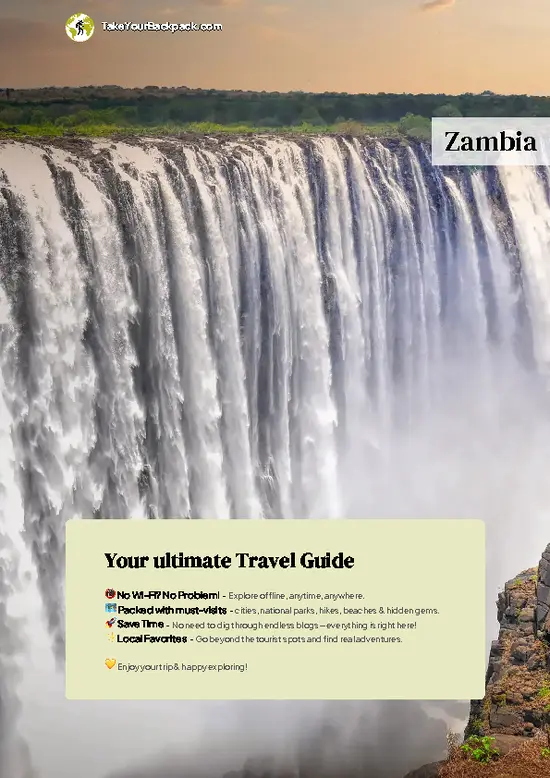
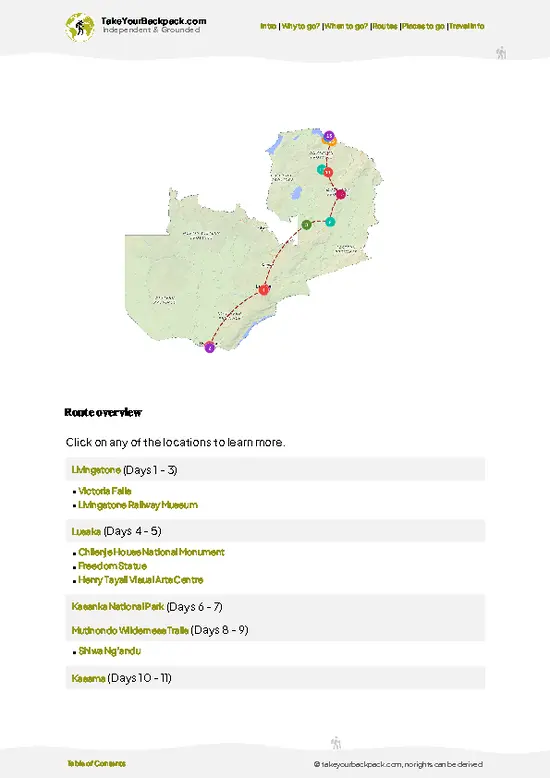
example page 0 from our offline Travel Guide for Zambia
example page 1 from our offline Travel Guide for Zambia
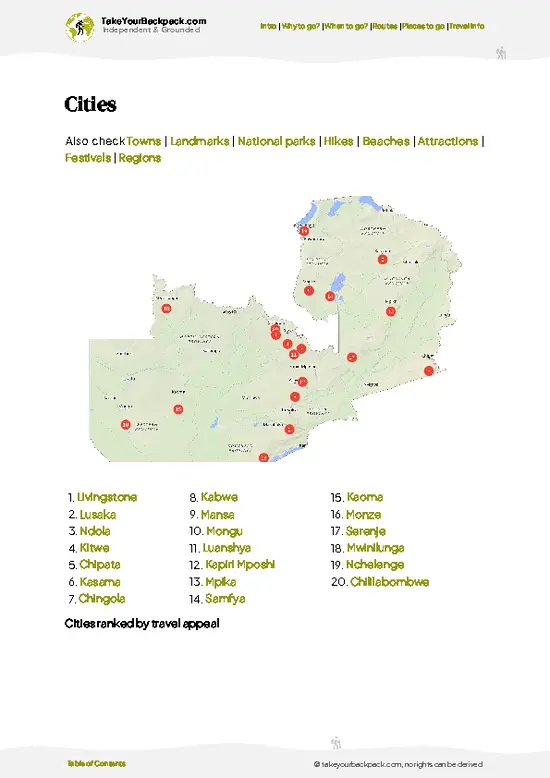
example page 2 from our offline Travel Guide for Zambia
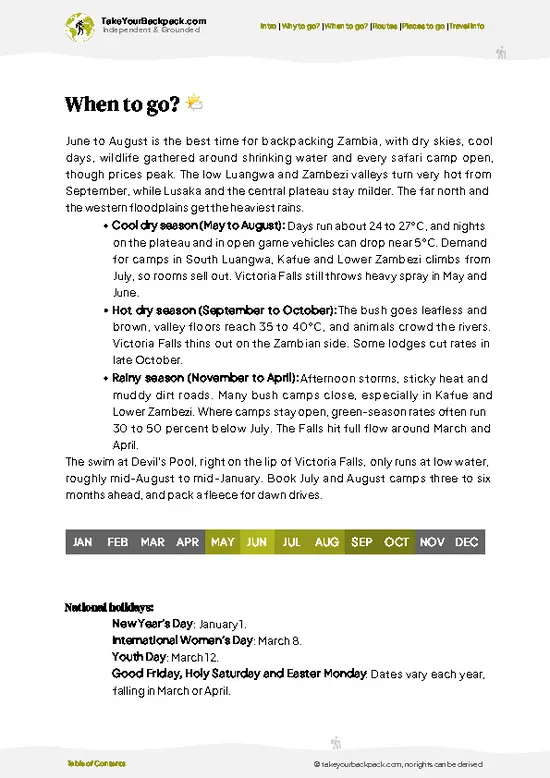
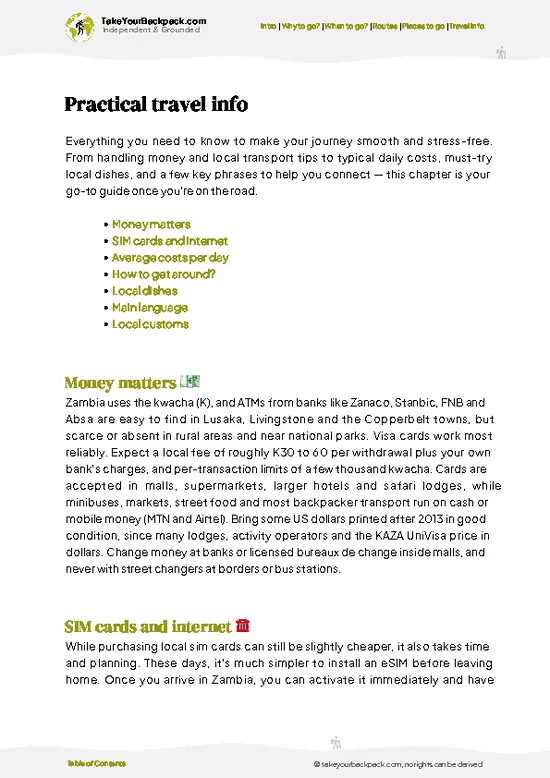
example page 3 from our offline Travel Guide for Zambia
example page 4 from our offline Travel Guide for Zambia
example page 5 from our offline Travel Guide for Zambia
example page 6 from our offline Travel Guide for Zambia
example page 7 from our offline Travel Guide for Zambia
The digital guide (351 pages) contains:
✅ 89 highlights, ranked by travel appeal
✅ Optimized 5, 10 & 15-day travel routes
✅ Cities, national parks, landmarks, beaches
✅ How to get around
✅ Offline-friendly for travel without Wi-Fi
👉 Click to see all 30+ guide features

📅 Plan smarter in minutes, not weeks
✅ Month by month travel advice
✅ Festivals & national holidays
✅ Budget expectations

🗺️ Go to the right places, skip the overrated ones
✅ Honest pros & cons of destinations
✅ Top hikes, parks & viewpoints
✅ Lesser-known places most travelers miss
✅ Clear “worth it vs skip it” guidance

🛏️ Travel smoothly without rookie mistakes
✅ Best areas to stay
✅ Transport systems explained simply
✅ Common scams & safety advice
✅ SIM cards, money & practical tips

🌍 Understand the country, not just visit it
✅ Culture & traditions
✅ 52 Essential phrases & customs
✅ Festivals worth planning around
✅ Traveler-friendly historical context
✅ Insights that make places more meaningful

📱 Built for real travel conditions
✅ Fully downloadable PDF
✅ Works completely offline
✅ Optimized for phone use
✅ Useful in remote areas & buses
✅ Everything in one place
Stop searching, start planning
Get instant access to your full guide. 30‑day money-back guarantee.
+ Add another guide for just

By proceeding you agree to our terms.
Sent to your inbox immediately after payment • 100% Secure Checkout
Best Backpacking Travel Advisor 2025 tourism awardBest Backpacking
Travel Advisor
2025
What others say about Take Your Backpack Guides:
⭐⭐⭐⭐⭐
Fantastic, amazing amount of information!
⭐⭐⭐⭐⭐
My goodness this is amazing, it's what I've been looking for hats off too you!
⭐⭐⭐⭐⭐
I think this is absolutely BRILLIANT
⭐⭐⭐⭐
Very complete and informative. It's still missing places, but I gotta to commend you
⭐⭐⭐⭐⭐
This is truly amazing, thank you, can't wait to explore it with my kids!
⭐⭐⭐⭐⭐
Awesome resource, thank you!
⭐⭐⭐⭐⭐
This is amazing! Can't wait to explore the ones I haven't seen
⭐⭐⭐⭐
I love this! Well done, great idea.
⭐⭐⭐⭐⭐
Thanks for taking the time to make this gem!
⭐⭐⭐⭐⭐
This might be the best website I've ever seen.
⭐⭐⭐⭐⭐
Congratulations, and thank you so much for your work; it's incredibly valuable.
⭐⭐⭐⭐
In all seriousness I think you did a great job pointing out the important spots
⭐⭐⭐⭐⭐
10/10 very good
⭐⭐⭐⭐⭐
As someone who's only just starting to visit regularly this is awesome, thank you.
⭐⭐⭐⭐
Thank you very much! I'm going to visit my dad, it's going to be very useful!
⭐⭐⭐⭐⭐
This is really cool! We'll be travelling for the first time and this definitely come in handy.
⭐⭐⭐⭐⭐
You are now our minister of culture, congratulations 👨‍💼
⭐⭐⭐⭐⭐
Just wanted to tell you that this is a pearl! Going to follow your recommendations.
⭐⭐⭐⭐⭐
This is so cool. I'll definitely be using the resource for my travels soon.
⭐⭐⭐⭐⭐
This is very impressive! Good work.
⭐⭐⭐⭐⭐
This is an amazing and informative site. Very well done!

🛏️ Where to stay?Top Places to Consider Staying

Backpacking Zambia is easy on a budget: dorm beds run roughly US$12 to 20 a night, and most hostels also offer private rooms and camping on the lawn. In Lusaka, the leafy suburbs east of the center such as Rhodes Park, Longacres and Kabulonga hold the best budget options; they are quiet, gated and close to the malls and restaurant strips, but you need a taxi or ride-hailing app to get anywhere after dark. In Livingstone, the hostels cluster in the town center along Mosi-oa-Tunya Road, which puts you within walking distance of bars, ATMs and adventure-booking desks and about 10 km from Victoria Falls, while the quieter riverside stretch upstream on the Zambezi is mostly pricier lodges and campsites. … read more 👉
Backpacking Zambia is easy on a budget: dorm beds run roughly US$12 to 20 a night, and most hostels also offer private rooms and camping on the lawn. In Lusaka, the leafy suburbs east of the center such as Rhodes Park, Longacres and Kabulonga hold the best budget options; they are quiet, gated and close to the malls and restaurant strips, but you need a taxi or ride-hailing app to get anywhere after dark. In Livingstone, the hostels cluster in the town center along Mosi-oa-Tunya Road, which puts you within walking distance of bars, ATMs and adventure-booking desks and about 10 km from Victoria Falls, while the quieter riverside stretch upstream on the Zambezi is mostly pricier lodges and campsites.

If you enjoy meeting fellow travelers, consider choosing hostels with high ratings for atmosphere. On the other hand, if you prefer having your own space, a hotel might be a better option.

ZambiaMore Places Across Zambia

👋 Meet the founderWho’s Behind Take Your Backpack?

Johan, backpacker and founder of TakeYourBackpackHi, I’m Johan (Netherlands 🇳🇱), the creator of TakeYourBackpack. Over the past 3 decades, I’ve backpacked through 90+ countries across six continents, gaining extensive experience with independent travel, long-term trips, and overland routes.

This site is built on a combination of firsthand travel experience and carefully curated insights from other backpackers. Many guides are based on places I’ve personally visited, while others bring together tips, observations, and practical advice shared by trusted travelers I’ve met along the way.

The goal is to provide realistic, experience-driven guidance — not generic itineraries — so you can explore destinations with better context, clearer expectations, and more confidence.