×

Albania🇦🇱 | best regionsBest 2 regions in Albania

Albania packs three different countries into a space smaller than Maryland. The Albanian Riviera down the Ionian coast smells of salt, oregano and sunscreen, with pebble beaches and prices that jump in August. The northern Accursed Mountains mean gravel roads, church bells, wood smoke and guesthouse tables loaded with homemade raki and cheese. The interior and southern towns are stone, cobbled and quiet, with daily costs lower than the coast. Independent travel works everywhere, but furgon minibuses run on fill-and-go schedules, and mountain access is slower and weather-bound. Pick by atmosphere first, then by how much hard travel you will tolerate.

By Johan Kruseman 🇳🇱 | Updated October 18, 2026
Explore the best cities in Albania

Why go?Key Factors That Shape the Experience

Albania suits regional travel because geography changes fast. Mountains cover most of the country, so within a few hours you can go from salt air and cicadas on the Ionian shore to cold limestone valleys where the loudest sound is a cowbell. That compression means you can sample very different landscapes without long flights or border crossings.

History keeps each area distinct. Decades of isolation under communist rule, the Ottoman legacy in stone towns, Greek and Italian influence on the coast, and strong mountain clan traditions left different food, dialects and customs. You will notice it in the bread, the coffee and the way a host greets you.

Infrastructure is the part to plan around. Roads have improved a lot, yet mountain tracks are rough, and the furgon network has no printed timetables. … read more 👉
Albania suits regional travel because geography changes fast. Mountains cover most of the country, so within a few hours you can go from salt air and cicadas on the Ionian shore to cold limestone valleys where the loudest sound is a cowbell. That compression means you can sample very different landscapes without long flights or border crossings.

History keeps each area distinct. Decades of isolation under communist rule, the Ottoman legacy in stone towns, Greek and Italian influence on the coast, and strong mountain clan traditions left different food, dialects and customs. You will notice it in the bread, the coffee and the way a host greets you.

Infrastructure is the part to plan around. Roads have improved a lot, yet mountain tracks are rough, and the furgon network has no printed timetables. Departures leave when full, usually in the morning, and drivers know the real schedule. Trains are almost irrelevant for travelers. Cash is still king outside the cities, and ATMs thin out in the hills.

Before choosing Albania, accept unpredictability in exchange for low prices and warm hospitality. Expect dust on the roads, loud car horns in town, and a coffee for around 100 to 150 lek (about US$1 to 1.50) that is strong and excellent.
Behind the Scenes of Selection
The list of best regions in Albania is created based on landscapes, local culture, attractions, vibes, and overall appeal. If you feel a region is missing in this list, please let us know.

When to go?Best Time to Visit Albania for regions

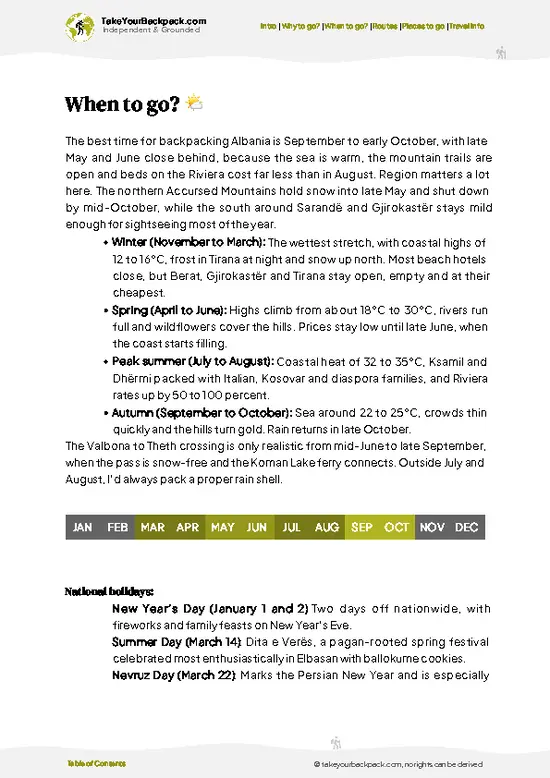
Best months and seasons: The best months are May to June and September to early October, when coastal days sit around 24 to 30°C, the sea is swimmable and mountain trails are mostly open without July heat. Light is clear and golden, and the air carries thyme and dry grass.

Summer peak and winter: July and August bring 30 to 38°C heat on the coast and in inland towns, packed beaches and the highest prices, with coastal rooms often 30 to 60 percent above shoulder rates. Cicadas are deafening, and the pavement radiates heat by noon. In the northern mountains, summer is the usable season: July and August have cool nights and the highest passes are free of snow, though afternoon storms can roll in fast.

November to March is wet. Rain is heaviest in late autumn and winter, and the coast gets most … read more 👉
Best months and seasons: The best months are May to June and September to early October, when coastal days sit around 24 to 30°C, the sea is swimmable and mountain trails are mostly open without July heat. Light is clear and golden, and the air carries thyme and dry grass.

Summer peak and winter: July and August bring 30 to 38°C heat on the coast and in inland towns, packed beaches and the highest prices, with coastal rooms often 30 to 60 percent above shoulder rates. Cicadas are deafening, and the pavement radiates heat by noon. In the northern mountains, summer is the usable season: July and August have cool nights and the highest passes are free of snow, though afternoon storms can roll in fast.

November to March is wet. Rain is heaviest in late autumn and winter, and the coast gets most of it, often well over 1,000 mm a year across the country's western lowlands. Many coastal guesthouses and beach restaurants close from roughly November to April. Northern roads and high trails can be blocked by snow, and ferry or guesthouse services shut down in the high valleys.

Shoulder timing: April is green and flowering but unsettled, with sea temperatures near 15 to 17°C. Late September gives warm water, around 22 to 24°C, and fewer people, so it is the best value window for a mix of beach, town and hills.

region hoppingOptimizing Your Multi-Stop Itinerary

How many days to plan: A trip linking several regions needs 10 to 14 days, and 7 days is only enough for two areas. Albania is small, but mountain roads are slow, so distance on the map misleads.

Direction and grouping: Start in Tirana, the main transport hub, and move in one direction rather than looping back. A north-to-south sweep works well because the coast gets warmer and softer as you go, ending with beach days after trail days. Group areas that share roads: the northern mountains cluster around Shkodër, the central interior links through Tirana, Berat and Gjirokastër, and the coast runs along the SH8 road. Allow 2 to 4 nights per stop, with 3 as a good default. Travel between hubs usually takes 2 to 5 hours by furgon or bus, and the northern mountain legs can take 3 to 6 hours including … read more 👉
How many days to plan: A trip linking several regions needs 10 to 14 days, and 7 days is only enough for two areas. Albania is small, but mountain roads are slow, so distance on the map misleads.

Direction and grouping: Start in Tirana, the main transport hub, and move in one direction rather than looping back. A north-to-south sweep works well because the coast gets warmer and softer as you go, ending with beach days after trail days. Group areas that share roads: the northern mountains cluster around Shkodër, the central interior links through Tirana, Berat and Gjirokastër, and the coast runs along the SH8 road. Allow 2 to 4 nights per stop, with 3 as a good default. Travel between hubs usually takes 2 to 5 hours by furgon or bus, and the northern mountain legs can take 3 to 6 hours including a ferry or rough track.

Planning mistakes: The common error is stuffing in too many stops and spending the trip in minibuses with your bag on your lap. Cut a stop instead. Another is traveling in the afternoon: furgons thin out after about 2 pm, so leave in the morning. People also underestimate summer heat on coastal roads and book tight connections. Leave a buffer day before flights from Tirana, and carry cash for rural fares.

The ListTop regions of Albania

1 Lake Ohrid Region

lakeshore towns, Byzantine churches, fishing piers, UNESCO heritage

Wander lakeside promenades, visit centuries-old religious sites, and experience a cross-border region where history and daily life meet the water’s edge.

albania-region-lake-ohrid-region
© Google | Randolfo Santos

2 Dibër County

mountain villages, alpine valleys, Ottoman bridges, mineral springs

Hike through remote uplands, encounter traditional communities, and discover landscapes shaped by centuries of isolation and natural resources.

albania-region-diber-county
© Google | Ylli Murati
Loading the map 🌍

Expert viewWhat You Should Know

How many regions to pick: Three regions is the number I advise for a trip of two to three weeks, and two if you have ten days. Albania looks small on the map, but the mountain roads are slow, minibuses leave when full, and a 150 km hop can eat five hours. Pack in a fourth region and you spend the trip staring through a dusty window at the same switchbacks. With three, you still have time to sit at a plastic table with a Turkish coffee and a plate of fresh figs while the afternoon goes soft and gold.
Choosing between coast, mountains and old towns: Match the kind of region to the kind of traveler. If you want hiking, pick a mountain region first: the trails are rocky, the guesthouse dinners are heavy on cheese, bread and homemade raki, and the silence at night is total. If you want swimming … read more 👉
How many regions to pick: Three regions is the number I advise for a trip of two to three weeks, and two if you have ten days. Albania looks small on the map, but the mountain roads are slow, minibuses leave when full, and a 150 km hop can eat five hours. Pack in a fourth region and you spend the trip staring through a dusty window at the same switchbacks. With three, you still have time to sit at a plastic table with a Turkish coffee and a plate of fresh figs while the afternoon goes soft and gold.
Choosing between coast, mountains and old towns: Match the kind of region to the kind of traveler. If you want hiking, pick a mountain region first: the trails are rocky, the guesthouse dinners are heavy on cheese, bread and homemade raki, and the silence at night is total. If you want swimming and a social hostel scene, pick a coastal region, where the water is clear and the shoreline smells of pine and sunscreen, but July and August bring packed beaches and doubled prices. If history and food interest you, pick an inland stone-town region, with cobbled lanes that turn slick after rain and cafes that stay lively until late. Mixing one of each gives the best balance, because the contrast is the point of coming to Albania.
What it costs: Budget US$30 to 50 a day for independent travel in shoulder season, and US$50 to 80 in peak summer on the coast. Dorm beds run roughly US$10 to 20, guesthouses with dinner and breakfast US$25 to 45 per person in the mountains. Meals at local grills cost US$5 to 10, and a coffee is under US$2. Furgons (minibuses) between towns cost about US$2 to 10 depending on distance. Entry fees to castles, museums and archaeological sites are usually US$2 to 10, national parks are mostly free or a few dollars, and a local guide for a full mountain day runs US$40 to 80. Over a three-region trip of two weeks, plan on US$450 to 800 for everything on the ground, plus more if you rent a car (US$25 to 50 a day). A full tank on a mountain road buys you the view of a ridgeline turning pink at dusk.
Safety and cultural points: Albania is generally safe for backpackers, and hospitality is real: you may be handed coffee, sweets or a shot of raki before you have asked for anything. Accepting a small offering is polite, and refusing firmly is fine if you smile. Dress modestly when visiting mosques and monasteries, and take shoes off where others do. Mountain roads have sharp drops, few guardrails and drivers who overtake on bends, so avoid night driving. Carry cash in lek, since many villages have no card machines and ATMs can be empty. Hiking in the north needs a proper map or offline track, as trail markings fade, and weather turns fast at altitude. Stray dogs are common, usually harmless, and sometimes follow hikers for miles. The reward for the prep is a trip that feels unhurried, full of local meals and quiet landscapes.

✈️ The backpacker research shortcutAlbania Travel Guide

An offline-friendly backpacking guide with optimized travel routes, ranked highlights, transport advice, and the best areas to stay.
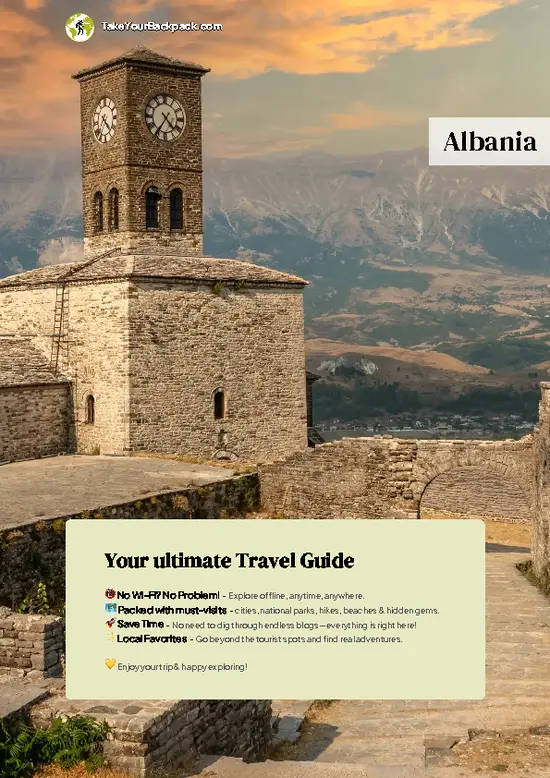
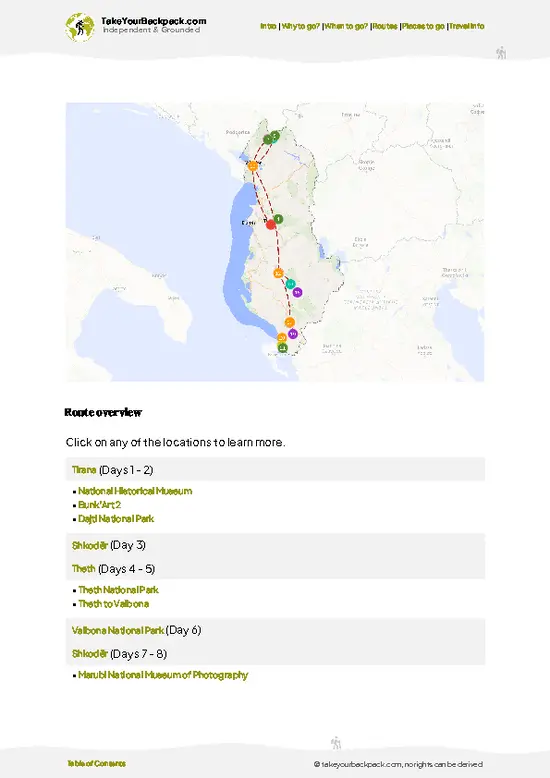
example page 0 from our offline Travel Guide for Albania
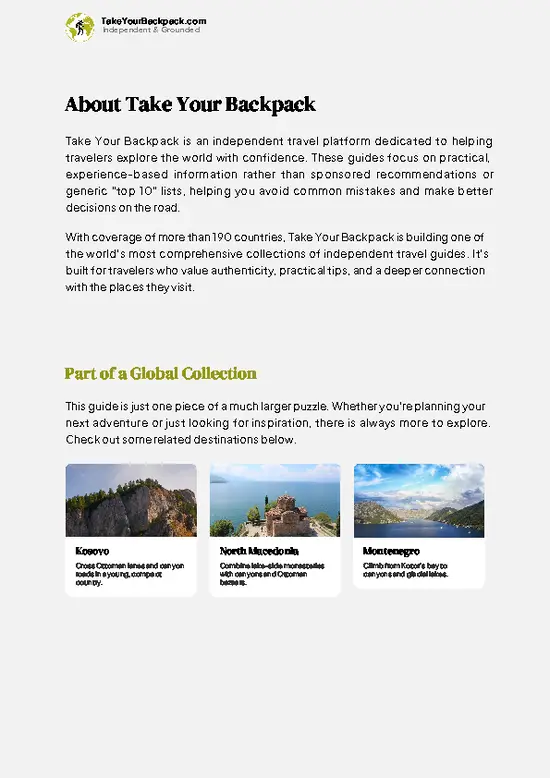
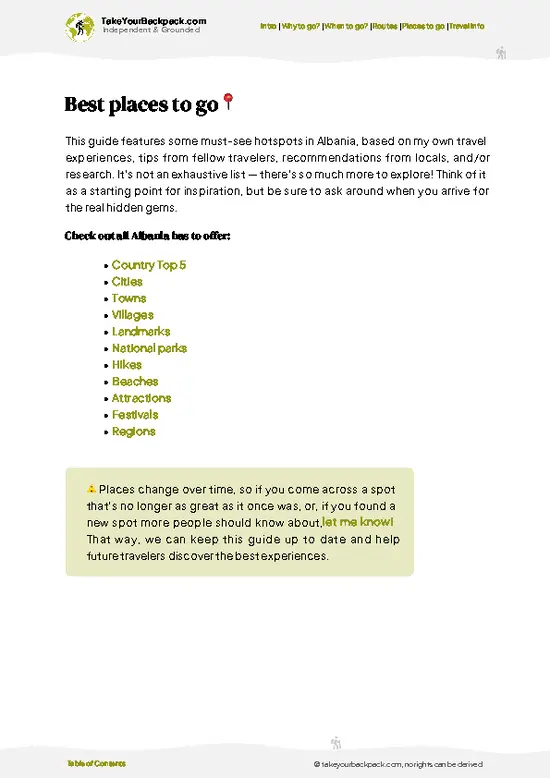
example page 1 from our offline Travel Guide for Albania
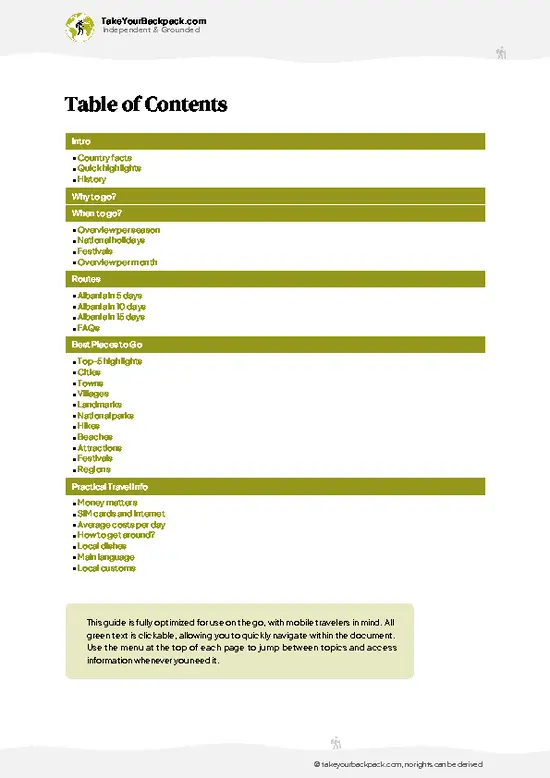
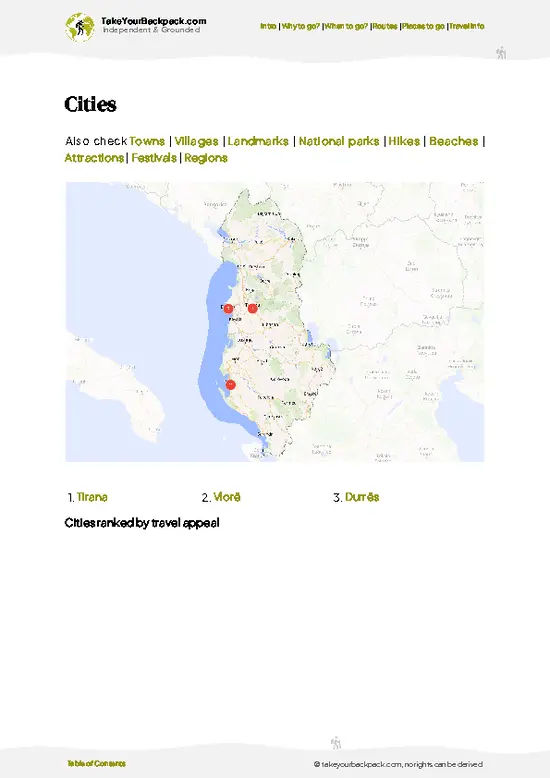
example page 2 from our offline Travel Guide for Albania
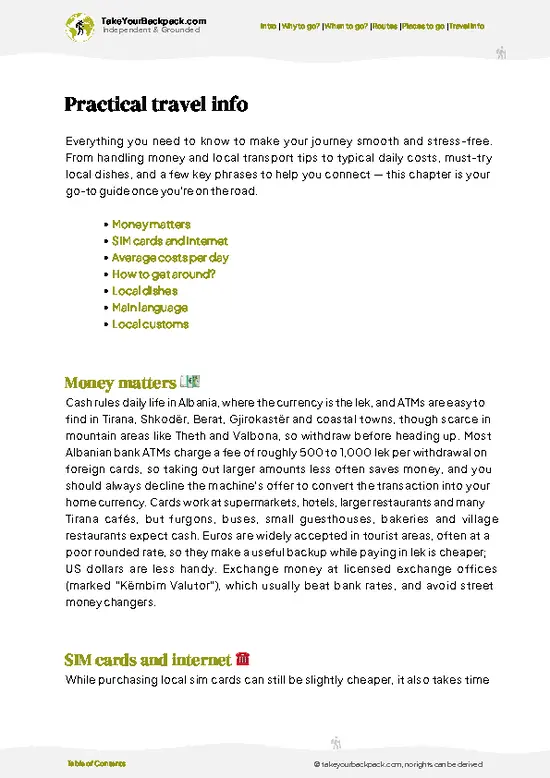
example page 3 from our offline Travel Guide for Albania
example page 4 from our offline Travel Guide for Albania
example page 5 from our offline Travel Guide for Albania
example page 6 from our offline Travel Guide for Albania
example page 7 from our offline Travel Guide for Albania
The digital guide (305 pages) contains:
✅ 78 highlights, ranked by travel appeal
✅ Optimized 5, 10 & 15-day travel routes
✅ Cities, national parks, landmarks, beaches
✅ How to get around
✅ Offline-friendly for travel without Wi-Fi
👉 Click to see all 30+ guide features

📅 Plan smarter in minutes, not weeks
✅ Month by month travel advice
✅ Festivals & national holidays
✅ Budget expectations

🗺️ Go to the right places, skip the overrated ones
✅ Honest pros & cons of destinations
✅ Top hikes, parks & viewpoints
✅ Lesser-known places most travelers miss
✅ Clear “worth it vs skip it” guidance

🛏️ Travel smoothly without rookie mistakes
✅ Best areas to stay
✅ Transport systems explained simply
✅ Common scams & safety advice
✅ SIM cards, money & practical tips

🌍 Understand the country, not just visit it
✅ Culture & traditions
✅ 52 Essential phrases & customs
✅ Festivals worth planning around
✅ Traveler-friendly historical context
✅ Insights that make places more meaningful

📱 Built for real travel conditions
✅ Fully downloadable PDF
✅ Works completely offline
✅ Optimized for phone use
✅ Useful in remote areas & buses
✅ Everything in one place
Stop searching, start planning
Get instant access to your full guide. 30‑day money-back guarantee.
+ Add another guide for just

By proceeding you agree to our terms.
Sent to your inbox immediately after payment • 100% Secure Checkout
Best Backpacking Travel Advisor 2025 tourism awardBest Backpacking
Travel Advisor
2025
What others say about Take Your Backpack Guides:
⭐⭐⭐⭐⭐
Fantastic, amazing amount of information!
⭐⭐⭐⭐⭐
My goodness this is amazing, it's what I've been looking for hats off too you!
⭐⭐⭐⭐⭐
I think this is absolutely BRILLIANT
⭐⭐⭐⭐
Very complete and informative. It's still missing places, but I gotta to commend you
⭐⭐⭐⭐⭐
This is truly amazing, thank you, can't wait to explore it with my kids!
⭐⭐⭐⭐⭐
Awesome resource, thank you!
⭐⭐⭐⭐⭐
This is amazing! Can't wait to explore the ones I haven't seen
⭐⭐⭐⭐
I love this! Well done, great idea.
⭐⭐⭐⭐⭐
Thanks for taking the time to make this gem!
⭐⭐⭐⭐⭐
This might be the best website I've ever seen.
⭐⭐⭐⭐⭐
Congratulations, and thank you so much for your work; it's incredibly valuable.
⭐⭐⭐⭐
In all seriousness I think you did a great job pointing out the important spots
⭐⭐⭐⭐⭐
10/10 very good
⭐⭐⭐⭐⭐
As someone who's only just starting to visit regularly this is awesome, thank you.
⭐⭐⭐⭐
Thank you very much! I'm going to visit my dad, it's going to be very useful!
⭐⭐⭐⭐⭐
This is really cool! We'll be travelling for the first time and this definitely come in handy.
⭐⭐⭐⭐⭐
You are now our minister of culture, congratulations 👨‍💼
⭐⭐⭐⭐⭐
Just wanted to tell you that this is a pearl! Going to follow your recommendations.
⭐⭐⭐⭐⭐
This is so cool. I'll definitely be using the resource for my travels soon.
⭐⭐⭐⭐⭐
This is very impressive! Good work.
⭐⭐⭐⭐⭐
This is an amazing and informative site. Very well done!

🛏️ Where to stay?Best Places to Stay in Albania

Albania has a dense, cheap hostel scene, with dorm beds typically running 1,200 to 2,000 lek (about US$13 to 22) and private guesthouse rooms not far above that. In Tirana, the streets around Skanderbeg Square put you within walking distance of the main sights and bus connections, while Blloku has the best bars and cafés but louder nights and higher prices. Down south, Saranda packs hostels near the seafront promenade for beach access and summer nightlife, whereas the old quarters of Berat (Mangalem) and Gjirokastër (around the Old Bazaar) are quiet and atmospheric but involve steep cobbled climbs with a backpack.

If you enjoy meeting fellow travelers, consider choosing hostels with high ratings … read more 👉
Albania has a dense, cheap hostel scene, with dorm beds typically running 1,200 to 2,000 lek (about US$13 to 22) and private guesthouse rooms not far above that. In Tirana, the streets around Skanderbeg Square put you within walking distance of the main sights and bus connections, while Blloku has the best bars and cafés but louder nights and higher prices. Down south, Saranda packs hostels near the seafront promenade for beach access and summer nightlife, whereas the old quarters of Berat (Mangalem) and Gjirokastër (around the Old Bazaar) are quiet and atmospheric but involve steep cobbled climbs with a backpack.

If you enjoy meeting fellow travelers, consider choosing hostels with high ratings for atmosphere. On the other hand, if you prefer having your own space, a hotel might be a better option.

AlbaniaExplore Albania

👋 Meet the founderWho’s Behind Take Your Backpack?

Johan, backpacker and founder of TakeYourBackpackHi, I’m Johan (Netherlands 🇳🇱), the creator of TakeYourBackpack. Over the past 3 decades, I’ve backpacked through 90+ countries across six continents, gaining extensive experience with independent travel, long-term trips, and overland routes.

This site is built on a combination of firsthand travel experience and carefully curated insights from other backpackers. Many guides are based on places I’ve personally visited, while others bring together tips, observations, and practical advice shared by trusted travelers I’ve met along the way.

The goal is to provide realistic, experience-driven guidance — not generic itineraries — so you can explore destinations with better context, clearer expectations, and more confidence.