×

Albania🇦🇱 | best beachesBest 7 beaches in Albania

Albania packs two different coasts into a country smaller than Maryland. On the Adriatic side, the sand runs flat and wide around Durrës and Velipoja, with warm shallows, beach bars thumping from noon and sunbeds packed in rows. Down the Ionian coast, from Vlora past Himara to Ksamil, limestone mountains drop into water so clear you can count pebbles at four meters, and the air smells of pine resin and oregano. Expect gravel instead of sand, steep access roads and prices that climb each July. For independent travelers, the north is cheaper and rougher, the south prettier and pricier. Choose by what you want from a day.

By Johan Kruseman 🇳🇱 | Updated October 18, 2026
Explore the best attractions in Albania

Why go?Key Factors That Shape the Experience

Albania sits where the flat, silty Adriatic meets the deep, clear Ionian Sea, and that single geographic fact explains most of what you will find. The Adriatic lowlands are long, shallow and sandy, shaped by river deposits, so the water is warm but often cloudy. South of the Llogara Pass, the Ceraunian Mountains shove straight into the sea, leaving pebble coves, sea caves and water in a hard turquoise that looks retouched. Summers are dry and hot, with little rain from June to September, and the sun on white limestone is fierce by midday.

The country opened to tourism only after 1991, so the coast still carries leftovers: concrete bunkers half-buried in dunes, unfinished hotel shells, and fast-growing resort strips where cranes still swing. Development is uneven. Some stretches have tidy … read more 👉
Albania sits where the flat, silty Adriatic meets the deep, clear Ionian Sea, and that single geographic fact explains most of what you will find. The Adriatic lowlands are long, shallow and sandy, shaped by river deposits, so the water is warm but often cloudy. South of the Llogara Pass, the Ceraunian Mountains shove straight into the sea, leaving pebble coves, sea caves and water in a hard turquoise that looks retouched. Summers are dry and hot, with little rain from June to September, and the sun on white limestone is fierce by midday.

The country opened to tourism only after 1991, so the coast still carries leftovers: concrete bunkers half-buried in dunes, unfinished hotel shells, and fast-growing resort strips where cranes still swing. Development is uneven. Some stretches have tidy sunbeds and cold Korçë beer, others have a dirt track and a goat. Infrastructure is improving, but rural roads can be narrow and rutted, and public transport thins out fast away from the main towns.

Before choosing Albania, know that the best-known beaches fill up in July and August, sunbed fees add up, and the sea can be rough when the wind turns. In exchange, you get Mediterranean water at a fraction of Greek or Croatian prices.
Evaluating the Top Choices
The list of best beaches in Albania is created based on beauty, vibe, water quality, activities, and surrounding scenery. If you feel a beach is missing in this list, please let us know.

When to go?Best Time to Visit Albania for beaches

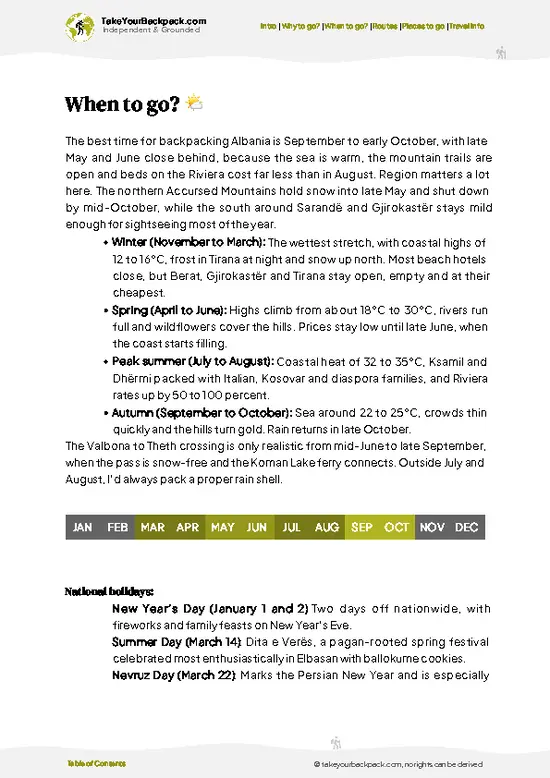
Best months for beaches: The best months for Albanian beaches are June and September, when the sea sits around 22 to 25°C, the air runs 26 to 31°C and the crowds have not yet arrived or have already left. Days are dry, the light is sharp and gold by late afternoon, and cicadas drown out almost everything else.

Peak season: July and August are hot, with highs of 32 to 37°C inland and a sea of 25 to 27°C. Rain is almost absent, but the heat on pebble and concrete is real, and shade is worth paying for. Rooms and sunbeds cost the most now, often 30 to 60 percent above June or September rates, and the Ionian coast around Ksamil and Himara fills first. Traffic on coastal roads crawls on weekends. The Adriatic strip near Durrës is busy with Albanian and Kosovar families, so expect loud music and … read more 👉
Best months for beaches: The best months for Albanian beaches are June and September, when the sea sits around 22 to 25°C, the air runs 26 to 31°C and the crowds have not yet arrived or have already left. Days are dry, the light is sharp and gold by late afternoon, and cicadas drown out almost everything else.

Peak season: July and August are hot, with highs of 32 to 37°C inland and a sea of 25 to 27°C. Rain is almost absent, but the heat on pebble and concrete is real, and shade is worth paying for. Rooms and sunbeds cost the most now, often 30 to 60 percent above June or September rates, and the Ionian coast around Ksamil and Himara fills first. Traffic on coastal roads crawls on weekends. The Adriatic strip near Durrës is busy with Albanian and Kosovar families, so expect loud music and grilled corn smoke.

Shoulder and off-season: May is pleasant but the sea is still a cool 18 to 20°C, fine for a quick dip. October keeps the water near 21 to 23°C, though showers arrive and October is among the wetter months. From November to March, the coast gets 100 to 150 mm of rain a month in the south, many beach bars and seasonal guesthouses close, and swimming is for the very stubborn.

beach hoppingOptimizing Your Multi-Stop Itinerary

How many days to plan: A trip combining several Albanian beaches needs 7 to 12 days, so you can swim at each stop without spending the trip in a minibus. Less than a week turns the coast into a blur of road.

Direction and grouping: Travel north to south or the reverse, but pick one line. The Adriatic cluster around Durrës is close to Tirana, about 40 to 60 minutes by road or train-bus link, so it works as an arrival or departure stop. The Ionian cluster runs from Vlora through Dhërmi and Himara to Sarandë and Ksamil. Starting in Tirana, then heading south toward Vlora and the Llogara Pass, lets you finish with the clearest water and fly out via Corfu ferry or return north. Tirana to Vlora takes about 2.5 to 3 hours, Vlora to Himara 1.5 to 2 hours on a winding mountain road, and Himara to … read more 👉
How many days to plan: A trip combining several Albanian beaches needs 7 to 12 days, so you can swim at each stop without spending the trip in a minibus. Less than a week turns the coast into a blur of road.

Direction and grouping: Travel north to south or the reverse, but pick one line. The Adriatic cluster around Durrës is close to Tirana, about 40 to 60 minutes by road or train-bus link, so it works as an arrival or departure stop. The Ionian cluster runs from Vlora through Dhërmi and Himara to Sarandë and Ksamil. Starting in Tirana, then heading south toward Vlora and the Llogara Pass, lets you finish with the clearest water and fly out via Corfu ferry or return north. Tirana to Vlora takes about 2.5 to 3 hours, Vlora to Himara 1.5 to 2 hours on a winding mountain road, and Himara to Sarandë around 1.5 hours.

Time per stop and common mistakes: Give each base 2 to 3 nights. One-night stops mean packing wet towels at 8 a.m. and driving through switchbacks in the midday glare. Another mistake is trusting map distances: 60 kilometers on the Riviera can take two hours behind trucks and sheep. Minibuses (furgons) leave mostly in the morning and thin out after 2 p.m., so travel early, and leave the long hauls for cooler hours rather than July noon.

The ListTop beaches of Albania

1 Ksamil Beach

islets offshore, white sand, shallow turquoise water, sunbeds

Swim to nearby islets or relax on soft sand, with shallow, clear water and plenty of facilities for a comfortable day.

albania-beach-ksamil-beach
© Google | Duka

2 Gjipe Beach

canyon entrance, tent camping, turquoise cove, rocky cliffs

Reach a secluded cove framed by steep canyon walls, where clear water and basic camping draw those seeking a remote escape.

albania-beach-gjipe-beach
© Google |

3 Jale Beach

music bars, water sports, crescent bay, summer crowds

Join a social scene where music, water activities, and a curved bay attract travelers looking for both relaxation and nightlife.

albania-beach-jale-beach
© Google |

4 Borsh Beach

long pebble shore, olive groves, mountain backdrop, quiet stretches

Walk along a wide, pebbled coastline where the mountains meet the sea and olive trees line the edges of uncrowded sands.

albania-beach-borsh-beach
© Google | Oksana Duduk

5 Himara Beach

town promenade, mixed sand and pebble, local tavernas, gentle waves

Swim in calm waters steps from a lively promenade, with easy access to local food and a blend of sand and pebbles underfoot.

albania-beach-himara-beach
© Google | Oleh Piven

6 Saranda Beach

urban setting, ferry port, city views, paved waterfront

Experience a city beach with easy transport links, a paved promenade, and views across the bay to Corfu’s distant hills.

albania-beach-saranda-beach
© Google |

7 Grama Bay

boat access, wild landscape, limestone cliffs, untouched shoreline

Arrive by boat to a rugged bay with dramatic cliffs and a raw, undeveloped coastline that feels far from civilization.

albania-beach-grama-bay
© Google |
Loading the map 🌍

Expert viewWhat You Should Know

How many beaches to visit: Plan on four to six beaches over a week and a half, no more. Each one deserves a full half-day at minimum, because the best part is the slow stretch after you arrive: the first cold plunge, the smell of sunscreen and grilled fish drifting from a shack, the afternoon light turning the water from turquoise to ink. Cram in ten and you spend your days on switchback roads instead of in the water.

Choosing your kind of beach: Social travelers and anyone on a tight budget should lean toward the long sandy Adriatic beaches, where beer is cheap, music is loud and hostels or guesthouses cost less. Snorkelers, photographers and couples will get more from the Ionian pebble coves, where the water is clear and quiet mornings feel almost private. Travelers with kids or mobility … read more 👉
How many beaches to visit: Plan on four to six beaches over a week and a half, no more. Each one deserves a full half-day at minimum, because the best part is the slow stretch after you arrive: the first cold plunge, the smell of sunscreen and grilled fish drifting from a shack, the afternoon light turning the water from turquoise to ink. Cram in ten and you spend your days on switchback roads instead of in the water.

Choosing your kind of beach: Social travelers and anyone on a tight budget should lean toward the long sandy Adriatic beaches, where beer is cheap, music is loud and hostels or guesthouses cost less. Snorkelers, photographers and couples will get more from the Ionian pebble coves, where the water is clear and quiet mornings feel almost private. Travelers with kids or mobility issues do better on flat, sandy shores with easy parking. Confident drivers and hikers can chase the isolated coves down dirt tracks, where the reward is silence and a shallow bay with nobody in it.

What it costs: Budget US$35 to 55 a day in high season, covering a dorm bed or simple room (US$15 to 30), meals (US$10 to 18), and transport. Sunbed and umbrella sets usually run 1,500 to 4,000 lek (about US$16 to 42) in popular Ionian spots, less on quieter beaches, and often free if you buy drinks. Many beaches have no entry fee, though parking can cost 200 to 500 lek. Boat trips to sea caves cost roughly 1,500 to 3,500 lek per person. Carry cash, since smaller beach bars may not take cards.

Safety and local etiquette: Currents and waves can turn strong when the wind blows, and many beaches have no lifeguards, so swim near shore and never alone. Sea urchins hide among the rocks on pebble coves, and reef shoes (about US$8 to 12) save your soles. Sun is brutal from noon to 4 p.m., so carry 2 liters of water. Tap water is not always safe to drink, so buy bottled. Skip leftover bunkers and unfinished buildings, which can have open shafts. Albanians are relaxed about swimwear, but cover up when walking through town and ask before photographing locals. Keep valuables off the sand. Driving at night on coastal roads is slow and risky, with unlit curves and animals on the road.

✈️ The backpacker research shortcutAlbania Travel Guide

An offline-friendly backpacking guide with optimized travel routes, ranked highlights, transport advice, and the best areas to stay.
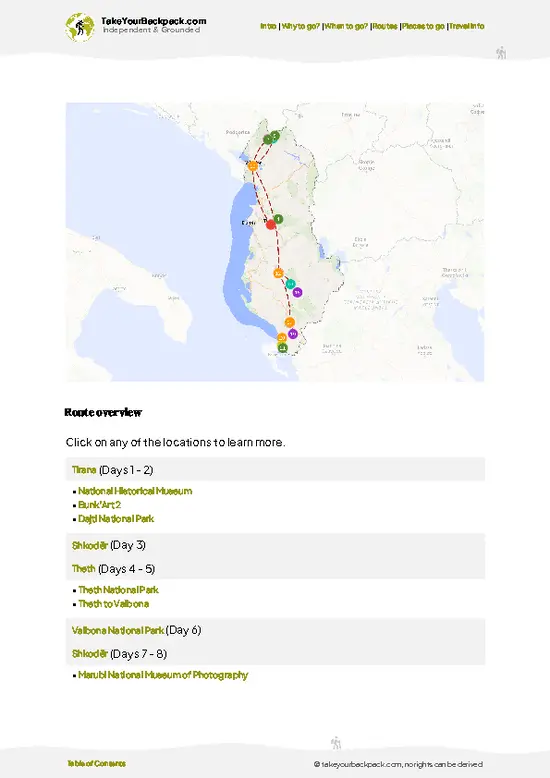
example page 0 from our offline Travel Guide for Albania
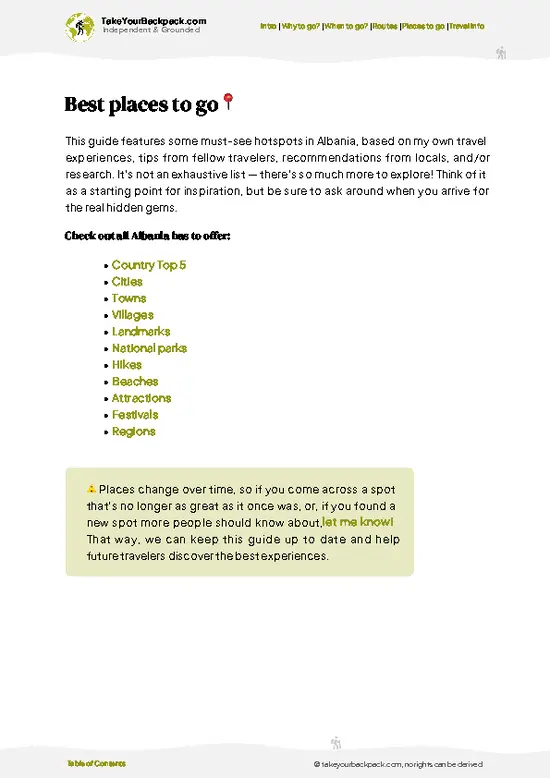
example page 1 from our offline Travel Guide for Albania
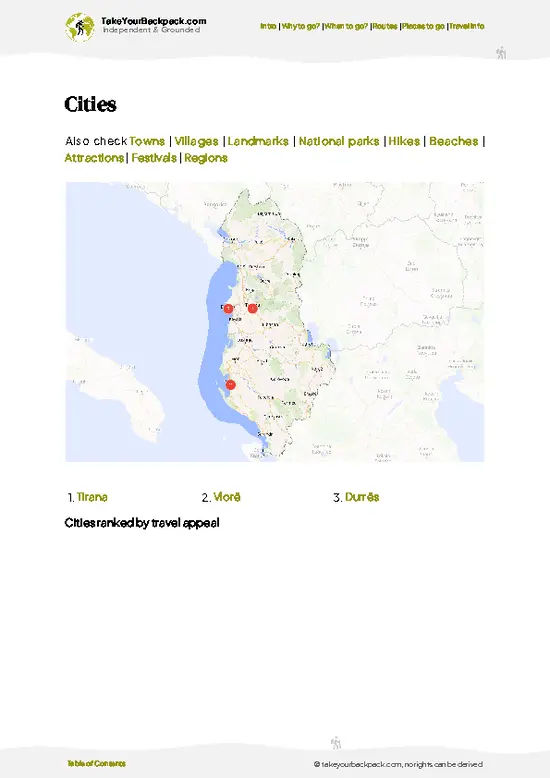
example page 2 from our offline Travel Guide for Albania
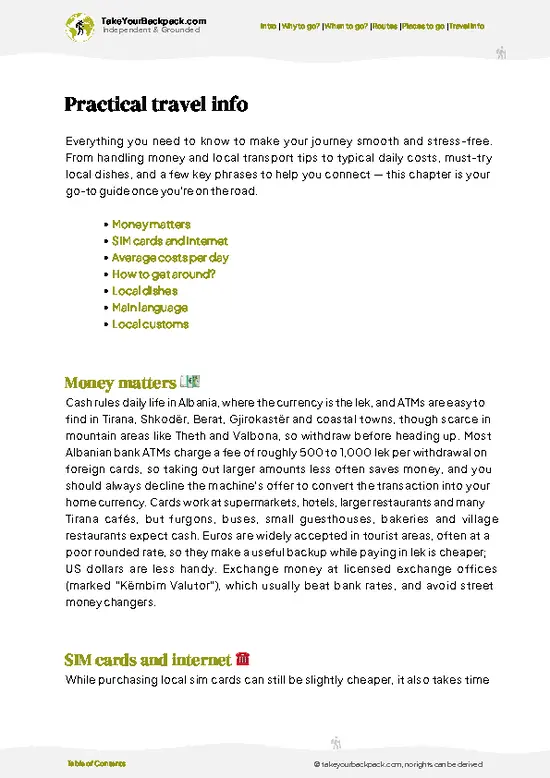
example page 3 from our offline Travel Guide for Albania
example page 4 from our offline Travel Guide for Albania
example page 5 from our offline Travel Guide for Albania
example page 6 from our offline Travel Guide for Albania
example page 7 from our offline Travel Guide for Albania
The digital guide (305 pages) contains:
✅ 78 highlights, ranked by travel appeal
✅ Optimized 5, 10 & 15-day travel routes
✅ Cities, national parks, landmarks, beaches
✅ How to get around
✅ Offline-friendly for travel without Wi-Fi
👉 Click to see all 30+ guide features

📅 Plan smarter in minutes, not weeks
✅ Month by month travel advice
✅ Festivals & national holidays
✅ Budget expectations

🗺️ Go to the right places, skip the overrated ones
✅ Honest pros & cons of destinations
✅ Top hikes, parks & viewpoints
✅ Lesser-known places most travelers miss
✅ Clear “worth it vs skip it” guidance

🛏️ Travel smoothly without rookie mistakes
✅ Best areas to stay
✅ Transport systems explained simply
✅ Common scams & safety advice
✅ SIM cards, money & practical tips

🌍 Understand the country, not just visit it
✅ Culture & traditions
✅ 52 Essential phrases & customs
✅ Festivals worth planning around
✅ Traveler-friendly historical context
✅ Insights that make places more meaningful

📱 Built for real travel conditions
✅ Fully downloadable PDF
✅ Works completely offline
✅ Optimized for phone use
✅ Useful in remote areas & buses
✅ Everything in one place
Stop searching, start planning
Get instant access to your full guide. 30‑day money-back guarantee.
+ Add another guide for just

By proceeding you agree to our terms.
Sent to your inbox immediately after payment • 100% Secure Checkout
Best Backpacking Travel Advisor 2025 tourism awardBest Backpacking
Travel Advisor
2025
What others say about Take Your Backpack Guides:
⭐⭐⭐⭐⭐
Fantastic, amazing amount of information!
⭐⭐⭐⭐⭐
My goodness this is amazing, it's what I've been looking for hats off too you!
⭐⭐⭐⭐⭐
I think this is absolutely BRILLIANT
⭐⭐⭐⭐
Very complete and informative. It's still missing places, but I gotta to commend you
⭐⭐⭐⭐⭐
This is truly amazing, thank you, can't wait to explore it with my kids!
⭐⭐⭐⭐⭐
Awesome resource, thank you!
⭐⭐⭐⭐⭐
This is amazing! Can't wait to explore the ones I haven't seen
⭐⭐⭐⭐
I love this! Well done, great idea.
⭐⭐⭐⭐⭐
Thanks for taking the time to make this gem!
⭐⭐⭐⭐⭐
This might be the best website I've ever seen.
⭐⭐⭐⭐⭐
Congratulations, and thank you so much for your work; it's incredibly valuable.
⭐⭐⭐⭐
In all seriousness I think you did a great job pointing out the important spots
⭐⭐⭐⭐⭐
10/10 very good
⭐⭐⭐⭐⭐
As someone who's only just starting to visit regularly this is awesome, thank you.
⭐⭐⭐⭐
Thank you very much! I'm going to visit my dad, it's going to be very useful!
⭐⭐⭐⭐⭐
This is really cool! We'll be travelling for the first time and this definitely come in handy.
⭐⭐⭐⭐⭐
You are now our minister of culture, congratulations 👨‍💼
⭐⭐⭐⭐⭐
Just wanted to tell you that this is a pearl! Going to follow your recommendations.
⭐⭐⭐⭐⭐
This is so cool. I'll definitely be using the resource for my travels soon.
⭐⭐⭐⭐⭐
This is very impressive! Good work.
⭐⭐⭐⭐⭐
This is an amazing and informative site. Very well done!

🛏️ Where to stay?Best Places to Stay in Albania

Albania has a dense, cheap hostel scene, with dorm beds typically running 1,200 to 2,000 lek (about US$13 to 22) and private guesthouse rooms not far above that. In Tirana, the streets around Skanderbeg Square put you within walking distance of the main sights and bus connections, while Blloku has the best bars and cafés but louder nights and higher prices. Down south, Saranda packs hostels near the seafront promenade for beach access and summer nightlife, whereas the old quarters of Berat (Mangalem) and Gjirokastër (around the Old Bazaar) are quiet and atmospheric but involve steep cobbled climbs with a backpack.

If you enjoy meeting fellow travelers, consider choosing hostels with high ratings … read more 👉
Albania has a dense, cheap hostel scene, with dorm beds typically running 1,200 to 2,000 lek (about US$13 to 22) and private guesthouse rooms not far above that. In Tirana, the streets around Skanderbeg Square put you within walking distance of the main sights and bus connections, while Blloku has the best bars and cafés but louder nights and higher prices. Down south, Saranda packs hostels near the seafront promenade for beach access and summer nightlife, whereas the old quarters of Berat (Mangalem) and Gjirokastër (around the Old Bazaar) are quiet and atmospheric but involve steep cobbled climbs with a backpack.

If you enjoy meeting fellow travelers, consider choosing hostels with high ratings for atmosphere. On the other hand, if you prefer having your own space, a hotel might be a better option.

AlbaniaExplore Albania

👋 Meet the founderWho’s Behind Take Your Backpack?

Johan, backpacker and founder of TakeYourBackpackHi, I’m Johan (Netherlands 🇳🇱), the creator of TakeYourBackpack. Over the past 3 decades, I’ve backpacked through 90+ countries across six continents, gaining extensive experience with independent travel, long-term trips, and overland routes.

This site is built on a combination of firsthand travel experience and carefully curated insights from other backpackers. Many guides are based on places I’ve personally visited, while others bring together tips, observations, and practical advice shared by trusted travelers I’ve met along the way.

The goal is to provide realistic, experience-driven guidance — not generic itineraries — so you can explore destinations with better context, clearer expectations, and more confidence.