×

Algeria🇩🇿 | national parksBelezma National ParkAurès cedar slopes, limestone scree, Djebel Tuggurt crest, Batna basin views | things to do and best time to go

Explore Ahaggar National ParkExplore Chréa National Park

Backpacking in Belezma
👌 Worth visitingnational park ranked #9
By Johan Kruseman 🇳🇱 | Updated October 22, 2026

The real decision at Belezma National Park is whether to treat it as a half-day add-on to Batna or to give it a full day on foot; the cedar forest rewards the second. The park sits in the Aurès region in the north of Algeria, a short drive from Batna. Expect resinous cedar air, crunching limestone scree and wind whistling over ridges, with Barbary macaques and golden eagles as the stars. Signage is thin and public transport stops well short of the forest, so a taxi that drops you with no pickup plan strands you; agree a return time before you get out. Trails are rarely marked, so download an offline map and bring all your water. Hire a local guide through the park office in Batna before you go.

Discover everything you want to know in the 📖 Algeria Travel Guide.


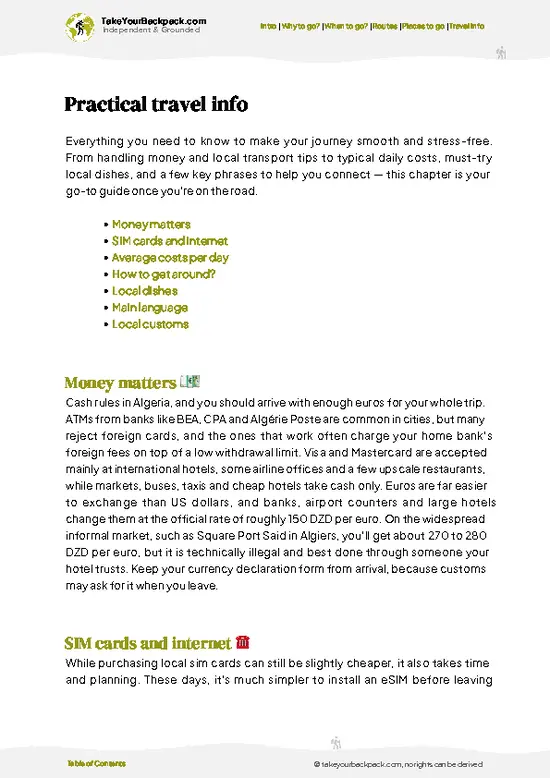
example page 0 from our offline Travel Guide for Algeria
example page 1 from our offline Travel Guide for Algeria
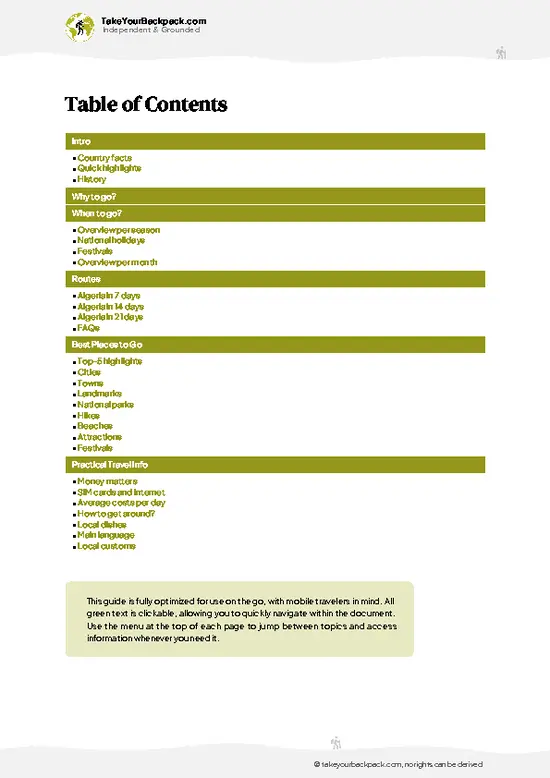
example page 2 from our offline Travel Guide for Algeria
example page 3 from our offline Travel Guide for Algeria
example page 4 from our offline Travel Guide for Algeria
example page 5 from our offline Travel Guide for Algeria
example page 6 from our offline Travel Guide for Algeria
example page 7 from our offline Travel Guide for Algeria
Loading the map 🌍
CLICK TO FILTER
cities
towns
landmarks
national parks
hikes
beaches
attractions
festivals
SHOW COUNTRY’S BESTSHOW ALL

✨ Why go?
Ranked #9 national park in Algeria
What makes this national park worth exploring

Backpackers choose Belezma National Park because it is wild in a way few Algerian parks are, with Atlas cedar stands above 2,000 meters and almost no other hikers. You pick your own line along ridges, gullies and shepherd tracks, and you can camp or sleep cheaply in Batna and return each day. It works best for self-guided travelers who can read a map and speak a little French or Arabic; tours are scarce, so you set the pace. The park also protects Barbary macaques, which you can often spot near the cedars, and it sits close to the Roman ruins of Timgad and Lambaesis, so one trip can combine hiking with antiquity. If you want waymarked loops and cafes, look elsewhere. If you want quiet, this fits.

💡 HighlightsMust-see experiences and standout moments

  1. Atlas cedar forests: The park’s signature sight, with ancient trees on steep slopes, deep shade and a sharp resin smell.
  2. Barbary macaques: Wild troops live in the cedar zone; keep your distance and expect sightings early or late in the day.
  3. Djebel Tuggurt ridge: A high crest with long views across the Batna basin toward the Aurès peaks.
  4. Golden eagle and raptor watching: Cliff faces draw eagles and other birds of prey, best seen from open ridges on clear days.
  5. Limestone gorges and cliffs: Pale rock walls cut by dry streambeds make for scrambling and good photographs.
  6. Shepherd tracks through the highlands: Old paths link meadows and springs, and you may meet herders with their flocks.
  7. Wildflower slopes: In spring, the meadows between the cedars fill with color and the air smells of thyme.
Belezma National … read more 👉
  1. Atlas cedar forests: The park’s signature sight, with ancient trees on steep slopes, deep shade and a sharp resin smell.
  2. Barbary macaques: Wild troops live in the cedar zone; keep your distance and expect sightings early or late in the day.
  3. Djebel Tuggurt ridge: A high crest with long views across the Batna basin toward the Aurès peaks.
  4. Golden eagle and raptor watching: Cliff faces draw eagles and other birds of prey, best seen from open ridges on clear days.
  5. Limestone gorges and cliffs: Pale rock walls cut by dry streambeds make for scrambling and good photographs.
  6. Shepherd tracks through the highlands: Old paths link meadows and springs, and you may meet herders with their flocks.
  7. Wildflower slopes: In spring, the meadows between the cedars fill with color and the air smells of thyme.
Belezma National Park takes a full day to see the main highlights, or two days if you walk deeper into the ridges.
Spotted a mistake or missing something? Contact us.

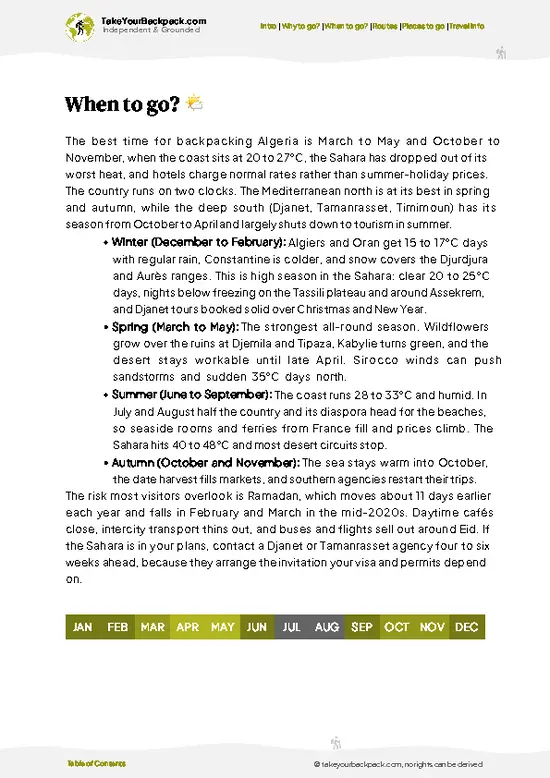
🌤️ When to go?Seasonal considerations and timing

  • Spring (April to June): Daytime highs run 15 to 27°C (59 to 81°F), the cedar slopes turn green and wildflowers appear, and long daylight gives you 13 to 14 hours on the trail. Crowds stay thin and prices are flat.
  • Summer (July to August): Highs reach 33 to 38°C (91 to 100°F) in Batna, cooler up in the cedar forest of Mount Tuggurt. Start at dawn. Local families fill guesthouses, so beds cost slightly more.
  • Autumn (September to November): Temperatures ease to 12 to 26°C (54 to 79°F), the light is clear and the walking is comfortable. Fewer visitors.
  • Winter (December to February): Highs of 3 to 10°C (37 to 50°F) with frost and snow on the ridges, and only about 10 hours of daylight. Cheapest rooms, but trails can be icy.
Aim for late April or October, when you get mild walking weather and Algerian school holidays are not driving up room rates.

source: climatestotravel.comJANJanuary: fair for travelingFEBFebruary: fair for travelingMARMarch: good for travelingAPRApril: excellent for travelingMAYMay: excellent for travelingJUNJune: highly recommended for travelingJULJuly: below average for travelingAUGAugust: below average for travelingSEPSeptember: highly recommended for travelingOCTOctober: excellent for travelingNOVNovember: good for travelingDECDecember: fair for traveling
when-to-go

✈️ The backpacker research shortcutAlgeria Travel Guide

An offline-friendly backpacking guide with optimized travel routes, ranked highlights, transport advice, and the best areas to stay.
example page 0 from our offline Travel Guide for Algeria
example page 1 from our offline Travel Guide for Algeria
example page 2 from our offline Travel Guide for Algeria
example page 3 from our offline Travel Guide for Algeria
example page 4 from our offline Travel Guide for Algeria
example page 5 from our offline Travel Guide for Algeria
example page 6 from our offline Travel Guide for Algeria
example page 7 from our offline Travel Guide for Algeria
The digital guide (314 pages) contains:
✅ 79 highlights, ranked by travel appeal
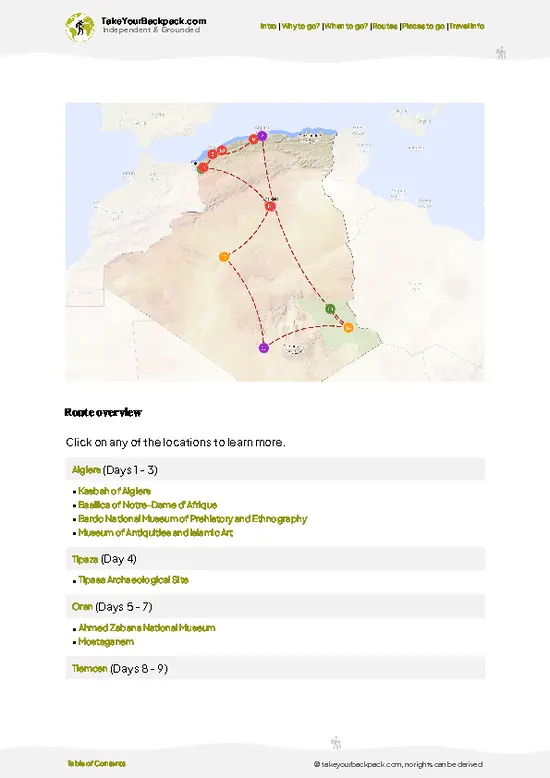
✅ Optimized 7, 14 & 21-day travel routes
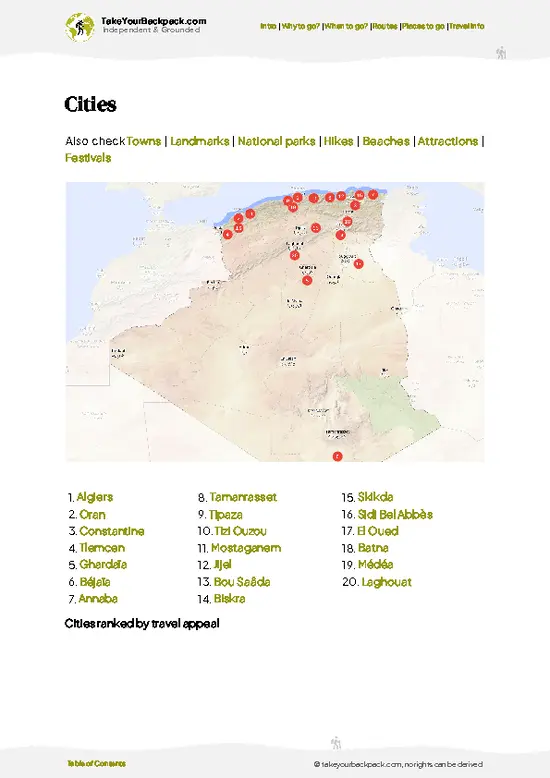
✅ Cities, national parks, landmarks, beaches
✅ How to get around
✅ Offline-friendly for travel without Wi-Fi
👉 Click to see all 30+ guide features

📅 Plan smarter in minutes, not weeks
✅ Month by month travel advice
✅ Festivals & national holidays
✅ Budget expectations

🗺️ Go to the right places, skip the overrated ones
✅ Honest pros & cons of destinations
✅ Top hikes, parks & viewpoints
✅ Lesser-known places most travelers miss
✅ Clear “worth it vs skip it” guidance

🛏️ Travel smoothly without rookie mistakes
✅ Best areas to stay
✅ Transport systems explained simply
✅ Common scams & safety advice
✅ SIM cards, money & practical tips

🌍 Understand the country, not just visit it
✅ Culture & traditions
✅ 52 Essential phrases & customs
✅ Festivals worth planning around
✅ Traveler-friendly historical context
✅ Insights that make places more meaningful

📱 Built for real travel conditions
✅ Fully downloadable PDF
✅ Works completely offline
✅ Optimized for phone use
✅ Useful in remote areas & buses
✅ Everything in one place
Stop searching, start planning
Get instant access to your full guide. 30‑day money-back guarantee.
+ Add another guide for just

By proceeding you agree to our terms.
Sent to your inbox immediately after payment • 100% Secure Checkout
Best Backpacking Travel Advisor 2025 tourism awardBest Backpacking
Travel Advisor
2025
What others say about Take Your Backpack Guides:
⭐⭐⭐⭐⭐
Fantastic, amazing amount of information!
⭐⭐⭐⭐⭐
My goodness this is amazing, it's what I've been looking for hats off too you!
⭐⭐⭐⭐⭐
I think this is absolutely BRILLIANT
⭐⭐⭐⭐
Very complete and informative. It's still missing places, but I gotta to commend you
⭐⭐⭐⭐⭐
This is truly amazing, thank you, can't wait to explore it with my kids!
⭐⭐⭐⭐⭐
Awesome resource, thank you!
⭐⭐⭐⭐⭐
This is amazing! Can't wait to explore the ones I haven't seen
⭐⭐⭐⭐
I love this! Well done, great idea.
⭐⭐⭐⭐⭐
Thanks for taking the time to make this gem!
⭐⭐⭐⭐⭐
This might be the best website I've ever seen.
⭐⭐⭐⭐⭐
Congratulations, and thank you so much for your work; it's incredibly valuable.
⭐⭐⭐⭐
In all seriousness I think you did a great job pointing out the important spots
⭐⭐⭐⭐⭐
10/10 very good
⭐⭐⭐⭐⭐
As someone who's only just starting to visit regularly this is awesome, thank you.
⭐⭐⭐⭐
Thank you very much! I'm going to visit my dad, it's going to be very useful!
⭐⭐⭐⭐⭐
This is really cool! We'll be travelling for the first time and this definitely come in handy.
⭐⭐⭐⭐⭐
You are now our minister of culture, congratulations 👨‍💼
⭐⭐⭐⭐⭐
Just wanted to tell you that this is a pearl! Going to follow your recommendations.
⭐⭐⭐⭐⭐
This is so cool. I'll definitely be using the resource for my travels soon.
⭐⭐⭐⭐⭐
This is very impressive! Good work.
⭐⭐⭐⭐⭐
This is an amazing and informative site. Very well done!

🛏️ Where to stay?Best areas and accommodation options

Batna is the practical place to stay, since Belezma National Park has no campgrounds or hostels of its own. The city sits roughly 5 to 15 kilometers from the park’s western edge and has the widest choice of simple hotels, typically US$15 to 35 a night for a double, plus a few mid-range options up to US$50. It also has the main bus station and taxi stands, so reaching trailheads is easy to arrange.
For a quieter base, look at the small town of Seriana on the park’s edge, or Fesdis, where you can find basic rooms and occasional family guesthouses. Options are limited, so call ahead. Hotels in Batna … read more 👉
Batna is the practical place to stay, since Belezma National Park has no campgrounds or hostels of its own. The city sits roughly 5 to 15 kilometers from the park’s western edge and has the widest choice of simple hotels, typically US$15 to 35 a night for a double, plus a few mid-range options up to US$50. It also has the main bus station and taxi stands, so reaching trailheads is easy to arrange.
For a quieter base, look at the small town of Seriana on the park’s edge, or Fesdis, where you can find basic rooms and occasional family guesthouses. Options are limited, so call ahead. Hotels in Batna rarely suit shoestring dormitory seekers, as true hostels are almost nonexistent in Algeria. Camping inside the park is informal and best arranged through the park administration in Batna before you go. Many travelers also use Batna as a hub for Timgad and Lambese, both a short ride away, which makes the city a sensible home for several nights.

👛 Costs (as of 22 October 2026)How expensive it really is

Belezma National Park costs most travelers about US$45 to 70 a day when based in Batna, using simple hotels, local food and shared taxis.
CategoryBudget RangeLocal Reality
Entrance feeUS$0 to 2Access is usually free or a token charge, paid in cash dinars if asked.
Accommodation (high season)US$20 to 35Basic hotel in Batna; rates dip in winter to roughly US$15 to 25.
Local transportUS$5 to 15Shared taxis and city buses to park edges are cheap; a private taxi to trailheads costs more.
Food and suppliesUS$8 to 12Sandwiches, grilled meat and couscous at local cafés; stock up on water in town.
Guide (optional)US$10 to 20Arranged through the park office or a Batna agency for a day walk.
Total Daily BudgetUS$45 to 70Excludes long-distance travel to Batna.
⚠️ Prices can change and everyone travels differently, so take this as a rough guide. Hope it helps you plan your adventure!

🥾 TrailsBest hikes in Belezma national park

Belezma National Park has few formally named, measured trails, so most hikers follow shepherd paths and forest tracks from the villages and forest edges near Batna. Terrain is steep limestone, loose scree and cedar woodland, with the highest ground cold and windy.
  • Cedar forest walk: Start at the forest edge and climb through the trees for about half a day; moderate difficulty with steady uphill.
  • Ridge traverse: Follow the high crest toward Djebel Tuggurt for open views; full day, demanding, with little shade or water.
  • Gorge scramble: Follow dry watercourses between cliff walls for a few hours; easy
… read more 👉
Belezma National Park has few formally named, measured trails, so most hikers follow shepherd paths and forest tracks from the villages and forest edges near Batna. Terrain is steep limestone, loose scree and cedar woodland, with the highest ground cold and windy.
  • Cedar forest walk: Start at the forest edge and climb through the trees for about half a day; moderate difficulty with steady uphill.
  • Ridge traverse: Follow the high crest toward Djebel Tuggurt for open views; full day, demanding, with little shade or water.
  • Gorge scramble: Follow dry watercourses between cliff walls for a few hours; easy to moderate, but slippery after rain.
  • Wildlife focus: Macaques are most active in the cedars, and raptors circle the cliffs; go quietly and early.
Reaching the park without a car is hard. Take public transport to Batna, then a taxi to the forest edge, and arrange pickup in advance. Crowds are almost nonexistent, even on weekends. Check with the park office in Batna about any entrance fee, and take a guide if you want to go beyond the obvious paths.
⚠️ Hiking info can sometimes be outdated or inaccurate. Before you hit the trail, check the latest conditions with locals. If you do spot anything that's off, I'd love to hear from you, so I can update it for fellow travelers.

🛡️ SafetySafety Tips and Common Scams in Belezma

Belezma National Park is straightforward walking country, with the main risks being heat, cold and navigation. Summer afternoons on the exposed limestone slopes get hot, so carry at least 3 liters of water and walk in the morning. Winter brings frost, snow and short days on the higher ridges around Mount Tuggurt, so pack layers and sturdy boots. Marked trails are few and mobile signal drops in the valleys, so download an offline map and tell your lodging where you are headed. Hiring a local guide through the park office in Batna is wise for longer routes. Wild boar and the odd jackal live in the forest and avoid people. Keep food sealed and give any animal space. Dogs near farms can be territorial, so walk calmly past them.

FAQFrequently asked questions about Belezma

Two days is enough for Belezma National Park if you base yourself in Batna. Spend one day on the cedar forest and Mount Tuggurt walks, and the second on the Tazoult or Seriana side. Add a third day if you want to pair it with the Roman ruins of Timgad, about 35 kilometers east of Batna.
Belezma National Park is hard to reach without a car, but doable. Shared taxis and minibuses run from Batna’s stations to Seriana and Fesdis for roughly US$1 to 3, and a private taxi for a half day costs about US$20 to 40. Trailheads are often a few kilometers beyond the last public stop, so expect some road walking.
Belezma National Park has no major entrance fee, and access is usually free or at most a token charge of around US$0 to 2. No formal hiking permit is routinely required for day walks. For longer treks or camping, check with the park administration in Batna, and consider a local guide at about US$10 to 20 a day.
⚠️ Things can change over time, so always validate details locally before you go.

Other Algerian national parks near Belezma

Explore more nearby:


💡 Not sure where to go next?
Create a personalized itinerary for Algeria including Belezma and the places that fit your trip.

Generate my itinerary

👉 Discover all national parks

Or checkout all Algeria has to offer (think cities, towns, villages, national parks, hikes, beaches, festivals)
Country photo of Algeria

We 💚 feedbackIs it worth it?

Belezma National Park suits fit, self-reliant hikers who like solitude and can read terrain, and it will frustrate anyone wanting marked trails or a cafe stop. I would bring a full day of water, layers for the cold ridge and a guide from Batna, then spend the afternoon looking for macaques.

✍️ Help improve this page!
The information on this page is based on in-depth research, insights shared by experienced travelers, and feedback from the local travel community in Algeria. While every effort is made to keep the information accurate and current, conditions can change — so if you spot anything incorrect or outdated, please get in touch.


🙋‍♂️ Give feedback

👋 Meet the founderWho’s Behind Take Your Backpack?

Johan, backpacker and founder of TakeYourBackpackHi, I’m Johan (Netherlands 🇳🇱), the creator of TakeYourBackpack. Over the past 3 decades, I’ve backpacked through 90+ countries across six continents, gaining extensive experience with independent travel, long-term trips, and overland routes.

This site is built on a combination of firsthand travel experience and carefully curated insights from other backpackers. Many guides are based on places I’ve personally visited, while others bring together tips, observations, and practical advice shared by trusted travelers I’ve met along the way.

The goal is to provide realistic, experience-driven guidance — not generic itineraries — so you can explore destinations with better context, clearer expectations, and more confidence.