×

American Samoa🇦🇸 | national parksFagatele Bay National Marine SanctuaryCrater overlook, table corals, humpback season, turtle reef | things to do and best time to go

Explore Fagasa PassExplore National Park of American Samoa

Backpacking in Fagatele Bay National Marine Sanctuary
🌟 Highlightnational park ranked #2
By Johan Kruseman 🇳🇱 | Updated October 15, 2026

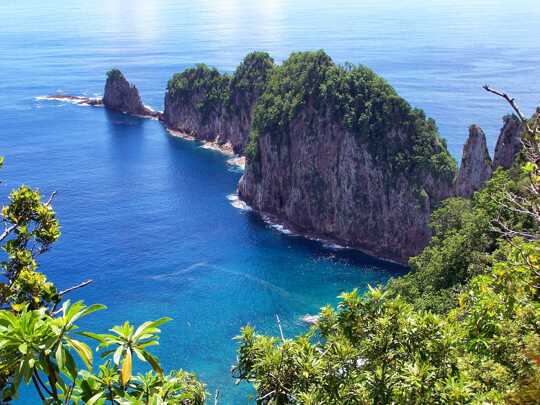
You reach the end of the paved road, the engine ticks as it cools, and the hush drops in. Below you, a green wall of forest tumbles toward a bowl of water the color of sea glass, with surf thumping on the reef edge. Fagatele Bay sits on the southwest coast of Tutuila in American Samoa, inside a collapsed volcanic crater. The reef is excellent, turtles are common, and humpbacks pass offshore in the southern winter. Access is the catch. There is no beach resort, no snack shack and almost no shade at the viewpoint, because the crater walls are steep and the water is reached only by rough footing or a boat. Go early, since the cliffs hold the morning light and the afternoon squalls tend to build later. Bring your own water and skip the swim unless you have local guidance. You’ll like it if you enjoy quiet lookouts and marine life. Skip it if you need services or an easy walk to the water.

Discover everything you want to know in the 📖 American Samoa Travel Guide.


example page 0 from our offline Travel Guide for American Samoa
example page 1 from our offline Travel Guide for American Samoa
example page 2 from our offline Travel Guide for American Samoa
example page 3 from our offline Travel Guide for American Samoa
example page 4 from our offline Travel Guide for American Samoa
example page 5 from our offline Travel Guide for American Samoa
example page 6 from our offline Travel Guide for American Samoa
example page 7 from our offline Travel Guide for American Samoa
Loading the map 🌍
CLICK TO FILTER
towns
villages
landmarks
national parks
hikes
beaches
attractions
festivals
regions
SHOW COUNTRY’S BESTSHOW ALL

✨ Why go?
Ranked #2 national park in American Samoa
Reasons people choose to explore here

Backpackers pick Fagatele Bay because it is one of the few places in American Samoa where you can read the geology and ecology of a whole crater in one look, without a tour group between you and the view. The bay is a drowned volcanic caldera, and the sheer walls plunging into the water make the formation obvious from the lookout. That alone suits self-guided travelers well, since you arrive on your own schedule and stand at the rim as long as you like.
The second reason is the water itself. Fagatele holds the coral reef within the sanctuary that is among the best protected on Tutuila, and the clear conditions make snorkelers and divers travel here when sea conditions allow. Because the bay is small and its entry is rough, going with local operators or sanctuary staff is smarter than improvising, … read more 👉
Backpackers pick Fagatele Bay because it is one of the few places in American Samoa where you can read the geology and ecology of a whole crater in one look, without a tour group between you and the view. The bay is a drowned volcanic caldera, and the sheer walls plunging into the water make the formation obvious from the lookout. That alone suits self-guided travelers well, since you arrive on your own schedule and stand at the rim as long as you like.
The second reason is the water itself. Fagatele holds the coral reef within the sanctuary that is among the best protected on Tutuila, and the clear conditions make snorkelers and divers travel here when sea conditions allow. Because the bay is small and its entry is rough, going with local operators or sanctuary staff is smarter than improvising, and that keeps the place quiet.
Finally, the sanctuary is the Tutuila anchor of the wider National Marine Sanctuary of American Samoa. Visiting the bay gives you context for the rest of the island’s marine life, and it costs little beyond transport and a morning.

💡 HighlightsThe experiences that define the visit

  1. Fagatele Bay Overlook: The sight everyone comes for. From the road end you look down into the crater, with cliffs dropping straight into turquoise water and the open Pacific beyond the gap in the rim.
  2. The Collapsed Crater Walls: The bay is the remains of an ancient volcano whose seaward side fell away. The steep, forested slopes show the crater shape better than any sign could.
  3. Fagatele Coral Reef: Healthy table corals and dense reef fish fill the shallows. It is one of the main reasons the bay was protected, and the clear water rewards snorkelers who go with someone who knows the conditions.
  4. Green Sea Turtles: Turtles graze along the reef and in the bay, and a patient look from the overlook on a calm day often picks out a head surfacing.
  5. Humpback Whale Watching: Humpbacks pass the southern coast
… read more 👉
  1. Fagatele Bay Overlook: The sight everyone comes for. From the road end you look down into the crater, with cliffs dropping straight into turquoise water and the open Pacific beyond the gap in the rim.
  2. The Collapsed Crater Walls: The bay is the remains of an ancient volcano whose seaward side fell away. The steep, forested slopes show the crater shape better than any sign could.
  3. Fagatele Coral Reef: Healthy table corals and dense reef fish fill the shallows. It is one of the main reasons the bay was protected, and the clear water rewards snorkelers who go with someone who knows the conditions.
  4. Green Sea Turtles: Turtles graze along the reef and in the bay, and a patient look from the overlook on a calm day often picks out a head surfacing.
  5. Humpback Whale Watching: Humpbacks pass the southern coast of Tutuila during the southern winter. The high cliffs make a good place to scan the horizon for spouts and breaches without a boat.
  6. Coastal Forest Slopes: The steep walls hold native forest, including seabird-friendly cliff vegetation. Birdsong and rustling fruit bats in the evening make the road end more lively than it first looks.
  7. Vaitogi Turtle and Shark Site: A short drive away, this village site on lava rock is tied to a Samoan legend of a girl and her blind grandmother who became a shark and a turtle. The cliffs and blowholes are worth a stop.
  8. Tauese P.F. Sunia Ocean Center: The sanctuary’s visitor center in Pago Pago Harbor has exhibits on the reef, whales and the wider sanctuary, and it gives useful background before or after you see the bay.
The overlook and Vaitogi pair easily in one morning, since both are on the same stretch of south coast road and each needs only an hour or so.
Spotted a mistake or missing something? Contact us.

🌤️ When to go?Seasonal considerations and timing

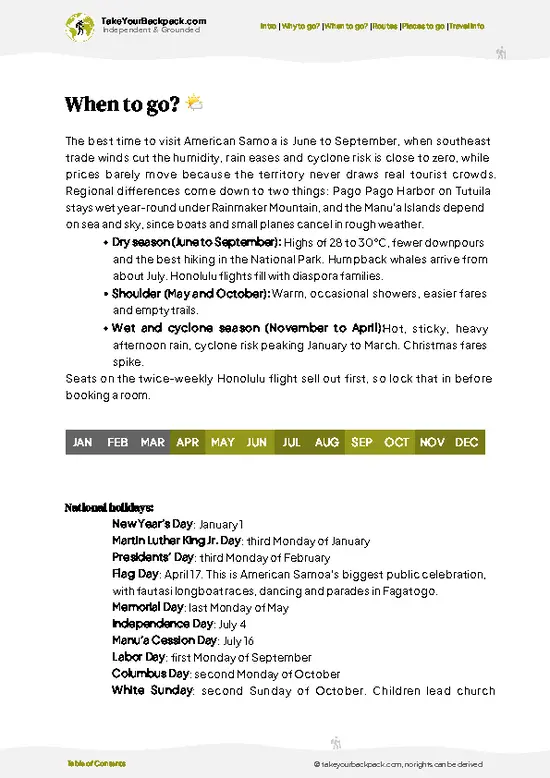
  • Dry Season (May to October): Calmest window for the bay. Days run 26 to 30°C (79 to 86°F), trade winds keep humidity tolerable, and southern swells are mostly modest, though the open south-facing coast can still churn. Sunrise to sunset is roughly 11.5 to 12.5 hours.
  • Wet Season (November to April): Hot and sticky at 28 to 32°C (82 to 90°F), with heavy afternoon downpours and the cyclone season peaking from December to March. Runoff clouds the water and the rough access track gets slick.
  • Whale Season (July to October): Humpbacks pass along the south coast, and this is the best reason to time a visit then.
  • Crowds and Prices: The area sees few visitors year-round. Flights and lodging in Tafuna and Pago Pago rise a little in July and August and around Christmas.
  • Daylight: Near the equator, expect
… read more 👉
  • Dry Season (May to October): Calmest window for the bay. Days run 26 to 30°C (79 to 86°F), trade winds keep humidity tolerable, and southern swells are mostly modest, though the open south-facing coast can still churn. Sunrise to sunset is roughly 11.5 to 12.5 hours.
  • Wet Season (November to April): Hot and sticky at 28 to 32°C (82 to 90°F), with heavy afternoon downpours and the cyclone season peaking from December to March. Runoff clouds the water and the rough access track gets slick.
  • Whale Season (July to October): Humpbacks pass along the south coast, and this is the best reason to time a visit then.
  • Crowds and Prices: The area sees few visitors year-round. Flights and lodging in Tafuna and Pago Pago rise a little in July and August and around Christmas.
  • Daylight: Near the equator, expect dusk around 6 to 6:45 pm, so start early.
Book a morning outing in June or July, when mornings are driest and the water is clearest.


source: climatestotravel.comJANJanuary: fair for travelingFEBFebruary: fair for travelingMARMarch: fair for travelingAPRApril: fair for travelingMAYMay: highly recommended for travelingJUNJune: excellent for travelingJULJuly: excellent for travelingAUGAugust: excellent for travelingSEPSeptember: excellent for travelingOCTOctober: highly recommended for travelingNOVNovember: fair for travelingDECDecember: fair for traveling
when-to-go

✈️ The backpacker research shortcutAmerican Samoa Travel Guide

An offline-friendly backpacking guide with optimized travel routes, ranked highlights, transport advice, and the best areas to stay.
example page 0 from our offline Travel Guide for American Samoa
example page 1 from our offline Travel Guide for American Samoa
example page 2 from our offline Travel Guide for American Samoa
example page 3 from our offline Travel Guide for American Samoa
example page 4 from our offline Travel Guide for American Samoa
example page 5 from our offline Travel Guide for American Samoa
example page 6 from our offline Travel Guide for American Samoa
example page 7 from our offline Travel Guide for American Samoa
The digital guide (141 pages) contains:
✅ 36 highlights, ranked by travel appeal
✅ Optimized 2, 3 & 5-day travel routes
✅ Cities, national parks, landmarks, beaches
✅ How to get around
✅ Offline-friendly for travel without Wi-Fi
👉 Click to see all 30+ guide features

📅 Plan smarter in minutes, not weeks
✅ Month by month travel advice
✅ Festivals & national holidays
✅ Budget expectations

🗺️ Go to the right places, skip the overrated ones
✅ Honest pros & cons of destinations
✅ Top hikes, parks & viewpoints
✅ Lesser-known places most travelers miss
✅ Clear “worth it vs skip it” guidance

🛏️ Travel smoothly without rookie mistakes
✅ Best areas to stay
✅ Transport systems explained simply
✅ Common scams & safety advice
✅ SIM cards, money & practical tips

🌍 Understand the country, not just visit it
✅ Culture & traditions
✅ 52 Essential phrases & customs
✅ Festivals worth planning around
✅ Traveler-friendly historical context
✅ Insights that make places more meaningful

📱 Built for real travel conditions
✅ Fully downloadable PDF
✅ Works completely offline
✅ Optimized for phone use
✅ Useful in remote areas & buses
✅ Everything in one place
Stop searching, start planning
Get instant access to your full guide. 30‑day money-back guarantee.
+ Add another guide for just

By proceeding you agree to our terms.
Sent to your inbox immediately after payment • 100% Secure Checkout
Best Backpacking Travel Advisor 2025 tourism awardBest Backpacking
Travel Advisor
2025
What others say about Take Your Backpack Guides:
⭐⭐⭐⭐⭐
Fantastic, amazing amount of information!
⭐⭐⭐⭐⭐
My goodness this is amazing, it's what I've been looking for hats off too you!
⭐⭐⭐⭐⭐
I think this is absolutely BRILLIANT
⭐⭐⭐⭐
Very complete and informative. It's still missing places, but I gotta to commend you
⭐⭐⭐⭐⭐
This is truly amazing, thank you, can't wait to explore it with my kids!
⭐⭐⭐⭐⭐
Awesome resource, thank you!
⭐⭐⭐⭐⭐
This is amazing! Can't wait to explore the ones I haven't seen
⭐⭐⭐⭐
I love this! Well done, great idea.
⭐⭐⭐⭐⭐
Thanks for taking the time to make this gem!
⭐⭐⭐⭐⭐
This might be the best website I've ever seen.
⭐⭐⭐⭐⭐
Congratulations, and thank you so much for your work; it's incredibly valuable.
⭐⭐⭐⭐
In all seriousness I think you did a great job pointing out the important spots
⭐⭐⭐⭐⭐
10/10 very good
⭐⭐⭐⭐⭐
As someone who's only just starting to visit regularly this is awesome, thank you.
⭐⭐⭐⭐
Thank you very much! I'm going to visit my dad, it's going to be very useful!
⭐⭐⭐⭐⭐
This is really cool! We'll be travelling for the first time and this definitely come in handy.
⭐⭐⭐⭐⭐
You are now our minister of culture, congratulations 👨‍💼
⭐⭐⭐⭐⭐
Just wanted to tell you that this is a pearl! Going to follow your recommendations.
⭐⭐⭐⭐⭐
This is so cool. I'll definitely be using the resource for my travels soon.
⭐⭐⭐⭐⭐
This is very impressive! Good work.
⭐⭐⭐⭐⭐
This is an amazing and informative site. Very well done!

🛏️ Where to stay?Best areas to stay in American Samoa

There is nowhere to sleep inside Fagatele Bay National Marine Sanctuary, so you stay on the island of Tutuila and drive in. The best base is the Tafuna airport area on the south coast, about 20 to 30 minutes from the sanctuary's Leone side. Motels and guesthouses here cost roughly US$90 to 150 a night, and you get easy access to rental cars and supermarkets such as Cost-U-Less.

Leone, the village closest to the bay, has a few family-run homestays and fales (open-sided Samoan huts) at around US$40 to 90, which puts you within a short drive of the trailhead and the quiet village life. Ask locally, … read more 👉
There is nowhere to sleep inside Fagatele Bay National Marine Sanctuary, so you stay on the island of Tutuila and drive in. The best base is the Tafuna airport area on the south coast, about 20 to 30 minutes from the sanctuary's Leone side. Motels and guesthouses here cost roughly US$90 to 150 a night, and you get easy access to rental cars and supermarkets such as Cost-U-Less.

Leone, the village closest to the bay, has a few family-run homestays and fales (open-sided Samoan huts) at around US$40 to 90, which puts you within a short drive of the trailhead and the quiet village life. Ask locally, as many places take bookings by phone or Facebook message rather than online platforms.

Pago Pago and Utulei on the harbor have the widest choice, including mid-range hotels at US$110 to 180, plus restaurants and the main bus terminal. Expect 45 to 60 minutes by road to the bay. No hostels exist on the island, so budget for a private room. Camping is not set up near the bay, and village permission is required for any informal pitch.

👛 Costs (as of 15 October 2026)Travel costs and budget guide for Fagatele Bay National Marine Sanctuary

Expect to spend about US$110 to 220 a day on Tutuila while visiting Fagatele Bay National Marine Sanctuary, mostly because lodging and a rental car cost more than in neighboring Samoa. The US dollar is the local currency.
CategoryBudget RangeLocal Reality
Entrance feeUS$0No sanctuary fee is charged. Village permission or a small courtesy gift may be expected on some land.
Accommodation (high season)US$50 to 110Homestays and basic motels. Standard hotels cost more and there are no hostels.
Local transportUS$20 to 50Rental cars run roughly US$60 to 90 a day. Shared taxis and colorful aiga buses are cheap but infrequent and do not reach the bay directly.
Food and suppliesUS$20 to 40Local plate lunches cost US$6 to 10, and groceries from supermarkets are pricey because most goods are imported.
Activities
… read more 👉
Expect to spend about US$110 to 220 a day on Tutuila while visiting Fagatele Bay National Marine Sanctuary, mostly because lodging and a rental car cost more than in neighboring Samoa. The US dollar is the local currency.
CategoryBudget RangeLocal Reality
Entrance feeUS$0No sanctuary fee is charged. Village permission or a small courtesy gift may be expected on some land.
Accommodation (high season)US$50 to 110Homestays and basic motels. Standard hotels cost more and there are no hostels.
Local transportUS$20 to 50Rental cars run roughly US$60 to 90 a day. Shared taxis and colorful aiga buses are cheap but infrequent and do not reach the bay directly.
Food and suppliesUS$20 to 40Local plate lunches cost US$6 to 10, and groceries from supermarkets are pricey because most goods are imported.
Activities and gearUS$10 to 20Snorkel gear rental or purchase and a guide if you want one. Whale-watching and guided trips vary in price.
Total Daily BudgetUS$110 to 220Sharing a car and room with a partner cuts the per-person cost sharply.
⚠️ Prices can change and everyone travels differently, so take this as a rough guide. Hope it helps you plan your adventure!

🥾 TrailsScenic routes and wildlife spotting in Fagatele Bay National Marine Sanctuary

Hiking at Fagatele Bay is short, steep and rough rather than long, and there is no signed network of named trails. What people actually do is walk from the end of the road to the rim and look down into the crater, and a few go farther on rough footing toward the water.
  • Road-end rim walk: A short stroll from where the road stops to the viewpoint, with grass and stone underfoot and big views. It takes about 15 to 30 minutes with stops, and it is easy for most visitors.
  • Descent toward the bay: A steep, slippery, root-laced scramble down the crater slope toward the shore. It is hard going, takes well
… read more 👉
Hiking at Fagatele Bay is short, steep and rough rather than long, and there is no signed network of named trails. What people actually do is walk from the end of the road to the rim and look down into the crater, and a few go farther on rough footing toward the water.
  • Road-end rim walk: A short stroll from where the road stops to the viewpoint, with grass and stone underfoot and big views. It takes about 15 to 30 minutes with stops, and it is easy for most visitors.
  • Descent toward the bay: A steep, slippery, root-laced scramble down the crater slope toward the shore. It is hard going, takes well over an hour round trip, and is best done with local guidance, particularly after rain.
  • Cliff and coastal views: The rim gives sweeping views of the open ocean and the crater walls, and it is good for whale spotting in the southern winter and for sunsets over the sea.
  • Terrain: Rocky ground, loose soil, tropical forest, and exposed sun at the road end. Sturdy shoes with grip matter more than any gear.
  • Wildlife: Green sea turtles in the water, fruit bats and seabirds around the cliffs, and reef fish if you get into the water with a guide.
  • Difficulty: Easy at the rim, strenuous on any descent.
Getting there is the real challenge. Public buses on Tutuila run along the main south coast road, but they do not go all the way to the end of the bay road, so expect a walk on the last stretch or a lift from a taxi or rental car. Having your own vehicle makes it simpler. The site sees very few visitors, so you will often have the overlook to yourself. There is no entrance fee for viewing the bay from the road. Bring water, sun protection and rain gear, and ask at the sanctuary office in Pago Pago about current conditions and guided access before attempting anything beyond the rim.
⚠️ Hiking info can sometimes be outdated or inaccurate. Before you hit the trail, check the latest conditions with locals. If you do spot anything that's off, I'd love to hear from you, so I can update it for fellow travelers.

🛡️ SafetyStaying Safe: What Travelers Should Know

Fagatele Bay is a remote, lightly visited spot, so the main hazards are heat, rough surf and being on your own. The cliffs around the bay are steep and the crater rim footing is loose and muddy after rain, so wear shoes with grip and carry at least 2 liters of water per person. The sanctuary has no services, and phone coverage can drop out.

The open ocean beyond the bay can produce strong currents and swells, especially from May to October when south swells build. Snorkel only on calm days, go with a buddy, and never swim out through the bay mouth. Coral is fragile and sharp, so don't stand on it.

Animals are not a worry on land. Stray village dogs can be a nuisance on the road, so walk calmly and keep moving. Tell your host where you are headed, start early to avoid afternoon storms, and … read more 👉
Fagatele Bay is a remote, lightly visited spot, so the main hazards are heat, rough surf and being on your own. The cliffs around the bay are steep and the crater rim footing is loose and muddy after rain, so wear shoes with grip and carry at least 2 liters of water per person. The sanctuary has no services, and phone coverage can drop out.

The open ocean beyond the bay can produce strong currents and swells, especially from May to October when south swells build. Snorkel only on calm days, go with a buddy, and never swim out through the bay mouth. Coral is fragile and sharp, so don't stand on it.

Animals are not a worry on land. Stray village dogs can be a nuisance on the road, so walk calmly and keep moving. Tell your host where you are headed, start early to avoid afternoon storms, and respect village customs when passing through Leone, including asking before entering private land.

FAQCommon questions from travelers

Half a day is enough for Fagatele Bay itself, since the sanctuary has no developed trails or facilities and the main experience is a viewpoint and a snorkel or dive on a calm day. Most backpackers combine it with the nearby Leone village and Tafuna beaches for a full day. Allow 2 to 3 days on Tutuila if you also want to see National Park of American Samoa and Pago Pago.
Reaching it without a car is difficult. The local aiga buses run from Pago Pago to Leone on the south coast, taking about 45 to 60 minutes and costing roughly US$1 to 2, but they stop well short of the bay and run irregularly. A taxi from Leone or Tafuna costs around US$15 to 30 each way, and renting a car at around US$60 to 90 a day is the easiest option.
No entrance fee is charged and no permit is needed for general visits to the sanctuary. Diving, research and commercial activities may require permission from the sanctuary office in Pago Pago. Access crosses village land around Leone, so ask locally before heading in, and a small courtesy gift or donation is appreciated.
⚠️ Things can change over time, so always validate details locally before you go.

Other American Samoan national parks near Fagatele Bay National Marine Sanctuary

Explore more nearby:


💡 Not sure where to go next?
Create a personalized itinerary for American Samoa including Fagatele Bay National Marine Sanctuary and the places that fit your trip.

Generate my itinerary

👉 Discover all national parks

Or checkout all American Samoa has to offer (think cities, towns, villages, national parks, hikes, beaches, festivals)
Country photo of American Samoa

We 💚 feedbackParting advice and final tips

Go on a calm morning in the southern winter, roughly July through October, when the crater is lit gold and humpbacks are cruising past. I would arrive before the sun gets high, bring a hat and plenty of water, and leave the descent for another day unless a local is leading the way.

✍️ Help improve this page!
The information on this page is based on in-depth research, insights shared by experienced travelers, and feedback from the local travel community in American Samoa. While every effort is made to keep the information accurate and current, conditions can change — so if you spot anything incorrect or outdated, please get in touch.


🙋‍♂️ Give feedback

👋 Meet the founderWho’s Behind Take Your Backpack?

Johan, backpacker and founder of TakeYourBackpackHi, I’m Johan (Netherlands 🇳🇱), the creator of TakeYourBackpack. Over the past 3 decades, I’ve backpacked through 90+ countries across six continents, gaining extensive experience with independent travel, long-term trips, and overland routes.

This site is built on a combination of firsthand travel experience and carefully curated insights from other backpackers. Many guides are based on places I’ve personally visited, while others bring together tips, observations, and practical advice shared by trusted travelers I’ve met along the way.

The goal is to provide realistic, experience-driven guidance — not generic itineraries — so you can explore destinations with better context, clearer expectations, and more confidence.