×

Angola🇦🇴 | regionsNamib DesertIona 4x4 tracks, Welwitschia plains, Moçâmedes seafront, Mucubal villages | things to do and best time to go

Explore Kwanza RiverExplore Cangandala

Backpacking in Namib Desert
🏆 Top pickregion ranked #1
By Johan Kruseman 🇳🇱 | Updated October 13, 2026

The choice that shapes a trip here is whether to stay on the paved coast or commit to a 4x4 expedition into Iona National Park. Tip toward the park if you can split vehicle costs with others, because solo it eats days and cash. The desert fills the southwest corner of Angola, in Namibe province, running from the port city of Moçâmedes south toward the Namibian border. Mornings arrive in grey sea fog that smells of salt and drying fish, then burns off to hard white light on orange dunes. Roads end in sand, fuel is thin, and signal vanishes. In return you get empty beaches, gravel plains scattered with welwitschia plants, and Mucubal herders in bright beads. It is far rawer than the green highlands around Lubango, and it has almost no other travelers.

Discover everything you want to know in the 📖 Angola Travel Guide.


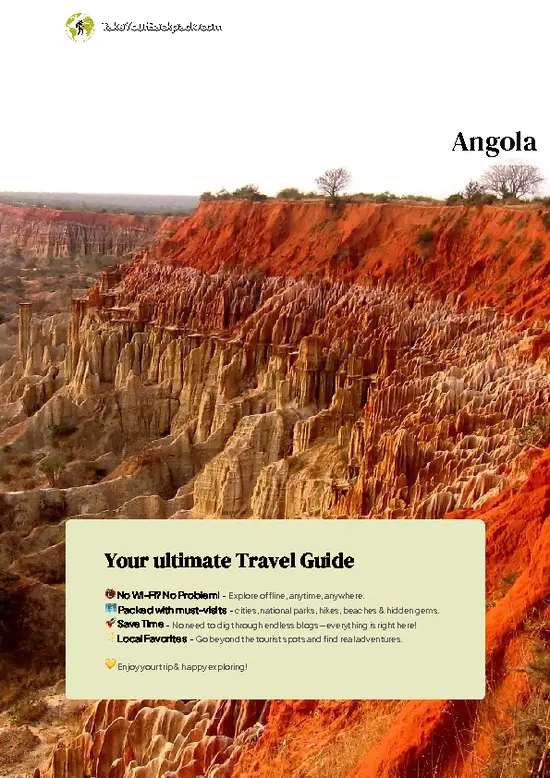
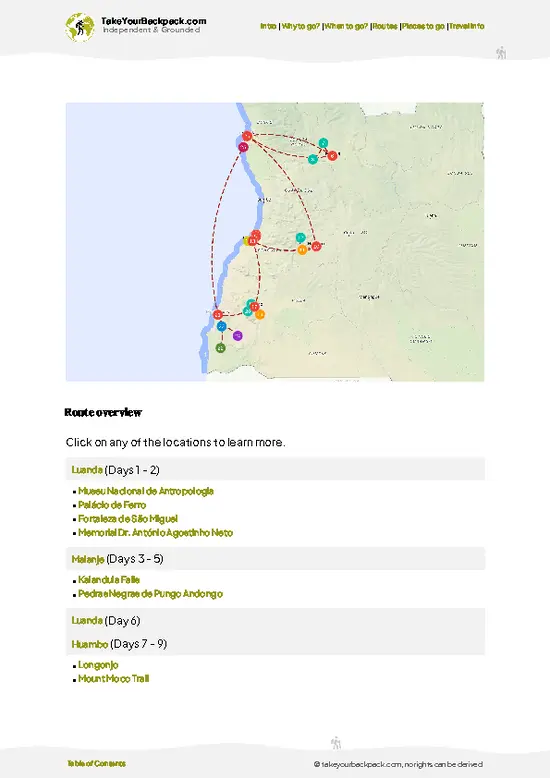
example page 0 from our offline Travel Guide for Angola
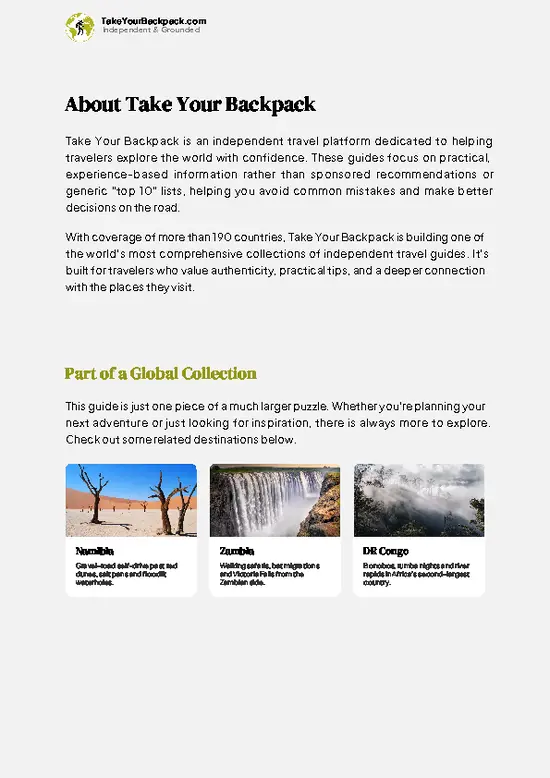
example page 1 from our offline Travel Guide for Angola
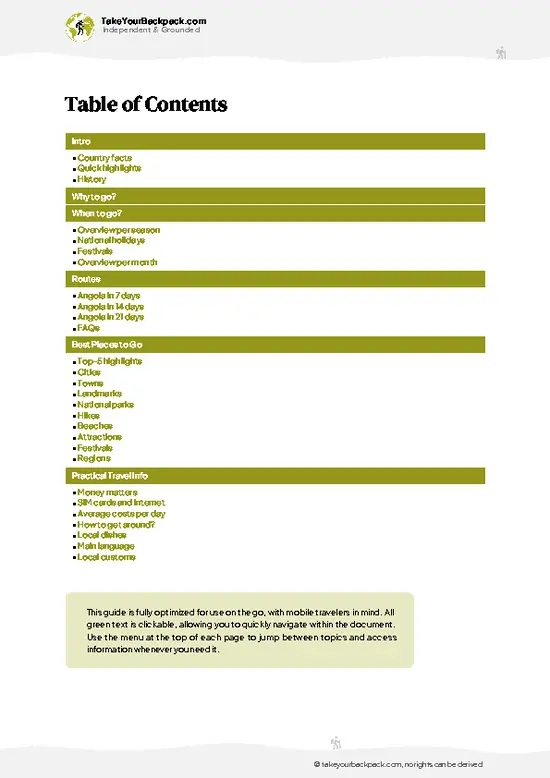
example page 2 from our offline Travel Guide for Angola
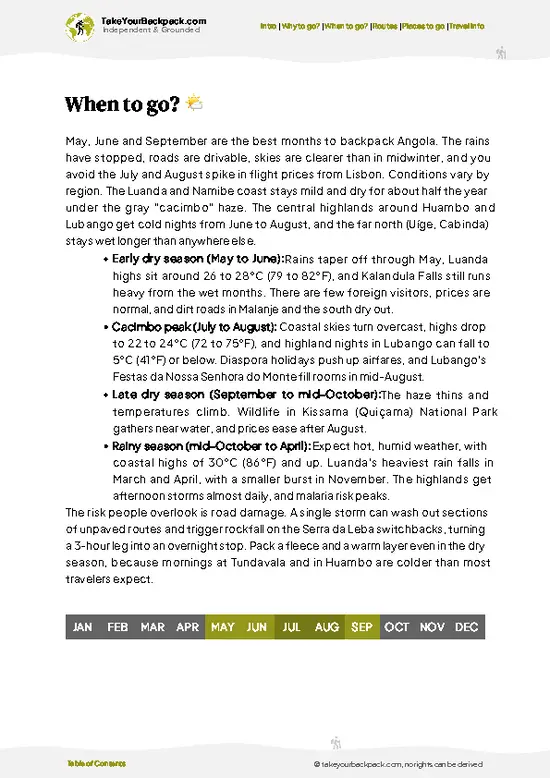
example page 3 from our offline Travel Guide for Angola
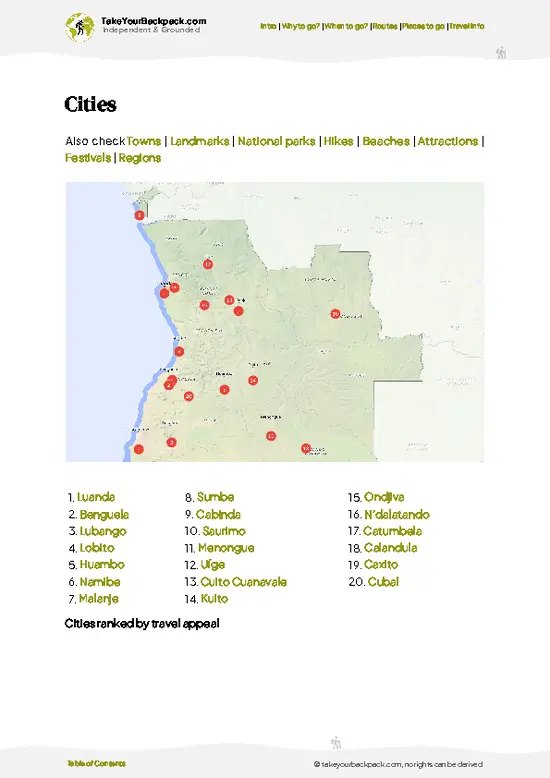
example page 4 from our offline Travel Guide for Angola
example page 5 from our offline Travel Guide for Angola
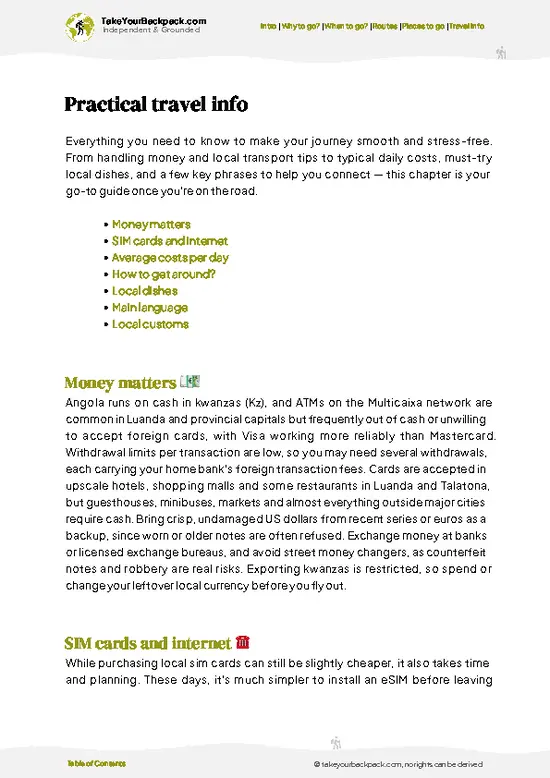
example page 6 from our offline Travel Guide for Angola
example page 7 from our offline Travel Guide for Angola
Loading the map 🌍
CLICK TO FILTER
cities
towns
landmarks
national parks
hikes
beaches
attractions
festivals
regions
SHOW COUNTRY’S BESTSHOW ALL

✨ Why go?
Ranked #1 region in Angola
Why Namib Desert should be on your travel list

Backpackers come for the contrast packed into a short distance. Within a day you can go from the Portuguese-era seafront of Moçâmedes to gravel plains with ancient welwitschia plants and on to dunes that drop straight into the Atlantic, with no change of base needed. That cuts both transit time and accommodation costs.
The second reason is access to Iona National Park, Angola’s oldest park, where oryx, springbok and ostrich cross desert that feels like the Namibian coast without the crowds. Going with a local operator out of Moçâmedes takes the stress out of permits and sand driving.
The third is people. The Mucubal herders around Virei keep cattle traditions that have changed little, and a slow visit to their villages adds a human layer to the empty landscape. The Moçâmedes railway and the … read more 👉
Backpackers come for the contrast packed into a short distance. Within a day you can go from the Portuguese-era seafront of Moçâmedes to gravel plains with ancient welwitschia plants and on to dunes that drop straight into the Atlantic, with no change of base needed. That cuts both transit time and accommodation costs.
The second reason is access to Iona National Park, Angola’s oldest park, where oryx, springbok and ostrich cross desert that feels like the Namibian coast without the crowds. Going with a local operator out of Moçâmedes takes the stress out of permits and sand driving.
The third is people. The Mucubal herders around Virei keep cattle traditions that have changed little, and a slow visit to their villages adds a human layer to the empty landscape. The Moçâmedes railway and the road up through Serra da Leba also link the desert to Lubango, so the region fits into a longer Angolan loop.

💡 HighlightsMust-see experiences and standout moments

  1. Moçâmedes waterfront and Fortaleza de São Fernando: Colonial streets, pastel facades and a small fort over the bay, best at dusk when fishing boats come in.
  2. Praia das Miragens: A beach right at the city’s edge where dunes meet the sea and fishermen sell the morning catch.
  3. Praia Amélia: A quieter beach near Moçâmedes with cold Atlantic surf and almost no one on it on weekdays.
  4. Welwitschia plains near Bero: Flat gravel desert dotted with welwitschia, low sprawling plants that can live for centuries. Go with a guide who knows where they grow.
  5. Iona National Park: Angola’s biggest park, with oryx, springbok, ostrich and dunes. It needs a 4x4, supplies and a local operator.
  6. Carunjamba: A lesser-known area in Iona with a lagoon and ancient fossil beds, which few visitors ever reach.
  7. Tômbwa: A small southern
… read more 👉
  1. Moçâmedes waterfront and Fortaleza de São Fernando: Colonial streets, pastel facades and a small fort over the bay, best at dusk when fishing boats come in.
  2. Praia das Miragens: A beach right at the city’s edge where dunes meet the sea and fishermen sell the morning catch.
  3. Praia Amélia: A quieter beach near Moçâmedes with cold Atlantic surf and almost no one on it on weekdays.
  4. Welwitschia plains near Bero: Flat gravel desert dotted with welwitschia, low sprawling plants that can live for centuries. Go with a guide who knows where they grow.
  5. Iona National Park: Angola’s biggest park, with oryx, springbok, ostrich and dunes. It needs a 4x4, supplies and a local operator.
  6. Carunjamba: A lesser-known area in Iona with a lagoon and ancient fossil beds, which few visitors ever reach.
  7. Tômbwa: A small southern fishing town, a quiet and dusty base for the far desert coast.
  8. Baía dos Tigres: A sandy peninsula, once an island, with an abandoned fishing settlement. Reaching it takes a serious expedition, so it is for the committed only.
  9. Virei and the Mucubal villages: Herding communities known for beadwork and cattle culture, a rare chance to meet people on their own terms. Ask permission before taking photos.
The waterfront in Moçâmedes and Praia das Miragens pair well in one day, with the fort in the morning and fish and sunset on the sand.
Spotted a mistake or missing something? Contact us.

⌛️ 5 daysSeeing the highlights in 5 days

Day 1: Moçâmedes: Transport sets the pace here. Roads are limited, the good ones are paved only near the coast, and anything beyond needs a 4x4 and a guide, so start in the city and arrange everything from there. Spend the day on the waterfront, the fort and Praia das Miragens, then confirm vehicle, fuel and permits for the park.
Day 2: Bero: Head inland to the gravel plains for the welwitschia, a half-day trip that tests your vehicle and your guide before the harder drive. Return to Moçâmedes for a proper meal and a shower.
Day 3: Iona National Park: This is the day that justifies the whole trip. Leave early and cross the sand toward the park, where oryx and springbok move in silence and the dunes run to the ocean. Camp or stay in simple lodging.
Day 4: Tômbwa: Drive out along the southern coast … read more 👉
Day 1: Moçâmedes: Transport sets the pace here. Roads are limited, the good ones are paved only near the coast, and anything beyond needs a 4x4 and a guide, so start in the city and arrange everything from there. Spend the day on the waterfront, the fort and Praia das Miragens, then confirm vehicle, fuel and permits for the park.
Day 2: Bero: Head inland to the gravel plains for the welwitschia, a half-day trip that tests your vehicle and your guide before the harder drive. Return to Moçâmedes for a proper meal and a shower.
Day 3: Iona National Park: This is the day that justifies the whole trip. Leave early and cross the sand toward the park, where oryx and springbok move in silence and the dunes run to the ocean. Camp or stay in simple lodging.
Day 4: Tômbwa: Drive out along the southern coast to the fishing town, a slow day of dust, salt and quiet roads. Use it as a buffer, since sand driving rarely keeps to schedule.
Day 5: Moçâmedes: Return to the city, rest and catch fresh fish by the sea. A longer day trip toward Virei fits as a detour on the way out of the region, adding a Mucubal village visit without breaking the logistics. From Moçâmedes you can continue by road or train toward Lubango, roughly three hours by road via Serra da Leba.

🌤️ When to go?Seasonal considerations and timing

  • Cool Fog Season (May to September): This is the best window, with coastal highs of 20 to 25°C (68 to 77°F), lows near 15°C (59°F) and the cool fog locals call cacimbo. Days run about 11.5 hours, mornings are gray, and afternoons clear. Prices stay steady and crowds are thin.
  • Hot Season (December to April): Coastal highs reach 28 to 31°C (82 to 88°F), and inland dunes and gravel plains climb past 35°C (95°F). Rain is rare, usually under 50 mm a year. Days stretch to nearly 13 hours. Hotel rates and 4x4 hire climb around Christmas and New Year as Angolan families arrive.
  • Shoulder Months (October and November): Warming air, clearer skies and fewer visitors make this good for dune and Welwitschia trips. Midday sun gets harsh by November.
Book 4x4 transport at least a week ahead for June to August, when most overland trips run.

source: climatestotravel.comJANJanuary: fair for travelingFEBFebruary: fair for travelingMARMarch: fair for travelingAPRApril: good for travelingMAYMay: excellent for travelingJUNJune: excellent for travelingJULJuly: excellent for travelingAUGAugust: excellent for travelingSEPSeptember: highly recommended for travelingOCTOctober: highly recommended for travelingNOVNovember: good for travelingDECDecember: fair for traveling
angola-region-namib-desert
© Google |

✈️ The backpacker research shortcutAngola Travel Guide

An offline-friendly backpacking guide with optimized travel routes, ranked highlights, transport advice, and the best areas to stay.
example page 0 from our offline Travel Guide for Angola
example page 1 from our offline Travel Guide for Angola
example page 2 from our offline Travel Guide for Angola
example page 3 from our offline Travel Guide for Angola
example page 4 from our offline Travel Guide for Angola
example page 5 from our offline Travel Guide for Angola
example page 6 from our offline Travel Guide for Angola
example page 7 from our offline Travel Guide for Angola
The digital guide (246 pages) contains:
✅ 71 highlights, ranked by travel appeal
✅ Optimized 7, 14 & 21-day travel routes
✅ Cities, national parks, landmarks, beaches
✅ How to get around
✅ Offline-friendly for travel without Wi-Fi
👉 Click to see all 30+ guide features

📅 Plan smarter in minutes, not weeks
✅ Month by month travel advice
✅ Festivals & national holidays
✅ Budget expectations

🗺️ Go to the right places, skip the overrated ones
✅ Honest pros & cons of destinations
✅ Top hikes, parks & viewpoints
✅ Lesser-known places most travelers miss
✅ Clear “worth it vs skip it” guidance

🛏️ Travel smoothly without rookie mistakes
✅ Best areas to stay
✅ Transport systems explained simply
✅ Common scams & safety advice
✅ SIM cards, money & practical tips

🌍 Understand the country, not just visit it
✅ Culture & traditions
✅ 52 Essential phrases & customs
✅ Festivals worth planning around
✅ Traveler-friendly historical context
✅ Insights that make places more meaningful

📱 Built for real travel conditions
✅ Fully downloadable PDF
✅ Works completely offline
✅ Optimized for phone use
✅ Useful in remote areas & buses
✅ Everything in one place
Stop searching, start planning
Get instant access to your full guide. 30‑day money-back guarantee.
+ Add another guide for just

By proceeding you agree to our terms.
Sent to your inbox immediately after payment • 100% Secure Checkout
Best Backpacking Travel Advisor 2025 tourism awardBest Backpacking
Travel Advisor
2025
What others say about Take Your Backpack Guides:
⭐⭐⭐⭐⭐
Fantastic, amazing amount of information!
⭐⭐⭐⭐⭐
My goodness this is amazing, it's what I've been looking for hats off too you!
⭐⭐⭐⭐⭐
I think this is absolutely BRILLIANT
⭐⭐⭐⭐
Very complete and informative. It's still missing places, but I gotta to commend you
⭐⭐⭐⭐⭐
This is truly amazing, thank you, can't wait to explore it with my kids!
⭐⭐⭐⭐⭐
Awesome resource, thank you!
⭐⭐⭐⭐⭐
This is amazing! Can't wait to explore the ones I haven't seen
⭐⭐⭐⭐
I love this! Well done, great idea.
⭐⭐⭐⭐⭐
Thanks for taking the time to make this gem!
⭐⭐⭐⭐⭐
This might be the best website I've ever seen.
⭐⭐⭐⭐⭐
Congratulations, and thank you so much for your work; it's incredibly valuable.
⭐⭐⭐⭐
In all seriousness I think you did a great job pointing out the important spots
⭐⭐⭐⭐⭐
10/10 very good
⭐⭐⭐⭐⭐
As someone who's only just starting to visit regularly this is awesome, thank you.
⭐⭐⭐⭐
Thank you very much! I'm going to visit my dad, it's going to be very useful!
⭐⭐⭐⭐⭐
This is really cool! We'll be travelling for the first time and this definitely come in handy.
⭐⭐⭐⭐⭐
You are now our minister of culture, congratulations 👨‍💼
⭐⭐⭐⭐⭐
Just wanted to tell you that this is a pearl! Going to follow your recommendations.
⭐⭐⭐⭐⭐
This is so cool. I'll definitely be using the resource for my travels soon.
⭐⭐⭐⭐⭐
This is very impressive! Good work.
⭐⭐⭐⭐⭐
This is an amazing and informative site. Very well done!

🛏️ Where to stay?Choosing the right base

Moçâmedes, the city of Namibe, is the best place to stay for most backpackers because it holds the region’s widest range of budget rooms, guesthouses and home stays within walking distance of restaurants, ATMs and transport. The streets are quiet and the seafront promenade is safe to stroll after dark in the busier blocks, though solo travelers should still take a taxi late at night. It is also where 4x4 drivers and tour operators are based, so you can find travel partners to split desert trips, and the evening scene around the beachfront cafés is easy to join.

Tômbua (Tombwa), to the south, … read more 👉
Moçâmedes, the city of Namibe, is the best place to stay for most backpackers because it holds the region’s widest range of budget rooms, guesthouses and home stays within walking distance of restaurants, ATMs and transport. The streets are quiet and the seafront promenade is safe to stroll after dark in the busier blocks, though solo travelers should still take a taxi late at night. It is also where 4x4 drivers and tour operators are based, so you can find travel partners to split desert trips, and the evening scene around the beachfront cafés is easy to join.

Tômbua (Tombwa), to the south, is a fishing town with a working harbor and fewer visitors. It makes sense if you are heading toward Baía dos Tigres or the Iona National Park, and the people are quick to talk to travelers, although the social scene is small and options for accommodation are limited. Plan on basic guesthouses and limited evening choices.

Praia Azul and the coastal stretches near the city suit a night or two when you want sand and quiet instead of town life. They work best with your own transport.

Lubango, in the highlands about three to four hours inland, is not in the desert, but it has the strongest backpacker community in the south and a cooler climate. Many travelers sleep there and take the descent to the coast as a trip. For desert time, Moçâmedes is the more practical base.

🚌 Getting aroundGetting around like a local

The center of Moçâmedes (the city of Namibe) is flat, laid out in a tidy grid, and easy on foot: you can cross it in 20 minutes along arcaded colonial streets with salt air drifting up from the bay. Walking stops making sense at the edges, where the pavement gives way to sand and the beaches, fishing settlements and desert sights sit 10 to 100 km apart. Most backpackers combine shared transport for the main roads with a hired vehicle for anything off the tarmac. The paved coastal and highland roads are fairly reliable, but departure times are loose and vehicles leave when full.
  • Moto-taxis (kupapata): Motorbikes buzz through town with a whine of two-stroke engines, and a short hop costs roughly Kz 500 to 1,500 (US$0.50 to 1.60). They are the fastest and cheapest way to reach the port or the
… read more 👉
The center of Moçâmedes (the city of Namibe) is flat, laid out in a tidy grid, and easy on foot: you can cross it in 20 minutes along arcaded colonial streets with salt air drifting up from the bay. Walking stops making sense at the edges, where the pavement gives way to sand and the beaches, fishing settlements and desert sights sit 10 to 100 km apart. Most backpackers combine shared transport for the main roads with a hired vehicle for anything off the tarmac. The paved coastal and highland roads are fairly reliable, but departure times are loose and vehicles leave when full.
  • Moto-taxis (kupapata): Motorbikes buzz through town with a whine of two-stroke engines, and a short hop costs roughly Kz 500 to 1,500 (US$0.50 to 1.60). They are the fastest and cheapest way to reach the port or the bus lot, but you give up comfort and any real padding if the road fails. For short rides they are the best value; for luggage, take a car.
  • Shared taxis and minibuses (candongueiros): These blue and white vans run toward Lubango over the Serra da Leba escarpment in about 3 to 4 hours for around US$8 to 15. You sit tight against strangers with the windows down and dust coming in, and waiting for the van to fill can eat an hour. Cheap and scenic, so this is the best value for long hops on paved routes.
  • Hired 4x4 with driver: The Arco, Iona National Park and the dune coast need high clearance and someone who knows the soft sand, so budget US$150 to 300 per day for the vehicle. Splitting it among three or four people drops the cost to a fair level, and it saves days of hitchhiking. This is the option that matters most in the desert.
  • Private taxis: Sedans wait near the market and the main squares and cost roughly US$5 to 15 for runs to nearby beaches like Praia Azul. You pay for air-conditioning and a seat to yourself, which is welcome in the hot months, but prices are negotiable and must be settled before you get in.
Carry small Kwanza notes for fares and fill your water bottles before leaving town, since stops are few once the pavement ends.

🍲 FoodLocal Flavors for Backpackers

Fish rules here. The cold Benguela Current feeds the coast, so the day’s catch arrives at the Moçâmedes harbor in the morning, and grilled fish with olive oil, garlic and lemon smells of charcoal and salt by lunchtime. Look for lobster, prawns and caldeirada, a tomato and onion fish stew eaten with funge, the dense cassava or corn porridge that Angolans use to scoop sauce. Dried fish, peixe seco, hangs in the markets with a sharp, salty tang.

For drinks, Cuca is the national lager, served cold and often bought by the bottle in cafés and beachfront bars. Inland, Mucubal herders sell sour milk, thick, tangy and cool, at roadside stops. Fresh fruit juice from the market, such as mango or passion fruit, is a good break from the dry heat.

For budget meals, go to the central market for grilled … read more 👉
Fish rules here. The cold Benguela Current feeds the coast, so the day’s catch arrives at the Moçâmedes harbor in the morning, and grilled fish with olive oil, garlic and lemon smells of charcoal and salt by lunchtime. Look for lobster, prawns and caldeirada, a tomato and onion fish stew eaten with funge, the dense cassava or corn porridge that Angolans use to scoop sauce. Dried fish, peixe seco, hangs in the markets with a sharp, salty tang.

For drinks, Cuca is the national lager, served cold and often bought by the bottle in cafés and beachfront bars. Inland, Mucubal herders sell sour milk, thick, tangy and cool, at roadside stops. Fresh fruit juice from the market, such as mango or passion fruit, is a good break from the dry heat.

For budget meals, go to the central market for grilled fish, roasted corn and fried snacks, or to small tascas and cafés near the square for a plate of rice, beans and grilled meat at a fair price. Fish sold by weight is common, so ask the price before they cook it.

Meals are leisurely and shared. Greet staff with a simple “bom dia” or “boa tarde”, and expect to ask for the bill, since it will not arrive unprompted. Carry Kwanza in small notes, because many small places do not take cards.

FAQCommon questions from travelers

Plan on four to five days to see the desert properly. Moçâmedes and its beaches take one day, the welwitschia plains near Bero a half-day, and Iona National Park at least one full day, plus extra time for Tômbwa or Virei. Sand driving often runs behind schedule, so add a buffer day.
Without your own vehicle, base yourself in Moçâmedes and use taxis for short city trips. For anything beyond the coast, a local operator with a 4x4 is the practical option, especially for Iona National Park. Tômbwa lies roughly 100 km south by road, and Lubango is about three hours away by road via Serra da Leba.
The Namibe Desert is known for its Atlantic dunes, the welwitschia plants on the gravel plains, and Iona National Park, Angola’s oldest. It is also known for the port city of Moçâmedes and its Portuguese-era seafront. The Mucubal herders near Virei are another draw, with their cattle traditions and bright beadwork.
⚠️ Things can change over time, so always validate details locally before you go.

More places to explore across Angola

Namib Desert isn’t the only highlight in Angola. Explore all what Angola has to offer.
Country photo of Angola

We 💚 feedbackWhat to keep in mind

Come if you like emptiness and don’t mind sand in your teeth. This place rewards the patient overlander, the photographer who loves low light on dunes, and the traveler comfortable with plans that shift when a track washes out. The best surprise is the fish on the sand at Moçâmedes. The small warning is fuel and water: carry more than you think. If you need nightlife or ready-made tours, the highlands will suit you better.

✍️ Help improve this page!
The information on this page is based on in-depth research, insights shared by experienced travelers, and feedback from the local travel community in Angola. While every effort is made to keep the information accurate and current, conditions can change — so if you spot anything incorrect or outdated, please get in touch.


🙋‍♂️ Give feedback

👋 Meet the founderWho’s Behind Take Your Backpack?

Johan, backpacker and founder of TakeYourBackpackHi, I’m Johan (Netherlands 🇳🇱), the creator of TakeYourBackpack. Over the past 3 decades, I’ve backpacked through 90+ countries across six continents, gaining extensive experience with independent travel, long-term trips, and overland routes.

This site is built on a combination of firsthand travel experience and carefully curated insights from other backpackers. Many guides are based on places I’ve personally visited, while others bring together tips, observations, and practical advice shared by trusted travelers I’ve met along the way.

The goal is to provide realistic, experience-driven guidance — not generic itineraries — so you can explore destinations with better context, clearer expectations, and more confidence.