×

Angola🇦🇴 | best regionsYour Guide to the 2 Best regions in Angola

Angola is split by geography more than by borders. The Atlantic coast around Luanda smells of diesel, frying fish and salt, and it carries the country’s highest prices (a basic double often runs US$80 to 150). Move inland and the air thins onto the central highlands, where mornings are cold and woodsmoke hangs over red-earth villages. The far south turns to dry thornscrub and desert, the north to humid forest and palm oil country. Distances are huge, roads vary from fresh asphalt to corrugated dirt, and few places have hostels, so independent travel here means planning around long drives and patchy services. Crowds are almost nonexistent outside the capital. That is the appeal and the hard part. Which region suits you depends on how much grit, cost and driving you want to trade for empty beaches, waterfalls and cool highland evenings.

By Johan Kruseman 🇳🇱 | Updated October 19, 2026
Explore the best cities in Angola

Why go?Understanding Their Importance

Angola suits regional travel because its landscapes change sharply over short stretches of a very large country. A single long drive can take you from fog-wrapped coastal cliffs to granite escarpments, then to flat savanna where the horizon shimmers at noon. The cause is geography: a narrow Atlantic desert strip, a raised central plateau, and river basins draining north and east. Climate follows, so the same week can give you cold dawns and sweltering afternoons.

History leaves its marks everywhere. Portuguese colonial architecture sits beside concrete from the long civil war that ended in 2002, and you will still see pastel facades pocked with age, plus fortresses above the sea. Portuguese is the common language, with Umbundu, Kimbundu and Kikongo heard in markets, so basic Portuguese helps … read more 👉
Angola suits regional travel because its landscapes change sharply over short stretches of a very large country. A single long drive can take you from fog-wrapped coastal cliffs to granite escarpments, then to flat savanna where the horizon shimmers at noon. The cause is geography: a narrow Atlantic desert strip, a raised central plateau, and river basins draining north and east. Climate follows, so the same week can give you cold dawns and sweltering afternoons.

History leaves its marks everywhere. Portuguese colonial architecture sits beside concrete from the long civil war that ended in 2002, and you will still see pastel facades pocked with age, plus fortresses above the sea. Portuguese is the common language, with Umbundu, Kimbundu and Kikongo heard in markets, so basic Portuguese helps far more than English.

Before choosing Angola, know the trade-offs. Infrastructure is uneven: many main roads have been rebuilt, yet secondary routes turn to ruts or mud in the rains, and fuel, cash and phone signal thin out fast beyond provincial capitals. Tourism services are limited, so most trips rely on private drivers, shared minibuses (candongueiros) or a rented 4x4. Costs are high compared with neighboring countries, especially in Luanda. A visa is needed for many passports, though several nationalities can now enter visa-free or with an e-visa, so check current rules before booking. Expect few signs, few other foreigners and a lot of curiosity from locals.
Why These Made the Cut
The list of best regions in Angola is created based on landscapes, local culture, attractions, vibes, and overall appeal. If you feel a region is missing in this list, please let us know.

When to go?Timing Your Visit for the Best Experience

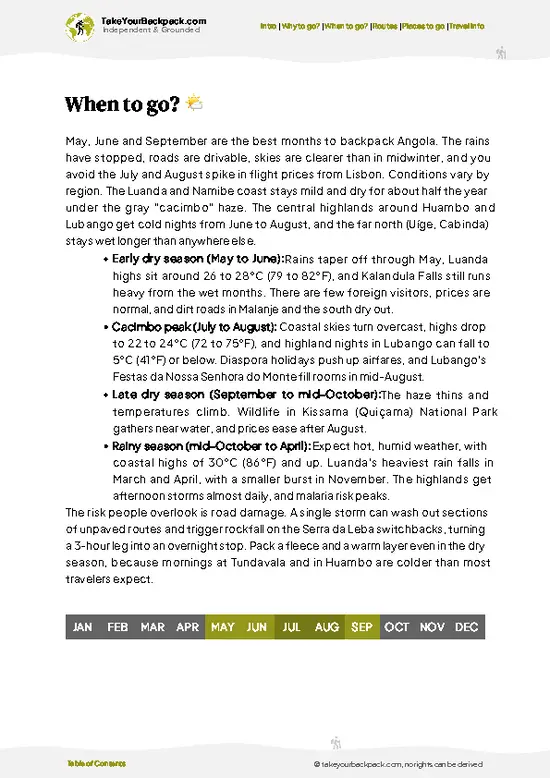
Best months and why: The best months for regions in Angola are May to September, the cacimbo dry season, when rain is almost absent, roads are firmest and humidity drops. Days on the coast sit around 22 to 27°C, often under a flat gray marine haze, while the central highlands feel crisp, with nights that can fall to 5 to 10°C and a low sun that turns dust gold by late afternoon.

The wet season: The rains run roughly November to April, with the heaviest downpours from February to April. Highland towns such as Huambo and Lubango can receive 1,000 to 1,500 mm over the year, mostly in these months. Dirt roads turn to red slurry, rivers swell and waterfalls run at full roar, which is spectacular but makes some tracks impassable without a high-clearance 4x4. Heat and humidity climb on the coast … read more 👉
Best months and why: The best months for regions in Angola are May to September, the cacimbo dry season, when rain is almost absent, roads are firmest and humidity drops. Days on the coast sit around 22 to 27°C, often under a flat gray marine haze, while the central highlands feel crisp, with nights that can fall to 5 to 10°C and a low sun that turns dust gold by late afternoon.

The wet season: The rains run roughly November to April, with the heaviest downpours from February to April. Highland towns such as Huambo and Lubango can receive 1,000 to 1,500 mm over the year, mostly in these months. Dirt roads turn to red slurry, rivers swell and waterfalls run at full roar, which is spectacular but makes some tracks impassable without a high-clearance 4x4. Heat and humidity climb on the coast and in the north, where 30 to 33°C feels heavier.

Shoulder periods: October and early November, along with April and early May, are workable shoulder times. Early storms or late showers can arrive in the afternoon, usually as short, loud bursts that clear to washed-blue skies. The far south, around Namibe, stays arid year-round, with fog on the coast and strong sun inland, so rain matters little there.

Crowds and prices: Angola has no true tourist peak, so you will rarely fight for space. Prices shift mostly around business travel and holidays in Luanda, where hotel rates stay high all year, and around Carnival in February, when accommodation fills in places that host big celebrations. In July and August some lodges and 4x4 operators book earlier because the dry months suit expeditions best.

region hoppingHow to Combine regions Into One Trip

How many days to plan: A trip combining several regions in Angola needs 14 to 21 days, because distances are large and roads slow. Rushing it with fewer than ten days means spending most hours in a vehicle, windows rattling, with red dust coating everything.

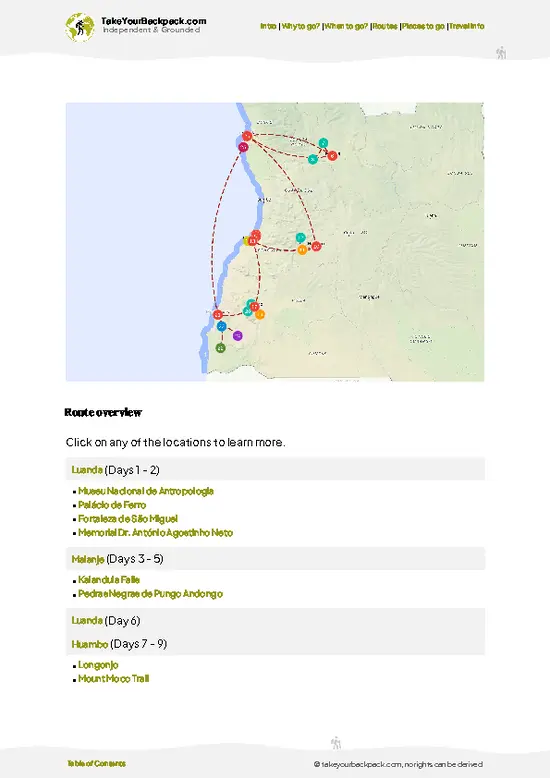
Direction and grouping: Start in Luanda, the main air hub, and work south along the coast and then inland. Regions in the same corridor group well: the coast and the Benguela-Huambo-Lubango axis follow one main line, and the road between them has improved. Heading north or east from Luanda is a separate, longer commitment, so treat it as its own trip or add a week. Flying back to Luanda from Lubango or Catumbela saves a full day on the return.

Time per stop and transit: Plan 2 to 4 nights per stop, longer where a 4x4 excursion or hike … read more 👉
How many days to plan: A trip combining several regions in Angola needs 14 to 21 days, because distances are large and roads slow. Rushing it with fewer than ten days means spending most hours in a vehicle, windows rattling, with red dust coating everything.

Direction and grouping: Start in Luanda, the main air hub, and work south along the coast and then inland. Regions in the same corridor group well: the coast and the Benguela-Huambo-Lubango axis follow one main line, and the road between them has improved. Heading north or east from Luanda is a separate, longer commitment, so treat it as its own trip or add a week. Flying back to Luanda from Lubango or Catumbela saves a full day on the return.

Time per stop and transit: Plan 2 to 4 nights per stop, longer where a 4x4 excursion or hike is the purpose. Typical drives are 5 to 8 hours between major hubs: Luanda to Benguela about 6 to 7 hours, Benguela to Lubango roughly 6 to 8 hours including the climb up the escarpment, and Lubango to Namibe about 3 hours down a switchbacked road. Domestic flights shorten the longest legs (Luanda to Lubango is around 1.5 hours). Shared taxis and long-distance buses exist, but departure times float and they leave when full.

Common planning mistakes: The first mistake is trusting map distances, since a 200 km stretch can take five hours. Add buffer time and avoid tight flight connections. The second is traveling at dusk, when unlit trucks and livestock appear on the road, so aim to arrive before 5 pm. The third is underestimating cash and fuel: carry kwanza notes and fill the tank in every provincial capital. Finally, booking accommodation late in smaller towns can leave you with few options, so reserve ahead for stops outside the big cities.

The ListThe Best regions of Angola

1 Namib Desert

Iona 4x4 tracks, Welwitschia plains, Moçâmedes seafront, Mucubal villages

Drive from the Moçâmedes waterfront and its fortress toward Tômbwa and Baía dos Tigres, or head inland to Bero and Virei for Welwitschia and Mucubal villages.

angola-region-namib-desert
© Google |

2 Kwanza River

River mouth, Quiçama savanna, Muxima pilgrimage church, Portuguese forts, Dondo landing

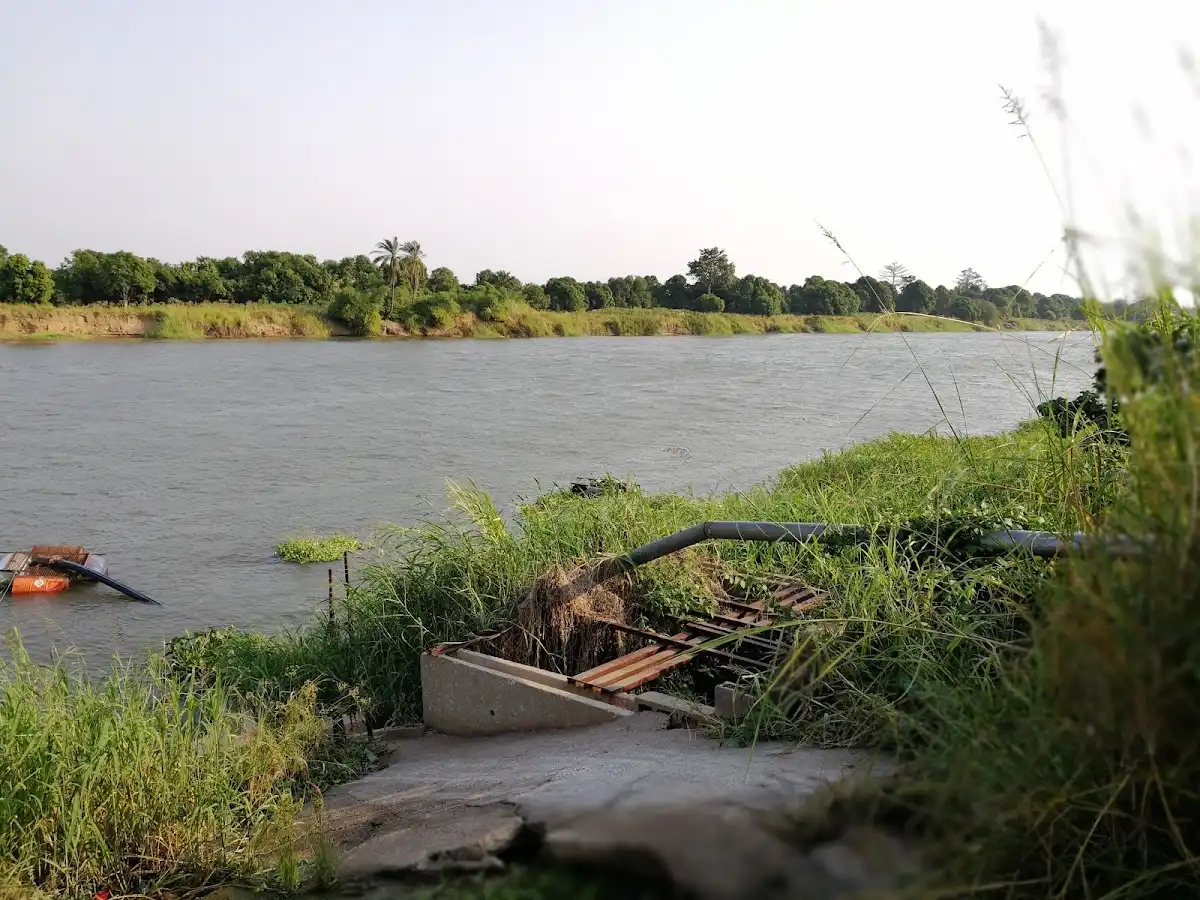
Follow the river from grilled-fish shacks at the Atlantic mouth to baobab tracks in Quiçama, a whitewashed hilltop church and crumbling ramparts.

angola-region-kwanza-river
© Google |
Loading the map 🌍

Expert viewPro Tips for Exploring the Best

How many regions to visit: I advise two or three regions on one trip. Angola’s distances mean each extra region costs a full day or more on the road, and the best moments happen when you stop: a roadside stall selling grilled fish and cold beer, a highland market stacked with sacks of maize, the evening light turning a canyon wall orange. Two regions in ten days or three in two to three weeks leaves time to actually look around.

Choosing between kinds of regions: If you want comfort and the easiest logistics, the coast and the cities have the best restaurants, hotels and flights, at the highest prices. If you like cooler air, hiking and rural life, the highlands give you dramatic escarpments, waterfalls and village markets, with good value and long drives. If you want desert and wide skies, … read more 👉
How many regions to visit: I advise two or three regions on one trip. Angola’s distances mean each extra region costs a full day or more on the road, and the best moments happen when you stop: a roadside stall selling grilled fish and cold beer, a highland market stacked with sacks of maize, the evening light turning a canyon wall orange. Two regions in ten days or three in two to three weeks leaves time to actually look around.

Choosing between kinds of regions: If you want comfort and the easiest logistics, the coast and the cities have the best restaurants, hotels and flights, at the highest prices. If you like cooler air, hiking and rural life, the highlands give you dramatic escarpments, waterfalls and village markets, with good value and long drives. If you want desert and wide skies, the arid south rewards you with dunes, strange plants and empty tracks, but it works best with a guide and a 4x4. Wildlife seekers should know that parks are still recovering after the war and need more planning than in neighboring countries, so go for the landscape first and animals second.

What it costs: Budget about US$60 to 100 a day for a lean independent trip outside Luanda, and US$120 to 200 or more if you add the capital. Guesthouses run US$40 to 90 a night, meals at local places US$5 to 12, and a restaurant dinner in Luanda US$20 to 40. Shared taxis cost US$2 to 15 depending on distance, while a private driver or rental 4x4 with driver runs about US$100 to 200 a day plus fuel. Park and site entries are modest, often US$5 to 20, and local guides for hikes or desert days typically charge US$30 to 80. For a two-week trip, plan US$900 to 1,800 including internal flights, with the higher figure if you hire a vehicle. The payoff is access to places few travelers see.

Money and practicalities: Carry cash in US dollars or euros to exchange, plus kwanza for daily spending. Cards work in larger hotels but fail often elsewhere, and ATMs may refuse foreign cards, so bring more cash than seems sensible. Fuel stations can run dry, so fill up early.

Safety on the ground: Luanda has street theft and phone snatching, so keep devices out of sight and use registered taxis or ride apps after dark. Outside the cities, the main danger is the road. Avoid night driving, carry water and a spare tire, and expect police checkpoints where calm politeness and copies of your documents smooth the stop. Landmines remain in some rural areas, so stay on well-used paths and never wander into unmarked bush, especially in the east and center. Malaria is present, so take prophylaxis and cover up at dusk. Yellow fever vaccination proof is required for entry.

Cultural considerations: Greet people before asking anything, with a handshake and a bom dia or boa tarde. It is the difference between a blank stare and a smile. Ask permission before photographing people, and do not photograph government buildings, police or military sites, which can lead to problems. Dress neatly in towns, since locals take care with their clothes. Learn a few Portuguese phrases and you will find the markets, drivers and guesthouse owners far more open.

✈️ The backpacker research shortcutAngola Travel Guide

An offline-friendly backpacking guide with optimized travel routes, ranked highlights, transport advice, and the best areas to stay.
example page 0 from our offline Travel Guide for Angola
example page 1 from our offline Travel Guide for Angola
example page 2 from our offline Travel Guide for Angola
example page 3 from our offline Travel Guide for Angola
example page 4 from our offline Travel Guide for Angola
example page 5 from our offline Travel Guide for Angola
example page 6 from our offline Travel Guide for Angola
example page 7 from our offline Travel Guide for Angola
The digital guide (246 pages) contains:
✅ 71 highlights, ranked by travel appeal
✅ Optimized 7, 14 & 21-day travel routes
✅ Cities, national parks, landmarks, beaches
✅ How to get around
✅ Offline-friendly for travel without Wi-Fi
👉 Click to see all 30+ guide features

📅 Plan smarter in minutes, not weeks
✅ Month by month travel advice
✅ Festivals & national holidays
✅ Budget expectations

🗺️ Go to the right places, skip the overrated ones
✅ Honest pros & cons of destinations
✅ Top hikes, parks & viewpoints
✅ Lesser-known places most travelers miss
✅ Clear “worth it vs skip it” guidance

🛏️ Travel smoothly without rookie mistakes
✅ Best areas to stay
✅ Transport systems explained simply
✅ Common scams & safety advice
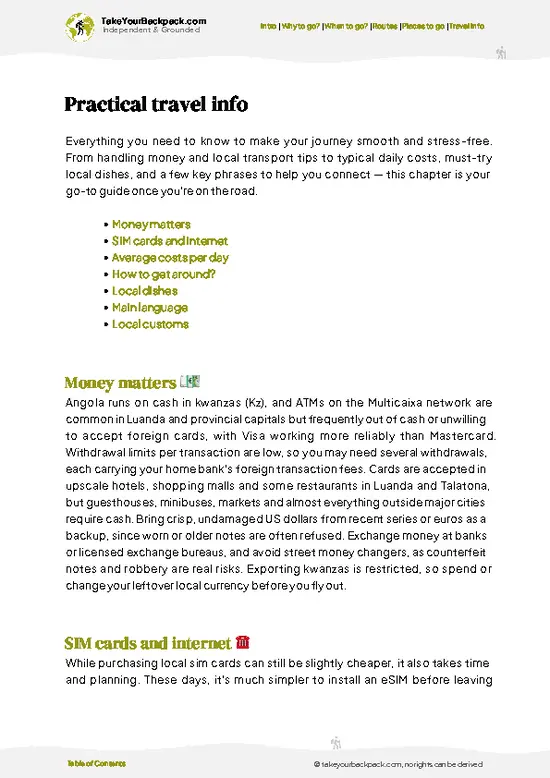
✅ SIM cards, money & practical tips

🌍 Understand the country, not just visit it
✅ Culture & traditions
✅ 52 Essential phrases & customs
✅ Festivals worth planning around
✅ Traveler-friendly historical context
✅ Insights that make places more meaningful

📱 Built for real travel conditions
✅ Fully downloadable PDF
✅ Works completely offline
✅ Optimized for phone use
✅ Useful in remote areas & buses
✅ Everything in one place
Stop searching, start planning
Get instant access to your full guide. 30‑day money-back guarantee.
+ Add another guide for just

By proceeding you agree to our terms.
Sent to your inbox immediately after payment • 100% Secure Checkout
Best Backpacking Travel Advisor 2025 tourism awardBest Backpacking
Travel Advisor
2025
What others say about Take Your Backpack Guides:
⭐⭐⭐⭐⭐
Fantastic, amazing amount of information!
⭐⭐⭐⭐⭐
My goodness this is amazing, it's what I've been looking for hats off too you!
⭐⭐⭐⭐⭐
I think this is absolutely BRILLIANT
⭐⭐⭐⭐
Very complete and informative. It's still missing places, but I gotta to commend you
⭐⭐⭐⭐⭐
This is truly amazing, thank you, can't wait to explore it with my kids!
⭐⭐⭐⭐⭐
Awesome resource, thank you!
⭐⭐⭐⭐⭐
This is amazing! Can't wait to explore the ones I haven't seen
⭐⭐⭐⭐
I love this! Well done, great idea.
⭐⭐⭐⭐⭐
Thanks for taking the time to make this gem!
⭐⭐⭐⭐⭐
This might be the best website I've ever seen.
⭐⭐⭐⭐⭐
Congratulations, and thank you so much for your work; it's incredibly valuable.
⭐⭐⭐⭐
In all seriousness I think you did a great job pointing out the important spots
⭐⭐⭐⭐⭐
10/10 very good
⭐⭐⭐⭐⭐
As someone who's only just starting to visit regularly this is awesome, thank you.
⭐⭐⭐⭐
Thank you very much! I'm going to visit my dad, it's going to be very useful!
⭐⭐⭐⭐⭐
This is really cool! We'll be travelling for the first time and this definitely come in handy.
⭐⭐⭐⭐⭐
You are now our minister of culture, congratulations 👨‍💼
⭐⭐⭐⭐⭐
Just wanted to tell you that this is a pearl! Going to follow your recommendations.
⭐⭐⭐⭐⭐
This is so cool. I'll definitely be using the resource for my travels soon.
⭐⭐⭐⭐⭐
This is very impressive! Good work.
⭐⭐⭐⭐⭐
This is an amazing and informative site. Very well done!

🛏️ Where to stay?Top Areas to Stay

Hostels in the dorm-bed sense are almost absent in Angola, so backpackers rely on simple guesthouses (pensões and residenciais) that typically cost 35,000 to 60,000 kwanza (about US$40 to 65) a night in Luanda and noticeably less in Benguela and Lubango. In the capital, Ingombota and Maianga put you within walking distance of the Marginal waterfront, the fortress and most restaurants, though streets empty out after dark; Ilha de Luanda has the beach bars and the liveliest nightlife but few rooms and higher prices; Talatona is the quietest and most secure, with malls nearby but a long, traffic-heavy ride from the historic center.

If you enjoy meeting fellow travelers, consider choosing hostels … read more 👉
Hostels in the dorm-bed sense are almost absent in Angola, so backpackers rely on simple guesthouses (pensões and residenciais) that typically cost 35,000 to 60,000 kwanza (about US$40 to 65) a night in Luanda and noticeably less in Benguela and Lubango. In the capital, Ingombota and Maianga put you within walking distance of the Marginal waterfront, the fortress and most restaurants, though streets empty out after dark; Ilha de Luanda has the beach bars and the liveliest nightlife but few rooms and higher prices; Talatona is the quietest and most secure, with malls nearby but a long, traffic-heavy ride from the historic center.

If you enjoy meeting fellow travelers, consider choosing hostels with high ratings for atmosphere. On the other hand, if you prefer having your own space, a hotel might be a better option.

AngolaDiscover the Country

👋 Meet the founderWho’s Behind Take Your Backpack?

Johan, backpacker and founder of TakeYourBackpackHi, I’m Johan (Netherlands 🇳🇱), the creator of TakeYourBackpack. Over the past 3 decades, I’ve backpacked through 90+ countries across six continents, gaining extensive experience with independent travel, long-term trips, and overland routes.

This site is built on a combination of firsthand travel experience and carefully curated insights from other backpackers. Many guides are based on places I’ve personally visited, while others bring together tips, observations, and practical advice shared by trusted travelers I’ve met along the way.

The goal is to provide realistic, experience-driven guidance — not generic itineraries — so you can explore destinations with better context, clearer expectations, and more confidence.