×

Angola🇦🇴 | landmarksPico de angolaMount Moco summit, montane grassland, forest patches, francolin birding | things to do and best time to go

Explore Bela VistaExplore Tchitundo-Hulo

Backpacking in Pico de angola
By Johan Kruseman 🇳🇱 | Updated October 15, 2026

Cold mist drags across the grass, your boots slide on wet red clay, and somewhere below, a rooster from a village you can’t see keeps going. Pico de Angola, better known as Mount Moco, sits in Huambo province in the central highlands, roughly 60 km west of Huambo city. At about 2,620 m it is the highest point in the country, yet it is a rounded, grassy mountain rather than a jagged spire, so the wow-factor comes from space and silence. Crowds are close to nonexistent. The cost is logistics: rough tracks, no facilities, and a need for a local guide because of past conflict in the area. Bring layers, because the wind bites. The reward is a summit with almost nobody on it.

Discover everything you want to know in the 📖 Angola Travel Guide.


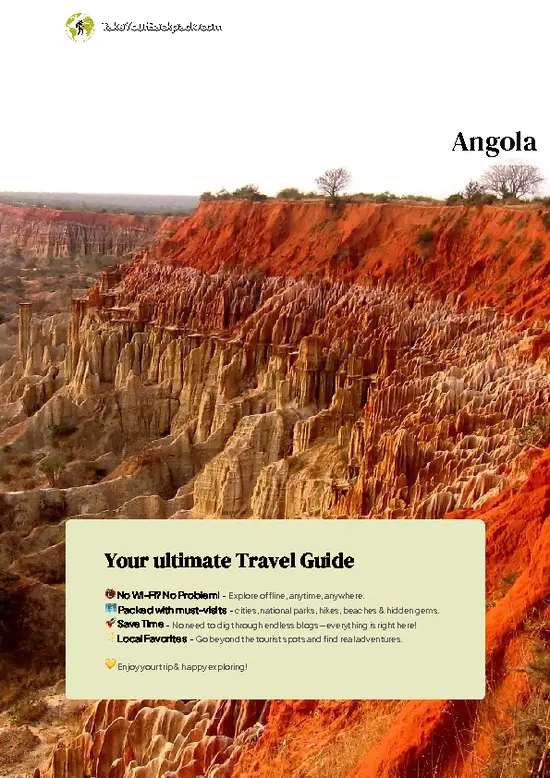
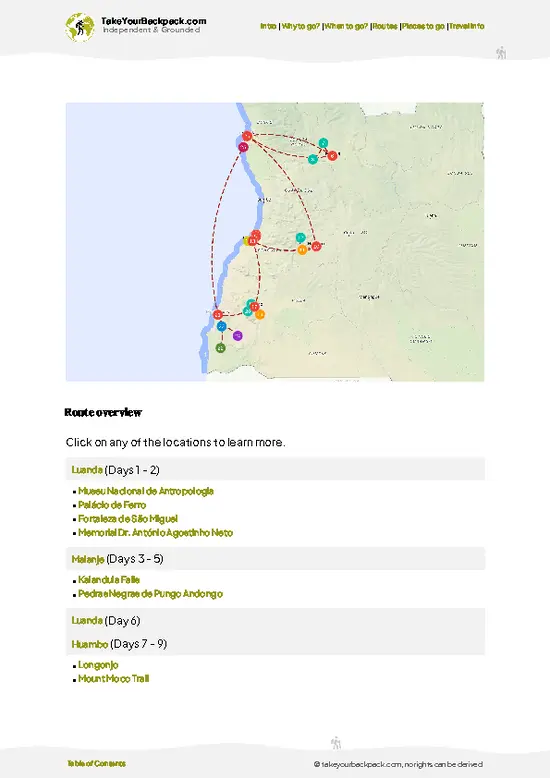
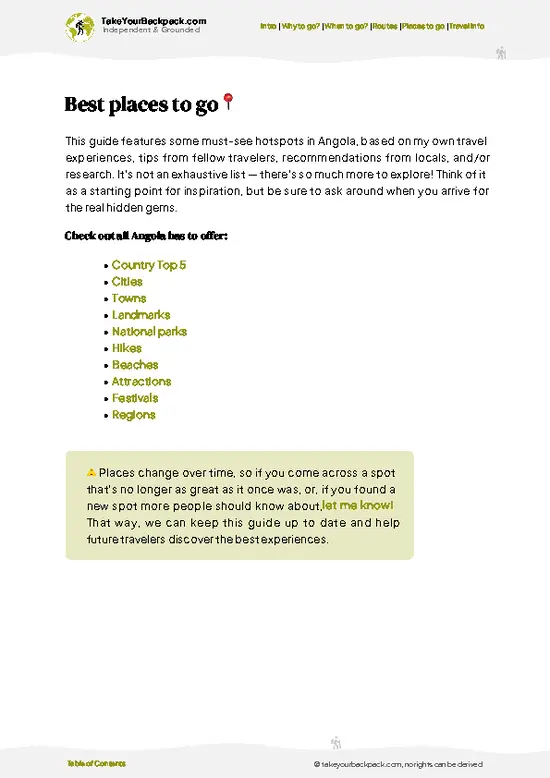
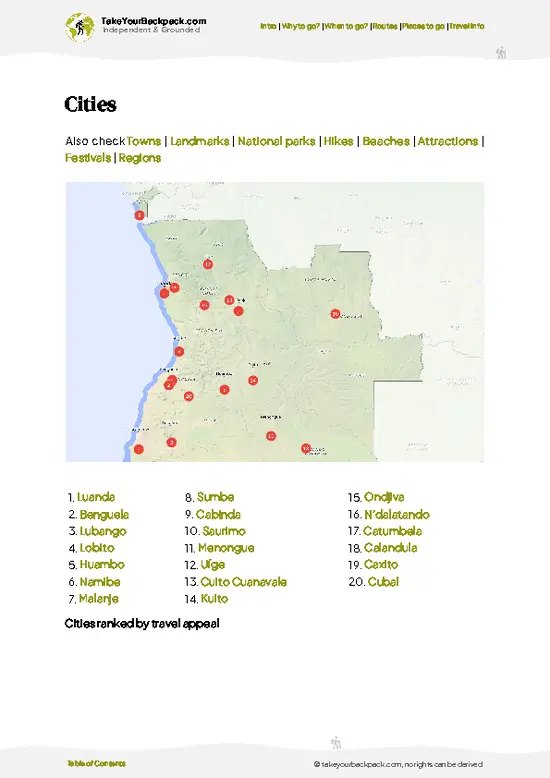
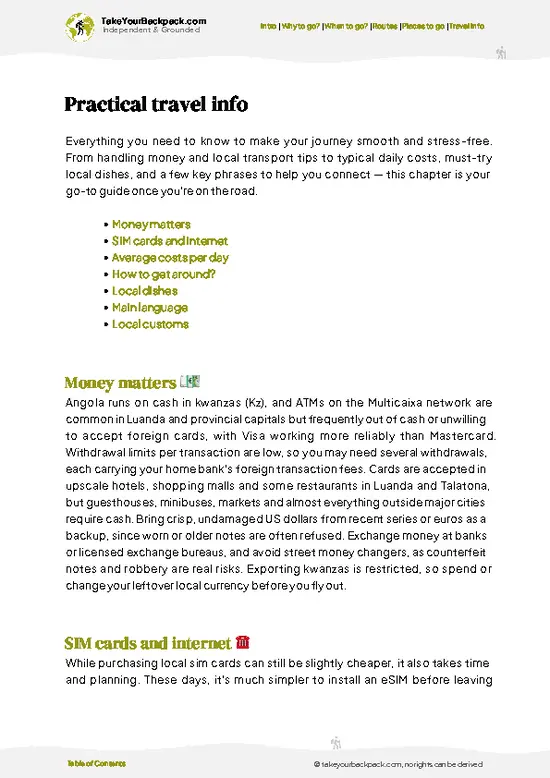
example page 0 from our offline Travel Guide for Angola
example page 1 from our offline Travel Guide for Angola
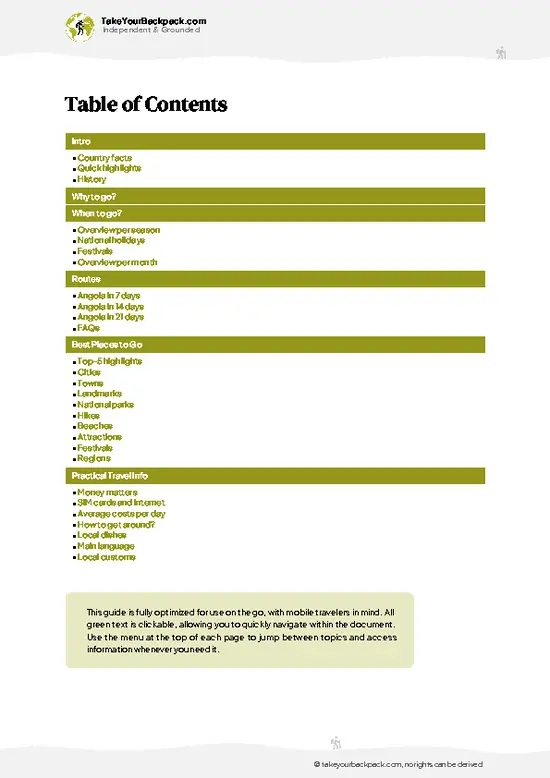
example page 2 from our offline Travel Guide for Angola
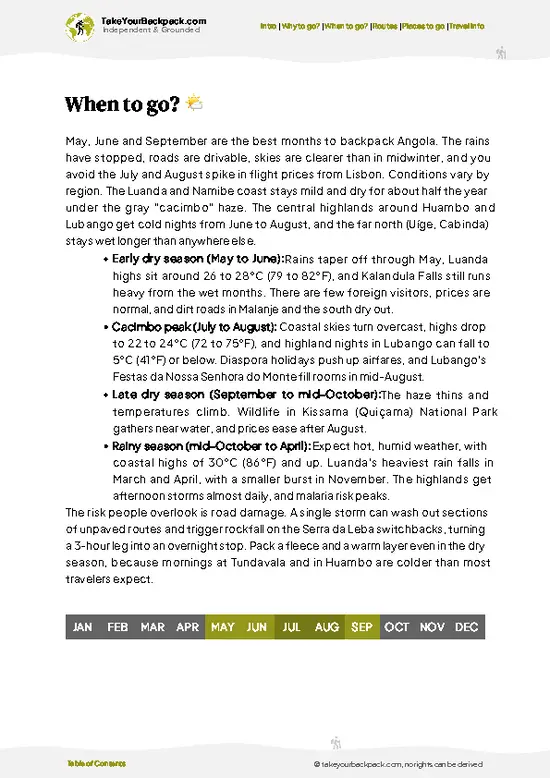
example page 3 from our offline Travel Guide for Angola
example page 4 from our offline Travel Guide for Angola
example page 5 from our offline Travel Guide for Angola
example page 6 from our offline Travel Guide for Angola
example page 7 from our offline Travel Guide for Angola
Loading the map 🌍
CLICK TO FILTER
cities
towns
landmarks
national parks
hikes
beaches
attractions
festivals
regions
SHOW COUNTRY’S BESTSHOW ALL

✨ Why go?
Ranked #99 unique site in Angola
Why Pico de angola should be on your travel list

Moco is the answer to a question few travelers think to ask: where is the top of Angola? Standing on the 2,620 m summit, you are on the country’s highest ground, in a landscape of grassland, granite outcrops and small pockets of cloud forest that look nothing like the coastal Angola most visitors see. Birders have a particular reason to come, since the mountain shelters Swierstra’s francolin, a rare bird found only in Angola’s western escarpment and highlands. The mountain also fits neatly into a highlands loop. Fly or take a long bus from Luanda to Huambo, spend a day or two among its colonial-era streets and markets, then make Moco a day trip or an overnight. You need to arrange transport and a guide in Huambo, so it rewards planning, and it gives you a real sense of how the country’s interior feels.

💡 HighlightsEssential experiences to have while visiting Pico de angola

  1. The summit of Mount Moco. The highest point in Angola at about 2,620 m. The climb is a steady walk over open grass rather than a technical scramble, and the top gives wide views over the central plateau.
  2. Montane grasslands. The upper slopes are rolling highland grass, often wrapped in cloud and wind. The light shifts quickly here, so photos change every ten minutes.
  3. Afromontane forest patches. Small stands of dense forest fill the sheltered gullies. They are cooler, darker and damper than the open slopes, and they hold much of the mountain’s wildlife.
  4. Birdwatching for Swierstra’s francolin. This threatened bird is the mountain’s best-known resident. Even if you don’t spot it, other highland species make an early morning walk worthwhile.
  5. Granite outcrops and boulders. Rocky knobs break through
… read more 👉
  1. The summit of Mount Moco. The highest point in Angola at about 2,620 m. The climb is a steady walk over open grass rather than a technical scramble, and the top gives wide views over the central plateau.
  2. Montane grasslands. The upper slopes are rolling highland grass, often wrapped in cloud and wind. The light shifts quickly here, so photos change every ten minutes.
  3. Afromontane forest patches. Small stands of dense forest fill the sheltered gullies. They are cooler, darker and damper than the open slopes, and they hold much of the mountain’s wildlife.
  4. Birdwatching for Swierstra’s francolin. This threatened bird is the mountain’s best-known resident. Even if you don’t spot it, other highland species make an early morning walk worthwhile.
  5. Granite outcrops and boulders. Rocky knobs break through the grass on the upper slopes and make natural rest stops and viewpoints.
  6. Highland villages on the approach. The road passes farming communities where maize fields, mud-brick homes and roadside stalls show how life works on the plateau. A greeting in Portuguese goes a long way.
Start with the summit walk at first light, because the mist usually thickens by late morning and the views are clearest early.
Spotted a mistake or missing something? Contact us.

🌤️ When to go?When to go for the best experience

The best time to visit Pico de Angola is the dry season from May to September, when skies are clear and trails and dirt roads are passable.
  • Dry Season (May to September): Days run 22 to 27°C (72 to 81°F), and nights on the highland plateau can drop to 8 to 12°C (46 to 54°F). Rain is almost absent, views are sharpest, and daylight lasts about 11.5 hours, roughly 6am to 5:45pm. Expect the most visitors and the firmest prices for transport.
  • Hot Transition (October to November): Heat and haze build, with highs near 28 to 30°C (82 to 86°F). Early storms begin, so mornings are best for any climb.
  • Rainy Season (December to April): Highs of 24 to 28°C (75 to 82°F), with heavy afternoon downpours. Tracks turn to mud, rivers rise, and cloud often hides the summit. Fewer travelers and lower lodging prices,
… read more 👉
The best time to visit Pico de Angola is the dry season from May to September, when skies are clear and trails and dirt roads are passable.
  • Dry Season (May to September): Days run 22 to 27°C (72 to 81°F), and nights on the highland plateau can drop to 8 to 12°C (46 to 54°F). Rain is almost absent, views are sharpest, and daylight lasts about 11.5 hours, roughly 6am to 5:45pm. Expect the most visitors and the firmest prices for transport.
  • Hot Transition (October to November): Heat and haze build, with highs near 28 to 30°C (82 to 86°F). Early storms begin, so mornings are best for any climb.
  • Rainy Season (December to April): Highs of 24 to 28°C (75 to 82°F), with heavy afternoon downpours. Tracks turn to mud, rivers rise, and cloud often hides the summit. Fewer travelers and lower lodging prices, but access is unreliable.
Start walks at sunrise, since haze and heat gather by midday even in the dry months.


source: climatestotravel.comJANJanuary: below average for travelingFEBFebruary: below average for travelingMARMarch: fair for travelingAPRApril: fair for travelingMAYMay: highly recommended for travelingJUNJune: highly recommended for travelingJULJuly: highly recommended for travelingAUGAugust: excellent for travelingSEPSeptember: excellent for travelingOCTOctober: excellent for travelingNOVNovember: fair for travelingDECDecember: below average for traveling
when-to-go

✈️ The backpacker research shortcutAngola Travel Guide

An offline-friendly backpacking guide with optimized travel routes, ranked highlights, transport advice, and the best areas to stay.
example page 0 from our offline Travel Guide for Angola
example page 1 from our offline Travel Guide for Angola
example page 2 from our offline Travel Guide for Angola
example page 3 from our offline Travel Guide for Angola
example page 4 from our offline Travel Guide for Angola
example page 5 from our offline Travel Guide for Angola
example page 6 from our offline Travel Guide for Angola
example page 7 from our offline Travel Guide for Angola
The digital guide (246 pages) contains:
✅ 71 highlights, ranked by travel appeal
✅ Optimized 7, 14 & 21-day travel routes
✅ Cities, national parks, landmarks, beaches
✅ How to get around
✅ Offline-friendly for travel without Wi-Fi
👉 Click to see all 30+ guide features

📅 Plan smarter in minutes, not weeks
✅ Month by month travel advice
✅ Festivals & national holidays
✅ Budget expectations

🗺️ Go to the right places, skip the overrated ones
✅ Honest pros & cons of destinations
✅ Top hikes, parks & viewpoints
✅ Lesser-known places most travelers miss
✅ Clear “worth it vs skip it” guidance

🛏️ Travel smoothly without rookie mistakes
✅ Best areas to stay
✅ Transport systems explained simply
✅ Common scams & safety advice
✅ SIM cards, money & practical tips

🌍 Understand the country, not just visit it
✅ Culture & traditions
✅ 52 Essential phrases & customs
✅ Festivals worth planning around
✅ Traveler-friendly historical context
✅ Insights that make places more meaningful

📱 Built for real travel conditions
✅ Fully downloadable PDF
✅ Works completely offline
✅ Optimized for phone use
✅ Useful in remote areas & buses
✅ Everything in one place
Stop searching, start planning
Get instant access to your full guide. 30‑day money-back guarantee.
+ Add another guide for just

By proceeding you agree to our terms.
Sent to your inbox immediately after payment • 100% Secure Checkout
Best Backpacking Travel Advisor 2025 tourism awardBest Backpacking
Travel Advisor
2025
What others say about Take Your Backpack Guides:
⭐⭐⭐⭐⭐
Fantastic, amazing amount of information!
⭐⭐⭐⭐⭐
My goodness this is amazing, it's what I've been looking for hats off too you!
⭐⭐⭐⭐⭐
I think this is absolutely BRILLIANT
⭐⭐⭐⭐
Very complete and informative. It's still missing places, but I gotta to commend you
⭐⭐⭐⭐⭐
This is truly amazing, thank you, can't wait to explore it with my kids!
⭐⭐⭐⭐⭐
Awesome resource, thank you!
⭐⭐⭐⭐⭐
This is amazing! Can't wait to explore the ones I haven't seen
⭐⭐⭐⭐
I love this! Well done, great idea.
⭐⭐⭐⭐⭐
Thanks for taking the time to make this gem!
⭐⭐⭐⭐⭐
This might be the best website I've ever seen.
⭐⭐⭐⭐⭐
Congratulations, and thank you so much for your work; it's incredibly valuable.
⭐⭐⭐⭐
In all seriousness I think you did a great job pointing out the important spots
⭐⭐⭐⭐⭐
10/10 very good
⭐⭐⭐⭐⭐
As someone who's only just starting to visit regularly this is awesome, thank you.
⭐⭐⭐⭐
Thank you very much! I'm going to visit my dad, it's going to be very useful!
⭐⭐⭐⭐⭐
This is really cool! We'll be travelling for the first time and this definitely come in handy.
⭐⭐⭐⭐⭐
You are now our minister of culture, congratulations 👨‍💼
⭐⭐⭐⭐⭐
Just wanted to tell you that this is a pearl! Going to follow your recommendations.
⭐⭐⭐⭐⭐
This is so cool. I'll definitely be using the resource for my travels soon.
⭐⭐⭐⭐⭐
This is very impressive! Good work.
⭐⭐⭐⭐⭐
This is an amazing and informative site. Very well done!

🛏️ Where to stay?How to pick the right area

The best base for backpackers is the nearby city of Huambo, the closest place with a real range of budget beds, restaurants and transport links.
Huambo’s central neighborhoods, around the main avenues and the old colonial-era streets, are the safest and most walkable. You can find guesthouses and simple pensions here, plus cafes, markets and shared taxi (candongueiro) stops within a few blocks. Travelers tend to meet at cheap grill restaurants and in the central market area, so solo visitors find company easily. Stay inside the center after dark and use a taxi for late returns, as streetlights … read more 👉
The best base for backpackers is the nearby city of Huambo, the closest place with a real range of budget beds, restaurants and transport links.
Huambo’s central neighborhoods, around the main avenues and the old colonial-era streets, are the safest and most walkable. You can find guesthouses and simple pensions here, plus cafes, markets and shared taxi (candongueiro) stops within a few blocks. Travelers tend to meet at cheap grill restaurants and in the central market area, so solo visitors find company easily. Stay inside the center after dark and use a taxi for late returns, as streetlights are patchy in outer districts.
For a quieter option, small guesthouses on the edge of the highlands close to the mountain offer cooler nights, home-cooked meals and early access to trails. Facilities are basic, hot water is not guaranteed, and few places take cards, so bring cash in kwanzas. Social life is thin here, but hosts often arrange guides and rides to the foot of the peak.
If you travel by 4x4 from the regional towns, Huambo also gives you fuel, ATMs and supplies, which become scarce once you head toward the peak.

👛 Costs (as of 15 October 2026)How expensive it really is

Expect to spend roughly US$45 to 90 a day around Pico de Angola, with Huambo as the base and prices quoted in kwanzas (AOA) or US dollars.
CategoryBudget RangeLocal Reality
AccommodationUS$20 to 50 per nightBasic guesthouses in Huambo, with dorms rare. Prices are high for the quality, and rooms are often paid in cash.
FoodUS$8 to 20 per dayGrilled chicken or fish with funge or rice at local restaurants costs US$4 to 8. Market fruit and bread are cheaper.
Local transportUS$2 to 10 per dayShared candongueiro taxis within town cost under US$1 per ride. Motorbike taxis suit short hops.
Intercity transportUS$10 to 30 per tripShared minibuses run between Huambo and other highland towns. Fares depend on road conditions and fuel.
Guide and 4x4 transferUS$30 to 80 per dayA local guide or hired vehicle is
… read more 👉
Expect to spend roughly US$45 to 90 a day around Pico de Angola, with Huambo as the base and prices quoted in kwanzas (AOA) or US dollars.
CategoryBudget RangeLocal Reality
AccommodationUS$20 to 50 per nightBasic guesthouses in Huambo, with dorms rare. Prices are high for the quality, and rooms are often paid in cash.
FoodUS$8 to 20 per dayGrilled chicken or fish with funge or rice at local restaurants costs US$4 to 8. Market fruit and bread are cheaper.
Local transportUS$2 to 10 per dayShared candongueiro taxis within town cost under US$1 per ride. Motorbike taxis suit short hops.
Intercity transportUS$10 to 30 per tripShared minibuses run between Huambo and other highland towns. Fares depend on road conditions and fuel.
Guide and 4x4 transferUS$30 to 80 per dayA local guide or hired vehicle is often needed for the last stretch on rough tracks. Negotiate before leaving.
Entry and feesUS$0 to 10No formal ticket system is usual, though small community or access fees may be requested.
Water and snacksUS$2 to 5 per dayBottled water costs about US$1 per liter. Carry enough for the whole hike.
⚠️ Prices can change and everyone travels differently, so take this as a rough guide. Hope it helps you plan your adventure!

FAQFrequently asked questions about Pico de angola

Pico de Angola, also called Mount Moco, is the highest mountain in Angola at about 2,620 m. It rises in Huambo province in the central highlands, roughly 60 km west of Huambo city. The slopes are grassland with patches of montane forest, and the area is known for the rare Swierstra’s francolin.
Plan a full day if you base yourself in Huambo, since the drive takes around 2 to 3 hours each way and the summit walk takes several hours. An overnight stay nearby gives you the clearest morning views and a better chance of birdwatching at dawn. Add a day in Huambo itself to arrange a guide and transport.
Fly or take a long-distance bus from Luanda to Huambo, which is about 600 km and takes 8 to 10 hours by road or about an hour by plane. From Huambo, hire a 4x4 with a local driver and guide for the 2 to 3 hour trip west on rough roads. Public transport does not go to the mountain, so arrange transport the day before.
⚠️ Things can change over time, so always validate details locally before you go.

Other Angolan landmarks near Pico de angola

Explore more nearby:

  • Tundavala Fissure—Plateau rim, 1,000-meter drop, shifting cloud, Serra da Leba| 326 km away
  • Tchitundo-Hulo—Painted granite, rock engravings, Mucubal herders, semi-desert drive| 459 km away
  • Bela Vista—Hill viewpoints, red laterite roads, Kimbundu villages, Dembos coffee country| 538 km away

💡 Not sure where to go next?
Create a personalized itinerary for Angola including Pico de angola and the places that fit your trip.

Generate my itinerary

👉 Discover all landmarks

Or checkout all Angola has to offer (think cities, towns, villages, national parks, hikes, beaches, festivals)
Country photo of Angola

We 💚 feedbackWhat to keep in mind

Moco suits hikers who like empty places, birders chasing a rare francolin, and anyone building a trip around Angola’s highlands rather than its beaches. It is not a postcard peak with a ticket booth. Expect cold wind, slick clay and long gaps without signal. Go with a guide from Huambo, start early, and pack a warm jacket. The silence on top is the surprise.

✍️ Help improve this page!
The information on this page is based on in-depth research, insights shared by experienced travelers, and feedback from the local travel community in Angola. While every effort is made to keep the information accurate and current, conditions can change — so if you spot anything incorrect or outdated, please get in touch.


🙋‍♂️ Give feedback

👋 Meet the founderWho’s Behind Take Your Backpack?

Johan, backpacker and founder of TakeYourBackpackHi, I’m Johan (Netherlands 🇳🇱), the creator of TakeYourBackpack. Over the past 3 decades, I’ve backpacked through 90+ countries across six continents, gaining extensive experience with independent travel, long-term trips, and overland routes.

This site is built on a combination of firsthand travel experience and carefully curated insights from other backpackers. Many guides are based on places I’ve personally visited, while others bring together tips, observations, and practical advice shared by trusted travelers I’ve met along the way.

The goal is to provide realistic, experience-driven guidance — not generic itineraries — so you can explore destinations with better context, clearer expectations, and more confidence.