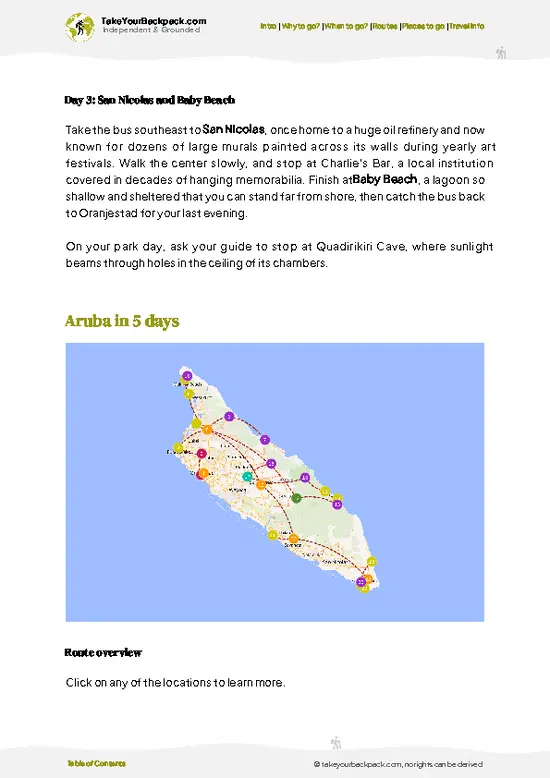
This five-day loop is for travelers who want the full island: the famous west-coast sand, the windswept cactus country of the northeast, and the fishing villages and murals of the south. The pace is relaxed, with two bases (three nights in Noord, two in Savaneta), so you never pack your bag twice in a row. Arubus buses handle most of the moving from the Oranjestad terminal, a guided 4x4 tour covers the park day, and a couple of short taxi rides or a rented scooter fill the gaps the bus lines skip.
Day 1: Oranjestad and Eagle Beach
Start in
Oranjestad, because the capital explains the rest of the island. The
National Archaeological Museum Aruba, set in restored colonial buildings near the center, lays out the Caquetío story through pottery, burial urns and tools, and it gives the rock art you will see later in the week real context. From there, take a short ride to the
Aruba Aloe Factory in Hato, where a quick guided walk shows how a plant that once covered much of the island became a cosmetics …
read more 👉This five-day loop is for travelers who want the full island: the famous west-coast sand, the windswept cactus country of the northeast, and the fishing villages and murals of the south. The pace is relaxed, with two bases (three nights in Noord, two in Savaneta), so you never pack your bag twice in a row. Arubus buses handle most of the moving from the Oranjestad terminal, a guided 4x4 tour covers the park day, and a couple of short taxi rides or a rented scooter fill the gaps the bus lines skip.
Day 1: Oranjestad and Eagle Beach
Start in Oranjestad, because the capital explains the rest of the island. The National Archaeological Museum Aruba, set in restored colonial buildings near the center, lays out the Caquetío story through pottery, burial urns and tools, and it gives the rock art you will see later in the week real context. From there, take a short ride to the Aruba Aloe Factory in Hato, where a quick guided walk shows how a plant that once covered much of the island became a cosmetics export. In the late afternoon, catch the bus north and get off at Eagle Beach, a wide, low-rise stretch of pale sand where the leaning fofoti trees make the best sunset silhouettes on the coast. Then check into a guesthouse in Noord, the residential village behind the hotel strip, where rooms run cheaper than the beachfront towers and local snack spots stay open late.Day 2: The North Tip, from Chapel to Lighthouse
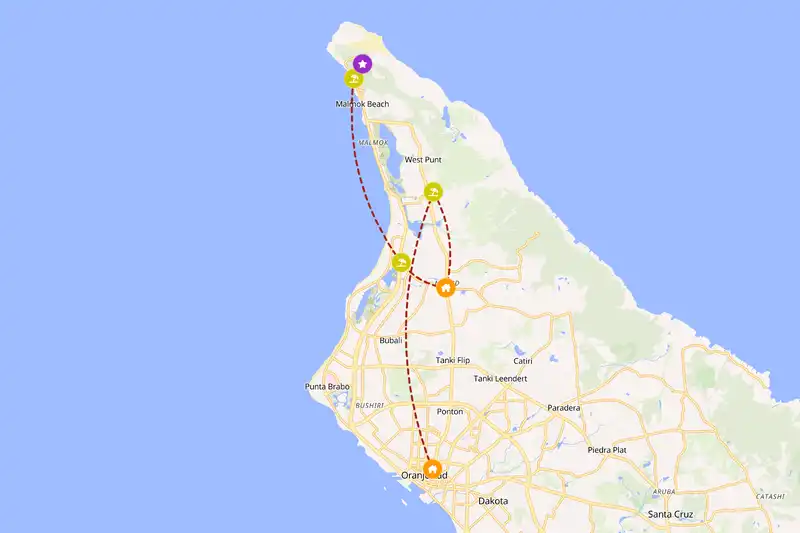
Use the morning for the sights the buses ignore. A taxi or rented scooter gets you to Alto Vista Chapel, a small yellow church on a bare hilltop with white crosses marking the road up, and then across to the Bushiribana Gold Mill Ruins, crumbling stone walls built during the island’s 19th-century gold rush, sitting right above a coast hammered by Atlantic surf. By noon, swap the rough coast for calm water at Malmok Beach, where the shallow shelf and a visible shipwreck draw snorkelers. Continue to Arashi Beach for a swim with fewer loungers, then walk the road uphill to California Lighthouse, the stone tower named after a steamship wrecked offshore. Ride back toward Noord and end at Palm Beach, where the strip of bars and the lit-up pier turn the evening into a people-watching session.Day 3: Arikok National Park
Today belongs to the wild side, and it is the one day worth paying for a guided 4x4 tour with hotel pickup, since the park’s tracks are rough and no bus enters. Arikok National Park covers roughly a fifth of the island, and the landscape flips completely: cactus forest, red-brown hills and goats instead of beach umbrellas. Inside, Fontein Cave holds Indigenous drawings on its ceiling, Boca Prins brings big white dunes and a cove where the surf is too strong for swimming, and Dos Playa pairs two scalloped bays that are for looking at only. Save your energy for Conchi Natural Pool, a pocket of seawater walled in by volcanic rock, where waves explode over the barrier while you float in the calm inside. Bring water shoes, since the final stretch is a scramble over sharp rock.Days 4-5: The Interior and the South Coast
Move south by bus, stopping on the way to break up the trip. Climb Hooiberg early, before the heat, up roughly 560 steps to the 165-meter summit, where on a clear day you can spot Venezuela’s coastline. A short taxi hop gets you to the Ayo Rock Formations, piled diorite boulders with faded rock paintings, then continue through Santa Cruz, the island’s inland heart, for a cheap lunch where locals actually eat. Settle into Savaneta, the oldest town on the island and the quietest base on this route, and spend the afternoon snorkeling over mangrove roots and coral at Mangel Halto. Day five runs east: walk the mural-covered streets of San Nicolas, the former refinery town that reinvented itself with street art, then head to Baby Beach, a shallow lagoon where you can wade out a long way in water barely waist-deep. Next door, Rodgers Beach trades the crowds for a local scene with the refinery stacks as backdrop. Finish with a walk across Seroe Colorado, the old refinery staff colony with its iguanas and cliff views, and down to Boca Grandi, where kitesurfers race the trade winds beside a red anchor memorial for lost seafarers. Back in Savaneta, a plate of fried fish at Zeerovers on the pier makes the right last dinner.
If you have a spare hour on the north coast, drive out to Andicuri Beach, a small sandy cove tucked between cliffs where bodyboarders ride the swell and tour groups rarely stop.



 Best Backpacking