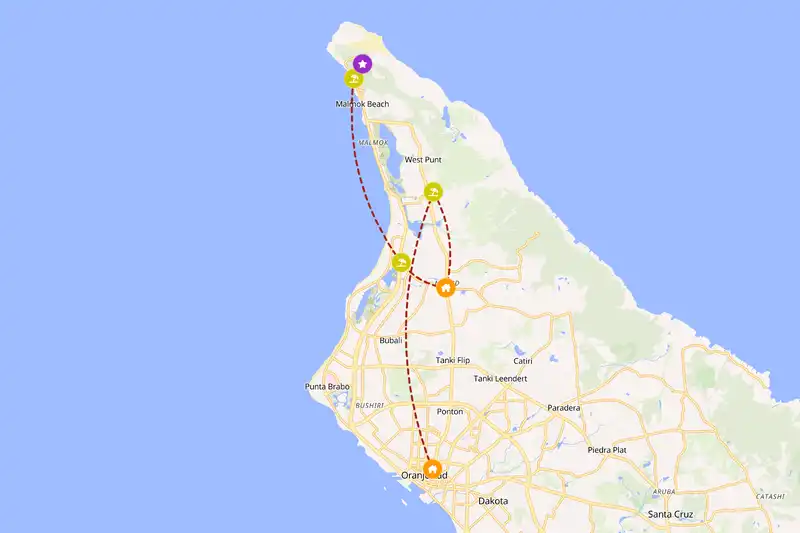
Yes, Aruba is one of the easiest Caribbean islands to travel on your own: English is widely spoken, US dollars are accepted almost everywhere, and the island is small and safe.
The Arubus network runs from the Oranjestad terminal to
Palm Beach,
Arashi Beach,
Santa Cruz,
Savaneta and
San Nicolas, with single fares of roughly US$2.50 to 3. The real challenge is cost. Dorm hostels barely exist, so plan on guesthouses or apartments in
Noord or
Savaneta at about US$60 to 120 a night, and a daily budget of US$90 to 150 if you eat at snack trucks and Zeerovers. Only
Arikok National Park and the Natural Pool need a tour (US$90 to 150) or a 4x4.
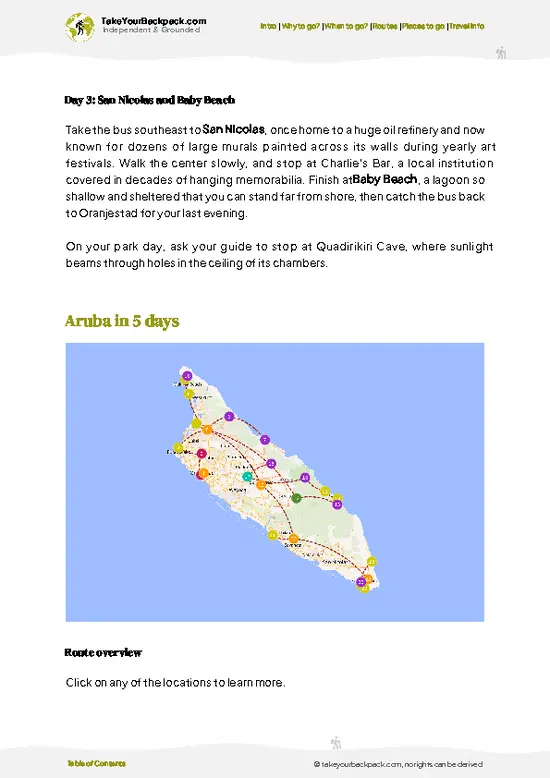
Four to five days is the right amount of time for Aruba, enough to cover the beaches, the national park and the south without rushing.
The island is only about 30 kilometers long, so driving tip to tip takes under an hour, but buses and heat slow you down. Two days covers the west coast:
Eagle Beach,
Palm Beach and
California Lighthouse. Three days adds a 4x4 day in
Arikok National Park and an afternoon in
San Nicolas and
Baby Beach. Five days lets you add the
Bushiribana Gold Mill Ruins, a
Hooiberg climb and two quiet nights in
Savaneta. Beyond a week, Aruba becomes a pure beach holiday.
Yes, you can get around most of Aruba without a car, since public buses link the capital with the hotel beaches, the interior and the south coast.
From the Oranjestad terminal, Arubus lines run north past
Eagle Beach and
Palm Beach to
Arashi Beach, roughly every 15 to 30 minutes in the daytime, and southeast via
Savaneta to
San Nicolas. Fares are about US$2.50 to 3 a ride. Taxis use fixed rates, around US$30 to 35 from the airport to Palm Beach. Where buses stop working is
Arikok National Park, the
Natural Pool and the north coast ruins: book a 4x4 tour (US$90 to 150) or rent a UTV or scooter for a day.
The must-visits in Aruba are
Eagle Beach,
Palm Beach,
Arikok National Park with its
Natural Pool, and
California Lighthouse.
Eagle Beach is the wide, low-rise beach for sunsets under the fofoti trees, while Palm Beach has the calmest water and the liveliest evenings. Arikok covers roughly a fifth of the island, and a full-day 4x4 tour (US$90 to 150) ends with a swim in the rock-walled Natural Pool. Add the
National Archaeological Museum Aruba in Oranjestad for Caquetío history, then a day in the south for the murals of
San Nicolas and the shallow lagoon at
Baby Beach. Together these fit comfortably into 3 days.
If time is short in Aruba, skip the
Aruba Aloe Factory,
Alto Vista Chapel and
Seroe Colorado; they are pleasant but the least distinctive stops on the island.
The aloe tour lasts about 30 minutes and mostly ends in a shop. Alto Vista is a small chapel best visited only if you are already driving the north coast, and Seroe Colorado makes sense only as an add-on to
Baby Beach.
Paradera and
Santa Cruz are residential towns with little to see, and the
Cave Pool involves a rough approach for a small swim. Put those hours into
Arikok National Park, which needs a full day, or an extra afternoon on
Eagle Beach.
Yes, our itinerary-planner does exactly that. Set your trip length in days, give your interests and travel style, optionally give start- and end location and/or some mandatory stops you would like to include and the itinerary planner creates your personalized routes for Aruba in seconds. Try it out!
Try the itinerary planner
 Best Backpacking