×

Australia🇦🇺 | landmarksGreat Ocean RoadLimestone stacks, Loch Ard cove, Bells surf break, roadside koalas | things to do and best time to go

Explore Willandra Lakes RegionExplore Halls Gap

Backpacking in Great Ocean Road
🌟 Highlightunique site ranked #3
By Johan Kruseman 🇳🇱 | Updated October 15, 2026

The Twelve Apostles are what put the Great Ocean Road on every Instagram feed, but the real prize is the 240-kilometer coastline itself, a war memorial road built by returned soldiers, with surf breaks, rainforest and koalas lounging in roadside gum trees. It runs along Victoria’s southwest coast in Australia, starting near Torquay, southwest of Melbourne. The Apostles are worth 20 minutes, and no more, because the car park crowd thickens fast and the stacks look the same from every railing. Skip the helicopter add-ons. Spend that time at Cape Otway and Loch Ard Gorge instead. I hired a campervan in Melbourne, and ten minutes past Lorne a koala-spotting traffic jam formed, with a dozen rental cars stopped dead for one sleeping marsupial that did not care. Nobody was in a hurry after that. Compared with the Great Ocean Road, the Sydney to Byron Bay run is faster and flatter, but this one has far better cliffs and far slower driving.

Discover everything you want to know in the 📖 Australia Travel Guide.


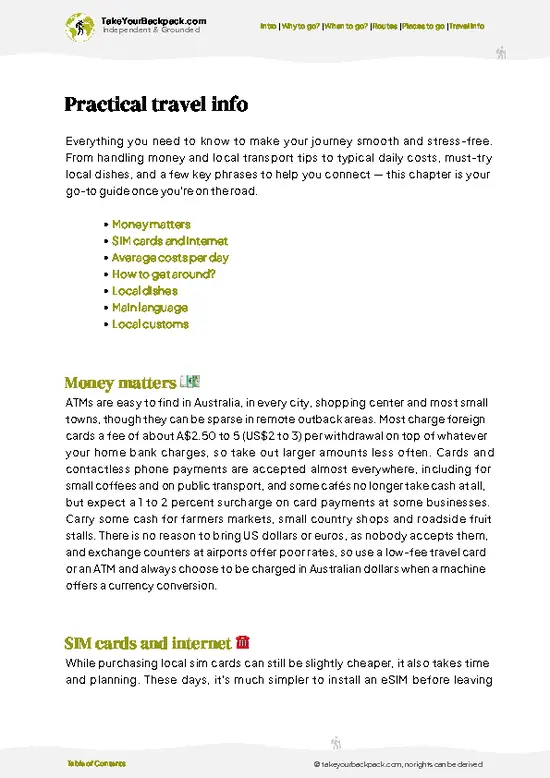
example page 0 from our offline Travel Guide for Australia
example page 1 from our offline Travel Guide for Australia
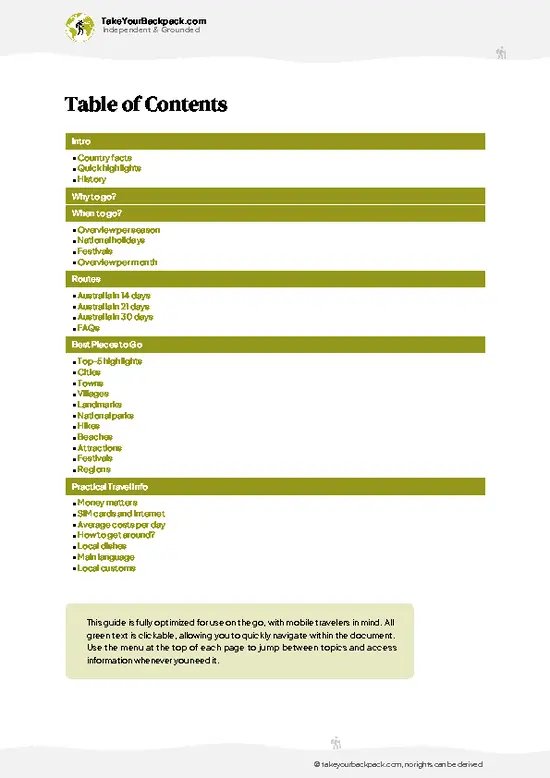
example page 2 from our offline Travel Guide for Australia
example page 3 from our offline Travel Guide for Australia
example page 4 from our offline Travel Guide for Australia
example page 5 from our offline Travel Guide for Australia
example page 6 from our offline Travel Guide for Australia
example page 7 from our offline Travel Guide for Australia
Loading the map 🌍
CLICK TO FILTER
cities
towns
villages
landmarks
national parks
hikes
beaches
attractions
festivals
regions
SHOW COUNTRY’S BESTSHOW ALL

✨ Why go?
Ranked #3 unique site in Australia
Reasons people choose to visit here

The main reason is the sheer variety packed into one coastline. Within a couple of days you pass Bells Beach, one of Australia’s most famous surf breaks, then climb into Great Otway National Park with tree ferns, waterfalls and wild koalas, then reach the limestone stacks and gorges of the Shipwreck Coast. Few drives anywhere switch landscapes this fast, and every stop is a short walk from the car, which makes it friendly for first-timers and people with limited mobility.

It also fits a bigger route easily. Most travelers loop it between Melbourne and Adelaide, and the road ends near Warrnambool, where the Princes Highway carries on west toward South Australia. Hostels and caravan parks in Apollo Bay, Port Campbell and Lorne give you cheap places to stop, and the national park lookouts are … read more 👉
The main reason is the sheer variety packed into one coastline. Within a couple of days you pass Bells Beach, one of Australia’s most famous surf breaks, then climb into Great Otway National Park with tree ferns, waterfalls and wild koalas, then reach the limestone stacks and gorges of the Shipwreck Coast. Few drives anywhere switch landscapes this fast, and every stop is a short walk from the car, which makes it friendly for first-timers and people with limited mobility.

It also fits a bigger route easily. Most travelers loop it between Melbourne and Adelaide, and the road ends near Warrnambool, where the Princes Highway carries on west toward South Australia. Hostels and caravan parks in Apollo Bay, Port Campbell and Lorne give you cheap places to stop, and the national park lookouts are free. If you have no car, small-group tours and the coast’s regional buses cover the main points, though a car lets you reach the quiet pull-offs before the crowds do. Go for at least two days, and use the extra time on the western end, where the rock formations are.

💡 HighlightsPlaces and moments you shouldn't skip

  1. Twelve Apostles: The limestone stacks rising from the Southern Ocean near Port Campbell are the sight everyone searches for. Fewer than a dozen remain standing, but the boardwalk views and the golden light at sunrise and sunset still deliver. Entry to the lookouts is free.
  2. Loch Ard Gorge: A sheltered cove with high orange cliffs, named after a clipper wrecked here in 1878. Stairs lead down to a small beach, and the walk to Tom and Eva’s lookout tells the survivors’ story.
  3. London Bridge: A rock formation whose connecting span collapsed in 1990, leaving two visitors stranded on the outer part until a helicopter rescued them. The remaining arch and the sea stacks make a quick, good stop.
  4. The Arch: A natural archway just west of Port Campbell, popular for photos at golden hour and typically quieter
… read more 👉
  1. Twelve Apostles: The limestone stacks rising from the Southern Ocean near Port Campbell are the sight everyone searches for. Fewer than a dozen remain standing, but the boardwalk views and the golden light at sunrise and sunset still deliver. Entry to the lookouts is free.
  2. Loch Ard Gorge: A sheltered cove with high orange cliffs, named after a clipper wrecked here in 1878. Stairs lead down to a small beach, and the walk to Tom and Eva’s lookout tells the survivors’ story.
  3. London Bridge: A rock formation whose connecting span collapsed in 1990, leaving two visitors stranded on the outer part until a helicopter rescued them. The remaining arch and the sea stacks make a quick, good stop.
  4. The Arch: A natural archway just west of Port Campbell, popular for photos at golden hour and typically quieter than the Apostles.
  5. Bells Beach: The famous surf break near Torquay, home of the Rip Curl Pro. Watching the swell from the cliff viewing platform costs nothing, and the Australian National Surfing Museum in Torquay adds the history.
  6. Memorial Arch: The Eastern View arch near Aireys Inlet marks the road’s opening in 1932, built by returned soldiers. It is worth a brief photo stop on the way in.
  7. Kennett River koalas: The gum trees along Grey River Road hold wild koalas, and colorful parrots will land on you if you hold out seed. Walk slowly and look up.
  8. Otway Fly Treetop Walk: An elevated steel walkway through cool temperate rainforest, with a tower rising above the canopy. It charges an entry fee and suits those wanting a break from the coast.
Loch Ard Gorge and The Arch pair well in one afternoon, since both sit within minutes of Port Campbell and show different faces of the same limestone coast.
Spotted a mistake or missing something? Contact us.

Things to do around Great Ocean Road

Ratings based on Tripadvisor reviews. When you book through this link, you support our work at no extra cost to you.

🌤️ When to go?When to go for the best experience

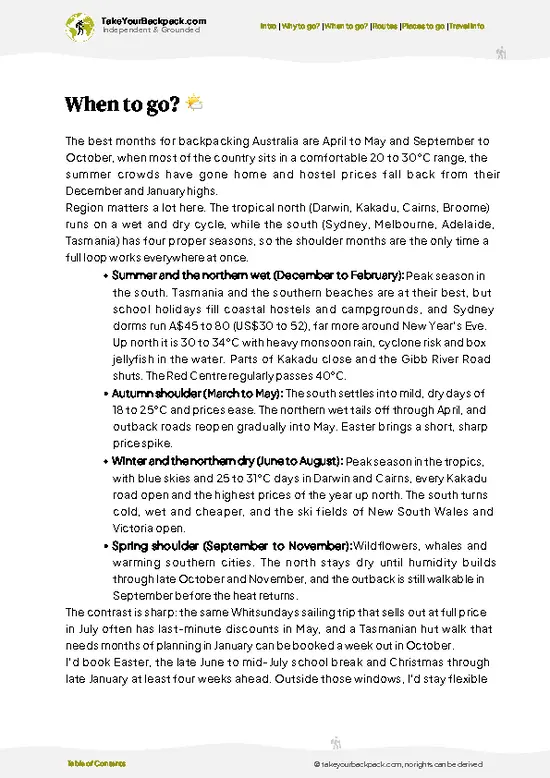
February and March are the driest, warmest months on the Great Ocean Road, with the clearest coastal views. Pick your window by what you want from the coast.
  • Summer (Dec to Feb): Highs of 20 to 26°C (68 to 79°F), daylight until about 9 pm, and the busiest roads and beaches. Torquay and Lorne fill up, and accommodation prices peak, especially around Christmas and January school holidays.
  • Autumn (Mar to May): Highs of 17 to 22°C (63 to 72°F), settled weather and thinner crowds. Prices ease after Easter.
  • Winter (Jun to Aug): Highs of 12 to 15°C (54 to 59°F), rain, wind and about 9.5 hours of daylight. Surf swells are big, whales pass Warrnambool from roughly June to September, and beds are cheapest.
  • Spring (Sep to Nov): Highs of 15 to 20°C (59 to 68°F), changeable showers, wildflowers and good koala
… read more 👉
February and March are the driest, warmest months on the Great Ocean Road, with the clearest coastal views. Pick your window by what you want from the coast.
  • Summer (Dec to Feb): Highs of 20 to 26°C (68 to 79°F), daylight until about 9 pm, and the busiest roads and beaches. Torquay and Lorne fill up, and accommodation prices peak, especially around Christmas and January school holidays.
  • Autumn (Mar to May): Highs of 17 to 22°C (63 to 72°F), settled weather and thinner crowds. Prices ease after Easter.
  • Winter (Jun to Aug): Highs of 12 to 15°C (54 to 59°F), rain, wind and about 9.5 hours of daylight. Surf swells are big, whales pass Warrnambool from roughly June to September, and beds are cheapest.
  • Spring (Sep to Nov): Highs of 15 to 20°C (59 to 68°F), changeable showers, wildflowers and good koala spotting around Kennett River.
Weekdays beat weekends all year, and starting the Twelve Apostles before 9 am avoids the tour buses.


source: climatestotravel.comJANJanuary: highly recommended for travelingFEBFebruary: highly recommended for travelingMARMarch: good for travelingAPRApril: highly recommended for travelingMAYMay: excellent for travelingJUNJune: good for travelingJULJuly: fair for travelingAUGAugust: fair for travelingSEPSeptember: excellent for travelingOCTOctober: excellent for travelingNOVNovember: highly recommended for travelingDECDecember: highly recommended for traveling
australia-unique-site-great-ocean-road
© Google |

✈️ The backpacker research shortcutAustralia Travel Guide

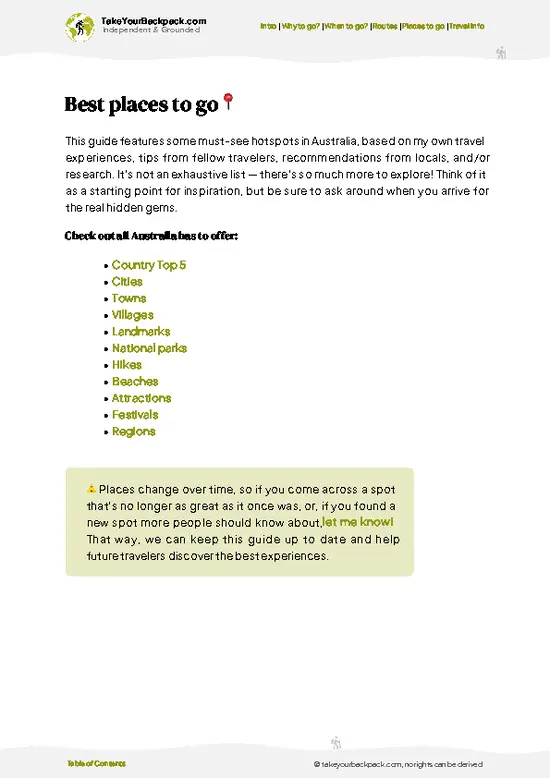
An offline-friendly backpacking guide with optimized travel routes, ranked highlights, transport advice, and the best areas to stay.
example page 0 from our offline Travel Guide for Australia
example page 1 from our offline Travel Guide for Australia
example page 2 from our offline Travel Guide for Australia
example page 3 from our offline Travel Guide for Australia
example page 4 from our offline Travel Guide for Australia
example page 5 from our offline Travel Guide for Australia
example page 6 from our offline Travel Guide for Australia
example page 7 from our offline Travel Guide for Australia
The digital guide (414 pages) contains:
✅ 143 highlights, ranked by travel appeal
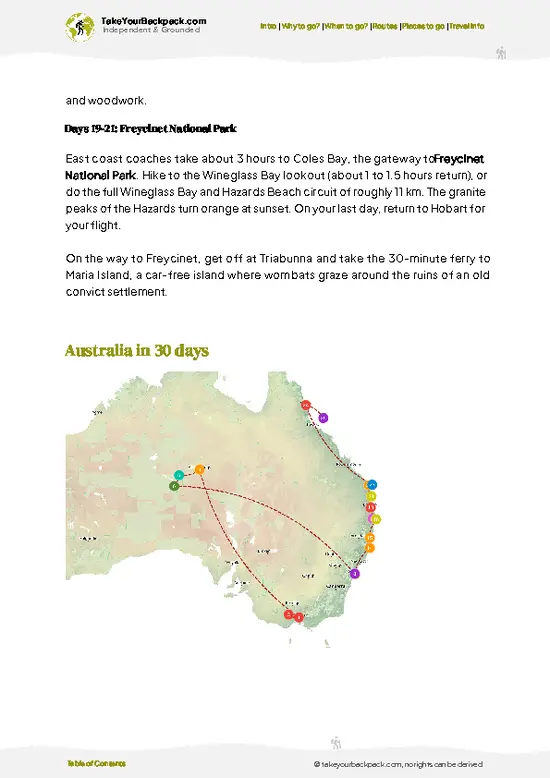
✅ Optimized 14, 21 & 30-day travel routes
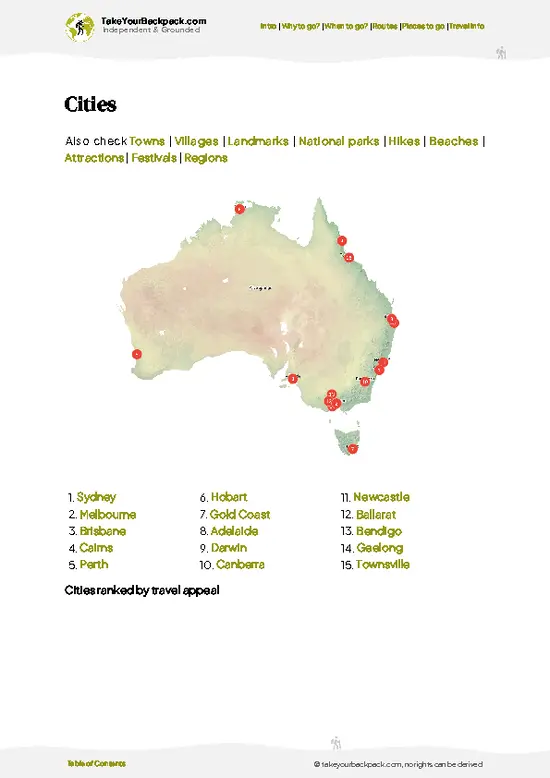
✅ Cities, national parks, landmarks, beaches
✅ How to get around
✅ Offline-friendly for travel without Wi-Fi
👉 Click to see all 30+ guide features

📅 Plan smarter in minutes, not weeks
✅ Month by month travel advice
✅ Festivals & national holidays
✅ Budget expectations

🗺️ Go to the right places, skip the overrated ones
✅ Honest pros & cons of destinations
✅ Top hikes, parks & viewpoints
✅ Lesser-known places most travelers miss
✅ Clear “worth it vs skip it” guidance

🛏️ Travel smoothly without rookie mistakes
✅ Best areas to stay
✅ Transport systems explained simply
✅ Common scams & safety advice
✅ SIM cards, money & practical tips

🌍 Understand the country, not just visit it
✅ Culture & traditions
✅ Local customs
✅ Festivals worth planning around
✅ Traveler-friendly historical context
✅ Insights that make places more meaningful

📱 Built for real travel conditions
✅ Fully downloadable PDF
✅ Works completely offline
✅ Optimized for phone use
✅ Useful in remote areas & buses
✅ Everything in one place
Stop searching, start planning
Get instant access to your full guide. 30‑day money-back guarantee.
+ Add another guide for just

By proceeding you agree to our terms.
Sent to your inbox immediately after payment • 100% Secure Checkout
Best Backpacking Travel Advisor 2025 tourism awardBest Backpacking
Travel Advisor
2025
What others say about Take Your Backpack Guides:
⭐⭐⭐⭐⭐
Fantastic, amazing amount of information!
⭐⭐⭐⭐⭐
My goodness this is amazing, it's what I've been looking for hats off too you!
⭐⭐⭐⭐⭐
I think this is absolutely BRILLIANT
⭐⭐⭐⭐
Very complete and informative. It's still missing places, but I gotta to commend you
⭐⭐⭐⭐⭐
This is truly amazing, thank you, can't wait to explore it with my kids!
⭐⭐⭐⭐⭐
Awesome resource, thank you!
⭐⭐⭐⭐⭐
This is amazing! Can't wait to explore the ones I haven't seen
⭐⭐⭐⭐
I love this! Well done, great idea.
⭐⭐⭐⭐⭐
Thanks for taking the time to make this gem!
⭐⭐⭐⭐⭐
This might be the best website I've ever seen.
⭐⭐⭐⭐⭐
Congratulations, and thank you so much for your work; it's incredibly valuable.
⭐⭐⭐⭐
In all seriousness I think you did a great job pointing out the important spots
⭐⭐⭐⭐⭐
10/10 very good
⭐⭐⭐⭐⭐
As someone who's only just starting to visit regularly this is awesome, thank you.
⭐⭐⭐⭐
Thank you very much! I'm going to visit my dad, it's going to be very useful!
⭐⭐⭐⭐⭐
This is really cool! We'll be travelling for the first time and this definitely come in handy.
⭐⭐⭐⭐⭐
You are now our minister of culture, congratulations 👨‍💼
⭐⭐⭐⭐⭐
Just wanted to tell you that this is a pearl! Going to follow your recommendations.
⭐⭐⭐⭐⭐
This is so cool. I'll definitely be using the resource for my travels soon.
⭐⭐⭐⭐⭐
This is very impressive! Good work.
⭐⭐⭐⭐⭐
This is an amazing and informative site. Very well done!

🛏️ Where to stay?Best areas to stay in Australia

Apollo Bay is the best base for most backpackers, roughly the midpoint of the drive, with a small hostel scene, a harbor, a Saturday market and cafes within walking distance of the beach. It is also the easiest place to meet other travelers, and the Otway rainforest and Cape Otway lighthouse sit nearby.
Lorne suits you if you want surf lessons, a lively main street and easy walks to waterfalls such as Erskine Falls. It is pricier in summer, but its pubs and beach make it social.
Torquay, at the eastern start, is the surf capital with the most budget beds and a young crowd. It works well if you arrive … read more 👉
Apollo Bay is the best base for most backpackers, roughly the midpoint of the drive, with a small hostel scene, a harbor, a Saturday market and cafes within walking distance of the beach. It is also the easiest place to meet other travelers, and the Otway rainforest and Cape Otway lighthouse sit nearby.
Lorne suits you if you want surf lessons, a lively main street and easy walks to waterfalls such as Erskine Falls. It is pricier in summer, but its pubs and beach make it social.
Torquay, at the eastern start, is the surf capital with the most budget beds and a young crowd. It works well if you arrive from Melbourne by train and bus and want to start with a surf lesson.
Port Campbell is the closest town to the Twelve Apostles, small and quiet, and good for sunrise or sunset visits when the day-trippers have gone. Warrnambool, at the western end, is larger, with more choice, supermarkets and a train link back to Melbourne. Camping and holiday parks are common along the route and are the cheapest option if you have a car or campervan. Book ahead for summer weekends and school holidays, since towns fill early.

👛 Costs (as of 15 October 2026)How expensive it really is

A backpacker doing the Great Ocean Road on a self-drive or shared-car budget spends about US$115 a day in high season. Driving is the big variable, because public transport along the route is thin and most travelers split a rental car. Prices are in US dollars, though you pay in Australian currency.
CategoryBudget RangeLocal Reality
Accommodation (high season)US$30 to 45Dorm beds in Apollo Bay, Port Campbell and Torquay run higher from December to February and on weekends. Off-season dorms drop to about US$22 to 32.
TransportUS$25 to 40A small rental car splits four ways costs about US$15 to 25 per person per day plus fuel. Fuel is US$1.20 to 1.50 a liter, and cheaper in Geelong than along the coast.
FoodUS$22 to 35Supermarkets in Torquay, Apollo Bay and Warrnambool keep self-catering cheap. Fish
… read more 👉
A backpacker doing the Great Ocean Road on a self-drive or shared-car budget spends about US$115 a day in high season. Driving is the big variable, because public transport along the route is thin and most travelers split a rental car. Prices are in US dollars, though you pay in Australian currency.
CategoryBudget RangeLocal Reality
Accommodation (high season)US$30 to 45Dorm beds in Apollo Bay, Port Campbell and Torquay run higher from December to February and on weekends. Off-season dorms drop to about US$22 to 32.
TransportUS$25 to 40A small rental car splits four ways costs about US$15 to 25 per person per day plus fuel. Fuel is US$1.20 to 1.50 a liter, and cheaper in Geelong than along the coast.
FoodUS$22 to 35Supermarkets in Torquay, Apollo Bay and Warrnambool keep self-catering cheap. Fish and chips cost US$11 to 17 and a pub meal US$18 to 28.
Attractions and feesUS$0 to 12The Twelve Apostles, Gibson Steps and London Arch lookouts are free. Parking at some sites is free, and walks in Great Otway National Park cost nothing. Paid extras include Cape Otway Lightstation at about US$22 and helicopter flights from about US$110.
ToursUS$0 to 90A one-day bus tour from Melbourne costs about US$70 to 100 and covers the main stops in a rush. Skip it if you have wheels.
ExtrasUS$5 to 10Coffee runs about US$3 to 4, and a beer at a pub about US$6 to 8.
Total Daily BudgetUS$115Based on a shared car, a dorm bed, self-catered meals plus one café or pub meal, and free lookouts.
⚠️ Prices can change and everyone travels differently, so take this as a rough guide. Hope it helps you plan your adventure!

FAQCommon questions from travelers

The Great Ocean Road is a 243 km (151 mile) coastal drive in Victoria, running from Torquay to Allansford near Warrnambool. It was built by returned soldiers after World War I and passes surf beaches, Otway rainforest and the limestone Twelve Apostles near Port Campbell. Most travelers also stop at Lorne, Apollo Bay and Loch Ard Gorge.
Plan two days and one night at minimum, and three days if you want walks and time in the Otways. A single long day trip from Melbourne is possible, but it means about 10 to 12 hours, with roughly 4 hours of driving each way to reach the Twelve Apostles and back. Apollo Bay or Port Campbell make good overnight stops.
Most travelers drive from Melbourne, about 1.5 hours to Torquay via the M1 and Princes Freeway, then follow the coast road west. Day tours from Melbourne cost roughly A$100 to 150, and hostels often run 2 or 3 day trips. V/Line trains run from Melbourne to Geelong and on to Warrnambool, with buses covering parts of the coastal route, though services are limited.
⚠️ Things can change over time, so always validate details locally before you go.

Other Australian landmarks near Great Ocean Road

Explore more nearby:


💡 Not sure where to go next?
Create a personalized itinerary for Australia including Great Ocean Road and the places that fit your trip.

Generate my itinerary

👉 Discover all landmarks

Or checkout all Australia has to offer (think cities, towns, villages, national parks, hikes, beaches, festivals)
Country photo of Australia

We 💚 feedbackParting advice and final tips

Treat the road as the middle chapter of a longer trip. I would pair it with Melbourne at one end and the Grampians or Adelaide at the other, and give the coast two nights rather than a rushed day. Book a bed in Apollo Bay or Port Campbell, and bring a full tank, since fuel stations thin out.

✈️ When did I visit Australia?
On my trip to New Zealand in 1993, I had a short stop in Australia as well.

✍️ Help improve this page!
The information on this page is based on my own backpacking experience in Australia, supplemented with up-to-date research and feedback from other travelers. Travel details can change, so if you notice anything outdated or incomplete, feel free to let me know.


🙋‍♂️ Give feedback

👋 Meet the founderWho’s Behind Take Your Backpack?

Johan, backpacker and founder of TakeYourBackpackHi, I’m Johan (Netherlands 🇳🇱), the creator of TakeYourBackpack. Over the past 3 decades, I’ve backpacked through 90+ countries across six continents, gaining extensive experience with independent travel, long-term trips, and overland routes.

This site is built on a combination of firsthand travel experience and carefully curated insights from other backpackers. Many guides are based on places I’ve personally visited, while others bring together tips, observations, and practical advice shared by trusted travelers I’ve met along the way.

The goal is to provide realistic, experience-driven guidance — not generic itineraries — so you can explore destinations with better context, clearer expectations, and more confidence.