×

Australia🇦🇺 | best landmarksWhere to Find the 9 Best landmarks in Australia

Landmarks in Australia come in two sizes: enormous and very far away. The country is roughly the width of the contiguous United States, so a famous rock, reef or bridge is rarely a casual detour. Expect a mix of natural wonders, Aboriginal cultural sites and a handful of convict-era and colonial structures, and expect each to behave differently depending on where it sits.
The east coast is the easy mode. Sites cluster near cities, buses and trains run often, hostels are everywhere, and so are the crowds, especially at harbor-side icons where selfie sticks outnumber seagulls. The Red Centre and the Top End are hard mode. Distances run to hundreds of kilometers between fuel stops, park entry is ticketed, and a single tour or rental car can eat a week of budget. Tasmania and the southwest sit between the two: quieter, greener, and a little pricier than you would guess for the effort.
For backpacking or independent travel, that split matters more than any ranking. Pick the kind of landmark that fits your wallet and your patience for driving, and Australia will cooperate. Ignore the map, and it will politely remind you how big it is.

By Johan Kruseman 🇳🇱 | Updated October 18, 2026
Explore the best national parks in Australia

Why go?Understanding Their Importance

Australia is oddly well suited to landmarks, mostly because it has so much empty space around them. The continent is old, flat in large stretches and sparsely settled, so the things that do stand out, geologically or culturally, stand out dramatically. There is no tangle of medieval towns to compete for your attention. A rock formation, a coral system or a gorge gets the horizon to itself.
The cultural layer is the part many visitors underestimate. Aboriginal and Torres Strait Islander peoples have continuous connections to this land stretching back at least 65,000 years, and many of the country’s most famous places are sacred sites first and photo stops second. Some areas are jointly managed with traditional owners, and that shapes the rules: certain areas are closed to photography, certain … read more 👉
Australia is oddly well suited to landmarks, mostly because it has so much empty space around them. The continent is old, flat in large stretches and sparsely settled, so the things that do stand out, geologically or culturally, stand out dramatically. There is no tangle of medieval towns to compete for your attention. A rock formation, a coral system or a gorge gets the horizon to itself.
The cultural layer is the part many visitors underestimate. Aboriginal and Torres Strait Islander peoples have continuous connections to this land stretching back at least 65,000 years, and many of the country’s most famous places are sacred sites first and photo stops second. Some areas are jointly managed with traditional owners, and that shapes the rules: certain areas are closed to photography, certain paths are off limits, and some activities have been retired altogether. Treat the signage as the instruction it is.
The colonial layer is far shorter, dating from 1788, so built landmarks are young by European standards. Australia does engineering and harbors well, but anyone expecting cathedrals and castles will be underwhelmed. Come for the natural and Indigenous heritage, and treat the colonial sites as bonus material.
Climate is the other deciding factor. The north swings between a wet season with flooding, stingers in the water and closed roads, and a dry season when everything is open. The interior can top 40°C in summer, which shuts down walking trails by mid-morning. The south is cooler and wetter in winter. Conditions can change what you can actually do at a famous place, so check closures before you commit.
Before choosing Australia for landmarks, accept three realities. Distances are huge, and domestic flights or long drives are routine. Costs are high by Asian or Latin American standards, with park passes, tours and fuel adding up quickly. And wildlife and heat are real safety factors rather than brochure decoration. Plan with those in mind and the payoff is landscapes you will not find anywhere else, with room to enjoy them.
Evaluating the Top Choices
The list of best unique sites in Australia is created based on history or culture, wow factor, atmosphere, quirks, and memorability. If you feel a unique site is missing in this list, please let us know.

When to go?Optimal Periods for Travel

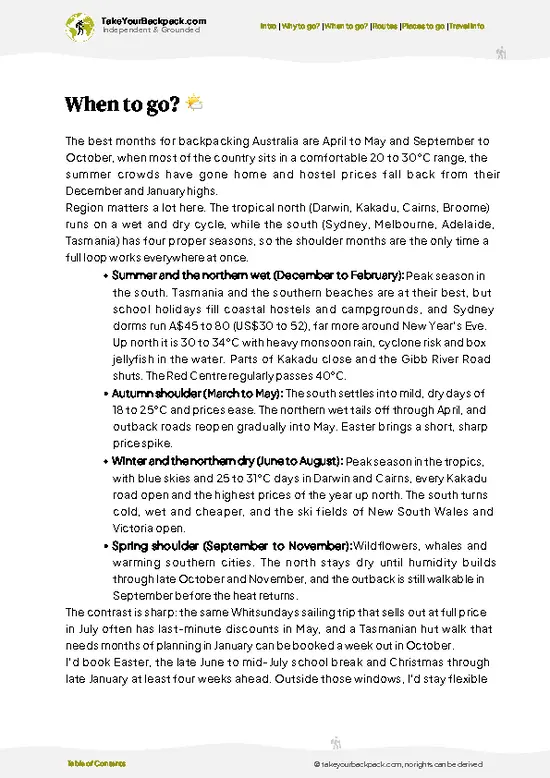
Best months by region: The best window for landmarks across Australia is April to October for the north and center, and November to March for the south, because those are the periods when the heat, rain or cold are least likely to shut something down. Since the country spans tropical and temperate zones, no single month suits everywhere, which is mildly inconvenient for people who like simple answers.
The tropical north (Darwin, Kakadu region, Cairns and the Great Barrier Reef coast) has a dry season from roughly May to October, with days of 28 to 33°C and little rain. The wet season, November to April, brings heavy downpours, humidity and flooding that can close roads and parks. From about November to May, box jellyfish and irukandji make unprotected swimming off northern beaches a poor idea. … read more 👉
Best months by region: The best window for landmarks across Australia is April to October for the north and center, and November to March for the south, because those are the periods when the heat, rain or cold are least likely to shut something down. Since the country spans tropical and temperate zones, no single month suits everywhere, which is mildly inconvenient for people who like simple answers.
The tropical north (Darwin, Kakadu region, Cairns and the Great Barrier Reef coast) has a dry season from roughly May to October, with days of 28 to 33°C and little rain. The wet season, November to April, brings heavy downpours, humidity and flooding that can close roads and parks. From about November to May, box jellyfish and irukandji make unprotected swimming off northern beaches a poor idea.
The Red Centre is best from May to September. Days sit around 20 to 25°C, but winter nights can drop to 0°C or below in the desert, so a warm layer is not optional. Summer days regularly pass 40°C, and walking trails often close or restrict access in the hot part of the day.
The south and east (Sydney, Melbourne, Tasmania, the Great Ocean Road coast) are at their best from November to April, with warm days of 20 to 28°C. Tasmania and the south coast can still deliver cold, wet days in any month, so pack accordingly.
Shoulder seasons and crowds: The shoulder months (April to May and September to October) tend to give the best balance of mild weather and thinner crowds across much of the country. Peak periods that change decisions are the Australian summer school holidays from late December to January, and the Easter and July school breaks in many states. During these, accommodation prices in popular coastal and outback gateways commonly rise by 20 to 50 percent, and tours fill up weeks ahead.
Book sunrise or guided experiences early in peak months. In the wet season in the north, rates drop and crowds vanish, which is tempting, but only if you are comfortable with changed plans and closed access. Check park alerts before setting out, because conditions are posted and they do mean it.

unique site hoppingHow to Combine landmarks Into One Trip

How long a combined trip takes: A trip combining several Australian landmarks needs 14 to 28 days, because the distances between regions are measured in flights and long driving days rather than short hops. Trying it in a week produces a lot of airport coffee and very little looking at anything.
The regions group into three sensible clusters. The east coast (Sydney, the Blue Mountains, Brisbane, Cairns) is linked by frequent flights and the coastal rail and bus corridor. The Red Centre works as a separate leg, usually reached by flying into Alice Springs or Ayers Rock Airport, with Alice Springs as the road-trip hub. The south (Melbourne, the Great Ocean Road, Adelaide, Tasmania) forms another compact loop with easy flights from Melbourne.
A workable direction is to fly into Sydney or Melbourne, … read more 👉
How long a combined trip takes: A trip combining several Australian landmarks needs 14 to 28 days, because the distances between regions are measured in flights and long driving days rather than short hops. Trying it in a week produces a lot of airport coffee and very little looking at anything.
The regions group into three sensible clusters. The east coast (Sydney, the Blue Mountains, Brisbane, Cairns) is linked by frequent flights and the coastal rail and bus corridor. The Red Centre works as a separate leg, usually reached by flying into Alice Springs or Ayers Rock Airport, with Alice Springs as the road-trip hub. The south (Melbourne, the Great Ocean Road, Adelaide, Tasmania) forms another compact loop with easy flights from Melbourne.
A workable direction is to fly into Sydney or Melbourne, move through the south and east first while you adjust to the time zone, then finish with the Red Centre or the tropical north. The north is also a useful finale in the dry season, since the weather is at its most dependable. Sydney to Melbourne is roughly 1.5 hours by air or 10 to 12 hours by road. Sydney to Cairns is about 3 hours by air. Alice Springs to the national park around Uluru is roughly 4.5 to 5 hours by road.
Time per stop and common planning mistakes: Allow 2 to 3 days for big city gateways, 1 to 2 days for natural sites that can be seen from a base town, and 3 to 4 days for remote regions where travel time takes up most of a day each way. Reef trips and wilderness areas often need a full day on the water or trail.
The classic mistake is treating the map as small. Australia’s scale tricks people into stacking too many stops and ending up with a trip made of transit. Instead, choose two or three regions and give each real time. Another error is driving at dusk or dawn in rural areas, when kangaroos are most active and collisions common. Plan arrivals before late afternoon.
A third is ignoring seasons. Pairing the Red Centre with the tropical north in January produces one hot oven and one flood. Check each region’s season before locking the order. Finally, one-way car rentals carry heavy drop-off fees, often A$200 to 500 or more over long distances, so loops usually beat straight lines.

The ListThe Best landmarks of Australia

1 Great Barrier Reef

Outer reef edge, turtles over shallows, Yongala wreck, liveaboard dives

Board a catamaran from Townsville to snorkel coral gardens, dive the upright Yongala wreck, or book a multi-day boat to remote Ribbon Reefs.

Australia - the Great Barrier Reef

2 Sydney Opera House

Tiled sails, Concert Hall organ, forecourt steps, harborside bar

Circle the forecourt to see the chevron-tiled roofs up close, then take a tour or catch a performance beneath the Grand Organ.

Australia - the Sydney Opera House

3 Great Ocean Road

Limestone stacks, Loch Ard cove, Bells surf break, roadside koalas

Drive Victoria’s southwest coast from Torquay, stopping at sea stacks and cliffs, then slow down in Kennett River’s gum trees for wild koalas.

australia-unique-site-great-ocean-road
© Google |

4 Sydney Harbour Bridge

Steel arch, free walkway, Pylon lookout, Luna Park face

Walk the eastern footpath from Cumberland Street for free, or climb the arch in a harness for views over the harbor and Opera House.

Australia - the Sydney Harbour Bridge

5 Gondwana Rainforests of Australia

Strangler figs, Antarctic beech, canopy bridge, glowworm cave, waterfall arches

Walk old-growth tracks between Lamington and Springbrook, crossing a canopy bridge, peering into a glowworm cave and looking out over cool valleys from mossy beech forest.

6 Shark Bay

Dawn dolphins, stromatolites, cockleshell beach, dugong seagrass

Wade ankle-deep at Monkey Mia for dolphin feeding, then see the Hamelin Pool stromatolites and cruise seagrass flats where dugongs graze.

australia-unique-site-shark-bay
© Google |

7 Wave Rock

Striped granite curl, wheatbelt detour, Hippos Yawn, hand-stencil shelter

Walk the base of the 14-meter granite wall, climb to its crest above wheat fields, and continue to Mulka’s Cave and Hippos Yawn.

8 Willandra Lakes Region

Eroded dune crescent, Mungo Man, dirt loop drive, dark outback sky

Drive the dirt loop around the lunette to the Walls of China at dusk, then join a Traditional Owner tour and stay for the stars.

9 Wilpena Pound

Quartzite amphitheater, pioneer homestead, ochre paintings, dark skies

Camp beside the great ring of folded rock, climb to Wangara Lookout and take a longer loop or a summit day if time allows.

australia-unique-site-wilpena-pound
© Google | James Popple
Loading the map 🌍

Expert viewPro Tips for Exploring the Best

How many landmarks to aim for: Plan on four to six landmarks for a trip of two to four weeks, because that is the number you can see properly without turning the holiday into a transport audit. Australia punishes ambition. Each major site usually costs a half day to two days once travel, queues and recovery are counted, and the gaps between regions swallow whole days. Go beyond six and you collect photos of car windows. Go below four and you will spend good money on a flight to Australia and see mostly the inside of a hostel.
Choosing between kinds of landmarks: Australia offers three broad kinds: urban and built icons, natural wonders and Indigenous cultural places. For a tight budget, city icons give the most. They are often free to see from public viewpoints, reachable by public transit, … read more 👉
How many landmarks to aim for: Plan on four to six landmarks for a trip of two to four weeks, because that is the number you can see properly without turning the holiday into a transport audit. Australia punishes ambition. Each major site usually costs a half day to two days once travel, queues and recovery are counted, and the gaps between regions swallow whole days. Go beyond six and you collect photos of car windows. Go below four and you will spend good money on a flight to Australia and see mostly the inside of a hostel.
Choosing between kinds of landmarks: Australia offers three broad kinds: urban and built icons, natural wonders and Indigenous cultural places. For a tight budget, city icons give the most. They are often free to see from public viewpoints, reachable by public transit, and need no tour. Natural wonders are the best use of money if you are fit and willing to pay, as park fees are modest (typically A$0 to 40 a person, with the Red Centre national park pass around A$38 for three days) but the access costs, such as fuel, tours or reef boats, are not.
Indigenous cultural experiences are where a guided visit gives the most for the money. A guide led by a traditional owner explains what a landscape means, which turns a rock into a place with a story. Expect A$60 to 150 for a half-day cultural tour. Skipping it saves cash but costs the context, and I would pay for at least one.
For a comfort-first traveler, base in a city and take day tours, which cost more per visit (A$100 to 250) but spare you the driving. For a time-rich backpacker, rent a campervan or share a car with other travelers, which cuts cost per person and gives flexibility but demands long days at the wheel. Joining a small-group overland tour from Alice Springs or Darwin trades some freedom for a lot less planning and shared fuel costs.
Budget per day and per visit: A backpacker doing it cheaply should budget roughly A$100 to 160 (about US$65 to 105) a day, covering a hostel dorm bed at A$35 to 60, self-catered food, local transit and the odd park fee. Add a rental car or van and the figure climbs by A$40 to 100 a day before fuel, which is steep at remote roadhouses. Remote regions raise everything: groceries, water and fuel often cost noticeably more than in the cities.
Per visit, entry to natural sites is often free or A$15 to 40. Guided experiences run A$60 to 250 depending on length and remoteness. Reef day trips are the biggest single spend, commonly A$200 to 300 for a day with snorkeling, and they are worth the money if the weather cooperates. Spend there and skimp on dinners.
Book popular tours and sunrise slots early in peak season, since walk-up availability is a gamble. Buying park passes online ahead of time saves queueing and sometimes money.
Safety and cultural considerations: The biggest risks are mundane. Heat and dehydration are the most common problems in the interior, where walking in midday sun can become dangerous quickly. Carry at least 3 to 4 liters of water for a day hike, start at dawn and follow trail closure signs. Remote roads have long stretches without phone coverage, so tell someone your route and carry extra water and fuel.
In tropical waters, swim only at netted, patrolled beaches during stinger season, and stay clear of rivers and estuaries in the north, where saltwater crocodiles live. Signs are there because someone ignored them. At surf beaches, swim between the red and yellow flags. Sun here is brutal even on cloudy days, so apply sunscreen often.
Culturally, respect for Indigenous sites is not optional. Follow rules on photography, restricted areas and activities that traditional owners have asked visitors to avoid. Do not take rocks or sand as souvenirs. Parks sometimes receive them back in the mail from people who regret it. Ask before photographing people, and use guides and operators owned or led by Indigenous communities where you can, so the money reaches the people whose land you are visiting.
Carry cash for the odd roadhouse, download offline maps, and accept that a landmark an hour away on the map may be four on the road. That mindset saves more money than any coupon.

✈️ The backpacker research shortcutAustralia Travel Guide

An offline-friendly backpacking guide with optimized travel routes, ranked highlights, transport advice, and the best areas to stay.
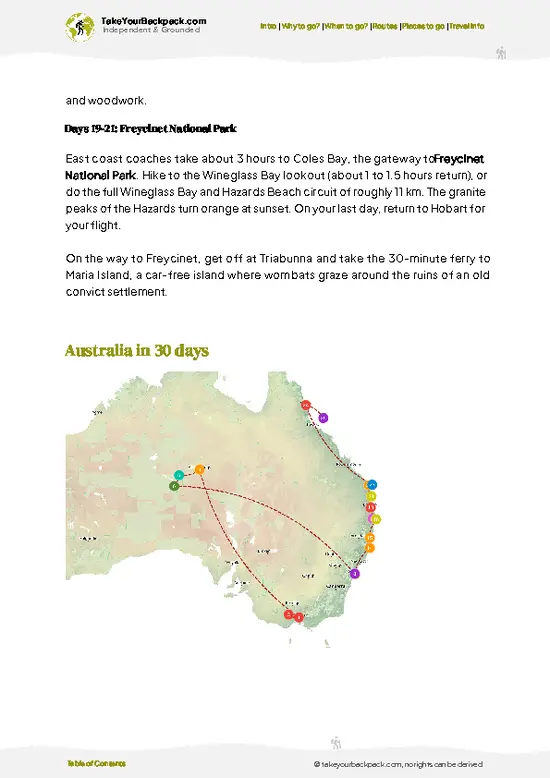
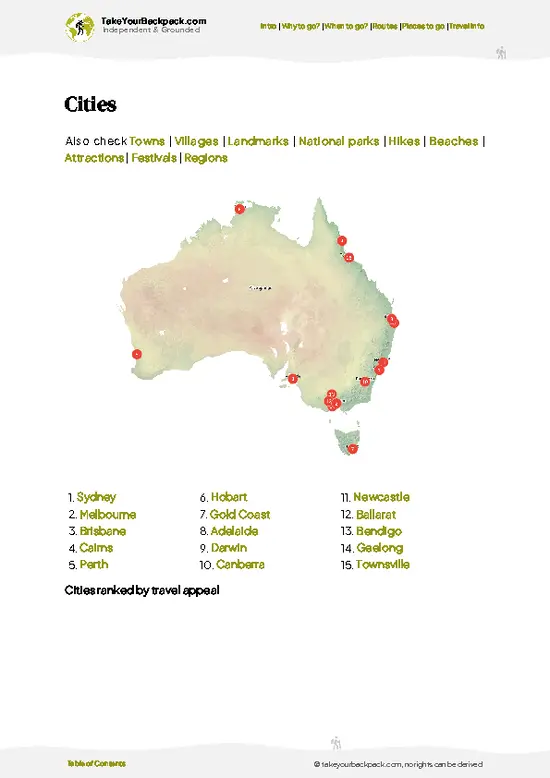
example page 0 from our offline Travel Guide for Australia
example page 1 from our offline Travel Guide for Australia
example page 2 from our offline Travel Guide for Australia
example page 3 from our offline Travel Guide for Australia
example page 4 from our offline Travel Guide for Australia
example page 5 from our offline Travel Guide for Australia
example page 6 from our offline Travel Guide for Australia
example page 7 from our offline Travel Guide for Australia
The digital guide (414 pages) contains:
✅ 143 highlights, ranked by travel appeal
✅ Optimized 14, 21 & 30-day travel routes
✅ Cities, national parks, landmarks, beaches
✅ How to get around
✅ Offline-friendly for travel without Wi-Fi
👉 Click to see all 30+ guide features

📅 Plan smarter in minutes, not weeks
✅ Month by month travel advice
✅ Festivals & national holidays
✅ Budget expectations

🗺️ Go to the right places, skip the overrated ones
✅ Honest pros & cons of destinations
✅ Top hikes, parks & viewpoints
✅ Lesser-known places most travelers miss
✅ Clear “worth it vs skip it” guidance

🛏️ Travel smoothly without rookie mistakes
✅ Best areas to stay
✅ Transport systems explained simply
✅ Common scams & safety advice
✅ SIM cards, money & practical tips

🌍 Understand the country, not just visit it
✅ Culture & traditions
✅ Local customs
✅ Festivals worth planning around
✅ Traveler-friendly historical context
✅ Insights that make places more meaningful

📱 Built for real travel conditions
✅ Fully downloadable PDF
✅ Works completely offline
✅ Optimized for phone use
✅ Useful in remote areas & buses
✅ Everything in one place
Stop searching, start planning
Get instant access to your full guide. 30‑day money-back guarantee.
+ Add another guide for just

By proceeding you agree to our terms.
Sent to your inbox immediately after payment • 100% Secure Checkout
Best Backpacking Travel Advisor 2025 tourism awardBest Backpacking
Travel Advisor
2025
What others say about Take Your Backpack Guides:
⭐⭐⭐⭐⭐
Fantastic, amazing amount of information!
⭐⭐⭐⭐⭐
My goodness this is amazing, it's what I've been looking for hats off too you!
⭐⭐⭐⭐⭐
I think this is absolutely BRILLIANT
⭐⭐⭐⭐
Very complete and informative. It's still missing places, but I gotta to commend you
⭐⭐⭐⭐⭐
This is truly amazing, thank you, can't wait to explore it with my kids!
⭐⭐⭐⭐⭐
Awesome resource, thank you!
⭐⭐⭐⭐⭐
This is amazing! Can't wait to explore the ones I haven't seen
⭐⭐⭐⭐
I love this! Well done, great idea.
⭐⭐⭐⭐⭐
Thanks for taking the time to make this gem!
⭐⭐⭐⭐⭐
This might be the best website I've ever seen.
⭐⭐⭐⭐⭐
Congratulations, and thank you so much for your work; it's incredibly valuable.
⭐⭐⭐⭐
In all seriousness I think you did a great job pointing out the important spots
⭐⭐⭐⭐⭐
10/10 very good
⭐⭐⭐⭐⭐
As someone who's only just starting to visit regularly this is awesome, thank you.
⭐⭐⭐⭐
Thank you very much! I'm going to visit my dad, it's going to be very useful!
⭐⭐⭐⭐⭐
This is really cool! We'll be travelling for the first time and this definitely come in handy.
⭐⭐⭐⭐⭐
You are now our minister of culture, congratulations 👨‍💼
⭐⭐⭐⭐⭐
Just wanted to tell you that this is a pearl! Going to follow your recommendations.
⭐⭐⭐⭐⭐
This is so cool. I'll definitely be using the resource for my travels soon.
⭐⭐⭐⭐⭐
This is very impressive! Good work.
⭐⭐⭐⭐⭐
This is an amazing and informative site. Very well done!

🛏️ Where to stay?Where to Stay in Australia

Australia has hostels in every major city and backpacker hub, with dorm beds typically A$35 to 60 (US$23 to 39) a night and private doubles from about A$100 (US$65). In Sydney, Kings Cross and Potts Point put you a short train ride from the CBD and in the middle of late-night bars, though the main strip gets rowdy after dark, while Bondi and Coogee trade a 30 to 45 minute bus ride for sand at your doorstep and a beach-party crowd. In Melbourne, the CBD is the most central base for trams and laneway food, St Kilda mixes a seafront with a lively and occasionally rough-edged nightlife, and Brisbane splits between Fortitude Valley (club central, loud on weekends) and quieter South Brisbane, within … read more 👉
Australia has hostels in every major city and backpacker hub, with dorm beds typically A$35 to 60 (US$23 to 39) a night and private doubles from about A$100 (US$65). In Sydney, Kings Cross and Potts Point put you a short train ride from the CBD and in the middle of late-night bars, though the main strip gets rowdy after dark, while Bondi and Coogee trade a 30 to 45 minute bus ride for sand at your doorstep and a beach-party crowd. In Melbourne, the CBD is the most central base for trams and laneway food, St Kilda mixes a seafront with a lively and occasionally rough-edged nightlife, and Brisbane splits between Fortitude Valley (club central, loud on weekends) and quieter South Brisbane, within walking distance of South Bank and the museums.

If you enjoy meeting fellow travelers, consider choosing hostels with high ratings for atmosphere. On the other hand, if you prefer having your own space, a hotel might be a better option.

AustraliaMore of Australia

👋 Meet the founderWho’s Behind Take Your Backpack?

Johan, backpacker and founder of TakeYourBackpackHi, I’m Johan (Netherlands 🇳🇱), the creator of TakeYourBackpack. Over the past 3 decades, I’ve backpacked through 90+ countries across six continents, gaining extensive experience with independent travel, long-term trips, and overland routes.

This site is built on a combination of firsthand travel experience and carefully curated insights from other backpackers. Many guides are based on places I’ve personally visited, while others bring together tips, observations, and practical advice shared by trusted travelers I’ve met along the way.

The goal is to provide realistic, experience-driven guidance — not generic itineraries — so you can explore destinations with better context, clearer expectations, and more confidence.