×

Australia🇦🇺 | citiesHobartSalamanca Saturday, cliff-cut MONA, kunanyi summit, dockside fish punts | things to do and best time to go

Explore CanberraExplore Melbourne

Backpacking in Hobart
🌟 Highlightcity ranked #6
By Johan Kruseman 🇳🇱 | Updated October 16, 2026

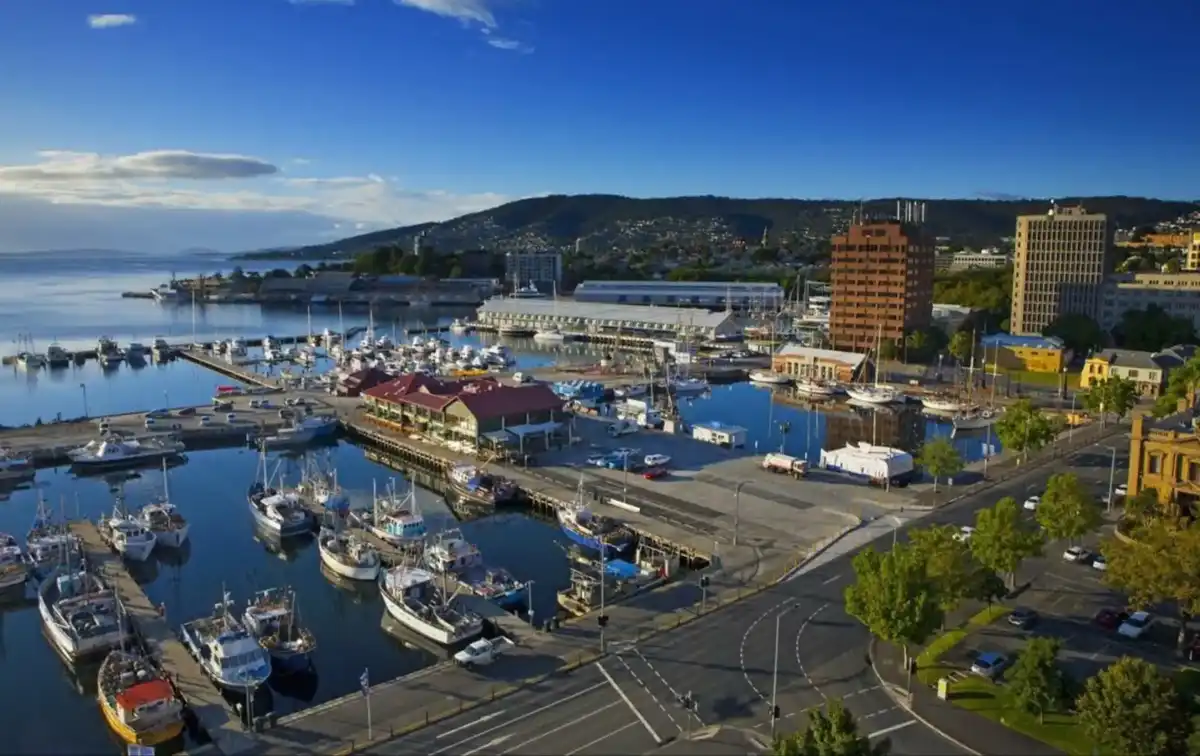
Hobart suits backpackers who like their adventures with a good coffee nearby: hikers, food-and-art people, and anyone who wants a small harbor city with a wild mountain behind it. If you need a big nightlife scene, a beach town buzz or dense backpacker crowds, you may find it a touch sleepy and the hostel scene thin. The city sits in the south-east of Tasmania, Australia’s island state, on the Derwent River beneath kunanyi/Mount Wellington. Spend your time at Salamanca on Saturday, the waterfront and the mountain. Skip the souvenir shops, which sell the same tea towels everywhere. I still connect Hobart with the clank of rigging on yachts at Constitution Dock, a sound like a thousand tiny wind chimes arguing with each other. It plays all day over the fish-and-chip smell. Even the seagulls here seem to have opinions about your chips, and they hover near the Mures counter.

Discover everything you want to know in the 📖 Australia Travel Guide.


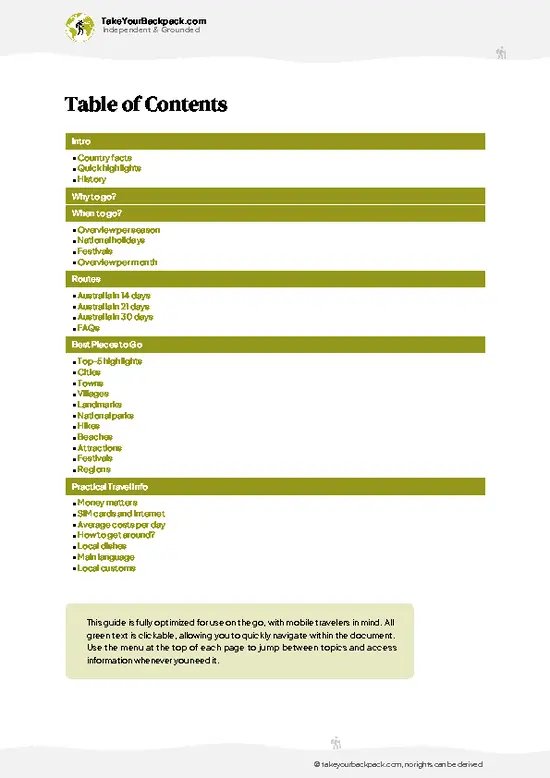
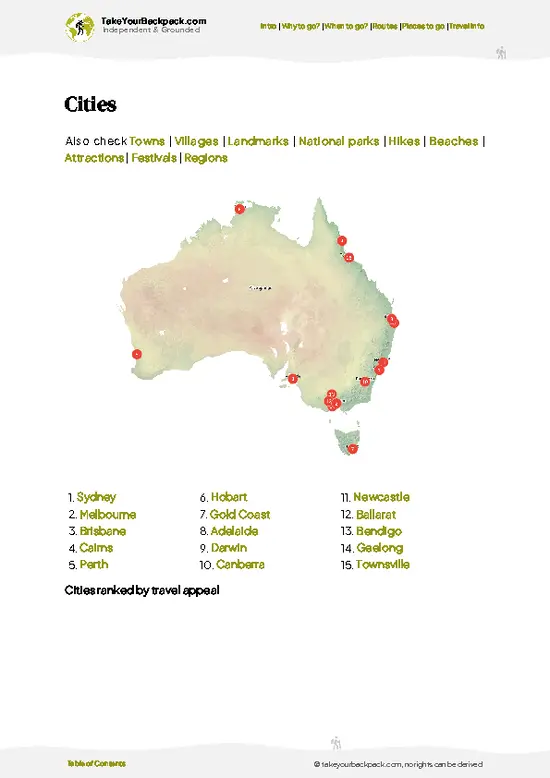
example page 0 from our offline Travel Guide for Australia
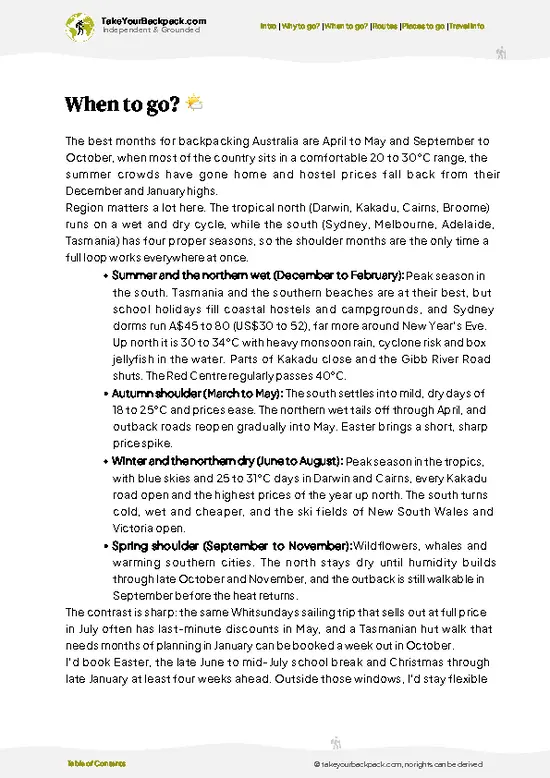
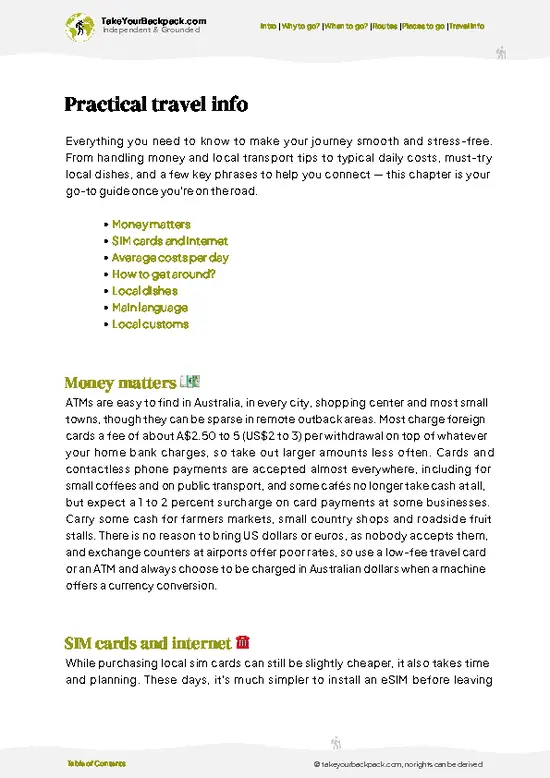
example page 1 from our offline Travel Guide for Australia
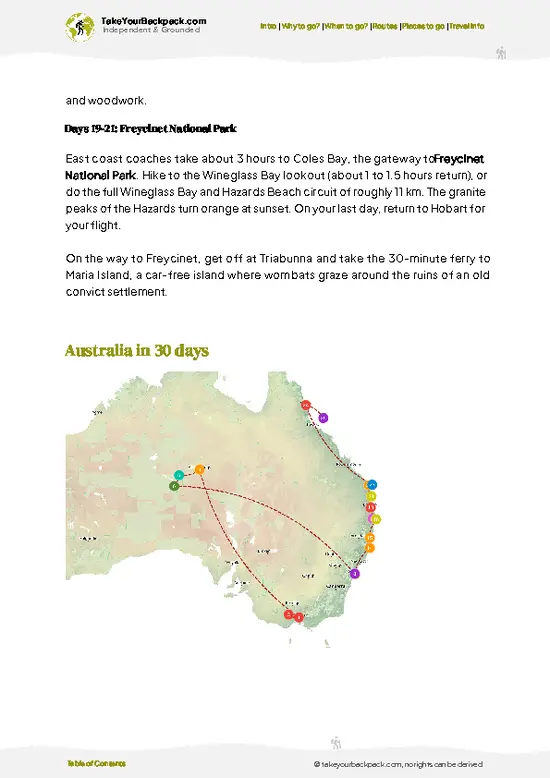
example page 2 from our offline Travel Guide for Australia
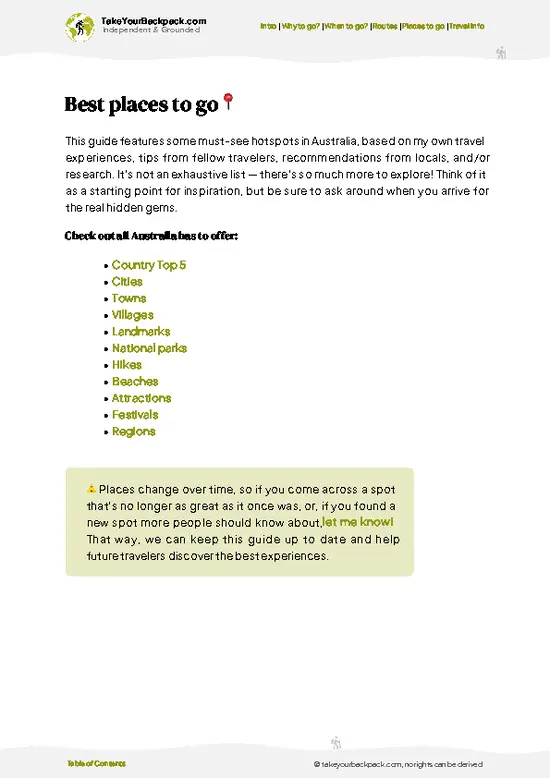
example page 3 from our offline Travel Guide for Australia
example page 4 from our offline Travel Guide for Australia
example page 5 from our offline Travel Guide for Australia
example page 6 from our offline Travel Guide for Australia
example page 7 from our offline Travel Guide for Australia
Loading the map 🌍
CLICK TO FILTER
cities
towns
villages
landmarks
national parks
hikes
beaches
attractions
festivals
regions
SHOW COUNTRY’S BESTSHOW ALL

✨ Why go?
Ranked #6 city in Australia
What makes this city worth visiting

Backpackers come to Hobart because it packs a lot into a very walkable center. Most of what matters sits within a flat, easy stroll of the waterfront, so you can drop your pack and ditch the bus timetable for days. The city works as a base for kunanyi/Mount Wellington, which looms over town and gives you serious alpine scenery without leaving the suburbs, plus a launch point for the wider southern coast and the Tasman Peninsula. Food is the other big draw. Fresh seafood off the docks, local cheese, whisky and cider make eating here a hobby rather than a chore. Then there is MONA, which pulls travelers across the Tasman Sea just for a weekend. Be honest about the limits, though. The hostel count is small, evenings are quiet outside a few pubs, and Hobart works best as a three to four day stop … read more 👉
Backpackers come to Hobart because it packs a lot into a very walkable center. Most of what matters sits within a flat, easy stroll of the waterfront, so you can drop your pack and ditch the bus timetable for days. The city works as a base for kunanyi/Mount Wellington, which looms over town and gives you serious alpine scenery without leaving the suburbs, plus a launch point for the wider southern coast and the Tasman Peninsula. Food is the other big draw. Fresh seafood off the docks, local cheese, whisky and cider make eating here a hobby rather than a chore. Then there is MONA, which pulls travelers across the Tasman Sea just for a weekend. Be honest about the limits, though. The hostel count is small, evenings are quiet outside a few pubs, and Hobart works best as a three to four day stop on a Tasmanian loop rather than a month-long base. Most people fly or drive in, then continue to Port Arthur, Bruny Island or the east coast.

💡 HighlightsKey sights and experiences for travelers

  1. Salamanca Place and Salamanca Market: Sandstone warehouses turned into galleries and cafes, with a Saturday market of roughly 300 stalls selling local produce, woodwork and crafts. Go on Saturday from 8:30 am to 3 pm, arriving before 10 am to beat the crowds. Free entry, 1 to 2 hours.
  2. Museum of Old and New Art (MONA): A privately owned museum carved into a sandstone cliff, with provocative modern and ancient art. Reach it by ferry from the waterfront in about 25 minutes. Entry is around A$35 to 40 for adults (Tasmanian residents free). Allow 3 to 4 hours, best on weekdays.
  3. kunanyi/Mount Wellington: The 1,271 meter summit gives views across the Derwent estuary and beyond. Drive or take a shuttle, then walk the short lookout paths. Free, 2 to 3 hours. Go on a clear day and carry a warm jacket,
… read more 👉
  1. Salamanca Place and Salamanca Market: Sandstone warehouses turned into galleries and cafes, with a Saturday market of roughly 300 stalls selling local produce, woodwork and crafts. Go on Saturday from 8:30 am to 3 pm, arriving before 10 am to beat the crowds. Free entry, 1 to 2 hours.
  2. Museum of Old and New Art (MONA): A privately owned museum carved into a sandstone cliff, with provocative modern and ancient art. Reach it by ferry from the waterfront in about 25 minutes. Entry is around A$35 to 40 for adults (Tasmanian residents free). Allow 3 to 4 hours, best on weekdays.
  3. kunanyi/Mount Wellington: The 1,271 meter summit gives views across the Derwent estuary and beyond. Drive or take a shuttle, then walk the short lookout paths. Free, 2 to 3 hours. Go on a clear day and carry a warm jacket, since it is often much colder at the top.
  4. Battery Point: A quiet maritime neighborhood of Georgian cottages, tiny lanes and Arthur Circus, an oval of cottages around a village green. Free, 1 to 2 hours, pleasant any time of day.
  5. Constitution Dock and Victoria Dock: The finish line of the Sydney to Hobart yacht race, now lined with floating fish-and-chip punts. Free to wander, with meals A$15 to 25. Allow 1 hour, best at lunchtime.
  6. Cascade Brewery: Australia’s oldest continuously operating brewery, opened in 1824 below the mountain. Tours run about 1.5 hours and cost roughly A$35 to 45, with tastings and the historic gardens included.
  7. Tasmanian Museum and Art Gallery: Free general entry, with strong displays on Aboriginal Tasmanian culture, colonial history and the extinct thylacine. Allow 1 to 2 hours, ideal for a wet day.
  8. Hobart Convict Penitentiary Chapel and Cascades Female Factory: Tours dig into the harsh convict past that shaped the city, with guided visits typically around A$25 to 30 and lasting about 1 hour.
For day trips, consider Bruny Island, Port Arthur Historic Site, Mount Field National Park and the Richmond village. If time is short, skip the Female Factory and the Penitentiary Chapel and spend the hours on MONA and the mountain instead.
Spotted a mistake or missing something? Contact us.

Things to do in Hobart

Ratings based on Tripadvisor reviews. When you book through this link, you support our work at no extra cost to you.

🏘️ NeighborhoodsHow different areas shape the experience

Hobart packs its best bits into a few walkable pockets, so you can skip the taxi and let your calves do the work.
  • Salamanca Place and Battery Point: Sandstone warehouses, a Saturday market (around 300 stalls, 8:30am to 3pm) and steep lanes of tiny colonial cottages. Worth a full morning. Go for the market, stay for the wander uphill, and ignore the fudge shops.
  • Waterfront and Constitution Dock: Fishing boats, fish-and-chip punts and the finish line of the Sydney to Hobart yacht race. Pleasant for an hour. Eat standing up, fend off the seagulls, move on.
  • North Hobart: Restaurant strip on Elizabeth Street with pubs, a cinema and the best late dinners. This is where locals actually go. About 20 minutes on foot from the center, and easy to do at night.
  • Sandy Bay: Beaches, a casino and university students.
… read more 👉
Hobart packs its best bits into a few walkable pockets, so you can skip the taxi and let your calves do the work.
  • Salamanca Place and Battery Point: Sandstone warehouses, a Saturday market (around 300 stalls, 8:30am to 3pm) and steep lanes of tiny colonial cottages. Worth a full morning. Go for the market, stay for the wander uphill, and ignore the fudge shops.
  • Waterfront and Constitution Dock: Fishing boats, fish-and-chip punts and the finish line of the Sydney to Hobart yacht race. Pleasant for an hour. Eat standing up, fend off the seagulls, move on.
  • North Hobart: Restaurant strip on Elizabeth Street with pubs, a cinema and the best late dinners. This is where locals actually go. About 20 minutes on foot from the center, and easy to do at night.
  • Sandy Bay: Beaches, a casino and university students. Fine for a coastal stroll, but the sights are thin. Skip it unless you have spare time.
  • South Hobart and the Cascade area: Quiet residential streets, old brewery grounds and a pleasant walk. A short detour, not a destination.
  • Moonah: Gritty, multicultural and cheap for food. Only for the curious, and entirely worth a lunch stop.

⌛️ 1 dayHow to make the most of one day

8:00 AM: Salamanca Place
Start with a flat white at one of the sandstone warehouse cafes before the Saturday crowds (if it is Saturday, the market stalls open around 8:30 AM and run until 3:00 PM). Wander the length of the row, then climb the Kelly's Steps squeezed between two old buildings at the northern end. Total time here is about an hour.

9:30 AM: Battery Point
Kelly's Steps drop you into a tangle of lanes lined with 1830s cottages. Walk to Arthur Circus, a small ring of houses around a green, and then along Hampden Road. It feels like a village that forgot to become a suburb, and it costs nothing.

11:30 AM: Constitution Dock and the waterfront
Stroll down to the docks, where fishing boats sell fish and chips straight from floating punts. Eat early, because seagulls here are professionals. … read more 👉
8:00 AM: Salamanca Place
Start with a flat white at one of the sandstone warehouse cafes before the Saturday crowds (if it is Saturday, the market stalls open around 8:30 AM and run until 3:00 PM). Wander the length of the row, then climb the Kelly's Steps squeezed between two old buildings at the northern end. Total time here is about an hour.

9:30 AM: Battery Point
Kelly's Steps drop you into a tangle of lanes lined with 1830s cottages. Walk to Arthur Circus, a small ring of houses around a green, and then along Hampden Road. It feels like a village that forgot to become a suburb, and it costs nothing.

11:30 AM: Constitution Dock and the waterfront
Stroll down to the docks, where fishing boats sell fish and chips straight from floating punts. Eat early, because seagulls here are professionals. Sit on the pier and watch the boats.

1:00 PM: Tasmanian Museum and Art Gallery
A five-minute walk away, this free museum has a strong Tasmanian Aboriginal collection and an excellent room on the extinct thylacine. Give it about 90 minutes and skip the gift shop.

3:00 PM: Cascade Brewery Road, South Hobart
Catch a local bus or take a short rideshare to the less visited end of town. Walk the Hobart Rivulet Track, a shaded path along the creek that locals use for jogging and dog walks. It ends near Australia's oldest operating brewery, a good place for a tasting paddle if you want one.

5:30 PM: Mount Nelson Signal Station
Finish by getting a ride or bus up to the lookout for the view over the Derwent River, the city grid and the bridges as the light turns gold. The cafe nearby is handy for a pie and a drink.

🌤️ When to go?Weather, crowds, and seasonal trade-offs

Summer (December to February) is the easiest time, with highs of 21 to 23°C (70 to 73°F), up to 15 hours of daylight and festival energy, but also the highest prices and fullest dorms.
  • Summer: Dry and mild, with the Taste of Summer food festival (formerly Taste of Tasmania) around New Year and the yacht race finish. Book beds weeks ahead.
  • Autumn (March to May): Highs of 14 to 20°C (57 to 68°F), golden foliage and fewer crowds. Prices ease.
  • Winter (June to August): Highs of 12°C (54°F), lows near 4°C (39°F) and about 9 hours of light. Snow often dusts kunanyi/Mount Wellington, and Dark Mofo in June fills the city with night-time events. Beds are cheap, apart from that festival.
  • Spring (September to November): Highs of 14 to 19°C (57 to 66°F), changeable and windy, with blossom and quiet streets.
… read more 👉
Summer (December to February) is the easiest time, with highs of 21 to 23°C (70 to 73°F), up to 15 hours of daylight and festival energy, but also the highest prices and fullest dorms.
  • Summer: Dry and mild, with the Taste of Summer food festival (formerly Taste of Tasmania) around New Year and the yacht race finish. Book beds weeks ahead.
  • Autumn (March to May): Highs of 14 to 20°C (57 to 68°F), golden foliage and fewer crowds. Prices ease.
  • Winter (June to August): Highs of 12°C (54°F), lows near 4°C (39°F) and about 9 hours of light. Snow often dusts kunanyi/Mount Wellington, and Dark Mofo in June fills the city with night-time events. Beds are cheap, apart from that festival.
  • Spring (September to November): Highs of 14 to 19°C (57 to 66°F), changeable and windy, with blossom and quiet streets.
Pack layers whatever the month, since four seasons in one day is a real Hobart habit.


source: climatestotravel.comJANJanuary: excellent for travelingFEBFebruary: excellent for travelingMARMarch: highly recommended for travelingAPRApril: highly recommended for travelingMAYMay: good for travelingJUNJune: fair for travelingJULJuly: fair for travelingAUGAugust: fair for travelingSEPSeptember: good for travelingOCTOctober: highly recommended for travelingNOVNovember: highly recommended for travelingDECDecember: excellent for traveling
australia-city-hobart
© Google | Saeed Ullah

✈️ The backpacker research shortcutAustralia Travel Guide

An offline-friendly backpacking guide with optimized travel routes, ranked highlights, transport advice, and the best areas to stay.
example page 0 from our offline Travel Guide for Australia
example page 1 from our offline Travel Guide for Australia
example page 2 from our offline Travel Guide for Australia
example page 3 from our offline Travel Guide for Australia
example page 4 from our offline Travel Guide for Australia
example page 5 from our offline Travel Guide for Australia
example page 6 from our offline Travel Guide for Australia
example page 7 from our offline Travel Guide for Australia
The digital guide (414 pages) contains:
✅ 143 highlights, ranked by travel appeal
✅ Optimized 14, 21 & 30-day travel routes
✅ Cities, national parks, landmarks, beaches
✅ How to get around
✅ Offline-friendly for travel without Wi-Fi
👉 Click to see all 30+ guide features

📅 Plan smarter in minutes, not weeks
✅ Month by month travel advice
✅ Festivals & national holidays
✅ Budget expectations

🗺️ Go to the right places, skip the overrated ones
✅ Honest pros & cons of destinations
✅ Top hikes, parks & viewpoints
✅ Lesser-known places most travelers miss
✅ Clear “worth it vs skip it” guidance

🛏️ Travel smoothly without rookie mistakes
✅ Best areas to stay
✅ Transport systems explained simply
✅ Common scams & safety advice
✅ SIM cards, money & practical tips

🌍 Understand the country, not just visit it
✅ Culture & traditions
✅ Local customs
✅ Festivals worth planning around
✅ Traveler-friendly historical context
✅ Insights that make places more meaningful

📱 Built for real travel conditions
✅ Fully downloadable PDF
✅ Works completely offline
✅ Optimized for phone use
✅ Useful in remote areas & buses
✅ Everything in one place
Stop searching, start planning
Get instant access to your full guide. 30‑day money-back guarantee.
+ Add another guide for just

By proceeding you agree to our terms.
Sent to your inbox immediately after payment • 100% Secure Checkout
Best Backpacking Travel Advisor 2025 tourism awardBest Backpacking
Travel Advisor
2025
What others say about Take Your Backpack Guides:
⭐⭐⭐⭐⭐
Fantastic, amazing amount of information!
⭐⭐⭐⭐⭐
My goodness this is amazing, it's what I've been looking for hats off too you!
⭐⭐⭐⭐⭐
I think this is absolutely BRILLIANT
⭐⭐⭐⭐
Very complete and informative. It's still missing places, but I gotta to commend you
⭐⭐⭐⭐⭐
This is truly amazing, thank you, can't wait to explore it with my kids!
⭐⭐⭐⭐⭐
Awesome resource, thank you!
⭐⭐⭐⭐⭐
This is amazing! Can't wait to explore the ones I haven't seen
⭐⭐⭐⭐
I love this! Well done, great idea.
⭐⭐⭐⭐⭐
Thanks for taking the time to make this gem!
⭐⭐⭐⭐⭐
This might be the best website I've ever seen.
⭐⭐⭐⭐⭐
Congratulations, and thank you so much for your work; it's incredibly valuable.
⭐⭐⭐⭐
In all seriousness I think you did a great job pointing out the important spots
⭐⭐⭐⭐⭐
10/10 very good
⭐⭐⭐⭐⭐
As someone who's only just starting to visit regularly this is awesome, thank you.
⭐⭐⭐⭐
Thank you very much! I'm going to visit my dad, it's going to be very useful!
⭐⭐⭐⭐⭐
This is really cool! We'll be travelling for the first time and this definitely come in handy.
⭐⭐⭐⭐⭐
You are now our minister of culture, congratulations 👨‍💼
⭐⭐⭐⭐⭐
Just wanted to tell you that this is a pearl! Going to follow your recommendations.
⭐⭐⭐⭐⭐
This is so cool. I'll definitely be using the resource for my travels soon.
⭐⭐⭐⭐⭐
This is very impressive! Good work.
⭐⭐⭐⭐⭐
This is an amazing and informative site. Very well done!

🛏️ Where to stay?Best areas and accommodation options

Central Hobart, between the waterfront and Elizabeth Street, is the best bet for a budget bed, with dorms typically A$35 to 55 a night.
The central grid puts you within walking distance of the bus interchange, the airport shuttle stop and the ferry to MONA, and you will rarely need transport once you arrive. It stays lively but not rowdy, and late-night streets are well lit and reasonably busy on weekends. Expect some pub noise on Friday and Saturday nights, so pick a room away from the street if you sleep lightly.
North Hobart is the alternative, about 20 minutes on foot or a short bus ride north. … read more 👉
Central Hobart, between the waterfront and Elizabeth Street, is the best bet for a budget bed, with dorms typically A$35 to 55 a night.
The central grid puts you within walking distance of the bus interchange, the airport shuttle stop and the ferry to MONA, and you will rarely need transport once you arrive. It stays lively but not rowdy, and late-night streets are well lit and reasonably busy on weekends. Expect some pub noise on Friday and Saturday nights, so pick a room away from the street if you sleep lightly.
North Hobart is the alternative, about 20 minutes on foot or a short bus ride north. Beds are fewer, and it suits people who prefer a residential feel and walkable restaurants over being steps from the water. It is quiet after the restaurants close, with straightforward bus links back to the center.
Book ahead for summer, the New Year period and the June Dark Mofo festival, when the cheapest beds vanish weeks early. In winter, you can often walk in and find a deal.

🚌 Getting aroundHow to get around Hobart

Hiring a car for a city stay is the mistake that costs the most, with rentals around A$50 to 90 a day plus parking of A$15 to 30 downtown, when the central area is flat enough to cross on foot in 15 minutes. Keep the car for trips outside town, and only for those days.
  • Walking: Free and the best option for the waterfront, Salamanca, Battery Point and the main streets. Battery Point has hills that will make you reconsider your breakfast.
  • Metro Tasmania buses: Cover the suburbs and the Mount Wellington base, and are fare-free until 30 June 2027. Services run roughly 6am to 11pm on main routes, but are thin on Sundays and after dark.
  • Mount Wellington shuttle or tour: Public buses do not reach the 1,271 m summit. Shuttle and tour options cost around A$30 to 50 return. Worth it on a clear day, pointless
… read more 👉
Hiring a car for a city stay is the mistake that costs the most, with rentals around A$50 to 90 a day plus parking of A$15 to 30 downtown, when the central area is flat enough to cross on foot in 15 minutes. Keep the car for trips outside town, and only for those days.
  • Walking: Free and the best option for the waterfront, Salamanca, Battery Point and the main streets. Battery Point has hills that will make you reconsider your breakfast.
  • Metro Tasmania buses: Cover the suburbs and the Mount Wellington base, and are fare-free until 30 June 2027. Services run roughly 6am to 11pm on main routes, but are thin on Sundays and after dark.
  • Mount Wellington shuttle or tour: Public buses do not reach the 1,271 m summit. Shuttle and tour options cost around A$30 to 50 return. Worth it on a clear day, pointless in cloud, so check the webcam first.
  • Ferries: Cross to the Museum of Old and New Art (MONA) by fast boat for about A$25 to 35 return in 25 minutes. It is the most fun commute in the country, and the boat has a sheep-themed lounge deck.
  • Rideshare and taxis: Uber works, with typical city rides at A$10 to 25. Handy for late nights and the airport (about 20 minutes, A$40 to 55).
The Airporter shuttle costs around A$20 to 25 one way and drops at central hotels, which beats a taxi if you are alone.

👛 Costs (as of 16 October 2026)Money, prices, and spending tips

Backpacking in Hobart costs about US$85 a day in high season (December to February), with dorm beds taking the biggest bite.
CategoryBudget RangeLocal Reality
Dorm accommodation (high season)US$30 to 45Prices climb around Christmas and during Taste of Summer, so book weeks ahead.
Dorm accommodation (off-season)US$22 to 32June to August is quieter and beds are easier to find.
MealsUS$22 to 35A supermarket breakfast, a bakery pie or fish and chips for lunch (US$9 to 14), and a pub or cooked-at-the-hostel dinner.
Local transportUS$0Metro Tasmania buses are fare-free until 30 June 2027, so you ride around town without paying.
City transport passUS$0No pass is needed while buses are fare-free. Greater Hobart fares are expected to return afterward.
Basic activities/entry feesUS$0 to 15kunanyi/Mount Wellington,
… read more 👉
Backpacking in Hobart costs about US$85 a day in high season (December to February), with dorm beds taking the biggest bite.
CategoryBudget RangeLocal Reality
Dorm accommodation (high season)US$30 to 45Prices climb around Christmas and during Taste of Summer, so book weeks ahead.
Dorm accommodation (off-season)US$22 to 32June to August is quieter and beds are easier to find.
MealsUS$22 to 35A supermarket breakfast, a bakery pie or fish and chips for lunch (US$9 to 14), and a pub or cooked-at-the-hostel dinner.
Local transportUS$0Metro Tasmania buses are fare-free until 30 June 2027, so you ride around town without paying.
City transport passUS$0No pass is needed while buses are fare-free. Greater Hobart fares are expected to return afterward.
Basic activities/entry feesUS$0 to 15kunanyi/Mount Wellington, Salamanca Market and the waterfront cost nothing. The Tasmanian Museum and Art Gallery is free, while MONA is around US$20 to 25 and best kept for one splurge day.
MiscellaneousUS$8 to 15A craft beer or two, laundry, a SIM card or a coffee at about US$3 to 4.
Total Daily BudgetUS$85Based on a US$37 dorm bed, US$28 for food, US$8 for activities and US$12 miscellaneous.
Hobart is pricier than mainland regional towns, but the free buses and free sights soften it. Buy groceries from a supermarket and cook at the hostel to cut food costs by a third or more.
⚠️ Prices can change and everyone travels differently, so take this as a rough guide. Hope it helps you plan your adventure!

🚌 Day tripsShort trips worth adding

Hobart works well as a base, with most worthwhile trips doable in a day by tour, bus or a shared rental car.
Port Arthur Historic Site:
The convict ruins sit on a headland about 1.5 hours from the city, with entry from around A$45 to 50 and tour buses from A$100 to 150 return. Allow four hours on site. The common mistake is arriving at midday with no time left, so leave before 9am.

Bruny Island:
A 40-minute drive to Kettering then a 20-minute car ferry (around A$40 to 50 per car, foot passengers cheaper). Oysters, cheese, cliff walks and the narrow Neck isthmus make it a full day. Without a car, a guided tour (about A$200 and up) is the only realistic option. Go in summer or autumn for the calmest crossings.

Mount Field National Park:
About 1.25 hours by road, with Russell Falls on a flat … read more 👉
Hobart works well as a base, with most worthwhile trips doable in a day by tour, bus or a shared rental car.
Port Arthur Historic Site:
The convict ruins sit on a headland about 1.5 hours from the city, with entry from around A$45 to 50 and tour buses from A$100 to 150 return. Allow four hours on site. The common mistake is arriving at midday with no time left, so leave before 9am.

Bruny Island:
A 40-minute drive to Kettering then a 20-minute car ferry (around A$40 to 50 per car, foot passengers cheaper). Oysters, cheese, cliff walks and the narrow Neck isthmus make it a full day. Without a car, a guided tour (about A$200 and up) is the only realistic option. Go in summer or autumn for the calmest crossings.

Mount Field National Park:
About 1.25 hours by road, with Russell Falls on a flat 30-minute track and entry covered by a Parks Pass (around A$48 per day for a vehicle, A$24 for one person). Autumn brings color in the fagus trees, a rarity in Australia. Public transport is not practical, so share a car.

Richmond:
A short 25-minute drive to Australia’s oldest bridge (1823) and a village of sandstone cottages. Plan two to three hours, and add a bakery stop. Buses are scarce, and tours cost around A$70 to 100 combined with wineries.

🍲 FoodWhat to Eat & Drink

Tasmania’s cold, clean waters give Hobart its best eating: fresh seafood like scallop pie, abalone, oysters from Bruny Island and flathead fish and chips straight from the floating punts at Constitution Dock (around A$15 to 25 per meal). Look for scallop pie in local bakeries too, a creamy filling in a flaky crust, best eaten warm on a windy wharf.
Local cheese, leatherwood honey and cold-climate berries (summer cherries and raspberries) are worth buying at the Salamanca Market. Whisky is the standout drink, as Tasmania’s distilleries have won international awards, and a dram at a waterfront bar costs about A$15 to 25. Cool-climate wines such as pinot noir and sparkling are excellent, and craft beer from Cascade Brewery, the country’s oldest, is on tap in most pubs.
For budget eating, North … read more 👉
Tasmania’s cold, clean waters give Hobart its best eating: fresh seafood like scallop pie, abalone, oysters from Bruny Island and flathead fish and chips straight from the floating punts at Constitution Dock (around A$15 to 25 per meal). Look for scallop pie in local bakeries too, a creamy filling in a flaky crust, best eaten warm on a windy wharf.
Local cheese, leatherwood honey and cold-climate berries (summer cherries and raspberries) are worth buying at the Salamanca Market. Whisky is the standout drink, as Tasmania’s distilleries have won international awards, and a dram at a waterfront bar costs about A$15 to 25. Cool-climate wines such as pinot noir and sparkling are excellent, and craft beer from Cascade Brewery, the country’s oldest, is on tap in most pubs.
For budget eating, North Hobart’s Elizabeth Street has Asian and Middle Eastern places with mains around A$15 to 22, Moonah has cheaper international options, and Farm Gate Market on Sundays has coffee and breakfast rolls. Pub counter meals are generous.

🛡️ SafetySafety Tips and Common Scams in Hobart

Hobart is one of the safest cities in Australia, and ordinary common sense is enough. Solo travelers, including women, generally walk the center and waterfront at night without trouble, though the streets around the bars on Salamanca and Elizabeth Street can get rowdy after midnight on Fridays and Saturdays. Lock your car and keep valuables out of sight, since break-ins at trailheads and viewpoints are the most common crime visitors meet. The real hazard is weather. Mount Wellington can drop 10°C and bring snow or fog within an hour, so take a jacket and a map even on a sunny morning. Bushfire season runs through summer, so check the TasAlert site before hiking. Wildlife on roads at dusk, especially wallabies, is a bigger risk than people when driving. No scams worth mentioning exist.

FAQCommon questions from travelers

Three days covers Hobart well, with one for the waterfront, Salamanca and Battery Point, one for MONA and kunanyi/Mount Wellington, and one for a day trip to Port Arthur or Bruny Island. Add two more days for Mount Field and Richmond. A weekend works if you only want the highlights.
Yes, Hobart is among Australia’s safest cities for solo backpackers. The central streets are well lit and busy on weekends, and violent crime against visitors is rare. The main risks are car break-ins at trailheads and sudden weather changes on Mount Wellington (1,271 m), where temperatures can fall 10°C within an hour.
Hobart is known for MONA, the quirky privately owned art museum reached by a 25-minute ferry. It is also known for the Saturday Salamanca Market, convict-era sandstone buildings, Mount Wellington, Cascade Brewery and the finish of the Sydney to Hobart yacht race on December 28 to 30. Fresh seafood and Dark Mofo in June round it out.
⚠️ Things can change over time, so always validate details locally before you go.

Other Australian cities near Hobart

Explore more nearby:

  • Geelong—Painted bollards, Eastern Beach baths, wool museum, Corio Bay pier| 583 km away
  • Melbourne—Graffiti laneways, free trams, Queen Vic Market, St Kilda pier| 598 km away
  • Ballarat—Sovereign Hill, gold panning, Eureka story, Lake Wendouree loop| 661 km away

💡 Not sure where to go next?
Create a personalized itinerary for Australia including Hobart and the places that fit your trip.

Generate my itinerary

👉 Discover all cities

Or checkout all Australia has to offer (think cities, towns, villages, national parks, hikes, beaches, festivals)
Country photo of Australia

We 💚 feedbackIs it worth it?

Most first-timers rush through Battery Point on the way to somewhere else, but its cottage lanes and the tiny Arthur Circus green are the quietest, most characterful corner of the city. I would give it an unhurried hour on a weekday morning, and pack a warm layer, since Hobart’s weather changes quickly even in summer.

✈️ When did I visit Australia?
On my trip to New Zealand in 1993, I had a short stop in Australia as well.

✍️ Help improve this page!
The information on this page is based on my own backpacking experience in Australia, supplemented with up-to-date research and feedback from other travelers. Travel details can change, so if you notice anything outdated or incomplete, feel free to let me know.


🙋‍♂️ Give feedback

👋 Meet the founderWho’s Behind Take Your Backpack?

Johan, backpacker and founder of TakeYourBackpackHi, I’m Johan (Netherlands 🇳🇱), the creator of TakeYourBackpack. Over the past 3 decades, I’ve backpacked through 90+ countries across six continents, gaining extensive experience with independent travel, long-term trips, and overland routes.

This site is built on a combination of firsthand travel experience and carefully curated insights from other backpackers. Many guides are based on places I’ve personally visited, while others bring together tips, observations, and practical advice shared by trusted travelers I’ve met along the way.

The goal is to provide realistic, experience-driven guidance — not generic itineraries — so you can explore destinations with better context, clearer expectations, and more confidence.