×

Australia🇦🇺 | regionsKimberleyStriped domes, Gibb River gorges, boab country, 4WD tracks | things to do and best time to go

Explore Kangaroo IslandExplore K’gari (Fraser Island)

Backpacking in Kimberley
🏆 Top pickregion ranked #3
By Johan Kruseman 🇳🇱 | Updated October 15, 2026

Not long ago the Kimberley was a place you reached by cattle-station track and sheer stubbornness, and most people never did. Today there are daily flights into Kununurra and Broome, sealed stretches of the Great Northern Highway, and sunset cruises with a gin and tonic. It sits in the far north of Australia, in Western Australia’s top corner, and it is still absurdly big, with gorges, boab country and red dirt that goes on for days. The Gibb River Road is rough, fuel is pricey, and everything is far from everything else. In Kununurra I filled a jerry can and a second water container before leaving town, and that dull chore saved me from rationing warm water at a remote gorge, where I got a swim instead. You can do the same. Adventurous, self-sufficient travelers with a 4WD or a tour seat will love it. Anyone who wants spontaneity, crowds-free cheapness or quick hops between sights will not.

Discover everything you want to know in the 📖 Australia Travel Guide.


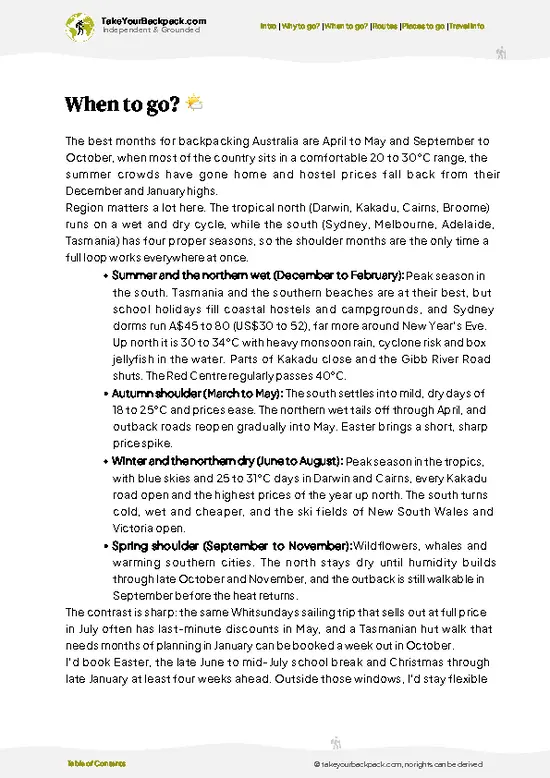
example page 0 from our offline Travel Guide for Australia
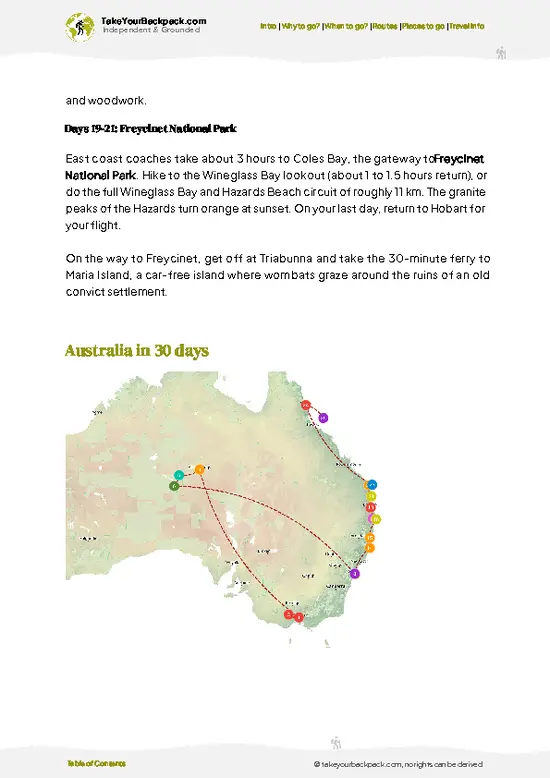
example page 1 from our offline Travel Guide for Australia
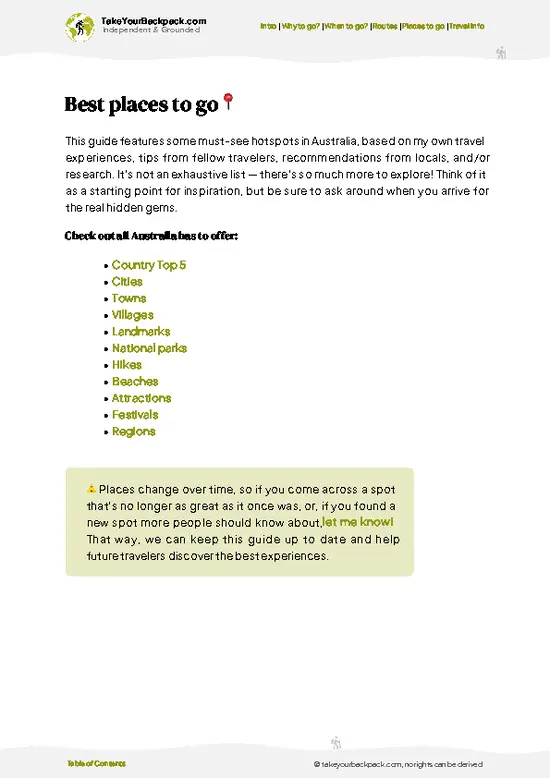
example page 2 from our offline Travel Guide for Australia
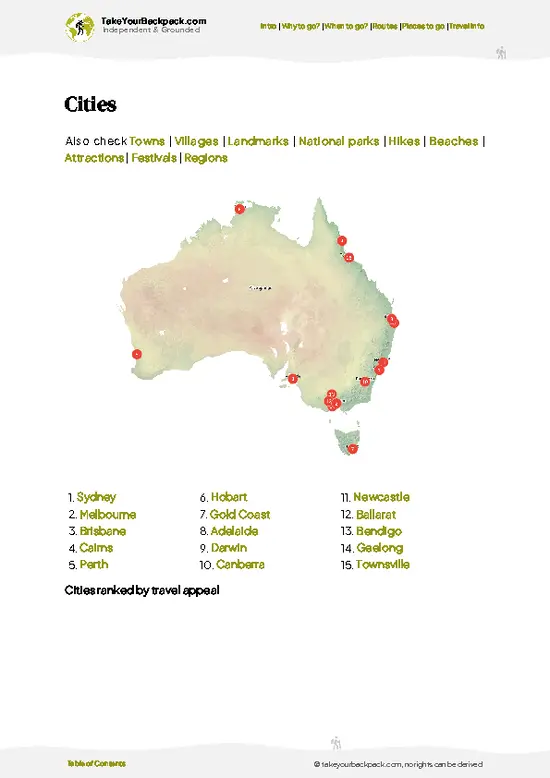
example page 3 from our offline Travel Guide for Australia
example page 4 from our offline Travel Guide for Australia
example page 5 from our offline Travel Guide for Australia
example page 6 from our offline Travel Guide for Australia
example page 7 from our offline Travel Guide for Australia
Loading the map 🌍
CLICK TO FILTER
cities
towns
villages
landmarks
national parks
hikes
beaches
attractions
festivals
regions
SHOW COUNTRY’S BESTSHOW ALL

✨ Why go?
Ranked #3 region in Australia
What sets this place apart

Backpackers come for scale that you cannot get elsewhere in the country. The Gibb River Road runs about 660 km of mostly unsealed track past gorges, waterholes and cattle stations, and you can camp or stay at a station most nights, so a single route delivers swimming, walking and some rough-and-ready company without constantly repacking at new towns.

It also works for mixing nature with culture. Aboriginal-owned and guided experiences, such as those at Mimbi Caves near Fitzroy Crossing, put the landscape in context in a way a roadside lookout cannot. Rock art and Dreaming stories turn a gorge from a pretty swimming hole into something with a long human history.

Then there is the bookend towns. Kununurra gives you the lake, ranges and Ord River, while Broome gives you Cable Beach and a relaxed … read more 👉
Backpackers come for scale that you cannot get elsewhere in the country. The Gibb River Road runs about 660 km of mostly unsealed track past gorges, waterholes and cattle stations, and you can camp or stay at a station most nights, so a single route delivers swimming, walking and some rough-and-ready company without constantly repacking at new towns.

It also works for mixing nature with culture. Aboriginal-owned and guided experiences, such as those at Mimbi Caves near Fitzroy Crossing, put the landscape in context in a way a roadside lookout cannot. Rock art and Dreaming stories turn a gorge from a pretty swimming hole into something with a long human history.

Then there is the bookend towns. Kununurra gives you the lake, ranges and Ord River, while Broome gives you Cable Beach and a relaxed pace after the dust. Flights, tours and rental 4WDs make it flexible, so you can go independent or hop on a guided trip depending on budget and nerve.

💡 HighlightsWhat this place is best known for

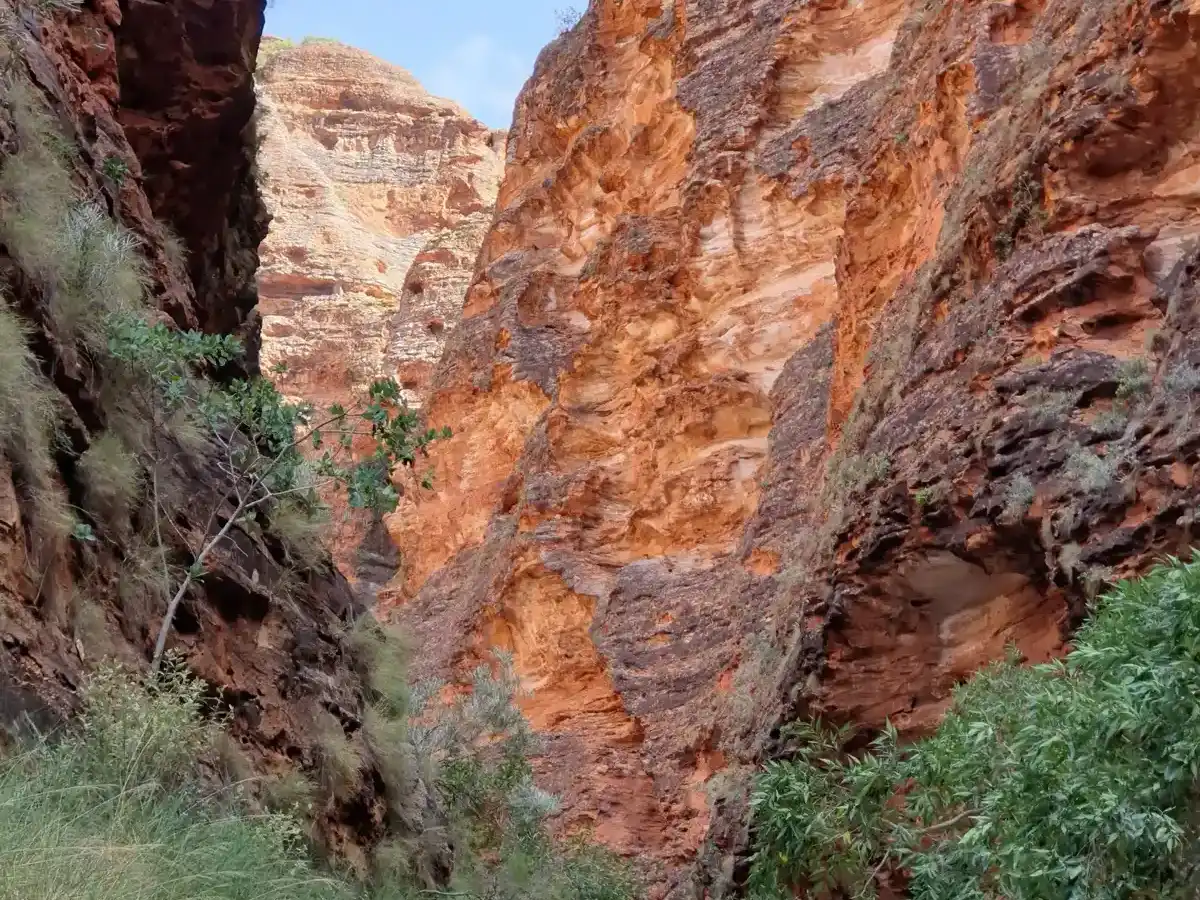
  1. Bungle Bungle Range (Purnululu National Park): Beehive domes banded orange and black, best seen on foot in Cathedral Gorge and Echidna Chasm. Access is by 4WD track or by scenic flight from Kununurra.
  2. Windjana Gorge: Limestone walls from an ancient reef, with freshwater crocodiles lazing on the sandbanks. A flat walk takes you right alongside them.
  3. Tunnel Creek: Walk through a long tunnel under the Napier Range, wading shallow pools with a torch in hand. Bats cling overhead and the far end opens to daylight.
  4. Bell Gorge: Multi-tiered falls and a deep pool for swimming, reached by a rocky walk of an hour or so each way from the car park.
  5. Mitchell Falls: Four-tiered falls in the remote north, reached by a long walk or a helicopter flight. It takes planning and is deeply satisfying.
  6. El Questro Wilderness
… read more 👉
  1. Bungle Bungle Range (Purnululu National Park): Beehive domes banded orange and black, best seen on foot in Cathedral Gorge and Echidna Chasm. Access is by 4WD track or by scenic flight from Kununurra.
  2. Windjana Gorge: Limestone walls from an ancient reef, with freshwater crocodiles lazing on the sandbanks. A flat walk takes you right alongside them.
  3. Tunnel Creek: Walk through a long tunnel under the Napier Range, wading shallow pools with a torch in hand. Bats cling overhead and the far end opens to daylight.
  4. Bell Gorge: Multi-tiered falls and a deep pool for swimming, reached by a rocky walk of an hour or so each way from the car park.
  5. Mitchell Falls: Four-tiered falls in the remote north, reached by a long walk or a helicopter flight. It takes planning and is deeply satisfying.
  6. El Questro Wilderness Park: Home to Zebedee Springs, a warm palm-shaded thermal pool, and Emma Gorge. A station-style base with a range of walks.
  7. Lake Argyle: A huge man-made lake with an infinity pool at the caravan park overlooking the water. Cruises show freshwater crocs and rock wallabies.
  8. Mimbi Caves: Aboriginal-guided tours of caves with fossil reef remains and local stories, tucked away and rarely on the standard itinerary.
  9. Wyndham’s Five Rivers Lookout: A high viewpoint over the meeting of five rivers and tidal flats at the end of the highway, with giant crocodile statues in town and few visitors.
  10. Kununurra’s Mirima National Park: Small sandstone domes nicknamed the mini Bungles, with short walks just minutes from town and often empty.
Start with Mirima National Park, since a short, easy walk on your first day gives you the landscape and a sense of Kimberley light without committing to the long drive.
Spotted a mistake or missing something? Contact us.
⌛️ 5 daysSeeing the highlights in 5 days

Start in Kununurra early, because the town is where you stock up, rent or join your 4WD, and shop for fuel and water before the road gets remote. Everything in the Kimberley is dictated by distances and the unsealed Gibb River Road, so each day is a driving day with one or two stops.

Day 1: Kununurra: Spend the morning at Mirima National Park and the afternoon sorting supplies. A relaxed start lets you check your vehicle, fill containers and sleep in a real bed before the dust begins.

Day 2: El Questro: Head onto the Gibb River Road and settle in at El Questro. Zebedee Springs is best when the pool is quiet, and the station is a comfortable place to learn how the road behaves.

Day 3: Bell Gorge: Push west across creek crossings to Bell Gorge. This is the longest haul, so you arrive with … read more 👉
Start in Kununurra early, because the town is where you stock up, rent or join your 4WD, and shop for fuel and water before the road gets remote. Everything in the Kimberley is dictated by distances and the unsealed Gibb River Road, so each day is a driving day with one or two stops.

Day 1: Kununurra: Spend the morning at Mirima National Park and the afternoon sorting supplies. A relaxed start lets you check your vehicle, fill containers and sleep in a real bed before the dust begins.

Day 2: El Questro: Head onto the Gibb River Road and settle in at El Questro. Zebedee Springs is best when the pool is quiet, and the station is a comfortable place to learn how the road behaves.

Day 3: Bell Gorge: Push west across creek crossings to Bell Gorge. This is the longest haul, so you arrive with enough daylight for a swim and a camp nearby.

Day 4: Windjana Gorge and Tunnel Creek: Finish the track and pair these two sights, which sit close together. Torch in hand, you wade through the tunnel and then meet the crocs at the gorge.

Day 5: Broome: Roll out on sealed road to Broome and finish on Cable Beach. Flights home or onward are easy from here.

For a detour, take a scenic flight over the Bungle Bungle from Kununurra early on, which adds a huge view without extra driving.

If I had one day, it would be Day 4. The tunnel and the gorge feel properly wild, and the crocs make it memorable.

🌤️ When to go?When to go for the best experience

  • Dry Season (May to September): Days run 28 to 33°C (82 to 91°F) with almost no rain and cool nights of 14 to 20°C (57 to 68°F). Gorges are swimmable, the Gibb River Road is open, and daylight lasts roughly 11.5 to 12.5 hours. Crowds and prices peak from June to August, so book tours and campervans months ahead.
  • Build-Up (October to November): Heat climbs to 35 to 40°C (95 to 104°F) with heavy humidity and storms starting late in the period. Few travelers, cheaper rooms, but hiking is punishing past 9 am.
  • Wet Season (December to March): Monsoon rain, 30 to 35°C (86 to 95°F), and roads often cut for days. Waterfalls such as Mitchell and King George thunder, and scenic flights are the best way to see them. Many stations and camps close, and rates drop sharply.
  • Early Dry (April): Humidity eases and
… read more 👉
  • Dry Season (May to September): Days run 28 to 33°C (82 to 91°F) with almost no rain and cool nights of 14 to 20°C (57 to 68°F). Gorges are swimmable, the Gibb River Road is open, and daylight lasts roughly 11.5 to 12.5 hours. Crowds and prices peak from June to August, so book tours and campervans months ahead.
  • Build-Up (October to November): Heat climbs to 35 to 40°C (95 to 104°F) with heavy humidity and storms starting late in the period. Few travelers, cheaper rooms, but hiking is punishing past 9 am.
  • Wet Season (December to March): Monsoon rain, 30 to 35°C (86 to 95°F), and roads often cut for days. Waterfalls such as Mitchell and King George thunder, and scenic flights are the best way to see them. Many stations and camps close, and rates drop sharply.
  • Early Dry (April): Humidity eases and the landscape is still green, though some tracks stay closed until mid-month.
Aim for May or early June to get open roads, full waterfalls and thinner crowds before the July rush.


source: climatestotravel.comJANJanuary: below average for travelingFEBFebruary: below average for travelingMARMarch: below average for travelingAPRApril: fair for travelingMAYMay: highly recommended for travelingJUNJune: excellent for travelingJULJuly: excellent for travelingAUGAugust: highly recommended for travelingSEPSeptember: highly recommended for travelingOCTOctober: fair for travelingNOVNovember: below average for travelingDECDecember: below average for traveling

✈️ The backpacker research shortcutAustralia Travel Guide

An offline-friendly backpacking guide with optimized travel routes, ranked highlights, transport advice, and the best areas to stay.
example page 0 from our offline Travel Guide for Australia
example page 1 from our offline Travel Guide for Australia
example page 2 from our offline Travel Guide for Australia
example page 3 from our offline Travel Guide for Australia
example page 4 from our offline Travel Guide for Australia
example page 5 from our offline Travel Guide for Australia
example page 6 from our offline Travel Guide for Australia
example page 7 from our offline Travel Guide for Australia
The digital guide (414 pages) contains:
✅ 143 highlights, ranked by travel appeal
✅ Optimized 14, 21 & 30-day travel routes
✅ Cities, national parks, landmarks, beaches
✅ How to get around
✅ Offline-friendly for travel without Wi-Fi
👉 Click to see all 30+ guide features

📅 Plan smarter in minutes, not weeks
✅ Month by month travel advice
✅ Festivals & national holidays
✅ Budget expectations

🗺️ Go to the right places, skip the overrated ones
✅ Honest pros & cons of destinations
✅ Top hikes, parks & viewpoints
✅ Lesser-known places most travelers miss
✅ Clear “worth it vs skip it” guidance

🛏️ Travel smoothly without rookie mistakes
✅ Best areas to stay
✅ Transport systems explained simply
✅ Common scams & safety advice
✅ SIM cards, money & practical tips

🌍 Understand the country, not just visit it
✅ Culture & traditions
✅ Local customs
✅ Festivals worth planning around
✅ Traveler-friendly historical context
✅ Insights that make places more meaningful

📱 Built for real travel conditions
✅ Fully downloadable PDF
✅ Works completely offline
✅ Optimized for phone use
✅ Useful in remote areas & buses
✅ Everything in one place
Stop searching, start planning
Get instant access to your full guide. 30‑day money-back guarantee.
+ Add another guide for just

By proceeding you agree to our terms.
Sent to your inbox immediately after payment • 100% Secure Checkout
Best Backpacking Travel Advisor 2025 tourism awardBest Backpacking
Travel Advisor
2025
What others say about Take Your Backpack Guides:
⭐⭐⭐⭐⭐
Fantastic, amazing amount of information!
⭐⭐⭐⭐⭐
My goodness this is amazing, it's what I've been looking for hats off too you!
⭐⭐⭐⭐⭐
I think this is absolutely BRILLIANT
⭐⭐⭐⭐
Very complete and informative. It's still missing places, but I gotta to commend you
⭐⭐⭐⭐⭐
This is truly amazing, thank you, can't wait to explore it with my kids!
⭐⭐⭐⭐⭐
Awesome resource, thank you!
⭐⭐⭐⭐⭐
This is amazing! Can't wait to explore the ones I haven't seen
⭐⭐⭐⭐
I love this! Well done, great idea.
⭐⭐⭐⭐⭐
Thanks for taking the time to make this gem!
⭐⭐⭐⭐⭐
This might be the best website I've ever seen.
⭐⭐⭐⭐⭐
Congratulations, and thank you so much for your work; it's incredibly valuable.
⭐⭐⭐⭐
In all seriousness I think you did a great job pointing out the important spots
⭐⭐⭐⭐⭐
10/10 very good
⭐⭐⭐⭐⭐
As someone who's only just starting to visit regularly this is awesome, thank you.
⭐⭐⭐⭐
Thank you very much! I'm going to visit my dad, it's going to be very useful!
⭐⭐⭐⭐⭐
This is really cool! We'll be travelling for the first time and this definitely come in handy.
⭐⭐⭐⭐⭐
You are now our minister of culture, congratulations 👨‍💼
⭐⭐⭐⭐⭐
Just wanted to tell you that this is a pearl! Going to follow your recommendations.
⭐⭐⭐⭐⭐
This is so cool. I'll definitely be using the resource for my travels soon.
⭐⭐⭐⭐⭐
This is very impressive! Good work.
⭐⭐⭐⭐⭐
This is an amazing and informative site. Very well done!

🛏️ Where to stay?Best areas and accommodation options

Broome and Kununurra are the two bases that make sense for backpackers, and each suits a different end of the Kimberley.

Broome, on the western coast, is the social one. Hostels cluster around Chinatown and a short walk from Cable Beach, so you meet people at sunset camel-line watching and at the open-air Sun Pictures cinema. Dorms run roughly A$35 to 55 a night. It is also where most Gibb River Road and Horizontal Falls trips begin, and where you find travelers hunting for rides or sharing a hire car.

Kununurra, in the east, is smaller and greener, with irrigated farmland, boab-lined streets … read more 👉
Broome and Kununurra are the two bases that make sense for backpackers, and each suits a different end of the Kimberley.

Broome, on the western coast, is the social one. Hostels cluster around Chinatown and a short walk from Cable Beach, so you meet people at sunset camel-line watching and at the open-air Sun Pictures cinema. Dorms run roughly A$35 to 55 a night. It is also where most Gibb River Road and Horizontal Falls trips begin, and where you find travelers hunting for rides or sharing a hire car.

Kununurra, in the east, is smaller and greener, with irrigated farmland, boab-lined streets and a couple of caravan parks that double as backpacker hubs. Dorm beds are around A$30 to 50, and campsites about A$20 to 40. It works well for Lake Argyle, El Questro, Ord River cruises and flights over the Bungle Bungles.

Derby is a quieter stop with tidal flats and cheap, basic rooms, handy as a pause on the way to the Gibb. Fitzroy Crossing suits one night near Geikie Gorge. In the dry season, book ahead in all of these.

🚌 Getting aroundHow to get from A to B

The main public link is the Greyhound coach between Broome and Kununurra, about A$250 to 330 one way, while a local bus in Kununurra or Broome does not really exist for travelers. That is the Kimberley in one line: distances are enormous (Broome to Kununurra is roughly 1,050 km), and public transport is thin, so most backpackers either ride the coach or join a tour, or buy a cheap 4WD or campervan with a few strangers and split the diesel.

The Great Northern Highway is the only sealed spine, and it is reliable year-round except in the Wet, when floods can close sections for days. Everything else, including the Gibb River Road, is gravel and dust.

  • Long-distance coach: Services run on weekdays between Broome, Derby, Fitzroy Crossing, Halls Creek and Kununurra, about A$250 to 330 end to end
… read more 👉
The main public link is the Greyhound coach between Broome and Kununurra, about A$250 to 330 one way, while a local bus in Kununurra or Broome does not really exist for travelers. That is the Kimberley in one line: distances are enormous (Broome to Kununurra is roughly 1,050 km), and public transport is thin, so most backpackers either ride the coach or join a tour, or buy a cheap 4WD or campervan with a few strangers and split the diesel.

The Great Northern Highway is the only sealed spine, and it is reliable year-round except in the Wet, when floods can close sections for days. Everything else, including the Gibb River Road, is gravel and dust.

  • Long-distance coach: Services run on weekdays between Broome, Derby, Fitzroy Crossing, Halls Creek and Kununurra, about A$250 to 330 end to end and about 14 hours. You get air-con, a reclining seat and the odd roadhouse pie stop, plus a front-row look at termite mounds standing like tiny cathedrals.
  • Multi-day small-group tours: Gibb River Road and Bungle Bungle trips run about A$1,800 to 4,000 for 5 to 10 days, camping included. Someone else changes the flat tire, and you get gorges like Bell Gorge and Windjana without the rental bill.
  • Rental or bought 4WD: Expect A$200 to 350 a day for a rental with camping gear, and fuel often A$2.30 to 3.00 a liter in remote stops. Splitting it four ways turns it into the cheapest route to swimming holes nobody else has reached before breakfast.
  • Scenic flights and helicopters: A Bungle Bungle flight from Kununurra costs roughly A$300 to 600 for 1 to 3 hours. The orange-and-black striped domes only make sense from above, and you land with dry feet.
  • Hitching and ride boards: Hostel noticeboards in Broome and Kununurra list lifts for fuel money, and waits at roadhouses can stretch hours in the heat. A good match gets you across the Kimberley for A$50 to 100 and a decent story.

Book coaches a few days ahead in the dry season, May to September, and carry at least 10 liters of water per person on any gravel road, since the next roadhouse can be 200 km away.

🍲 FoodWhat to Eat & Drink

Kimberley food is built on what comes out of the sea, river and paddock. Barramundi is the headline, grilled or fried with chips at pub counters and takeaways, with a sweet, clean flesh that beats most fish you will eat in Australia. In Broome look for pearl meat and fresh mud crab, and for Kimberley beef as a steak, thick and smoky off a station grill.

Backpackers mostly eat at pub bistros, bakeries, fish and chip shops and weekend markets. Broome’s Courthouse Markets overflow with mango smoothies, satay and laksa-style noodles, a legacy of the pearling era’s Asian communities. In dry season, mangoes and melons from Kununurra’s farms are cheap and fragrant. Station roadhouses along the Gibb serve burgers and a cold drink at remote prices, about A$18 to 30 a meal, so stock groceries in town. … read more 👉
Kimberley food is built on what comes out of the sea, river and paddock. Barramundi is the headline, grilled or fried with chips at pub counters and takeaways, with a sweet, clean flesh that beats most fish you will eat in Australia. In Broome look for pearl meat and fresh mud crab, and for Kimberley beef as a steak, thick and smoky off a station grill.

Backpackers mostly eat at pub bistros, bakeries, fish and chip shops and weekend markets. Broome’s Courthouse Markets overflow with mango smoothies, satay and laksa-style noodles, a legacy of the pearling era’s Asian communities. In dry season, mangoes and melons from Kununurra’s farms are cheap and fragrant. Station roadhouses along the Gibb serve burgers and a cold drink at remote prices, about A$18 to 30 a meal, so stock groceries in town.

For drinks, local craft beer in Broome and Kununurra goes down well after a hot day. Dress is casual, ordering is at the counter, and tipping is not expected. Alcohol is restricted in some communities and takeaway sales can be limited, so check before a long drive.

FAQTraveler FAQ

Plan 7 to 10 days to see the main highlights. A week covers Broome, Windjana and Tunnel Creek, Geikie Gorge and Kununurra by tour or hire car. The full Gibb River Road takes 5 to 7 days on its own, and the Bungle Bungles need an extra day or a scenic flight of about 1 to 2 hours.
Without a car, base yourself in Broome or Kununurra and take guided tours, which cost roughly A$150 to 300 a day depending on the destination. Greyhound coaches run the Great Northern Highway between Broome, Derby, Fitzroy Crossing, Halls Creek and Kununurra, taking about 14 hours between Broome and Kununurra. Small-group camping tours of the Gibb River Road run 5 to 10 days, and scenic flights cover Horizontal Falls and the Bungle Bungles.
Kimberley is known for its dramatic gorges, huge boab trees and some of Australia’s emptiest country. Top draws include the Gibb River Road, Bungle Bungle Range in Purnululu National Park, Horizontal Falls, and Cable Beach in Broome. It also has Aboriginal rock art, pearl farming history and crocodiles, so swim only in marked safe spots. The dry season runs May to September.
⚠️ Things can change over time, so always validate details locally before you go.

Other Australian regions near Kimberley

Explore more nearby:

  • Top End—Wetland cruises, rock art, monsoon seasons, thermal springs| 1012 km away
  • South West region—Margaret River cellars, karri forest, long jetty, surf breaks| 1973 km away
  • Flinders Ranges—Quartzite ranges, rock engravings, gorge drives, outback pub| 2078 km away

💡 Not sure where to go next?
Create a personalized itinerary for Australia including Kimberley and the places that fit your trip.

Generate my itinerary

👉 Discover all regions

Or checkout all Australia has to offer (think cities, towns, villages, national parks, hikes, beaches, festivals)
Country photo of Australia

We 💚 feedbackWhat to keep in mind

Go in the dry season, around May to September, and plan your days around dawn. Mornings are the time for gorge walks and calm swims, before the heat and crowds build at midday. The Kimberley will not be hurried, and it is not cheap. I would book a tour for the remotest parts and drive the rest yourself.

✈️ When did I visit Australia?
On my trip to New Zealand in 1993, I had a short stop in Australia as well.

✍️ Help improve this page!
The information on this page is based on my own backpacking experience in Australia, supplemented with up-to-date research and feedback from other travelers. Travel details can change, so if you notice anything outdated or incomplete, feel free to let me know.


🙋‍♂️ Give feedback

👋 Meet the founderWho’s Behind Take Your Backpack?

Johan, backpacker and founder of TakeYourBackpackHi, I’m Johan (Netherlands 🇳🇱), the creator of TakeYourBackpack. Over the past 3 decades, I’ve backpacked through 90+ countries across six continents, gaining extensive experience with independent travel, long-term trips, and overland routes.

This site is built on a combination of firsthand travel experience and carefully curated insights from other backpackers. Many guides are based on places I’ve personally visited, while others bring together tips, observations, and practical advice shared by trusted travelers I’ve met along the way.

The goal is to provide realistic, experience-driven guidance — not generic itineraries — so you can explore destinations with better context, clearer expectations, and more confidence.