×

Australia🇦🇺 | national parksKosciuszko National ParkMainland summit, glacial Blue Lake, Main Range, alpine wildflowers | things to do and best time to go

Explore Karijini National ParkExplore Lincoln National Park

Backpacking in Kosciuszko
🌟 Highlightnational park ranked #9
By Johan Kruseman 🇳🇱 | Updated October 15, 2026

Kosciuszko National Park gives you mainland Australia’s highest summit on a walk you can finish before lunch, no climbing gear required. It sits in the Snowy Mountains of New South Wales, in southeastern Australia, a few hours’ drive southwest of Canberra. The scenery is alpine herbfields, glacial lakes and granite tors rather than anything tropical, and wombats, pygmy possums and brumbies share it with you. Crowds thin out fast beyond the Mount Kosciuszko track, though summer weekends fill the car parks. Public transport is thin, so planning matters. I once left my lunch and water in the car, convinced the summit track was a quick stroll, and learned that Australian alpine distances lie politely: it was a long, hungry afternoon, so now I pack food for twice the time. Start day one at Charlotte Pass or Thredbo, walk to the top, and eat your sandwich at the highest point on the continent’s mainland.

Discover everything you want to know in the 📖 Australia Travel Guide.


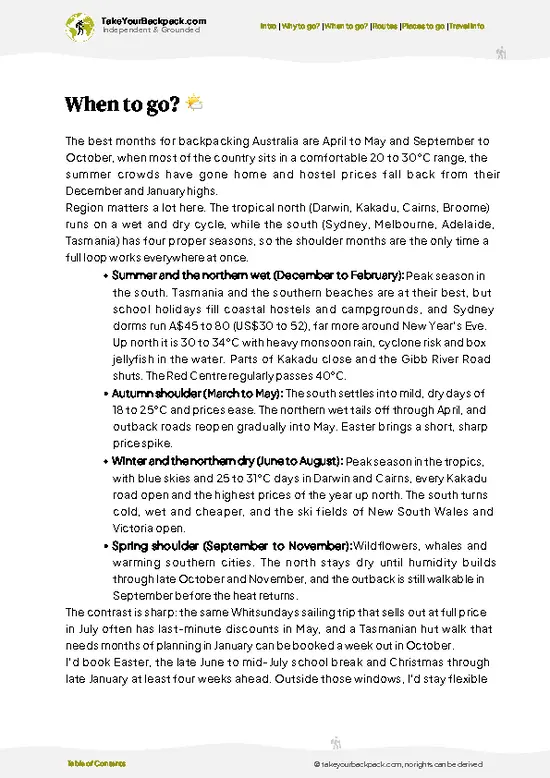
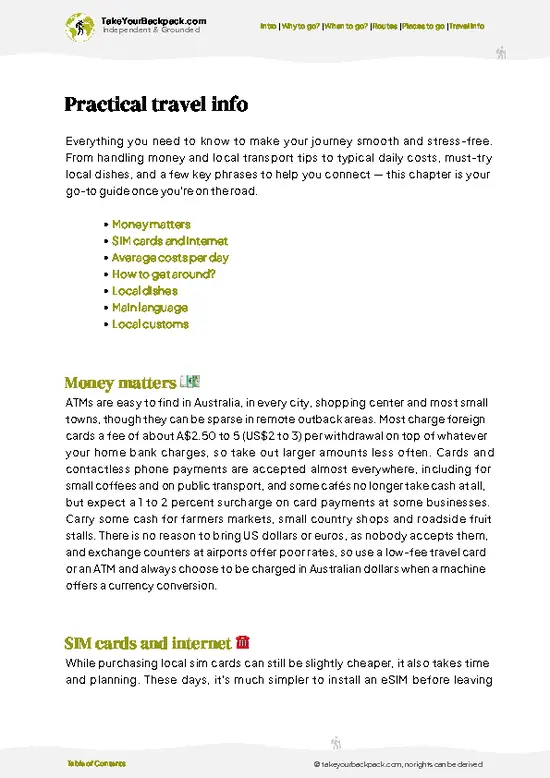
example page 0 from our offline Travel Guide for Australia
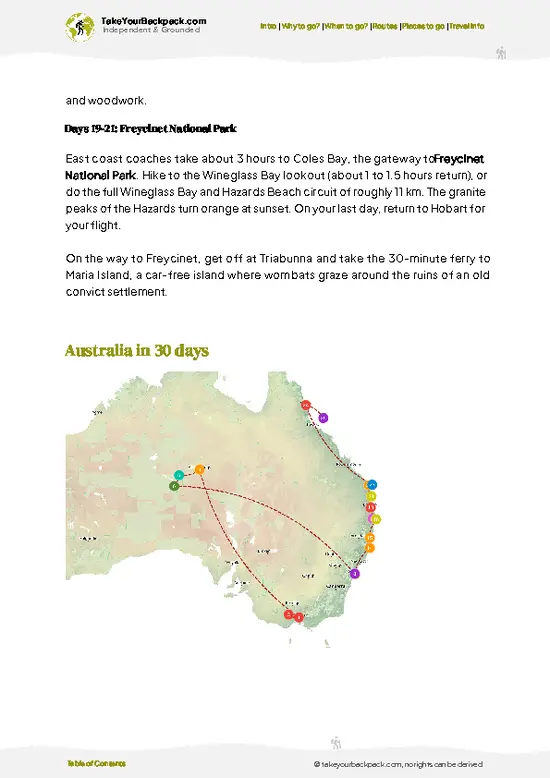
example page 1 from our offline Travel Guide for Australia
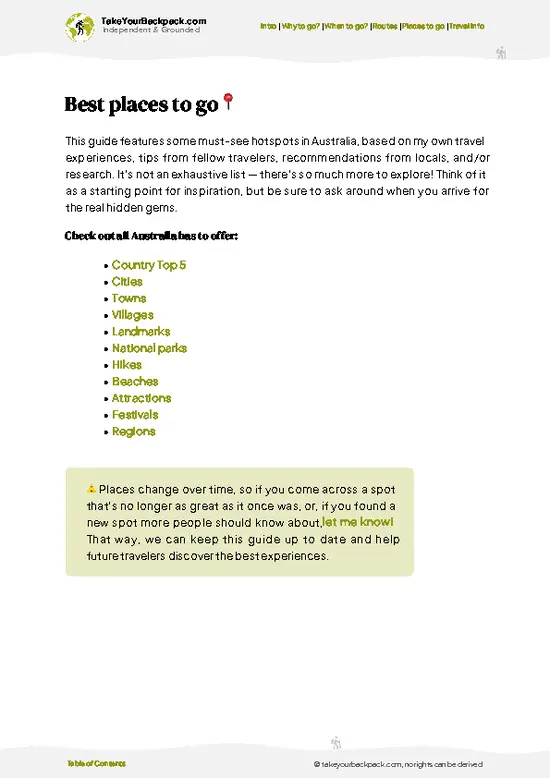
example page 2 from our offline Travel Guide for Australia
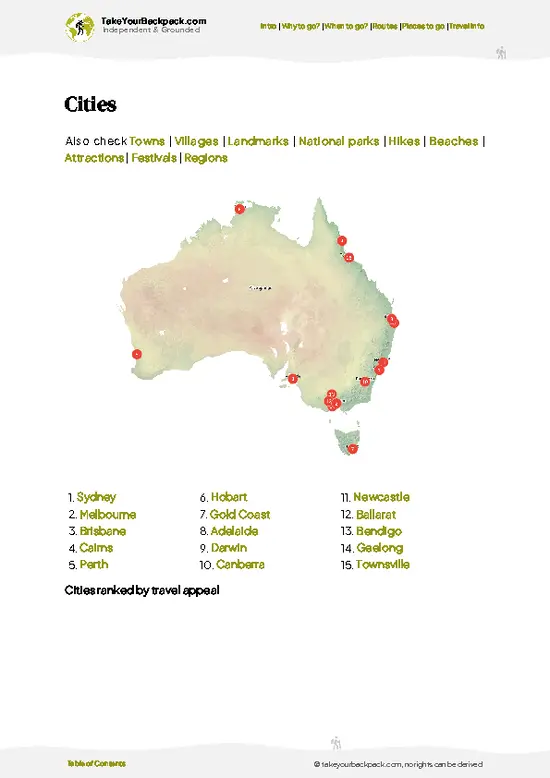
example page 3 from our offline Travel Guide for Australia
example page 4 from our offline Travel Guide for Australia
example page 5 from our offline Travel Guide for Australia
example page 6 from our offline Travel Guide for Australia
example page 7 from our offline Travel Guide for Australia
Loading the map 🌍
CLICK TO FILTER
cities
towns
villages
landmarks
national parks
hikes
beaches
attractions
festivals
regions
SHOW COUNTRY’S BESTSHOW ALL

✨ Why go?
Ranked #9 national park in Australia
Why Kosciuszko should be on your travel list

Backpackers come here because the park rewards independent travelers more than any tour. The Main Range Walk is a 22 kilometer loop that links Australia’s highest peaks and glacial lakes, and you can set your own pace, camp where rules allow, and skip anyone’s schedule. Free bush camping is permitted in much of the backcountry, which keeps costs low for a country this expensive. Towns like Jindabyne and Thredbo have hostels and lodges for the nights you want a roof.

The second pull is variety in one park. You can summit Mount Kosciuszko at 2,228 meters on a wide, gentle track, then trade that for a multi-day traverse through snow gum woodland and tussock grassland. Self-guided hikers do well here because tracks are marked and the terrain is open, so you can see where you are going. Winter … read more 👉
Backpackers come here because the park rewards independent travelers more than any tour. The Main Range Walk is a 22 kilometer loop that links Australia’s highest peaks and glacial lakes, and you can set your own pace, camp where rules allow, and skip anyone’s schedule. Free bush camping is permitted in much of the backcountry, which keeps costs low for a country this expensive. Towns like Jindabyne and Thredbo have hostels and lodges for the nights you want a roof.

The second pull is variety in one park. You can summit Mount Kosciuszko at 2,228 meters on a wide, gentle track, then trade that for a multi-day traverse through snow gum woodland and tussock grassland. Self-guided hikers do well here because tracks are marked and the terrain is open, so you can see where you are going. Winter turns the whole area into a ski and backcountry playground.

💡 HighlightsTop highlights of Kosciuszko

  1. Mount Kosciuszko Summit: At 2,228 meters, it is the highest point on mainland Australia. The well-formed track from Thredbo or Charlotte Pass makes it achievable for most fit walkers, and the cairn at the top is the prize.
  2. Main Range Walk: A 22 kilometer circuit from Charlotte Pass that passes Blue Lake, Hedley Tarn and Mount Townsend, with big views across the high plateau.
  3. Blue Lake: The deepest of mainland Australia’s glacial lakes, sitting in a cirque beneath steep slopes and ringed with snow patches into summer.
  4. Thredbo Valley Track: A riverside route of about 37 kilometers between Thredbo and Lake Crackenback, popular with mountain bikers and walkers for its forest and bridges.
  5. Yarrangobilly Caves: Limestone caves in the north of the park, with guided tours and a thermal pool in the Yarrangobilly
… read more 👉
  1. Mount Kosciuszko Summit: At 2,228 meters, it is the highest point on mainland Australia. The well-formed track from Thredbo or Charlotte Pass makes it achievable for most fit walkers, and the cairn at the top is the prize.
  2. Main Range Walk: A 22 kilometer circuit from Charlotte Pass that passes Blue Lake, Hedley Tarn and Mount Townsend, with big views across the high plateau.
  3. Blue Lake: The deepest of mainland Australia’s glacial lakes, sitting in a cirque beneath steep slopes and ringed with snow patches into summer.
  4. Thredbo Valley Track: A riverside route of about 37 kilometers between Thredbo and Lake Crackenback, popular with mountain bikers and walkers for its forest and bridges.
  5. Yarrangobilly Caves: Limestone caves in the north of the park, with guided tours and a thermal pool in the Yarrangobilly River gorge where the water sits near 27°C.
  6. Wildflower Season on the High Plains: Alpine daisies, billy buttons and snow gums bloom across the high country in summer, especially along the Dead Horse Gap and Main Range areas.
  7. Charlotte Pass: The highest trailhead reachable by road in summer; in winter the road from Perisher closes and access is by oversnow transport.
Combine Blue Lake with the Main Range Walk, since the lake sits right on the route and makes a perfect lunch stop.
Spotted a mistake or missing something? Contact us.

Things to do near Kosciuszko National Park

Ratings based on Tripadvisor reviews. When you book through this link, you support our work at no extra cost to you.

🌤️ When to go?Seasonal considerations and timing

  • Summer (Dec to Feb): Walking season for the Main Range and Mount Kosciuszko. Days reach 15 to 25°C (59 to 77°F), nights can drop near 2°C (36°F), and daylight runs about 14 hours. Afternoon thunderstorms are common, and wildflowers peak in January.
  • Autumn (Mar to May): Crisp, stable days of 8 to 18°C (46 to 64°F), thin crowds and golden snow gums. Frosts begin by April.
  • Winter (Jun to Sep): Snow cover, 9 hours of daylight and -8 to 5°C (18 to 41°F). Skiing and snowshoeing dominate, and Thredbo and Perisher lodging prices peak, especially in July and August.
  • Spring (Oct to Nov): Snowmelt, mud and swollen creeks, with highs of 5 to 15°C (41 to 59°F). Quiet, and lower rates return.
Book winter beds months ahead, but summer midweek is usually easy.

source: climatestotravel.comJANJanuary: excellent for travelingFEBFebruary: excellent for travelingMARMarch: highly recommended for travelingAPRApril: highly recommended for travelingMAYMay: good for travelingJUNJune: fair for travelingJULJuly: fair for travelingAUGAugust: fair for travelingSEPSeptember: good for travelingOCTOctober: highly recommended for travelingNOVNovember: highly recommended for travelingDECDecember: excellent for traveling
australia-national-park-kosciuszko-national-park
© Google | Brent Bischoff

✈️ The backpacker research shortcutAustralia Travel Guide

An offline-friendly backpacking guide with optimized travel routes, ranked highlights, transport advice, and the best areas to stay.
example page 0 from our offline Travel Guide for Australia
example page 1 from our offline Travel Guide for Australia
example page 2 from our offline Travel Guide for Australia
example page 3 from our offline Travel Guide for Australia
example page 4 from our offline Travel Guide for Australia
example page 5 from our offline Travel Guide for Australia
example page 6 from our offline Travel Guide for Australia
example page 7 from our offline Travel Guide for Australia
The digital guide (414 pages) contains:
✅ 143 highlights, ranked by travel appeal
✅ Optimized 14, 21 & 30-day travel routes
✅ Cities, national parks, landmarks, beaches
✅ How to get around
✅ Offline-friendly for travel without Wi-Fi
👉 Click to see all 30+ guide features

📅 Plan smarter in minutes, not weeks
✅ Month by month travel advice
✅ Festivals & national holidays
✅ Budget expectations

🗺️ Go to the right places, skip the overrated ones
✅ Honest pros & cons of destinations
✅ Top hikes, parks & viewpoints
✅ Lesser-known places most travelers miss
✅ Clear “worth it vs skip it” guidance

🛏️ Travel smoothly without rookie mistakes
✅ Best areas to stay
✅ Transport systems explained simply
✅ Common scams & safety advice
✅ SIM cards, money & practical tips

🌍 Understand the country, not just visit it
✅ Culture & traditions
✅ Local customs
✅ Festivals worth planning around
✅ Traveler-friendly historical context
✅ Insights that make places more meaningful

📱 Built for real travel conditions
✅ Fully downloadable PDF
✅ Works completely offline
✅ Optimized for phone use
✅ Useful in remote areas & buses
✅ Everything in one place
Stop searching, start planning
Get instant access to your full guide. 30‑day money-back guarantee.
+ Add another guide for just

By proceeding you agree to our terms.
Sent to your inbox immediately after payment • 100% Secure Checkout
Best Backpacking Travel Advisor 2025 tourism awardBest Backpacking
Travel Advisor
2025
What others say about Take Your Backpack Guides:
⭐⭐⭐⭐⭐
Fantastic, amazing amount of information!
⭐⭐⭐⭐⭐
My goodness this is amazing, it's what I've been looking for hats off too you!
⭐⭐⭐⭐⭐
I think this is absolutely BRILLIANT
⭐⭐⭐⭐
Very complete and informative. It's still missing places, but I gotta to commend you
⭐⭐⭐⭐⭐
This is truly amazing, thank you, can't wait to explore it with my kids!
⭐⭐⭐⭐⭐
Awesome resource, thank you!
⭐⭐⭐⭐⭐
This is amazing! Can't wait to explore the ones I haven't seen
⭐⭐⭐⭐
I love this! Well done, great idea.
⭐⭐⭐⭐⭐
Thanks for taking the time to make this gem!
⭐⭐⭐⭐⭐
This might be the best website I've ever seen.
⭐⭐⭐⭐⭐
Congratulations, and thank you so much for your work; it's incredibly valuable.
⭐⭐⭐⭐
In all seriousness I think you did a great job pointing out the important spots
⭐⭐⭐⭐⭐
10/10 very good
⭐⭐⭐⭐⭐
As someone who's only just starting to visit regularly this is awesome, thank you.
⭐⭐⭐⭐
Thank you very much! I'm going to visit my dad, it's going to be very useful!
⭐⭐⭐⭐⭐
This is really cool! We'll be travelling for the first time and this definitely come in handy.
⭐⭐⭐⭐⭐
You are now our minister of culture, congratulations 👨‍💼
⭐⭐⭐⭐⭐
Just wanted to tell you that this is a pearl! Going to follow your recommendations.
⭐⭐⭐⭐⭐
This is so cool. I'll definitely be using the resource for my travels soon.
⭐⭐⭐⭐⭐
This is very impressive! Good work.
⭐⭐⭐⭐⭐
This is an amazing and informative site. Very well done!

🛏️ Where to stay?Where staying makes the most sense

Thredbo is the best base for backpackers, with the Kosciuszko Express chairlift and the summit walk starting from the village. Beds in hostel-style lodges and ski clubs are limited, so book early in winter. Inside the park, there are campgrounds such as Thredbo Diggings and Island Bend, plus free backcountry camping away from the alpine core. Huts like Seamans Hut are for emergency shelter only. Jindabyne, about 35 minutes by road from Thredbo, is the cheapest and most practical town base. It has a backpacker-friendly lodge, holiday parks with cabins and powered or unpowered sites, and supermarkets … read more 👉
Thredbo is the best base for backpackers, with the Kosciuszko Express chairlift and the summit walk starting from the village. Beds in hostel-style lodges and ski clubs are limited, so book early in winter. Inside the park, there are campgrounds such as Thredbo Diggings and Island Bend, plus free backcountry camping away from the alpine core. Huts like Seamans Hut are for emergency shelter only. Jindabyne, about 35 minutes by road from Thredbo, is the cheapest and most practical town base. It has a backpacker-friendly lodge, holiday parks with cabins and powered or unpowered sites, and supermarkets for supplies. Perisher suits winter visitors, but its accommodation is mostly lodges priced for ski groups. Cooma, about an hour from Jindabyne, and Khancoban on the western side have motels and caravan parks for overnight stops en route.

👛 Costs (as of 15 October 2026)What things cost and how to budget

A realistic daily budget for Kosciuszko National Park is about US$95 per person in high season, with winter running higher. The table below covers a typical backpacker day, with Australian dollars as the payment currency.
CategoryBudget RangeLocal Reality
Park entryUS$12 to 17 per vehicle per dayCharged at the Sawpit Creek and Charlotte Pass gates, and paid by the vehicle, so sharing a car cuts the per-person cost. Walkers entering on foot generally avoid it. In winter the fee is higher (roughly US$17 to 20) and covers snow season access.
Accommodation (high season)US$10 to 55 a nightBasic campsites run US$8 to 15 a night per person, while hostel dorms and lodge beds in Jindabyne and Thredbo cost US$35 to 55 outside peak snow weeks. Winter prices in Thredbo jump sharply.
Food and suppliesUS$20
… read more 👉
A realistic daily budget for Kosciuszko National Park is about US$95 per person in high season, with winter running higher. The table below covers a typical backpacker day, with Australian dollars as the payment currency.
CategoryBudget RangeLocal Reality
Park entryUS$12 to 17 per vehicle per dayCharged at the Sawpit Creek and Charlotte Pass gates, and paid by the vehicle, so sharing a car cuts the per-person cost. Walkers entering on foot generally avoid it. In winter the fee is higher (roughly US$17 to 20) and covers snow season access.
Accommodation (high season)US$10 to 55 a nightBasic campsites run US$8 to 15 a night per person, while hostel dorms and lodge beds in Jindabyne and Thredbo cost US$35 to 55 outside peak snow weeks. Winter prices in Thredbo jump sharply.
Food and suppliesUS$20 to 35Self-catering from the Jindabyne supermarkets keeps costs low. A pub meal is US$15 to 25, and café prices in Thredbo village run higher.
Local transportUS$0 to 15Most backpackers rely on a car or a lift. Winter shuttle buses and the Kosciuszko Express chairlift (about US$25 to 35 return in summer) add up if you use them.
Permits and extrasUS$0 to 10Backcountry camping needs no permit in most areas. Gear hire, gas canisters and parking in Thredbo are the usual extras.
Total Daily BudgetUS$95Based on a mid-range split with one campsite night, shared vehicle entry and self-catered meals.


source: nationalparks.nsw.gov.au
⚠️ Prices can change and everyone travels differently, so take this as a rough guide. Hope it helps you plan your adventure!

🥾 TrailsWhere to hike in Kosciuszko: trails for every level

Walking here ranges from gentle boardwalks to multi-day alpine traverses, on open terrain of granite, tussock and snow gum.
  • Mount Kosciuszko Summit Walk from Thredbo: About 13 kilometers return, 4 to 6 hours, easy to moderate. A chairlift cuts the climb, and the raised metal walkway protects the fragile alpine plants.
  • Main Range Walk: 22 kilometers loop from Charlotte Pass, 6 to 8 hours, moderate. It passes Blue Lake, Hedley Tarn, Mount Townsend and the summit, with exposed ridges and glacial landscapes.
  • Charlotte Pass to Kosciuszko via Summit Walk: About 18 kilometers return, 5 to 7 hours, moderate.
… read more 👉
Walking here ranges from gentle boardwalks to multi-day alpine traverses, on open terrain of granite, tussock and snow gum.
  • Mount Kosciuszko Summit Walk from Thredbo: About 13 kilometers return, 4 to 6 hours, easy to moderate. A chairlift cuts the climb, and the raised metal walkway protects the fragile alpine plants.
  • Main Range Walk: 22 kilometers loop from Charlotte Pass, 6 to 8 hours, moderate. It passes Blue Lake, Hedley Tarn, Mount Townsend and the summit, with exposed ridges and glacial landscapes.
  • Charlotte Pass to Kosciuszko via Summit Walk: About 18 kilometers return, 5 to 7 hours, moderate. A wide gravel track follows the old road with gradual climbs and wide views.
  • Thredbo Valley Track: About 37 kilometers one way, a long day on foot, easy to moderate. It follows the river through eucalypt forest and crosses suspension bridges.
  • Yarrangobilly Thermal Pool Walk: A short descent of about 1.5 kilometers each way, easy, ending at a warm swimming spot in the gorge.
Wildlife includes wombats, echidnas, eastern grey kangaroos, mountain pygmy possums in boulder fields and plenty of birdlife such as flame robins. Leeches and snakes are not the main concern in the high country, but fast weather changes are, so carry layers even in summer.

Public transport is limited. Buses run to Jindabyne and Thredbo from Canberra and Sydney in the ski season, and a car makes access much easier. Summer weekends and school holidays draw the biggest crowds on the summit track, while backcountry sections stay quiet. A park vehicle entry fee applies, and Thredbo’s chairlift charges its own ticket.
⚠️ Hiking info can sometimes be outdated or inaccurate. Before you hit the trail, check the latest conditions with locals. If you do spot anything that's off, I'd love to hear from you, so I can update it for fellow travelers.

🛡️ SafetyScams, Hazards, and Annoyances

The Main Range walk from Thredbo is well-formed and straightforward, but the weather is the real risk. Snow can fall any month, and temperatures can drop quickly with wind and rain, so carry a waterproof shell, warm layer, hat and gloves even in January. Start early to be off the ridge before afternoon storms, and avoid exposed high ground during lightning. Fog can hide the track on Rawson Pass, so keep to marked routes and carry a map. Sun is intense at altitude, so wear sunscreen and sunglasses. Snakes, mainly eastern brown and copperhead, are active in warm months; watch your steps and give them space. Wombats and kangaroos are harmless if left alone. Fill water bottles before the climb, as the higher sections have limited supply. Winter backcountry trips need avalanche awareness and navigation skills.

FAQTraveler FAQ

Plan on 2 to 3 days for the main highlights. One day covers the Main Range or the Mount Kosciuszko summit walk from Thredbo, about 13 km return and 5 to 6 hours. A second day suits the Blue Lake or Charlotte Pass circuit, and a third lets you add Yarrangobilly Caves. Multi-day hikers can spend 4 to 6 days on the Main Range Track.
Yes, but it is limited. In winter, shuttle buses and coaches run from Canberra and Sydney to Jindabyne, Thredbo and Perisher, and a chairlift in Thredbo takes you up toward the summit trail. In summer, public transport to trailheads is minimal. A car gives access to Charlotte Pass, Yarrangobilly and Khancoban, and Canberra is about 2.5 hours from Jindabyne.
Yes, a park entry fee applies in the main areas, about A$17 to 29 per vehicle per day, with higher winter rates. Camping in designated campgrounds costs extra, around A$10 to 25 per person. The Kosciuszko Pass can be pre-purchased online or at the Jindabyne visitor center. Free backcountry camping is allowed at least 30 m from water, but no permit is required for the summit walk.
⚠️ Things can change over time, so always validate details locally before you go.

Other Australian national parks near Kosciuszko

Explore more nearby:

  • Booderee National Park—White quartz sand, Jervis Bay headland, Wreck Bay community, lighthouse ruins| 214 km away
  • Blue Mountains—Three Sisters, Giant Stairway, Scenic Railway, Jamison Valley| 330 km away
  • Wilsons Promontory—Squeaky Beach, Mount Oberon, Tidal River wombats, Sealers Cove| 394 km away

💡 Not sure where to go next?
Create a personalized itinerary for Australia including Kosciuszko and the places that fit your trip.

Generate my itinerary

👉 Discover all national parks

Or checkout all Australia has to offer (think cities, towns, villages, national parks, hikes, beaches, festivals)
Country photo of Australia

We 💚 feedbackParting advice and final tips

Go in the weeks when the snow has gone and the wildflowers are out, and start walking soon after dawn. Mornings keep the summit track quiet and the sky clear before cloud builds in the afternoon. I would pack a rain shell regardless, because the high plateau changes its mind quickly.

✈️ When did I visit Australia?
On my trip to New Zealand in 1993, I had a short stop in Australia as well.

✍️ Help improve this page!
The information on this page is based on my own backpacking experience in Australia, supplemented with up-to-date research and feedback from other travelers. Travel details can change, so if you notice anything outdated or incomplete, feel free to let me know.


🙋‍♂️ Give feedback

👋 Meet the founderWho’s Behind Take Your Backpack?

Johan, backpacker and founder of TakeYourBackpackHi, I’m Johan (Netherlands 🇳🇱), the creator of TakeYourBackpack. Over the past 3 decades, I’ve backpacked through 90+ countries across six continents, gaining extensive experience with independent travel, long-term trips, and overland routes.

This site is built on a combination of firsthand travel experience and carefully curated insights from other backpackers. Many guides are based on places I’ve personally visited, while others bring together tips, observations, and practical advice shared by trusted travelers I’ve met along the way.

The goal is to provide realistic, experience-driven guidance — not generic itineraries — so you can explore destinations with better context, clearer expectations, and more confidence.