×

Australia🇦🇺 | beachesWhitehaven BeachHill Inlet swirls, 7 km silica sand, stinger season, bush campground | things to do and best time to go

Explore Tathra BeachExplore Wool Bay

Backpacking in Whitehaven Beach
🏆 Top pickbeach ranked #1
By Johan Kruseman 🇳🇱 | Updated October 15, 2026

The sand here stays cool enough to walk barefoot at midday, because it is almost pure silica and refuses to hold heat. Whitehaven Beach runs for about 7 kilometers along the east side of Whitsunday Island, off the Queensland coast in Australia, east of Airlie Beach. It is spotless, and the water is calm, clear and swimmable, though there are no shops, no cafes and no budget beds beyond a bush campground. Boats arrive in waves, so mid-morning means company, and you walk a few minutes along the sand to lose it. Snorkeling is better elsewhere in the islands. My mistake was reaching the Hill Inlet lookout at high tide, phone raised, to find a plain blue channel instead of the famous swirling sand patterns, and I got a lesson in reading tide tables over brochures. Check the low tide time before you book any tour, and carry your own food and water.

Discover everything you want to know in the 📖 Australia Travel Guide.


example page 0 from our offline Travel Guide for Australia
example page 1 from our offline Travel Guide for Australia
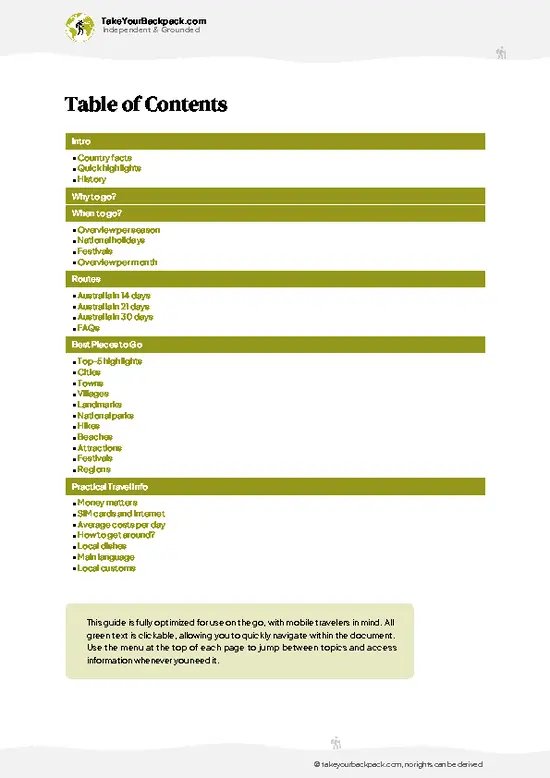
example page 2 from our offline Travel Guide for Australia
example page 3 from our offline Travel Guide for Australia
example page 4 from our offline Travel Guide for Australia
example page 5 from our offline Travel Guide for Australia
example page 6 from our offline Travel Guide for Australia
example page 7 from our offline Travel Guide for Australia
Loading the map 🌍
CLICK TO FILTER
cities
towns
villages
landmarks
national parks
hikes
beaches
attractions
festivals
regions
SHOW COUNTRY’S BESTSHOW ALL

✨ Why go?
Ranked #1 beach in Australia
What sets this place apart

Backpackers stop here for the sheer plainness of the place: 7 kilometers of 98 percent silica sand with no resort, no souvenir stalls and no music. You pay for the boat and the rest is free, so the beach becomes the main event of a Whitsundays trip rather than a side stop between hostels. The sand squeaks underfoot and sits bright white against turquoise water, and photographs are only part of it. You can walk until the day-trip crowd thins out, then swim in water that is usually flat enough to float in.
The other draw is staying put. The bush campground at the southern end is one of the few ways to see the beach after the tour boats leave, with a night sky and a quiet shoreline to yourself, though sites are limited and need a permit in advance. Sailing trips out of Airlie Beach also anchor … read more 👉
Backpackers stop here for the sheer plainness of the place: 7 kilometers of 98 percent silica sand with no resort, no souvenir stalls and no music. You pay for the boat and the rest is free, so the beach becomes the main event of a Whitsundays trip rather than a side stop between hostels. The sand squeaks underfoot and sits bright white against turquoise water, and photographs are only part of it. You can walk until the day-trip crowd thins out, then swim in water that is usually flat enough to float in.
The other draw is staying put. The bush campground at the southern end is one of the few ways to see the beach after the tour boats leave, with a night sky and a quiet shoreline to yourself, though sites are limited and need a permit in advance. Sailing trips out of Airlie Beach also anchor nearby for a stop, so you can tick it off on a multi-day sail, which suits a loose travel schedule and a tight bank balance.

💡 HighlightsTop highlights of Whitehaven Beach

  1. Hill Inlet Lookout: this is the view on every postcard. From the high platform above Tongue Bay, white silica sand and green tidal water twist together into shifting swirls. It looks best around low tide in clear light, so time your visit rather than just turning up.
  2. The long walk along the sand: stroll the full length of the beach, since most boat passengers stay near the landing spot. The sand squeaks as you walk and stays cool underfoot, and the farther you go, the fewer footprints you see.
  3. Swimming in the calm shallows: the water is clear and usually gentle, ideal for floating and wading. Between roughly November and May, marine stingers can be present, so a full-body stinger suit is the sensible choice if you plan to swim.
  4. Tongue Bay track and the northern beach: a short bush track leads
… read more 👉
  1. Hill Inlet Lookout: this is the view on every postcard. From the high platform above Tongue Bay, white silica sand and green tidal water twist together into shifting swirls. It looks best around low tide in clear light, so time your visit rather than just turning up.
  2. The long walk along the sand: stroll the full length of the beach, since most boat passengers stay near the landing spot. The sand squeaks as you walk and stays cool underfoot, and the farther you go, the fewer footprints you see.
  3. Swimming in the calm shallows: the water is clear and usually gentle, ideal for floating and wading. Between roughly November and May, marine stingers can be present, so a full-body stinger suit is the sensible choice if you plan to swim.
  4. Tongue Bay track and the northern beach: a short bush track leads from Tongue Bay up to the Hill Inlet lookout, then down to the inlet-side sand. You get shade, bird calls and a close look at the tidal flats from ground level, which is a very different angle from the platform.
  5. Camping at the Whitehaven Beach campground: stay overnight at the southern end for sunset and a night sky with almost no artificial light. Spots are few and you need a permit from Queensland Parks and Wildlife, so book well ahead and bring in all your food and water, because the campground has only basic facilities.
Most visitors leave with the afternoon boats and miss what the beach looks like at sunset and first light, which is exactly what the campground is for.
Spotted a mistake or missing something? Contact us.

Things to do around Whitehaven Beach

Ratings based on Tripadvisor reviews. When you book through this link, you support our work at no extra cost to you.

🌤️ When to go?Choosing the right time of year

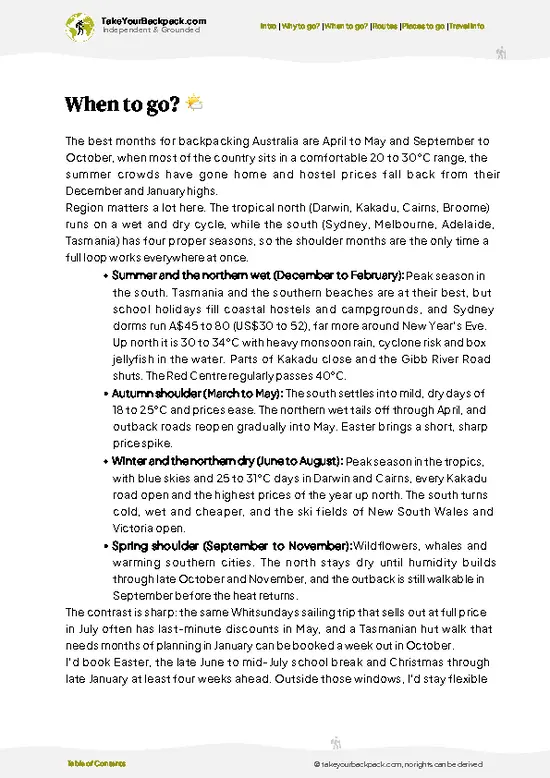
  • Dry Season (June to October): Whitehaven Beach is at its most comfortable from June to October. Days run 22 to 26°C (72 to 79°F), nights dip to about 14 to 18°C (57 to 64°F), and rain is rare. Daylight lasts roughly 11 hours in winter. Whales pass through the Whitsundays from July to September, and the sand is cool enough for a long barefoot walk.
  • Stinger Season (November to May): Box jellyfish and Irukandji are present, so swimming means wearing a full-body stinger suit. Hire them on the boat. Water sits around 27 to 30°C (81 to 86°F).
  • Wet Season (January to March): Expect 29 to 32°C (84 to 90°F), heavy humidity, sudden downpours and cyclone risk. Days stretch to about 13.5 hours, tours get canceled in bad weather, and prices dip.
  • School Holidays (late December, January, Easter, July, September):
… read more 👉
  • Dry Season (June to October): Whitehaven Beach is at its most comfortable from June to October. Days run 22 to 26°C (72 to 79°F), nights dip to about 14 to 18°C (57 to 64°F), and rain is rare. Daylight lasts roughly 11 hours in winter. Whales pass through the Whitsundays from July to September, and the sand is cool enough for a long barefoot walk.
  • Stinger Season (November to May): Box jellyfish and Irukandji are present, so swimming means wearing a full-body stinger suit. Hire them on the boat. Water sits around 27 to 30°C (81 to 86°F).
  • Wet Season (January to March): Expect 29 to 32°C (84 to 90°F), heavy humidity, sudden downpours and cyclone risk. Days stretch to about 13.5 hours, tours get canceled in bad weather, and prices dip.
  • School Holidays (late December, January, Easter, July, September): Boats fill, accommodation prices climb, and the Hill Inlet lookout gets busy by late morning.
Book tours a few days ahead in July and August, but leave a flexible day in case wind cancels sailing.


source: climatestotravel.comJANJanuary: fair for travelingFEBFebruary: fair for travelingMARMarch: fair for travelingAPRApril: fair for travelingMAYMay: highly recommended for travelingJUNJune: highly recommended for travelingJULJuly: highly recommended for travelingAUGAugust: good for travelingSEPSeptember: highly recommended for travelingOCTOctober: highly recommended for travelingNOVNovember: below average for travelingDECDecember: fair for traveling

✈️ The backpacker research shortcutAustralia Travel Guide

An offline-friendly backpacking guide with optimized travel routes, ranked highlights, transport advice, and the best areas to stay.
example page 0 from our offline Travel Guide for Australia
example page 1 from our offline Travel Guide for Australia
example page 2 from our offline Travel Guide for Australia
example page 3 from our offline Travel Guide for Australia
example page 4 from our offline Travel Guide for Australia
example page 5 from our offline Travel Guide for Australia
example page 6 from our offline Travel Guide for Australia
example page 7 from our offline Travel Guide for Australia
The digital guide (414 pages) contains:
✅ 143 highlights, ranked by travel appeal
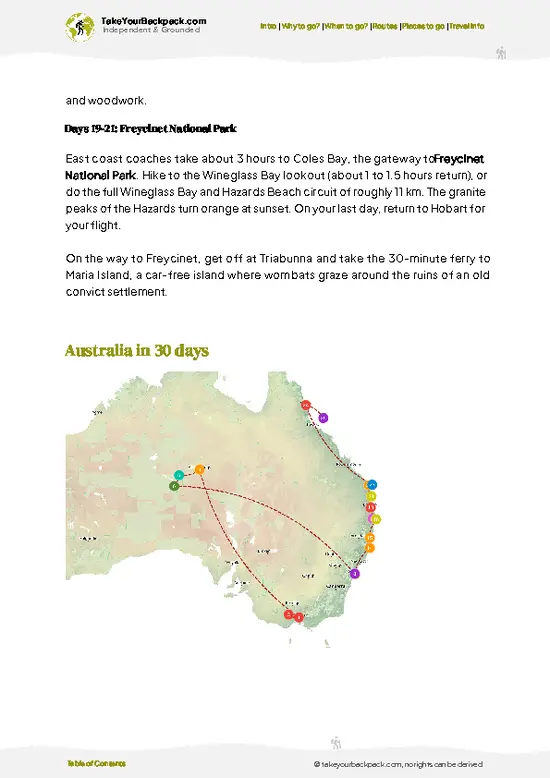
✅ Optimized 14, 21 & 30-day travel routes
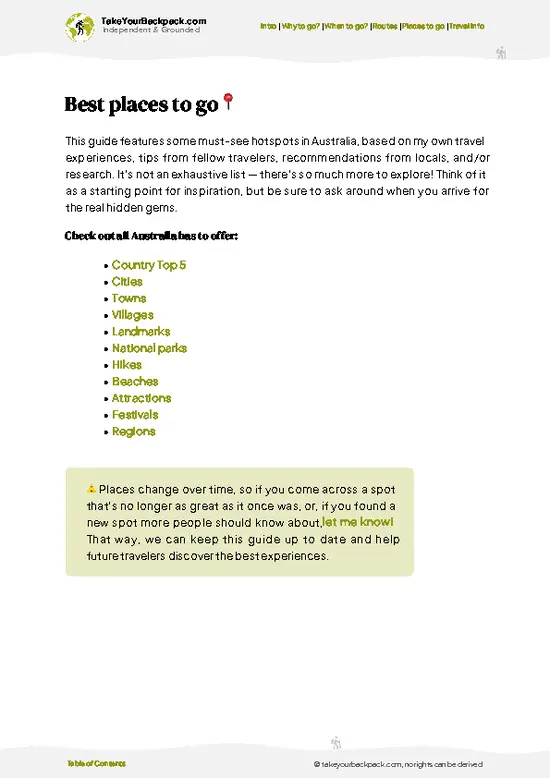
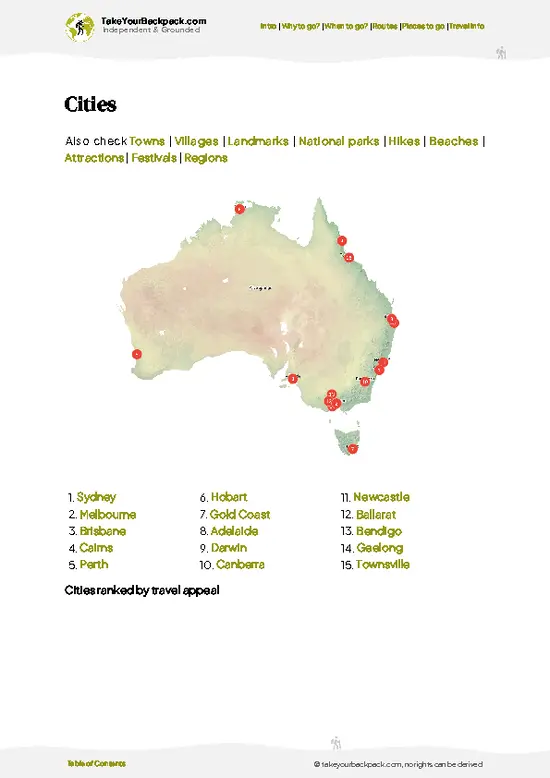
✅ Cities, national parks, landmarks, beaches
✅ How to get around
✅ Offline-friendly for travel without Wi-Fi
👉 Click to see all 30+ guide features

📅 Plan smarter in minutes, not weeks
✅ Month by month travel advice
✅ Festivals & national holidays
✅ Budget expectations

🗺️ Go to the right places, skip the overrated ones
✅ Honest pros & cons of destinations
✅ Top hikes, parks & viewpoints
✅ Lesser-known places most travelers miss
✅ Clear “worth it vs skip it” guidance

🛏️ Travel smoothly without rookie mistakes
✅ Best areas to stay
✅ Transport systems explained simply
✅ Common scams & safety advice
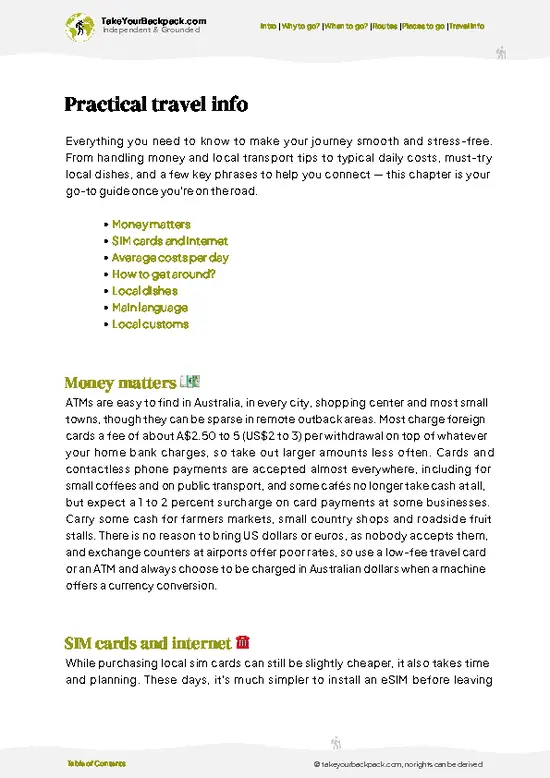
✅ SIM cards, money & practical tips

🌍 Understand the country, not just visit it
✅ Culture & traditions
✅ Local customs
✅ Festivals worth planning around
✅ Traveler-friendly historical context
✅ Insights that make places more meaningful

📱 Built for real travel conditions
✅ Fully downloadable PDF
✅ Works completely offline
✅ Optimized for phone use
✅ Useful in remote areas & buses
✅ Everything in one place
Stop searching, start planning
Get instant access to your full guide. 30‑day money-back guarantee.
+ Add another guide for just

By proceeding you agree to our terms.
Sent to your inbox immediately after payment • 100% Secure Checkout
Best Backpacking Travel Advisor 2025 tourism awardBest Backpacking
Travel Advisor
2025
What others say about Take Your Backpack Guides:
⭐⭐⭐⭐⭐
Fantastic, amazing amount of information!
⭐⭐⭐⭐⭐
My goodness this is amazing, it's what I've been looking for hats off too you!
⭐⭐⭐⭐⭐
I think this is absolutely BRILLIANT
⭐⭐⭐⭐
Very complete and informative. It's still missing places, but I gotta to commend you
⭐⭐⭐⭐⭐
This is truly amazing, thank you, can't wait to explore it with my kids!
⭐⭐⭐⭐⭐
Awesome resource, thank you!
⭐⭐⭐⭐⭐
This is amazing! Can't wait to explore the ones I haven't seen
⭐⭐⭐⭐
I love this! Well done, great idea.
⭐⭐⭐⭐⭐
Thanks for taking the time to make this gem!
⭐⭐⭐⭐⭐
This might be the best website I've ever seen.
⭐⭐⭐⭐⭐
Congratulations, and thank you so much for your work; it's incredibly valuable.
⭐⭐⭐⭐
In all seriousness I think you did a great job pointing out the important spots
⭐⭐⭐⭐⭐
10/10 very good
⭐⭐⭐⭐⭐
As someone who's only just starting to visit regularly this is awesome, thank you.
⭐⭐⭐⭐
Thank you very much! I'm going to visit my dad, it's going to be very useful!
⭐⭐⭐⭐⭐
This is really cool! We'll be travelling for the first time and this definitely come in handy.
⭐⭐⭐⭐⭐
You are now our minister of culture, congratulations 👨‍💼
⭐⭐⭐⭐⭐
Just wanted to tell you that this is a pearl! Going to follow your recommendations.
⭐⭐⭐⭐⭐
This is so cool. I'll definitely be using the resource for my travels soon.
⭐⭐⭐⭐⭐
This is very impressive! Good work.
⭐⭐⭐⭐⭐
This is an amazing and informative site. Very well done!

🛏️ Where to stay?Choosing the right base

Airlie Beach on the mainland is the best base for backpackers, with Whitehaven Beach itself having no accommodation at all. The only overnight option on the island is a few basic national park campsites at the southern end, which need a permit and a lot of self-sufficiency.
Airlie Beach: This is the backpacker hub of the Whitsundays. Dorm beds run roughly A$30 to 50 a night, and the town packs hostels, cheap bars and tour booking desks along a few blocks of Shute Harbour Road. It is the easiest place to meet other solo travelers and to find people to share a sailing trip with. Boats to Whitehaven … read more 👉
Airlie Beach on the mainland is the best base for backpackers, with Whitehaven Beach itself having no accommodation at all. The only overnight option on the island is a few basic national park campsites at the southern end, which need a permit and a lot of self-sufficiency.
Airlie Beach: This is the backpacker hub of the Whitsundays. Dorm beds run roughly A$30 to 50 a night, and the town packs hostels, cheap bars and tour booking desks along a few blocks of Shute Harbour Road. It is the easiest place to meet other solo travelers and to find people to share a sailing trip with. Boats to Whitehaven leave from Coral Sea Marina (formerly Abell Point Marina) and Port of Airlie, with the crossing taking 1 to 1.5 hours.
Cannonvale: A few minutes west of Airlie, this suburb has quieter motels and apartments, plus supermarkets for self-catering. It suits anyone wanting cheaper food and early sleep.
Shute Harbour and Jubilee Pocket: Quieter again, handy for early departures but with little nightlife.
Hamilton Island: Closer to the beach by boat, though accommodation here is resort-priced and not geared to budget travelers.
Sailing trips with a night on board are the social option, usually 2 nights from about A$450 to 700, and they include Whitehaven.

🛡️ SafetyTraveler Safety Guide

Whitehaven Beach is well managed and very safe for day visitors, with calm, shallow, clear water and gentle waves inside the Whitsunday Islands. Rips are rare, and tides are modest, though the water at Hill Inlet changes dramatically between low and high tide. Marine stingers (box jellyfish and Irukandji) occur from about November to May, and tour operators provide full-length stinger suits, which you should wear. Stingers are uncommon in winter. Sharks and rays exist in the area, but incidents on this beach are very rare, and most people wade in the shallows without trouble.
Sun is the real hazard. The white silica sand reflects strongly, there is almost no shade, and the walk from the boat dock to the water can burn feet in summer. Bring reef-safe sunscreen, a hat, polarized sunglasses and … read more 👉
Whitehaven Beach is well managed and very safe for day visitors, with calm, shallow, clear water and gentle waves inside the Whitsunday Islands. Rips are rare, and tides are modest, though the water at Hill Inlet changes dramatically between low and high tide. Marine stingers (box jellyfish and Irukandji) occur from about November to May, and tour operators provide full-length stinger suits, which you should wear. Stingers are uncommon in winter. Sharks and rays exist in the area, but incidents on this beach are very rare, and most people wade in the shallows without trouble.
Sun is the real hazard. The white silica sand reflects strongly, there is almost no shade, and the walk from the boat dock to the water can burn feet in summer. Bring reef-safe sunscreen, a hat, polarized sunglasses and water. Sand flies can bite at dusk. Theft is minimal, though keep valuables with the boat crew or in a dry bag. Follow crew instructions on where to swim and what time to return to the boat.

FAQTraveler FAQ

Most travelers reach Whitehaven Beach by boat from Airlie Beach, with the crossing taking about 1 to 1.5 hours from Coral Sea Marina or Port of Airlie. Day tours generally cost A$120 to 250 depending on the boat, with fast catamarans at the lower end of that range and small speedboats or seaplane add-ons costing more. Boats also run from Hamilton Island in about 30 minutes. Airlie Beach is roughly 30 to 40 minutes by road or shuttle bus from Proserpine Airport.
Whitehaven is excellent for swimming, thanks to calm, clear, shallow water with almost no surf and no real waves for surfing. Snorkeling is possible off the beach, but the sandy bottom means little marine life, so most visitors add reef stops elsewhere on the same tour. From about November to May a stinger suit is needed for swimming, and tour boats supply them for around A$10 to 15 or free. Hill Inlet at the northern end is best for views and photographs rather than swimming.
Entering the beach itself costs nothing, but you cannot reach it without a boat, so the real cost is transport. Day tours run roughly A$120 to 250, and a night on a sailing trip costs more. Some operators add a national park or environmental management charge of a few dollars. Camping at the southern end needs a Queensland national park permit of about A$7 per person per night, booked in advance online.
⚠️ Things can change over time, so always validate details locally before you go.

Other Australian beaches near Whitehaven Beach

Explore more nearby:

  • Palm Cove—Timber jetty, paperbark foreshore, stinger net, esplanade dining| 530 km away
  • Seventy-Five Mile Beach—Sand highway, Maheno wreck, Eli Creek, Pinnacles cliffs| 709 km away
  • Noosa Main Beach—Laguna Bay calm, First Point longboards, national park walk, Hastings Street| 794 km away

💡 Not sure where to go next?
Create a personalized itinerary for Australia including Whitehaven Beach and the places that fit your trip.

Generate my itinerary

👉 Discover all beaches

Or checkout all Australia has to offer (think cities, towns, villages, national parks, hikes, beaches, festivals)
Country photo of Australia

We 💚 feedbackIs it worth it?

Go in the dry months, roughly June to October, when stingers are rarely a concern and the sky is dependably clear. Whatever the season, aim for a low tide around late morning, so Hill Inlet shows its swirls and the beach has not yet filled. I would book a sailing trip or campsite that lets you stay past the day boats.

✈️ When did I visit Australia?
On my trip to New Zealand in 1993, I had a short stop in Australia as well.

✍️ Help improve this page!
The information on this page is based on my own backpacking experience in Australia, supplemented with up-to-date research and feedback from other travelers. Travel details can change, so if you notice anything outdated or incomplete, feel free to let me know.


🙋‍♂️ Give feedback

👋 Meet the founderWho’s Behind Take Your Backpack?

Johan, backpacker and founder of TakeYourBackpackHi, I’m Johan (Netherlands 🇳🇱), the creator of TakeYourBackpack. Over the past 3 decades, I’ve backpacked through 90+ countries across six continents, gaining extensive experience with independent travel, long-term trips, and overland routes.

This site is built on a combination of firsthand travel experience and carefully curated insights from other backpackers. Many guides are based on places I’ve personally visited, while others bring together tips, observations, and practical advice shared by trusted travelers I’ve met along the way.

The goal is to provide realistic, experience-driven guidance — not generic itineraries — so you can explore destinations with better context, clearer expectations, and more confidence.