×

Belgium🇧🇪 | best festivalsDiscover the 10 Best festivals Across Belgium

Festivals in Belgium come in two broad flavors: huge, tented summer weekends and small, beer-fueled town parades that start at a suspiciously early hour. The country is small enough that Flanders, Wallonia and Brussels each run their own calendar, with different languages, prices and moods. Flanders brings polished mega-events and sold-out dorm beds. Wallonia offers rural fields, cheaper pints and patchy trains. Brussels sits in the middle with good connections. A backpacker or independent traveler can sample all of it, provided they accept that a Belgian queue for fries is part of the program.

By Johan Kruseman 🇳🇱 | Updated October 25, 2026
Explore the best regions in Belgium

Why go?What Makes Them Special

Belgium suits festivals for reasons that are mostly logistical and a little stubborn. The country is roughly 300 kilometers across and has one of Europe’s densest rail networks, so you can sleep in a cheap city and reach almost any site by train, often with a shuttle bus or a 20 to 40 minute walk at the end. Centuries of guild, church and town traditions left every community with its own parade, procession or giant puppet, and many are still run by local associations rather than promoters. That gives you a rare mix of professional music festivals and folk events that feel like a neighborhood reunion with better costumes.

There are things to know before you commit. Beer is part of the culture, not a side attraction, and strong brews (6 to 10 percent) go down far more easily than the label … read more 👉
Belgium suits festivals for reasons that are mostly logistical and a little stubborn. The country is roughly 300 kilometers across and has one of Europe’s densest rail networks, so you can sleep in a cheap city and reach almost any site by train, often with a shuttle bus or a 20 to 40 minute walk at the end. Centuries of guild, church and town traditions left every community with its own parade, procession or giant puppet, and many are still run by local associations rather than promoters. That gives you a rare mix of professional music festivals and folk events that feel like a neighborhood reunion with better costumes.

There are things to know before you commit. Beer is part of the culture, not a side attraction, and strong brews (6 to 10 percent) go down far more easily than the label suggests. Language matters too: Dutch in the north, French in the south, German in a small eastern corner, so signs and announcements change at invisible borders. Weather is unreliable, so a poncho is part of the ticket. Finally, popular events sell out months ahead and nearby accommodation follows, so spontaneity here has a price.
How the List Was Created
The list of best festivals in Belgium is created based on energy, traditions, crowd experience, activities, and overall excitement. If you feel a festival is missing in this list, please let us know.

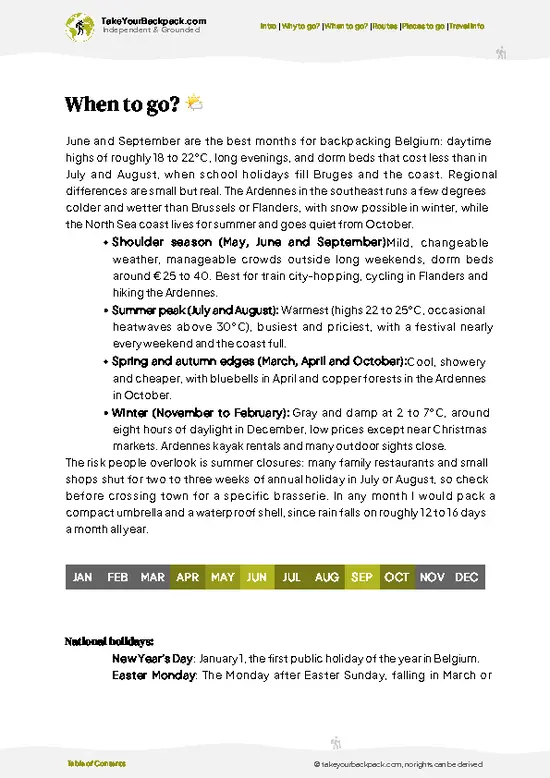
When to go?Best Time to Visit Belgium for festivals

Best months and weather: The best months for festivals in Belgium are June to September, when open-air events cluster and daytime highs run 19 to 24°C. That is also the season when it rains on roughly one day in three, so "summer" here is more a rumor than a guarantee. Expect 60 to 80 mm of rain a month, often in short showers rather than all-day downpours.

Shoulder seasons: April, May and October bring 10 to 17°C and fewer crowds. Spring has plenty of processions and religious or folk traditions, and autumn has food and beer events. Pack layers, because the same afternoon can offer sun, hail and a rainbow.

Winter and carnival season: From February to March, carnival season fills southern towns in Wallonia with parades in 0 to 7°C weather, which is cold enough to make a costume out of a … read more 👉
Best months and weather: The best months for festivals in Belgium are June to September, when open-air events cluster and daytime highs run 19 to 24°C. That is also the season when it rains on roughly one day in three, so "summer" here is more a rumor than a guarantee. Expect 60 to 80 mm of rain a month, often in short showers rather than all-day downpours.

Shoulder seasons: April, May and October bring 10 to 17°C and fewer crowds. Spring has plenty of processions and religious or folk traditions, and autumn has food and beer events. Pack layers, because the same afternoon can offer sun, hail and a rainbow.

Winter and carnival season: From February to March, carnival season fills southern towns in Wallonia with parades in 0 to 7°C weather, which is cold enough to make a costume out of a coat. Christmas markets in December run in many cities, with mulled wine at about €4 to 6 a cup.

Peak prices: Hostel dorms usually cost €25 to 40 normally, but festival weekends in Flanders and Brussels can push them to €45 to 80, if any remain. Wallonia stays cheaper, around €20 to 35. Book 2 to 4 months ahead for July and August.

festival hoppingTips for Visiting Multiple Destinations

How long you need: A trip combining several festivals in Belgium needs 7 to 12 days, which is enough to cover two or three regions without spending the whole time on trains. Belgium is compact, so the real constraint is the festival dates, not distance.

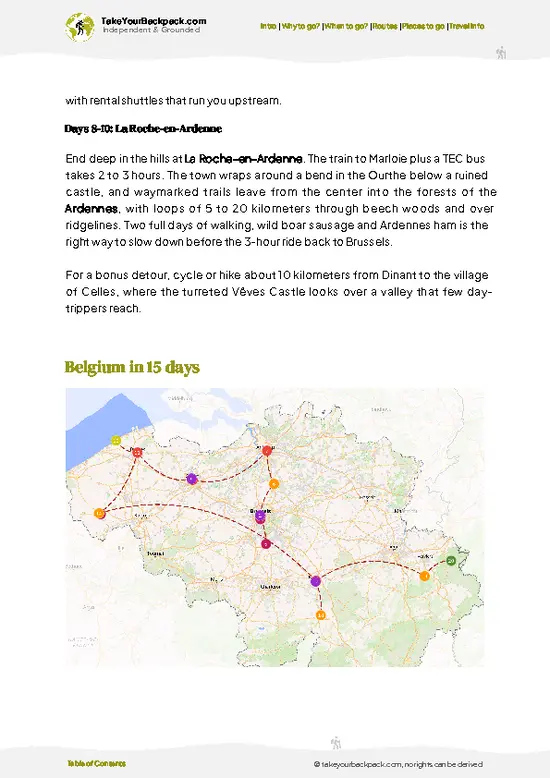
Grouping regions and direction: Cluster by region. Brussels works as the hub, with Ghent, Antwerp, Bruges and Leuven each 30 to 60 minutes away by train. Wallonia (Namur, Liège, Mons, Charleroi) is another 45 to 90 minutes from the capital. A sensible direction is west to east or the reverse, finishing near Liège or Brussels Airport rather than doubling back. Flanders pairs naturally with itself, as does Wallonia.

Time per stop: Give each stop 1 to 3 nights. Large music festivals need the full weekend plus a recovery day, while a town parade … read more 👉
How long you need: A trip combining several festivals in Belgium needs 7 to 12 days, which is enough to cover two or three regions without spending the whole time on trains. Belgium is compact, so the real constraint is the festival dates, not distance.

Grouping regions and direction: Cluster by region. Brussels works as the hub, with Ghent, Antwerp, Bruges and Leuven each 30 to 60 minutes away by train. Wallonia (Namur, Liège, Mons, Charleroi) is another 45 to 90 minutes from the capital. A sensible direction is west to east or the reverse, finishing near Liège or Brussels Airport rather than doubling back. Flanders pairs naturally with itself, as does Wallonia.

Time per stop: Give each stop 1 to 3 nights. Large music festivals need the full weekend plus a recovery day, while a town parade needs one day and perhaps an overnight. Transfers between regions typically take 1 to 2 hours door to door.

Common planning mistakes: The classic error is stacking back-to-back dates in different corners and trying to arrive fresh after a late night. Leave a buffer day. Another is assuming trains run late: many rural services end around midnight, and festival shuttles sell out. Book a bed in a bigger hub and commute, or reserve a campsite early. Last, check that strikes and engineering works have not rerouted your line.

The ListThe Best festivals of Belgium

1 Tomorrowland

electronic dance, elaborate stages, immersive visuals

Dance with thousands at an electronic music spectacle known for its intricate stage design, themed areas, and international DJ lineups.

2 Rock Werchter

stadium-scale shows, global rock icons, large crowds

See legendary bands and chart-toppers perform in a purpose-built arena, with efficient logistics and a focus on big-stage experiences.

3 Gentse Feesten

citywide celebration, street performances, local traditions

Immerse yourself in ten days of music, theater, and spontaneous events as Ghent transforms into a lively, walkable festival city.

4 Pukkelpop

mainstream headliners, indie discoveries, festival camping

Catch major international acts alongside emerging artists, with multiple stages and a dedicated campsite drawing diverse crowds to Hasselt.

5 Dour Festival

open fields, alternative music, cross-genre acts

Join crowds in rural Wallonia for five days of eclectic sounds, late-night sets, and a relaxed, communal festival atmosphere.

6 Graspop Metal Meeting

heavy metal, festival camping, international fans

Join metal enthusiasts for a weekend of loud music, energetic crowds, and a packed lineup spanning classic and extreme subgenres.

7 Brussels Summer Festival

urban stages, diverse genres, city center venues

Move between outdoor and indoor stages in central Brussels, where local and international acts perform across a range of musical styles.

8 Couleur Café

world music, multicultural food, urban festival

Sample global sounds and street food at a festival celebrating diversity, with live acts and art installations in a Brussels park.

9 Carnaval de Binche

UNESCO heritage, Gilles costumes, confetti parades

Witness centuries-old rituals as masked Gilles parade through Binche, tossing oranges and filling the streets with music and color.

10 Ommegang

medieval pageantry, costumed procession, Grand Place

Watch a historical reenactment unfold in Brussels’ central square, with hundreds in period dress recreating a royal welcome from centuries past.

11 Les Ardentes

urban park, hip hop, electronic beats

Experience a mix of rap, pop, and dance music in Liège’s riverside park, with a youthful crowd and a city backdrop.

12 Dranouter Festival

folk roots, countryside setting, acoustic stages

Experience a blend of traditional and contemporary folk in a village landscape, where music and local culture intertwine under open skies.

13 Brussels Jazz Weekend

free concerts, city squares, jazz ensembles

Stroll between open-air stages and intimate venues as Brussels hosts live jazz performances in public spaces throughout the city.

14 Zythos Beer Festival

Belgian breweries, tasting sessions, craft specialties

Sample hundreds of beers from across Belgium in a single venue, with brewers on hand to discuss styles and brewing techniques.

15 LaSemo

family-friendly, eco-conscious, castle grounds

Enjoy concerts, workshops, and local food in a relaxed, green setting, with activities designed for all ages in a scenic park.

Think you know Belgium?

Prove you’re a true local — uncover 5 lesser-known festivals in Belgium that locals tend to keep to themselves.
Loading the map 🌍

Expert viewTips and Advice from Travelers

How many festivals to attempt: Two to three festivals in one trip is the right number. That is enough to taste both the big-production side and the local-tradition side, with recovery days in between. Four or more turns the trip into a logistics exercise, and anything past a long weekend of a huge festival will flatten your budget and your knees.

Which kind to prioritize: For social, budget-minded travelers, a large multi-day music festival is the best value, because camping, cheap food stands and strangers who share their stove make it easy to meet people. For culture-first travelers, a local folk procession or carnival is the better use of a day: free to watch, specific to its town, and far less like every other festival in Europe. For beer and food people, skip the tourist-heavy tastings … read more 👉
How many festivals to attempt: Two to three festivals in one trip is the right number. That is enough to taste both the big-production side and the local-tradition side, with recovery days in between. Four or more turns the trip into a logistics exercise, and anything past a long weekend of a huge festival will flatten your budget and your knees.

Which kind to prioritize: For social, budget-minded travelers, a large multi-day music festival is the best value, because camping, cheap food stands and strangers who share their stove make it easy to meet people. For culture-first travelers, a local folk procession or carnival is the better use of a day: free to watch, specific to its town, and far less like every other festival in Europe. For beer and food people, skip the tourist-heavy tastings and go to a regional beer weekend, where entry is often free and you pay per glass. I would skip any event that charges more than €15 for a drinks-and-snacks package unless it includes something you cannot buy elsewhere.

What it costs: Budget US$70 to 110 a day (about €65 to 100) for a normal day with hostel dorms, trains and street food. On a festival day, add more. Tickets for big music festivals run roughly €100 to 300 for a weekend pass, with camping sometimes extra at €20 to 60. Town parades and carnivals are usually free. Beer costs €3 to 5 a glass, and many festivals use a token or cashless wristband system, so keep the receipt for refunds. Trains cost €5 to 20 per leg, and some festivals add a €5 to 12 shuttle.

Safety and etiquette: Belgium is safe, but crowded events attract pickpockets, especially around Brussels stations and at the entrance queues. Keep your phone in a zipped front pocket and carry only what you need. Drink water between strong beers, since the alcohol percentage on a Belgian label is not a suggestion. Tap water is safe, and large festivals often provide free refill points.

Local customs deserve respect. Traditional processions and carnival figures are part of civic identity, so ask before photographing someone in costume at close range. A polite greeting in the local language goes a long way, and starting with “Bonjour” in Wallonia or “Goedendag” in Flanders is better than defaulting to English. Cleaning up after yourself matters: many sites charge a deposit on reusable cups, and you will want that €1 or 2 back. Finally, pack a rain layer regardless of the forecast. A cheap poncho beats a wet sleeping bag every time.

✈️ The backpacker research shortcutBelgium Travel Guide

An offline-friendly backpacking guide with optimized travel routes, ranked highlights, transport advice, and the best areas to stay.
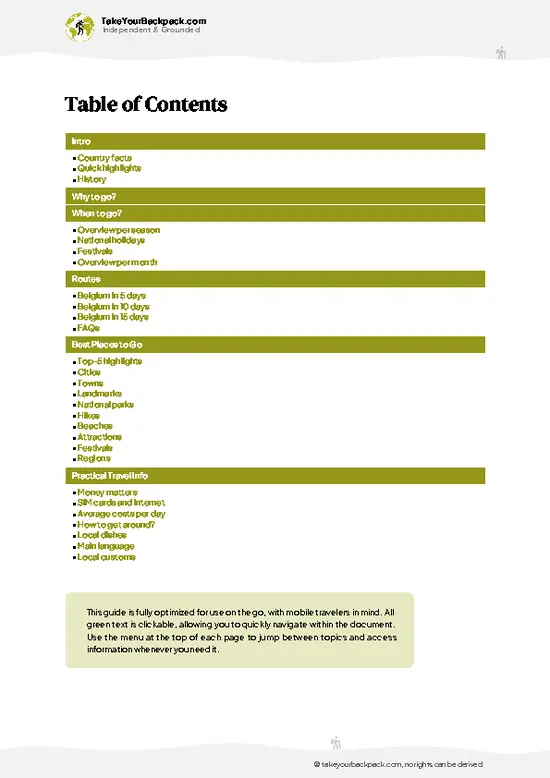
example page 0 from our offline Travel Guide for Belgium
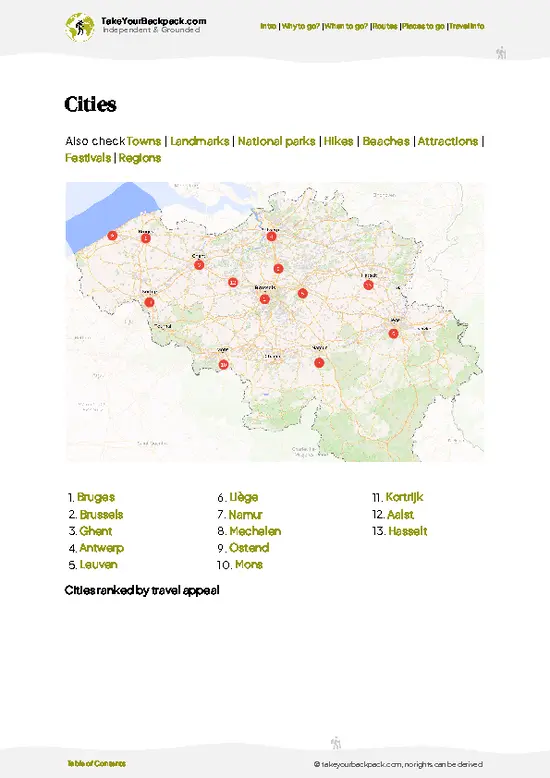
example page 1 from our offline Travel Guide for Belgium
example page 2 from our offline Travel Guide for Belgium
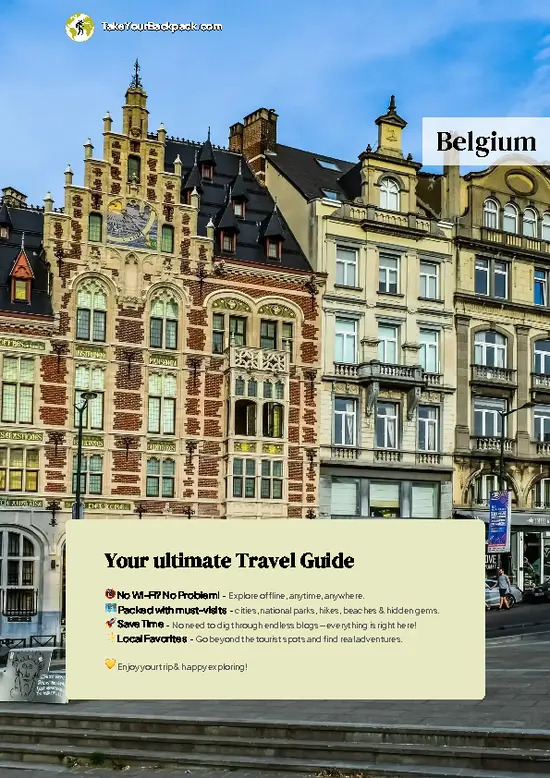
example page 3 from our offline Travel Guide for Belgium
example page 4 from our offline Travel Guide for Belgium
example page 5 from our offline Travel Guide for Belgium
example page 6 from our offline Travel Guide for Belgium
example page 7 from our offline Travel Guide for Belgium
The digital guide (337 pages) contains:
✅ 85 highlights, ranked by travel appeal
✅ Optimized 5, 10 & 15-day travel routes
✅ Cities, national parks, landmarks, beaches
✅ How to get around
✅ Offline-friendly for travel without Wi-Fi
👉 Click to see all 30+ guide features

📅 Plan smarter in minutes, not weeks
✅ Month by month travel advice
✅ Festivals & national holidays
✅ Budget expectations

🗺️ Go to the right places, skip the overrated ones
✅ Honest pros & cons of destinations
✅ Top hikes, parks & viewpoints
✅ Lesser-known places most travelers miss
✅ Clear “worth it vs skip it” guidance

🛏️ Travel smoothly without rookie mistakes
✅ Best areas to stay
✅ Transport systems explained simply
✅ Common scams & safety advice
✅ SIM cards, money & practical tips

🌍 Understand the country, not just visit it
✅ Culture & traditions
✅ 52 Essential phrases & customs
✅ Festivals worth planning around
✅ Traveler-friendly historical context
✅ Insights that make places more meaningful

📱 Built for real travel conditions
✅ Fully downloadable PDF
✅ Works completely offline
✅ Optimized for phone use
✅ Useful in remote areas & buses
✅ Everything in one place
Stop searching, start planning
Get instant access to your full guide. 30‑day money-back guarantee.
+ Add another guide for just

By proceeding you agree to our terms.
Sent to your inbox immediately after payment • 100% Secure Checkout
Best Backpacking Travel Advisor 2025 tourism awardBest Backpacking
Travel Advisor
2025
What others say about Take Your Backpack Guides:
⭐⭐⭐⭐⭐
Fantastic, amazing amount of information!
⭐⭐⭐⭐⭐
My goodness this is amazing, it's what I've been looking for hats off too you!
⭐⭐⭐⭐⭐
I think this is absolutely BRILLIANT
⭐⭐⭐⭐
Very complete and informative. It's still missing places, but I gotta to commend you
⭐⭐⭐⭐⭐
This is truly amazing, thank you, can't wait to explore it with my kids!
⭐⭐⭐⭐⭐
Awesome resource, thank you!
⭐⭐⭐⭐⭐
This is amazing! Can't wait to explore the ones I haven't seen
⭐⭐⭐⭐
I love this! Well done, great idea.
⭐⭐⭐⭐⭐
Thanks for taking the time to make this gem!
⭐⭐⭐⭐⭐
This might be the best website I've ever seen.
⭐⭐⭐⭐⭐
Congratulations, and thank you so much for your work; it's incredibly valuable.
⭐⭐⭐⭐
In all seriousness I think you did a great job pointing out the important spots
⭐⭐⭐⭐⭐
10/10 very good
⭐⭐⭐⭐⭐
As someone who's only just starting to visit regularly this is awesome, thank you.
⭐⭐⭐⭐
Thank you very much! I'm going to visit my dad, it's going to be very useful!
⭐⭐⭐⭐⭐
This is really cool! We'll be travelling for the first time and this definitely come in handy.
⭐⭐⭐⭐⭐
You are now our minister of culture, congratulations 👨‍💼
⭐⭐⭐⭐⭐
Just wanted to tell you that this is a pearl! Going to follow your recommendations.
⭐⭐⭐⭐⭐
This is so cool. I'll definitely be using the resource for my travels soon.
⭐⭐⭐⭐⭐
This is very impressive! Good work.
⭐⭐⭐⭐⭐
This is an amazing and informative site. Very well done!

🛏️ Where to stay?Where to Stay: Belgium Edition

Belgium has plenty of hostels, with dorm beds typically running €25 to €45 a night (more on summer weekends in Bruges) and a handful of guesthouses and budget hotels filling the gap above that. In Brussels, the Lower Town around the Grand-Place puts you within walking distance of the main sights and bars but gets loud at night, while Saint-Gilles near Midi station is cheaper and local-feeling though a bit scruffy after dark, and Ixelles is safer and livelier for nightlife but a tram ride from the center. In Bruges, staying inside the canal ring is quiet and a short walk from the Markt (with little nightlife), and in Ghent the historic center wins on student-fueled bars, whereas Antwerp splits … read more 👉
Belgium has plenty of hostels, with dorm beds typically running €25 to €45 a night (more on summer weekends in Bruges) and a handful of guesthouses and budget hotels filling the gap above that. In Brussels, the Lower Town around the Grand-Place puts you within walking distance of the main sights and bars but gets loud at night, while Saint-Gilles near Midi station is cheaper and local-feeling though a bit scruffy after dark, and Ixelles is safer and livelier for nightlife but a tram ride from the center. In Bruges, staying inside the canal ring is quiet and a short walk from the Markt (with little nightlife), and in Ghent the historic center wins on student-fueled bars, whereas Antwerp splits between the handy but grittier area by Centraal station and the trendier, calmer Zuid district.

If you enjoy meeting fellow travelers, consider choosing hostels with high ratings for atmosphere. On the other hand, if you prefer having your own space, a hotel might be a better option.

BelgiumExplore Beyond This Category

👋 Meet the founderWho’s Behind Take Your Backpack?

Johan, backpacker and founder of TakeYourBackpackHi, I’m Johan (Netherlands 🇳🇱), the creator of TakeYourBackpack. Over the past 3 decades, I’ve backpacked through 90+ countries across six continents, gaining extensive experience with independent travel, long-term trips, and overland routes.

This site is built on a combination of firsthand travel experience and carefully curated insights from other backpackers. Many guides are based on places I’ve personally visited, while others bring together tips, observations, and practical advice shared by trusted travelers I’ve met along the way.

The goal is to provide realistic, experience-driven guidance — not generic itineraries — so you can explore destinations with better context, clearer expectations, and more confidence.